Author: Anand

  • California Buyers: Mello‑Roos Tax Cuts Your Buying Power by $50,000

    California Buyers: Mello‑Roos Tax Cuts Your Buying Power by $50,000

    Mello-Roos is a voter-approved special tax on properties inside a Community Facilities District, added straight onto your property tax bill to pay for local infrastructure or services. It is not tied to your home’s assessed value, so two nearly identical houses can carry very different bills. Before you fall for a listing, pull the parcel’s APN and check for a Notice of Special Tax. That single step tells you whether this cost belongs in your budget.


    TL;DR:

    • Mello-Roos taxes are parcel-based assessments that can range from $360 to over $10,000 annually depending on district size and infrastructure needs.
    • The assessment duration varies from 20 to 40 years for bond-related costs, but service fees can continue indefinitely, often without clear expiration dates.
    • Mello-Roos costs are a significant factor in mortgage qualification, effectively reducing borrowing power by up to $50,000 for every $300 monthly payment.
    • Buyers should verify the Notice of Special Tax and district documents early, as delays or missing information can indicate potential hidden costs or lack of transparency.
    • Most Mello-Roos payments are not tax-deductible for primary residences, but prepaying bonds or deducting for investment properties may offer some financial benefits.

    Ficustree
    Make Mello-Roos Part of Your Budget
    Ficustree helps first-time California buyers bring taxes, insurance, HOA costs, and maintenance into a clearer home-buying decision.

    Explore Ficustree

    Table of Contents

    What Is Mello-Roos Tax and How Does the CFD Work?

    Mello-Roos gets its name from the Mello-Roos Community Facilities Act of 1982, the state law that created Community Facilities Districts as a workaround after Proposition 13 capped how fast property tax revenue could grow. Cities, counties, and school districts needed another way to fund growth, so they formed CFDs, and voters or landowners inside the proposed district approve the special tax before it takes effect.

    A CFD generally does one of two jobs:

    • Repay bonds issued to build roads, schools, sewer lines, or parks in a new development
    • Fund ongoing services like landscaping, fire protection, or police patrols with no fixed end date

    The tax itself is parcel-based rather than tied to assessed value, calculated using a formula set at formation. That’s why a $500,000 starter home and a $900,000 home in the same district can pay the exact same Mello-Roos amount.

    How Much Does Mello-Roos Typically Cost Each Year?

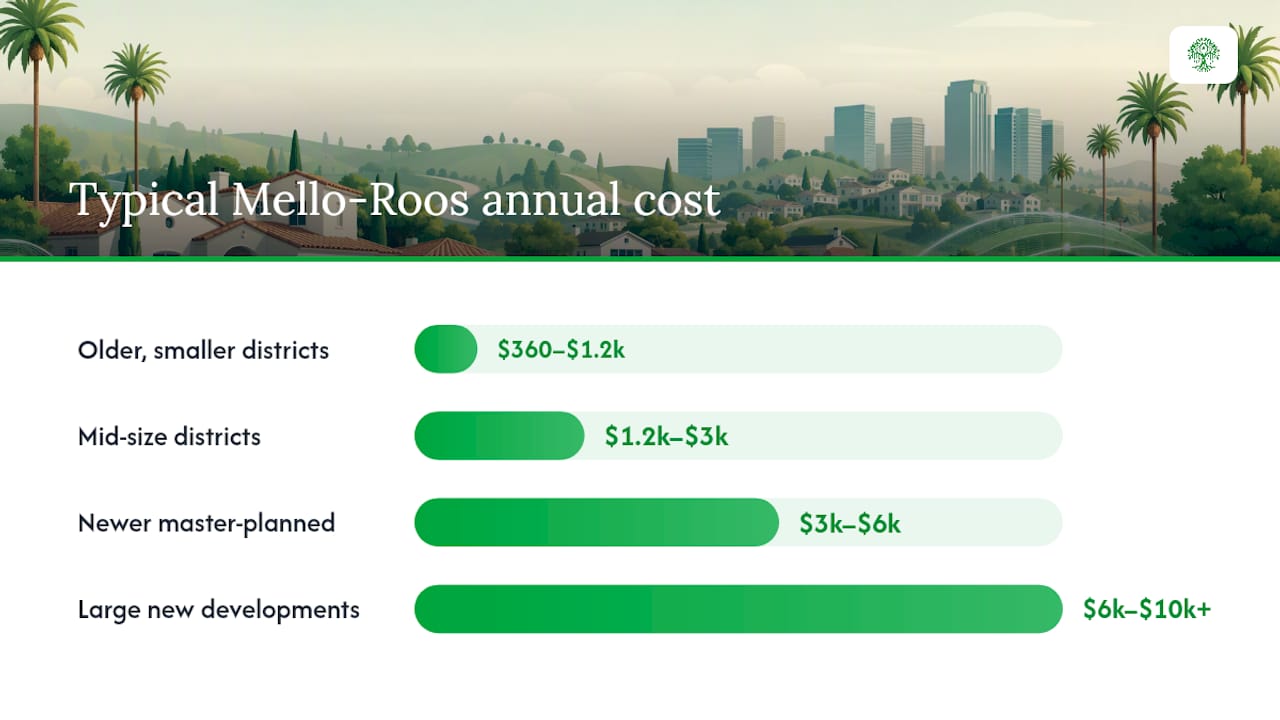
    Mello-Roos costs swing hard depending on the district’s age, size, and what it’s financing. Here’s a rough breakdown of what buyers actually see on tax bills across California:

    1. Older, smaller districts: roughly $360 to $1,200 per year
    2. Mid-size districts: roughly $1,200 to $3,000 per year
    3. Newer master-planned communities: roughly $3,000 to $6,000 per year
    4. Large new developments with heavy infrastructure: $6,000 to $10,000 or more per year

    Statistic Callout: Many buyers land between roughly $1,200 and $6,000 a year, which works out to $100 to $500 a month tacked onto your existing mortgage payment.

    That monthly figure matters more than the annual one, because it’s what your lender uses when calculating your debt-to-income ratio. A $400 monthly Mello-Roos bill behaves like an extra loan payment, and it can shrink your purchase power. It also arrives as a separate line item from any HOA dues, so a newer community can quietly stack two recurring costs on top of your mortgage before you’ve noticed.
    How Much Does Mello-Roos Typically Cost Each Year? — overview diagram

    How Long Does Mello-Roos Last and When Does It End?

    Bond-backed Mello-Roos assessments typically run 20 to 40 years, matching the term of the municipal bonds they repay. Once the bonds are retired, that portion of your bill disappears. Service-related Mello-Roos, on the other hand, can continue indefinitely, since it funds ongoing costs like park upkeep or emergency services rather than a project with a payoff date.

    • Check the district’s Rate and Method of Apportionment, the recorded formation document that spells out the exact formula and term
    • Search by APN through your county assessor or tax collector’s office
    • Contact the CFD administrator listed on your tax bill for a maturity schedule

    Pro Tip: Don’t assume Mello-Roos will vanish on a set date. Many districts fold in permanent service components that survive long after the bonds are paid off, so read the RMA before you count on relief.

    Some districts allow bond prepayment, letting you pay off the remaining bond balance in one lump sum to remove that portion from future bills. It’s a large upfront cost, so it usually only makes sense if you plan to stay in the home for many years.

    Is Mello-Roos Tax Deductible on Your Federal Return?

    Mostly, no. The bulk of a Mello-Roos payment covers bond principal, and the IRS treats that portion as non-deductible because it’s a special assessment tied to a specific improvement, not a general property tax under Section 164.

    Statistic Callout: A small slice of your bill, the maintenance and interest components, may qualify for a deduction, but it’s often modest enough that the $10,000 SALT cap and the standard deduction wipe out any real benefit for most owners.

    There’s a silver lining buried in IRS Publication 551: the non-deductible principal you pay can often be added to your property’s tax basis, which can reduce your taxable gain when you eventually sell.

    Rental property owners get a better deal. Mello-Roos on an investment property is typically deductible in full as a business expense on Schedule E, unlike the limited treatment for a primary residence.

    To know exactly where you stand:

    • Request an itemized breakdown from the CFD administrator or county tax collector
    • Ask specifically which portion, if any, covers interest or maintenance
    • Run the numbers past a CPA before assuming any deduction applies

    Mello-Roos, Your Mortgage, and What It Does to Resale

    Lenders count Mello-Roos as part of your monthly housing cost, right alongside principal, interest, taxes, and insurance, when calculating your debt-to-income ratio. A $300 monthly Mello-Roos bill can reduce your buying power by roughly $50,000, since that same $300 could otherwise support a bigger loan.

    A few things every buyer should know before writing an offer:

    • The assessment runs with the parcel, not the seller, so it transfers to you at closing regardless of who benefited from the original project
    • Sellers typically prorate the current year’s bill at closing, but every future payment becomes your responsibility
    • A high Mello-Roos bill can shrink your resale buyer pool later, since it raises the effective monthly cost for whoever buys from you
    • Unpaid special taxes can trigger foreclosure faster than unpaid property tax in some cases, so treat delinquency risk seriously

    Talk to your lender early, before you fall for a specific neighborhood. Ask them to run your DTI with and without the Mello-Roos line item so you see the real impact on what you can offer.

    Your Step-by-Step Mello-Roos Checklist Before You Offer

    1. Pull the APN and current secured tax bill. Confirm whether a CFD or Mello-Roos line item appears, and note the exact dollar amount.
    2. Request the Notice of Special Tax and the Rate and Method of Apportionment. These documents show the formula, the term, and whether prepayment is even an option for that district.
    3. Bring the numbers to your lender or escrow officer. Ask them to show how the Mello-Roos amount affects your DTI, your closing costs, and your prorated bill at closing.
    4. Compare against similar homes without Mello-Roos. A lower list price in a Mello-Roos district can still cost more monthly than a higher-priced home without one, so reviewing all seller disclosures matters here.

    Pro Tip: If a listing agent can’t produce the Notice of Special Tax within a day, treat that as a red flag. This document is required by California disclosure law, and any delay usually means nobody bothered to check it.

    Once you have real numbers, you have leverage. You can ask for seller concessions to offset the first year of payments, negotiate a price reduction that reflects the added monthly cost, or, if you’re planning to stay decades, evaluate whether bond prepayment makes long-term sense. Walk away if the district can’t produce its formation documents at all. That opacity is rare, but it’s the clearest warning sign in the entire process.

    Decision paths for evaluating Mello-Roos costs

    A Practical Note From Ficustree

    Mello-Roos looks scary on a tax bill, but it’s manageable once you know where to look. The mistake isn’t buying in a CFD. It’s forgetting to fold that monthly number into your real affordability picture before you fall for the house. Get the documents early, and the surprises disappear.

    — Anand

    Let Ficustree Help You Budget for Mello-Roos Before You Offer

    Ficustree is the alternative to guessing your way through a Mello-Roos disclosure. Our AI-powered buyer platform builds total-cost budgeting directly into your home search, pulling in Mello-Roos figures alongside your mortgage, insurance, and HOA costs before you ever write an offer.

    Ficustree

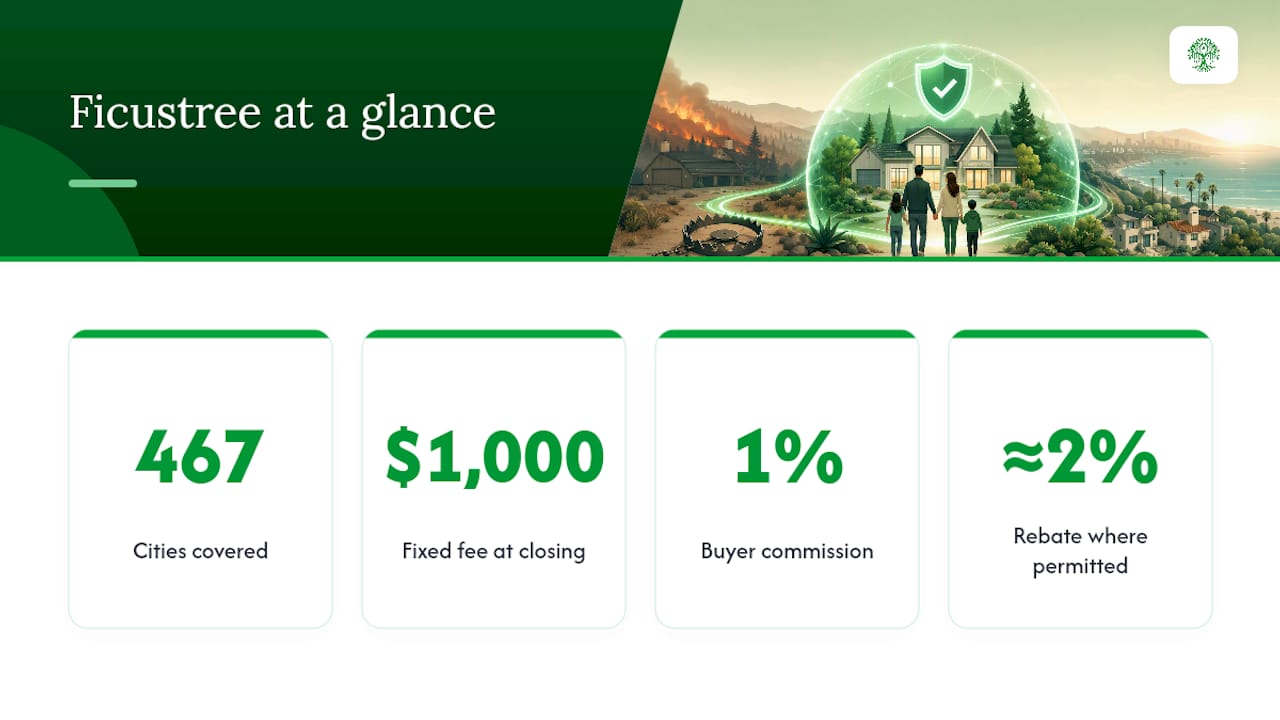
    We also help verify the Notice of Special Tax and the Rate and Method of Apportionment for any property you’re considering, so you’re not relying on a listing agent’s word for it. Ficustree represents buyers directly for a flat $1,000 fee at closing plus 1% commission, with a rebate kept where legally permitted, and hourly showing agents you can book on demand. The premium platform, including the affordability tools that catch costs like Mello-Roos before they catch you, is free to use. Head to Ficustree and start your home search with the real numbers already built in.

    Where to Verify Mello-Roos Facts Yourself

    • Your county assessor or tax collector for parcel/APN lookups and current CFD amounts, such as the OC Treasurer-Tax Collector’s Mello-Roos page
    • The Rate and Method of Apportionment, recorded with the county recorder for that specific district
    • IRS Publication 551 and Publication 527 for deductibility and basis rules on special assessments

    Sources

    FAQ

    How Do I Avoid Mello-Roos Taxes?

    You can’t remove Mello-Roos from a property that already has it, but you can avoid it entirely by targeting older, established neighborhoods that predate most CFD formations. Pulling the APN and checking the county tax bill before you tour a home is the fastest way to screen out Mello-Roos properties altogether.

    Is Mello-Roos Tax Forever?

    Not always. Bond-related portions typically last 20 to 40 years and end once the bonds are repaid, but service-related portions can continue indefinitely with no scheduled expiration. The only way to know for a specific property is to check that district’s Rate and Method of Apportionment.

    Are Mello-Roos Taxes a Good or Bad Thing?

    Neither, really. Mello-Roos funds real infrastructure and services that a new community needs, but it adds a recurring cost that reduces how much home you can afford, so it deserves the same scrutiny as any other monthly expense.

    Can I Write Off Mello-Roos Taxes?

    Mostly no. Most Mello-Roos payments cover non-deductible bond principal, though small maintenance or interest portions may occasionally qualify. Rental property owners generally get better treatment, since Mello-Roos on an investment property is typically deductible in full on Schedule E.

  • 29/30-Day Rule: Rent-Back Agreement Checklist for Buyers and Sellers

    29/30-Day Rule: Rent-Back Agreement Checklist for Buyers and Sellers

    A rent-back agreement lets a seller stay in the home after closing as a temporary renter. It can win a competitive offer or give a seller breathing room to move, but it also turns the buyer into a landlord for a few weeks. That trade needs written lender approval, proof of insurance, and clear contract terms before anyone signs.


    TL;DR:

    • Rent-back agreements longer than 29 days change the legal status from a license to a lease, which grants tenants’ protections and complicates eviction processes.
    • Calculating rent-back rent typically involves dividing the buyer’s monthly PITI and HOA dues by 30 and multiplying by the number of occupancy days, or using local market rent data.
    • Key risks include insurance gaps, lender violations, and holdover disputes, all preventable through written approval, proper documentation, and escrow holdbacks.
    • Precise, enforceable clauses must clearly specify occupancy dates, rent, security deposits, holdover penalties, utilities, insurance, and inspection rights, ideally reviewed by an attorney.
    • Lender approval and proof of renters insurance are critical before closing, especially in states like California with strict form distinctions based on occupancy duration.

    Ficustree
    Buy With Clearer Decisions
    Ficustree helps first-time buyers understand complex choices, from rent-backs to offers, with AI-powered decision intelligence and direct representation.

    Explore Ficustree

    Table of Contents

    What Is a Rent-Back Agreement and How Does It Work?

    A rent-back agreement, also called a leaseback or post-closing occupancy agreement, lets the seller remain in the home after the buyer takes title, in exchange for rent or another agreed payment. The buyer becomes the legal owner at closing. The seller becomes a short-term occupant under a separate written contract, not a squatter and not a co-owner.

    The sequence matters. Title and funds transfer first, then the seller occupies under the rent-back terms. This setup shows up constantly in competitive markets, when a seller needs extra time to close on their next home or a buyer wants to make an offer more attractive by giving the seller flexibility.

    Two document paths handle this:

    • A purchase agreement addendum that adds occupancy terms directly onto the existing contract.
    • A standalone occupancy agreement, drafted separately, which most attorneys and brokers prefer for anything longer than a few days.

    Most rent-backs run anywhere from a few days to a couple of months, though some stretch longer when a seller is building a new home.

    License vs. Lease: Why the 29/30-Day Line Matters

    The single most important legal distinction in a rent-back agreement is duration, because it determines whether the seller has tenant rights or not. In California, the C.A.R. Seller in Possession (SIP) form is built for stays of 29 days or less and operates as a license, not a lease. A license is revocable and doesn’t trigger landlord-tenant law.

    Cross into 30 days or more, and the Residential Lease After Sale (RLAS) form applies instead, which creates an actual landlord-tenant relationship.

    • A license (SIP-style) means faster removal if the seller overstays, with none of the formal eviction process.
    • A lease (RLAS-style) means the seller gains tenant protections, and removing a holdover seller may require a full unlawful detainer eviction lawsuit.
    • Longer occupancy under a lease can also expose the property to local rent-control ordinances, depending on the jurisdiction.

    Get the day count wrong and the form choice, and you’ve accidentally handed the seller tenant status you never intended.

    How Do You Calculate Rent-Back Rent and Fees?

    Most rent-back rent is typically calculated using a daily PITI formula: take the buyer’s monthly principal, interest, taxes, and insurance (plus HOA dues if applicable), divide by the number of days in a month, and multiply by the number of days the seller stays.

    1. Daily PITI method: Monthly PITI + HOA, divided by 30, times days of occupancy. This is the most common benchmark because it simply covers the buyer’s carrying cost.
    2. Market rent method: Some parties instead use local fair market rent data to set a comparable rate, especially in high-demand areas.
    3. Flat or discounted rate: A seller might negotiate a lower rate in exchange for other concessions, like leaving certain furnishings or covering closing costs.

    Security deposits, delivery fees, and escrow holdbacks all serve different purposes. A security deposit covers damage. A delivery fee is a lump payment tied to vacating on time. An escrow holdback sets aside seller proceeds at closing, released only after a clean move-out inspection.

    Pro Tip: Set the holdover penalty above the daily PITI rate, not equal to it. If overstaying costs the same as staying on schedule, you’ve given the seller zero incentive to leave on time.

    What Are the Biggest Risks in a Rent-Back Agreement?

    The three biggest risks in a rent-back are insurance gaps, lender violations, and holdover disputes, and all three are preventable with the right paperwork.

    Insurance is the one most buyers overlook. Standard homeowner policies are written for owner-occupants, and a policy may not cover a loss that happens while a non-owner occupies the home. Buyers should confirm coverage with their insurer and consider a landlord endorsement. Sellers should carry their own renters insurance and name the buyer as an additional insured.

    Lender risk comes next. Many owner-occupant mortgages require the buyer to occupy the property within a set window, commonly 60 days, and a rent-back that extends past that window without written lender approval can trigger a loan covenant violation.

    The third risk is what happens if the seller won’t leave. Vague possession agreements have produced long eviction timelines, insurance gaps, and expensive disputes when buyers treated a rent-back as a handshake deal instead of a real contract.

    Reduce all three with the same checklist:

    • Get the lender’s occupancy approval in writing before closing.
    • Confirm the seller’s renters insurance policy and buyer’s own coverage in advance.
    • Require an escrow holdback tied to move-out condition.
    • Take dated photos or video before occupancy begins and again at move-out.
    • Require a notarized move-out certificate confirming the date and condition of the property.

    A significant portion of the risk in a rent-back disappears the moment lender and insurer sign-off happens in writing, before the seller ever moves back in.

    What Clauses Belong in a Rent-Back Agreement?

    A rent-back agreement should read like a mini-lease, not an afterthought bolted onto the purchase contract. Vague terms are exactly what create disputes down the line.

    1. Occupancy dates: Exact start and end date, with no ambiguous language like “on or about.”
    2. Rent amount and payment schedule: How much, how often, and by what method.
    3. Security deposit: Amount, and the exact timeline for returning it after move-out.
    4. Holdover fees: A per-day penalty that kicks in automatically if the seller stays past the agreed date.
    5. Utilities: Who pays what during the occupancy period.
    6. Insurance requirements: Proof of the seller’s renters policy, naming the buyer as additional insured.
    7. Access for inspections: The buyer’s right to inspect before move-out.
    8. Condition and repair obligations: What state the home must be returned in.
    9. Deposit return timeline: A firm number of days after move-out, tied to the condition inspection.

    Optional but smart additions include an escrow holdback released only after a clean walkthrough, and a requirement for photo or video documentation at both ends of the occupancy period.

    Sample language is illustrative only. Every clause here should get reviewed by a real estate attorney before signing, since local landlord-tenant law varies enough to change how enforceable any of these terms actually are.

    Why California’s SIP vs. RLAS Distinction Is a Model for Everyone

    California’s form system is worth studying even if you’re buying elsewhere, because it shows exactly how form choice changes legal outcome. The SIP form is designed for 29 days or less and functions as a license, while RLAS applies at 30 days or more and creates a landlord-tenant relationship with real tenant protections attached.

    Practitioners warn that using the wrong form, or leaving occupancy terms undocumented, can accidentally reclassify the arrangement and complicate an eviction if the seller won’t leave. Broker risk guidance consistently recommends a separate written occupancy agreement rather than a casual side letter.

    The takeaway for any state:

    • Count the days precisely before choosing a license or lease structure.
    • Require escrow holdbacks and firm holdover penalties regardless of which form applies.
    • Bring in an attorney the moment occupancy runs past 30 days.

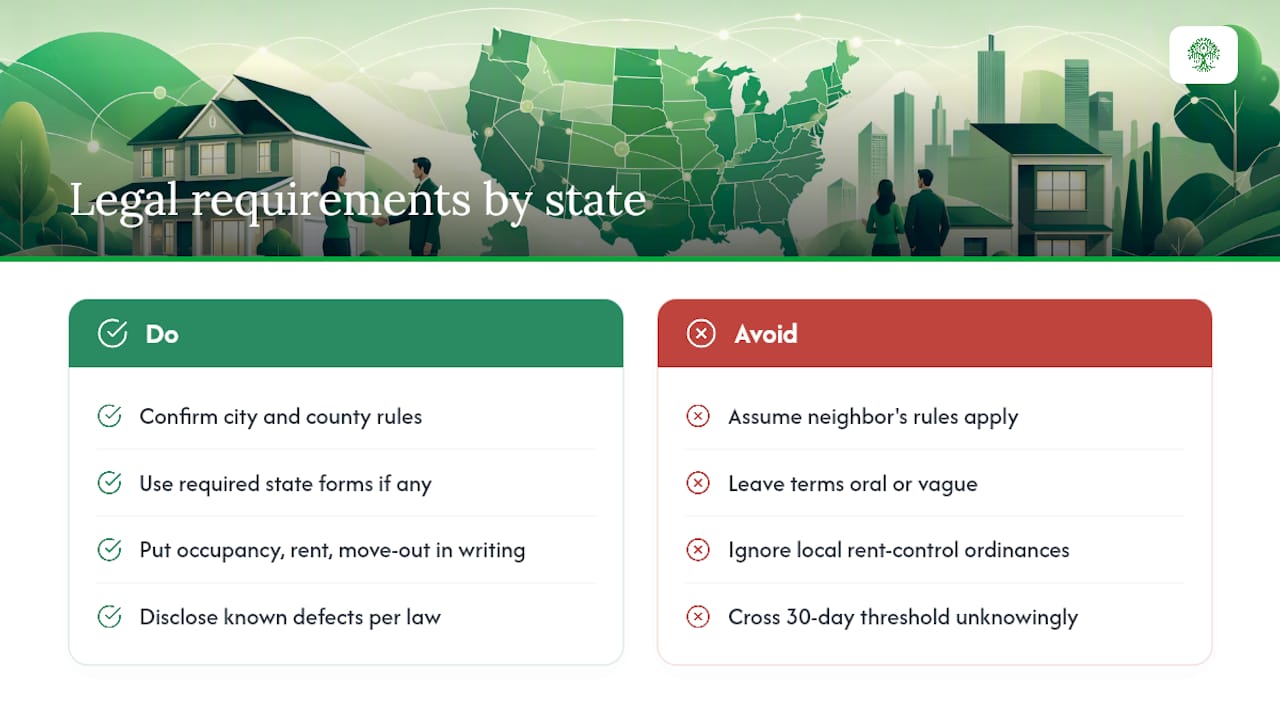
    There’s no single federal rule governing rent-back agreements. Every state handles post-closing occupancy differently, and some cities layer on their own rent-control or tenant-notice ordinances on top of state law.

    California leans on standardized forms like SIP and RLAS specifically because the 29/30-day line has real legal consequences there. Texas doesn’t use an identical form system, but a leaseback agreement Texas buyers and sellers sign still needs to spell out occupancy dates, rent, and move-out terms in writing, since Texas courts will look at the actual language of the agreement, not the parties’ intentions, if a dispute lands in court.

    Disclosure obligations also don’t disappear just because the seller is staying put. Any known defects still need to be disclosed under normal state disclosure law, and a rent-back doesn’t extend or shorten that disclosure timeline. If the property sits in a rent-controlled jurisdiction, crossing the 30-day threshold can pull the arrangement under local tenant ordinances even when the parties never intended to create a formal tenancy.

    The safest approach in any state: never assume your neighboring county or a friend’s last transaction used the same rules that apply to your deal. Confirm the specific form and disclosure requirements for your city and county, and treat the agreement as a real lease or license, not an informal favor between buyer and seller.

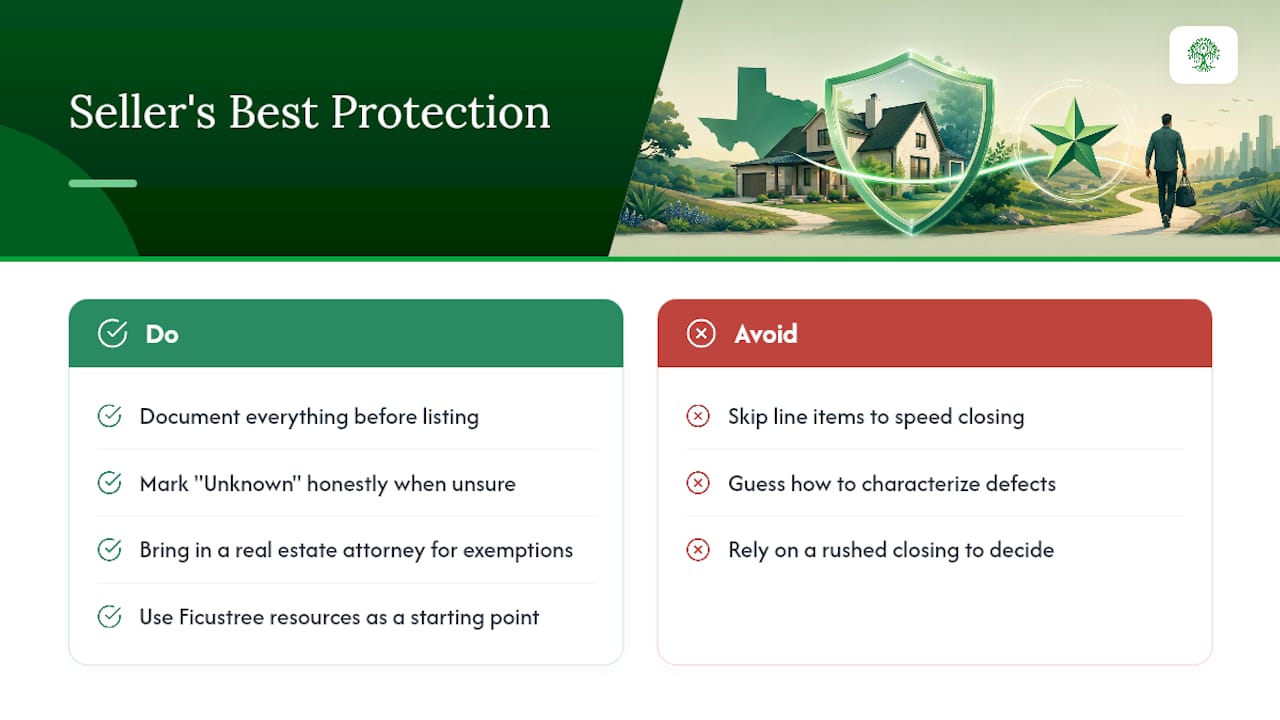
    Legal Requirements and Disclosures Vary by State — overview diagram

    What Are the Tax Implications of a Rent-Back Agreement?

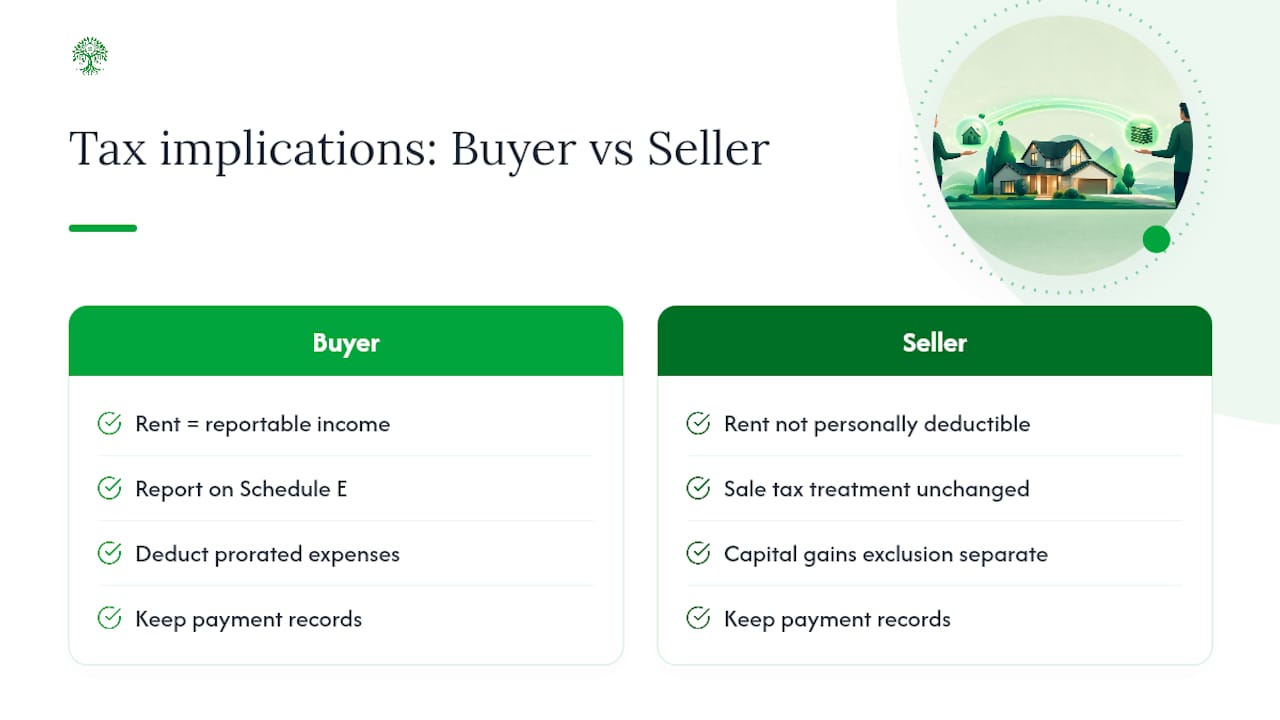
    The buyer receiving rent payments is the one with a tax question to answer, and the answer usually points toward reportable rental income. IRS guidance draws a line between short-term rentals and reportable rental activity, and because most rent-back periods run longer than 14 days, the payments a buyer collects will generally count as rental income reportable on Schedule E.

    That also means the buyer can deduct related expenses, potentially including a prorated share of mortgage interest, property taxes, insurance, and any repairs tied directly to the occupancy period. Keep every payment record and receipt, because Schedule E deductions only hold up with documentation.

    For the seller, the rent paid isn’t typically deductible as a personal expense, though the arrangement itself doesn’t usually affect the tax treatment of the home sale. The bigger question for sellers is usually the capital gains exclusion on the sale itself, which is a separate calculation from the rent-back terms.

    Neither side should treat this as settled without a conversation with a tax advisor, since the specifics depend on loan structure, occupancy length, and how the agreement labels the payments. Calling a payment “use and occupancy fee” instead of “rent” doesn’t change the tax analysis. What matters is the substance of the arrangement, not the label on the contract.

    What Are the Tax Implications of a Rent-Back Agreement? — overview diagram

    Negotiation Tips for Buyers and Sellers

    Sellers usually want a rent-back for one reason: timing. They’re waiting on their next home to close, or they need extra weeks to pack and move. Buyers usually agree to one for a different reason: it makes their offer more competitive, or it simply closes the deal.

    Understanding the other side’s real motivation changes the negotiation. A seller who’s desperate for 45 days of flexibility will often accept a below-market daily rate in exchange for getting the time. A buyer who’s not in a rush to move in has more room to be generous on rent in exchange for tighter holdover penalties and a bigger escrow holdback.

    A few practical negotiation moves worth using:

    • Ask for a larger deposit or escrow holdback in exchange for a lower daily rent. This protects you if things go wrong without making the deal feel punitive upfront.
    • Trade rent rate for time. A seller who needs 10 extra days beyond a typical window might accept a higher daily rate to get it.
    • Negotiate seller concessions and rent-back terms together, not separately, since sellers often have more flexibility on one if they get what they want on the other.
    • Never leave the holdover penalty as an afterthought. Negotiate it as hard as you negotiate the rent itself, because that’s the number that actually protects your move-in date.

    Both sides benefit from writing down every point of agreement before drafting the final contract language, so nothing gets lost between the handshake and the paperwork.

    How Does a Rent-Back Agreement Affect Your Mortgage?

    Your mortgage lender cares about a rent-back agreement more than most buyers expect, because owner-occupant loans come with occupancy promises attached. Many conventional loans require the buyer to occupy the home within a set window after closing, commonly around 60 days, and a rent-back that pushes past that window without lender sign-off risks a covenant violation.

    That’s not a minor technicality. Lenders can, in some cases, reclassify the loan or call it into question if they discover an undisclosed extended rent-back after the fact. The fix is simple: tell your lender about the rent-back before closing, get written approval, and keep that approval with your closing documents.

    Some loan programs are stricter than others. FHA and VA loans, for example, tend to have firmer owner-occupancy timelines than certain conventional loan products, so buyers using government-backed financing should raise the rent-back question with their loan officer as early as possible, ideally before the purchase contract is even finalized.

    HOA approval matters too, in communities with occupancy or lease restrictions. Some HOAs limit rental periods or require board notification, and a rent-back can technically qualify as a short-term rental under those bylaws even though it’s really just a seller staying a few extra weeks.

    Sample Clause Language for a Rent-Back Agreement

    Seeing actual clause structure makes the checklist from earlier easier to apply. These examples are illustrative only, meant to show the level of specificity a real agreement needs, not language to copy directly into a contract.

    Occupancy period clause example: “Seller shall occupy the Property from the Closing Date through [specific date], a period not to exceed 29 days, under license and not as a tenant.”

    Rent clause example: “Seller shall pay Buyer $[amount] per day, due in advance for the full occupancy period at closing, calculated using Buyer’s monthly PITI divided by 30.”

    Holdover clause example: “Should Seller remain in possession beyond [end date], Seller shall pay Buyer $[amount] per day as liquidated damages, which the parties agree represents a reasonable estimate of Buyer’s actual damages.”

    Move-out condition clause example: “Seller shall return the Property in the same condition as of the Closing Date, normal wear excepted, and shall provide Buyer access for a walkthrough inspection within 24 hours prior to vacating.”

    Every one of these needs actual dates, actual dollar amounts, and a jurisdiction-specific form structure behind it. The language above shows the shape of the clause. It doesn’t replace reviewing your California disclosures or having an attorney confirm the final wording matches your state’s requirements.

    Ficustree’s Perspective: Managing Rent-Backs as a First-Time Buyer

    Most first-time buyers hear “rent-back” and focus on winning the offer. They rarely think through what happens if the seller’s insurance lapses or the lender flags the occupancy after the fact. That gap is exactly where Ficustree’s decision-intelligence checklists and lender coordination earn their keep, catching the lender approval and insurance sign-off steps before they become problems at move-in.

    Ficustree represents buyers directly for a fixed fee plus commission, with on-demand showing agents and step-by-step guidance built for exactly this kind of moment. If a seller proposes a rent-back on your deal, get the lender’s approval in writing and require proof of renters insurance and an escrow holdback before you agree to anything.

    — Anand

    How Ficustree Helps You Negotiate a Safer Rent-Back

    A rent-back agreement is a negotiation, and negotiations go better with someone in your corner who’s read a hundred of these contracts, not your first one. Ficustree represents you directly as your buyer’s agent for a $1,000 fee at closing plus 1% commission, with a rebate of roughly 2% where legally permitted, so you get real representation without the traditional agent markup.

    Ficustree

    That representation matters most in exactly the moment a rent-back gets proposed. Ficustree’s step-by-step decision-intelligence tools flag the lender approval question, the insurance gap, and the escrow holdback before you’re staring at a contract deadline with no time to think it through. You also get on-demand showing agents and premium platform access at no extra cost, so the guidance doesn’t stop once the rent-back terms are settled.

    If you’re negotiating a purchase offer right now and a seller has asked for extra time after closing, start with Ficustree’s buyer platform to get matched with representation before you sign anything.

    Sources

    FAQ

    Is a Rent-Back a Good Idea?

    A rent-back can be a smart move for both sides when it’s documented properly. It gives sellers time to move without a rushed closing and can make a buyer’s offer more attractive, but it only works safely with written lender approval, confirmed insurance coverage, and clear holdover penalties in place.

    How Much Do You Charge for a Rent-Back?

    Rent-back cost typically follows a daily PITI formula, where the buyer’s monthly principal, interest, taxes, insurance, and HOA dues get divided by 30 and multiplied by the number of days the seller stays. Some parties instead use local market rent data or negotiate a flat rate tied to other concessions in the deal.

    How Do You Write a Rent-Back Agreement?

    A rent-back agreement should specify exact occupancy dates, rent amount and payment schedule, security deposit, holdover fees, utility responsibility, insurance requirements, and a deposit return timeline. In California, standardized forms like the C.A.R. SIP or RLAS reduce drafting errors, and any agreement should get reviewed by a real estate attorney before signing.

    What Is a Rent-Back Clause?

    A rent-back clause is the specific contract language, usually added as an addendum to the purchase agreement or as a standalone occupancy agreement, that lets the seller remain in the home after closing in exchange for rent or another form of consideration. It sets the occupancy period, payment terms, and consequences if the seller doesn’t move out on schedule.

  • 2.4–2.8% Buyer Agent Fees: How U.S. Buyers Lock a Fee Before Tours

    2.4–2.8% Buyer Agent Fees: How U.S. Buyers Lock a Fee Before Tours

    The 2024 settlement pulled offers of buyer-agent compensation off the MLS and now requires a signed, written buyer-broker agreement before any home tour. Commissions haven’t collapsed. Buyer-side rates still average roughly 2.4% to 2.8%, with total commissions sitting in the mid-5% range. Your move: negotiate and lock in your agent’s fee in writing before you sign anything, and ask for a seller concession if paying it yourself would strain your closing costs.


    TL;DR:

    • Buyer-agent commissions remain around 2.4% to 2.8%, and total commissions stay close to 5.5% to 5.7%, despite regulatory changes.
    • Buyers must now sign a written agreement before touring homes and negotiate the fee upfront, with the possibility of seller concessions covering costs.
    • Compensation discussions shifted from MLS listings to purchase offers and seller concessions, but sellers can still pay fees off-MLS.
    • Negotiating the agent’s fee early and obtaining clear, written terms helps protect against dispute caps and reduces transaction uncertainty.
    • Platforms like Ficustree offer transparent, fixed-fee models with upfront costs and rebates, simplifying the process for first-time buyers.

    Ficustree
    Make Your Buyer Costs Clear
    Ficustree helps first-time buyers understand its fixed closing payment, commission, and potential rebate before choosing their next step.

    Explore Ficustree

    Table of Contents

    Where Buyer Agent Commission Levels Sit Today

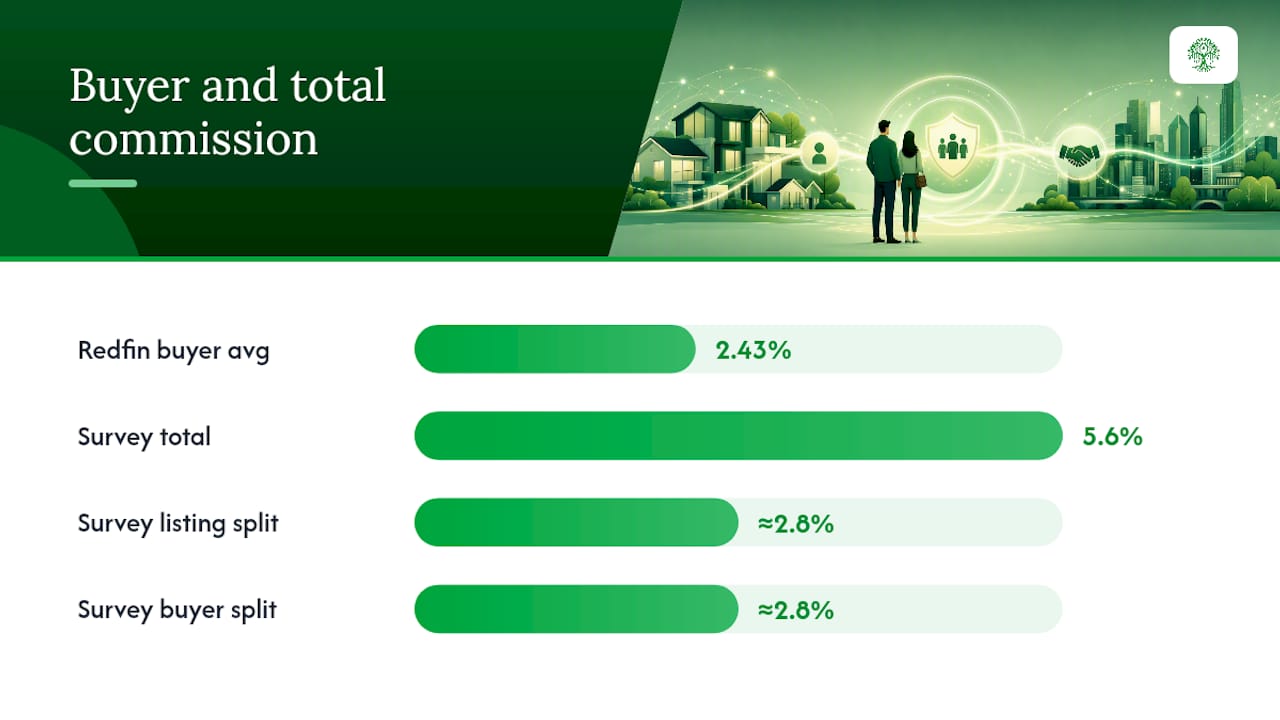
    If you expected buyer-agent fees to crater after the rules changed, the numbers say otherwise. Redfin’s transaction data put the average buyer-agent commission at about 2.43% in the second quarter of 2025, nearly identical to pre-settlement levels. That figure reflects what actually closed, not what agents advertised, and it’s the number that matters most for your budgeting.

    Buyer and total commission rates compared

    Separately, industry surveys from Clever and FastExpert paint a similar picture from a different angle. Their polling of working agents shows total commission still landing between 5.5% and 5.7%, split close to evenly between listing and buyer sides.

    Statistic Callout: Buyer-side commissions have held near 2.4% to 2.8% through 2025 and into 2026, despite predictions that removing MLS compensation offers would push rates sharply lower.

    Why the stability? A few forces are at work:

    • Home price appreciation, not policy, drives most of the long-term decline in commission percentage, according to Federal Reserve research on commission trends.
    • Sellers in competitive markets keep offering to cover buyer-agent fees because it widens their buyer pool.
    • Survey-based averages and closed-transaction averages measure slightly different things, so expect small gaps between the two.

    Read our breakdown of how real estate commission works for buyers and sellers if you want the full mechanics behind these figures.

    What Changed in Policy and Practice Since 2026

    The August 17, 2024 settlement rewired two core practices. First, MLS listings can no longer carry offers of buyer-agent compensation. Second, buyers must sign a written buyer-broker agreement before an agent shows them a home. Both changes came straight from NAR’s settlement FAQs and practice-change summary, which also confirms that sellers can still offer compensation off-MLS or as a purchase-offer concession.

    NAR’s guidance clarifies a few practical points buyers run into constantly:

    • Compensation talk moved off the MLS but not out of the transaction. It now happens through purchase offers, broker-to-broker calls, or seller concessions.
    • MLS participants may still opt in to display cooperative compensation in some markets, so rules vary locally.
    • Buyer agreements must state a fee that’s objectively ascertainable. Vague language like “TBD” or open-ended percentages won’t hold up.

    Then came the 2026 NAR ethics updates, effective January 1. Article 7’s disclosure duty narrowed to apply mainly to the agent’s own client. Standard of Practice 3-4, which required disclosing compensation offers to cooperating brokers, was deleted outright. And arbitration awards are now capped at whatever amount your buyer agreement specifies, or what you actually paid, whichever applies.

    Pro Tip: Ask your agent for the exact arbitration cap language in your buyer agreement before signing. Under the 2026 rules, that clause now limits what you can recover in a dispute, not just what your agent can claim.

    Who Pays the Fee Now, and How It Shows Up at Closing

    Nothing in the settlement bans sellers from paying buyer-agent commissions. It just moved that conversation out of the MLS and into the purchase contract. You can still ask a seller to cover your agent’s fee as a concession, and plenty of sellers agree, especially in markets where buyer demand is soft.

    Statistic Callout: Analysts tracking post-settlement deals found that sellers frequently continue offering buyer-side compensation through purchase offers rather than MLS listings, meaning the underlying incentive to pay didn’t disappear, only the advertising mechanism did.

    Here’s what changes practically for your transaction:

    • Your buyer-broker agreement sets the fee amount or percentage before you tour a single home, so negotiate it early rather than at the closing table.
    • The fee appears on your Closing Disclosure, itemized separately from the seller’s own commission obligations.
    • If a seller concession covers part or all of the fee, that gets documented in your purchase agreement, not buried in fine print.
    • VA loan buyers face extra scrutiny here. NAR’s own guidance flags that VA program rules can restrict how buyer commissions are paid, so confirm structure with your lender before you assume a concession will work the same way it does with conventional financing.

    Talk to your lender or a real estate attorney if your situation touches VA financing, a low-down-payment program, or state-specific concession limits. Our guide on how to review California buyer disclosures covers related paperwork you’ll encounter around the same time.

    How Do You Negotiate Your Agent’s Commission?

    Negotiating your buyer-agent fee isn’t rude. It’s expected, and the new agreements make it easier because the number has to be spelled out in writing anyway. Here’s how to work it:

    1. Get quotes before you sign anything. Ask two or three agents what percentage or flat fee they charge, and don’t sign the first buyer agreement handed to you.
    2. Counter the percentage. If an agent proposes 3%, ask why, and propose a lower figure or a flat dollar amount instead. Many agents will negotiate, especially for straightforward transactions.
    3. Build a seller concession into your offer. Structure your purchase offer to request the seller cover part or all of your agent’s fee, particularly in a slower market where sellers have more incentive to close.
    4. Ask about rebates where they’re legal. Some brokerages return part of their commission to you at closing; confirm whether your state permits it before you count on it.
    5. Read the arbitration and cap language line by line. Under the 2026 ethics update, that clause caps what you can recover if a dispute arises, so vague wording works against you, not just your agent.

    Your buyer agreement checklist should cover the exact fee or percentage, any cap, a clear list of included services, the dispute resolution process, and how amendments get made if your situation changes mid-search. For state-specific scripts, see our Texas buyer representation guide or the practical primer on seller concessions in California.

    Pro Tip: If an agent resists putting a specific number in writing, treat that as a warning sign. The 2026 rules require the fee to be objectively ascertainable, so vague answers usually mean a harder negotiation later, not a favor to you.

    Flat-fee buyer representation, hourly showing agents, and platform-based models are all worth comparing here. They can offer more predictable costs than a straight percentage, particularly on higher-priced homes.

    How a Transparent, AI-Enabled Buyer Model Reduces Friction

    Ficustree represents buyers directly under a fixed structure: $1,000 due at closing plus 1% commission, with a rebate of roughly 2% passed back to you where state law allows it. That’s the whole fee, stated upfront, before you sign anything or tour a single showing.

    The friction most buyers run into with commission negotiations comes from not knowing what’s normal or what to ask for. Ficustree’s decision intelligence tools were built to close that gap:

    • Explainable offer strategy support, so you understand why a counter makes sense before you make it.
    • Disclosure analysis that flags what actually matters in the paperwork you’re signing.
    • Neighborhood fit scoring based on your actual criteria, not just listing photos.
    • Hourly showing agents on demand, so you’re not locked into a single agent relationship before you’ve found the right home.

    Every one of these tools runs on the premium platform at no cost to you until you close.

    The One Thing First-Time Buyers Should Do First

    If you take one thing from all of this: negotiate your buyer agreement’s fee language before you tour a single home, then get it in writing with specific numbers, not ranges. That single step protects your negotiating position and keeps your remedy options open if a dispute ever comes up under the new arbitration caps.

    Buying your first home is stressful enough without wondering whether your agent’s fee is fair or fixed. Locking it down early turns one more unknown into a settled question, and settled questions are what actually reduce the overwhelm everyone talks about in this market.

    — Anand

    Ready to Buy With a Clear Fee From Day One?

    Ficustree is the alternative to a traditional agent for buyers navigating these commission changes in California and Texas: one flat fee of $1,000 at closing plus 1% commission, stated upfront, with a rebate of roughly 2% back to you where legally permitted, instead of a vague percentage you negotiate blind.

    Ficustree

    You get AI-guided offer strategy, disclosure analysis, and neighborhood scoring free on the platform, plus hourly showing agents when you need a tour without committing to a long-term agreement. If the negotiation steps above felt like a lot to manage alone, that’s exactly the gap Ficustree’s Direct Path was built to close. Start your search on Ficustree and see what a transparent fee looks like before you sign anything.

    Sources

    FAQ

    Is a 3% Buyer Agent Commission Normal?

    A 3% fee is on the higher end but not unheard of, since transaction data shows buyer-side commissions averaging closer to 2.4% to 2.8%. Always negotiate the percentage before signing your buyer-broker agreement rather than accepting the first number offered.

    Can a Seller Refuse to Pay a Buyer’s Agent?

    Yes. Since the 2024 settlement removed compensation offers from the MLS, sellers decide case by case whether to cover your agent’s fee through a concession. If a seller declines, you’re contractually responsible for the fee stated in your buyer agreement, which is exactly why negotiating that number early matters.

    Will Real Estate Agents Work for a 2% Commission?

    Many will, particularly for straightforward transactions or when you’re a well-qualified, pre-approved buyer. Rates are negotiable under the new written-agreement requirement, so ask directly and get competing quotes before you commit.

    Do Real Estate Agents Still Charge 6% Total Commission?

    Total commission today typically runs in the mid-5% range, closer to 5.5% to 5.7% combined across both sides, rather than a flat 6%. The exact split between listing and buyer-agent commission is negotiated separately in most transactions now.

    What Does Ficustree Charge Buyers?

    Ficustree charges a $1,000 fee at closing plus 1% commission, with a rebate of roughly 2% passed back where legally permitted. Details are available on the Ficustree buyer page.

  • California Escalation Clauses: Decision Checks for First Time Buyers

    California Escalation Clauses: Decision Checks for First Time Buyers

    An escalation clause helps California buyers stay competitive in tight bidding markets, but it works best when paired with a firm cap, a strict proof requirement, and a lender who has already confirmed your numbers. The main risks are an appraisal gap you have to cover in cash and a cap that tips your hand to the seller. Before writing one into an offer, confirm the listing agent will accept escalation language at all, then talk through the math with your lender.


    TL;DR:

    • Escalation clauses should be paired with a firm cap, proof requirement, and lender confirmation to avoid overpaying or appraisal gaps in California markets.
    • Using small to moderate increments signals confidence without revealing too much to sellers, especially when the cap aligns with your true affordability.
    • Confirm the listing agent’s acceptance and check your lender’s limits before drafting or submitting an escalation clause, as ambiguous language can lead to disputes.
    • Many brokerages restrict custom escalation language, so it is advisable to have a real estate attorney review your clause to ensure enforceability.
    • An escalation clause works best when you have a clear bidding strategy, are mentally prepared for the cash gap if the price exceeds appraisals, and are in a market that still considers them acceptable.

    Ficustree
    Bring Clarity to Your California Offer
    Ficustree helps first-time buyers evaluate affordability, offers, and bidding decisions with an AI-powered home buying platform.

    Explore Ficustree

    Table of Contents

    How Does an Escalation Clause Work in California?

    An escalation clause is a contract addendum that automatically raises your offer above a competing bid, in set increments, up to a maximum you choose. It only activates when the seller receives a verified competing offer, which is why the drafting checklist matters as much as the concept itself.

    Four pieces make the mechanism work:

    1. Base offer. The starting price you are willing to pay outright, competing offers or not.
    2. Increment. The dollar amount your offer rises each time a higher bid appears.
    3. Cap. The absolute ceiling your offer will never cross, no matter how many competing bids show up.
    4. Verification. Proof the seller must provide showing a real, qualifying competing offer exists.

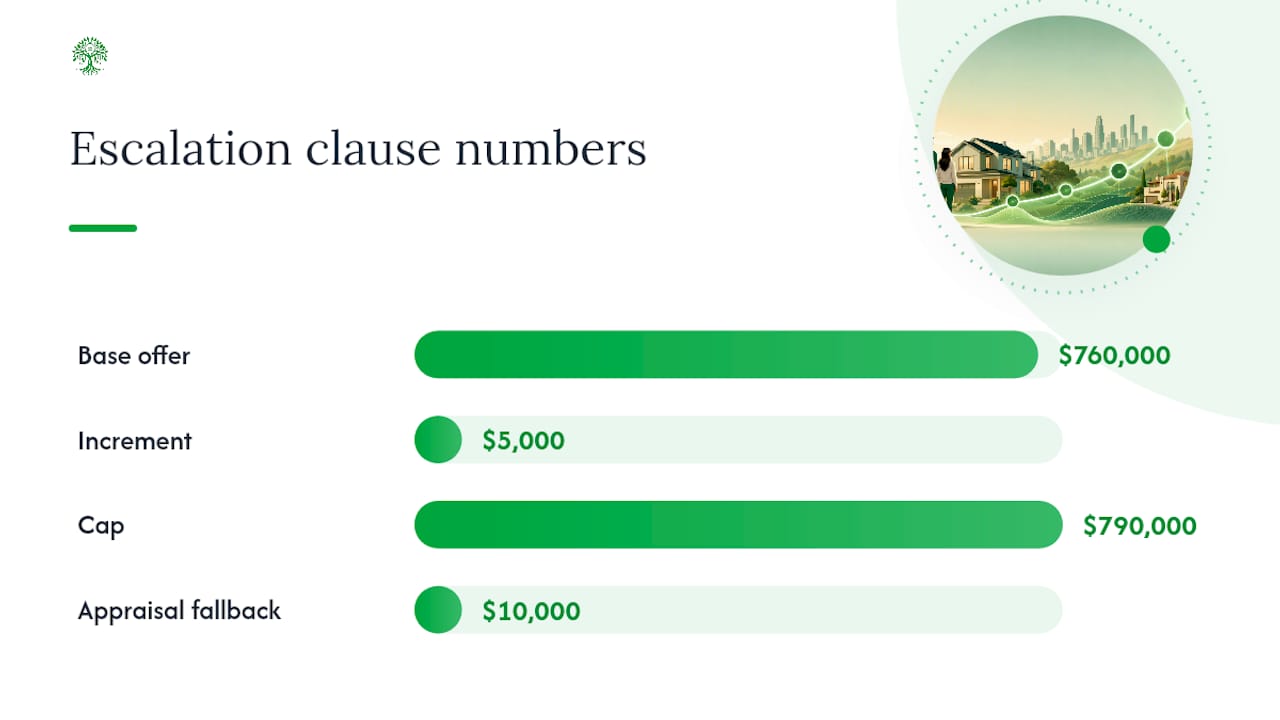
    Here’s the math in action. Say a home is listed at $750,000. You offer $760,000 with a $5,000 increment and a $790,000 cap. A competing buyer offers $770,000. Your offer escalates to $775,000 (one increment above $770,000). If a second buyer comes in at $785,000, your offer rises to $790,000, your hard stop, and you either win at that price or lose the house. The seller typically must supply a redacted copy of the competing contract before your escalation triggers, not just a verbal claim that another offer exists.

    The Four Essential Drafting Elements to Include

    A vague escalation clause is often worse than no clause at all. Get these four elements locked down before you sign anything.

    • Increment sizing. Smaller increments ($2,000 to $5,000) signal less desperation on homes under $500,000; larger jumps ($5,000 to $15,000) tend to show up on higher-priced properties, according to market practice guidance.
    • Cap calculation. Set your ceiling based on real affordability, not just what you think will win. Factor in your lender’s limits and what you expect the home to appraise for.
    • Proof requirement. Spell out exactly what counts as verification, typically a redacted purchase agreement plus proof of funds or a pre-approval letter from the competing buyer.
    • Gross vs. net language. State clearly whether escalation is based on the competing offer’s gross price or its net price after concessions, since the two can differ by thousands of dollars.

    Pro Tip: Never leave “bona fide competing offer” undefined in your clause. Courts and agents interpret vague terms inconsistently, so spell out what documentation counts as proof before you submit the offer.

    Pros, Cons, and Common Risks for California Buyers

    Escalation clauses solve a real problem: bidding blind. Instead of guessing what a competing buyer might offer and either overpaying or losing the house by a few thousand dollars, you let the clause respond in real time.

    The trade-offs are just as real.

    • Pro: You stay competitive without committing to your absolute maximum upfront.
    • Con: Your cap tells the seller exactly how high you’ll go, which weakens your negotiating position if the clause gets revealed.
    • Con: An escalated price that outpaces the appraisal leaves you covering the gap in cash, since lenders won’t finance above appraised value.
    • Risk: Without a strict proof requirement, a seller could claim a competing offer exists that never really did.
    • Market behavior: Many listing agents prefer clean, highest-and-best offers and will ignore escalation language entirely.

    When Is an Escalation Clause a Good Idea for First-Time Buyers?

    Use one when the situation actually calls for it, not by default on every offer.

    1. Confirm the listing agent accepts escalation clauses first. Some California listing agents, especially in high-demand markets like Silicon Valley, request highest-and-best offers and won’t consider them.
    2. Use one when you have a firm number in mind. If you know your true ceiling and want to avoid guessing at a single blind bid, an escalation clause keeps you disciplined.
    3. Skip it when appraisal risk runs high. If comparable sales suggest the home may not appraise near asking price, an escalation clause just increases your exposure to a cash gap.
    4. Decide your contingencies before you escalate. Waiving inspection or appraisal contingencies changes your risk profile independently of any escalation math.

    Not every agent will write this clause for you. Many California brokerages restrict agents from drafting custom escalation language beyond standard C.A.R. forms, which pushes buyers toward attorney-drafted addenda for anything non-standard.

    That caution exists for good reason. Ambiguous terms are the top cause of escalation clauses falling apart in a dispute, and courts have been inconsistent about enforcing language that doesn’t clearly define the trigger, the proof standard, or the cap.

    • Ask your agent directly whether their brokerage allows custom escalation addenda.
    • Budget for attorney review. It typically costs a few hundred dollars, which is modest relative to the financial exposure of a poorly worded clause on a home purchase.
    • Understand the appraisal interaction before you sign: if your escalated price lands above the appraised value, you are on the hook for the difference in cash unless you’ve negotiated an appraisal-gap provision separately.
    • Verify your lender’s stance on escalated purchase prices before you submit, since lenders lend against appraised value, not your winning bid.

    Practical Checklist and Sample Clause Pattern

    Run through this before you submit any offer with escalation language attached.

    1. Confirm the listing agent will accept an escalation clause.
    2. Check with your lender about appraisal and financing limits at your proposed cap.
    3. Set your cap based on real affordability, not competitive pressure.
    4. Choose an increment that signals confidence without over-committing.
    5. Require redacted proof of any competing offer before escalation triggers.
    6. Get the clause reviewed by a real estate attorney before signing.

    A basic pattern looks like this: Base Offer $760,000, Increment $5,000, Cap $790,000, Proof Requirement redacted competing contract plus proof of funds, Gross vs. Net based on gross contract price, Appraisal Fallback buyer covers gap up to $10,000 above appraised value.

    Pairing that structure with strong proof-of-funds documentation or an appraisal-gap guarantee tends to reduce seller resistance, since sellers increasingly weigh the whole offer package, not price alone.

    Practical Checklist and Sample Clause Pattern — overview diagram

    California courts have not issued a landmark ruling specifically striking down or blessing escalation clauses statewide, but the pattern in disputes that do surface is consistent: ambiguity kills enforceability. When a clause fails to define what counts as a “bona fide” competing offer, or leaves gross versus net proceeds unaddressed, buyers and sellers end up in disagreement over what price actually applies, and that disagreement can stall or unwind a closing.

    Three escalation clause enforceability checks

    Brokerage-level policy has shifted faster than case law. More California brokerages now require any escalation language to run through an attorney rather than get bolted onto a standard C.A.R. purchase agreement by an agent, a trend that tracks directly with legal guidance urging precise contract language to avoid disputes.

    On the market-practice side, high-demand submarkets have been quietly moving away from escalation clauses altogether. Agents in intensely competitive areas increasingly ask for highest-and-best offers instead, partly because escalation language slows down multiple-offer review and partly because it can invite the exact ambiguity disputes courts have flagged. If you’re buying in one of these submarkets, ask your agent directly whether escalation clauses are even being considered before you spend time drafting one. The regulatory direction of travel favors clearer, simpler offer terms over clever conditional pricing, and buyers who follow that trend tend to face fewer surprises at closing.

    Ficustree’s Perspective: How We Advise First-Time Buyers in California

    Anand has spent years watching California bidding wars punish buyers who escalate without doing the math first. At Ficustree, we run three checks before recommending escalation language: true affordability including appraisal-gap exposure, a direct lender conversation confirming your ceiling is financeable, and a verification plan that won’t let a seller bluff you into overpaying. Cap-setting happens before drafting, not after.

    — Anand

    How Ficustree Helps You Draft a Safer Competitive Offer

    Ficustree is the direct alternative to piecing together escalation strategy from generic templates and hoping your agent catches the risk. Instead of guessing at your cap or discovering the appraisal gap after you’re already under contract, you get AI-guided offer strategy that checks affordability first, flags lender and appraisal constraints before you sign, and connects you with attorney review when your clause needs it.

    Ficustree

    You also get hourly showing agents on demand instead of scheduling around one agent’s calendar, and the platform itself is free to use. Buyers who close through Ficustree pay a fee at closing plus commission, with a rebate kept where legally permitted. If you’re heading into a competitive bid and want your escalation math checked before you submit, start with Ficustree and walk into your offer with numbers you can trust.

    Sources

    FAQ

    Can an Escalation Clause Backfire?

    Yes. Revealing your cap can lead a seller or listing agent to counter at or near your maximum, and if your escalated price outpaces the appraisal, you cover the gap in cash unless you’ve negotiated appraisal-gap protection.

    Is an Escalation Clause a Good Idea?

    It depends on your market and your numbers. It can help in bidding wars where you have a firm ceiling in mind, but it’s a poor fit where appraisal risk is high or the listing agent wants clean highest-and-best offers.

    How Do You Beat an Escalation Clause?

    A strong, clean offer with solid pre-approval, proof of funds, and flexible terms can outcompete an escalation clause because sellers weigh the whole offer package, not price alone. Confirming your numbers with a platform like Ficustree before you bid helps you compete on strength rather than just price.

    What Is a Typical Escalation Clause?

    A typical clause sets a base offer, an increment of $2,000 to $15,000 depending on price tier, a hard cap, and a requirement that the seller provide redacted proof of any competing offer before the escalation triggers.

    Does Ficustree Charge for Help With an Escalation Clause?

    Ficustree’s platform and guidance are free to use. Buyers who close through Ficustree pay a $1,000 fee at closing plus 1% commission, with a rebate kept where legally permitted.

  • Avoid the FAIR Plan Trap: How California Buyers Secure Coverage

    Avoid the FAIR Plan Trap: How California Buyers Secure Coverage

    For most California homeowners, the smartest path to coverage right now is shopping admitted-standard carriers and the surplus and excess (E&S) lines at the same time, not waiting to get rejected by one before trying the other. Treat the FAIR Plan as a last resort, paired with a supplemental policy. Stanford research shows statewide premiums climbing roughly 84% since 2020, and the California Department of Insurance urges homeowners to compare quotes independently rather than settle for the first offer.


    TL;DR:

    • Shopping both admitted-standard and surplus lines simultaneously offers the best chance of coverage and competitive rates, especially in wildfire-prone counties.
    • Standard carriers have reduced capacity due to wildfire losses and rising reinsurance costs, leading to higher deductibles and limited availability in high-risk areas.
    • Comparing policies should focus on replacement cost coverage, policy forms, endorsements, and confirming carriers are actively accepting new business in your ZIP code.
    • The FAIR Plan alone covers only fire-related damages and must be paired with additional policies to provide comprehensive protection against theft, water damage, and liability.
    • Improving home resilience through wildfire mitigation and documenting upgrades can significantly lower premiums and improve chances of obtaining standard coverage.

    Ficustree
    Make Insurance Part of Your Search
    Ficustree helps California first-time buyers factor insurance into clearer home purchase decisions, alongside affordability and neighborhood fit.

    Table of Contents

    What Are the Best Homeowners Insurance Options in California Right Now?

    California’s homeowners insurance market splits into four distinct lanes, and knowing which one applies to your property changes how you shop. Most searches for the best homeowners insurance in California assume there’s one ranked list of top providers. There isn’t. Availability now depends heavily on your ZIP code, home value, and construction, which means the “best” carrier for your neighbor might not even quote your address.

    • Admitted standard carriers. Regulated under Proposition 103, these companies offer the most consumer protections and the most predictable pricing, but many have pulled back new business in wildfire-exposed counties.
    • Surplus and excess (E&S) lines. Less regulated, often pricier, but frequently the only option for homes standard insurers won’t touch. The Triple-I reports E&S market share rose notably by 2025, up sharply from prior years.
    • High-net-worth specialty carriers. Built for larger homes with higher rebuild costs; NerdWallet notes insurers like Chubb specialize here, though availability varies by ZIP code and isn’t guaranteed statewide.
    • The FAIR Plan plus a Difference-in-Conditions (DIC) wrap. California’s insurer-of-last-resort program, now covering close to 5% of single-family homes statewide as of March 2026.

    Wildfire losses, rising reinsurance costs, and rate-review limits under Proposition 103 have combined to squeeze standard-market capacity. The state’s Sustainable Insurance Strategy reforms aim to loosen some of those constraints, but the effects are still working through the system. Deductibles have risen too, from an average of $1,813 to $2,553 according to the Stanford research. Ask every agent or broker to run quotes across at least two lanes before you accept a decline as final.

    How Do You Compare Policies and Pick the Right Coverage?

    Shopping for homeowners insurance in California takes more discipline than shopping for auto coverage, mostly because the stakes are higher and the market is less forgiving of a wrong guess. Follow these steps in order:

    1. Calculate replacement cost, not market value. Insuring your home for what it would cost to rebuild, materials and labor included, is the only sound basis for your dwelling limit. Insuring against your home’s sale price or the land under it leads to over-insurance and inflated premiums.
    2. Compare policy forms. An HO-3 (all-risk) policy covers more perils by default than an HO-2 (named-peril) policy. Check wildfire-specific provisions closely, since some carriers apply a percentage deductible on fire claims instead of a flat dollar amount.
    3. Review endorsements. Water backup coverage, ordinance-or-law coverage for code upgrades after a loss, and additional living expense limits often need to be added separately.
    4. Confirm the carrier is actually writing new business in your ZIP code. Some insurers technically operate in California but have stopped issuing new policies in specific high-risk areas.
    5. If FAIR Plan is your only offer, ask for DIC quotes immediately. Understand exactly which perils the base policy excludes before you sign anything.

    Bring photos of the home, receipts for any upgrades, and recent inspection reports to your broker meeting. Ask directly whether wildfire mitigation work, defensible space, or a home-hardening certificate qualifies you for a discount or better placement.

    Pro Tip: Get quotes from at least one admitted carrier and one E&S broker in the same week. Rates and appetite shift fast, and a broker who quoted you a decline in January may have new capacity by summer.

    What Can You Do to Lower Your Premium or Qualify for Standard Coverage?

    Underwriters weigh specific home features more heavily than most homeowners realize, which means the fixes that matter most are often invisible from the curb.

    Harden the structure. Defensible space clearance, a non-combustible roof, and ember-resistant vents are the improvements insurers ask about first in fire-prone areas. Enrolling in a local wildfire mitigation program can unlock discounts and open doors to carriers that otherwise decline the address outright.

    Stack the easy discounts. Bundling home and auto with the same insurer, installing a monitored alarm system, and confirming working smoke detectors and deadbolt locks are simple line items that lower the quote without touching the structure.

    • Bundle home and auto policies with one carrier.
    • Install monitored fire and burglar alarms.
    • Verify smoke detectors and deadbolts meet the insurer’s checklist.
    • Document any electrical panel or plumbing upgrades with contractor invoices.

    Document your upgrades before you call for quotes. A pre-inspection report or an itemized contractor invoice for rewiring or repiping can shift an underwriter’s decision from decline to approve, since aging electrical and plumbing systems are common reasons standard carriers walk away.

    Know when to go specialty. If your home’s value, construction type, or location gets a flat no from standard carriers, an experienced E&S broker who places wildfire-zone or high-value homes regularly is worth the extra step. For buyers still comparing neighborhoods, our wildfire risk guide walks through mitigation factors before you’re locked into an address.

    Pro Tip: Ask your broker for the insurer’s current wildfire mitigation discount list by name. Some programs, like Wildfire Prepared Home certification, aren’t advertised on every quote page.

    What Does the FAIR Plan Actually Cover?

    The FAIR Plan exists because some California homes genuinely cannot get standard coverage, but it was never built to be a complete substitute for a regular policy. It’s a safety net, not a full replacement.

    • What it covers: fire, smoke, lightning, and in-home explosion damage.
    • What it typically excludes: theft, most water damage, liability protection, and many personal property perils that a standard HO-3 policy would include automatically.

    Because of those gaps, most homeowners who end up on the FAIR Plan pair it with a Difference-in-Conditions (DIC) policy, or a standalone liability and contents policy, to fill in what’s missing. Skipping that second policy means you’re uninsured against a burglary or a slip-and-fall lawsuit even while your fire coverage is technically active.

    This matters more every year. Stanford’s research on the California home insurance crisis found FAIR Plan enrollment increased substantially in recent years, a sign that availability pressure has spread well past the classic wildfire zones and into markets homeowners assumed were safe from it.

    Anand’s Perspective: What First-Time Buyers Should Actually Prioritize

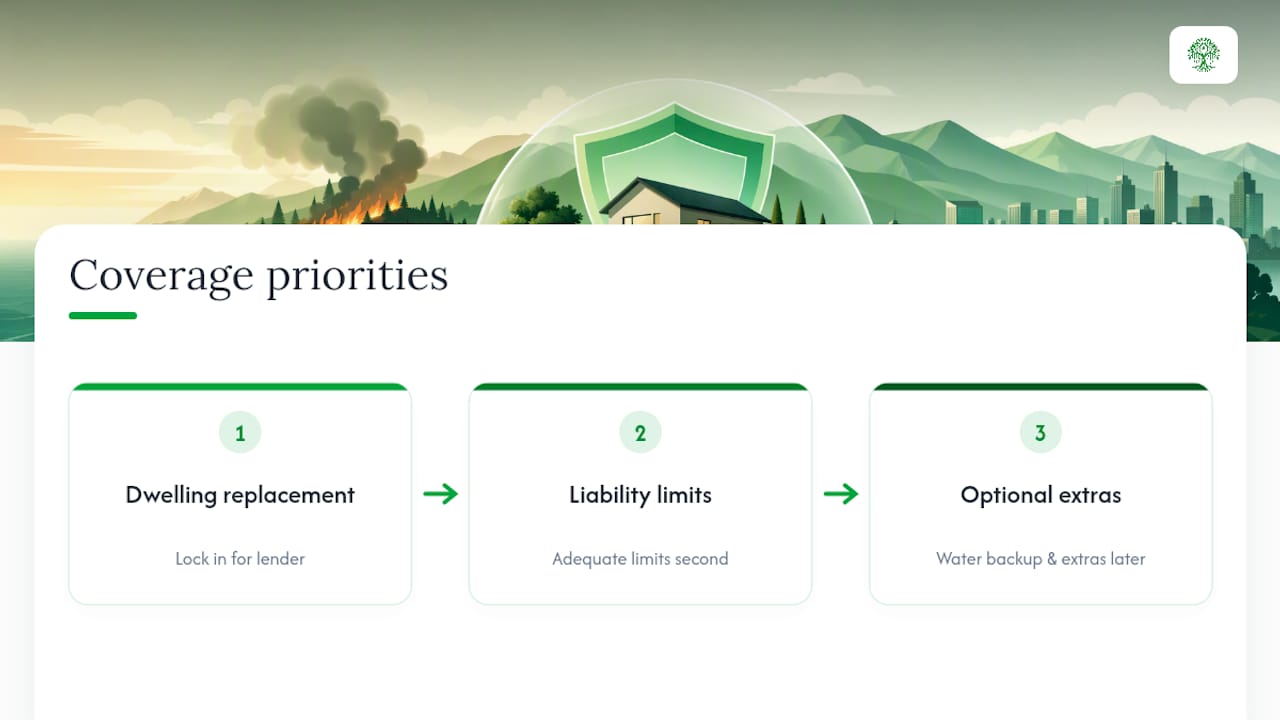
    Here’s what most first-time buyers get backward: they shop for the cheapest premium before they’ve locked in the coverage their lender actually requires. Dwelling replacement cost and adequate liability limits come first. Water backup riders and other extras can wait until the essentials are funded.

    Home insurance coverage priority sequence

    The bigger mistake is treating insurance as an afterthought in the affordability math. A $400 monthly premium quote that jumps to $650 after underwriting can break a budget that was calculated too tightly. Folding a realistic premium and a higher wildfire deductible into your upfront numbers, not your post-closing surprises, is what separates buyers who stay comfortable from buyers who feel stretched thin.

    This is exactly where decision intelligence earns its keep. Ficustree’s neighborhood risk scoring and affordability tools surface likely insurance exposure before you fall in love with an address, which cuts weeks off the guesswork most first-time buyers go through on their own.

    — Anand

    Ficustree is the alternative to shopping blind. Instead of falling for a listing and finding out about wildfire exposure or a FAIR Plan situation during underwriting, you see the risk signals up front, while you’re still comparing neighborhoods.

    Ficustree

    Our platform lets you browse homes across 467 California cities with neighborhood-level context built in, so insurance risk becomes part of your search from day one instead of a closing-week surprise. The same wildfire risk research that shapes this guide feeds directly into how Ficustree scores neighborhoods for first-time buyers. And because Ficustree represents you directly, for a fixed $1,000 fee at closing plus 1% commission, with a rebate of roughly 2% kept where legally permitted, you get a showing agent on demand and a platform built to compress months of confusion into weeks of clarity, at no cost to use the premium tools themselves.

    If insurance availability is already shaping where you’re willing to buy, start on the Ficustree buyer page and let the platform surface the trade-offs before you write an offer.

    How Ficustree Helps You Factor Insurance Into Your Home Search — overview diagram

    Primary Sources and Further Reading

    For deeper detail, see the Stanford Woods Institute research on premium and FAIR Plan trends, the Triple-I market reform report, NerdWallet’s California carrier roundup, and Phys of the broader crisis.

    This article is general information, not a substitute for advice from a qualified financial advisor. Consult a qualified financial professional about your own circumstances before acting on anything here.

    Sources

    FAQ

    Is the FAIR Plan considered part of the best homeowners insurance in California?

    Only as a last resort. The FAIR Plan covers fire, smoke, and explosion damage but excludes theft and liability, so most homeowners pair it with a supplemental Difference-in-Conditions policy.

    What is the cheapest homeowners insurance in California right now?

    There’s no single cheapest carrier statewide, since pricing depends on your ZIP code, home value, and construction. Comparing admitted and surplus-line quotes side by side is the most reliable way to find affordable homeowners insurance in California for your specific address.

    How do I choose home insurance in California if I keep getting declined?

    Ask your broker to quote surplus and excess (E&S) lines immediately after a standard decline, and request FAIR Plan plus DIC quotes if no standard carrier will write your address.

    Does Ficustree offer homeowners insurance directly?

    No. Ficustree is a buyer representation platform that helps first-time buyers factor insurance risk and affordability into their home search; current service details are available on the Ficustree buyer page.

    Should I insure my home for its market value or its replacement cost?

    Replacement cost, not market value. Basing your dwelling limit on what it would actually cost to rebuild avoids over-insuring and keeps your premium tied to real risk.

  • State by State: Title Company vs Escrow for US First Time Buyers

    State by State: Title Company vs Escrow for US First Time Buyers

    Title companies protect your ownership. Escrow companies hold your money and paperwork until every contract condition is met, then release everything at once. Both roles can live under one roof or two separate companies depending on where you buy, so the real question isn’t “title company vs escrow.” It’s who is doing which job in your specific closing, and whether you’ve confirmed that in writing before you wire a dollar.


    TL;DR:

    • Most states have regional models that determine whether one or separate companies handle closing funds, documents, and title insurance, affecting costs and timelines.
    • Confirm in writing who holds your funds and who is issuing your title policy to prevent confusion and reduce fraud risks before wiring any money.
    • Title companies focus on ownership protection and issue policies, while escrow companies manage the disbursement of funds and verify contract conditions during closing.
    • In states like Texas, one company often does both title and escrow work, whereas in California, separate licensed companies are typically involved, influencing the closing process.
    • Securing an owner’s title insurance and verifying wire instructions by phone are essential first steps for first-time buyers to protect their investment and prevent last-minute issues.

    Ficustree
    Navigate Closing With More Clarity
    Ficustree helps first-time buyers make clearer home purchase decisions across California and Texas, including title and escrow questions.

    Explore Ficustree

    Table of Contents

    What an Escrow Company Actually Does

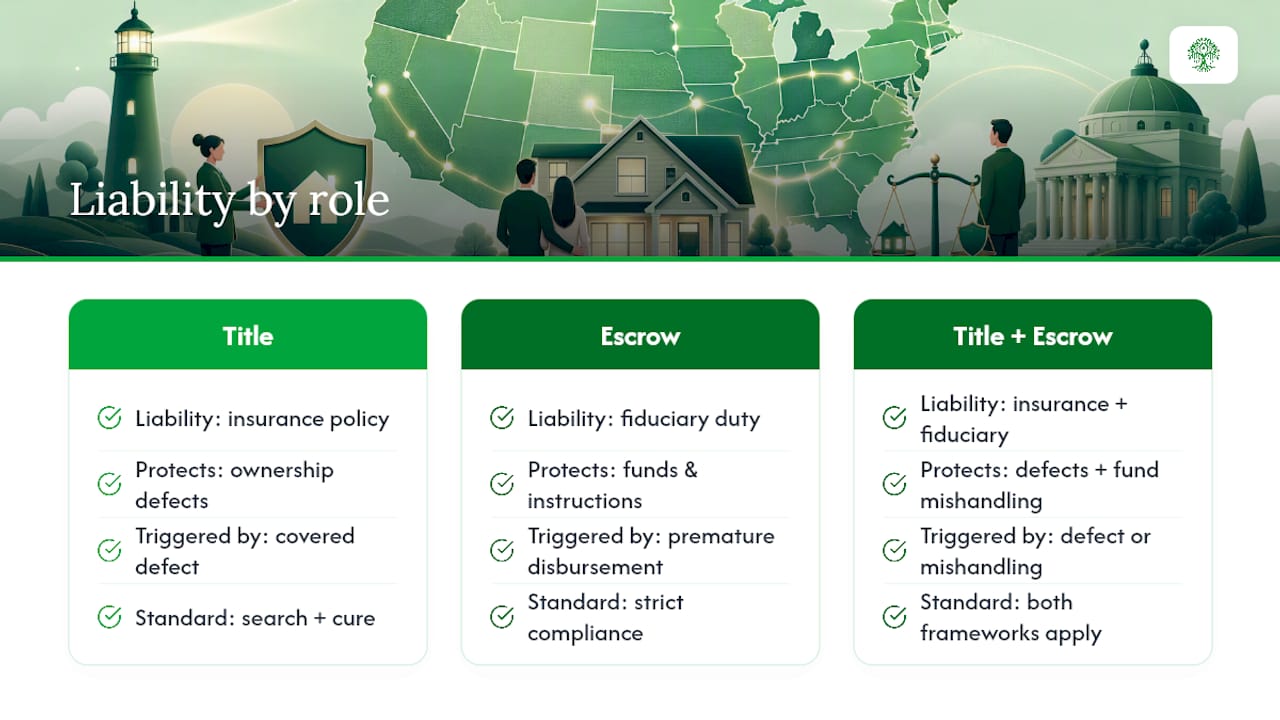
    An escrow company (or escrow officer) is a neutral third party. It holds your earnest money, your loan proceeds, and your signed documents, and it releases none of it until every condition in your purchase contract has been satisfied. That neutrality isn’t just a nice idea. Escrow agents owe duties of careful, unbiased handling of funds, and they can face real liability if they disburse money before conditions are actually met.

    Typical escrow tasks include:

    • Receiving and depositing your earnest money deposit
    • Collecting the lender’s loan proceeds once underwriting clears
    • Verifying inspection, appraisal, and financing contingencies are satisfied
    • Disbursing funds to the seller, agents, and service providers at closing
    • Managing ongoing escrow accounts for property taxes and homeowners insurance after you move in

    Who can act as an escrow holder varies by state. It might be a dedicated escrow company, a title company wearing an escrow hat, a real estate attorney, or a bank trust department. Licensing rules differ too. California regulates independent escrow companies through the Department of Financial Protection and Innovation, while other states fold escrow duties into title company licensing.

    Pro Tip: Ask early who is physically holding your earnest money. If the answer is vague, that’s your first red flag, not your last.

    What a Title Company Actually Does

    Title is your legal right to own the property, free of undisclosed claims. A title company’s core job is running a title search: combing public records for liens, unpaid judgments, old easements, or ownership disputes that could threaten your claim later. When it finds a problem, it works to “cure” the defect, meaning it clears the lien or resolves the dispute before closing can happen.

    Title companies also issue title insurance, and there are two distinct types:

    • Owner’s title insurance protects you, the buyer, for as long as you or your heirs own the home
    • Lender’s title insurance protects the mortgage lender’s financial interest in the property

    Lenders almost always require a lender’s policy before funding a loan. There’s no federal law forcing you to buy an owner’s policy, but skipping it means you’re personally exposed if a title defect surfaces after closing, and the premium is small relative to what a home is worth.

    At the closing table, the title company typically prepares the title commitment (a preview of what the policy will cover), clears any defects it found, issues the final policy, and often prepares or records the closing documents with the county. The American Land Title Association sets standardized policy forms that most underwriters, including the largest national players, follow across state lines, which is part of why a title policy from one state reads similarly to one from another.

    Escrow vs Title: The Practical Differences

    Here’s the split that actually matters when you’re staring down a closing date: title protects ownership, escrow protects the transaction itself. One guards against a legal claim showing up five years from now. The other makes sure nobody’s money moves before every box is checked today.

    What to confirm Title company Escrow company
    Primary role Ownership protection (search, insurance) Custody and disbursement of funds/documents
    Holds your money No Yes
    Issues title insurance Yes (owner’s and lender’s policies) No
    Prepares/records the deed Usually yes Sometimes, depending on the state
    Common delivery model Standalone or combined with escrow Standalone or combined with title

    Three things worth confirming before you sign anything:

    1. Ask directly whether your title and escrow functions are handled by the same company or two separate ones.
    2. Request the RESPA affiliated-business disclosure if title and escrow share ownership, since federal rules require it and let you shop for a different provider anyway.
    3. Confirm in writing, by phone, who is authorized to send you wiring instructions, and never trust a late change that arrives only by email.

    How Escrow and Title Work Together at Closing

    The two roles run on parallel tracks that converge right before you get your keys.

    1. Escrow opens. Once your purchase contract is signed, escrow opens and issues instructions to every party spelling out what has to happen before funds move.
    2. Title work runs in the background. The title company searches records, flags defects, and works to clear them while inspections and financing proceed on their own timeline.
    3. Escrow waits, then funds. Escrow won’t disburse a cent until title confirms the property is clear and your lender has sent loan proceeds. Title can’t issue the owner’s policy until funds and documents are confirmed and the deed is ready to record, and escrow can’t release money until title gives the green light. Each one is stuck waiting on the other.
    4. Recording and policy issuance. The deed records with the county, escrow disburses final funds, and title issues your owner’s and lender’s policies.

    If something stalls, call your escrow officer for money and timing questions, and your title officer for anything about liens, the deed, or the policy itself.

    How Your State Changes the Closing Process

    Where you buy determines who you’re dealing with, and it changes more than paperwork. It changes your timeline and sometimes your closing costs.

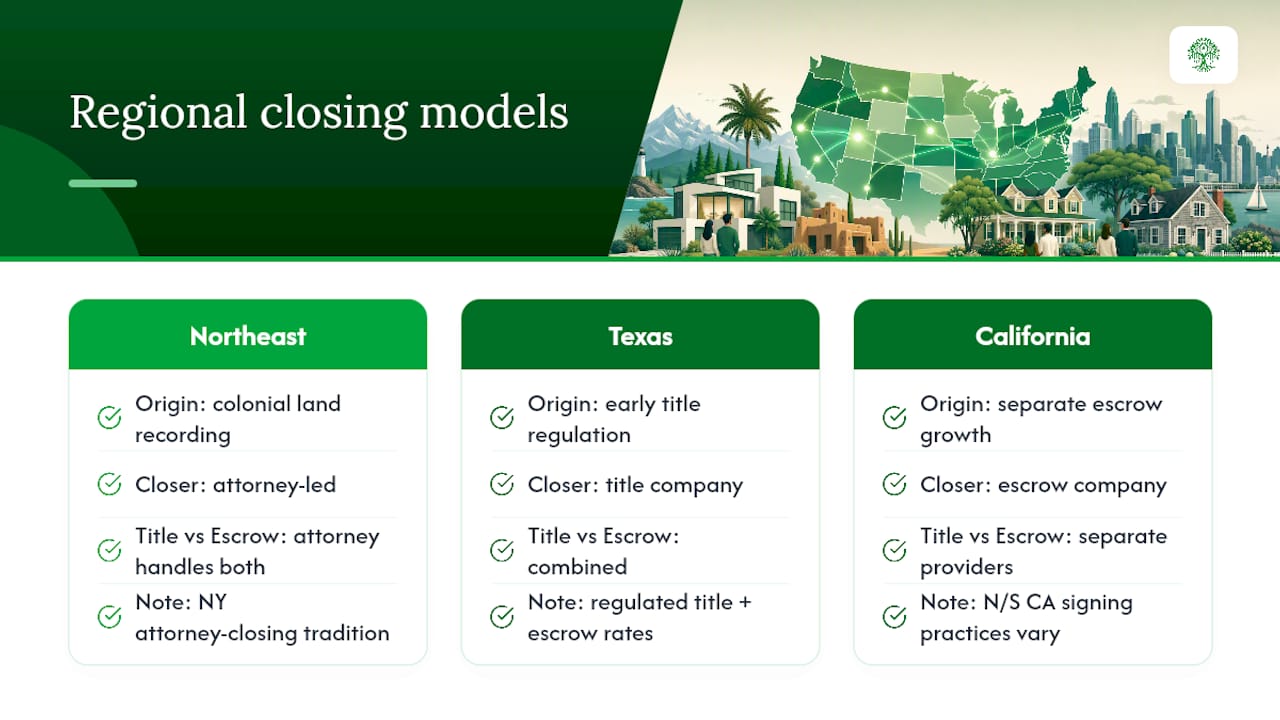
    The U.S. runs on three main models. In title states like Texas, the title company typically closes the transaction directly, and title agents there often act as your escrow holder too, with rates regulated by the Texas Department of Insurance. In escrow states like California, independent escrow companies frequently handle the money and paperwork while a separate title company issues the policy, meaning buyer and seller may never sit at the same closing table. In attorney states like New York, a real estate attorney runs much of the closing itself.

    • Title states: expect one company, one closing appointment, often an in-person signing
    • Escrow states: expect separate companies, more paperwork routed by mail or courier, and no shared closing table
    • Attorney states: expect attorney fees added to your closing costs, plus more direct legal review

    Ask your agent or lender which model applies before you assume anything about how your closing will feel.

    Questions to Ask and Red Flags to Watch For

    Before you’re staring at a wire transfer deadline, get direct answers to these:

    1. Who exactly is holding my earnest money, and what company is it?
    2. Who is issuing my owner’s title policy, and is that separate from whoever holds escrow?
    3. Are you affiliated with my real estate agent’s brokerage or my lender?
    4. What’s your specific process for verifying any change to wiring instructions?

    Watch for these warning signs: a last-minute email changing wiring details, a provider who can’t clearly state their state license, or pressure to skip calling the title or escrow office directly to verify instructions by phone. Wiring fraud remains one of the most common closing-day risks, and legitimate providers expect you to double-check, not resent it.

    Keep copies of your title commitment, your Closing Disclosure, the recorded deed, and your final title insurance policy. You’ll want all four if a dispute ever comes up.

    Pro Tip: Call the escrow or title office using a phone number you find independently, not one from an email you just received. That single habit stops most wire fraud attempts cold.

    How Ficustree Helps You Navigate Title and Escrow

    An AI-powered buyer representation platform can help first-time buyers understand who’s doing what at closing. Because Ficustree represents you directly rather than sitting on both sides of a transaction, there’s no ambiguity about whose interest is being served when title and escrow questions come up.

    Ficustree’s guides walk buyers through state-specific closing models, including a detailed escrow process breakdown for California buyers and an explainer on what title companies actually do, so you walk into your closing knowing exactly what to expect and who to call.

    Why Title and Escrow Split Differently by Region

    The title state, escrow state, and attorney state models didn’t happen by accident. They grew out of how each region historically handled land records and legal review.

    In the Northeast, where colonial-era land recording systems were often inconsistent and legal disputes over boundaries were common, attorneys became the trusted party to review title and manage the closing. New York’s attorney-closing tradition traces directly back to that history. In Texas, land title insurance became state-regulated early, and title agents naturally absorbed escrow duties because the industry consolidated around title companies that could offer both services under one regulated rate structure.

    California took a different path. Independent escrow companies emerged as their own licensed industry, separate from title insurers, partly because the state’s real estate market grew fast enough to support specialized escrow businesses that didn’t need to also underwrite insurance. That’s part of why California buyers today often deal with one escrow company and a separate title insurer, while a Texas buyer might deal with a single title company that does both jobs.

    Regional comparison of title and escrow models

    Even within California, Northern and Southern California practices differ slightly, with variations in how joint versus unilateral signing instructions get handled and how much mobile notary services get used for signings.

    None of these models is objectively better. They reflect regional legal traditions and how each state’s real estate industry organized itself over the past century. What matters for you is knowing which model governs your purchase, since it determines your timeline, your costs, and who physically handles your paperwork.

    When Title and Escrow Roles Blur Together

    Confusion tends to show up in a handful of predictable spots, and knowing them in advance saves you a panicked phone call later.

    The most common one: your title company and escrow company are the same business, operating under one roof with two different job functions. This happens constantly in Texas and is common elsewhere too. When that’s the case, one point of contact might answer questions about your policy and your wire transfer, which is convenient, but it also means you should specifically confirm which hat they’re wearing when you ask a question.

    A second common scenario: your escrow holder is technically a title company’s escrow division, but a separate underwriter is issuing the actual insurance policy. You might get an invoice showing a title fee and a separate escrow fee on the same closing statement, with no explanation of why they’re split. That’s normal. It reflects two distinct services, even if one company delivered both.

    A third scenario involves affiliated business arrangements, where your real estate brokerage owns a stake in the title or escrow company handling your file. This isn’t illegal, but federal disclosure rules require you to be told about it in writing, and you retain the right to choose a different provider if you’d rather not use the affiliated one.

    Last, first-time buyers sometimes assume the escrow company is holding their loan funds from day one. In reality, loan proceeds typically don’t arrive until very close to closing, often the same day, which is why last-minute funding delays can push a closing date by a day or two even when everything else is ready.

    Who’s Liable When Something Goes Wrong

    Title companies and escrow companies carry different kinds of legal exposure, and understanding the split helps you know who to contact if a problem surfaces.

    Title companies are liable primarily through the title insurance policy itself. If a covered defect surfaces after closing, a lien nobody caught or a forged prior deed, the title insurer is contractually obligated to defend your ownership or cover your loss up to the policy amount. This is why the title search and cure process matters so much before closing: a thorough search reduces the odds of a claim, but the insurance is what actually protects you if the search missed something.

    Escrow companies carry a different kind of liability. Because they hold a fiduciary-like duty of neutrality, an escrow agent who disburses funds before conditions are met, or who mishandles instructions, can be held personally and financially responsible for that breach. Courts have generally held escrow agents to a standard of strict compliance with written instructions, meaning they don’t get much benefit of the doubt if they deviate from what the contract says, even with good intentions.

    Where things get complicated is in states where one company wears both hats. A combined title and escrow agent can theoretically face liability under both frameworks: as an insurer if a title defect surfaces, and as a fiduciary if funds were mishandled during the transaction. That dual exposure is part of why Texas title agents are required to avoid conflicts of interest and act with good faith even when serving both functions for the same closing.

    For you as a buyer, the practical takeaway is simple: your title insurance policy is your protection against ownership problems, and your closing instructions are your protection against fund mishandling. Keep both, and read both, before you sign.

    Who's Liable When Something Goes Wrong — overview diagram

    What Title and Escrow Fees Actually Pay For

    Closing statements list title and escrow fees separately because they cover genuinely different work, even when one company performs both.

    Title-related fees typically include the title search fee, the title examination fee, and the premium for your owner’s and lender’s title insurance policies. Some states also charge a separate settlement or closing fee for preparing the actual closing documents. These costs vary by state and by the price of the home, since title insurance premiums are typically calculated as a percentage of the purchase price or loan amount.

    Escrow fees cover the cost of opening and managing the escrow account, tracking contract conditions, coordinating fund transfers between buyer, seller, and lender, and disbursing money at closing. Some escrow companies also charge a small wire fee or a document preparation fee separate from the base escrow charge.

    Who pays which fee is negotiable and varies significantly by state and even by county custom. In many California counties, sellers customarily pay for the owner’s title policy, while buyers pay for escrow fees, though this can be negotiated either way in your purchase contract. In Texas, fee splits follow different local customs. California closing costs specifically break down these variations if you want a state-specific look at what you’re likely to see on your own statement.

    The one rule that holds everywhere: your Closing Disclosure has to itemize every fee at least three business days before closing, so you have time to question anything that looks off before you’re at the table signing.

    What First-Time Buyers Should Actually Focus On

    If you take one thing from this article, make it this: confirm who’s holding your funds, verify wiring instructions by phone using a number you found yourself, and secure an owner’s title policy even though nobody’s forcing you to buy one. Everything else, fee splits, state models, company names, is secondary to those three habits. If your closing paperwork ever feels unclear, ask your agent point blank who is handling escrow and who is handling title in your transaction. A good agent answers that in one sentence.

    — Anand

    Get Hands-On Help With Title and Escrow Decisions

    Ficustree gives you a buyer’s advocate for exactly these moments, someone whose only job is protecting your side of the closing, not managing a title company’s own book of business. As direct buyer representation, Ficustree charges a fixed $1,000 fee at closing plus 1% commission, with a rebate of roughly 2% kept where legally permitted, so you know the cost structure before you’re anywhere near a closing table.

    Ficustree

    Some platforms combine buyer representation with state-aware guidance, on-demand showing agents, and step-by-step closing checklists that clarify where title and escrow responsibilities split. If you want a workflow that keeps your documents and deadlines organized automatically, the home buying workflow tools show how that works in practice. Start by checking your affordability and browsing represented listings at Ficustree to see what hands-on guidance looks like before you’re staring down your own closing date.

    Sources

    FAQ

    Does the Title Company Hold Money in Escrow?

    Sometimes. In title states like Texas, the title company often also serves as the escrow holder, but in states like California, a separate escrow company usually holds the funds while the title company only issues insurance.

    How Much Do Title Companies Charge for Escrow?

    Escrow fees vary by state, county, and home price, and are typically charged separately from title insurance premiums, so check your specific Closing Disclosure rather than assuming a flat rate applies everywhere.

    Do Escrow Agents Work at Title Companies?

    Yes, in many states escrow agents are employees of title companies, though independent escrow companies also exist, particularly in states like California where the two functions are often kept separate.

    What Are the Risks of Not Using a Title Company?

    Skipping a title search and owner’s title policy leaves you personally exposed to undiscovered liens, ownership disputes, or forged prior deeds that could surface years after you move in, with no insurance to cover the loss.

  • $1,000 Fee: Ficustree Finds Best Mortgage Lenders in Texas

    $1,000 Fee: Ficustree Finds Best Mortgage Lenders in Texas

    The best mortgage lenders in Texas for first-time buyers combine local underwriting, transparent fees, and real experience with programs like TDHCA down payment assistance. For most first-time buyers, working with a lender who partners well with a buyer representation platform like Ficustree solves the two hardest parts of this process at once: finding the right loan and finding the right home. If your credit is under 620, self-employment complicates your income, or you’re set on a niche program a specific lender doesn’t offer, you’ll want to shop beyond the obvious names. Either way, start by pulling Loan Estimates from two or three lenders before you fall in love with a house.


    TL;DR:

    • Shopping for multiple Loan Estimates within a 14-day window ensures accurate APR comparisons and prevents hidden origination fees from eroding your savings.
    • Prioritizing closing reliability is crucial, especially in Texas’s competitive market, as in-house underwriting speeds up the process and reduces the risk of losing your purchase.
    • Confirm that your lender is approved for Texas-specific programs like TDHCA and TSAHC, as program availability varies and affects your ability to access down payment assistance.
    • Texas property taxes and homeowner insurance costs significantly impact monthly payments, regardless of the mortgage rate or loan type, so budget accordingly before making an offer.
    • Using a platform like Ficustree helps coordinate lender selection, program eligibility, and closing timelines, which can improve your chances of closing smoothly on your first home.

    Ficustree
    Bring Mortgage Clarity Into Your Search
    Ficustree helps Texas first-time buyers connect lender selection, program eligibility, and closing timelines while finding the right home.

    Explore Ficustree

    Table of Contents

    How to Choose a Mortgage Lender in Texas

    Rate is the number everyone fixates on, but it’s rarely the reason a deal falls apart. Closing reliability is. A lender who can’t fund on time in a hot Texas market, where competing offers often close in under 30 days, can cost you the house even if their rate was a quarter point lower.

    Here’s the order that actually matters when you’re comparing options:

    1. Closing reliability. Ask directly whether underwriting happens in-house or gets sent to a centralized processing center. In-house underwriting tends to move faster and gives you a real person to call when a document goes missing three days before closing.
    2. Fees and APR. The interest rate alone hides origination charges, discount points, and lender fees. Compare the annual percentage rate, not just the headline number.
    3. Program availability. Confirm the lender actually offers FHA, VA, and Texas-specific programs like those through TDHCA and TSAHC, not just conventional loans.
    4. Communication speed. How fast do they respond to a pre-approval request? That pace usually predicts how they’ll handle your file once you’re under contract.
    5. Licensing and complaint history. Every legitimate lender and loan officer carries an NMLS Consumer Access record you can check in minutes.

    When you talk to a loan officer, ask pointed questions:

    • “Do you underwrite in-house, or is this sent out?”
    • “Have you closed loans using TDHCA or TSAHC down payment assistance before?”
    • “What’s your average time from application to clear-to-close?”
    • “Can you lock my rate today, and for how long?”

    Watch for red flags: vague answers about fees, reluctance to put anything in writing, or pressure to sign disclosures you haven’t read. Getting three Loan Estimates is the sweet spot, enough to compare meaningfully without drowning in paperwork. Submit those applications within a 14-day window. Credit scoring models generally treat multiple mortgage inquiries in a short period as a single inquiry, so shopping around doesn’t tank your score the way people assume.

    Texas-Specific Programs and Down Payment Assistance Explained

    Texas gives first-time buyers more assistance options than most states, but the programs only work through lenders who are actually approved to close them. That distinction trips up more buyers than any rate comparison ever will.

    TDHCA runs two flagship programs worth knowing by name. My First Texas Home pairs a low-interest mortgage with down payment and closing cost assistance for eligible first-time buyers and veterans. My Choice Texas Home opens that same assistance to repeat buyers too, which matters if you’ve owned a home before but haven’t in the last three years, a common qualifying window for “first-time buyer” programs. Both require a homebuyer education course and compliance with income and purchase price limits that vary by county.

    Down payment assistance isn’t universal across lenders. Some national lenders decline to close loans that carry program-specific second liens or subordinate financing structures, according to guidance from TDHCA. That means the lender with the lowest advertised rate might not be able to close your assistance loan at all.

    The Texas State Affordable Housing Corporation, TSAHC, runs a parallel set of programs with its own approved-lender network and its own income limits, which sometimes differ from TDHCA’s. Confirming your lender sits on both approved lists before you get emotionally attached to a rate quote saves real heartache later.

    City-level programs add another layer. Houston and Dallas both run homebuyer assistance programs that can offer forgivable loans or grants toward down payment and closing costs, and these often come with their own approved-lender requirements. A lender who’s never closed a City of Houston assistance loan may need extra time to get up to speed, or may not participate at all.

    The practical takeaway: before you fall for a rate quote, ask your lender directly which state and city programs they’re approved for. Cross-reference the answer against the program’s own portal. A lender who’s vague about this, or who tries to steer you into conventional financing you didn’t ask about, isn’t the right fit for a first-time buyer trying to minimize cash to close.

    If reducing your upfront cash is the priority, it’s worth reading through the full range of low and no down payment paths available to Texas buyers before you commit to one lender’s product lineup.

    Texas-Specific Programs and Down Payment Assistance Explained — overview diagram

    How Do You Compare Loan Estimates Line by Line?

    Every lender is federally required to send you a standardized three-page Loan Estimate within three business days of a completed application, and that standardization is exactly what makes side-by-side comparison possible. The document looks the same regardless of who issues it, so you’re comparing numbers, not marketing language.

    Start with the APR, not the interest rate printed at the top. Comparing APR instead of the headline rate exposes offers where a lender bought down the rate with points and fees you’d pay for upfront, sometimes wiping out any savings over the years you’ll actually hold the loan.

    Work through the Loan Estimate in this order:

    1. Loan terms section (page 1). Confirm the loan amount, rate, and whether the rate can change. This is where adjustable-rate features hide if you weren’t expecting them.
    2. Projected payments. Check whether property taxes, insurance, and any mortgage insurance premium are included in the estimated monthly payment. Texas property taxes run high, and a lender who lowballs this estimate is setting you up for a surprise.
    3. Origination charges (page 2, section A). This is the lender’s own fee for processing your loan. Compare this dollar figure directly across offers.
    4. Services you cannot shop for and services you can. Some third-party costs, like the appraisal, are fixed. Others, like the title company, you can shop separately.
    5. Rate-lock terms. Confirm how many days the lock lasts and what happens if closing slips past that window.

    Pro Tip: Print all three Loan Estimates and lay them side by side on a table. Circle the origination charges and the “cash to close” figure on each one. Those two numbers, more than the rate, tell you which lender is actually cheaper.

    Once you have competing Loan Estimates in hand, use them. Tell your preferred lender what a competitor quoted and give them a chance to match or beat it. Loan officers have more flexibility on fees than most buyers realize, especially in a market where they’re competing for your business against two or three other lenders.

    What Documents Do You Need for Preapproval in Texas?

    A reliable preapproval takes about one to three business days once you’ve submitted a complete file, and the documents rarely change from lender to lender. Gather these before you start:

    • Two most recent pay stubs and W2s, or two years of tax returns if you’re self-employed
    • Two months of bank statements for every account you’ll use for the down payment
    • A government-issued photo ID
    • Documentation for any additional assets, including retirement accounts or gift funds
    • Recent statements for existing debts, like auto loans or student loans

    From preapproval to closing, expect somewhere between 30 and 45 days once you’re under contract, though the exact pace depends heavily on who’s underwriting your file. Local lenders and credit unions with in-house underwriting often close faster than lenders who send files to a centralized processing hub out of state, because there’s no queue to wait behind and the underwriter can pick up the phone and ask you directly if something’s unclear.

    Texas closings happen at a title company with an escrow officer present, and the rules around funding your closing differ from what buyers in other states might expect. Wire transfers are the standard method for delivering your cash to close; personal checks are frequently refused outright because they can’t be verified in time. Confirm your title company’s wiring instructions directly with them by phone, never by email alone, since wire fraud targeting home buyers has become a real and costly problem nationally.

    If your income situation includes student loan debt, it’s worth understanding how that debt factors into your approval before you submit your documents, since debt-to-income calculations catch many first-time buyers off guard.

    What Are Average Mortgage Rates and Fees in Texas Right Now?

    Texas mortgage rates generally track close to the national average rather than running meaningfully higher or lower, since rates are driven primarily by national bond markets rather than state-specific risk. Where Texas does stand apart is in fees tied to state-specific closing customs and, more significantly, property taxes.

    Texas has no state income tax, which is part of why property tax rates run well above the national average in many counties. That gap shows up directly in your monthly payment through the escrow portion covering taxes and insurance, even when your rate and principal are identical to what a buyer in a lower-tax state would pay. Homeowners insurance in Texas also tends to run higher than the national average because of hurricane and severe weather risk along the coast and in parts of North Texas.

    Origination fees and third-party closing costs vary more by lender than by state, which is exactly why comparing Loan Estimates matters more than chasing headline rate advertisements. Bankrate’s analysis of Texas lenders weighs affordability, program availability, and borrower experience together, rather than rate alone, because a lender advertising the lowest rate in Texas often makes it up elsewhere in points or fees. Ask any lender for their full fee breakdown before you compare their advertised rate to anyone else’s.

    How Does Your Credit Score Affect Your Texas Mortgage Offer?

    Your credit score doesn’t just determine whether you qualify. It determines what rate, what loan programs, and what down payment requirement you’ll be offered, sometimes shifting your monthly payment by hundreds of dollars for the exact same loan amount.

    Conventional loans generally require a minimum score around 620, though the best rates go to borrowers well above 740. FHA loans open the door much wider, allowing scores as low as 580 with a 3.5% down payment, and some lenders will go even lower with a larger down payment. VA loans, available to eligible veterans and service members, don’t set a hard minimum score federally, though individual lenders often apply their own floor, commonly around 580 to 620.

    A lower score doesn’t just mean a higher rate. It can also limit which lenders will work with you at all. Some lenders specialize in serving borrowers with credit challenges and structure their underwriting accordingly, while others simply decline applications below their internal cutoff without much explanation. This is one more reason lender shopping matters more for buyers with imperfect credit, not less. If your score sits below 620, it’s worth reading through specific strategies for buying with a lower credit score before you assume you’re stuck waiting.

    Improving your score even 20 to 30 points before you apply can meaningfully change your rate offer, so paying down revolving balances in the months before you shop is rarely wasted effort.

    What Mortgage Types Are Available to Texas Buyers?

    Texas buyers have access to the full range of federal loan programs, and the right one depends heavily on your down payment, service history, and where you’re buying.

    Fixed-rate mortgages, typically in 15 or 30-year terms, keep your principal and interest payment identical for the life of the loan. This is the default choice for most first-time buyers who want predictability.

    Adjustable-rate mortgages, or ARMs, start with a lower fixed rate for a set period, often five or seven years, before adjusting based on market conditions. These make sense for buyers who know they’ll sell or refinance before the adjustment period hits.

    FHA loans, backed by the Federal Housing Administration, allow down payments as low as 3.5% with more flexible credit requirements, making them one of the most common entry points for first-time Texas buyers. Reading through how FHA compares to conventional financing helps clarify which one fits your specific credit and down payment situation.

    VA loans offer eligible veterans and active-duty service members financing with no down payment requirement and no private mortgage insurance, making them one of the strongest benefits available to those who qualify.

    USDA loans support buyers purchasing in eligible rural and some suburban areas outside major Texas metros, offering zero down payment for qualifying income levels. Given how much of Texas outside Austin, Dallas, Houston, and San Antonio qualifies as USDA-eligible, this program deserves a look for buyers open to smaller communities.

    What Mortgage Types Are Available to Texas Buyers? — overview diagram

    How Do Texas Lenders Compare on Reputation and Service?

    Lender reputation in Texas comes down to two things buyers can actually measure: complaint history and how lenders perform on independent rankings built from real loan data.

    Bankrate’s Texas lender rankings draw on Home Mortgage Disclosure Act data to identify which lenders originate the highest volume of Texas mortgages, then layer in affordability and borrower experience scoring on top. U.S. News takes a similar approach, publishing lender detail pages that let buyers compare program availability side by side. Neither ranking is a substitute for getting your own Loan Estimate, but both are useful starting points for narrowing a list of lenders worth calling.

    Scotsman Guide takes a different angle, ranking lenders industry-wide by production volume and requiring NMLS documentation to verify the numbers. A lender with high production volume isn’t automatically the best fit for your situation, but consistent volume over multiple years suggests a stable operation that isn’t likely to disappear mid-transaction.

    The most useful reputation signal for a first-time buyer, though, rarely shows up in a ranking article. It’s how fast a loan officer returns your call after you ask a hard question. Pay attention to that during your first conversation, before you’ve signed anything. It tends to predict exactly how responsive they’ll be three weeks later when your closing date is on the line.

    What’s the Timeline From Application to Closing in Texas?

    A Texas mortgage typically moves through five stages, and knowing the expected duration at each one helps you spot delays before they become a crisis.

    • Preapproval (1 to 3 business days): Submit your documents and get a conditional approval letter you can use when making offers.
    • Application to processing (3 to 5 business days): Once you’re under contract, your loan officer submits your full file for processing and orders the appraisal.
    • Underwriting (1 to 2 weeks): The underwriter reviews income, assets, and the appraisal, then issues conditions you’ll need to satisfy.
    • Clear to close (a few days to a week): Once conditions are cleared, you get your Closing Disclosure at least three business days before signing, a federally mandated waiting period.
    • Closing (1 day): You sign at the title company, wire your funds, and get your keys.

    Total time from application to closing generally runs 30 to 45 days. Lenders with in-house underwriting tend to land at the shorter end of that range, since there’s no external queue slowing down the review. National lenders that outsource underwriting to a centralized hub sometimes stretch closer to 45 or even 60 days, particularly during high-volume periods like spring and early summer when Texas home sales peak.

    What First-Time Texas Buyers Consistently Get Wrong

    Most first-time buyers I talk to compare interest rates and stop there. They never actually lay three Loan Estimates side by side, which means they never catch the origination fee that quietly erased their rate advantage. That’s the single most expensive mistake in this entire process, and it’s completely avoidable.

    The second mistake is treating underwriting speed as an afterthought instead of a closing risk. And the third is forgetting that Texas property taxes will reshape their monthly payment regardless of what rate they lock. Ficustree’s affordability tools surface all three of these before you’re emotionally attached to a house, which is exactly when buyers stop thinking clearly. Pull your Loan Estimates early. Compare them line by line. Then negotiate.

    — Anand

    How Ficustree Helps You Choose Lenders and Close Reliably

    Ficustree is the alternative to hiring a traditional buyer’s agent for Texas first-time buyers who want a partner in both the loan shopping and the home search, not two separate headaches running on two separate timelines. As your direct buyer representative, Ficustree charges $1,000 at closing plus 1% commission, with a rebate of roughly 2% passed back to you where Texas law permits, so the financial incentive is aligned with helping you close a deal that actually fits your budget.

    Ficustree

    In practice, that means Ficustree helps you request Loan Estimates from multiple lenders, cross-reference which ones are approved for TDHCA and TSAHC assistance, and coordinate the closing timeline so your preapproval, your offer, and your lender’s underwriting all move in sync. Add in on-demand showing agents you can book by the hour and affordability calculators that factor in Texas property taxes from day one, and you get a clearer picture of what you can actually afford before you ever submit an offer. If you’re ready to see how this works for your search, start on the Ficustree buyer platform and get matched with next steps today.

    Sources

    FAQ

    Who Are the Top 5 Mortgage Lenders in the US?

    National rankings shift year to year, and the “top” lender for you depends more on your credit profile, down payment, and desired program than on overall origination volume. Rather than chasing a fixed national top five, compare Loan Estimates from lenders active in Texas, including those approved for TDHCA and TSAHC programs.

    What Is the Best Mortgage Rate in Texas Right Now?

    There’s no single “best” rate in Texas since pricing depends on your credit score, loan type, and how many points you choose to pay upfront. The only reliable way to find your best available rate is comparing APRs across multiple Loan Estimates within the same short shopping window.

    How Much Does a Mortgage Broker Make on a $500,000 Loan?

    Mortgage broker compensation varies by lender agreement and state, typically running 1% to 2% of the loan amount, paid either by the borrower or the lender. On a $500,000 loan, that generally translates to a range of $5,000 to $10,000, though the exact figure should always be disclosed on your Loan Estimate.

    Who Are the Big Five Mortgage Lenders?

    The largest mortgage lenders by national volume typically include a mix of major banks and dedicated mortgage companies, though rankings shift annually based on origination data. For Texas-specific comparisons, Bankrate’s HMDA-based analysis offers a more useful starting point than a generic national list.

    Is Ficustree a Mortgage Lender?

    No. Ficustree is a buyer representation platform, not a mortgage lender, and it works alongside the lender you choose to help you shop Loan Estimates, navigate Texas assistance programs, and coordinate your closing timeline.

  • Lower Closing Costs in Texas: Buyers 2–5%, Sellers 6–10%

    Lower Closing Costs in Texas: Buyers 2–5%, Sellers 6–10%

    Texas buyers typically pay 2% to 5% of the purchase price in closing costs, while sellers pay 6% to 10%, most of it eaten up by agent commissions. On a $350,000 home, that means a buyer should budget several thousand dollars beyond the down payment. Texas charges no state transfer tax, but higher property tax bills mean your escrow prepaids will run heavier than in many other states.


    TL;DR:

    • Texas buyers should budget between 2% and 5% of the purchase price for closing costs, with the actual amount depending heavily on loan program and negotiation.
    • Lender fees in Texas, such as origination and underwriting costs, are negotiable or fixed, but title insurance premiums are set by the state and do not vary by provider.
    • The most significant seller closing cost is typically the agent commission, which often accounts for 5% to 6% of the sale price, while other costs are relatively small.
    • No state transfer tax exists in Texas, but high property taxes mean prepaid property tax reserves can add substantially to closing costs.
    • Shopping lenders and requesting seller concessions before signing can reduce the overall cash required at closing significantly.

    Ficustree
    Bring Closing Costs Into Focus
    Ficustree helps first-time buyers in Texas make clearer home purchase decisions with AI-powered guidance and direct buyer representation.

    Table of Contents

    What Closing Costs in Texas Actually Cover

    Your down payment buys equity. Closing costs pay for everything else it takes to get the loan funded and the title transferred into your name. That distinction trips up a lot of first-time buyers who budget for the down payment and forget the rest.

    Closing costs break into three functional buckets:

    • Lender fees: origination charges, underwriting, application fees, and any discount points you buy to lower your rate.
    • Third-party and title fees: appraisal, credit report, title insurance, settlement or escrow fees, recording fees, survey, and inspections.
    • Prepaids and escrows: homeowner’s insurance, prepaid interest, and property tax reserves that fund your escrow account for the first year.

    Texas has no state-level real estate transfer tax, which is real money saved compared to states that charge 1% to 2% on every sale. But Texas also carries some of the highest property tax burdens in the country, and lenders collect several months of taxes upfront into escrow. The transfer tax savings are real, but don’t let them fool you into underestimating your prepaid tax reserve.

    Buyer Closing Costs: Line Items and Three Worked Examples

    Buyer Closing Costs: Line Items and Three Worked Examples — overview diagram

    Your Closing Disclosure will list a dozen or more line items, and not all of them cost the same or work the same way. Some are fixed by state rule. Others are wide open to negotiation.

    Here’s what typically shows up on a Texas buyer’s closing statement:

    • Loan origination fee: 0.5% to 1% of loan amount, negotiable with your lender.
    • Discount points: optional, roughly 1% of loan amount per point, negotiable.
    • Underwriting and application fees: $400 to $900 combined, sometimes negotiable or waived.
    • Appraisal: $450 to $700, fairly fixed regardless of lender.
    • Credit report: $30 to $100, fixed.
    • Lender’s title insurance: required by your lender, rates are promulgated by the Texas Department of Insurance, meaning the premium is the same no matter which title company you use.
    • Owner’s title insurance: often customary for the seller to pay in Texas, though this is negotiable.
    • Settlement or escrow fee: $300 to $700, varies by title company and can be shopped.
    • Recording fees: typically $150 to $250, set by the county.
    • Home inspection: $300 to $600, optional but strongly recommended.
    • Survey: $400 to $900 if required by the lender or title company.
    • Prepaid homeowner’s insurance: often above the national average in Texas, expect $1,500 to $3,500 for the first year depending on location and coverage.
    • Prepaid property taxes and interest: varies widely with your closing date and county tax rate.
    • PMI: applies if you put down less than 20% on a conventional loan, added to your monthly payment rather than paid in full at closing.

    Pro Tip: Lender’s title insurance premiums are set by state schedule, so shopping title companies won’t change that number. Your leverage is in the settlement fee and who pays the owner’s policy.

    Here’s how those ranges translate into real dollars at three common price points, based on typical Texas cost ranges:

    Purchase Price Estimated Closing Costs (2%–5%) Realistic Cash-to-Close Range
    $300,000 $6,000 – $15,000 $8,000 – $12,000
    $350,000 $7,000 – $17,500 $9,500 – $14,000
    $400,000 $8,000 – $20,000 $11,000 – $16,000

    The “realistic” column narrows the wide percentage range using typical Texas loan terms, insurance costs, and prepaid tax reserves rather than the extreme ends of the spread. Your actual number depends heavily on your loan program, your county’s tax rate, and how much you negotiate on lender fees.

    Seller Closing Costs: Why Commission Runs the Bill

    Sellers in Texas typically pay 6% to 10% of the sale price in closing costs, and the overwhelming majority of that is agent commission, which usually runs 5% to 6% split between the listing and buyer’s agents. Everything else on a seller’s closing statement is small by comparison.

    Beyond commission, sellers commonly cover:

    • Owner’s title insurance policy, customary in most Texas markets though negotiable.
    • Prorated property taxes, calculated from January 1 through the closing date.
    • HOA transfer fees, if applicable, usually $200 to $400.
    • Payoff of existing mortgage or liens, deducted directly from proceeds.
    • Negotiated repairs or buyer concessions, agreed to during option period negotiations.

    Here’s how that plays out on two sample sales. Commission alone typically outweighs every other seller cost combined.

    Who Pays What: Texas Customs vs. Contract Control

    Texas customary versus negotiated closing costs

    Nothing in Texas law forces a buyer or seller to pay any specific closing cost. The purchase contract controls every allocation, and local custom only fills in the blanks when nobody negotiates otherwise.

    Common Texas customs, all of which can be rewritten in the contract:

    1. Sellers customarily pay for the owner’s title policy.
    2. Sellers customarily cover the survey if one already exists or needs updating.
    3. Buyers customarily pay lender’s title insurance and loan-related fees.
    4. Property taxes get prorated between both parties at closing based on the closing date.

    Seller concessions, where the seller agrees to cover part of the buyer’s closing costs, are capped by loan program. Conventional loans typically allow concessions up to 3% of the sale price with less than 10% down, and up to 6% with larger down payments. FHA loans cap concessions at 6%.

    Pro Tip: Get every concession agreement in writing inside the contract itself. A verbal understanding about who pays the survey means nothing at the closing table.

    How to Lower Your Cash-to-Close in Texas

    Reducing what you bring to closing starts weeks before you ever see a Closing Disclosure, not the night before signing.

    Get Loan Estimates from at least three lenders and compare them line by line, not just the headline rate. One lender’s “no origination fee” offer sometimes hides a higher rate or discount points baked into the deal, so shopping multiple lenders is one of the two most effective ways to cut your costs.

    Ask for seller concessions during your option period, especially in a market where homes are sitting longer. A seller who won’t budge on price may still agree to cover $5,000 to $8,000 in your closing costs, which is often an easier ask than a straight price cut.

    • Time your closing near the end of the month to minimize prepaid per diem interest, which can save $500 to $2,000 depending on your loan size and rate.
    • Ask your lender about a one-time lender credit in exchange for a slightly higher rate if you’re short on cash.
    • Confirm your Closing Disclosure three business days before signing, as required by federal rule, and check it against your most recent Loan Estimate.
    • Keep a folder tracking your earnest money receipt, appraisal invoice, inspection report, and insurance binder so nothing surprises you at the table.

    Pro Tip: If you’re also budgeting for the move itself, a virtual moving estimate can help you separate moving costs from closing costs so your total cash-needed number is accurate, not guessed.

    Your Last-Week Closing Checklist

    The week before closing is where small errors turn into stressful phone calls. Here’s the order to work through it.

    1. Review your Closing Disclosure the moment it arrives, at least three business days before signing. Check the loan amount, interest rate, and total cash to close against your last Loan Estimate first.
    2. Verify payoff and credit figures against your contract. Missing seller credits, wrong mortgage payoff amounts, and misspelled names are the most common last-minute errors, and all three delay signing if caught too late.
    3. Confirm wire instructions by phone, calling the title company directly using a number you already have on file, never one from an email. Wire fraud targeting home closings is a real and growing threat, and title companies expect this call.
    4. Bring certified funds or a verified wire, since personal checks are almost never accepted for the cash-to-close amount at a Texas title company.

    A closing checklist built for first-time buyers can help you track each of these steps against your actual timeline instead of relying on memory during an already stressful week.

    How Ficustree Helps Buyers Manage Closing-Cost Risk

    Closing costs feel unpredictable mostly because buyers don’t know what’s negotiable until someone tells them. That’s the gap Ficustree closes. Every buyer working with Ficustree gets a showing agent on demand, decision intelligence tools that flag which fees on your Loan Estimate are typical versus inflated, and direct representation built around a fixed fee of $1,000 at closing plus 1% commission, with a rebate provided where Texas law permits.

    That structure matters at the negotiating table. A buyer who understands loan-program concession limits walks into an offer knowing exactly how much to ask a seller to cover. A buyer comparing three Loan Estimates side by side catches an inflated origination fee before it becomes a surprise on the Closing Disclosure…

    The tools that matter most here are the ones that turn a stack of confusing numbers into a clear negotiation strategy before you’re locked into a contract, not after.

    The Overlooked Truth About Closing Costs in Texas

    Most closing cost guides treat the percentage ranges as if they’re handed down from above. They aren’t. Every allocation on a Texas closing statement traces back to a line in the purchase contract, and that line got there because somebody asked for it or nobody thought to negotiate it. The customs, seller pays the owner’s title policy, buyer pays lender fees, exist because they’re convenient defaults, not because any statute requires them.

    That’s a start, not a strategy. The real work is figuring out which of those line items you can push back on before you sign anything, and Texas’s lack of a state transfer tax already puts you ahead of buyers in states like Illinois or New York before you negotiate a single fee.

    First-time buyers should prioritize two things over everything else: shopping lenders hard enough to catch a padded origination fee, and asking for seller concessions before assuming the seller won’t budge. Everything else on the closing statement is smaller money.

    — Anand

    Get a Closing-Cost Estimate Built for Your Texas Purchase

    Ficustree gives Texas buyers something a printed rate sheet never will: a real answer to “what will I actually owe at closing,” tied to your specific loan, price point, and negotiating position.

    Ficustree

    If you’re weighing whether $7,000 or $17,000 is the more realistic number for your situation, that’s exactly the kind of question Ficustree’s tools are built to answer before you write an offer. Visit the Ficustree buyer page to request your estimate and see what representation looks like when it’s built around your numbers, not a generic percentage range.

    Sources

    FAQ

    What are common closing cost fees in Texas?

    The most common fees are loan origination, appraisal, credit report, lender’s and owner’s title insurance, settlement/escrow fees, recording fees, prepaid property taxes, and prepaid homeowner’s insurance.

    What would closing costs be on a $350,000 house?

    Buyers typically pay between 2% and 5% of the purchase price, while sellers usually pay 6% to 10%, most of it agent commission.

    What’s the average closing cost on a $300,000 house?

    Buyers should budget $6,000 to $15,000, with a more realistic range around $8,000 to $12,000 once financing and county-specific tax and insurance costs are factored in.

    Are Texas closing costs negotiable?

    Yes. The purchase contract, not state law, decides who pays each item, which is why working with a representative who understands buyer concession limits and lender comparisons can meaningfully lower what you bring to the table.

  • First Time Buyers: Broker vs Lender, Compare APR Not Rate

    First Time Buyers: Broker vs Lender, Compare APR Not Rate

    A mortgage lender funds and underwrites your loan directly; a mortgage broker shops your application to multiple wholesale lenders but never funds anything itself. Go direct to a lender if you have clean credit, steady W2 income, and want speed. Go with a broker if your income is complex, your credit needs shopping around, or you want access to niche loan products. Cost, speed, and accountability all shift depending on which path you pick.


    TL;DR:

    • Borrowers with clean credit and steady income typically benefit from faster closings with direct lenders, who handle underwriting in-house.
    • Complex income, mid-range credit scores, or niche loan needs often make brokers more suitable because of broader product access and wholesale network options.
    • Comparing APRs is the most accurate way to evaluate costs, as broker fees are usually built into the rate and vary between 0.5% and 2.75% of the loan.
    • Faster closing times and more straightforward problem resolution are common advantages of direct lenders, while brokers provide access to specialized loan programs.
    • Prioritizing the mortgage channel based on income type, credit score, and speed needs ensures a more tailored and cost-effective borrowing experience.

    Ficustree
    Bring More Clarity to Your Home Purchase
    Ficustree helps first-time buyers in California and Texas make clearer home-buying decisions with an AI-powered platform built for buyers.

    Explore Ficustree

    Table of Contents

    What Is a Mortgage Lender, and How Does the Process Work?

    A mortgage lender is a bank, credit union, or nonbank mortgage company that originates, underwrites, and funds your loan with its own money or credit line. That single fact drives almost everything else about the experience: one company handles your file from application to closing, which means one point of contact and one set of underwriting rules to satisfy. The Consumer Financial Protection Bureau draws this line clearly: lenders fund loans directly, while brokers do not.

    Lenders come in a few flavors:

    • Retail lenders work directly with you, the borrower, start to finish.
    • Correspondent lenders originate and fund loans, then sell them to bigger investors after closing.
    • Direct lenders (often banks or credit unions) may offer relationship pricing, like a fee waiver if you already hold a checking account there.

    Because underwriting happens in-house, direct lenders can often move faster and negotiate fees more flexibly for existing customers, something a broker simply cannot replicate since brokers don’t control underwriting or funding decisions. Federal rules require every lender to give you a standardized Loan Estimate within three business days of application, followed by a Closing Disclosure before you sign.

    What Is a Mortgage Broker, and How Does the Wholesale Channel Work?

    A mortgage broker is an independent middleman who submits your application to multiple wholesale lenders and does not fund loans directly. Brokers earn a living by matching borrowers, especially those with complicated files, to lenders willing to approve them, and the CFPB’s origination guidance formally distinguishes this wholesale channel from retail lending. In some table funded deals, the broker briefly closes as the listed creditor before immediately assigning the loan to the actual funding source, a paperwork nuance worth asking about.

    Broker pay works one of three ways:

    • Borrower paid, typically 1% to 2% of the loan amount, paid at closing.
    • Lender paid, built into your interest rate so you never see a line item.
    • A blend of both, depending on the wholesale lender’s compensation plan.

    Compensation can run roughly 0.5% to 2.75% of the loan amount depending on the lender and loan type. Because brokers don’t underwrite or fund your loan, your timeline depends on a third party you never speak to directly, and that handoff is exactly where broker deals tend to lose time.

    Pro Tip: Before signing anything, look up any broker or loan officer on the NMLS Consumer Access database. It’s free, takes thirty seconds, and shows license status, disciplinary history, and every state they’re authorized to work in.

    How Do Costs, Speed, and Accountability Actually Compare?

    The honest answer is that neither option wins on every axis, so the factors that matter to your specific loan should decide the winner.

    Costs: Broker compensation generally lands between 0.5% and 2.75% of your loan amount, while direct lenders charge origination fees that often run in a similar range but can be waived for existing customers through relationship pricing. The only way to compare fairly is by APR, since it bundles rate and fees into one number.

    Speed: Loans handled entirely in house typically close faster because there’s no relay between broker and wholesale underwriter. Brokered loans can take longer simply because your file passes through an extra set of hands before final approval.

    Product access: Brokers earn their fee when your file is unusual. Non-QM loans, jumbo products, and specialty programs for self-employed borrowers often live in a broker’s wholesale network, not on a single bank’s shelf.

    Accountability: With a lender, one company owns every mistake and every fix. With a broker, responsibility splits between the broker and the wholesale lender, which can slow down problem resolution if something goes wrong late in underwriting.

    Factor Direct lender Mortgage broker
    Costs and fees Origination fees, possible relationship discounts 0.5% to 2.75% compensation, borrower or lender paid
    Closing speed Often faster, in-house underwriting Often slower, relies on wholesale channel
    Product access Limited to that lender’s programs Wider access, especially niche or complex loans
    Accountability Single point of contact Split between broker and wholesale lender

    Should You Work With a Broker or Go Direct to a Lender?

    Your income type, credit profile, and timeline should decide this before rate shopping even starts.

    Brokers tend to fit best if you:

    1. Are self-employed or have nontraditional, hard-to-document income.
    2. Have credit in the mid-range and need a lender willing to work with it.
    3. Need a jumbo loan, non-QM product, or another specialty program.

    Direct lenders tend to fit best if you:
    4. Have credit scores of 740 or higher with a clean, documented income history.
    5. Already bank with a lender offering relationship pricing or fee waivers.
    6. Need to close fast, such as for a tight offer deadline or expiring rate lock.

    Run through this checklist before you make your first call: Is your income W2 or self-employed? Is your credit above 740? Do you need a standard 30-year fixed or something specialized? Is speed more important than shopping multiple offers? Do you already have a banking relationship worth leveraging? Are you buying with student loan debt or other unusual liabilities complicating your file?

    Pro Tip: If you answer “complex” to two or more questions above, start with a broker conversation first. Complexity is exactly what wholesale networks are built to absorb, and a low credit score doesn’t have to mean a dead end.

    How Do You Actually Compare Broker and Lender Offers?

    Comparing rates alone is how buyers overpay. Here’s the process that actually works:

    1. Request a Loan Estimate from at least three sources, mixing direct lenders and brokers so you’re comparing channels, not just companies.
    2. Compare APR, not just interest rate. APR folds in points, fees, and lender credits, giving you the real cost of each offer.
    3. Ask brokers directly how they’re paid and whether their quoted rate already includes their compensation.
    4. Build in extra time for rate locks on brokered loans, since the wholesale handoff can eat into your lock window.
    5. Check the FTC’s mortgage shopping worksheet to line up every quote side by side on paper.

    Before you request quotes, gather:

    • Two years of tax returns and W2s or 1099s.
    • Two months of bank statements.
    • A preapproval letter or documentation of your current preapproval status.

    How Ficustree Helps You Choose Between a Broker and a Lender

    Deciding between a broker and a direct lender is really just one piece of a much bigger affordability puzzle, and that’s the layer Ficustree was built to simplify. Instead of leaving you to compare Loan Estimates alone at midnight, Ficustree’s home affordability calculator shows what you can actually carry each month before you even start collecting quotes.

    Ficustree pairs that clarity with direct buyer representation: you pay $1,000 at closing plus 1% commission, with a rebate of roughly 2% where state law allows it. That structure matters here because it means Ficustree has no incentive tied to which lender or broker you choose. It works well for first-time buyers who feel behind on affordability math or unsure which mortgage channel fits their income situation.

    • Affordability calculator that accounts for PITI, HOA, and insurance, not just principal and interest.
    • On-demand showing agents so you’re not waiting days for a tour.
    • Preapproval guidance that lines up with your mortgage channel decision.

    An Editorial Take on Choosing Between a Broker and a Lender

    The conventional advice, “just shop around,” undersells how different these two channels actually are. Shopping five direct lenders gets you five versions of the same retail process. Shopping one broker against two direct lenders gets you a genuinely different comparison, because you’re testing wholesale access against relationship pricing, not just rate against rate.

    An Editorial Take on Choosing Between a Broker and a Lender — overview diagram

    Where most guides fall short is treating broker compensation as a footnote instead of the headline it deserves to be. A rate that looks half a point better might have that broker fee quietly built in, and you’d never know without asking directly and comparing APR, not the sticker rate. The CFPB’s own guidance on broker pay makes that disclosure a right, not a favor.

    If you take one thing from this, prioritize matching the channel to your file’s complexity before you chase a rate. A borrower with a clean W2 and 760 credit score is leaving money on the table by not starting with their own bank. A self-employed borrower forcing that same bank to understand two years of Schedule C income is doing the opposite.

    — Anand

    Get Clarity on Your Mortgage Path With Ficustree

    Ficustree exists to remove the guesswork from exactly this kind of decision. For $1,000 at closing plus 1% commission, with a rebate of roughly 2% available where permitted by state law, you get direct buyer representation alongside a free platform built for first-time buyers in California and Texas.

    Ficustree

    Rather than comparing broker fees and lender rates in isolation, start with your actual numbers. Run your budget through the home affordability calculator to see what PITI, HOA, and insurance really cost you each month, then visit the buyer landing page to see how representation works alongside whichever mortgage channel you choose. Ficustree doesn’t originate loans or take broker compensation, so the guidance you get stays tied to your outcome, not a lender’s incentive.

    Sources

    FAQ

    Is It Better to Use a Mortgage Broker or a Direct Lender?

    Neither wins universally. Direct lenders often close faster and cost less for clean, straightforward borrowers, while brokers add value for complex income, mid-range credit, or specialty loan products.

    How Much Does a Mortgage Broker Make on a $500,000 Loan?

    Broker compensation typically runs 0.5% to 2.75% of the loan amount, which corresponds to a proportional amount depending on the loan size, depending on how the broker is paid.

    Is a Mortgage Better Through a Lender or a Broker?

    The “better” mortgage is the one with the lowest APR for your specific profile, not the channel itself. Compare Loan Estimates from both a direct lender and a broker before deciding.

    What Is the 3-7-3 Rule in Mortgages?

    Definitions of this rule vary across the industry, and it isn’t a standardized regulatory term, so treat any specific version you see online with caution rather than as an official CFPB or FTC standard.

    Can Ficustree Help Me Decide Between a Broker and a Lender?

    Ficustree doesn’t originate mortgages, but its affordability calculator and buyer representation help you enter either conversation with clear numbers and no conflicting incentives.

  • Avoid a 7 Day Walkaway: Texas Seller Disclosure and TREC OP-H

    Avoid a 7 Day Walkaway: Texas Seller Disclosure and TREC OP-H

    Yes: most Texas sellers of single-family homes must provide a written Seller’s Disclosure Notice under Texas Property Code Section 5.008. Deliver it late, meaning after the contract’s effective date, and the buyer gets a statutory right to walk away for any reason within seven days of receiving it. The fix is straightforward: fill out the current TREC OP-H form or a substantially similar notice, answer it honestly, and hand it over on or before the day the contract becomes binding.


    TL;DR:

    • Sellers must deliver the disclosure notice on or before the contract’s effective date to avoid giving the buyer a right to cancel within seven days for any reason.
    • The disclosure form only requires honest knowledge of the property’s condition; guessing or omitting answers creates additional legal exposure.
    • The form covers critical areas such as structural components, flood history, hazardous materials, permits, and safety devices, requiring sellers to gather supporting documentation.
    • Certain transfers like court-ordered foreclosures or transfers to spouses are exempt, but federal lead-based paint disclosures may still apply if relevant.
    • Late delivery of the notice automatically grants the buyer a seven-day unconditional cancellation window, emphasizing the importance of timely and accurate disclosure.

    Ficustree
    Buy With Clearer Closing Decisions
    Ficustree helps first-time Texas buyers understand disclosures and navigate the home purchase with AI-powered decision intelligence.

    Explore Ficustree

    Table of Contents

    What the Texas seller disclosure notice actually requires

    Section 5.008 doesn’t ask for a home inspection or an engineer’s report. It asks for a written statement of what you, the seller, actually know about the property’s condition as of the day you sign. That distinction matters because it shapes how you should approach every line item on the form.

    The TREC OP-H notice is the version almost every Texas transaction uses, and its own instructions state plainly that it is a disclosure of the seller’s knowledge, not a substitute for an inspection or a warranty of any kind. A buyer who wants assurance about the roof’s remaining life or the foundation’s structural integrity still needs to hire an inspector. Your job is narrower: tell the truth about what you know.

    The form covers ground that trips up a lot of first-time sellers, including:

    • Structural components, systems, and built-in appliances
    • Swimming pool and spa drain safety compliance
    • Smoke detector presence and function
    • Flood history, prior insurance claims, and FEMA or SBA disaster assistance
    • Permits pulled (or skipped) for past repairs and renovations

    Skipping a question or guessing at an answer creates more legal exposure than simply marking it “Unknown” when that’s the honest answer.

    What sellers must disclose: a category-by-category checklist

    Before you sit down with the notice, gather your paperwork. Trying to recall a 2019 foundation repair from memory is how sellers accidentally omit something that later becomes a dispute.

    1. Structural and mechanical systems. Foundation issues, roof age and condition, plumbing, electrical panels, and HVAC equipment all need a straight answer, including any past problems you fixed.
    2. Appliances and fixtures included in the sale. Note anything that doesn’t work, or hasn’t been tested recently, rather than assuming the buyer will figure it out during their walkthrough.
    3. Water and flood history. Disclose any prior flood insurance claims and FEMA or SBA assistance, and flag if the property sits in a mapped floodplain.
    4. Pest and hazardous material history. Termite damage, past treatments, asbestos, lead paint, or mold remediation all belong here, especially since TREC’s 2025 form updates expanded some of these questions.
    5. Repairs, permits, and unpermitted work. If you fixed something without pulling a permit, say so. Buyers and their lenders often catch this during title work anyway.
    6. Pool and spa safety items. Drain covers and anti-entrapment devices get their own line on the TREC form for a reason: they’re a common source of injury claims.

    Pro Tip: Attach copies of repair invoices, permits, inspection reports, or insurance claim paperwork directly to your disclosure. A seller who hands over documentation alongside the form is in a much stronger position if a buyer later claims they didn’t know something.

    Who’s exempt from the Texas seller disclosure requirement

    Section 5.008(e) carves out a short, specific list of transfers where the disclosure isn’t required. It’s narrower than most sellers assume, so don’t assume you qualify without checking the actual language.

    Exempt transfers generally include:

    • Court-ordered transfers, including foreclosure sales
    • Transfers by a trustee in bankruptcy
    • Deeds in lieu of foreclosure
    • Transfers by a fiduciary in the course of administering an estate, guardianship, conservatorship, or trust
    • Transfers between co-owners of the property
    • Transfers to a spouse or a person in the direct line of descent
    • Transfers by or to a government entity
    • Sales of new residences never previously occupied
    • Certain transfers involving very low-value dwellings

    Even if one of these fits your situation, other disclosure duties, like federal lead-based paint rules for homes built before 1978, can still apply. If a real estate professional handled a similar transfer, resources like the Texas Buyer Representation Rules explain how agent obligations continue to run alongside the seller’s own duties, exemption or not.

    Timing rules and the buyer’s 7-day termination right

    The statute is specific: you must deliver the disclosure notice on or before the effective date of an executory contract that binds the purchaser. Miss that window and the consequences are automatic, not discretionary.

    If the notice arrives after the contract is signed, the purchaser can terminate for any reason within seven days of receiving it. No cause required, no negotiation needed. The clock starts the moment the buyer actually receives the notice, not when you mail it or hand it to an agent.

    If you know delivery is going to be late:

    • Document the exact date and method of delivery in writing
    • Consider a mutual amendment to the contract acknowledging the late notice
    • Talk to a real estate attorney before closing if the buyer’s termination window is still open

    Buyers who receive a late disclosure notice have an unconditional seven-day window to cancel, regardless of what the notice actually says.

    Liability risks and where agent duties come in

    Nondisclosure claims tend to fall into a few predictable buckets, and sellers who skip a known defect often underestimate how many legal theories a buyer’s attorney can stack on top of each other.

    • Breach of contract, when the signed agreement itself references the accuracy of the disclosure
    • Fraudulent misrepresentation, when a seller knowingly hides a defect
    • Negligent misrepresentation, when a seller should have known but didn’t verify
    • Deceptive Trade Practices Act claims, which can expose sellers to enhanced damages in certain cases

    A seller’s liability and an agent’s liability run on separate tracks. Real estate agents have their own independent duty to disclose known defects, and an agent who conceals what they know can face personal liability and TREC discipline even if the seller’s paperwork looks clean. The highest-risk scenarios usually involve something the seller actively covered up, like painting over water stains or filling foundation cracks right before listing, rather than something they simply forgot.

    Whether a court lands on rescission or money damages often depends on timing: catch the problem before closing and a mutual amendment might resolve it, while a defect discovered after closing tends to push straight toward litigation. If disclosure issues surface during negotiations, understanding how “as-is” language interacts with disclosure duties helps sellers avoid making the situation worse.

    How to complete and deliver the disclosure without creating new risk

    Getting this right isn’t complicated, but it does take a little organization upfront.

    1. Collect your paperwork first. Permits, repair invoices, inspection reports, insurance claims, and any FEMA or SBA correspondence should all be in one folder before you start filling out the form.
    2. Answer to the best of your actual knowledge. Texas REALTORS® guidance confirms that marking “Unknown” satisfies the statute when you genuinely don’t know the answer. Guessing is riskier than admitting uncertainty.
    3. Update it if facts change. If you learn something new before closing, a burst pipe, a newly discovered leak, revise the notice rather than letting the original stand.
    4. Keep dated proof of delivery. An email timestamp or a signed receipt showing exactly when the buyer got the notice can be the difference between a clean closing and a contested one.

    Pro Tip: Sign and date every version of the disclosure you send, including revisions. If a dispute ever comes up, a paper trail showing you updated the notice the moment you learned something new is worth far more than a verbal explanation later.

    Resources Ficustree offers sellers and buyers preparing for closing

    Getting disclosure right is really about avoiding surprises for whoever’s on the other side of the table, and Ficustree’s guides are built around exactly that goal.

    Decision-intelligence tools built around documented, step-by-step workflows reduce the chance that a disclosure gets misunderstood or missed entirely, though nothing replaces a careful read of your own paperwork before you sign.

    Why documentation is the seller’s best protection

    Why documentation is the seller's best protection — overview diagram

    Full disclosure isn’t a formality to check off before listing. It’s the single cheapest form of protection a Texas seller has against a lawsuit that could cost far more than any defect would have. Buyers who feel misled don’t sue over the crack in the foundation. They sue over feeling like they were never told about it.

    Document everything, mark “Unknown” honestly when you mean it, and don’t let a rushed closing talk you into skipping a line item. If your situation touches an exemption, a late delivery, or a defect you’re unsure how to characterize, that’s the moment to bring in a real estate attorney rather than guess. For transaction-specific questions, Ficustree’s resources are a solid starting point before you talk to counsel.

    — Anand

    Get closing-ready with Ficustree’s buyer representation platform

    Ficustree gives Texas buyers something the disclosure process alone can’t: a second set of eyes trained to catch what a seller’s notice leaves vague. Where a traditional agent might skim the OP-H form during a busy showing week, Ficustree pairs on-demand showing agents with decision-intelligence tools that flag inconsistencies between what’s disclosed and what a buyer should independently verify, all while buyers keep a rebate of roughly 2% where legally permitted and pay just $1,000 at closing plus 1% commission.

    Ficustree

    That fee structure means a buyer pays for buyer representation and decision support, not just for form confirmation. If you’re actively buying in Texas and want a clearer read on a disclosure notice before you sign a contract, visit the Ficustree buyer platform to see how representation and readiness tools work together, or start at Ficustree to see the full picture of what “the house should find you” actually looks like in practice.

    Sources

    FAQ

    Does Texas require a seller disclosure statement?

    Yes. Most sellers of single-family residential property must provide a written disclosure notice under Section 5.008, typically using the TREC OP-H form or a substantially similar document.

    What are the requirements for amending a seller’s disclosure in Texas?

    If you learn new information about the property’s condition before closing, you should update the notice, sign and date the revision, and deliver it to the buyer promptly, keeping a copy for your records.

    Is Texas a mandatory disclosure state?

    Yes, with narrow exceptions. Texas requires written disclosure under Section 5.008 for most residential sales, though a specific list of exempt transfers exists under subsection (e).

    Who is exempt from filling out a seller’s disclosure in Texas?

    Exemptions include court-ordered transfers, bankruptcy trustee transfers, transfers between co-owners or to a spouse, government transfers, and sales of new homes that have never been occupied.

    What happens if a Texas seller delivers the disclosure notice late?

    The buyer gets an unconditional right to terminate the contract for any reason within seven days of receiving the notice, regardless of what the notice says.