
Yes: most Texas sellers of single-family homes must provide a written Seller’s Disclosure Notice under Texas Property Code Section 5.008. Deliver it late, meaning after the contract’s effective date, and the buyer gets a statutory right to walk away for any reason within seven days of receiving it. The fix is straightforward: fill out the current TREC OP-H form or a substantially similar notice, answer it honestly, and hand it over on or before the day the contract becomes binding.
TL;DR:
- Sellers must deliver the disclosure notice on or before the contract’s effective date to avoid giving the buyer a right to cancel within seven days for any reason.
- The disclosure form only requires honest knowledge of the property’s condition; guessing or omitting answers creates additional legal exposure.
- The form covers critical areas such as structural components, flood history, hazardous materials, permits, and safety devices, requiring sellers to gather supporting documentation.
- Certain transfers like court-ordered foreclosures or transfers to spouses are exempt, but federal lead-based paint disclosures may still apply if relevant.
- Late delivery of the notice automatically grants the buyer a seven-day unconditional cancellation window, emphasizing the importance of timely and accurate disclosure.
Table of Contents
- What the Texas seller disclosure notice actually requires
- What sellers must disclose: a category-by-category checklist
- Who’s exempt from the Texas seller disclosure requirement
- Timing rules and the buyer’s 7-day termination right
- Liability risks and where agent duties come in
- How to complete and deliver the disclosure without creating new risk
- Resources Ficustree offers sellers and buyers preparing for closing
- Why documentation is the seller’s best protection
- Get closing-ready with Ficustree’s buyer representation platform
- Sources
- FAQ
What the Texas seller disclosure notice actually requires
Section 5.008 doesn’t ask for a home inspection or an engineer’s report. It asks for a written statement of what you, the seller, actually know about the property’s condition as of the day you sign. That distinction matters because it shapes how you should approach every line item on the form.
The TREC OP-H notice is the version almost every Texas transaction uses, and its own instructions state plainly that it is a disclosure of the seller’s knowledge, not a substitute for an inspection or a warranty of any kind. A buyer who wants assurance about the roof’s remaining life or the foundation’s structural integrity still needs to hire an inspector. Your job is narrower: tell the truth about what you know.
The form covers ground that trips up a lot of first-time sellers, including:
- Structural components, systems, and built-in appliances
- Swimming pool and spa drain safety compliance
- Smoke detector presence and function
- Flood history, prior insurance claims, and FEMA or SBA disaster assistance
- Permits pulled (or skipped) for past repairs and renovations
Skipping a question or guessing at an answer creates more legal exposure than simply marking it “Unknown” when that’s the honest answer.
What sellers must disclose: a category-by-category checklist
Before you sit down with the notice, gather your paperwork. Trying to recall a 2019 foundation repair from memory is how sellers accidentally omit something that later becomes a dispute.
- Structural and mechanical systems. Foundation issues, roof age and condition, plumbing, electrical panels, and HVAC equipment all need a straight answer, including any past problems you fixed.
- Appliances and fixtures included in the sale. Note anything that doesn’t work, or hasn’t been tested recently, rather than assuming the buyer will figure it out during their walkthrough.
- Water and flood history. Disclose any prior flood insurance claims and FEMA or SBA assistance, and flag if the property sits in a mapped floodplain.
- Pest and hazardous material history. Termite damage, past treatments, asbestos, lead paint, or mold remediation all belong here, especially since TREC’s 2025 form updates expanded some of these questions.
- Repairs, permits, and unpermitted work. If you fixed something without pulling a permit, say so. Buyers and their lenders often catch this during title work anyway.
- Pool and spa safety items. Drain covers and anti-entrapment devices get their own line on the TREC form for a reason: they’re a common source of injury claims.
Pro Tip: Attach copies of repair invoices, permits, inspection reports, or insurance claim paperwork directly to your disclosure. A seller who hands over documentation alongside the form is in a much stronger position if a buyer later claims they didn’t know something.
Who’s exempt from the Texas seller disclosure requirement
Section 5.008(e) carves out a short, specific list of transfers where the disclosure isn’t required. It’s narrower than most sellers assume, so don’t assume you qualify without checking the actual language.
Exempt transfers generally include:
- Court-ordered transfers, including foreclosure sales
- Transfers by a trustee in bankruptcy
- Deeds in lieu of foreclosure
- Transfers by a fiduciary in the course of administering an estate, guardianship, conservatorship, or trust
- Transfers between co-owners of the property
- Transfers to a spouse or a person in the direct line of descent
- Transfers by or to a government entity
- Sales of new residences never previously occupied
- Certain transfers involving very low-value dwellings
Even if one of these fits your situation, other disclosure duties, like federal lead-based paint rules for homes built before 1978, can still apply. If a real estate professional handled a similar transfer, resources like the Texas Buyer Representation Rules explain how agent obligations continue to run alongside the seller’s own duties, exemption or not.
Timing rules and the buyer’s 7-day termination right
The statute is specific: you must deliver the disclosure notice on or before the effective date of an executory contract that binds the purchaser. Miss that window and the consequences are automatic, not discretionary.
If the notice arrives after the contract is signed, the purchaser can terminate for any reason within seven days of receiving it. No cause required, no negotiation needed. The clock starts the moment the buyer actually receives the notice, not when you mail it or hand it to an agent.
If you know delivery is going to be late:
- Document the exact date and method of delivery in writing
- Consider a mutual amendment to the contract acknowledging the late notice
- Talk to a real estate attorney before closing if the buyer’s termination window is still open
Buyers who receive a late disclosure notice have an unconditional seven-day window to cancel, regardless of what the notice actually says.
Liability risks and where agent duties come in
Nondisclosure claims tend to fall into a few predictable buckets, and sellers who skip a known defect often underestimate how many legal theories a buyer’s attorney can stack on top of each other.
- Breach of contract, when the signed agreement itself references the accuracy of the disclosure
- Fraudulent misrepresentation, when a seller knowingly hides a defect
- Negligent misrepresentation, when a seller should have known but didn’t verify
- Deceptive Trade Practices Act claims, which can expose sellers to enhanced damages in certain cases
A seller’s liability and an agent’s liability run on separate tracks. Real estate agents have their own independent duty to disclose known defects, and an agent who conceals what they know can face personal liability and TREC discipline even if the seller’s paperwork looks clean. The highest-risk scenarios usually involve something the seller actively covered up, like painting over water stains or filling foundation cracks right before listing, rather than something they simply forgot.
Whether a court lands on rescission or money damages often depends on timing: catch the problem before closing and a mutual amendment might resolve it, while a defect discovered after closing tends to push straight toward litigation. If disclosure issues surface during negotiations, understanding how “as-is” language interacts with disclosure duties helps sellers avoid making the situation worse.
How to complete and deliver the disclosure without creating new risk
Getting this right isn’t complicated, but it does take a little organization upfront.
- Collect your paperwork first. Permits, repair invoices, inspection reports, insurance claims, and any FEMA or SBA correspondence should all be in one folder before you start filling out the form.
- Answer to the best of your actual knowledge. Texas REALTORS® guidance confirms that marking “Unknown” satisfies the statute when you genuinely don’t know the answer. Guessing is riskier than admitting uncertainty.
- Update it if facts change. If you learn something new before closing, a burst pipe, a newly discovered leak, revise the notice rather than letting the original stand.
- Keep dated proof of delivery. An email timestamp or a signed receipt showing exactly when the buyer got the notice can be the difference between a clean closing and a contested one.
Pro Tip: Sign and date every version of the disclosure you send, including revisions. If a dispute ever comes up, a paper trail showing you updated the notice the moment you learned something new is worth far more than a verbal explanation later.
Resources Ficustree offers sellers and buyers preparing for closing
Getting disclosure right is really about avoiding surprises for whoever’s on the other side of the table, and Ficustree’s guides are built around exactly that goal.
- Buyer representation rules and scripts specific to Texas transactions
- Guidance on reviewing disclosures and understanding what’s at stake, adaptable for Texas buyers comparing notes against seller paperwork
- A home affordability calculator that helps buyers and sellers align on realistic closing cost expectations
- Practical breakdowns of how disclosure issues can affect offer negotiations
Decision-intelligence tools built around documented, step-by-step workflows reduce the chance that a disclosure gets misunderstood or missed entirely, though nothing replaces a careful read of your own paperwork before you sign.
Why documentation is the seller’s best protection
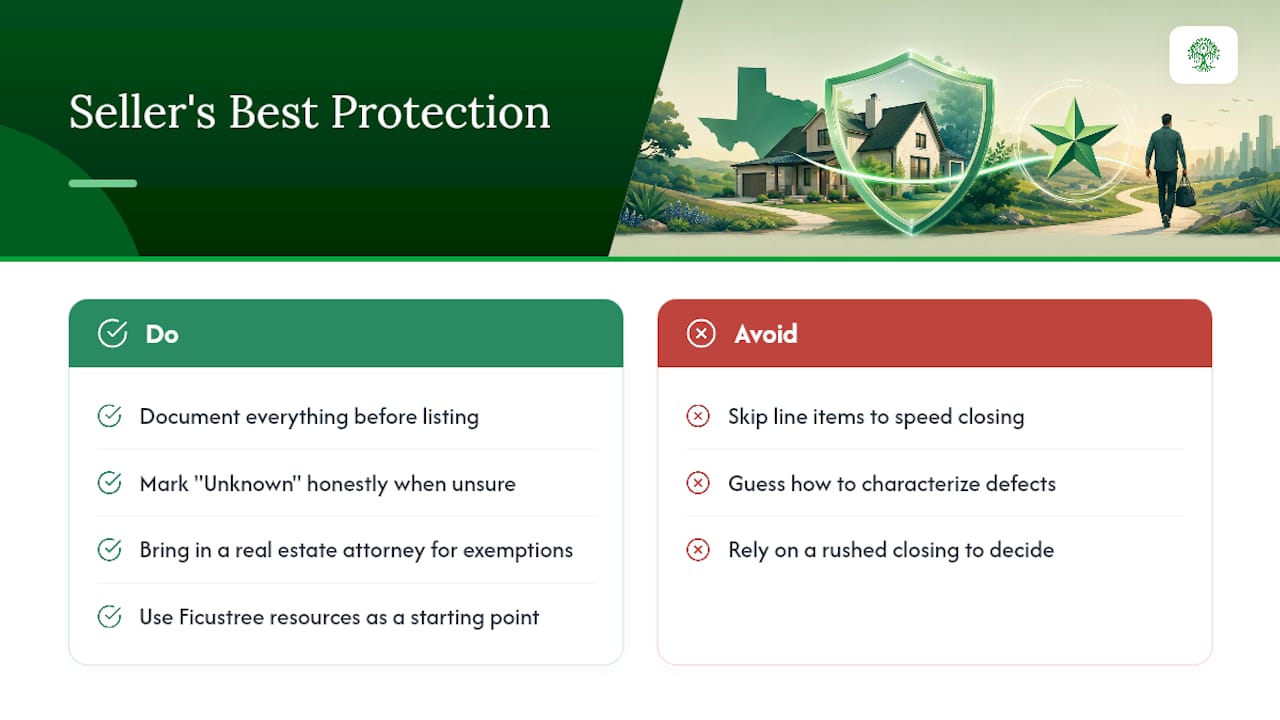
Full disclosure isn’t a formality to check off before listing. It’s the single cheapest form of protection a Texas seller has against a lawsuit that could cost far more than any defect would have. Buyers who feel misled don’t sue over the crack in the foundation. They sue over feeling like they were never told about it.
Document everything, mark “Unknown” honestly when you mean it, and don’t let a rushed closing talk you into skipping a line item. If your situation touches an exemption, a late delivery, or a defect you’re unsure how to characterize, that’s the moment to bring in a real estate attorney rather than guess. For transaction-specific questions, Ficustree’s resources are a solid starting point before you talk to counsel.
— Anand
Get closing-ready with Ficustree’s buyer representation platform
Ficustree gives Texas buyers something the disclosure process alone can’t: a second set of eyes trained to catch what a seller’s notice leaves vague. Where a traditional agent might skim the OP-H form during a busy showing week, Ficustree pairs on-demand showing agents with decision-intelligence tools that flag inconsistencies between what’s disclosed and what a buyer should independently verify, all while buyers keep a rebate of roughly 2% where legally permitted and pay just $1,000 at closing plus 1% commission.

That fee structure means a buyer pays for buyer representation and decision support, not just for form confirmation. If you’re actively buying in Texas and want a clearer read on a disclosure notice before you sign a contract, visit the Ficustree buyer platform to see how representation and readiness tools work together, or start at Ficustree to see the full picture of what “the house should find you” actually looks like in practice.
Sources
- Texas Property Code Section 5.008 (2025) – Seller’s Disclosure of Property Condition
- TREC NO. OP-H SELLER’S DISCLOSURE NOTICE (09/19)
- Disclosure Requirements – Texas REALTORS®
FAQ
Does Texas require a seller disclosure statement?
Yes. Most sellers of single-family residential property must provide a written disclosure notice under Section 5.008, typically using the TREC OP-H form or a substantially similar document.
What are the requirements for amending a seller’s disclosure in Texas?
If you learn new information about the property’s condition before closing, you should update the notice, sign and date the revision, and deliver it to the buyer promptly, keeping a copy for your records.
Is Texas a mandatory disclosure state?
Yes, with narrow exceptions. Texas requires written disclosure under Section 5.008 for most residential sales, though a specific list of exempt transfers exists under subsection (e).
Who is exempt from filling out a seller’s disclosure in Texas?
Exemptions include court-ordered transfers, bankruptcy trustee transfers, transfers between co-owners or to a spouse, government transfers, and sales of new homes that have never been occupied.
What happens if a Texas seller delivers the disclosure notice late?
The buyer gets an unconditional right to terminate the contract for any reason within seven days of receiving the notice, regardless of what the notice says.
Recommended

Leave a Reply