
A rent-back agreement lets a seller stay in the home after closing as a temporary renter. It can win a competitive offer or give a seller breathing room to move, but it also turns the buyer into a landlord for a few weeks. That trade needs written lender approval, proof of insurance, and clear contract terms before anyone signs.
TL;DR:
- Rent-back agreements longer than 29 days change the legal status from a license to a lease, which grants tenants’ protections and complicates eviction processes.
- Calculating rent-back rent typically involves dividing the buyer’s monthly PITI and HOA dues by 30 and multiplying by the number of occupancy days, or using local market rent data.
- Key risks include insurance gaps, lender violations, and holdover disputes, all preventable through written approval, proper documentation, and escrow holdbacks.
- Precise, enforceable clauses must clearly specify occupancy dates, rent, security deposits, holdover penalties, utilities, insurance, and inspection rights, ideally reviewed by an attorney.
- Lender approval and proof of renters insurance are critical before closing, especially in states like California with strict form distinctions based on occupancy duration.
Table of Contents
- What Is a Rent-Back Agreement and How Does It Work?
- License vs. Lease: Why the 29/30-Day Line Matters
- How Do You Calculate Rent-Back Rent and Fees?
- What Are the Biggest Risks in a Rent-Back Agreement?
- What Clauses Belong in a Rent-Back Agreement?
- Why California’s SIP vs. RLAS Distinction Is a Model for Everyone
- Legal Requirements and Disclosures Vary by State
- What Are the Tax Implications of a Rent-Back Agreement?
- Negotiation Tips for Buyers and Sellers
- How Does a Rent-Back Agreement Affect Your Mortgage?
- Sample Clause Language for a Rent-Back Agreement
- Ficustree’s Perspective: Managing Rent-Backs as a First-Time Buyer
- How Ficustree Helps You Negotiate a Safer Rent-Back
- Sources
- FAQ
What Is a Rent-Back Agreement and How Does It Work?
A rent-back agreement, also called a leaseback or post-closing occupancy agreement, lets the seller remain in the home after the buyer takes title, in exchange for rent or another agreed payment. The buyer becomes the legal owner at closing. The seller becomes a short-term occupant under a separate written contract, not a squatter and not a co-owner.
The sequence matters. Title and funds transfer first, then the seller occupies under the rent-back terms. This setup shows up constantly in competitive markets, when a seller needs extra time to close on their next home or a buyer wants to make an offer more attractive by giving the seller flexibility.
Two document paths handle this:
- A purchase agreement addendum that adds occupancy terms directly onto the existing contract.
- A standalone occupancy agreement, drafted separately, which most attorneys and brokers prefer for anything longer than a few days.
Most rent-backs run anywhere from a few days to a couple of months, though some stretch longer when a seller is building a new home.
License vs. Lease: Why the 29/30-Day Line Matters
The single most important legal distinction in a rent-back agreement is duration, because it determines whether the seller has tenant rights or not. In California, the C.A.R. Seller in Possession (SIP) form is built for stays of 29 days or less and operates as a license, not a lease. A license is revocable and doesn’t trigger landlord-tenant law.
Cross into 30 days or more, and the Residential Lease After Sale (RLAS) form applies instead, which creates an actual landlord-tenant relationship.
- A license (SIP-style) means faster removal if the seller overstays, with none of the formal eviction process.
- A lease (RLAS-style) means the seller gains tenant protections, and removing a holdover seller may require a full unlawful detainer eviction lawsuit.
- Longer occupancy under a lease can also expose the property to local rent-control ordinances, depending on the jurisdiction.
Get the day count wrong and the form choice, and you’ve accidentally handed the seller tenant status you never intended.
How Do You Calculate Rent-Back Rent and Fees?
Most rent-back rent is typically calculated using a daily PITI formula: take the buyer’s monthly principal, interest, taxes, and insurance (plus HOA dues if applicable), divide by the number of days in a month, and multiply by the number of days the seller stays.
- Daily PITI method: Monthly PITI + HOA, divided by 30, times days of occupancy. This is the most common benchmark because it simply covers the buyer’s carrying cost.
- Market rent method: Some parties instead use local fair market rent data to set a comparable rate, especially in high-demand areas.
- Flat or discounted rate: A seller might negotiate a lower rate in exchange for other concessions, like leaving certain furnishings or covering closing costs.
Security deposits, delivery fees, and escrow holdbacks all serve different purposes. A security deposit covers damage. A delivery fee is a lump payment tied to vacating on time. An escrow holdback sets aside seller proceeds at closing, released only after a clean move-out inspection.
Pro Tip: Set the holdover penalty above the daily PITI rate, not equal to it. If overstaying costs the same as staying on schedule, you’ve given the seller zero incentive to leave on time.
What Are the Biggest Risks in a Rent-Back Agreement?
The three biggest risks in a rent-back are insurance gaps, lender violations, and holdover disputes, and all three are preventable with the right paperwork.
Insurance is the one most buyers overlook. Standard homeowner policies are written for owner-occupants, and a policy may not cover a loss that happens while a non-owner occupies the home. Buyers should confirm coverage with their insurer and consider a landlord endorsement. Sellers should carry their own renters insurance and name the buyer as an additional insured.
Lender risk comes next. Many owner-occupant mortgages require the buyer to occupy the property within a set window, commonly 60 days, and a rent-back that extends past that window without written lender approval can trigger a loan covenant violation.
The third risk is what happens if the seller won’t leave. Vague possession agreements have produced long eviction timelines, insurance gaps, and expensive disputes when buyers treated a rent-back as a handshake deal instead of a real contract.
Reduce all three with the same checklist:
- Get the lender’s occupancy approval in writing before closing.
- Confirm the seller’s renters insurance policy and buyer’s own coverage in advance.
- Require an escrow holdback tied to move-out condition.
- Take dated photos or video before occupancy begins and again at move-out.
- Require a notarized move-out certificate confirming the date and condition of the property.
A significant portion of the risk in a rent-back disappears the moment lender and insurer sign-off happens in writing, before the seller ever moves back in.
What Clauses Belong in a Rent-Back Agreement?
A rent-back agreement should read like a mini-lease, not an afterthought bolted onto the purchase contract. Vague terms are exactly what create disputes down the line.
- Occupancy dates: Exact start and end date, with no ambiguous language like “on or about.”
- Rent amount and payment schedule: How much, how often, and by what method.
- Security deposit: Amount, and the exact timeline for returning it after move-out.
- Holdover fees: A per-day penalty that kicks in automatically if the seller stays past the agreed date.
- Utilities: Who pays what during the occupancy period.
- Insurance requirements: Proof of the seller’s renters policy, naming the buyer as additional insured.
- Access for inspections: The buyer’s right to inspect before move-out.
- Condition and repair obligations: What state the home must be returned in.
- Deposit return timeline: A firm number of days after move-out, tied to the condition inspection.
Optional but smart additions include an escrow holdback released only after a clean walkthrough, and a requirement for photo or video documentation at both ends of the occupancy period.
Sample language is illustrative only. Every clause here should get reviewed by a real estate attorney before signing, since local landlord-tenant law varies enough to change how enforceable any of these terms actually are.
Why California’s SIP vs. RLAS Distinction Is a Model for Everyone
California’s form system is worth studying even if you’re buying elsewhere, because it shows exactly how form choice changes legal outcome. The SIP form is designed for 29 days or less and functions as a license, while RLAS applies at 30 days or more and creates a landlord-tenant relationship with real tenant protections attached.
Practitioners warn that using the wrong form, or leaving occupancy terms undocumented, can accidentally reclassify the arrangement and complicate an eviction if the seller won’t leave. Broker risk guidance consistently recommends a separate written occupancy agreement rather than a casual side letter.
The takeaway for any state:
- Count the days precisely before choosing a license or lease structure.
- Require escrow holdbacks and firm holdover penalties regardless of which form applies.
- Bring in an attorney the moment occupancy runs past 30 days.
Legal Requirements and Disclosures Vary by State
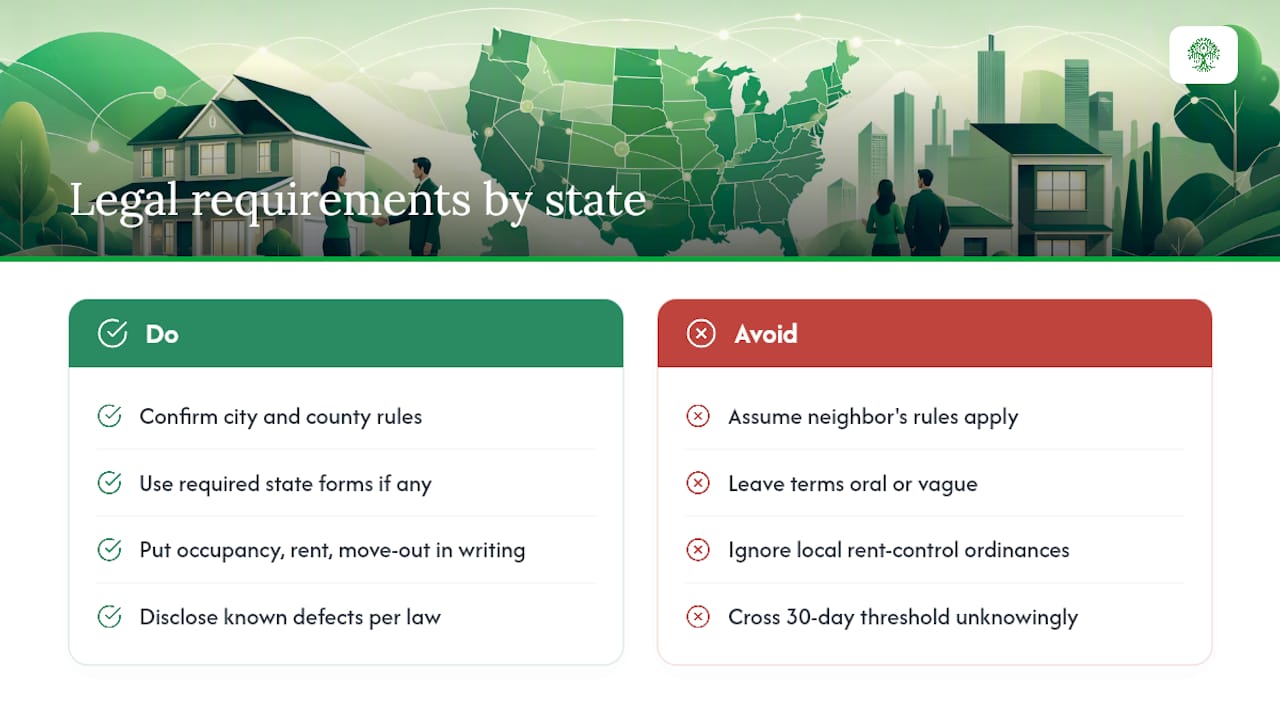
There’s no single federal rule governing rent-back agreements. Every state handles post-closing occupancy differently, and some cities layer on their own rent-control or tenant-notice ordinances on top of state law.
California leans on standardized forms like SIP and RLAS specifically because the 29/30-day line has real legal consequences there. Texas doesn’t use an identical form system, but a leaseback agreement Texas buyers and sellers sign still needs to spell out occupancy dates, rent, and move-out terms in writing, since Texas courts will look at the actual language of the agreement, not the parties’ intentions, if a dispute lands in court.
Disclosure obligations also don’t disappear just because the seller is staying put. Any known defects still need to be disclosed under normal state disclosure law, and a rent-back doesn’t extend or shorten that disclosure timeline. If the property sits in a rent-controlled jurisdiction, crossing the 30-day threshold can pull the arrangement under local tenant ordinances even when the parties never intended to create a formal tenancy.
The safest approach in any state: never assume your neighboring county or a friend’s last transaction used the same rules that apply to your deal. Confirm the specific form and disclosure requirements for your city and county, and treat the agreement as a real lease or license, not an informal favor between buyer and seller.
What Are the Tax Implications of a Rent-Back Agreement?
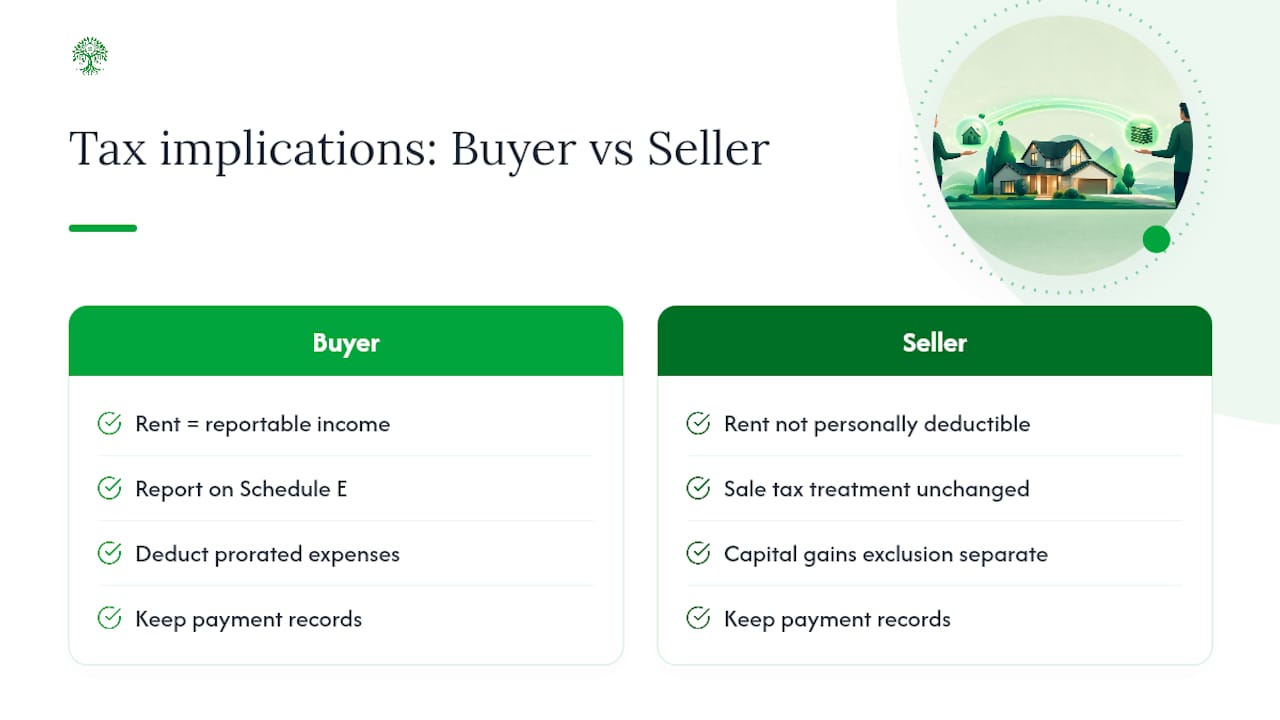
The buyer receiving rent payments is the one with a tax question to answer, and the answer usually points toward reportable rental income. IRS guidance draws a line between short-term rentals and reportable rental activity, and because most rent-back periods run longer than 14 days, the payments a buyer collects will generally count as rental income reportable on Schedule E.
That also means the buyer can deduct related expenses, potentially including a prorated share of mortgage interest, property taxes, insurance, and any repairs tied directly to the occupancy period. Keep every payment record and receipt, because Schedule E deductions only hold up with documentation.
For the seller, the rent paid isn’t typically deductible as a personal expense, though the arrangement itself doesn’t usually affect the tax treatment of the home sale. The bigger question for sellers is usually the capital gains exclusion on the sale itself, which is a separate calculation from the rent-back terms.
Neither side should treat this as settled without a conversation with a tax advisor, since the specifics depend on loan structure, occupancy length, and how the agreement labels the payments. Calling a payment “use and occupancy fee” instead of “rent” doesn’t change the tax analysis. What matters is the substance of the arrangement, not the label on the contract.
Negotiation Tips for Buyers and Sellers
Sellers usually want a rent-back for one reason: timing. They’re waiting on their next home to close, or they need extra weeks to pack and move. Buyers usually agree to one for a different reason: it makes their offer more competitive, or it simply closes the deal.
Understanding the other side’s real motivation changes the negotiation. A seller who’s desperate for 45 days of flexibility will often accept a below-market daily rate in exchange for getting the time. A buyer who’s not in a rush to move in has more room to be generous on rent in exchange for tighter holdover penalties and a bigger escrow holdback.
A few practical negotiation moves worth using:
- Ask for a larger deposit or escrow holdback in exchange for a lower daily rent. This protects you if things go wrong without making the deal feel punitive upfront.
- Trade rent rate for time. A seller who needs 10 extra days beyond a typical window might accept a higher daily rate to get it.
- Negotiate seller concessions and rent-back terms together, not separately, since sellers often have more flexibility on one if they get what they want on the other.
- Never leave the holdover penalty as an afterthought. Negotiate it as hard as you negotiate the rent itself, because that’s the number that actually protects your move-in date.
Both sides benefit from writing down every point of agreement before drafting the final contract language, so nothing gets lost between the handshake and the paperwork.
How Does a Rent-Back Agreement Affect Your Mortgage?
Your mortgage lender cares about a rent-back agreement more than most buyers expect, because owner-occupant loans come with occupancy promises attached. Many conventional loans require the buyer to occupy the home within a set window after closing, commonly around 60 days, and a rent-back that pushes past that window without lender sign-off risks a covenant violation.
That’s not a minor technicality. Lenders can, in some cases, reclassify the loan or call it into question if they discover an undisclosed extended rent-back after the fact. The fix is simple: tell your lender about the rent-back before closing, get written approval, and keep that approval with your closing documents.
Some loan programs are stricter than others. FHA and VA loans, for example, tend to have firmer owner-occupancy timelines than certain conventional loan products, so buyers using government-backed financing should raise the rent-back question with their loan officer as early as possible, ideally before the purchase contract is even finalized.
HOA approval matters too, in communities with occupancy or lease restrictions. Some HOAs limit rental periods or require board notification, and a rent-back can technically qualify as a short-term rental under those bylaws even though it’s really just a seller staying a few extra weeks.
Sample Clause Language for a Rent-Back Agreement
Seeing actual clause structure makes the checklist from earlier easier to apply. These examples are illustrative only, meant to show the level of specificity a real agreement needs, not language to copy directly into a contract.
Occupancy period clause example: “Seller shall occupy the Property from the Closing Date through [specific date], a period not to exceed 29 days, under license and not as a tenant.”
Rent clause example: “Seller shall pay Buyer $[amount] per day, due in advance for the full occupancy period at closing, calculated using Buyer’s monthly PITI divided by 30.”
Holdover clause example: “Should Seller remain in possession beyond [end date], Seller shall pay Buyer $[amount] per day as liquidated damages, which the parties agree represents a reasonable estimate of Buyer’s actual damages.”
Move-out condition clause example: “Seller shall return the Property in the same condition as of the Closing Date, normal wear excepted, and shall provide Buyer access for a walkthrough inspection within 24 hours prior to vacating.”
Every one of these needs actual dates, actual dollar amounts, and a jurisdiction-specific form structure behind it. The language above shows the shape of the clause. It doesn’t replace reviewing your California disclosures or having an attorney confirm the final wording matches your state’s requirements.
Ficustree’s Perspective: Managing Rent-Backs as a First-Time Buyer
Most first-time buyers hear “rent-back” and focus on winning the offer. They rarely think through what happens if the seller’s insurance lapses or the lender flags the occupancy after the fact. That gap is exactly where Ficustree’s decision-intelligence checklists and lender coordination earn their keep, catching the lender approval and insurance sign-off steps before they become problems at move-in.
Ficustree represents buyers directly for a fixed fee plus commission, with on-demand showing agents and step-by-step guidance built for exactly this kind of moment. If a seller proposes a rent-back on your deal, get the lender’s approval in writing and require proof of renters insurance and an escrow holdback before you agree to anything.
— Anand
How Ficustree Helps You Negotiate a Safer Rent-Back
A rent-back agreement is a negotiation, and negotiations go better with someone in your corner who’s read a hundred of these contracts, not your first one. Ficustree represents you directly as your buyer’s agent for a $1,000 fee at closing plus 1% commission, with a rebate of roughly 2% where legally permitted, so you get real representation without the traditional agent markup.

That representation matters most in exactly the moment a rent-back gets proposed. Ficustree’s step-by-step decision-intelligence tools flag the lender approval question, the insurance gap, and the escrow holdback before you’re staring at a contract deadline with no time to think it through. You also get on-demand showing agents and premium platform access at no extra cost, so the guidance doesn’t stop once the rent-back terms are settled.
If you’re negotiating a purchase offer right now and a seller has asked for extra time after closing, start with Ficustree’s buyer platform to get matched with representation before you sign anything.
Sources
- How Home Insurance Works with a Lease-Back (Rent-Back) Period
- The Hidden Legal Dangers of Letting a Seller Stay Past the Closing Date
- Tips on rental real estate income, deductions, and recordkeeping (IRS)
FAQ
Is a Rent-Back a Good Idea?
A rent-back can be a smart move for both sides when it’s documented properly. It gives sellers time to move without a rushed closing and can make a buyer’s offer more attractive, but it only works safely with written lender approval, confirmed insurance coverage, and clear holdover penalties in place.
How Much Do You Charge for a Rent-Back?
Rent-back cost typically follows a daily PITI formula, where the buyer’s monthly principal, interest, taxes, insurance, and HOA dues get divided by 30 and multiplied by the number of days the seller stays. Some parties instead use local market rent data or negotiate a flat rate tied to other concessions in the deal.
How Do You Write a Rent-Back Agreement?
A rent-back agreement should specify exact occupancy dates, rent amount and payment schedule, security deposit, holdover fees, utility responsibility, insurance requirements, and a deposit return timeline. In California, standardized forms like the C.A.R. SIP or RLAS reduce drafting errors, and any agreement should get reviewed by a real estate attorney before signing.
What Is a Rent-Back Clause?
A rent-back clause is the specific contract language, usually added as an addendum to the purchase agreement or as a standalone occupancy agreement, that lets the seller remain in the home after closing in exchange for rent or another form of consideration. It sets the occupancy period, payment terms, and consequences if the seller doesn’t move out on schedule.
Recommended
- How to Review California Buyer Disclosures (What’s at Stake)
- First Time Homebuyer Guide: Simple Steps for Your First Home
- Avoid a 7 Day Walkaway: Texas Seller Disclosure and TREC OP-H
- Mortgage Contingency Explained: What Buyers Must Know

Leave a Reply