
Mello-Roos is a voter-approved special tax on properties inside a Community Facilities District, added straight onto your property tax bill to pay for local infrastructure or services. It is not tied to your home’s assessed value, so two nearly identical houses can carry very different bills. Before you fall for a listing, pull the parcel’s APN and check for a Notice of Special Tax. That single step tells you whether this cost belongs in your budget.
TL;DR:
- Mello-Roos taxes are parcel-based assessments that can range from $360 to over $10,000 annually depending on district size and infrastructure needs.
- The assessment duration varies from 20 to 40 years for bond-related costs, but service fees can continue indefinitely, often without clear expiration dates.
- Mello-Roos costs are a significant factor in mortgage qualification, effectively reducing borrowing power by up to $50,000 for every $300 monthly payment.
- Buyers should verify the Notice of Special Tax and district documents early, as delays or missing information can indicate potential hidden costs or lack of transparency.
- Most Mello-Roos payments are not tax-deductible for primary residences, but prepaying bonds or deducting for investment properties may offer some financial benefits.
Table of Contents
- What Is Mello-Roos Tax and How Does the CFD Work?
- How Much Does Mello-Roos Typically Cost Each Year?
- How Long Does Mello-Roos Last and When Does It End?
- Is Mello-Roos Tax Deductible on Your Federal Return?
- Mello-Roos, Your Mortgage, and What It Does to Resale
- Your Step-by-Step Mello-Roos Checklist Before You Offer
- A Practical Note From Ficustree
- Let Ficustree Help You Budget for Mello-Roos Before You Offer
- Where to Verify Mello-Roos Facts Yourself
- Sources
- FAQ
What Is Mello-Roos Tax and How Does the CFD Work?
Mello-Roos gets its name from the Mello-Roos Community Facilities Act of 1982, the state law that created Community Facilities Districts as a workaround after Proposition 13 capped how fast property tax revenue could grow. Cities, counties, and school districts needed another way to fund growth, so they formed CFDs, and voters or landowners inside the proposed district approve the special tax before it takes effect.
A CFD generally does one of two jobs:
- Repay bonds issued to build roads, schools, sewer lines, or parks in a new development
- Fund ongoing services like landscaping, fire protection, or police patrols with no fixed end date
The tax itself is parcel-based rather than tied to assessed value, calculated using a formula set at formation. That’s why a $500,000 starter home and a $900,000 home in the same district can pay the exact same Mello-Roos amount.
How Much Does Mello-Roos Typically Cost Each Year?
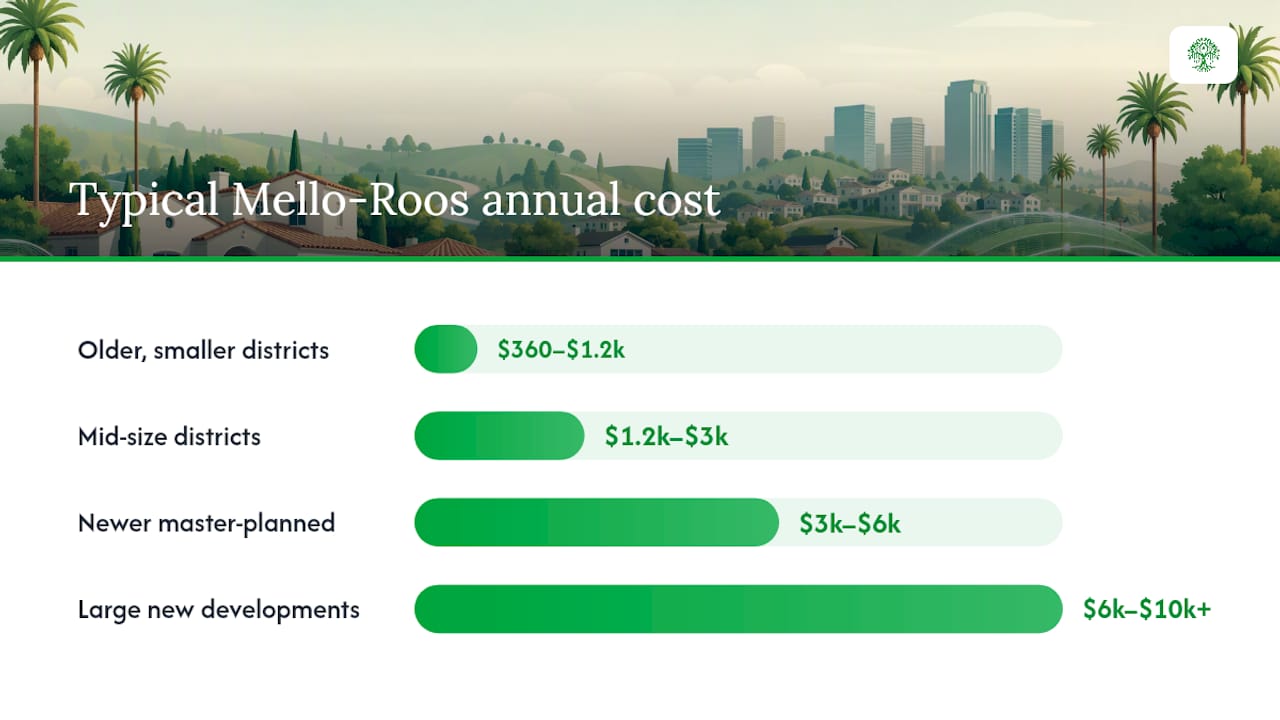
Mello-Roos costs swing hard depending on the district’s age, size, and what it’s financing. Here’s a rough breakdown of what buyers actually see on tax bills across California:
- Older, smaller districts: roughly $360 to $1,200 per year
- Mid-size districts: roughly $1,200 to $3,000 per year
- Newer master-planned communities: roughly $3,000 to $6,000 per year
- Large new developments with heavy infrastructure: $6,000 to $10,000 or more per year
Statistic Callout: Many buyers land between roughly $1,200 and $6,000 a year, which works out to $100 to $500 a month tacked onto your existing mortgage payment.
That monthly figure matters more than the annual one, because it’s what your lender uses when calculating your debt-to-income ratio. A $400 monthly Mello-Roos bill behaves like an extra loan payment, and it can shrink your purchase power. It also arrives as a separate line item from any HOA dues, so a newer community can quietly stack two recurring costs on top of your mortgage before you’ve noticed.
How Long Does Mello-Roos Last and When Does It End?
Bond-backed Mello-Roos assessments typically run 20 to 40 years, matching the term of the municipal bonds they repay. Once the bonds are retired, that portion of your bill disappears. Service-related Mello-Roos, on the other hand, can continue indefinitely, since it funds ongoing costs like park upkeep or emergency services rather than a project with a payoff date.
- Check the district’s Rate and Method of Apportionment, the recorded formation document that spells out the exact formula and term
- Search by APN through your county assessor or tax collector’s office
- Contact the CFD administrator listed on your tax bill for a maturity schedule
Pro Tip: Don’t assume Mello-Roos will vanish on a set date. Many districts fold in permanent service components that survive long after the bonds are paid off, so read the RMA before you count on relief.
Some districts allow bond prepayment, letting you pay off the remaining bond balance in one lump sum to remove that portion from future bills. It’s a large upfront cost, so it usually only makes sense if you plan to stay in the home for many years.
Is Mello-Roos Tax Deductible on Your Federal Return?
Mostly, no. The bulk of a Mello-Roos payment covers bond principal, and the IRS treats that portion as non-deductible because it’s a special assessment tied to a specific improvement, not a general property tax under Section 164.
Statistic Callout: A small slice of your bill, the maintenance and interest components, may qualify for a deduction, but it’s often modest enough that the $10,000 SALT cap and the standard deduction wipe out any real benefit for most owners.
There’s a silver lining buried in IRS Publication 551: the non-deductible principal you pay can often be added to your property’s tax basis, which can reduce your taxable gain when you eventually sell.
Rental property owners get a better deal. Mello-Roos on an investment property is typically deductible in full as a business expense on Schedule E, unlike the limited treatment for a primary residence.
To know exactly where you stand:
- Request an itemized breakdown from the CFD administrator or county tax collector
- Ask specifically which portion, if any, covers interest or maintenance
- Run the numbers past a CPA before assuming any deduction applies
Mello-Roos, Your Mortgage, and What It Does to Resale
Lenders count Mello-Roos as part of your monthly housing cost, right alongside principal, interest, taxes, and insurance, when calculating your debt-to-income ratio. A $300 monthly Mello-Roos bill can reduce your buying power by roughly $50,000, since that same $300 could otherwise support a bigger loan.
A few things every buyer should know before writing an offer:
- The assessment runs with the parcel, not the seller, so it transfers to you at closing regardless of who benefited from the original project
- Sellers typically prorate the current year’s bill at closing, but every future payment becomes your responsibility
- A high Mello-Roos bill can shrink your resale buyer pool later, since it raises the effective monthly cost for whoever buys from you
- Unpaid special taxes can trigger foreclosure faster than unpaid property tax in some cases, so treat delinquency risk seriously
Talk to your lender early, before you fall for a specific neighborhood. Ask them to run your DTI with and without the Mello-Roos line item so you see the real impact on what you can offer.
Your Step-by-Step Mello-Roos Checklist Before You Offer
- Pull the APN and current secured tax bill. Confirm whether a CFD or Mello-Roos line item appears, and note the exact dollar amount.
- Request the Notice of Special Tax and the Rate and Method of Apportionment. These documents show the formula, the term, and whether prepayment is even an option for that district.
- Bring the numbers to your lender or escrow officer. Ask them to show how the Mello-Roos amount affects your DTI, your closing costs, and your prorated bill at closing.
- Compare against similar homes without Mello-Roos. A lower list price in a Mello-Roos district can still cost more monthly than a higher-priced home without one, so reviewing all seller disclosures matters here.
Pro Tip: If a listing agent can’t produce the Notice of Special Tax within a day, treat that as a red flag. This document is required by California disclosure law, and any delay usually means nobody bothered to check it.
Once you have real numbers, you have leverage. You can ask for seller concessions to offset the first year of payments, negotiate a price reduction that reflects the added monthly cost, or, if you’re planning to stay decades, evaluate whether bond prepayment makes long-term sense. Walk away if the district can’t produce its formation documents at all. That opacity is rare, but it’s the clearest warning sign in the entire process.

A Practical Note From Ficustree
Mello-Roos looks scary on a tax bill, but it’s manageable once you know where to look. The mistake isn’t buying in a CFD. It’s forgetting to fold that monthly number into your real affordability picture before you fall for the house. Get the documents early, and the surprises disappear.
— Anand
Let Ficustree Help You Budget for Mello-Roos Before You Offer
Ficustree is the alternative to guessing your way through a Mello-Roos disclosure. Our AI-powered buyer platform builds total-cost budgeting directly into your home search, pulling in Mello-Roos figures alongside your mortgage, insurance, and HOA costs before you ever write an offer.

We also help verify the Notice of Special Tax and the Rate and Method of Apportionment for any property you’re considering, so you’re not relying on a listing agent’s word for it. Ficustree represents buyers directly for a flat $1,000 fee at closing plus 1% commission, with a rebate kept where legally permitted, and hourly showing agents you can book on demand. The premium platform, including the affordability tools that catch costs like Mello-Roos before they catch you, is free to use. Head to Ficustree and start your home search with the real numbers already built in.
Where to Verify Mello-Roos Facts Yourself
- Your county assessor or tax collector for parcel/APN lookups and current CFD amounts, such as the OC Treasurer-Tax Collector’s Mello-Roos page
- The Rate and Method of Apportionment, recorded with the county recorder for that specific district
- IRS Publication 551 and Publication 527 for deductibility and basis rules on special assessments
Sources
- How to find out when Mello-Roos taxes expire – LegalClarity
- Mello-Roos Tax: What It Is, How It Works, and What to Budget – JVM Lending
- Mello Roos Information | OC Treasurer-Tax Collector
FAQ
How Do I Avoid Mello-Roos Taxes?
You can’t remove Mello-Roos from a property that already has it, but you can avoid it entirely by targeting older, established neighborhoods that predate most CFD formations. Pulling the APN and checking the county tax bill before you tour a home is the fastest way to screen out Mello-Roos properties altogether.
Is Mello-Roos Tax Forever?
Not always. Bond-related portions typically last 20 to 40 years and end once the bonds are repaid, but service-related portions can continue indefinitely with no scheduled expiration. The only way to know for a specific property is to check that district’s Rate and Method of Apportionment.
Are Mello-Roos Taxes a Good or Bad Thing?
Neither, really. Mello-Roos funds real infrastructure and services that a new community needs, but it adds a recurring cost that reduces how much home you can afford, so it deserves the same scrutiny as any other monthly expense.
Can I Write Off Mello-Roos Taxes?
Mostly no. Most Mello-Roos payments cover non-deductible bond principal, though small maintenance or interest portions may occasionally qualify. Rental property owners generally get better treatment, since Mello-Roos on an investment property is typically deductible in full on Schedule E.
Recommended
- How to Ask for Seller Concessions in California (2026)
- California Property Taxes Explained: A Buyer’s Guide
- California Closing Costs Breakdown for First-Time Buyers
- 2026 Conforming Loan Limits in California: What Buyers Must Know

Leave a Reply