
Texas buyers typically pay 2% to 5% of the purchase price in closing costs, while sellers pay 6% to 10%, most of it eaten up by agent commissions. On a $350,000 home, that means a buyer should budget several thousand dollars beyond the down payment. Texas charges no state transfer tax, but higher property tax bills mean your escrow prepaids will run heavier than in many other states.
TL;DR:
- Texas buyers should budget between 2% and 5% of the purchase price for closing costs, with the actual amount depending heavily on loan program and negotiation.
- Lender fees in Texas, such as origination and underwriting costs, are negotiable or fixed, but title insurance premiums are set by the state and do not vary by provider.
- The most significant seller closing cost is typically the agent commission, which often accounts for 5% to 6% of the sale price, while other costs are relatively small.
- No state transfer tax exists in Texas, but high property taxes mean prepaid property tax reserves can add substantially to closing costs.
- Shopping lenders and requesting seller concessions before signing can reduce the overall cash required at closing significantly.
Table of Contents
- What Closing Costs in Texas Actually Cover
- Buyer Closing Costs: Line Items and Three Worked Examples
- Seller Closing Costs: Why Commission Runs the Bill
- Who Pays What: Texas Customs vs. Contract Control
- How to Lower Your Cash-to-Close in Texas
- Your Last-Week Closing Checklist
- How Ficustree Helps Buyers Manage Closing-Cost Risk
- The Overlooked Truth About Closing Costs in Texas
- Get a Closing-Cost Estimate Built for Your Texas Purchase
- Sources
- FAQ
What Closing Costs in Texas Actually Cover
Your down payment buys equity. Closing costs pay for everything else it takes to get the loan funded and the title transferred into your name. That distinction trips up a lot of first-time buyers who budget for the down payment and forget the rest.
Closing costs break into three functional buckets:
- Lender fees: origination charges, underwriting, application fees, and any discount points you buy to lower your rate.
- Third-party and title fees: appraisal, credit report, title insurance, settlement or escrow fees, recording fees, survey, and inspections.
- Prepaids and escrows: homeowner’s insurance, prepaid interest, and property tax reserves that fund your escrow account for the first year.
Texas has no state-level real estate transfer tax, which is real money saved compared to states that charge 1% to 2% on every sale. But Texas also carries some of the highest property tax burdens in the country, and lenders collect several months of taxes upfront into escrow. The transfer tax savings are real, but don’t let them fool you into underestimating your prepaid tax reserve.
Buyer Closing Costs: Line Items and Three Worked Examples
Your Closing Disclosure will list a dozen or more line items, and not all of them cost the same or work the same way. Some are fixed by state rule. Others are wide open to negotiation.
Here’s what typically shows up on a Texas buyer’s closing statement:
- Loan origination fee: 0.5% to 1% of loan amount, negotiable with your lender.
- Discount points: optional, roughly 1% of loan amount per point, negotiable.
- Underwriting and application fees: $400 to $900 combined, sometimes negotiable or waived.
- Appraisal: $450 to $700, fairly fixed regardless of lender.
- Credit report: $30 to $100, fixed.
- Lender’s title insurance: required by your lender, rates are promulgated by the Texas Department of Insurance, meaning the premium is the same no matter which title company you use.
- Owner’s title insurance: often customary for the seller to pay in Texas, though this is negotiable.
- Settlement or escrow fee: $300 to $700, varies by title company and can be shopped.
- Recording fees: typically $150 to $250, set by the county.
- Home inspection: $300 to $600, optional but strongly recommended.
- Survey: $400 to $900 if required by the lender or title company.
- Prepaid homeowner’s insurance: often above the national average in Texas, expect $1,500 to $3,500 for the first year depending on location and coverage.
- Prepaid property taxes and interest: varies widely with your closing date and county tax rate.
- PMI: applies if you put down less than 20% on a conventional loan, added to your monthly payment rather than paid in full at closing.
Pro Tip: Lender’s title insurance premiums are set by state schedule, so shopping title companies won’t change that number. Your leverage is in the settlement fee and who pays the owner’s policy.
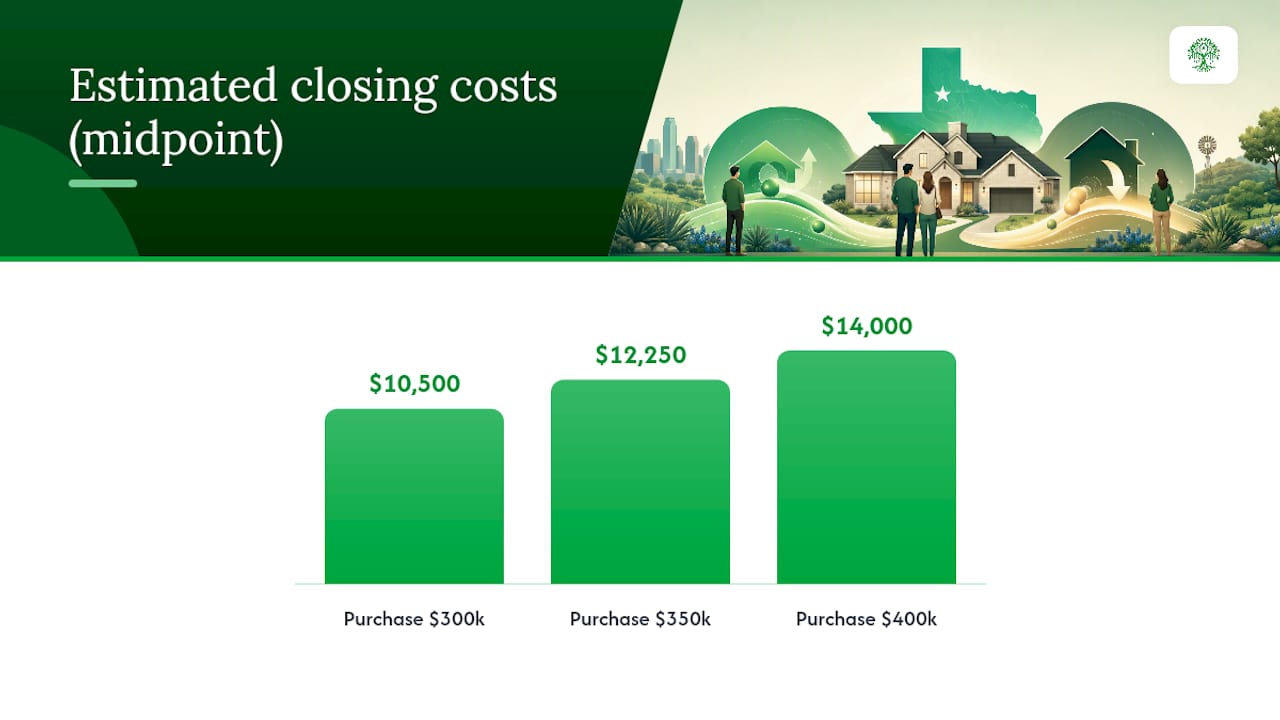
Here’s how those ranges translate into real dollars at three common price points, based on typical Texas cost ranges:
| Purchase Price | Estimated Closing Costs (2%–5%) | Realistic Cash-to-Close Range |
|---|---|---|
| $300,000 | $6,000 – $15,000 | $8,000 – $12,000 |
| $350,000 | $7,000 – $17,500 | $9,500 – $14,000 |
| $400,000 | $8,000 – $20,000 | $11,000 – $16,000 |
The “realistic” column narrows the wide percentage range using typical Texas loan terms, insurance costs, and prepaid tax reserves rather than the extreme ends of the spread. Your actual number depends heavily on your loan program, your county’s tax rate, and how much you negotiate on lender fees.
Seller Closing Costs: Why Commission Runs the Bill
Sellers in Texas typically pay 6% to 10% of the sale price in closing costs, and the overwhelming majority of that is agent commission, which usually runs 5% to 6% split between the listing and buyer’s agents. Everything else on a seller’s closing statement is small by comparison.
Beyond commission, sellers commonly cover:
- Owner’s title insurance policy, customary in most Texas markets though negotiable.
- Prorated property taxes, calculated from January 1 through the closing date.
- HOA transfer fees, if applicable, usually $200 to $400.
- Payoff of existing mortgage or liens, deducted directly from proceeds.
- Negotiated repairs or buyer concessions, agreed to during option period negotiations.
Here’s how that plays out on two sample sales. Commission alone typically outweighs every other seller cost combined.
Who Pays What: Texas Customs vs. Contract Control
Nothing in Texas law forces a buyer or seller to pay any specific closing cost. The purchase contract controls every allocation, and local custom only fills in the blanks when nobody negotiates otherwise.
Common Texas customs, all of which can be rewritten in the contract:
- Sellers customarily pay for the owner’s title policy.
- Sellers customarily cover the survey if one already exists or needs updating.
- Buyers customarily pay lender’s title insurance and loan-related fees.
- Property taxes get prorated between both parties at closing based on the closing date.
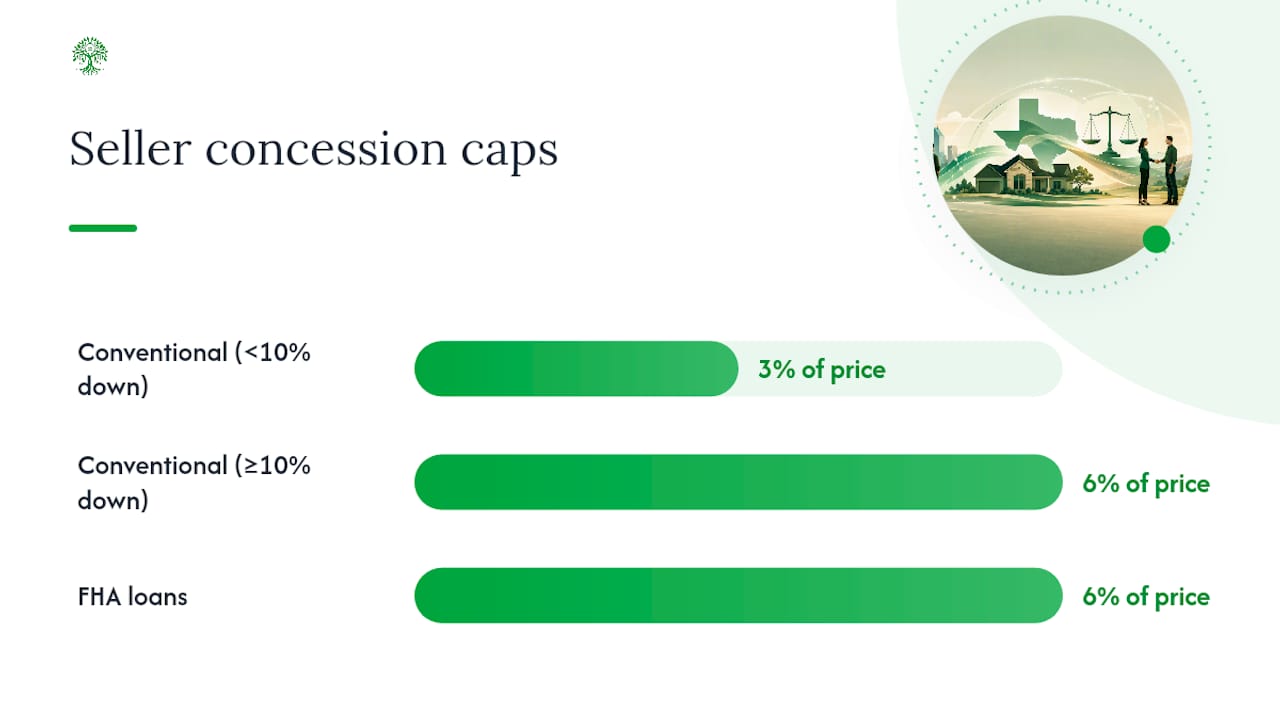
Seller concessions, where the seller agrees to cover part of the buyer’s closing costs, are capped by loan program. Conventional loans typically allow concessions up to 3% of the sale price with less than 10% down, and up to 6% with larger down payments. FHA loans cap concessions at 6%.
Pro Tip: Get every concession agreement in writing inside the contract itself. A verbal understanding about who pays the survey means nothing at the closing table.
How to Lower Your Cash-to-Close in Texas
Reducing what you bring to closing starts weeks before you ever see a Closing Disclosure, not the night before signing.
Get Loan Estimates from at least three lenders and compare them line by line, not just the headline rate. One lender’s “no origination fee” offer sometimes hides a higher rate or discount points baked into the deal, so shopping multiple lenders is one of the two most effective ways to cut your costs.
Ask for seller concessions during your option period, especially in a market where homes are sitting longer. A seller who won’t budge on price may still agree to cover $5,000 to $8,000 in your closing costs, which is often an easier ask than a straight price cut.
- Time your closing near the end of the month to minimize prepaid per diem interest, which can save $500 to $2,000 depending on your loan size and rate.
- Ask your lender about a one-time lender credit in exchange for a slightly higher rate if you’re short on cash.
- Confirm your Closing Disclosure three business days before signing, as required by federal rule, and check it against your most recent Loan Estimate.
- Keep a folder tracking your earnest money receipt, appraisal invoice, inspection report, and insurance binder so nothing surprises you at the table.
Pro Tip: If you’re also budgeting for the move itself, a virtual moving estimate can help you separate moving costs from closing costs so your total cash-needed number is accurate, not guessed.
Your Last-Week Closing Checklist
The week before closing is where small errors turn into stressful phone calls. Here’s the order to work through it.
- Review your Closing Disclosure the moment it arrives, at least three business days before signing. Check the loan amount, interest rate, and total cash to close against your last Loan Estimate first.
- Verify payoff and credit figures against your contract. Missing seller credits, wrong mortgage payoff amounts, and misspelled names are the most common last-minute errors, and all three delay signing if caught too late.
- Confirm wire instructions by phone, calling the title company directly using a number you already have on file, never one from an email. Wire fraud targeting home closings is a real and growing threat, and title companies expect this call.
- Bring certified funds or a verified wire, since personal checks are almost never accepted for the cash-to-close amount at a Texas title company.
A closing checklist built for first-time buyers can help you track each of these steps against your actual timeline instead of relying on memory during an already stressful week.
How Ficustree Helps Buyers Manage Closing-Cost Risk
Closing costs feel unpredictable mostly because buyers don’t know what’s negotiable until someone tells them. That’s the gap Ficustree closes. Every buyer working with Ficustree gets a showing agent on demand, decision intelligence tools that flag which fees on your Loan Estimate are typical versus inflated, and direct representation built around a fixed fee of $1,000 at closing plus 1% commission, with a rebate provided where Texas law permits.
That structure matters at the negotiating table. A buyer who understands loan-program concession limits walks into an offer knowing exactly how much to ask a seller to cover. A buyer comparing three Loan Estimates side by side catches an inflated origination fee before it becomes a surprise on the Closing Disclosure…
The tools that matter most here are the ones that turn a stack of confusing numbers into a clear negotiation strategy before you’re locked into a contract, not after.
The Overlooked Truth About Closing Costs in Texas
Most closing cost guides treat the percentage ranges as if they’re handed down from above. They aren’t. Every allocation on a Texas closing statement traces back to a line in the purchase contract, and that line got there because somebody asked for it or nobody thought to negotiate it. The customs, seller pays the owner’s title policy, buyer pays lender fees, exist because they’re convenient defaults, not because any statute requires them.
That’s a start, not a strategy. The real work is figuring out which of those line items you can push back on before you sign anything, and Texas’s lack of a state transfer tax already puts you ahead of buyers in states like Illinois or New York before you negotiate a single fee.
First-time buyers should prioritize two things over everything else: shopping lenders hard enough to catch a padded origination fee, and asking for seller concessions before assuming the seller won’t budge. Everything else on the closing statement is smaller money.
— Anand
Get a Closing-Cost Estimate Built for Your Texas Purchase
Ficustree gives Texas buyers something a printed rate sheet never will: a real answer to “what will I actually owe at closing,” tied to your specific loan, price point, and negotiating position.

If you’re weighing whether $7,000 or $17,000 is the more realistic number for your situation, that’s exactly the kind of question Ficustree’s tools are built to answer before you write an offer. Visit the Ficustree buyer page to request your estimate and see what representation looks like when it’s built around your numbers, not a generic percentage range.
Sources
- Typical Closing Costs in Texas for Buyers and Sellers | Herring Bank
- Who Pays Closing Costs in Texas? | Wallace Law PLLC
- Har
FAQ
What are common closing cost fees in Texas?
The most common fees are loan origination, appraisal, credit report, lender’s and owner’s title insurance, settlement/escrow fees, recording fees, prepaid property taxes, and prepaid homeowner’s insurance.
What would closing costs be on a $350,000 house?
Buyers typically pay between 2% and 5% of the purchase price, while sellers usually pay 6% to 10%, most of it agent commission.
What’s the average closing cost on a $300,000 house?
Buyers should budget $6,000 to $15,000, with a more realistic range around $8,000 to $12,000 once financing and county-specific tax and insurance costs are factored in.
Are Texas closing costs negotiable?
Yes. The purchase contract, not state law, decides who pays each item, which is why working with a representative who understands buyer concession limits and lender comparisons can meaningfully lower what you bring to the table.
Recommended

Leave a Reply