Author: Anand

  • Insure First: US Buyers’ Home Warranty vs Insurance and When to Add It

    Insure First: US Buyers’ Home Warranty vs Insurance and When to Add It

    A home warranty is a service contract that pays for repairs or replacements when major systems and appliances break down from normal wear and tear. Homeowners insurance is a policy that covers sudden, unexpected losses, like fire, theft, or storm damage, plus liability if someone gets hurt on your property. Most mortgage lenders require homeowners insurance before they’ll close your loan. A warranty is optional, and whether it’s worth adding depends on your home’s age, your budget, and how much risk you’re comfortable carrying yourself.


    TL;DR:

    • Home warranties cover aging appliances and systems with fixed service fees, but often exclude pre-existing conditions and have payout caps.
    • Homeowners insurance is mandatory through lenders and protects against sudden, external events like fires or storms, with higher annual premiums than warranties.
    • A warranty is more valuable for older homes with outdated systems, while insurance coverage is essential for catastrophic loss protection.
    • Inspecting the age and condition of major systems helps determine if a warranty adds value, especially if systems are out of warranty or costly to replace.
    • Carefully review contract exclusions, payout limits, and dispute procedures before purchasing either product, as fine print can undermine coverage.

    Ficustree
    Make Your Home Costs Clearer
    Ficustree helps first-time buyers assess true affordability, including insurance, maintenance, and other ongoing ownership costs.

    Explore Ficustree

    Table of Contents

    Home Warranty vs Insurance: Scope, Triggers, Costs, and Claims

    The fastest way to tell these two apart is to ask what breaks the coverage loose. A warranty pays out when something simply wears down over time, like a 12-year-old water heater finally giving up. Insurance pays out when something happens to you, like a pipe bursting overnight or a tree crashing through your roof in a windstorm.

    Here’s how the two stack up on the details that actually change your decision:

    • Scope of coverage: Warranties cover named appliances and systems (HVAC, water heater, dishwasher). Insurance covers the structure itself, your belongings, and your legal liability.
    • What triggers a claim: Warranties respond to mechanical failure from age and normal use. Insurance responds to sudden, accidental, or covered peril events like fire or hail.
    • Cost structure: Warranty plans run on annual premiums plus a service-call fee each time you request a repair. Insurance charges an annual premium with a deductible you pay only when you file a claim.
    • Claims process: With a warranty, you call the provider, they dispatch a contracted technician, and repairs typically happen within a few days to a couple of weeks depending on parts availability. With insurance, an adjuster inspects the damage first, and payout timing depends heavily on claim complexity.
    • Required by lender: Insurance, yes, almost universally. A warranty, no lender asks for one.

    Picture two scenarios side by side. Your 15-year-old furnace stops heating the house in January. That’s textbook warranty territory: gradual wear, no external cause, exactly what a service contract exists for. Now picture a windstorm that rips shingles off your roof and lets water into the attic. That’s an insurance claim: sudden, external, and tied to a specific covered event with a date and cause.

    Insurance premiums tend to run higher annually than warranty premiums, but the average cost comparison varies a lot by location, home size, and coverage level. The real difference isn’t just price. It’s what each dollar is protecting you against.

    What Does a Home Warranty Actually Cover?

    A typical warranty contract bundles coverage for your major mechanical systems and kitchen appliances into one annual plan. That usually means:

    1. HVAC systems (furnace, AC unit, ductwork)
    2. Plumbing systems and water heaters
    3. Electrical systems and wiring
    4. Kitchen appliances like dishwashers, ovens, and garbage disposals
    5. Optional add-ons for pools, septic systems, or home electronics, sold separately in most plans

    Every claim runs through a service-call fee, typically $65 to $200 per visit, even if the repair itself is minor. Plans also carry per-item payout caps and an annual maximum, so a catastrophic multi-system failure in one year could still leave you paying out of pocket. Most contracts also include a 30-day waiting period after you sign, so a system that fails in week two of ownership won’t be covered.

    The exclusions matter more than the coverage list. Warranty companies routinely deny claims tied to pre-existing conditions, poor maintenance history, cosmetic damage, or the cost of bringing an old system up to current building code. The Federal Trade Commission specifically warns buyers to read the pre-existing-condition language before signing, since that clause is where most disputes start.

    Pro Tip: Before you sign a warranty contract, ask the provider directly how they define “pre-existing condition” and request their claim denial rate if they’ll share it. A vague answer is a red flag worth walking away from.

    What Does Homeowners Insurance Actually Cover?

    Homeowners insurance is built around four core protections: dwelling coverage for the structure itself, other structures like a fence or detached garage, personal property for your belongings, and liability if a guest gets injured on your property. Most policies also include additional living expense coverage, which pays for a hotel or temporary rental if your home becomes unlivable after a covered loss.

    Here’s where the gaps show up:

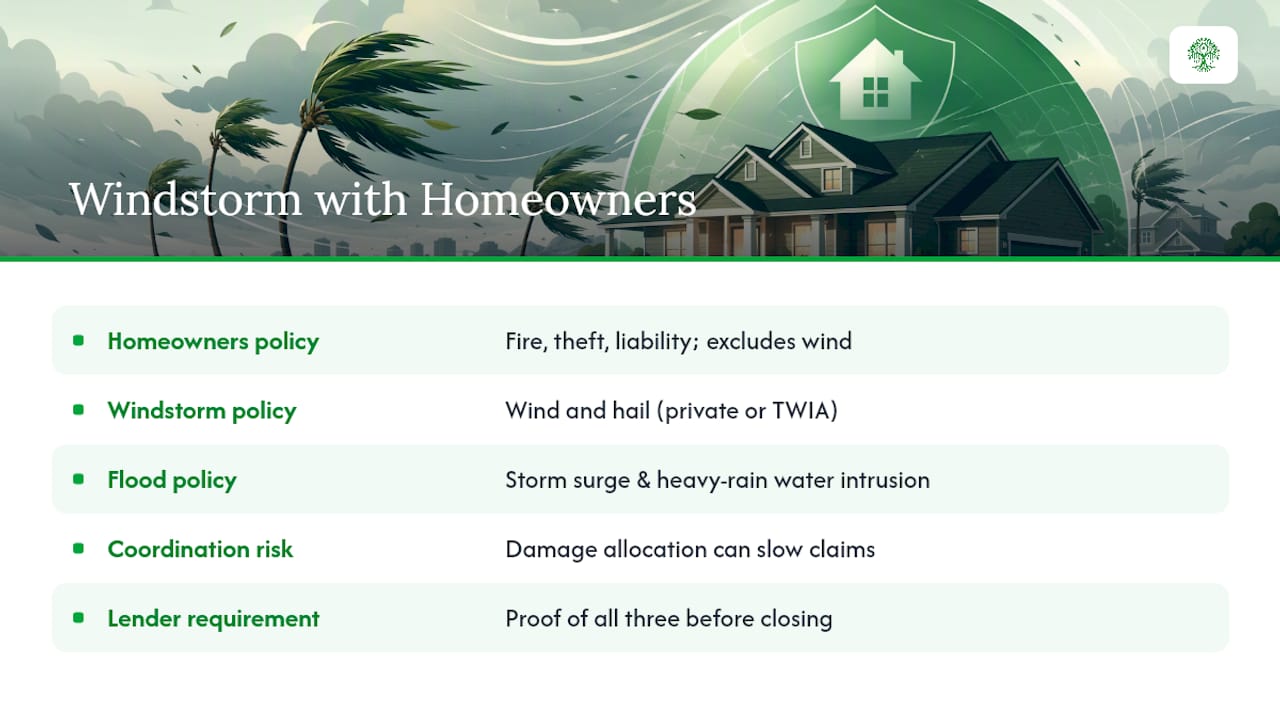
    • Flood damage is almost never included in a standard policy and requires a separate policy, often through the National Flood Insurance Program.
    • Earthquake damage is typically excluded too, especially relevant if you’re buying in California, and needs its own rider or standalone policy.
    • Deductibles apply per claim, meaning you pay a set amount before the insurer covers the rest, unlike a warranty’s flat service fee.
    • Sewer backup and certain water damage types are frequently excluded unless you add specific endorsements.

    Major claims, like fire or storm damage, involve an adjuster visit, a damage estimate, and a settlement process that can stretch from a few weeks to several months depending on severity. Mortgage lenders require homeowners insurance because the house is their collateral. If it burns down and you have no insurance to rebuild it, the lender’s investment disappears with it. That’s why insurance shows up on every closing disclosure, and a warranty never does.

    How Do You Decide Whether You Need a Home Warranty?

    Run through this before you sign anything:

    1. Inspect the age and condition of major systems. Pull the inspection report and note the age of the HVAC unit, water heater, and appliances. A home inspection checklist makes this step faster and more thorough.
    2. Estimate likely repair costs against the annual premium plus service fees. If your systems are all under five years old and still under manufacturer warranty, a service contract adds cost without adding much protection.
    3. Read the contract for caps, exclusions, and technician rules. Some plans limit you to their approved technician list, which matters if you already have a trusted repair person.
    4. Ask your lender or agent how warranty coverage interacts with the sale. New construction often comes with a builder’s warranty that overlaps with anything you’d buy separately.

    Consider two buyers. One purchases a 3-year-old townhouse with everything under manufacturer coverage. A warranty here is largely redundant money. The other buys a 22-year-old house with an original furnace and no emergency fund built up yet. That’s the buyer who benefits most, because a single furnace replacement can run well past what a year of warranty premiums and service fees would cost combined.

    Financial guidance generally frames insurance as protection against losses you truly cannot self-insure, while a warranty makes more sense when you genuinely can’t absorb a surprise repair bill. Run the math on your own systems before deciding either way.

    Reading the Fine Print Without Losing Your Mind

    Contracts for both products bury the details that matter most in language designed to be skimmed past. Slow down on three sections specifically.
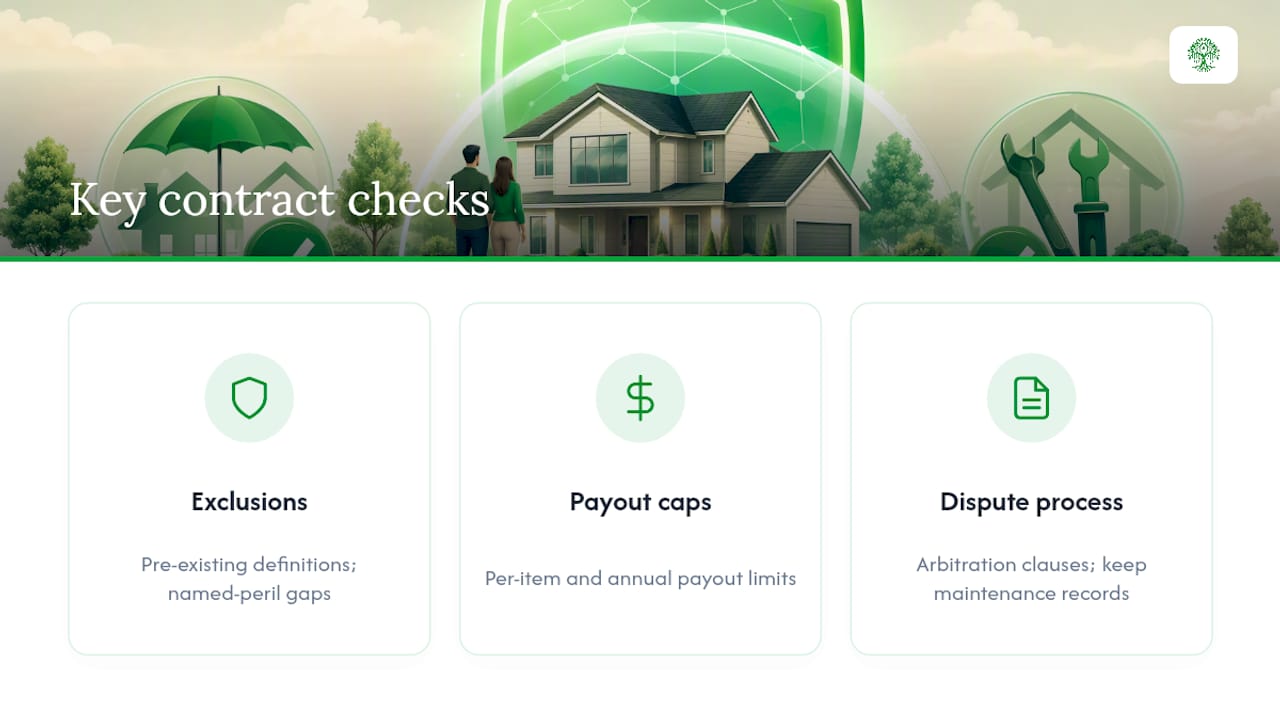
    Three checks for reviewing home contracts

    First, find the exclusions list. In a warranty contract, look for how “pre-existing condition” gets defined. Some providers interpret it broadly enough to deny almost any claim on an older system. In an insurance policy, check the named-peril list against your actual risks. If you’re in a flood zone or earthquake-prone area, the absence of that coverage is the whole ballgame.

    Second, check the caps. Warranty contracts list per-item and annual maximum payouts, often buried in an appendix rather than the main terms. Insurance policies list coverage limits per category (dwelling, personal property, liability) that may be lower than what it would actually cost to rebuild or replace everything you own.

    Third, look at the dispute process. The FTC’s guidance on service contracts specifically flags arbitration clauses as something buyers routinely overlook, since they can limit your ability to sue if a claim gets denied unfairly. Documentation matters here too. Keep maintenance records and pre-sale inspection reports on hand, since denied claims frequently trace back to a provider arguing the problem existed before coverage started.

    Ficustree’s View: What First-Time Buyers Should Prioritize

    If you’re buying your first home in California or Texas, get homeowners insurance locked in first. It’s not optional, and your lender won’t close without it. A warranty is the second decision, and it only earns its cost if your inspection shows aging systems or if your emergency fund can’t absorb a $4,000 furnace replacement without stress.
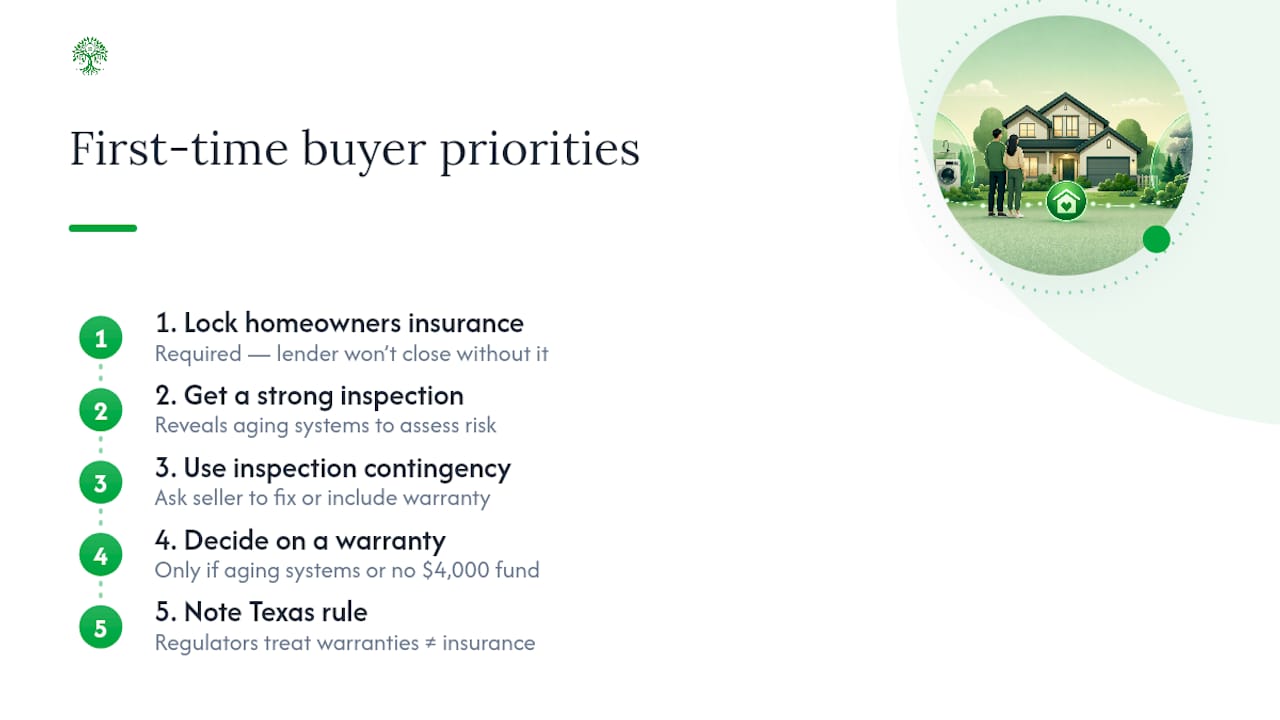
    Ficustree's View: What First-Time Buyers Should Prioritize — overview diagram

    This is exactly where inspection strategy and contract negotiation intersect. A strong inspection contingency gives you leverage to ask the seller to either fix aging systems or throw in a warranty at closing, rather than paying for one yourself after the fact. Texas buyers should also know that state regulators explicitly distinguish warranty providers from insurance companies, since licensing and consumer protections differ between the two.

    The buyers who navigate this best aren’t the ones who buy every add-on available. They’re the ones who inspect first, then decide what’s actually worth paying for.

    — Anand

    How Ficustree Helps You Get This Right Before Closing

    Deciding between a warranty and extra insurance riders is easier when you’re not doing it alone at 11 p.m. with a stack of PDFs. There are decision-intelligence platforms that walk first-time buyers through affordability, inspection risk, and closing negotiations with the numbers laid out clearly, not buried in fine print.

    Ficustree

    A fee structure like this means an agent may negotiate repairs or seller-paid warranty coverage into your offer, not just aim to close the sale fast. Run your numbers through the mortgage and affordability tools before you make an offer, and pair it with our inspection secrets guide so you walk into negotiations knowing exactly what you’re buying. If you’re weighing whether you even need a traditional agent for this process, our breakdown of what a listing agent actually does is worth a read first. Booking a consultation can help buyers sort out insurance-versus-warranty math before the closing deadline.

    Sources

    FAQ

    Is a Home Warranty Better Than Home Insurance?

    Neither is “better,” they cover different risks. Insurance protects against sudden disasters and is required by lenders, while a warranty covers gradual mechanical wear and is optional.

    What Does Dave Ramsey Say About Home Warranties?

    Personal finance guidance in this vein generally treats home warranties skeptically, arguing that building your own emergency fund for repairs often beats paying annual premiums and per-visit service fees for coverage with caps and exclusions.

    What Are the Downsides of a Home Warranty?

    The main downsides are service-call fees on every visit, annual and per-item payout caps, 30-day waiting periods, and frequent claim denials tied to pre-existing conditions or maintenance disputes.

    Who Is the Number One Home Warranty Company in the USA?

    There’s no single universally recognized “number one” warranty provider, since rankings shift by region, price, and customer service reviews. Compare contract terms, service-fee amounts, and exclusion language directly rather than relying on a single ranking.

    Do I Need Both a Home Warranty and Homeowners Insurance?

    You need homeowners insurance because your lender requires it and it covers catastrophic losses insurance alone protects against. A warranty is worth adding only if your systems are aging and your budget can’t absorb a surprise repair bill.

  • Avoid 2.5–3% Commission: WithJoy.AI Alternatives for First Time Buyers

    Avoid 2.5–3% Commission: WithJoy.AI Alternatives for First Time Buyers

    For most first-time buyers, the smartest WithJoy.AI alternatives are not pure AI platforms at all. They’re hybrid services that pair AI-driven home discovery with a licensed agent who can negotiate and stand behind the deal. Ficustree fits that hybrid category, and this guide walks through the categories, a checklist to test any platform, and the buyer profiles each option actually serves.


    TL;DR:

    • Hybrid platforms like Ficustree pair AI-driven home discovery with licensed agents who handle negotiations and closing, making them ideal for first-time buyers.
    • Ensure the platform provides active MLS access, direct representation, and clear legal terms before trusting it with a major purchase.
    • AI excels at quickly scanning listings and ranking matches but falls short in judgment, negotiation, and regional repair cost estimates.
    • First-time buyers especially benefit from a hybrid approach, combining fast discovery with the support of a human agent during critical negotiation stages.
    • Ficustree’s free tools and licensed representation aim to give buyers speed, guidance, and accountability throughout the homebuying process.

    Ficustree
    Buy With Clearer Decisions
    Ficustree combines AI-powered home buying tools with direct buyer representation for first-time buyers in California and Texas.

    Table of Contents

    What Are the Best WithJoy.AI Alternatives for Home Buyers?

    Searching for withjoy.ai alternatives usually means one of three things: you want a similar gift registry style platform, you’re evaluating alternative gift registries for a wedding, or you’ve landed here because “AI plus real estate” search results are a tangled mess of unrelated tools. This guide addresses the real estate side of that confusion, because a growing number of platforms marketed as free gift registry sites or comparable gift services have nothing to do with buying a house, and buyers researching AI homebuying tools deserve a clear map of what’s actually out there.

    Three broad categories cover almost every option you’ll find:

    • AI-only agentic platforms. These tools scan listings, rank matches, and sometimes draft offer language, but they carry no real estate license and no fiduciary duty to you. Pricing tends to run as a monthly subscription or a flat search fee, and the typical user is an experienced investor who already knows how to vet a contract.
    • Hybrid AI plus agent services. These combine algorithmic matching with a licensed human who handles negotiation, disclosures, and closing. Pricing usually blends a smaller flat fee with a reduced commission, often with a rebate back to the buyer. This is where Ficustree operates, and it’s the category most first-time buyers should start with.
    • Traditional human-first brokerages with AI toolsets. Here, an agent still drives the relationship, but the brokerage layers in AI for showing scheduling or market alerts. Pricing follows the standard commission model, typically 2.5 to 3 percent of the sale price, with no rebate structure built in.

    The gap between the first category and the other two matters more than most comparison charts admit. Brookings has documented how much of a traditional commission is baked into a home’s price rather than itemized as a visible fee, which is exactly why AI-only subscriptions look cheap by comparison, until you realize you’re on your own for the negotiation that determines your actual purchase price.

    How Do You Choose Between These Alternative Gift Registry Platforms and Real Estate Tools?

    Skip the platforms that don’t survive this checklist. Run any AI real estate tool through these six questions before you trust it with your biggest purchase:

    1. Is there a licensed agent attached to my search, and will they represent me in writing? A platform that only “connects” you to an agent network isn’t the same as one that provides direct representation.
    2. Can the platform negotiate on my behalf, or does it stop at generating a suggested offer price? Negotiation is a skill, not a data output.
    3. Does it have live MLS access for your specific market, or is it scraping public listing feeds that lag by days?
    4. What’s the actual pricing model? Flat fee, subscription, or commission, and is a rebate legally available in your state?
    5. How current and hyper-local is its cost data? A tool that doesn’t know your city’s transfer tax or a neighborhood’s typical repair costs will misprice your risk.
    6. What happens when something goes wrong? Is there a real, licensed party accountable for errors, or just a terms-of-service disclaimer?

    If you’re a first-time buyer, weight questions 1, 2, and 6 the heaviest. If you’re an experienced investor doing a cash deal, an AI-only or subscription model may genuinely be enough.

    Pro Tip: Before you commit to any platform, ask directly for proof of active MLS feed access and the exact wording of its representation agreement. G2’s research on comparable gift services and real estate alternatives shows users consistently rank reliability and ease of use above flashy features, and a platform that hesitates to show you its MLS credentials or representation terms is telling you something.

    Where Does AI Actually Help, and Where Does It Fall Short?

    AI is genuinely good at three things: scanning thousands of listings in seconds, ranking matches against your stated preferences, and monitoring new inventory around the clock so you never miss a listing that fits. That’s the discovery layer, and it’s a real upgrade over manually refreshing a search every morning.

    Where it breaks down is judgment. AI models can hallucinate details about a property’s condition, miscalculate local repair costs because construction pricing varies wildly by zip code, and miss the subtle cues a human picks up during a showing.

    Industry reporting is converging on the same conclusion: buyers increasingly use AI for discovery but still lean on human advisors once a deal gets serious, and that split is widening rather than closing.

    Three concrete failure modes show up repeatedly in industry reporting:

    • Agents interviewed by Inman point out that AI can’t read a buyer’s hesitation standing in a kitchen, a signal that often changes offer strategy on the spot.
    • Repair-cost estimates generated by algorithms routinely miss regional labor pricing, leading buyers to underbid or overbid based on bad math.
    • Forbes coverage of the shift notes that AI is reshaping agent workflows, not eliminating the need for a human who can adjust a negotiation strategy mid-conversation.

    None of this makes AI a bad tool. It just makes it a discovery tool, not a closing tool.

    How Does Ficustree Fit Into This Picture?

    Ficustree was built specifically for the gap the sections above describe: buyers who want AI-speed discovery but still need a licensed human accountable for the deal. You get decision intelligence matched to your actual budget and preferences, direct buyer representation, and hourly showing agents you can book on demand instead of waiting on one agent’s calendar.

    The platform, including affordability calculators and neighborhood insights, is free to use.

    Two buyer profiles map cleanly onto this:

    • A first-time buyer who’s never negotiated a contract and doesn’t know what “contingency” really protects. Ficustree pairs AI-driven matching with a licensed agent who handles the offer, disclosures, and closing, so you’re never negotiating alone.
    • A buyer who wants the commission rebate but doesn’t want to sacrifice guided support. The fee structure, combined with rebates where legal, aims to keep more money in your pocket than standard commission models without cutting you loose to figure out escrow on your own.

    Ficustree doesn’t try to be the AI-only category. It’s built for buyers who want both speed and someone answering for the outcome.

    Why the Hybrid Model Wins for Most First-Time Buyers

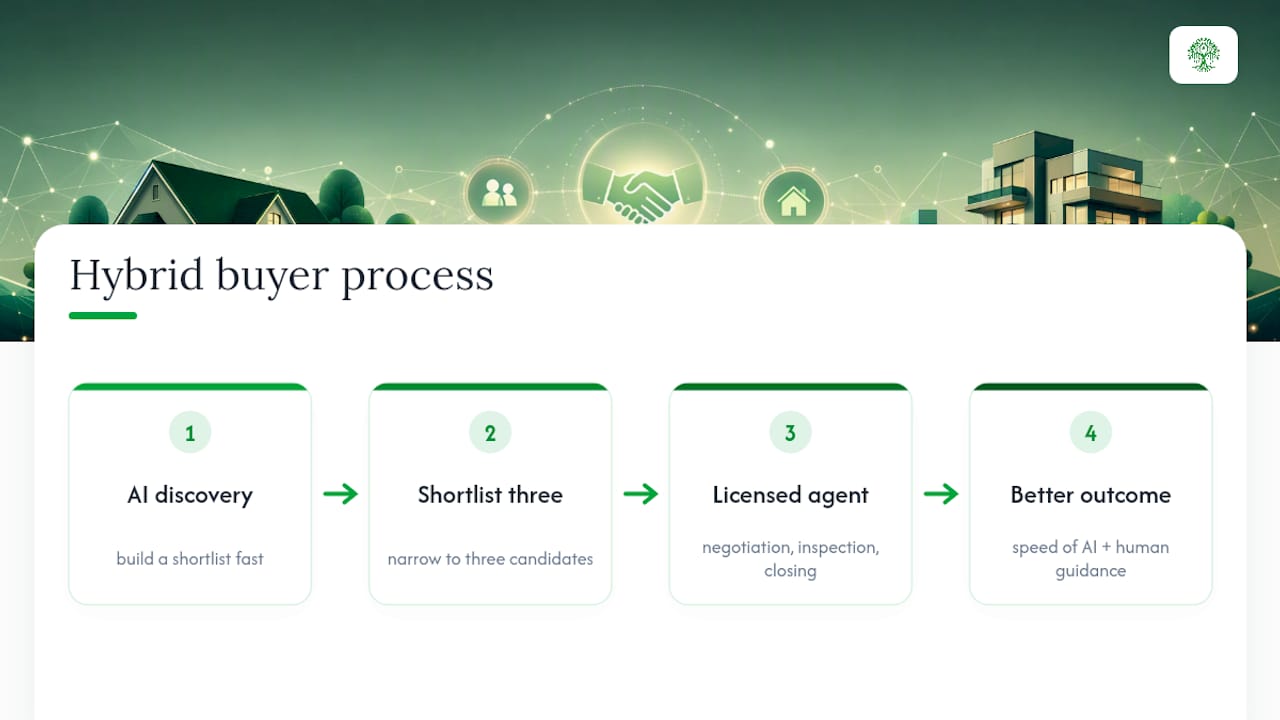
    Why the Hybrid Model Wins for Most First-Time Buyers — overview diagram

    The honest path forward is simple: use an AI discovery tier to build a shortlist fast, narrow it to three serious candidates, then hand the negotiation, inspection, and closing to a licensed agent who uses proven types of buyers agent search strategies in Sydney. That sequence gets you the speed of AI without gambling your largest purchase on a tool that can’t sit across a negotiating table.

    An AI-only route is reasonable if you’re a repeat buyer or an investor who already knows contract language cold and just wants faster listing access. For everyone else, especially anyone buying for the first time, the emotional and practical guidance a human agent brings during a stressful negotiation isn’t optional. It’s the part of the process where deals actually get won or lost.

    — Anand

    Try Ficustree: Decision Intelligence Plus Real Representation

    Ficustree gives you what the AI-only platforms above can’t: a licensed agent backing every offer, not just a ranked list of listings.

    Ficustree

    Getting started takes three steps. Visit the Ficustree homepage to see how the matching works for your budget and target neighborhoods. Book an hourly showing agent the next time you want to see a property without waiting on a single agent’s schedule. And when you’re ready to make an offer, you’ll already have a licensed representative in place instead of scrambling to find one after you’ve fallen for a house. The house should find you. Start by seeing what it finds.

    Sources

    FAQ

    What Is the Best AI Assistant for Real Estate Agents Right Now?

    There’s no single tool that dominates every market, but agentic platforms that handle listing analysis and showing scheduling are gaining ground fastest because they free agents up for negotiation and client strategy.

    Which CRM Does Keller Williams Use?

    Keller Williams runs its own proprietary platform called Command, built to handle lead management and transaction tracking for its agents.

    What Is the 80/20 Rule for Realtors?

    The 80/20 rule suggests roughly 80% of an agent’s business comes from about 20% of their efforts or clients, usually repeat buyers and referrals, which is why relationship-driven service still outperforms pure lead volume.

    Are There Free Gift Registry Sites That Work Like WithJoy.AI for Home Buying?

    WithJoy.AI’s registry features don’t translate to real estate, but Ficustree offers its full home-buying platform, including matching and calculators, free to buyers, with revenue coming only from the fee and commission paid at closing.

    Should a First-Time Buyer Choose an AI-Only Platform or a Hybrid Service?

    First-time buyers should generally choose a hybrid service, since reporting from HousingWire shows buyers increasingly rely on human advisors once negotiation and accountability enter the picture.

  • CFPB Warnings and Modeling: Balloon Mortgages for First Time Buyers

    CFPB Warnings and Modeling: Balloon Mortgages for First Time Buyers

    A balloon mortgage is a home loan with small payments for a few years, followed by one large final payment that pays off whatever principal is left. Terms generally run between several and about ten years, and the final “balloon payment” can be more than double a regular monthly payment. If you take one out, you need a concrete plan to refinance, sell, or pay cash before that date arrives.


    TL;DR:

    • Most balloon mortgages have terms of 5 to 10 years, with the final payment often exceeding twice the typical monthly installment.
    • These loans are mainly offered by specialized lenders such as hard-money lenders and small regional banks, not major national banks.
    • Without a solid exit plan like refinancing or selling, balloon loans pose significant foreclosure risks due to large lump-sum payments at maturity.
    • Borrowers should carefully project the balloon amount using amortization tools and assess their ability to refinance, sell, or pay the balance before committing.
    • Fixed-rate or adjustable-rate mortgages generally offer better long-term stability and equity-building for most buyers compared to balloon structures.

    Ficustree
    Make Your Home-Buying Decision Clearer
    Ficustree helps first-time buyers in California and Texas evaluate affordability and navigate the purchase with decision intelligence.

    Explore Ficustree

    Table of Contents

    How Does a Balloon Mortgage Work?

    A standard 30-year fixed loan amortizes fully. Every payment chips away at principal and interest until the balance hits zero on schedule. A balloon mortgage breaks that pattern on purpose. You make smaller payments for a set period, then owe the remaining balance in one lump sum.

    Lenders structure these three main ways. Interest-only balloons have you paying just the interest each month, so the full principal is due at maturity. Partial-amortization balloons, more common in practice, use a 30-year amortization schedule but call the loan due after 5 to 10 years, leaving a large chunk of principal unpaid. A smaller category has no payments at all until the balloon date, though this structure is rare in residential lending.

    Here’s a real number to anchor it. Your monthly payment (principal and interest) is roughly $1,896. After 7 years of payments, you’d still owe approximately $267,000 as a single balloon payment, because 30-year amortization barely dents principal in the first decade.

    • Interest-only: entire principal due at maturity, lowest monthly payment
    • Partial amortization: smaller monthly payment than a standard loan, but most of the balance remains
    • No-payment structures: rare, all principal and interest deferred to maturity

    Run your own numbers through an amortization calculator before assuming a balloon saves you money long term.

    What Terms and Lenders Are Common for Balloon Loans?

    Balloon mortgage terms cluster tightly around 5, 7, or 10 years, almost always paired with a 15 or 30 year amortization schedule for calculating the monthly payment. That combination keeps payments low while pushing the real cost to the maturity date.

    You won’t find many balloon loans at major national banks anymore. Since the 2008 mortgage crisis, most consumer balloon lending has shifted to hard-money lenders, boutique regional lenders, and private financing, largely because qualified mortgage rules restrict balloon features on standard owner-occupied loans. Big banks generally avoid the compliance complexity and the default risk.

    • Term lengths: 5 to 10 years is standard, with 7 years the most common sweet spot
    • Amortization basis: usually calculated as if it were a 15 or 30 year loan
    • Lender types: hard-money lenders, small local banks, portfolio lenders, and seller-financed deals
    • Regulatory backdrop: post crisis rules limit balloon features on qualified mortgages, per Investopedia’s explainer

    If a mainstream lender offers you one, ask directly why, and get the qualified-mortgage status in writing.

    What Are the Real Advantages and Risks?

    The pitch sounds good on paper: lower monthly payments now, more house for less cash flow, and a shot at refinancing later once your income or the property’s value improves. Investors flipping a property in under two years, or buyers expecting a bonus, inheritance, or business sale, sometimes use balloon structures deliberately.

    The risk side is where most first-time buyers get into trouble.

    • Lower initial payments: interest-only or partial-amortization structures free up monthly cash flow
    • Short-term flexibility: useful if you know you’re selling or refinancing within the term
    • Investor fit: flippers and short-term holders can exploit the low carrying cost
    • Large lump-sum risk: the balloon payment is often more than twice your regular monthly payment
    • Refinancing dependency: your exit plan assumes future approval, which isn’t guaranteed
    • Minimal equity buildup: partial-amortization structures leave most of the principal untouched, so Business Insider notes many borrowers end up relying on home-price appreciation just to qualify for a refinance
    • Foreclosure exposure: the CFPB is direct about this: if you can’t pay the balloon or refinance because of falling values or a changed financial picture, foreclosure becomes a real possibility

    Pro Tip: Before you sign anything, calculate the balloon amount at year 5, 7, and 10 using an amortization tool. Compare that number to your realistic savings trajectory, not your hopeful one.

    What Happens When the Balloon Payment Comes Due?

    You have four real paths when the balloon date arrives, and the earlier you start working one, the more leverage you keep.

    1. Refinance into a new loan. Lenders will look at your updated credit score, income, and the home’s current appraised value. Start this process 6 to 12 months before maturity, since underwriting takes time and a denial late in the game leaves no room to pivot.
    2. Sell the property. This works if the home has appreciated and the market is liquid, but factor in agent commissions, closing costs, and the real risk that your sale takes longer than expected in a slow market.
    3. Pay cash from savings or a windfall. This is the cleanest exit, but it requires disciplined saving from day one of the loan, not a hope that a bonus materializes on schedule.
    4. Negotiate with your lender. Some lenders will extend the term, reset the rate, or offer a short bridge loan, but this depends entirely on their portfolio policy and your payment history. Don’t assume it’s available.

    The Investopedia analysis is blunt about this: buyers who assume they’ll “just refinance later” without a fallback plan are the ones who end up in foreclosure court.

    Who Should Actually Consider a Balloon Mortgage?

    Balloon mortgages fit a narrow set of buyers well. If none of these describes you, a balloon loan is probably the wrong tool.

    • House flippers planning to sell within the balloon term, where low carrying costs matter more than long-term equity
    • Short-term occupants who know with certainty they’re relocating or upsizing before maturity
    • Windfall recipients with a documented, near-certain influx of cash, such as a vesting stock grant or a pending inheritance
    • Investors using the structure as a bridge to permanent financing on a rental property

    For nearly everyone else, a 30-year fixed loan, an adjustable-rate mortgage, or an interest-only loan with a longer horizon carries far less maturity risk. A fixed loan costs more month to month but builds real equity and never forces a lump-sum reckoning. NAR’s coverage of balloon affordability makes the same point: the short-term savings rarely outweigh the long-term exposure for a typical first-time buyer.

    How Do Ficustree’s Tools Help You Model a Balloon Scenario?

    You shouldn’t sign a balloon mortgage based on a lender’s optimistic pitch. Run the numbers yourself first. Ficustree’s amortization calculator shows exactly how much principal remains at any point in a balloon term, and the mortgage calculator with taxes and insurance lets you compare that balloon structure against a standard 30-year fixed payment, including PITI.

    Ficustree’s decision-intelligence layer takes this further by letting you test refinance-versus-sell scenarios side by side, using your actual income and the property’s likely appreciation path, instead of guessing.

    Before agreeing to a balloon clause, ask your lender or agent:

    • What is the exact balloon amount at maturity, in dollars?
    • What happens if I can’t refinance or sell in time?
    • Are there prepayment penalties if I pay it off early?
    • Is there a reset or extension option, and under what conditions?

    Are There Tax Implications to a Balloon Mortgage?

    Mortgage interest on a balloon loan is deductible under the same rules as any other qualified home loan, up to the current mortgage interest limits set by the IRS for acquisition debt. There’s no special balloon carve-out that increases or restricts your deduction just because the loan has a shorter term.

    Where it gets trickier is at the exit. If you sell the property to cover the balloon, capital gains rules apply exactly as they would with any home sale. You can typically exclude up to $250,000 of gain ($500,000 for married couples filing jointly) if you owned and lived in the home for at least two of the five years before the sale, under the standard primary-residence exclusion. A balloon loan’s shorter horizon can work against you here: if you’re forced to sell in year 3 or 4 to avoid a payment you can’t make, you may not have met that two-year residency threshold, which means the full gain becomes taxable.

    If you refinance instead of selling, refinancing itself isn’t a taxable event, but any cash-out portion used for something other than the home isn’t tax-deductible on the interest, per standard IRS rules on acquisition versus home-equity debt. Work through these scenarios with a tax professional before you assume a balloon exit is tax-neutral. It often isn’t.

    How Does Your Credit Score Affect Balloon Mortgage Eligibility?

    Balloon mortgages tend to carry stricter underwriting than they get credit for. Because niche and portfolio lenders hold these loans on their own books rather than selling them to Fannie Mae or Freddie Mac, they often compensate for that risk by demanding stronger borrower profiles upfront.

    Expect lenders to look closely at your credit score, debt-to-income ratio, and cash reserves, sometimes more closely than a conventional lender would for a standard 30-year loan. A lower credit score doesn’t just mean a higher rate here. It can mean outright denial, since the lender is betting on your ability to refinance or sell successfully at maturity, and a weak credit profile now suggests a weak one later too.

    This creates a real trap. If your credit is borderline today, it will likely still be borderline in 5 to 7 years unless you actively work to improve it, which makes your refinance exit less certain, not more. A strong credit profile at origination doesn’t guarantee approval at maturity either, since your score, income, and the home’s value can all move against you before the balloon comes due. Treat the qualification bar for a balloon mortgage as a floor, not a ceiling, and keep building your credit and savings throughout the term regardless of how easy the initial approval felt.

    How Does Your Credit Score Affect Balloon Mortgage Eligibility? — overview diagram

    Balloon Mortgage vs. Fixed Mortgage: What’s the Real Cost Difference?

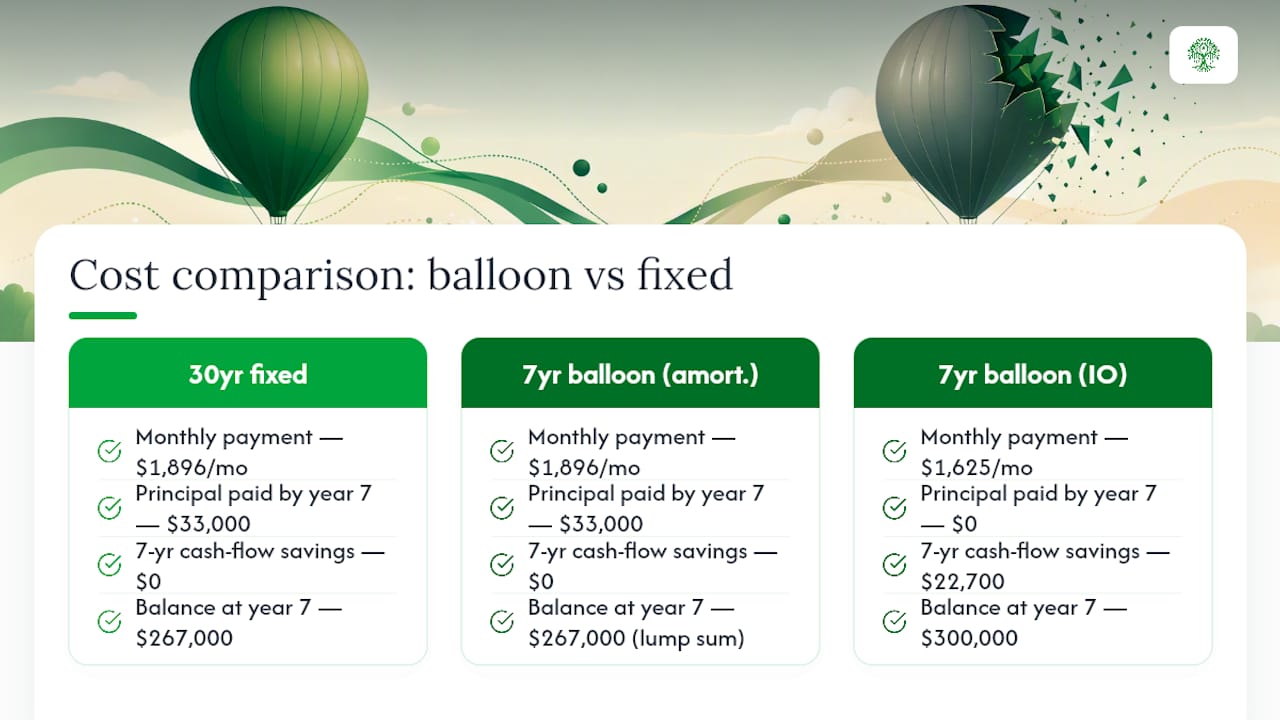
    Numbers make this comparison clearer than any general warning. Take that same $300,000 loan at 6.5%. A 30-year fixed mortgage costs about $1,896 a month for the full term, and by year 7 you’ve paid down roughly $33,000 of principal.

    A 7-year balloon loan calculated on the same 30-year amortization schedule has an identical monthly payment of $1,896, but at the end of year 7 you owe a lump sum of approximately $267,000. You haven’t saved a dime monthly. What you’ve actually done is defer a $267,000 obligation while betting on future refinancing or a sale.

    Where balloons genuinely save money is in interest-only variants, where the monthly payment might drop to around $1,625 on the same loan amount, a real monthly savings of roughly $271. Over 7 years, that’s about $22,700 saved in cash flow, against a full $300,000 balance still owed at maturity, since none of it amortized.

    The trade-off is stark once you lay it out: a fixed loan trades higher monthly cost for predictability and steadily growing equity. A balloon loan trades short-term cash flow relief for a hard deadline and zero guarantee that refinancing terms will be favorable when you need them.

    Balloon and fixed mortgage cost comparison

    Are Balloon Mortgages Common Today?

    Balloon mortgages were far more common before the 2008 financial crisis, when looser underwriting let borrowers stack risky features, including balloons, adjustable rates, and low documentation, into the same loan. That combination contributed heavily to the wave of defaults that followed.

    Post-crisis reforms changed the landscape substantially. Qualified mortgage standards now restrict balloon features on most conventional, owner-occupied loans, which is why you rarely see them advertised by major banks today. What remains is a smaller, more specialized market: hard-money lenders, portfolio lenders holding loans on their own books, and seller-financed deals, most often serving real estate investors rather than typical first-time buyers.

    The current environment of elevated interest rates has renewed some interest in balloon structures among borrowers hoping to “buy now, refinance later” if rates drop. Financial advisors have pushed back hard on this reasoning, since it hinges entirely on a rate forecast nobody can guarantee. If you’re considering a balloon mortgage in today’s market specifically to bet on falling rates, understand you’re making two speculative bets at once: on rates and on your own future qualification.

    What Contract Terms Should You Watch For?

    Balloon mortgage contracts carry a few clauses that don’t show up in standard fixed-rate paperwork, and missing them can cost you thousands.

    Prepayment penalties are more common in balloon loans than in conventional mortgages, especially with hard-money and portfolio lenders. If you plan to refinance or sell early to avoid balloon risk, a prepayment penalty can erase much of the benefit of moving fast. Always ask for the exact penalty schedule in writing.

    Balloon reset options let some lenders extend the loan or reset the rate at maturity instead of demanding full payment immediately, but this is a lender courtesy, not a borrower right, unless it’s explicitly written into your note. Never assume a reset will be offered just because a loan officer mentioned it was “usually” available.

    Due-on-sale clauses are standard, meaning the balloon becomes immediately payable if you sell or transfer the property, which matters if your exit strategy involves adding a co-owner or transferring title for estate planning.

    Rate adjustment triggers in hybrid balloon-ARM products can change your payment before the balloon date even arrives, so read the initial rate period carefully. Get every one of these clauses explained line by line before signing, and if a lender is vague about any of them, treat that vagueness as a warning sign.

    Where Conservative Financing Wins for First-Time Buyers

    Conservative financing wins for most first-time buyers because a fixed payment and a foreclosure date are two very different kinds of stress, and the balloon structure trades one for the other at the exact moment you have the least room to absorb a shock.

    If you’re weighing a balloon loan, hold yourself to two guardrails: a documented exit plan you’d trust with someone else’s money, and enough equity cushion that a stalled refinance doesn’t force a fire sale.

    — Anand

    Model Your Balloon Scenario Before You Sign With Ficustree

    Most buyers who look into a balloon mortgage are really trying to solve one problem: making the monthly number work today without getting trapped tomorrow. Ficustree gives you a way to test that trade-off before you’re locked into a contract, instead of discovering the real cost at closing.

    Ficustree

    A decision-intelligence platform can let you run a balloon structure against a standard 30-year fixed or an ARM side by side, using your real income, target neighborhood, and the actual property you’re eyeing, not a generic rate-sheet example. If the numbers suggest a balloon is genuinely your best fit, on-demand showing agents and direct buyer representation can help you negotiate the terms, including reset options and prepayment penalties. Head to Ficustree and run your own numbers before you talk to a lender.

    Sources

    The CFPB’s balloon payment guide is the clearest regulatory explanation of foreclosure risk. Investopedia and NAR cover structure and affordability, while Law.Cornell’s Wex entry gives a precise legal definition.

    FAQ

    Is a Balloon Loan a Good Idea?

    For most first-time buyers, no. The CFPB warns that inability to pay the lump sum or refinance can lead to foreclosure, so it only makes sense with a firm exit plan and financial cushion.

    What Is a 30-Year Mortgage With a 5-Year Balloon?

    It’s a loan calculated on a 30-year amortization schedule for a low monthly payment, but the entire remaining balance becomes due after 5 years instead of continuing for the full 30.

    Do Banks Still Offer Balloon Mortgages?

    Major national banks rarely offer them today because qualified mortgage rules restrict balloon features on most conventional loans; most current balloon lending comes from hard-money and portfolio lenders serving investors.

    How Can I Get Out of a Balloon Mortgage?

    You typically refinance into a new loan, sell the property, pay the balance in cash, or negotiate an extension or reset with your lender, and starting that process 6 to 12 months before maturity gives you the most options.

  • California Natural Hazard Disclosure: Six Zones That Change Offers

    California Natural Hazard Disclosure: Six Zones That Change Offers

    A natural hazard disclosure (NHD) is a map based statutory statement that tells you whether a property sits inside one of six government mapped hazard zones, covering everything from flood plains to earthquake fault lines. It directly affects your insurance costs, your lender’s requirements, and even your legal right to cancel a purchase contract. California’s Civil Code §1103 sets the model most states borrow from, and Decision intelligence platforms integrate similar analyses to guide first-time buyers toward confident offers.


    TL;DR:

    • Buyers should verify the specific hazard zones flagged on the NHD map by reviewing backup maps and confirming boundary lines, as a “yes” indicates map inclusion, not actual hazard impact.
    • It is essential to obtain independent flood and fire insurance estimates early, especially for properties in flagged zones, before removing contingencies to avoid surprises at closing.
    • The seller usually orders the NHD report early in the transaction to protect themselves legally by relying on third-party data, with costs typically between $50 and $150.
    • Late delivery of the NHD or missing reports within the legal time frame allows buyers to cancel the contract, emphasizing the importance of timely receipt and review.
    • Buyers should treat hazard flags as starting points for further investigation, including engaging specialists for seismic or liquefaction concerns and verifying mitigation records when necessary.

    Ficustree
    Turn Hazard Findings Into Clarity
    Ficustree helps first-time buyers use decision intelligence to evaluate disclosures and move toward a confident offer.

    Table of Contents

    What Is a Natural Hazard Disclosure Report?

    An NHD report is a statutory checklist. It tells you, in six yes-or-no boxes, whether a parcel falls inside a mapped hazard zone. Nothing more, nothing less. The report doesn’t evaluate the house itself. It evaluates the ground the house sits on and the government maps that already exist for that ground.

    That distinction matters because buyers often confuse the NHD with the Transfer Disclosure Statement (TDS). The TDS is the seller’s personal account of the property’s condition: the leaky faucet, the water stain in the attic, the fence dispute with the neighbor. The NHD is entirely different. It’s map driven. It doesn’t rely on what the seller remembers or chooses to admit. It relies on where the parcel’s boundary lines fall on official flood, fire, and seismic maps drawn by federal and state agencies.

    Because the NHD depends on precise mapping data rather than personal knowledge, almost no seller fills it out alone. Listing agents order these reports from third-party vendors as soon as a home hits the market, and there’s a legal reason for that habit. Under Section 1103.4, when a public agency or a qualified professional delivers the hazard information directly, that delivery satisfies the seller’s disclosure duty and shields the seller and their agent from liability, as long as they exercised ordinary care. Ordering a third-party report isn’t just convenient. It’s the seller’s best legal protection.

    A typical NHD package usually bundles more than the six statutory checkboxes. Common supplemental items include:

    • Airport influence area notices, when the parcel sits near flight paths
    • Military ordnance location disclosures, relevant near current or former bases
    • Mello-Roos and other special tax assessment notices
    • Commercial or industrial zoning proximity statements
    • Registered sex offender database notification language

    None of these supplemental items are part of the core six-zone hazard checklist, but vendors package them together because state and local law layers additional notice requirements onto the same transaction. Reading the NHD in isolation from these attachments means missing half the picture.

    What Are the Six Hazard Zones on the NHD?

    Every California NHD checks the same six statutory zones, and each “yes” answer means the parcel’s boundary falls inside a mapped area, not that the house has ever flooded, burned, or shifted. That distinction confuses more buyers than any other part of the report.

    Here’s what each zone actually means for your transaction:

    • Special Flood Hazard Area (FEMA Zone A or V): A “yes” here means your lender will almost certainly require flood insurance as a condition of a federally related mortgage, regardless of whether the home has ever taken on water.
    • Dam Inundation Area: Uncommon outside specific river valleys and reservoir basins, but when it applies, it can affect insurability and, in some cases, local emergency planning disclosures buyers should ask about directly.
    • Very High Fire Hazard Severity Zone (VHFHSZ): Tied to CAL FIRE’s mapping, this box has become one of the most consequential on the form, especially as insurers reassess fire exposure and California’s AB 38 retrofit disclosure rules layer on additional seller obligations for older homes in these zones.
    • State Responsibility Area (SRA): Marks land where the state, not a local fire department, holds primary wildfire suppression responsibility. It often overlaps with VHFHSZ but isn’t identical to it.
    • Earthquake Fault Zone (Alquist-Priolo): A “yes” here restricts new construction and can require a geologic study before a permit is issued for anything built across or near the mapped fault trace.
    • Seismic Hazard Zone: Flags liquefaction or landslide risk and often triggers a request for a geotechnical study before lenders or local building departments approve significant work.

    Quick fact: California’s NHD statute requires disclosure of these six zones specifically because each one maps to a distinct state or federal agency’s own hazard data, which is why the report cites FEMA, CAL FIRE, and the California Geological Survey by name rather than relying on a single combined “risk score.”

    A checked box is a starting point for questions, not a verdict on the property. Two houses on the same block can carry the same “yes” in the fire zone box and face very different real-world exposure depending on defensible space, roofing material, and slope.

    Who Pays for an NHD Report and What Does It Cost?

    The seller orders and pays for the NHD report in the overwhelming majority of California transactions, and this is standard market practice rather than a strict legal mandate. Because the disclosure duty falls on the seller, and because ordering early protects them under the Section 1103.4 liability shield, listing agents typically commission the report the moment a home goes under contract for sale, sometimes even before it hits the market.

    Cost is modest relative to everything else in a real estate transaction. A standard residential NHD report generally runs between $50 and $150, depending on the vendor and which supplemental disclosures get bundled in. Factors that push the price toward the higher end include:

    • Rural or unincorporated parcels that require more manual map cross-referencing
    • Properties near multiple overlapping hazard zones, which take longer to verify
    • Add-on reports like Mello-Roos tax searches or commercial proximity checks
    • Rush turnaround requests from listing agents working against a tight escrow timeline

    Because the price is negotiable in the purchase contract, buyers occasionally end up covering it, particularly in a hot seller’s market like Myrtle Beach where sellers push routine transaction costs back onto the buyer (Myrtle Beach Real Estate – Homes for Sale in Myrtle Beach). It’s also common for a buyer’s agent to request a supplemental hazard check, like an updated elevation certificate on a flood-zone property, if the standard report raises questions the front page doesn’t fully answer. That additional research typically comes at the buyer’s own expense, separate from the seller’s original NHD order.

    When Must the NHD Arrive and What Are Your Rescission Rights?

    California law requires delivery “as soon as practicable before transfer of title,” which in practice means sellers should hand over the NHD before you remove contingencies, not after. Waiting until just before closing isn’t compliant, and it isn’t fair to a buyer trying to make an informed decision.

    If the report arrives after you’ve already signed the purchase agreement, the law gives you a real out. You have three days after personal delivery, or five days after delivery by mail, to cancel the contract in writing. This isn’t a courtesy extended by a cooperative seller. It’s a statutory right, and it exists specifically because hazard information can change a buyer’s calculus after the ink is already dry.

    When a required hazard disclosure statement isn’t delivered by the scheduled transfer date, or arrives so late that a buyer never had a genuine opportunity to review it, that failure can permit the buyer to terminate the offer entirely rather than simply trigger the short rescission clock.

    The practical consequence: agents on both sides treat NHD delivery as a checkpoint, not an afterthought. A missing or late report doesn’t just create paperwork friction. It exposes the seller to a canceled deal and, in some interpretations, potential liability if nondisclosure was willful or the omission was material to the buyer’s decision.

    • Delivery before contingency removal keeps everyone protected
    • Late delivery starts a 3-day or 5-day rescission clock, depending on method
    • A missing NHD entirely can support a claim to void the purchase agreement outright

    How Do You Actually Read an NHD Report?

    Most buyers glance at the front page, see a few checked boxes, and move on. That’s a mistake, because the meaningful detail almost always lives in the backup maps, not the summary page.

    Here’s a practical sequence for reviewing one properly:

    1. Start with the front checkbox page, but treat it only as a table of contents. It tells you which zones apply; it doesn’t tell you why or how severely.
    2. Confirm the Assessor’s Parcel Number (APN) on the report matches the property you’re actually buying. Vendors occasionally pull the wrong parcel on adjacent or recently subdivided lots.
    3. Open the backup map pages for every checked zone and visually trace the property boundary against the hazard boundary line. Some parcels sit at the very edge, where a few feet make the practical difference between meaningful exposure and none at all.
    4. Review supplemental disclosure pages separately, since Mello-Roos, airport zones, and similar items are governed by different statutes than the core six-zone checklist.
    5. Call in a specialist when a zone is checked and the map is ambiguous. For seismic hazard or fault zone flags, that means a geotechnical engineer who can tell you whether the specific structure, not just the parcel, sits in a meaningful exposure path.

    Pro Tip: Ask the specialist a direct question, not a general one: “Does this specific structure’s foundation sit within the mapped hazard boundary, or just part of the lot?” Vague questions get vague, unhelpful answers.

    A good buyer’s agent, or a thorough home inspection process, treats the NHD as one more document to cross-reference against the inspection report, not a standalone form to file away. The two together often reveal whether a checked hazard box is a genuine concern or a technicality.

    How Do Hazard Flags Affect Insurance, Loans, and Resale?

    A checked hazard box rarely kills a deal on its own, but it reliably changes the cost and complexity of closing one. Each zone triggers its own distinct chain of consequences.

    Flood zones carry the most immediate financial impact. If a property sits in a FEMA Special Flood Hazard Area and the buyer is using a federally backed loan, the lender will require a flood insurance policy as a closing condition, not an optional add-on. Lenders run their own flood determination independent of the NHD, but the two almost always agree, since both pull from the same FEMA maps.

    Fire zones work differently. A VHFHSZ flag doesn’t trigger a mandatory insurance requirement the way flood zones do, but it dramatically affects the private insurance market. Buyers in these zones increasingly face higher premiums, and in the most exposed areas, outright nonrenewal from admitted carriers, pushing some homeowners into the state’s FAIR Plan as a last resort. AB 38 adds another layer for homes built before 2010 in these zones, requiring specific disclosures about prior retrofit work or the lack of it.

    Seismic and fault zone flags rarely affect insurance pricing directly, since standard homeowner policies exclude earthquake damage regardless of zone. What they do affect is future construction. An Alquist-Priolo Earthquake Fault Zone designation can block permits for new structures built across the mapped trace, and a Seismic Hazard Zone flag for liquefaction often means any major renovation requires a geotechnical study first, adding both cost and time to future projects.

    Quick fact: Overlapping zone designations don’t necessarily compound risk in the way buyers sometimes assume. A property in both a fire zone and a seismic hazard zone faces two separate, unrelated response paths, insurance strategy for one and technical study for the other, not a doubled version of either.

    These consequences show up in negotiations more often than buyers expect. A flood zone flag can justify a request for seller-paid elevation certificates. A fire zone flag can justify a contingency period built around getting an actual insurance quote before removing contingencies, rather than assuming coverage will be available at a normal rate.

    What Should You Do When the NHD Flags a Hazard?

    A checked box is the start of your due diligence, not the end of it. Here’s the sequence worth following once a hazard zone shows up on the report.

    1. Get a real insurance quote immediately, not a generic estimate. For flood zones, request a National Flood Insurance Program quote using the actual elevation certificate if one exists. For fire zones, call at least two carriers directly to confirm they’ll write a policy at all before assuming a number.
    2. Request your lender’s independent flood determination and compare it against the NHD result. Discrepancies do happen, particularly near zone boundary lines, and resolving them early avoids a closing-week surprise.
    3. Order a geotechnical or structural evaluation if the property sits in a seismic hazard or fault zone and you’re planning any renovation, addition, or major structural work down the line.
    4. Ask the listing agent for supporting documentation directly: prior mitigation records, any existing elevation certificate, defensible space compliance history, or retrofit records tied to AB 38 requirements.
    5. Watch for red flags that justify walking away or renegotiating, including a seller who can’t produce basic hazard mitigation records, an insurance quote that comes back significantly above your budget, or a geotechnical study that reveals liquefaction risk directly under the planned structure rather than just somewhere on the lot.

    Buyer agents who treat this checklist as routine, rather than optional, catch problems while there’s still contingency time to negotiate repairs, credits, or price adjustments. Waiting until after contingencies are removed to ask these questions removes almost all of your leverage.

    How NHD Findings May Affect Your Offer Strategy

    Reading a hazard disclosure is one thing. Knowing what it should actually change about your offer is another. Decision intelligence tools aim to close that gap for first-time buyers navigating hazard-heavy housing markets.

    When a hazard flag shows up on a property, decision intelligence platforms can incorporate that finding into your affordability picture, factoring in likely insurance costs for a fire zone property or the mandatory flood policy tied to a flood zone parcel, instead of leaving buyers to guess those numbers after making an offer. That changes the math before you commit, not after.

    It also shapes offer strategy. A property flagged for seismic hazard might justify a longer inspection contingency built around time for a geotechnical study. A flood zone property might justify a request for seller-paid elevation documentation as a condition of moving forward. These adjustments depend on what the specific NHD says about the parcel, with showing agents or buyer representatives available to help act on them quickly.

    Why California’s Disclosure Model Deserves More Credit Than It Gets

    Most coverage of natural hazard disclosure treats it as a compliance footnote, a box-checking exercise buried in a stack of escrow paperwork. That undersells it. California’s Civil Code §1103 framework is one of the more buyer-protective disclosure regimes in the country, precisely because it forces map-based, third-party verified data into the transaction rather than relying on a seller’s memory or incentive to stay quiet.

    The conventional advice, skim the front page and move on, gets the emphasis backward. The front page is a table of contents. The real information sits in the backup maps and in what you do after you see a checked box. Buyers who treat a “yes” as a negotiation starting point, not a dealbreaker or a non-issue, get better outcomes than buyers who either panic or ignore it entirely.

    If you take one thing from this: request your insurance quote and your lender’s flood determination before you remove contingencies, not after. That single habit prevents more closing-week surprises than any other step in this process.

    — Anand

    Get Help Turning Disclosure Findings Into a Confident Offer

    Some buyer representation services treat the NHD report as a decision-making tool, not paperwork to skim past.

    Ficustree

    If you’re evaluating a property in California or Texas and the hazard disclosure just raised more questions than it answered, that’s exactly the moment to bring in representation built for this. Ficustree’s platform is free to use, and the buyer landing page walks you through how offer strategy, affordability calculators, and hazard-aware guidance work together from search to keys. Start there, get matched with a showing agent, and get a straight answer on what a flagged hazard actually means for your specific offer before you’re locked into a contingency clock.

    • Civil Code §1103: the statutory text defining scope, required zones, and delivery rules
    • Attorney General Opinion No. 01-406: official interpretation of timing and rescission mechanics
    • FEMA and CAL FIRE mapping portals: the source maps every NHD vendor pulls flood and fire zone data from directly

    Sources

    FAQ

    What Is Natural Hazard Disclosure?

    A natural hazard disclosure is a statutory, map-based report required under California Civil Code §1103 that tells buyers whether a property sits inside one of six government-mapped hazard zones, including flood, fire, and earthquake fault areas.

    Who Pays for an NHD Report?

    The seller typically orders and pays for the NHD report as part of standard listing preparation, though the cost is negotiable and occasionally shifts to the buyer depending on contract terms.

    How Much Does an NHD Report Cost?

    A standard residential NHD report generally costs between $50 and $150, with the price rising for rural parcels or reports bundling supplemental disclosures like Mello-Roos tax searches.

    Are Natural Hazard Disclosure Statements Always Required?

    Yes, in California, sellers of residential property are required by law to provide a Natural Hazard Disclosure Statement, though the specific hazard boxes that apply to depend on the parcel’s actual location relative to mapped zones.

    What Happens if the NHD Arrives Late?

    If the report arrives after you’ve signed the purchase contract, you get three days after personal delivery or five days after mailed delivery to cancel in writing, and a missing report entirely can support terminating the offer.

  • From Jan 1, 2026: Texas Buyer Representation Rules and Scripts

    From Jan 1, 2026: Texas Buyer Representation Rules and Scripts

    As of January 1, 2026, Texas law requires a written agreement before an agent can show you residential property or present an offer on your behalf. This comes from Texas Occupations Code §1101.563, enforced through the Texas Real Estate Commission (TREC). In practice, no signed agreement means no showings, no advice, and no negotiation on your behalf, full stop.


    TL;DR:

    • A written buyer representation agreement in Texas is mandatory before an agent shows a home or presents an offer, even if no in-person tour occurs.
    • The agreement must specify services, termination date, exclusivity, representation type, clear compensation details, and that fees are negotiable.
    • A showing-only contract limits the agent’s role to showing properties and factual information, without advice or negotiation, and cannot be used to expand into full representation later.
    • Buyers should negotiate and confirm who pays the agent’s fee, what happens if the seller doesn’t cover it, and how to terminate early, with all terms documented in writing.
    • To exit an agreement, buyers should request a written release from the broker or consult legal advice for disputes, as TREC handles license law violations only.

    Ficustree
    Buy With Clearer Representation Terms
    Ficustree helps first-time buyers understand representation choices and move from home-buying confusion toward clearer decisions.

    Explore Ficustree

    Table of Contents

    What Does the 2026 Buyer Representation Agreement Texas Law Actually Require?

    The new rule is narrower than a lot of buyers assume. A buyer representation agreement in Texas now has to exist in writing before one of two things happens: the agent shows you a residential property, or the agent presents an offer on your behalf even if you never toured the home in person.

    This isn’t a blanket rule for every real estate interaction. SB 1968, the legislation that created this requirement, added Sections 1101.562 and 1101.563 to the Occupations Code specifically to close a gap where agents were showing homes and giving informal advice before any contract existed defining who they actually represented.

    Here’s what falls under the requirement, and what doesn’t:

    • Covered: Residential property showings, whether in person or by appointment through an agent.
    • Covered: Presenting an offer to a seller on a buyer’s behalf, even without a prior showing.
    • Not covered: Commercial property transactions, which operate under different brokerage norms.
    • Not covered: Tenant-only lease situations where no purchase is contemplated.
    • Separate requirement: The Information About Brokerage Services (IABS) form still has to be delivered at first substantive contact, independent of the written agreement itself.

    TREC’s own guidance frames the timing this way: the agreement has to exist before the substantive act (showing or offer), not after. An agent who lets you walk through a listing “just to see if you like it” before either of you signs anything is technically out of compliance the moment that showing happens.

    What Must a Texas Buyer Agreement Include? A Compliance Checklist

    Before you sign anything, run it against this list. TREC does not publish a standard form. Instead, buyer representation agreements are private contracts, so their quality depends entirely on how carefully the broker (or their attorney) drafted them. That’s exactly why checking the fine print matters.

    Under the statute, a compliant Texas buyer agreement has to spell out:

    1. The services being provided. Vague language like “assist buyer” isn’t enough. The agreement should name specific duties: locating properties, scheduling showings, submitting offers, negotiating terms.
    2. A termination date. Every agreement needs a hard end point. Open-ended agreements with no expiration are a compliance problem, not just a bad deal.
    3. Exclusivity status. The document has to state plainly whether it’s exclusive (you work with this one agent only) or non-exclusive (you can use multiple agents simultaneously).
    4. Representation status. It must clarify whether the agent represents you exclusively, or is acting as an intermediary between you and the seller.
    5. Compensation amount or rate, and how it’s determined. This has to be objectively verifiable, not a fill-in-the-blank promise. “To be negotiated later” does not satisfy the statute.
    6. A conspicuous disclosure that compensation is negotiable. This can’t be buried in fine print. TREC’s guidance requires this statement to stand out, because commission rates are never fixed by law, regardless of what a listing sheet implies.

    Broker minimum duties under Texas law (like honesty and disclosing material facts) can’t be waived by contract language, no matter how the agreement is worded.

    Pro Tip: If the compensation section reads like a placeholder (“commission per MLS” or “standard rate applies”), don’t sign yet. Ask for a specific number or percentage in writing before you agree to anything.

    What Is a Showing-Only Agreement, and When Do You Need One?

    Texas law carved out a narrower path for buyers who just want to see a house without committing to full representation. This is the non-representation, or showing-only, agreement created under Section 1101.562.

    It comes with real limits, and buyers should understand exactly what they’re giving up:

    • The agent can grant access to the property and confirm objective facts (square footage, listed price, whether the roof was replaced), nothing more.
    • No advice, no opinions on value or condition, and no negotiation on your behalf.
    • The agreement can last no more than a short, limited period and cannot be exclusive.
    • If the agent starts giving advice or negotiating after using a showing-only form, a separate full representation agreement is required. A showing-only form can’t quietly expand into something more.

    Open houses complicate this slightly. If you’re browsing an open house hosted by the listing broker’s own office, you generally don’t need a written agreement just to walk through, since no individual agent is representing you at that point. But the moment that host agent starts advising you on offer strategy or price, the written-agreement clock starts ticking. The IABS form still needs to change hands early in that conversation regardless.

    How Do You Negotiate Compensation and Terms Before You Sign?

    The compensation clause deserves more scrutiny than most buyers give it. If a seller refuses to cover the buyer’s agent fee, some agreements leave the buyer on the hook for the difference. That exposure is worth catching before you sign, not after you’re under contract on a house.

    A few negotiation levers matter more than others:

    • Fixed fee versus percentage. A flat dollar amount is easier to budget around than a percentage tied to a sale price that hasn’t been set yet.
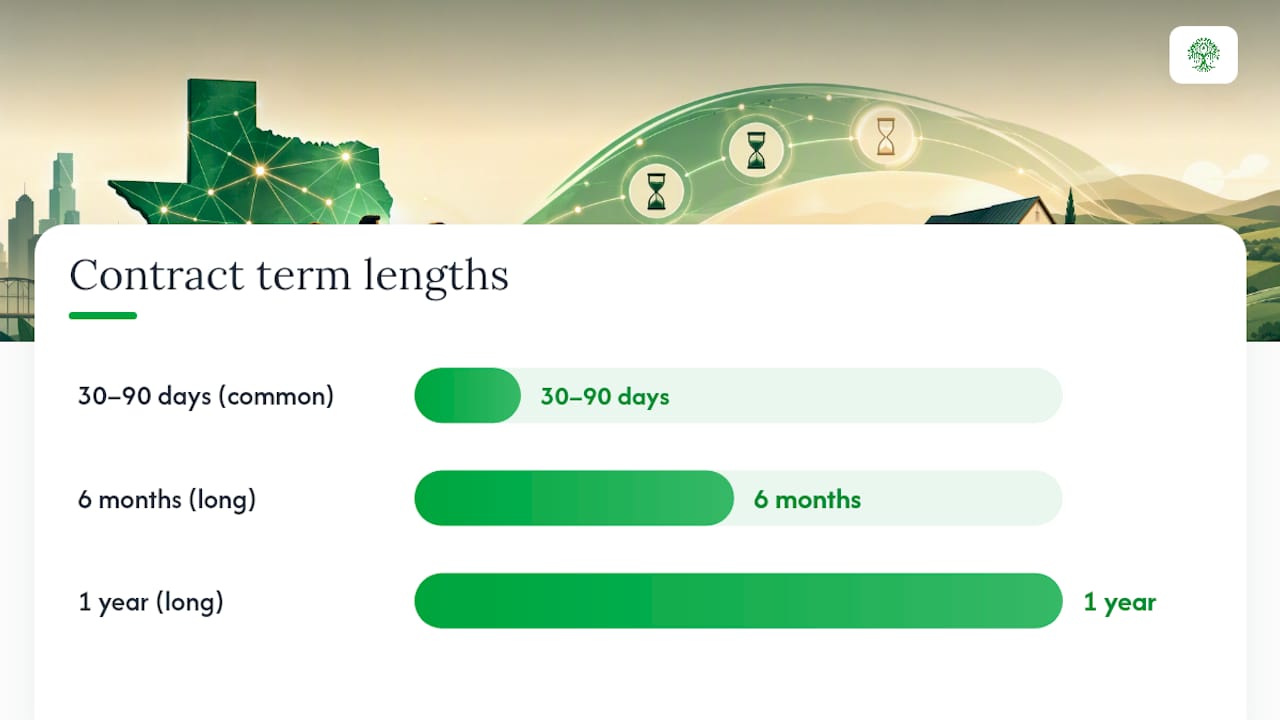
    • Termination date. Thirty to ninety days is common for first-time buyers still getting oriented. Six-month or one-year terms lock you in longer than most buyers realize until they want out.
    • Market area limits. Some agreements restrict representation to specific counties or ZIP codes. Confirm the areas you’re actually house hunting in are covered.
    • Carve-outs for new builds or FSBO listings. Builder sales offices and for-sale-by-owner deals sometimes have separate commission structures. Get clarity on whether your agreement’s compensation terms apply there too.

    Red flags to watch for: automatic renewal clauses with no notice period, compensation language that references “customary rates” instead of a number, and exclusivity terms with no easy exit.

    Pro Tip: Before signing, ask directly: “If the seller won’t pay your fee, am I responsible for the difference?” and “What exactly do I need to do to end this agreement early?” Get both answers in writing, not verbally.

    Understanding how real estate commission actually works for buyers and sellers helps you spot when a compensation clause is unusually favorable to the brokerage rather than to you.

    How Do You Negotiate Compensation and Terms Before You Sign? — overview diagram

    How Do You Get Out of a Buyer Representation Agreement in Texas?

    Buyer agreements are private contracts, not government-issued licenses, so getting released is between you and the broker (not TREC).

    • Request a release in writing. Most brokers will release a buyer who isn’t happy, especially early in the relationship, rather than deal with an unmotivated client.
    • Offer a reasonable compromise if needed. Some brokers ask for reimbursement of marketing costs or hours already spent; this is negotiable, not automatic.
    • Consult a private attorney for contract disputes. TREC does not resolve fee disputes or contract interpretation questions between buyers and brokers.
    • File a TREC complaint only for license law violations, like an agent showing property without any written agreement in place at all. TREC can discipline the license holder, but it won’t unwind your private contract for you.

    How Ficustree Builds 2026’s Transparency Rules Into Every Agreement

    Most of the friction in buyer representation agreements comes from vague language: compensation that’s “to be determined,” services that are loosely defined, termination dates that don’t exist. Ficustree’s model was built around the opposite instinct.

    That structure is disclosed upfront, not negotiated line by line after you’ve already toured five houses with an agent you’ve never signed anything with. Services, term length, and representation status are documented the same way for every buyer, which removes the guesswork the 2026 statute was designed to eliminate in the first place.

    Decision-intelligence tools also reduce a specific kind of friction first-time buyers hit: not knowing whether a clause is standard or unusual. When recommendations and next steps are explainable rather than opaque, buyers spend less time second-guessing paperwork and more time evaluating the house itself.

    — Anand

    Ready to Buy With a Clear Written Agreement in Place?

    If everything above made you want a simpler path through this paperwork, that’s the point of Ficustree. Instead of hunting for a Texas REALTORS® form and hoping your agent fills it out correctly, Ficustree gives first-time buyers in Texas a buyer representation agreement with the compensation, term, and services spelled out from day one, no vague “customary rate” language anywhere in it.

    Ficustree

    A premium platform with affordability calculators, neighborhood data, and on-demand showing agents is available to explore at any time. If you’re tired of piecing together advice about what a buyer’s agent actually does from five different websites, start by exploring your options at Ficustree and see what a transparent agreement looks like before you commit to one.

    This article is general information, not a substitute for advice from a qualified lawyer. Consult a qualified legal professional about your own circumstances before acting on anything here.

    Sources

    FAQ

    Is a Buyer Representation Agreement Required in Texas?

    Yes. Starting January 1, 2026, Texas Occupations Code §1101.563 requires a written agreement before an agent shows you residential property or presents an offer on your behalf.

    How Do You Get Out of a Buyer Representation Agreement in Texas?

    Request a written release from your broker; most agreements are private contracts and brokers can release buyers voluntarily. If the broker refuses and you believe a license law violation occurred, you can consult a private attorney or file a complaint with TREC.

    What Format Does a Texas Buyer Representation Agreement Use?

    TREC does not publish a standard form. Most brokers use Texas REALTORS® forms like the TXR 1501 or 1507, which include the required services, termination date, exclusivity status, and compensation disclosures.

    What Is a Buyer Representation Agreement?

    It’s a written contract between a home buyer and a real estate broker that defines the services provided, how long the relationship lasts, whether it’s exclusive, and how the broker gets paid. Under 2026 rules, it must exist before the agent shows you a home or presents an offer for you.

    Do You Need a New Agreement If Your Agent Changes Brokerages?

    Yes, in most cases. The contract is between you and the broker, not the individual agent, so if your agent switches firms, you typically stay bound to the original broker unless you’re released or sign a new agreement.

  • Exclusive Buyer Agency: NAR Rules and AI Tools First Time Buyers Need

    Exclusive Buyer Agency: NAR Rules and AI Tools First Time Buyers Need

    An exclusive buyer agency is a real estate arrangement where a broker represents only buyers, never sellers, and commits in writing to work solely for your interests throughout the search. That structure removes the dual-agency conflict that plagues traditional brokerages, and it generally pays off if you want an advocate with no listing-side loyalties competing for attention. The catch: read the compensation clause, the protection period, and the termination terms closely before you sign, because those details decide how easy it is to walk away if the relationship isn’t working.


    TL;DR:

    • Exclusive buyer agencies cannot represent sellers, eliminating conflicts of interest and ensuring your agent solely advocates for your home purchase.
    • State laws vary, with some banning dual agency outright, making exclusive buyer agency the clearest option for conflict-free representation.
    • You should verify contract details such as duration, protection periods, and fees to avoid long-term obligations and ensure the agent’s services align with your needs.
    • Since August 2024, buyer-agent fees are disclosed in writing beforehand, typically as a percentage around 2.4%, which can be negotiated for seller concessions.
    • First-time buyers benefit most from exclusive representation due to stronger negotiation power and full confidentiality, but budget for potential out-of-pocket fees if the seller does not cover commissions.

    Table of Contents

    What Exclusive Buyer Agency Means in Practice

    An exclusive buyer agency, sometimes called an exclusive buyer agent or exclusive buyer broker, is a firm that structurally cannot represent sellers. It’s not a policy choice made deal by deal. The business itself never accepts listings, which NAEBA argues removes the conflicts baked into traditional brokerages where the same office might represent both sides of a transaction.

    That “no listings, ever” rule changes how information flows to you. There’s no incentive to steer you toward in-house inventory or soften your negotiating position to protect a seller relationship down the hall.

    In practice, exclusive buyer agencies search everywhere a home might surface:

    • The MLS, same as any licensed agent
    • For-sale-by-owner listings that traditional brokerages sometimes skip
    • Pocket listings and pre-market opportunities shared through local networks
    • New construction and builder inventory, negotiated directly on your behalf

    Exclusive Buyer Agency vs. Dual Agency, Designated Agency, and Nonexclusive Deals

    Dual agency happens when one agent, or one brokerage, represents both the buyer and the seller in the same transaction. Designated agency tries to soften that by assigning two different agents from the same office, one to each side, but they still answer to the same broker and the same bottom line. Both models create a structural conflict that a true exclusive buyer agency simply cannot have, because the firm never lists homes.

    State law matters here. Several states restrict or ban dual agency outright, including Alaska, Colorado, Florida, Kansas, Maryland, Texas, Vermont, and Wyoming, though rules vary by state and this is not an exhaustive list.

    Nonexclusive buyer agreements sit in the middle ground:

    • You can work with multiple agents simultaneously without breaching contract
    • No agent has to commit full attention, since any of them could lose the sale to a competitor
    • They can suit buyers who are still shopping for the right agent or testing the market casually
    • The trade-off is diluted focus. An agent splitting attention across several non-binding leads has less reason to fight hard for your specific deal

    Key Contract Clauses to Check Before You Sign

    An exclusive buyer agency agreement is a binding contract, and the details decide whether it protects you or traps you. Before signing anything, walk through these points:

    1. Duration and termination. Know the exact expiration date and what notice period, if any, lets you exit early.
    2. Compensation. Get the fee or percentage in writing, along with any language about seller concessions covering it.
    3. Procuring cause and protection period. This clause can obligate you to pay your agent even after the agreement ends, if you buy a home they showed you within a set window.
    4. Scope of services. Confirm what’s included, such as showings, offer strategy, and negotiation, and what falls outside the agreement.
    5. Confidentiality terms. Since exclusive buyer agencies never represent sellers, this section should clearly state your information stays with your agent alone.

    Watch for red flags: open-ended fee language with no cap, protection periods stretching six months or longer, or termination clauses that require the agent’s approval rather than simple written notice.

    Pro Tip: Ask for the protection period in writing and negotiate it down to 30 or 60 days. A shorter window protects the agent’s legitimate interest without locking you into a relationship that isn’t working.

    Key Contract Clauses to Check Before You Sign — overview diagram

    How Buyer-Agent Compensation Works Now

    Since August 17, 2024, NAR requires written buyer agreements that spell out services and compensation before you tour homes. That single change reshaped how buyers pay for representation.

    Buyer-agent fees now show up in a few common shapes:

    • A flat fee, often used by AI-driven or streamlined brokerages
    • A percentage of the purchase price, commonly cited around 2.4% on average
    • A blended structure combining a smaller flat fee with a reduced percentage

    On a $500,000 home at 2.4%, that’s $12,000 in agent compensation. You can negotiate seller concession language into your offer asking the seller to cover part or all of that fee, and in many markets sellers still agree, though leverage depends on local competition. One practical note: buyer-agent commissions typically can’t be rolled into your mortgage, so budget cash for it separately at closing.

    Weighing the Advantages Against the Trade-Offs

    Exclusive buyer agency delivers real benefits, but it’s not automatically the right fit for every buyer.

    The advantages are concrete:

    • A dedicated fiduciary duty with zero listing-side bias, since the firm never represents sellers
    • Stronger negotiation posture, since your agent has no relationship with the seller to protect
    • Full confidentiality on your finances, motivations, and walk-away price
    • One estimate suggests dual-agency transactions can cost buyers 2 to 5% of purchase price in missed negotiation value, though results vary by deal and market

    The trade-offs are real too: you may pay out of pocket if a seller won’t cover the fee, you lose the flexibility to shop multiple agents at once, and procuring-cause disputes can arise if you switch agents mid-search.

    Pro Tip: First-time buyers and anyone who needs hands-on negotiation support tend to benefit most from exclusive representation. Confident repeat buyers with a strong local network sometimes prefer the flexibility of a nonexclusive arrangement instead.

    A Checklist for Evaluating and Negotiating Your Agreement

    Before you sign a buyer representation agreement, work through these steps in order:

    1. Confirm the exact compensation number, in dollars or percentage, and budget for the possibility you’ll pay it yourself.
    2. Draft seller concession language into your offer strategy so you can ask the seller to cover the fee when the market allows it.
    3. Negotiate the protection period down to a specific, short window and confirm exactly how termination works.
    4. Request a written scope of services, plus references or recent outcomes from buyers the agent has represented.
    5. If anything feels ambiguous, get a quick legal review, and document any agreed changes in writing before you sign.

    Following this order protects you from the two most common traps: vague compensation language and open-ended protection periods that outlast the working relationship.

    How Ficustree Approaches Exclusive Buyer Representation

    A buyer-only platform offers no seller listings, no split loyalties, and pricing disclosed before you tour a home. Premium platforms often include affordability tools and neighborhood insights available at no cost.

    The decision intelligence approach pairs that buyer-only structure with practical tools: an affordability calculator that accounts for PITI, HOA dues, and maintenance costs, on-demand showing agents you can book hourly instead of committing to one full-time agent, and search that pulls from broad inventory rather than a single office’s listings.

    Whatever provider you’re evaluating, ask these questions:

    • Does the firm ever accept seller listings, even occasionally?
    • Is the fee structure disclosed in writing before you tour homes?
    • Can you book showings on demand, or only through one dedicated agent’s calendar?
    • What happens to your protection period if you need to pause your search?

    Buyer-only representation isn’t a marketing label. It’s a structural fact about who a brokerage answers to, and it shows up in every negotiation from the first offer to the final walkthrough.

    A Note on Buyer Advocacy and Fairness

    Representation only means something when the person across the table has no reason to protect anyone but you. That’s the entire case for exclusive buyer agency, and it’s why the contract details matter as much as the philosophy behind them. A great advocate with a bad protection clause can still cost you flexibility you didn’t know you were giving up.

    Read your agreement line by line, and choose someone whose business model has no seller-side loyalties to manage.

    — Anand

    Getting Started With Ficustree’s Buyer-Only Service

    Ficustree works the way exclusive buyer agency should: no listings competing for attention, no hidden fee surprises, just representation built around you. If you’ve been weighing whether to sign a buyer broker agreement at all, this is the alternative to a traditional agency that shows you the math up front instead of after you’ve committed.

    Ficustree

    Getting started takes three steps. Share your search criteria and budget through the buyer landing page, book a quick consult to review how the $1,000 plus 1% commission structure applies to your situation, and read through your buyer representation agreement together before anything gets signed. If you want to see how the platform handles the early research phase first, the home buying workflow guide walks through what the first few weeks actually look like.

    Sources

    This article draws on NAEBA’s guidance on exclusive buyer agents, NAR’s consumer guide to written buyer agreements, and legal analysis on commission responsibility and procuring cause. Each source addresses a different piece of the picture: buyer-only advocacy, disclosure requirements, and who actually pays at closing.

    FAQ

    What Is a Disadvantage of Exclusive Buyer Agency?

    The main disadvantage is reduced flexibility. You’re committed to one agent for the agreement’s duration, and a poorly negotiated protection period can obligate you to pay that agent even if you switch representation later.

    Is It Worth Using a Buyer’s Agent?

    For most first-time buyers, yes. A dedicated buyer agent brings negotiation focus and no listing-side bias, and dual-agency deals may cost buyers 2 to 5% in missed negotiation value by comparison.

    Can a Seller Refuse to Pay a Buyer’s Agent?

    Yes. Since the 2024 changes to buyer agreements, sellers are not obligated to cover buyer-agent compensation, and buyers should budget for the possibility of paying it themselves at closing.

    How Do I Get Out of an Exclusive Agency Agreement?

    Check the termination clause first. Most agreements allow written notice to end the relationship, though a procuring-cause or protection period clause may still apply to homes your agent already showed you.

    Does Ficustree Charge Like a Traditional Buyer Agent?

    No.

  • Save on First Home: Flat Fee Buyer Agents with Rebates in California

    Save on First Home: Flat Fee Buyer Agents with Rebates in California

    A flat-fee buyer agent charges a set dollar amount, or a small fixed percentage, instead of the standard commission split, and for most California first-time buyers it is worth serious consideration. The model tends to save the most money on mid-range and higher-priced homes, and it works best when the agent puts every fee and rebate term in writing before you sign anything. If you’re comparing options right now, start by asking each agent for their exact fee structure and rebate percentage in plain numbers, not percentages buried in fine print.


    TL;DR:

    • Flat-fee buyer agents commonly charge fixed amounts or hybrid fees that can significantly reduce costs on higher-priced homes.
    • Some agents offer rebates that are fully disclosed and can be stacked with local programs, potentially lowering your total closing costs.
    • Service inclusions vary widely and may incur extra charges, so comparing what is included versus additional fees is critical.
    • Verify all fee and rebate terms in writing, confirm licensing, and ask how rebates are handled if the deal falls through to avoid surprises.
    • Rebate availability and the prevalence of flat-fee options tend to be higher in coastal and high-cost California markets, with rural areas offering fewer choices.

    Table of Contents

    What Is a Flat Fee Buyer Agent, and How Does the Model Work?

    A flat-fee buyer agent charges a predetermined dollar amount, or a small fixed fee plus reduced commission, instead of the traditional percentage cut that often applies to the sale price. The difference matters more than it sounds. Under the old model, a $700,000 home and a $1.2 million home generate wildly different paychecks for identical work, negotiating an offer, reviewing disclosures, coordinating escrow. A flat fee decouples pay from price.

    This shift is part of a broader unbundling trend across real estate. Platforms increasingly separate the operational grind (paperwork, scheduling, coordination) from the specialized work (offer strategy, negotiation, risk review), a pattern HousingWire has documented accelerating after recent commission rule changes. Instead of one all-inclusive bundle, buyers pick services piece by piece.

    Common arrangements include:

    • Hourly agents for buyers who want specific task support
    • Flat dollar fees covering the purchase process
    • Hybrid models combining a small flat fee with a reduced commission percentage
    • Fees paid at closing, deducted from proceeds rather than billed upfront

    Read our buyer’s agent overview for the fundamentals if you’re new to how agent compensation works at all.

    What Do Flat-Fee Buyer Agents Typically Charge?

    Pricing varies more than most buyers expect, and the tier you pick should match how much hand-holding you actually need. Pricing varies considerably depending on the services offered and market. Options range from hourly consulting to low, mid-range, and full-service flat fees, sometimes combined with a reduced commission percentage. Exact fees differ widely by agent and region.

    Industry coverage shows platforms increasingly favoring set-dollar fees or 1% hybrids as direct alternatives to percentage commissions, especially in competitive coastal markets where median prices push traditional commissions into the tens of thousands.

    Before comparing offers, ask exactly when the fee is due (at signing, at closing, or in installments) and whether it’s refundable if the purchase falls through. Our breakdown of how real estate commission works walks through the math on traditional splits, which makes the flat-fee comparison much easier to see.

    What Do Flat-Fee Buyer Agents Typically Charge? — overview diagram

    Yes. California permits buyer-agent commission rebates as long as the arrangement is fully disclosed, and the mechanics are simpler than most first-time buyers assume. The rebate typically shows up as a credit on your closing statement, run directly through escrow rather than handed to you as a check.

    There’s no standard rebate rate. The amount depends entirely on what the agent negotiates as their own compensation and how much of that they agree to return, which is exactly why getting the exact percentage in writing before you make an offer protects you from vague verbal promises.

    A few practical rules matter here:

    • Disclose the rebate early. Late credits can trigger lender re-disclosure requirements and delay your closing date.
    • Tell your loan officer about any expected rebate as soon as you’re under contract, not the week before closing.
    • Confirm in writing exactly how escrow will apply the credit, toward closing costs, a price reduction, or cash back within legal limits.

    Rebates often carry no income cap, which is what makes them a flexible tool for buyers who earn too much to qualify for traditional first-time buyer grants. They can frequently be stacked with CalHFA and local county programs, though sequencing and eligibility vary by county, so confirm order of operations with your lender before you count on both. Our closing costs breakdown shows where rebate credits typically land on the settlement statement.

    What’s Included in a Flat Fee, and What Costs Extra?

    Comparing flat-fee agents purely on price misses the point; understanding a full-service real estate brokerage can help clarify the differences in service offerings and value. Two agents charging the same $1,500 flat fee can offer very different scopes of service, and reporting on unbundled models consistently urges buyers to compare included services, not just headline numbers.

    Standard inclusions usually cover:

    • MLS access and property search support
    • Offer drafting and negotiation
    • Standard transaction coordination through closing
    • Disclosure review and basic contract guidance

    Add-ons that often cost extra:

    • Extensive in-person showings beyond a set number
    • Contract amendments after the initial offer
    • Support during a dispute or transaction litigation
    • Home inspection coordination, which our inspection checklist explains in more detail

    Pro Tip: Watch for agreements that say “showings included” without specifying a number. If it doesn’t say “unlimited,” assume there’s a cap, and ask what happens (and what it costs) once you hit it.

    How Do You Choose a Flat Fee Buyer Agent?

    Vetting a flat-fee agent takes a slightly different checklist than vetting a traditional one, because price alone tells you almost nothing about value. Work through these steps before signing:

    1. Verify the license. Confirm active status through the California DRE license lookup, no exceptions.
    2. Get the fee and rebate terms in writing. Verbal promises about rebate percentages or included services don’t hold up if a dispute arises later.
    3. Ask how escrow handles the rebate. Get specifics on timing and whether it appears as a credit or reduces the purchase price.
    4. Ask what happens if the deal falls through. Some flat fees are earned at signing regardless of outcome; others are refundable.
    5. Request references from recent buyers, ideally in your price range and county, since service quality can vary by market.
    6. Ask about showing availability. Is it on-demand, scheduled days ahead, or capped at a certain number per month?

    Red flags worth walking away from: agents who won’t put fee terms in writing, vague answers about rebate mechanics, or pressure to sign before you’ve compared at least one other option.

    How Much Could You Actually Save?

    Run the numbers on a $750,000 home, a common price point in many California metro areas. A traditional buyer-side commission charged as a percentage results in a much higher fee than a flat-fee arrangement, which might charge a fixed amount plus a rebate. Exact savings depend on negotiated fees and rebate shares.

    The exact figure depends on your local median price and the specific rebate percentage your agent offers, so recalculate using your own target price range.

    Does Flat-Fee Buyer Representation Vary by California Market?

    Availability isn’t uniform across the state, and that gap matters more in some counties than others. Dense metro markets, the Bay Area, Los Angeles, San Diego, tend to have more flat-fee and hybrid-fee agents competing for business, partly because higher median prices make percentage commissions look disproportionately large next to the actual work involved.

    Rural and smaller inland markets often have fewer flat-fee options simply because there are fewer agents overall, and lower home prices shrink the dollar gap between a flat fee and a percentage commission.

    Coastal and high-cost counties also tend to have more competitive rebate offers, since agents in expensive markets have more room to shave a meaningful dollar amount off their own compensation and still come out ahead on volume. If you’re buying in a lower-cost county, don’t assume the same rebate percentages you see advertised in Los Angeles listings will show up locally. Ask any agent, flat-fee or traditional, whether they actively work your specific county and how many transactions they’ve closed there recently.

    Does Flat-Fee Buyer Representation Vary by California Market? — overview diagram

    Why AI-First Buyer Representation Fits First-Time Buyers Better

    Traditional buyer representation asks you to trust a stranger with the biggest purchase of your life, based mostly on a first phone call. Decision intelligence platforms flip that. When affordability calculations, disclosure analysis, and offer strategy run through explainable AI before you ever talk to an agent, you walk into every conversation already knowing your numbers.

    That clarity compresses timelines. A transparent flat fee, paired with an on-demand hourly showing agent instead of one person’s calendar, means first-time buyers get support scaled to their actual budget rather than a one-size-fits-all retainer.

    — Anand

    Ficustree: A Transparent Flat-Fee Option Worth Comparing

    If you’re weighing hourly consultants against full flat-fee packages, here’s a third option worth putting on your list. Ficustree offers a flat-fee buyer representation model including a fixed closing fee plus commission, and provides rebates where legally permitted.

    ficustree

    You get access to a platform with affordability calculators, neighborhood insights, and offer strategy support, plus hourly showing agents available on demand. That combination matters most for first-time buyers juggling a day job with house hunting on weekends. Compare Ficustree’s written fee and rebate terms against any flat-fee or traditional agent you’re considering. If the numbers hold up, start your search with Ficustree and see your affordability numbers before you ever schedule a showing.

    Sources

    Always confirm current lender rules and county-level program eligibility directly with your loan officer before finalizing any rebate strategy.

    FAQ

    Is it worth using a buyer’s agent?

    For most first-time buyers, yes. Professional negotiation, disclosure review, and transaction coordination reduce costly mistakes, and flat-fee or hybrid models now make that representation available at a fraction of traditional commission costs.

    Yes, flat-fee and unbundled real estate models are legal nationwide, including in California, and have grown following recent commission rule changes across the industry.

    What is the best flat-fee MLS listing service?

    This depends on your specific needs, since flat-fee MLS listing services (for sellers) differ from flat-fee buyer representation (for buyers); confirm which service type you actually need before comparing providers.

    Yes, California permits buyer-agent commission rebates when fully disclosed, typically applied as a credit through escrow and reflected on your closing statement.

  • Avoid Closing Delays: TWIA, WPI-8 and Windstorm Insurance in Texas

    Avoid Closing Delays: TWIA, WPI-8 and Windstorm Insurance in Texas

    Windstorm insurance isn’t mandatory under Texas state law, but if you own property in a first-tier coastal county or Harris County, your mortgage lender will almost certainly require it, and standard homeowners policies there typically exclude wind and hail. The Texas Windstorm Insurance Association (TWIA) exists as the insurer of last resort for these areas. Your first move: check your lender’s requirement and search for a WPI-8 certificate on the property.


    TL;DR:

    • Private insurers frequently exclude wind and hail coverage in first-tier coastal counties, making TWIA or a separate wind endorsement essential for homeowners.
    • The typical windstorm policy covers damages to the structure, detached structures, personal belongings, and temporary living expenses, but excludes flood, wear and tear, and landscaping.
    • Obtaining a valid WPI-8 Certificate of Compliance is crucial, as its absence can block TWIA coverage and harm resale value, with inspections triggered by new construction or significant modifications.
    • Windstorm premiums vary based on construction type, proximity to the coast, coverage limits, and deductible choice, with percentage deductibles often resulting in higher out-of-pocket costs.
    • Buyers should verify WPI-8 existence before closing, ask for seller claims history, and build insurance premiums into their affordability assessments to avoid surprises on closing day.

    Table of Contents

    What Does Windstorm Insurance Cover in Texas?

    Windstorm insurance pays to repair or rebuild a home damaged by wind or hail, including damage tied to hurricanes, tropical storms, and tornadoes. It does not cover flooding, even when a hurricane causes the flood. That’s a separate policy entirely, through the National Flood Insurance Program or a private flood carrier.

    A typical windstorm policy breaks coverage into four parts:

    • Dwelling coverage: repairs or rebuilds the structure itself.
    • Other structures: detached garages, fences, and sheds.
    • Personal property: furniture, electronics, and belongings damaged by wind-driven rain or hail.
    • Loss of use: hotel bills and living expenses if the storm makes your home temporarily unlivable.

    Buyers often assume their homeowners policy already includes this. In coastal Texas, it frequently doesn’t. Wind and hail get carved out entirely, leaving TWIA or a separate wind endorsement as the only way to fill the gap.

    Where Is Windstorm Coverage Required in Texas?

    Texas doesn’t mandate windstorm insurance statewide, but geography and your lender decide the question for you in practice. The requirement clusters around the coast.

    • First-tier coastal counties: These sit directly on the Gulf, including Galveston, Nueces, Aransas, and Cameron. Private insurers routinely exclude wind and hail here, pushing homeowners toward TWIA.
    • Harris County exception: Parts of Harris County near the coast fall under TWIA’s designated catastrophe area, even though the county as a whole isn’t classified as first-tier.
    • Lender-driven requirement: Even where state law is silent, mortgage lenders in these zones typically will not close a loan without proof of windstorm coverage, separate from your flood or homeowners policy.
    • Inland surprises: Some inland private carriers exclude wind and hail from otherwise standard homeowners insurance, particularly after several rounds of severe hail losses. Always check your declarations page for a wind/hail exclusion, wherever you’re buying.

    If you’re shopping for a home near the coast, the safest assumption is that Texas storm insurance rates and requirements will factor into your closing timeline, not just your monthly payment.

    What Is TWIA and Why Does It Exist?

    TWIA is a residual-market insurer created under Texas Insurance Code Chapter 2210 to provide windstorm and hail coverage when private insurers won’t. It doesn’t compete with private carriers. It exists because they’ve largely withdrawn from wind and hail exposure along the coast, leaving a gap that would otherwise strand thousands of homeowners without coverage.

    Eligibility isn’t automatic. A property must sit inside the designated catastrophe area, and applicants generally need a declination from at least one private insurer before TWIA will write a policy. Many structures also need a Certificate of Compliance, the WPI-8, before TWIA will insure them at all.

    TWIA’s funding works in layers, not a single pool of cash:

    • Policyholder premiums and TWIA’s own reserves cover routine losses.
    • Catastrophe reserve funds and state-authorized financing kick in for larger events.
    • Member insurer assessments and reinsurance backstop the system in a severe hurricane season.

    This layered funding structure matters to you as a policyholder because it’s part of why TWIA covers wind and hail only, nothing else. Keep that boundary in mind. It’s the single most common misunderstanding among first-time coastal buyers.

    How Do You Check a WPI-8 Certificate?

    The Windstorm Inspections Program has existed since 1988, and it runs on a small alphabet soup of forms that each mean something different.

    1. WPI-1: The application for inspection, filed before construction or major renovation begins.
    2. WPI-2: The inspector’s report confirming the work meets windstorm building code.
    3. WPI-8: The Certificate of Compliance itself, the document TWIA and most coastal insurers require before writing a policy.
    4. WPI-8-E: A temporary certificate issued when final inspection is pending but the structure is otherwise substantially complete.

    You can look up an existing WPI-8 record through the Texas Department of Insurance’s online database using the property address. If the record is missing or wrong, contact TDI’s Windstorm Inspections Program directly. Don’t wait until closing week to sort it out.

    Timing matters more than most buyers expect. New construction, additions, roof replacements, and window retrofits in the catastrophe area all trigger a fresh inspection requirement. Skip it, and you may find the home uninsurable through TWIA regardless of its actual condition.

    Pro Tip: A missing WPI-8 doesn’t just block TWIA coverage today. It can scare off a private carrier’s underwriter and lower your resale value later, since the next buyer’s insurer will ask the same question.

    How Much Does Windstorm Insurance Cost in Texas?

    Windstorm premiums swing widely based on where the home sits, how it’s built, and what deductible you choose. There’s no flat number that applies to every coastal property.

    Deductibles come in two flavors, and the difference changes your out-of-pocket cost dramatically:

    • Flat deductible: A set dollar amount, say $1,000, regardless of the loss size.
    • Percentage deductible: A percentage of the dwelling coverage limit, often 1% to 5%. On a $300,000 dwelling limit, a 2% deductible means you cover the first $6,000 of any claim yourself.

    Premium drivers include:

    • Construction type and age (masonry generally costs less to insure than frame construction).
    • Proximity to the coastline.
    • Coverage limits and the deductible percentage you select.
    • Mitigation credits for code-compliant construction and protected openings.

    The Texas Department of Insurance notes that windstorm coverage costs vary substantially by location and structure, which is exactly why two neighbors on the same street can pay very different premiums depending on when their roof was last replaced.

    How Do You Get Windstorm Coverage in Texas?

    Getting covered follows a sequence, and skipping a step usually means starting over.

    1. Contact a licensed agent first. TWIA applications must be submitted through a Texas-licensed agent, not directly by the homeowner.
    2. Try the private market. Your agent will typically shop private wind/hail coverage before considering TWIA.
    3. Get a declination if private coverage falls through. A declination isn’t just a “no.” An offer that isn’t substantially equivalent to the coverage you’re seeking can also count, a nuance worth confirming with your agent before you assume you’re stuck.
    4. Submit the TWIA application with your WPI-8 if the structure requires one.
    5. Do this early. You cannot obtain a new TWIA policy while a named storm sits in the Gulf of Mexico. Waiting until a hurricane watch is issued means you’re too late.

    How Do You File a Windstorm Claim in Texas?

    File as soon as it’s safe to inspect the property, either through your agent, the TWIA website, or by phone. Photograph everything before you touch anything, and keep receipts for any emergency repairs, tarps, or temporary lodging.

    • Report the claim promptly. Delayed filing complicates the adjuster’s ability to tie damage to the specific storm.
    • Expect an inspection, often paired with aerial imagery review, followed by a repair estimate.
    • If you disagree with the payout, most policies offer an appraisal window, a defined period during which you can invoke a formal appraisal process rather than accepting the initial number.

    Pro Tip: Keep a folder, physical or digital, with your policy declarations page, the WPI-8, and dated storm photos before hurricane season even starts. You’ll move through the claim twice as fast when you’re not hunting for paperwork after the fact.

    Mitigation Credits and a Buyer’s Due-Diligence Checklist

    Premium credits reward homes built to current wind codes and homes with protected openings, meaning storm shutters or impact-rated windows and doors. Retrofits qualify too, but only once an inspector certifies the work and it’s logged into the WPI system.

    • Ask your insurer or agent which specific upgrades qualify for a credit before you spend money on them.
    • If you’re retrofitting, schedule the inspection before you close up the walls, not after.
    • As a buyer, verify the WPI-8 exists and matches the current structure, not an earlier version of the home.
    • Request the seller’s insurance claims history and current windstorm declarations page during due diligence.
    • Build an inspection and insurance contingency into your offer, giving you room to walk away if the WPI-8 is missing or the estimated premium busts your budget.

    Pro Tip: Run the windstorm premium estimate before you finalize your offer price, not after. A tool like Ficustree’s affordability calculator folds insurance costs into your true monthly payment, so a coastal listing that looks affordable on paper doesn’t turn into a budget problem at closing.

    What Should You Do Before, During, and After a Windstorm?

    Preparation before the storm determines how smoothly your claim goes afterward. Start with your paperwork: confirm your windstorm policy number, deductible type, and WPI-8 status are all current, and store copies somewhere other than the house itself, ideally in cloud storage or with a family member inland.

    Before the storm arrives, walk the property and photograph every exterior surface, including the roof if you can safely access it, along with fences, detached structures, and any recent improvements like new windows or shutters. Bring in or secure loose outdoor items that could become debris. Note your home’s current condition in writing, with a timestamp, since this becomes your baseline for comparison.

    During the storm, your only job is staying safe. Don’t attempt repairs, don’t go outside to “check on things,” and don’t try to document damage while wind and hail are still active. Insurers expect claimants to avoid unnecessary risk, and a mid-storm injury complicates everything.

    After the storm, once local authorities confirm it’s safe, photograph the damage from multiple angles before making any repairs. Make only the temporary repairs necessary to prevent further damage, tarping a roof or boarding a broken window, and keep every receipt. Contact your agent or TWIA to open a claim immediately rather than waiting to see if damage “gets worse.” Write a room-by-room inventory of damaged contents while details are fresh. Avoid signing anything from a door-to-door contractor promising a quick fix; verify licensing and insurance before hiring anyone for storm repairs, especially in the chaotic days right after a major hurricane.

    What Do Texas Windstorm Policies Typically Exclude?

    Texas windstorm coverage is narrower than most new buyers expect, and the exclusions matter as much as the coverage itself.

    Flood damage sits at the top of the list. Even when a hurricane’s storm surge causes the water damage, a windstorm policy won’t pay for it; that requires flood insurance through the National Flood Insurance Program or a private flood carrier. This trips up buyers constantly, since “the hurricane caused it” doesn’t automatically mean “windstorm insurance covers it.”

    Other common exclusions and limitations include:

    • Wear and tear or pre-existing damage. An adjuster who finds evidence of an older, unrepaired roof problem may attribute some damage to prior neglect rather than the storm.
    • Landscaping and pools, which are often limited or excluded entirely depending on the policy’s specific terms.
    • Business personal property, if you run a home-based business, which typically needs a separate commercial policy rider.
    • Mechanical breakdown, such as an air conditioning compressor failure unrelated to direct wind or hail impact.
    • Ordinance or law upgrades, meaning the cost to rebuild to current building code standards beyond your prior structure, unless you’ve purchased a specific endorsement for it.

    TWIA policies add one more limitation worth flagging: they cover wind and hail only. No fire, no theft, no liability. That’s why most coastal homeowners carry a TWIA policy alongside a standard homeowners policy that handles everything else, rather than treating either one as a complete solution on its own.

    How Does Windstorm Insurance Work With Your Homeowners Policy?

    Windstorm insurance in Texas usually doesn’t replace your homeowners policy. It fills the specific hole that policy leaves open in high-risk coastal areas. Think of it less as a competing product and more as a puzzle piece that has to click into the rest of your coverage exactly right.

    In practice, this means a coastal homeowner often carries three separate policies working together: a homeowners policy covering fire, theft, liability, and everything not wind-related; a windstorm policy (private or through TWIA) covering wind and hail specifically; and a flood policy covering water intrusion from storm surge or heavy rain. Miss one, and you’ve got a gap nobody catches until a claim gets denied.

    The coordination gets tricky after a hurricane, since wind and flood damage often hit the same property simultaneously. Insurers and adjusters have to determine which peril caused which damage, a process that can slow claims when the two policies come from different carriers. Keeping detailed, dated photos of damage as it appears, before any cleanup begins, gives both adjusters the evidence they need to allocate the claim correctly instead of arguing over it.

    Your mortgage lender typically requires proof of all three coverages before closing in a designated catastrophe area, and letting any one lapse can put you in default on your loan terms, not just uninsured. If you’re bundling homeowners and windstorm coverage with different carriers, keep both declarations pages together and review them every renewal to confirm the wind/hail exclusion language on your homeowners policy still matches what your windstorm policy is actually covering.

    How Does Windstorm Insurance Work With Your Homeowners Policy? — overview diagram

    What Options Exist Beyond Appraisal for Claim Disputes?

    Appraisal is the most commonly used dispute tool, but it isn’t the only one, and it isn’t always the right first move.

    Mediation offers a faster, less adversarial alternative. A neutral third party helps you and the insurer negotiate toward a settlement without the formality of appraisal or the cost of litigation. The Texas Department of Insurance offers mediation for certain property claims, and it tends to work best when the dispute is about a specific line item or valuation gap rather than a wholesale coverage denial.

    Appraisal, when your policy includes the provision, lets each side hire an appraiser, and the two appraisers pick a neutral umpire if they disagree on value. It settles the dollar amount of the loss but doesn’t resolve questions about whether something is covered at all.

    Filing a complaint with TDI is worth doing even alongside another dispute path. It creates a formal record and sometimes prompts the insurer to revisit a claim faster than internal appeals alone.

    Litigation becomes the option when coverage itself, not just the amount, is in dispute, or when an insurer is acting in bad faith. Texas law gives policyholders specific rights against unfair claims settlement practices, and an attorney experienced in property insurance disputes can advise whether your specific denial or delay crosses that line. Litigation takes longer and costs more than the other paths, so it’s usually a last resort rather than a first step.

    Whichever path you choose, the documentation you gathered immediately after the storm, photos, contractor estimates, and your written damage inventory, becomes the evidence that decides how fast and how favorably any of these processes resolve.

    What Options Exist Beyond Appraisal for Claim Disputes? — overview diagram

    How Do You Choose a Windstorm Insurance Agent in Texas?

    Not every agent handles coastal windstorm business regularly, and that experience gap shows up exactly when you need it least, during a claim dispute or a WPI-8 problem nobody anticipated.

    Look for an agent who is explicitly licensed to submit TWIA applications, since that’s a requirement, not a courtesy. Ask directly how many TWIA policies they’ve written in the past year. An agent who handles this weekly will know the declination nuances and moratorium timing cold, while one who rarely touches windstorm coverage may miss a detail that costs you weeks at closing.

    Ask how the agent handles claims support, not just sales. A good agent stays involved after the policy is written, helping you gather documentation and pushing back when an adjuster’s initial estimate looks low. Check how quickly they respond to questions before you buy, since that responsiveness rarely improves once you’re a paying customer.

    Independent agents who represent multiple carriers can shop the private market before defaulting to TWIA, often finding better rates or broader coverage than the residual market provides. A captive agent tied to one insurer can’t do that comparison for you.

    Finally, ask for references from other coastal clients, and check the agent’s standing with the Texas Department of Insurance for any disciplinary history. A few extra questions upfront save real frustration later, particularly the first time you file a claim after a major storm.

    An Editorial Take on Windstorm Costs and Offer Strategy

    Coastal desirability and windstorm costs pull in opposite directions, and too many first-time buyers price the home before pricing the insurance. Build a real premium estimate, not a guess, before you write an offer. Use inspection contingencies to force WPI-8 verification and request the seller’s claims history outright. True affordability means PITI plus that windstorm premium, not PITI alone.

    — Anand

    How Ficustree Helps You Factor Windstorm Costs Into Your Offer

    Some home buying platforms provide affordability modeling that factors in windstorm premiums, HOA dues, and maintenance, not just principal and interest, to help buyers understand costs earlier in the process.

    Ficustree

    If you’re weighing a coastal property against an inland one, book an hourly showing agent through Ficustree to walk both and pull the insurance documentation on-site. Start by comparing your target areas on the neighborhood comparison tool before you commit to a coastal search.

    Where to Verify Windstorm Rules and Coverage

    For official guidance, check the Texas Department of Insurance’s windstorm page, TWIA’s coverage and eligibility page, and Ficustree for buyer-focused affordability tools.

    FAQ

    What Is the Average Cost of Windstorm Insurance in Texas?

    Costs vary widely by location, construction type, and deductible choice, with coastal properties near the Gulf typically paying more than inland homes with wind/hail coverage. There’s no single statewide average that applies reliably to every property.

    Is There an Alternative to Texas Windstorm Insurance?

    Private insurers sometimes offer wind/hail coverage outside TWIA, but if you’re declined or offered coverage that isn’t substantially equivalent, TWIA becomes the practical fallback in designated catastrophe areas.

    Which Counties in Texas Require Windstorm Insurance?

    First-tier coastal counties, including Galveston, Nueces, Aransas, and Cameron, along with parts of Harris County, fall within TWIA’s designated catastrophe area where lenders typically require separate windstorm coverage.

    Is Windstorm Insurance Worth It in Texas?

    For coastal properties, it’s effectively non-optional since lenders require it and standard homeowners policies exclude wind and hail there. Even inland, it’s worth checking your policy for a wind/hail exclusion before assuming you’re covered.

    How Do I File a Windstorm Claim in Texas?

    Contact your agent or TWIA directly by phone or through their website as soon as it’s safe, and document damage with photos before making repairs beyond temporary protection like tarping.

  • Texas Buyers: Lock Replacement Cost Homeowners Insurance, Ficustree

    Texas Buyers: Lock Replacement Cost Homeowners Insurance, Ficustree

    For most Texas homeowners, the right approach is not chasing the cheapest quote. It is shopping the admitted market first, confirming replacement-cost dwelling coverage, and treating the Texas Windstorm Insurance Association (TWIA) or the Texas FAIR Plan as placement lanes rather than first choices. Check the roof valuation method and the wind/hail deductible before you sign anything, buy flood coverage separately if your home carries any risk, and if you are still shopping while buying a house, a buyer-representation platform like Ficustree can help you line up insurance timing with your closing date.


    TL;DR:

    • Homeowners in coastal or hail-prone areas should prioritize policies with lower wind and hail deductibles to avoid upfront costs exceeding insurance payouts after a storm.
    • It is essential to verify whether coverage is based on replacement cost or actual cash value, especially for roofs over 15 years old, to prevent depreciation from reducing claim payments.
    • Comparing insurance quotes requires checking each policy’s deductible dollar amount, roof valuation method, and coverage limits, rather than just focusing on premium prices.
    • Buyers should avoid canceling existing policies until new coverage is fully in effect and align insurance effective dates with their closing schedule to prevent coverage gaps.
    • For homes declined in the voluntary market, the Texas FAIR Plan and TWIA serve as residual options, but their policies typically come with narrower scope and higher deductibles than standard insurers.

    Table of Contents

    What Does “Best” Mean for Homeowners Insurance in Texas?

    There is no single best homeowners insurance company in Texas, because the right policy depends on where your house sits and what it is made of. A brick home in Plano fifty miles from the coast has a completely different risk profile than a 1980s frame house in Corpus Christi. The best homeowners insurance Texas policy for one is a mediocre fit for the other, and the market itself is structured to reflect that.

    Texas insurance operates in three lanes. The admitted market is made up of licensed carriers regulated directly by the Texas Department of Insurance (TDI), offering standard rate filings and the strongest consumer protections. The surplus lines (E&S) market picks up higher-risk homes, older roofs, or coastal properties that admitted carriers decline; rates are less regulated and often higher, but coverage exists where it otherwise wouldn’t. Then there are the residual markets, TWIA for coastal wind and hail, and the Texas FAIR Plan for general property risk, which exist specifically because private insurers won’t touch certain homes.

    Three Texas homeowners insurance market lanes

    Most homeowners never need to leave the admitted market. But if your home is within TWIA’s designated coastal counties, has a roof older than 15 to 20 years, or has a claims history that scared off two or more carriers, you may find yourself pushed toward surplus lines or a residual-market policy by default, not by choice.

    The category matters more than the carrier’s name on the declarations page. Two homeowners with the same insurer can have wildly different coverage quality depending on which lane wrote the policy, what deductible structure applies, and whether the roof is valued at replacement cost or actual cash value (ACV). That’s the real comparison to make, and it’s why generic “top 10 insurers” lists tend to mislead buyers who assume brand recognition equals better protection.

    What Does a Standard Texas Homeowners Policy Cover?

    A standard Texas homeowners policy, typically written on an HO-3 form, breaks down into six coverage areas. Understanding each one lets you actually read a quote instead of just checking whether the annual premium fits your budget.

    • Dwelling coverage (Coverage A): Pays to rebuild the structure itself after a covered loss like fire or wind damage.
    • Other structures (Coverage B): Covers detached garages, fences, and sheds, usually set around 10% of the dwelling limit.
    • Personal property (Coverage C): Covers belongings inside the home, generally defaulted to 50% of the dwelling limit.
    • Loss of use / additional living expenses (Coverage D): Pays for a hotel or rental while your home is rebuilt, often 20% of dwelling coverage.
    • Personal liability: Covers legal costs if someone is injured on your property or you’re found responsible for damage elsewhere.
    • Medical payments to others: A smaller, no-fault coverage for minor injuries to guests, regardless of liability.

    A standard Texas homeowners policy covers those six areas, but flood and earthquake damage are excluded outright. That single fact catches more Texas homeowners off guard than any other coverage gap, especially those buying outside a mapped flood zone who assume they’re automatically protected.

    Pro Tip: Buy flood coverage well before you think you need it. Flood insurance through the National Flood Insurance Program typically carries a 30-day waiting period before coverage takes effect, so a policy purchased the week a storm forms won’t help you.

    Coverage B, C, and D limits are commonly auto-set as percentages of your dwelling limit, often 10%, 50%, and 20% respectively. Those defaults aren’t tailored to your actual home, and under-insuring any of them can reduce a claim payout or trigger a coinsurance penalty on a partial loss. The other question that matters just as much as the limit itself is how the payout is calculated: replacement cost coverage rebuilds your home at today’s material and labor costs, while actual cash value factors in depreciation, which can leave you thousands of dollars short on an older roof.

    How Much Does Homeowners Insurance Cost in Texas?

    Texas homeowners insurance runs roughly $3,900 to $4,100 per year for a $300,000 dwelling, though your actual number could land well outside that range depending on where you live and what your roof looks like. Coastal counties and hail-belt regions like the Dallas-Fort Worth metro and parts of West Texas routinely see higher premiums than inland areas with milder storm exposure, sometimes by a wide margin.

    Several factors move that number up or down for any individual home:

    • Replacement cost of the dwelling: A larger or more expensive-to-rebuild home costs more to insure, independent of market value.
    • Roof age and material: A roof under 10 years old, especially impact-resistant shingles, typically earns better rates and avoids ACV roof schedules.
    • Deductible structure: Percentage-based wind/hail deductibles lower your premium on paper but increase your real exposure in a claim.
    • Claims history: Prior claims, even weather-related ones outside your control, can raise renewal premiums or trigger nonrenewal.
    • Available credits: Security systems, storm shutters, newer plumbing and electrical, and bundling home and auto can all shave money off the quote.

    Here’s where a lot of Texas homeowners get burned. A policy quoted several hundred dollars cheaper than the rest often hides a percentage wind/hail deductible or an ACV roof endorsement buried in the fine print. That “savings” evaporates the first time a hailstorm rolls through and your payout comes in thousands less than expected. Comparing premiums without comparing deductible structure and valuation method isn’t really comparing anything at all. If you’re still working out how insurance fits into your overall housing budget, a true cost of homeownership breakdown is worth reading before you lock in a mortgage payment that doesn’t account for the real premium.

    How Do You Compare Homeowners Insurance Quotes in Texas?

    Comparing Texas homeowners insurance quotes side by side only works if you’re comparing the same underlying structure, not just the bottom-line number. Run through this checklist before you sign anything.

    1. Confirm the dwelling is insured at true replacement cost, not market value or your purchase price. Ask the agent to walk you through how that figure was calculated.
    2. Convert every percentage deductible into a dollar amount. A 2% wind/hail deductible on a $350,000 dwelling limit is $7,000 out of pocket, not an abstract percentage on a form.
    3. Verify the roof valuation method. ACV roof schedules that depreciate payouts based on roof age are common on homes over 10 to 15 years old and can dramatically shrink a claim check.
    4. Check the additional living expense limit and time period. Twelve months of ALE coverage sounds generous until a major rebuild after a hailstorm stretches past that window.
    5. Ask what’s excluded or endorsed separately. Water backup, foundation movement, and scheduled personal property (jewelry, firearms) often need their own endorsement.

    At quote time, ask the agent directly whether the carrier is admitted or surplus lines, what happens to your rate at renewal after a claim, and whether the quote assumes any credits you haven’t actually confirmed (like a security system you don’t have yet). Treat a quote that’s dramatically cheaper than everything else you’ve received as a signal to dig deeper, not a reason to celebrate. It usually means a bigger deductible, a lower valuation method, or a coverage gap you haven’t spotted yet.

    What Are TWIA and the Texas FAIR Plan?

    Texas has two placement mechanisms built specifically for homes the voluntary market won’t touch, and both function very differently from a standard policy.

    TWIA provides windstorm and hail coverage as a residual option for specified coastal counties in Texas, and it exists because private insurers have historically limited their exposure along the Gulf Coast. TWIA doesn’t replace a full homeowners policy; it pairs with a separate policy covering fire, theft, liability, and everything else. If you’re buying near the coast, expect to carry two policies rather than one, and budget accordingly.

    The Texas FAIR Plan functions as the general-risk backstop for homeowners who have been declined by at least two insurers in the voluntary market. It comes with coverage caps and a narrower scope than a standard admitted-market policy, and eligibility typically needs to be refreshed periodically to stay in force. If you’ve been declined and are heading toward FAIR Plan placement, it’s worth requesting a written declination letter from the carriers that turned you down. That documentation is often what an agent needs to move your application forward.

    Here’s the deductible math that trips up more buyers than any other Texas insurance detail. Wind/hail percentage deductibles commonly range from 1% to 5% of the dwelling limit, and a 2% deductible on a $400,000 dwelling comes out to $8,000 you’d owe before coverage kicks in on a hail claim.

    • 1% on $400,000 = $4,000 out of pocket
    • 2% on $400,000 = $8,000 out of pocket
    • 5% on $400,000 = $20,000 out of pocket

    For a coastal or hail-belt home, that means shopping isn’t just about premium anymore. It’s about weighing a slightly higher monthly cost against a materially lower deductible, because the deductible is the number that determines whether a claim actually helps you financially. Inland buyers in low hail-risk counties have more flexibility here; coastal and hail-belt buyers should treat the deductible structure as the primary decision point, with premium as secondary.

    When Should You Shop for Insurance and When Should You Switch?

    Timing your insurance shopping around a home purchase or renewal takes more coordination than most first-time buyers expect, and getting the sequence wrong can leave you without coverage at the worst possible moment.

    1. Gather your documentation early. Have the home’s square footage, roof age and material, year of major system updates (electrical, plumbing, HVAC), and any prior claims history ready before you request quotes.
    2. Request quotes from multiple lanes at once. Compare at least one admitted-market carrier alongside any surplus-lines option your agent surfaces, especially on older or coastal homes.
    3. Never cancel your current policy until the new one is bound. TDI’s own guidance is explicit on this point: confirm the replacement coverage is fully finalized, with proof of coverage in hand, before you let the old policy lapse.
    4. Align effective dates with your closing date. Your lender will require proof of insurance before funding, and a mismatched effective date can delay closing by days.
    5. If pursuing FAIR Plan, request written declinations from at least two carriers first. That paperwork is usually a prerequisite, not an optional step.

    An independent broker who can shop admitted, surplus-lines, and residual markets in parallel tends to serve homeowners with older roofs or coastal exposure better than a single-carrier captive agent locked into one company’s underwriting rules. If you’re buying a home and juggling insurance shopping on top of financing and closing logistics, that’s exactly the coordination gap where a buyer-representation platform earns its keep.

    How Does Ficustree Help Texas Buyers Handle Insurance Timing?

    Insurance placement doesn’t happen in isolation. It happens in the middle of inspections, loan underwriting, and a closing date that doesn’t move for anyone’s convenience, which is exactly where first-time buyers in Texas tend to lose track of details that matter.

    Ficustree represents buyers directly through the entire purchase, not just the search phase, and that includes helping you sequence insurance shopping so it lands correctly before closing instead of becoming a last-minute scramble. The platform’s mortgage calculator with taxes and insurance lets you see how a percentage wind/hail deductible or a coastal TWIA pairing actually affects your monthly payment, not just your premium, before you fall in love with a listing you can’t realistically insure.

    Buyers who wait until the week of closing to think about insurance are the ones most likely to accept the first quote they see, deductible structure and all. Sequencing insurance shopping alongside financing, not after it, is what actually protects a buyer’s budget.

    A few concrete ways this shows up for Ficustree clients working through a Texas purchase:

    • On-demand showing agents who can flag roof age or coastal exposure concerns during a walkthrough, before you’re emotionally attached to a house that’s hard to insure affordably.
    • Buyer representation for a $1,000 fee at closing plus 1% commission, with a rebate provided where legally permitted, so the cost of guided representation doesn’t compete with your insurance budget.
    • Step-by-step decision intelligence guides that walk through closing logistics, including where insurance timing fits into the broader checklist.

    If you’re comparing homes in different parts of Texas, the buyer representation page walks through how that support actually works before you commit to anything.

    What First-Time Buyers Consistently Get Wrong About Insurance

    The mistake I see most often isn’t picking the wrong insurance company. It’s treating insurance as a line item to minimize instead of a coverage decision that determines what happens after the worst day of homeownership. A buyer who saves $40 a month by accepting a percentage wind/hail deductible without doing the math is making a bet they haven’t actually priced out, and most don’t realize it until a hailstorm sends them an $8,000 bill they assumed insurance would cover.

    Hail impact damage on Texas roof shingles

    The conventional advice to “shop around and pick the cheapest quote” isn’t wrong exactly, it’s just incomplete in a way that hurts Texas homeowners specifically. Cheap quotes in this state are cheap for identifiable reasons: an ACV roof schedule, a higher percentage deductible, or a surplus-lines carrier with thinner protections than an admitted one. None of that shows up on the premium line. It shows up months or years later, during a claim, when depreciation or a deductible you never converted to dollars eats the payout you were counting on.

    If there’s one action worth taking before you sign anything, it’s converting every percentage deductible into an actual dollar figure and comparing that number, not the premium, across your quotes. That single habit catches more bad decisions than any amount of brand research ever will. Anyone buying a home in Texas right now, especially a first-timer juggling financing and inspections at the same time, benefits from treating insurance as part of the purchase decision rather than a formality handled after the fact.

    — Anand

    Get Insurance Timing Right When You Buy in Texas

    Most homeowners insurance advice treats insurance and home buying as two separate errands. They aren’t. The deductible structure you accept, the roof valuation method on your policy, and the effective date of your coverage all need to line up with your closing timeline, and that coordination is exactly where Ficustree steps in for Texas buyers.

    Ficustree

    Ficustree represents buyers directly through the purchase for a fixed $1,000 fee at closing plus 1% commission, with a rebate provided where legally permitted, and the platform itself, including the affordability tools and decision intelligence guides, stays free to use. That structure means the guidance you get on insurance timing, deductible math, and closing logistics isn’t competing with a commission incentive to rush you into a decision. If you’re financing your purchase and want to understand how loan terms interact with insurance requirements, Texas Bank Statement Loans is a useful resource for self-employed buyers navigating that side of the process.

    If you’re actively shopping for a home in Texas and want insurance placement handled alongside your purchase timeline instead of after it, visit the Ficustree buyer page and request representation before you’re deep into an offer.

    Where to Verify Texas Insurance Rules Yourself

    A few official sources are worth bookmarking before you shop, since insurance rules shift and your agent’s summary is never a substitute for the primary source.

    Sources

    FAQ

    What Is a Good Price for Homeowners Insurance in Texas?

    A reasonable annual premium for a $300,000 home in Texas typically falls between $3,900 and $4,100, though coastal and hail-belt homes often run higher. The number matters less than what deductible structure and valuation method back it up.

    Which Homeowners Insurance Companies in Texas Are Considered the Worst?

    TDI doesn’t publish a definitive “worst company” ranking, but complaint ratios and nonrenewal rates on TDI’s own consumer site are the most reliable way to flag carriers with a pattern of claim disputes. Checking that record before buying matters more than relying on general reputation.

    How Much Is Homeowners Insurance on a $400,000 House in Texas?

    Scaling from the $300,000 average of roughly $3,900 to $4,100 a year, a $400,000 home in a comparable area typically lands somewhat higher, with the exact figure driven heavily by roof age, location, and deductible structure rather than dwelling value alone.

    Who Is the Most Trusted Homeowners Insurance Company in Texas?

    There’s no single most trusted carrier, since trust in this market depends on claims handling in your specific region and risk category. Checking TDI complaint records for admitted carriers serving your county is a more reliable measure than brand reputation alone.

    What Is the Best Homeowners Insurance in Texas for a First-Time Buyer?

    The best homeowners insurance Texas fit for a first-time buyer is usually an admitted-market policy with confirmed replacement-cost dwelling coverage and a flat, not percentage, deductible where available. Coordinating that shopping with a buyer representation platform like Ficustree helps make sure the policy lines up with your closing date.

  • 0.25% Rate Gap Can Cut Your Mortgage: Bank vs Credit Union for First Time Buyers

    0.25% Rate Gap Can Cut Your Mortgage: Bank vs Credit Union for First Time Buyers

    Credit unions typically win on lower fees and better loan rates; banks typically win on branch access, digital tools, and product variety. Both are equally safe up to $250,000 in coverage. The right answer depends on whether you prioritize cost savings or convenience, and whether you actually qualify to join a credit union near you.


    TL;DR:

    • Credit unions generally offer lower loan APRs and fees due to their nonprofit, member-owned status and tax-exempt advantages.
    • Both credit unions and banks are insured up to $250,000 per depositor through NCUA and FDIC, but membership eligibility may restrict access to credit unions.
    • Banks typically provide more branches, ATMs, and broader product selections, especially from national institutions, while credit unions often rely on shared branch networks.
    • For most consumers, choosing depends on whether cost savings or convenience better matches their banking habits and financial priorities.
    • First-time homebuyers may benefit from the slightly lower mortgage rates and fees at credit unions, but should verify membership eligibility and loan terms carefully.

    Table of Contents

    Bank vs Credit Union: The Quick Comparison

    Choosing between a bank and a credit union comes down to three questions: Who benefits from the profits? What’s actually insured? And which one fits how you bank day to day? Here’s the fast version before you dig into specifics.

    • Ownership: Banks are for-profit companies owned by shareholders; credit unions are nonprofit cooperatives owned by their members, which is a core difference between the two.
    • Insurance: Both are equally protected. FDIC covers bank deposits and NCUA covers credit union deposits, each up to $250,000 per depositor, per ownership category.
    • Rates and fees: Credit unions tend to undercut banks on loan APRs and overdraft fees; banks tend to win on branch density, mobile features, and sign-up bonuses.
    • Your next move: Write down your top three priorities, in order, before comparing a single rate. Rank cost savings, convenience, and product needs (like mortgage support), because that ranking decides which side of this comparison matters most to you.

    How Ownership Structure Shapes What You Pay

    A bank answers to shareholders. A credit union answers to you. That single distinction explains almost every downstream difference in pricing and product design.

    Banks operate as for-profit corporations, so profit gets distributed to investors, and pricing decisions get built around growing that profit. Credit unions are member-owned cooperatives: surplus revenue flows back to members as lower loan rates, higher savings yields, or reduced fees, not shareholder dividends. Credit unions also hold federal tax-exempt status, which gives them room to price loans more competitively since they aren’t funding a tax bill or a quarterly earnings call. That’s not charity. It’s a structural incentive that tends to push rates and fees in your favor, especially on everyday products like checking accounts and auto loans.

    Is Your Money Actually Safe at a Credit Union?

    Yes. NCUA insurance works the same way FDIC insurance does. Both agencies insure deposits up to $250,000 per depositor, per institution, per ownership category. Joint accounts, retirement accounts, and trust accounts can each carry separate coverage limits.

    By the numbers: $250,000 is the standard coverage ceiling at both FDIC-insured banks and NCUA-insured credit unions. A married couple with a joint account and separate individual accounts at the same institution can be covered well beyond that single figure, because each ownership category is insured separately.

    Before opening an account, confirm the credit union is federally insured. The NCUA’s Share Insurance page explains coverage details, and its locator tool lets you search any institution directly. Look for the NCUA signage at branches or on the website footer, too. What’s never covered at either type of institution: investments, annuities, mutual funds, and stocks, even if you bought them through a teller at your local branch.

    Where You’ll Actually Save Money on Rates and Fees

    The pattern holds up across most comparisons: credit unions tend to beat banks on loan pricing and everyday fees, while banks compete harder on product breadth and, in some cases, high-yield online savings accounts. Credit unions often post lower overdraft and NSF fees than the industry average, along with more competitive auto loan APRs and CD rates. Banks counter with wider product menus, and certain online-only banks now post top-tier APYs that rival or beat credit union offers.

    Before picking either, run this checklist on any two offers side by side:

    • Compare the actual APY on savings, not just the advertised headline rate.
    • Compare the APR on any loan, including origination fees and closing costs, not the sticker rate alone.
    • Add up monthly maintenance fees, ATM fees, and overdraft charges over a full year.
    • Ask what balance triggers a fee waiver, and whether you can realistically maintain it.

    Pro Tip: Call and ask for the current promotional rate before applying anywhere. Advertised rates online are often stale by weeks, and the real number a loan officer quotes you can differ by half a point or more.

    Can You Even Join a Credit Union?

    Credit unions restrict membership through “field of membership” rules, unlike banks, which will take anyone who walks in. That eligibility requirement is the single biggest practical barrier standing between you and a credit union’s better rates.

    Common membership paths include working for a specific employer, living in a defined county or metro area, or belonging to an affiliated association, like a school alumni group or a labor union. Many credit unions now offer a workaround: paying a small fee to join a partner nonprofit, which instantly qualifies you for membership. Family membership is another common route if a relative already belongs. If none of these fit your situation and no local credit union serves your area, a bank simply becomes the more practical choice, and that’s fine.

    Four paths to credit union membership

    Branch Access, ATMs, and Mobile Banking

    Banks generally have more branches and ATMs, especially the national players with locations in nearly every zip code. Credit unions close that gap through shared branching networks, which let members use thousands of other credit unions’ branches and fee-free ATMs as if they were their home institution.

    Before switching to a credit union, confirm two things: whether it participates in a shared branch network, and whether its mobile app supports the features you actually use, like mobile check deposit, Zelle transfers, or bill pay integrations. Smaller credit unions sometimes lag on app polish, though many have closed that gap fast in the past few years.

    Branch Access, ATMs, and Mobile Banking — overview diagram

    How to Choose Between a Bank and a Credit Union

    Turn this into a decision, not a debate, with four steps:

    1. Rank your priority. Decide whether cost, convenience, or a specific product (like mortgage support) matters most to you right now.
    2. Compare terms side by side. Line up APY, APR, monthly fees, and any membership requirements for one bank offer and one credit union offer.
    3. Verify the fundamentals. Confirm FDIC or NCUA insurance, check branch and ATM access against your daily routine, and test the mobile app before committing.
    4. Test their speed. Call both institutions and ask for a mortgage preapproval timeline or a basic document checklist; how fast and clearly they respond tells you a lot about service quality.

    Pro Tip: Watch how quickly a lender answers a specific underwriting question, like how they treat student loan debt in a debt-to-income calculation. A vague or delayed answer during shopping usually predicts a slower closing process later.

    Any credit union or bank that stalls, gives vague fee disclosures, or won’t put a rate in writing is a red flag worth walking away from.

    What This Means for First-Time Homebuyers

    The bank vs credit union decision has real teeth once a mortgage enters the picture. A lower loan rate at a credit union, even a quarter point, can lower a monthly payment enough to change what you qualify for, and some credit unions also trim origination and underwriting fees compared to big banks. Local credit unions sometimes move faster on manual underwriting too, since they’re not routing every file through a massive centralized system.

    That’s exactly the kind of trade-off Ficustree’s decision intelligence tools help buyers model before they commit to a lender or a listing.

    The Real Takeaway on Choosing a Financial Institution

    Most people overthink this comparison. Pick based on your actual habits, not hypothetical ones: if you rarely walk into a branch and chase the best loan rate, a credit union usually wins. If you travel often or want one-stop banking, a bank usually wins. Use the checklist above, verify your insurance, and move on.

    — Anand

    Compare Your Mortgage Options Before You Choose a Lender

    Ficustree is the alternative to guessing which lender fits your mortgage best. Instead of shopping banks and credit unions blind, you get AI decision intelligence that compares real loan scenarios side by side, so the rate difference between a local credit union and a national bank shows up in your actual monthly payment, not just a marketing flyer.

    Ficustree

    Here’s what that looks like in practice:

    • AI-powered comparisons across lender scenarios, tailored to your credit profile and target neighborhoods
    • Direct buyer representation for a flat $1,000 fee plus 1% commission at closing, with a rebate where legally permitted
    • On-demand showing agents you can book by the hour, with no long-term commitment
    • A free premium platform with affordability calculators built for first-time buyers

    If you’re weighing lender options while house hunting in California or Texas, start with Ficustree’s buyer platform and see how a mortgage comparison actually changes your numbers before you sign anything.

    Verify These Sources Before You Decide

    Confirm any credit union’s federal insurance directly through NCUA’s share insurance coverage page or the NCUA locator. For questions about cash transaction reporting rules, FinCEN’s official guidance clears up common misconceptions. For general rate and fee comparisons, Bankrate’s breakdown is a solid starting point, and buyers weighing mortgage terms can also compare options with First Choice Home Loans.

    This article is general information, not a substitute for advice from a qualified financial advisor. Consult a qualified financial professional about your own circumstances before acting on anything here.

    Sources

    FAQ

    Is It Better to Bank With a Bank or a Credit Union?

    It depends on your priorities. Credit unions typically offer lower fees and better loan rates, while banks typically offer wider branch access and product variety, and both carry equal deposit insurance up to $250,000.

    What Is the $3,000 Rule for Banks?

    It’s not a spending limit. It’s a federal recordkeeping requirement requiring institutions to log cash purchases of monetary instruments between $3,000 and $10,000, with formal Currency Transaction Reports required at $10,000 or more.

    Why Do Banks Compete So Hard Against Credit Unions?

    Credit unions’ nonprofit structure and tax-exempt status let them undercut banks on loan rates and fees, which pushes banks to sharpen their own pricing just to stay competitive for the same customers.

    What Is the Downside of Banking With a Credit Union?

    Membership eligibility can limit who qualifies to join, and some credit unions have smaller branch and ATM footprints or less polished mobile apps than large national banks, though shared branching networks narrow that gap considerably.