
A flat-fee buyer agent charges a set dollar amount, or a small fixed percentage, instead of the standard commission split, and for most California first-time buyers it is worth serious consideration. The model tends to save the most money on mid-range and higher-priced homes, and it works best when the agent puts every fee and rebate term in writing before you sign anything. If you’re comparing options right now, start by asking each agent for their exact fee structure and rebate percentage in plain numbers, not percentages buried in fine print.
TL;DR:
- Flat-fee buyer agents commonly charge fixed amounts or hybrid fees that can significantly reduce costs on higher-priced homes.
- Some agents offer rebates that are fully disclosed and can be stacked with local programs, potentially lowering your total closing costs.
- Service inclusions vary widely and may incur extra charges, so comparing what is included versus additional fees is critical.
- Verify all fee and rebate terms in writing, confirm licensing, and ask how rebates are handled if the deal falls through to avoid surprises.
- Rebate availability and the prevalence of flat-fee options tend to be higher in coastal and high-cost California markets, with rural areas offering fewer choices.
Table of Contents
- What Is a Flat Fee Buyer Agent, and How Does the Model Work?
- What Do Flat-Fee Buyer Agents Typically Charge?
- Are Buyer Rebates Legal in California, and How Do They Work?
- What’s Included in a Flat Fee, and What Costs Extra?
- How Do You Choose a Flat Fee Buyer Agent?
- How Much Could You Actually Save?
- Does Flat-Fee Buyer Representation Vary by California Market?
- Why AI-First Buyer Representation Fits First-Time Buyers Better
- Ficustree: A Transparent Flat-Fee Option Worth Comparing
- Sources
- FAQ
What Is a Flat Fee Buyer Agent, and How Does the Model Work?
A flat-fee buyer agent charges a predetermined dollar amount, or a small fixed fee plus reduced commission, instead of the traditional percentage cut that often applies to the sale price. The difference matters more than it sounds. Under the old model, a $700,000 home and a $1.2 million home generate wildly different paychecks for identical work, negotiating an offer, reviewing disclosures, coordinating escrow. A flat fee decouples pay from price.
This shift is part of a broader unbundling trend across real estate. Platforms increasingly separate the operational grind (paperwork, scheduling, coordination) from the specialized work (offer strategy, negotiation, risk review), a pattern HousingWire has documented accelerating after recent commission rule changes. Instead of one all-inclusive bundle, buyers pick services piece by piece.
Common arrangements include:
- Hourly agents for buyers who want specific task support
- Flat dollar fees covering the purchase process
- Hybrid models combining a small flat fee with a reduced commission percentage
- Fees paid at closing, deducted from proceeds rather than billed upfront
Read our buyer’s agent overview for the fundamentals if you’re new to how agent compensation works at all.
What Do Flat-Fee Buyer Agents Typically Charge?
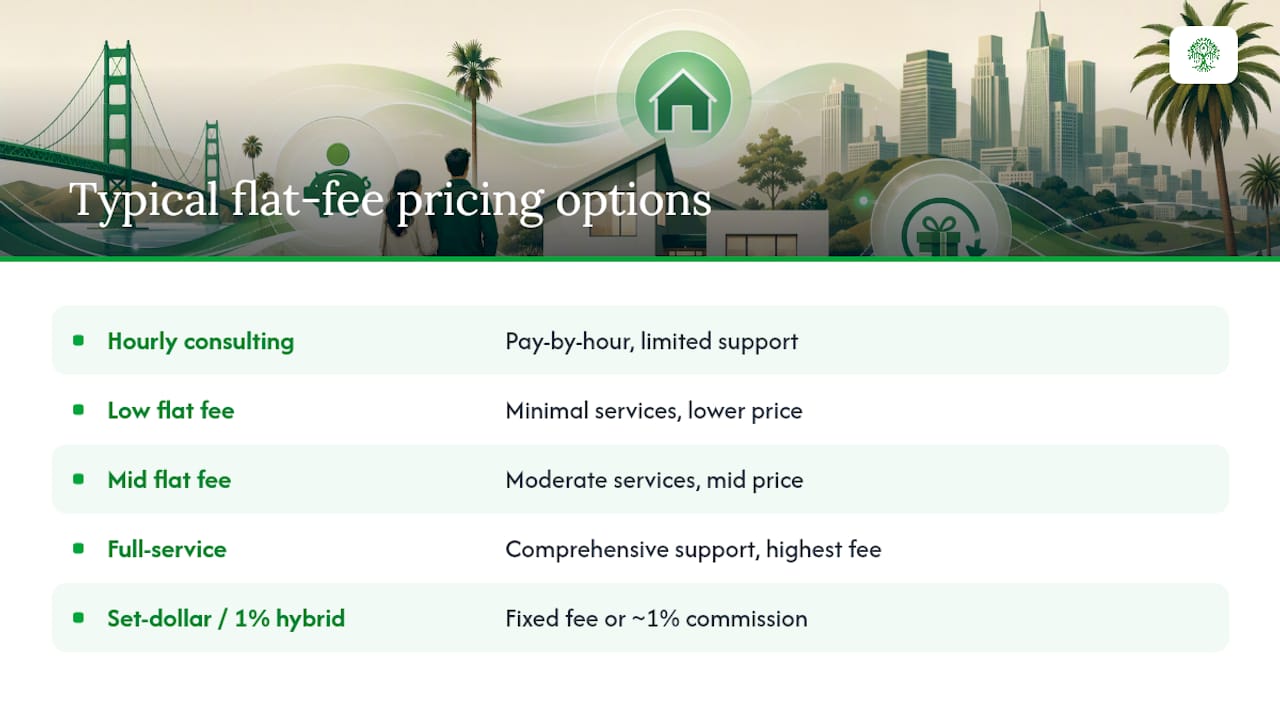
Pricing varies more than most buyers expect, and the tier you pick should match how much hand-holding you actually need. Pricing varies considerably depending on the services offered and market. Options range from hourly consulting to low, mid-range, and full-service flat fees, sometimes combined with a reduced commission percentage. Exact fees differ widely by agent and region.
Industry coverage shows platforms increasingly favoring set-dollar fees or 1% hybrids as direct alternatives to percentage commissions, especially in competitive coastal markets where median prices push traditional commissions into the tens of thousands.
Before comparing offers, ask exactly when the fee is due (at signing, at closing, or in installments) and whether it’s refundable if the purchase falls through. Our breakdown of how real estate commission works walks through the math on traditional splits, which makes the flat-fee comparison much easier to see.
Are Buyer Rebates Legal in California, and How Do They Work?
Yes. California permits buyer-agent commission rebates as long as the arrangement is fully disclosed, and the mechanics are simpler than most first-time buyers assume. The rebate typically shows up as a credit on your closing statement, run directly through escrow rather than handed to you as a check.
There’s no standard rebate rate. The amount depends entirely on what the agent negotiates as their own compensation and how much of that they agree to return, which is exactly why getting the exact percentage in writing before you make an offer protects you from vague verbal promises.
A few practical rules matter here:
- Disclose the rebate early. Late credits can trigger lender re-disclosure requirements and delay your closing date.
- Tell your loan officer about any expected rebate as soon as you’re under contract, not the week before closing.
- Confirm in writing exactly how escrow will apply the credit, toward closing costs, a price reduction, or cash back within legal limits.
Rebates often carry no income cap, which is what makes them a flexible tool for buyers who earn too much to qualify for traditional first-time buyer grants. They can frequently be stacked with CalHFA and local county programs, though sequencing and eligibility vary by county, so confirm order of operations with your lender before you count on both. Our closing costs breakdown shows where rebate credits typically land on the settlement statement.
What’s Included in a Flat Fee, and What Costs Extra?
Comparing flat-fee agents purely on price misses the point; understanding a full-service real estate brokerage can help clarify the differences in service offerings and value. Two agents charging the same $1,500 flat fee can offer very different scopes of service, and reporting on unbundled models consistently urges buyers to compare included services, not just headline numbers.
Standard inclusions usually cover:
- MLS access and property search support
- Offer drafting and negotiation
- Standard transaction coordination through closing
- Disclosure review and basic contract guidance
Add-ons that often cost extra:
- Extensive in-person showings beyond a set number
- Contract amendments after the initial offer
- Support during a dispute or transaction litigation
- Home inspection coordination, which our inspection checklist explains in more detail
Pro Tip: Watch for agreements that say “showings included” without specifying a number. If it doesn’t say “unlimited,” assume there’s a cap, and ask what happens (and what it costs) once you hit it.
How Do You Choose a Flat Fee Buyer Agent?
Vetting a flat-fee agent takes a slightly different checklist than vetting a traditional one, because price alone tells you almost nothing about value. Work through these steps before signing:
- Verify the license. Confirm active status through the California DRE license lookup, no exceptions.
- Get the fee and rebate terms in writing. Verbal promises about rebate percentages or included services don’t hold up if a dispute arises later.
- Ask how escrow handles the rebate. Get specifics on timing and whether it appears as a credit or reduces the purchase price.
- Ask what happens if the deal falls through. Some flat fees are earned at signing regardless of outcome; others are refundable.
- Request references from recent buyers, ideally in your price range and county, since service quality can vary by market.
- Ask about showing availability. Is it on-demand, scheduled days ahead, or capped at a certain number per month?
Red flags worth walking away from: agents who won’t put fee terms in writing, vague answers about rebate mechanics, or pressure to sign before you’ve compared at least one other option.
How Much Could You Actually Save?
Run the numbers on a $750,000 home, a common price point in many California metro areas. A traditional buyer-side commission charged as a percentage results in a much higher fee than a flat-fee arrangement, which might charge a fixed amount plus a rebate. Exact savings depend on negotiated fees and rebate shares.
The exact figure depends on your local median price and the specific rebate percentage your agent offers, so recalculate using your own target price range.
Does Flat-Fee Buyer Representation Vary by California Market?
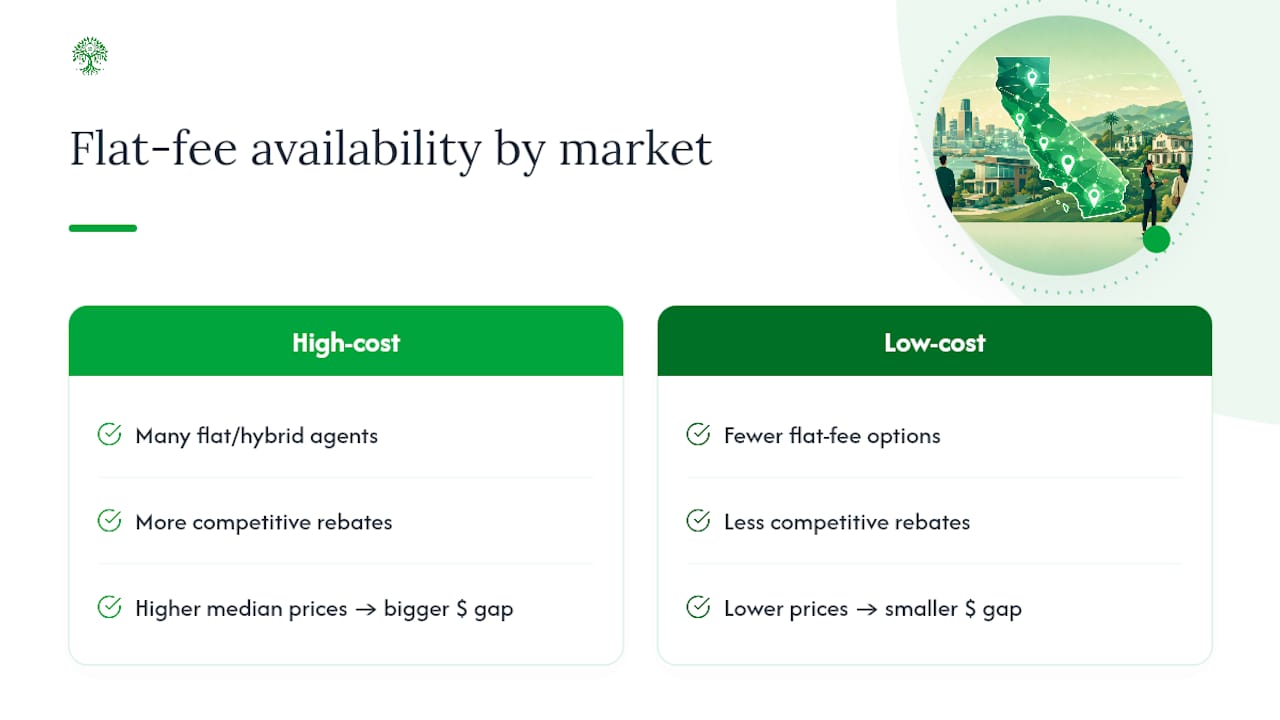
Availability isn’t uniform across the state, and that gap matters more in some counties than others. Dense metro markets, the Bay Area, Los Angeles, San Diego, tend to have more flat-fee and hybrid-fee agents competing for business, partly because higher median prices make percentage commissions look disproportionately large next to the actual work involved.
Rural and smaller inland markets often have fewer flat-fee options simply because there are fewer agents overall, and lower home prices shrink the dollar gap between a flat fee and a percentage commission.
Coastal and high-cost counties also tend to have more competitive rebate offers, since agents in expensive markets have more room to shave a meaningful dollar amount off their own compensation and still come out ahead on volume. If you’re buying in a lower-cost county, don’t assume the same rebate percentages you see advertised in Los Angeles listings will show up locally. Ask any agent, flat-fee or traditional, whether they actively work your specific county and how many transactions they’ve closed there recently.
Why AI-First Buyer Representation Fits First-Time Buyers Better
Traditional buyer representation asks you to trust a stranger with the biggest purchase of your life, based mostly on a first phone call. Decision intelligence platforms flip that. When affordability calculations, disclosure analysis, and offer strategy run through explainable AI before you ever talk to an agent, you walk into every conversation already knowing your numbers.
That clarity compresses timelines. A transparent flat fee, paired with an on-demand hourly showing agent instead of one person’s calendar, means first-time buyers get support scaled to their actual budget rather than a one-size-fits-all retainer.
— Anand
Ficustree: A Transparent Flat-Fee Option Worth Comparing
If you’re weighing hourly consultants against full flat-fee packages, here’s a third option worth putting on your list. Ficustree offers a flat-fee buyer representation model including a fixed closing fee plus commission, and provides rebates where legally permitted.
You get access to a platform with affordability calculators, neighborhood insights, and offer strategy support, plus hourly showing agents available on demand. That combination matters most for first-time buyers juggling a day job with house hunting on weekends. Compare Ficustree’s written fee and rebate terms against any flat-fee or traditional agent you’re considering. If the numbers hold up, start your search with Ficustree and see your affordability numbers before you ever schedule a showing.
Sources
- Buyer Agent Rebates in California: Rules and Savings | Home Stimulus
- California Home Buyer Rebates: A 2026 Financi… | TechBriefed
- Unbundled real estate models grow after commission overhaul | HousingWire
Always confirm current lender rules and county-level program eligibility directly with your loan officer before finalizing any rebate strategy.
FAQ
Is it worth using a buyer’s agent?
For most first-time buyers, yes. Professional negotiation, disclosure review, and transaction coordination reduce costly mistakes, and flat-fee or hybrid models now make that representation available at a fraction of traditional commission costs.
Is flat-fee MLS legal?
Yes, flat-fee and unbundled real estate models are legal nationwide, including in California, and have grown following recent commission rule changes across the industry.
What is the best flat-fee MLS listing service?
This depends on your specific needs, since flat-fee MLS listing services (for sellers) differ from flat-fee buyer representation (for buyers); confirm which service type you actually need before comparing providers.
Are buyer agent rebates legal in California?
Yes, California permits buyer-agent commission rebates when fully disclosed, typically applied as a credit through escrow and reflected on your closing statement.
Recommended
- California First-Time Buyer Programs Explained for 2026
- Escrow Process for First-Time Buyers: California Guide
- California Closing Costs Breakdown for First-Time Buyers
- First Home Buying California Guide: Steps That Work

Leave a Reply