
An exclusive buyer agency is a real estate arrangement where a broker represents only buyers, never sellers, and commits in writing to work solely for your interests throughout the search. That structure removes the dual-agency conflict that plagues traditional brokerages, and it generally pays off if you want an advocate with no listing-side loyalties competing for attention. The catch: read the compensation clause, the protection period, and the termination terms closely before you sign, because those details decide how easy it is to walk away if the relationship isn’t working.
TL;DR:
- Exclusive buyer agencies cannot represent sellers, eliminating conflicts of interest and ensuring your agent solely advocates for your home purchase.
- State laws vary, with some banning dual agency outright, making exclusive buyer agency the clearest option for conflict-free representation.
- You should verify contract details such as duration, protection periods, and fees to avoid long-term obligations and ensure the agent’s services align with your needs.
- Since August 2024, buyer-agent fees are disclosed in writing beforehand, typically as a percentage around 2.4%, which can be negotiated for seller concessions.
- First-time buyers benefit most from exclusive representation due to stronger negotiation power and full confidentiality, but budget for potential out-of-pocket fees if the seller does not cover commissions.
Table of Contents
- What Exclusive Buyer Agency Means in Practice
- Exclusive Buyer Agency vs. Dual Agency, Designated Agency, and Nonexclusive Deals
- Key Contract Clauses to Check Before You Sign
- How Buyer-Agent Compensation Works Now
- Weighing the Advantages Against the Trade-Offs
- A Checklist for Evaluating and Negotiating Your Agreement
- How Ficustree Approaches Exclusive Buyer Representation
- A Note on Buyer Advocacy and Fairness
- Getting Started With Ficustree’s Buyer-Only Service
- Sources
- FAQ
What Exclusive Buyer Agency Means in Practice
An exclusive buyer agency, sometimes called an exclusive buyer agent or exclusive buyer broker, is a firm that structurally cannot represent sellers. It’s not a policy choice made deal by deal. The business itself never accepts listings, which NAEBA argues removes the conflicts baked into traditional brokerages where the same office might represent both sides of a transaction.
That “no listings, ever” rule changes how information flows to you. There’s no incentive to steer you toward in-house inventory or soften your negotiating position to protect a seller relationship down the hall.
In practice, exclusive buyer agencies search everywhere a home might surface:
- The MLS, same as any licensed agent
- For-sale-by-owner listings that traditional brokerages sometimes skip
- Pocket listings and pre-market opportunities shared through local networks
- New construction and builder inventory, negotiated directly on your behalf
Exclusive Buyer Agency vs. Dual Agency, Designated Agency, and Nonexclusive Deals
Dual agency happens when one agent, or one brokerage, represents both the buyer and the seller in the same transaction. Designated agency tries to soften that by assigning two different agents from the same office, one to each side, but they still answer to the same broker and the same bottom line. Both models create a structural conflict that a true exclusive buyer agency simply cannot have, because the firm never lists homes.
State law matters here. Several states restrict or ban dual agency outright, including Alaska, Colorado, Florida, Kansas, Maryland, Texas, Vermont, and Wyoming, though rules vary by state and this is not an exhaustive list.
Nonexclusive buyer agreements sit in the middle ground:
- You can work with multiple agents simultaneously without breaching contract
- No agent has to commit full attention, since any of them could lose the sale to a competitor
- They can suit buyers who are still shopping for the right agent or testing the market casually
- The trade-off is diluted focus. An agent splitting attention across several non-binding leads has less reason to fight hard for your specific deal
Key Contract Clauses to Check Before You Sign
An exclusive buyer agency agreement is a binding contract, and the details decide whether it protects you or traps you. Before signing anything, walk through these points:
- Duration and termination. Know the exact expiration date and what notice period, if any, lets you exit early.
- Compensation. Get the fee or percentage in writing, along with any language about seller concessions covering it.
- Procuring cause and protection period. This clause can obligate you to pay your agent even after the agreement ends, if you buy a home they showed you within a set window.
- Scope of services. Confirm what’s included, such as showings, offer strategy, and negotiation, and what falls outside the agreement.
- Confidentiality terms. Since exclusive buyer agencies never represent sellers, this section should clearly state your information stays with your agent alone.
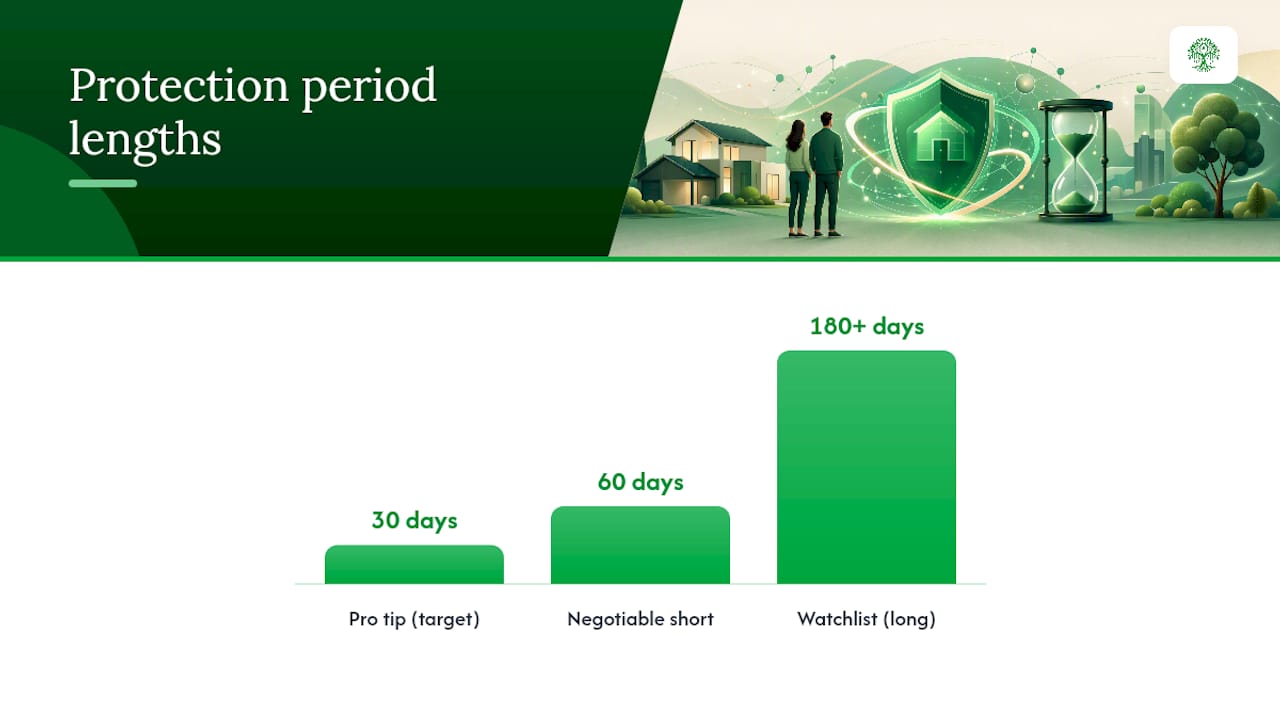
Watch for red flags: open-ended fee language with no cap, protection periods stretching six months or longer, or termination clauses that require the agent’s approval rather than simple written notice.
Pro Tip: Ask for the protection period in writing and negotiate it down to 30 or 60 days. A shorter window protects the agent’s legitimate interest without locking you into a relationship that isn’t working.
How Buyer-Agent Compensation Works Now
Since August 17, 2024, NAR requires written buyer agreements that spell out services and compensation before you tour homes. That single change reshaped how buyers pay for representation.
Buyer-agent fees now show up in a few common shapes:
- A flat fee, often used by AI-driven or streamlined brokerages
- A percentage of the purchase price, commonly cited around 2.4% on average
- A blended structure combining a smaller flat fee with a reduced percentage
On a $500,000 home at 2.4%, that’s $12,000 in agent compensation. You can negotiate seller concession language into your offer asking the seller to cover part or all of that fee, and in many markets sellers still agree, though leverage depends on local competition. One practical note: buyer-agent commissions typically can’t be rolled into your mortgage, so budget cash for it separately at closing.
Weighing the Advantages Against the Trade-Offs
Exclusive buyer agency delivers real benefits, but it’s not automatically the right fit for every buyer.
The advantages are concrete:
- A dedicated fiduciary duty with zero listing-side bias, since the firm never represents sellers
- Stronger negotiation posture, since your agent has no relationship with the seller to protect
- Full confidentiality on your finances, motivations, and walk-away price
- One estimate suggests dual-agency transactions can cost buyers 2 to 5% of purchase price in missed negotiation value, though results vary by deal and market
The trade-offs are real too: you may pay out of pocket if a seller won’t cover the fee, you lose the flexibility to shop multiple agents at once, and procuring-cause disputes can arise if you switch agents mid-search.
Pro Tip: First-time buyers and anyone who needs hands-on negotiation support tend to benefit most from exclusive representation. Confident repeat buyers with a strong local network sometimes prefer the flexibility of a nonexclusive arrangement instead.
A Checklist for Evaluating and Negotiating Your Agreement
Before you sign a buyer representation agreement, work through these steps in order:
- Confirm the exact compensation number, in dollars or percentage, and budget for the possibility you’ll pay it yourself.
- Draft seller concession language into your offer strategy so you can ask the seller to cover the fee when the market allows it.
- Negotiate the protection period down to a specific, short window and confirm exactly how termination works.
- Request a written scope of services, plus references or recent outcomes from buyers the agent has represented.
- If anything feels ambiguous, get a quick legal review, and document any agreed changes in writing before you sign.
Following this order protects you from the two most common traps: vague compensation language and open-ended protection periods that outlast the working relationship.
How Ficustree Approaches Exclusive Buyer Representation
A buyer-only platform offers no seller listings, no split loyalties, and pricing disclosed before you tour a home. Premium platforms often include affordability tools and neighborhood insights available at no cost.
The decision intelligence approach pairs that buyer-only structure with practical tools: an affordability calculator that accounts for PITI, HOA dues, and maintenance costs, on-demand showing agents you can book hourly instead of committing to one full-time agent, and search that pulls from broad inventory rather than a single office’s listings.
Whatever provider you’re evaluating, ask these questions:
- Does the firm ever accept seller listings, even occasionally?
- Is the fee structure disclosed in writing before you tour homes?
- Can you book showings on demand, or only through one dedicated agent’s calendar?
- What happens to your protection period if you need to pause your search?
Buyer-only representation isn’t a marketing label. It’s a structural fact about who a brokerage answers to, and it shows up in every negotiation from the first offer to the final walkthrough.
A Note on Buyer Advocacy and Fairness
Representation only means something when the person across the table has no reason to protect anyone but you. That’s the entire case for exclusive buyer agency, and it’s why the contract details matter as much as the philosophy behind them. A great advocate with a bad protection clause can still cost you flexibility you didn’t know you were giving up.
Read your agreement line by line, and choose someone whose business model has no seller-side loyalties to manage.
— Anand
Getting Started With Ficustree’s Buyer-Only Service
Ficustree works the way exclusive buyer agency should: no listings competing for attention, no hidden fee surprises, just representation built around you. If you’ve been weighing whether to sign a buyer broker agreement at all, this is the alternative to a traditional agency that shows you the math up front instead of after you’ve committed.

Getting started takes three steps. Share your search criteria and budget through the buyer landing page, book a quick consult to review how the $1,000 plus 1% commission structure applies to your situation, and read through your buyer representation agreement together before anything gets signed. If you want to see how the platform handles the early research phase first, the home buying workflow guide walks through what the first few weeks actually look like.
Sources
This article draws on NAEBA’s guidance on exclusive buyer agents, NAR’s consumer guide to written buyer agreements, and legal analysis on commission responsibility and procuring cause. Each source addresses a different piece of the picture: buyer-only advocacy, disclosure requirements, and who actually pays at closing.
- Top Ten Reasons To Choose An Exclusive Buyer Agent | Ask NAEBA
- Consumer guide to written buyer agreements | NAR
- Who Pays the Buyer’s Agent: Seller, Buyer, or Both? – LegalClarity
FAQ
What Is a Disadvantage of Exclusive Buyer Agency?
The main disadvantage is reduced flexibility. You’re committed to one agent for the agreement’s duration, and a poorly negotiated protection period can obligate you to pay that agent even if you switch representation later.
Is It Worth Using a Buyer’s Agent?
For most first-time buyers, yes. A dedicated buyer agent brings negotiation focus and no listing-side bias, and dual-agency deals may cost buyers 2 to 5% in missed negotiation value by comparison.
Can a Seller Refuse to Pay a Buyer’s Agent?
Yes. Since the 2024 changes to buyer agreements, sellers are not obligated to cover buyer-agent compensation, and buyers should budget for the possibility of paying it themselves at closing.
How Do I Get Out of an Exclusive Agency Agreement?
Check the termination clause first. Most agreements allow written notice to end the relationship, though a procuring-cause or protection period clause may still apply to homes your agent already showed you.
Does Ficustree Charge Like a Traditional Buyer Agent?
No.
Recommended
- How AI Matches Buyers to Listings: A First-Timer’s Guide
- AI Home Platform Features and Benefits for First-Time Buyers
- First Time Homebuyer Guide: Simple Steps for Your First Home
- What Is a Buyer’s Agent? Your 2026 Home Buying Guide

Leave a Reply