
Credit unions typically win on lower fees and better loan rates; banks typically win on branch access, digital tools, and product variety. Both are equally safe up to $250,000 in coverage. The right answer depends on whether you prioritize cost savings or convenience, and whether you actually qualify to join a credit union near you.
TL;DR:
- Credit unions generally offer lower loan APRs and fees due to their nonprofit, member-owned status and tax-exempt advantages.
- Both credit unions and banks are insured up to $250,000 per depositor through NCUA and FDIC, but membership eligibility may restrict access to credit unions.
- Banks typically provide more branches, ATMs, and broader product selections, especially from national institutions, while credit unions often rely on shared branch networks.
- For most consumers, choosing depends on whether cost savings or convenience better matches their banking habits and financial priorities.
- First-time homebuyers may benefit from the slightly lower mortgage rates and fees at credit unions, but should verify membership eligibility and loan terms carefully.
Table of Contents
- Bank vs Credit Union: The Quick Comparison
- How Ownership Structure Shapes What You Pay
- Is Your Money Actually Safe at a Credit Union?
- Where You’ll Actually Save Money on Rates and Fees
- Can You Even Join a Credit Union?
- Branch Access, ATMs, and Mobile Banking
- How to Choose Between a Bank and a Credit Union
- What This Means for First-Time Homebuyers
- The Real Takeaway on Choosing a Financial Institution
- Compare Your Mortgage Options Before You Choose a Lender
- Verify These Sources Before You Decide
- Sources
- FAQ
Bank vs Credit Union: The Quick Comparison
Choosing between a bank and a credit union comes down to three questions: Who benefits from the profits? What’s actually insured? And which one fits how you bank day to day? Here’s the fast version before you dig into specifics.
- Ownership: Banks are for-profit companies owned by shareholders; credit unions are nonprofit cooperatives owned by their members, which is a core difference between the two.
- Insurance: Both are equally protected. FDIC covers bank deposits and NCUA covers credit union deposits, each up to $250,000 per depositor, per ownership category.
- Rates and fees: Credit unions tend to undercut banks on loan APRs and overdraft fees; banks tend to win on branch density, mobile features, and sign-up bonuses.
- Your next move: Write down your top three priorities, in order, before comparing a single rate. Rank cost savings, convenience, and product needs (like mortgage support), because that ranking decides which side of this comparison matters most to you.
How Ownership Structure Shapes What You Pay
A bank answers to shareholders. A credit union answers to you. That single distinction explains almost every downstream difference in pricing and product design.
Banks operate as for-profit corporations, so profit gets distributed to investors, and pricing decisions get built around growing that profit. Credit unions are member-owned cooperatives: surplus revenue flows back to members as lower loan rates, higher savings yields, or reduced fees, not shareholder dividends. Credit unions also hold federal tax-exempt status, which gives them room to price loans more competitively since they aren’t funding a tax bill or a quarterly earnings call. That’s not charity. It’s a structural incentive that tends to push rates and fees in your favor, especially on everyday products like checking accounts and auto loans.
Is Your Money Actually Safe at a Credit Union?
Yes. NCUA insurance works the same way FDIC insurance does. Both agencies insure deposits up to $250,000 per depositor, per institution, per ownership category. Joint accounts, retirement accounts, and trust accounts can each carry separate coverage limits.
By the numbers: $250,000 is the standard coverage ceiling at both FDIC-insured banks and NCUA-insured credit unions. A married couple with a joint account and separate individual accounts at the same institution can be covered well beyond that single figure, because each ownership category is insured separately.
Before opening an account, confirm the credit union is federally insured. The NCUA’s Share Insurance page explains coverage details, and its locator tool lets you search any institution directly. Look for the NCUA signage at branches or on the website footer, too. What’s never covered at either type of institution: investments, annuities, mutual funds, and stocks, even if you bought them through a teller at your local branch.
Where You’ll Actually Save Money on Rates and Fees
The pattern holds up across most comparisons: credit unions tend to beat banks on loan pricing and everyday fees, while banks compete harder on product breadth and, in some cases, high-yield online savings accounts. Credit unions often post lower overdraft and NSF fees than the industry average, along with more competitive auto loan APRs and CD rates. Banks counter with wider product menus, and certain online-only banks now post top-tier APYs that rival or beat credit union offers.
Before picking either, run this checklist on any two offers side by side:
- Compare the actual APY on savings, not just the advertised headline rate.
- Compare the APR on any loan, including origination fees and closing costs, not the sticker rate alone.
- Add up monthly maintenance fees, ATM fees, and overdraft charges over a full year.
- Ask what balance triggers a fee waiver, and whether you can realistically maintain it.
Pro Tip: Call and ask for the current promotional rate before applying anywhere. Advertised rates online are often stale by weeks, and the real number a loan officer quotes you can differ by half a point or more.
Can You Even Join a Credit Union?
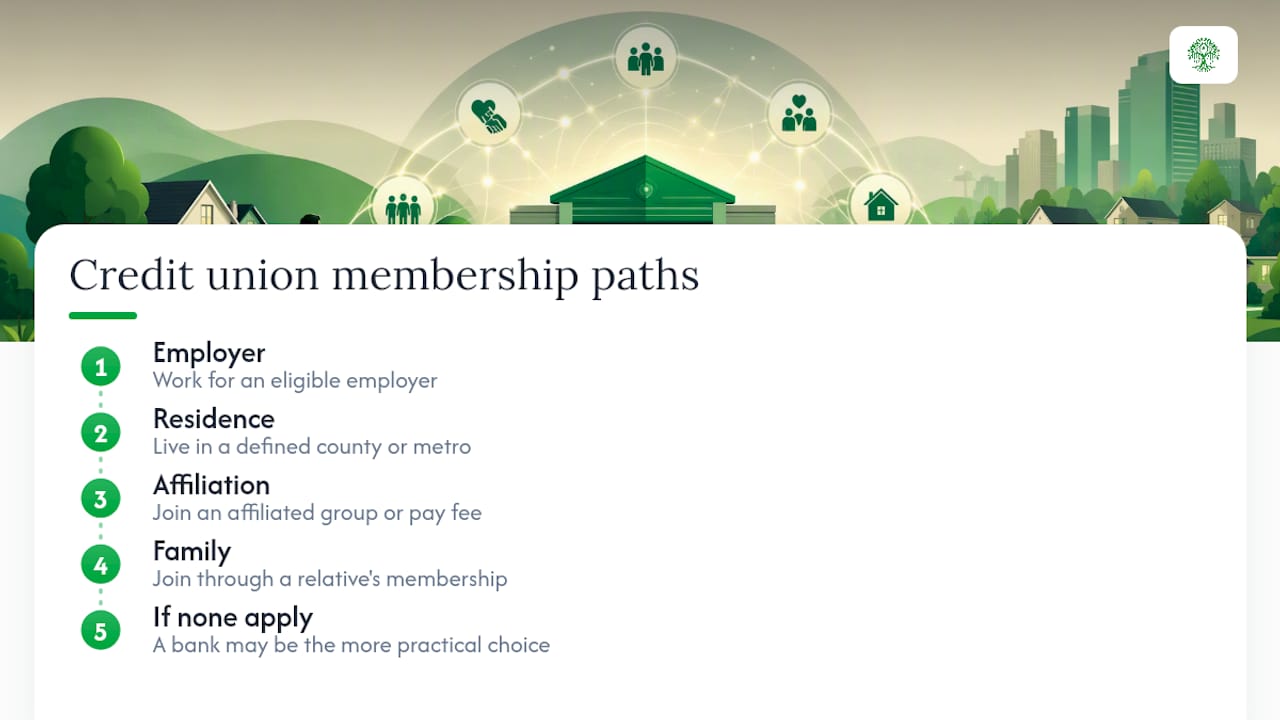
Credit unions restrict membership through “field of membership” rules, unlike banks, which will take anyone who walks in. That eligibility requirement is the single biggest practical barrier standing between you and a credit union’s better rates.
Common membership paths include working for a specific employer, living in a defined county or metro area, or belonging to an affiliated association, like a school alumni group or a labor union. Many credit unions now offer a workaround: paying a small fee to join a partner nonprofit, which instantly qualifies you for membership. Family membership is another common route if a relative already belongs. If none of these fit your situation and no local credit union serves your area, a bank simply becomes the more practical choice, and that’s fine.
Branch Access, ATMs, and Mobile Banking
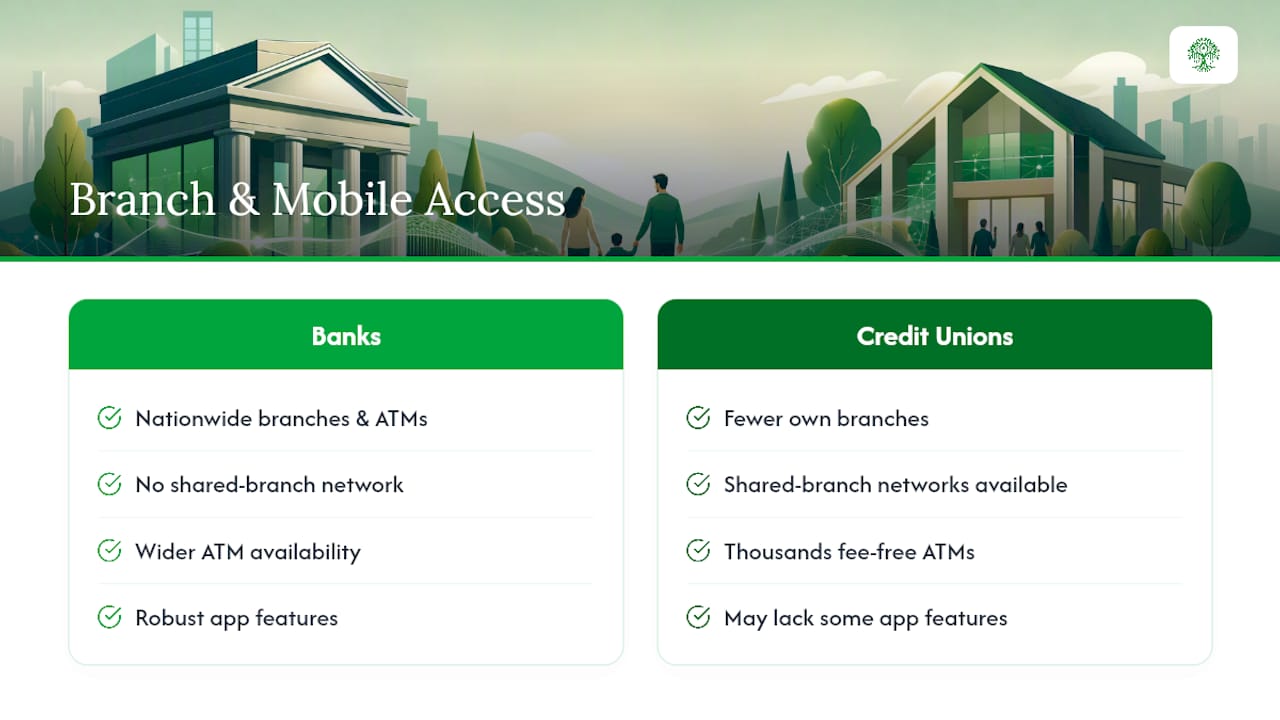
Banks generally have more branches and ATMs, especially the national players with locations in nearly every zip code. Credit unions close that gap through shared branching networks, which let members use thousands of other credit unions’ branches and fee-free ATMs as if they were their home institution.
Before switching to a credit union, confirm two things: whether it participates in a shared branch network, and whether its mobile app supports the features you actually use, like mobile check deposit, Zelle transfers, or bill pay integrations. Smaller credit unions sometimes lag on app polish, though many have closed that gap fast in the past few years.
How to Choose Between a Bank and a Credit Union
Turn this into a decision, not a debate, with four steps:
- Rank your priority. Decide whether cost, convenience, or a specific product (like mortgage support) matters most to you right now.
- Compare terms side by side. Line up APY, APR, monthly fees, and any membership requirements for one bank offer and one credit union offer.
- Verify the fundamentals. Confirm FDIC or NCUA insurance, check branch and ATM access against your daily routine, and test the mobile app before committing.
- Test their speed. Call both institutions and ask for a mortgage preapproval timeline or a basic document checklist; how fast and clearly they respond tells you a lot about service quality.
Pro Tip: Watch how quickly a lender answers a specific underwriting question, like how they treat student loan debt in a debt-to-income calculation. A vague or delayed answer during shopping usually predicts a slower closing process later.
Any credit union or bank that stalls, gives vague fee disclosures, or won’t put a rate in writing is a red flag worth walking away from.
What This Means for First-Time Homebuyers
The bank vs credit union decision has real teeth once a mortgage enters the picture. A lower loan rate at a credit union, even a quarter point, can lower a monthly payment enough to change what you qualify for, and some credit unions also trim origination and underwriting fees compared to big banks. Local credit unions sometimes move faster on manual underwriting too, since they’re not routing every file through a massive centralized system.
That’s exactly the kind of trade-off Ficustree’s decision intelligence tools help buyers model before they commit to a lender or a listing.
The Real Takeaway on Choosing a Financial Institution
Most people overthink this comparison. Pick based on your actual habits, not hypothetical ones: if you rarely walk into a branch and chase the best loan rate, a credit union usually wins. If you travel often or want one-stop banking, a bank usually wins. Use the checklist above, verify your insurance, and move on.
— Anand
Compare Your Mortgage Options Before You Choose a Lender
Ficustree is the alternative to guessing which lender fits your mortgage best. Instead of shopping banks and credit unions blind, you get AI decision intelligence that compares real loan scenarios side by side, so the rate difference between a local credit union and a national bank shows up in your actual monthly payment, not just a marketing flyer.

Here’s what that looks like in practice:
- AI-powered comparisons across lender scenarios, tailored to your credit profile and target neighborhoods
- Direct buyer representation for a flat $1,000 fee plus 1% commission at closing, with a rebate where legally permitted
- On-demand showing agents you can book by the hour, with no long-term commitment
- A free premium platform with affordability calculators built for first-time buyers
If you’re weighing lender options while house hunting in California or Texas, start with Ficustree’s buyer platform and see how a mortgage comparison actually changes your numbers before you sign anything.
Verify These Sources Before You Decide
Confirm any credit union’s federal insurance directly through NCUA’s share insurance coverage page or the NCUA locator. For questions about cash transaction reporting rules, FinCEN’s official guidance clears up common misconceptions. For general rate and fee comparisons, Bankrate’s breakdown is a solid starting point, and buyers weighing mortgage terms can also compare options with First Choice Home Loans.
This article is general information, not a substitute for advice from a qualified financial advisor. Consult a qualified financial professional about your own circumstances before acting on anything here.
Sources
- NCUA releases fourth-quarter 2025 credit union system performance data
- FinCEN guidance: Interpreting financial institution policies
- Credit unions vs. banks: Compare fees, rates, and service (Investopedia)
- Banks vs. credit unions: Which is right for you? (Bankrate)
FAQ
Is It Better to Bank With a Bank or a Credit Union?
It depends on your priorities. Credit unions typically offer lower fees and better loan rates, while banks typically offer wider branch access and product variety, and both carry equal deposit insurance up to $250,000.
What Is the $3,000 Rule for Banks?
It’s not a spending limit. It’s a federal recordkeeping requirement requiring institutions to log cash purchases of monetary instruments between $3,000 and $10,000, with formal Currency Transaction Reports required at $10,000 or more.
Why Do Banks Compete So Hard Against Credit Unions?
Credit unions’ nonprofit structure and tax-exempt status let them undercut banks on loan rates and fees, which pushes banks to sharpen their own pricing just to stay competitive for the same customers.
What Is the Downside of Banking With a Credit Union?
Membership eligibility can limit who qualifies to join, and some credit unions have smaller branch and ATM footprints or less polished mobile apps than large national banks, though shared branching networks narrow that gap considerably.
Recommended
- 3 Percent Down Mortgage for First-Time Buyers
- How to Avoid PMI as a First-Time Buyer in California
- 3.5% Down or 20% Equity: FHA vs Conventional for First Time Buyers
- Credit Score to Buy a House: 2026 Requirements Guide

Leave a Reply