Author: Anand

  • 2026 Conforming Loan Limits in California: What Buyers Must Know

    2026 Conforming Loan Limits in California: What Buyers Must Know

    The 2026 national baseline conforming loan limit for a single-family home is $832,750, up 3.26% ($26,250) from the 2025 limit of $806,500, according to the FHFA’s official announcement. For California buyers, that baseline is only part of the story. Many counties, particularly along the coast and in the Bay Area, qualify as high-cost areas with limits reaching up to $1,249,125 for a one-unit property.

    3.26% increase from 2025 to 2026 — the baseline rises from $806,500 to $832,750, a $26,250 gain.

    Your three immediate steps:

    • Check your county using the FHFA Conforming Loan Limit Values Map before assuming the baseline applies.
    • Confirm with your lender that they will deliver the loan under 2026 limits (delivery date matters, not just origination date).
    • Ask about high-balance pricing if your county limit exceeds the national baseline.

    Key Takeaways

    The 2026 baseline conforming loan limit is $832,750 nationally, but California buyers in high-cost counties can borrow up to $1,249,125 on a one-unit property under conforming guidelines.

    Point Details
    2026 baseline limit $832,750 for a one-unit property, up $26,250 (3.26%) from the 2025 limit of $806,500.
    High-cost county ceiling Up to $1,249,125 for one-unit properties in qualifying California counties.
    Delivery date governs Loans delivered to Fannie Mae or Freddie Mac on or after January 1, 2026 must use 2026 limits, regardless of origination date.
    Verify at the county level Use the FHFA Conforming Loan Limit Values Map to confirm the exact limit for your property’s county before making an offer.
    Ficustree for buyers Ficustree’s platform includes county-aware affordability tools and direct buyer representation to help you navigate conforming and high-balance limits confidently.

    Table of Contents

    What are the 2026 conforming loan limits for California buyers?

    The table below shows the full 2026 limits across property types. County-level limits may fall anywhere between the baseline and the statutory ceiling — the ceiling is the maximum a high-cost county can reach, not a guaranteed floor.
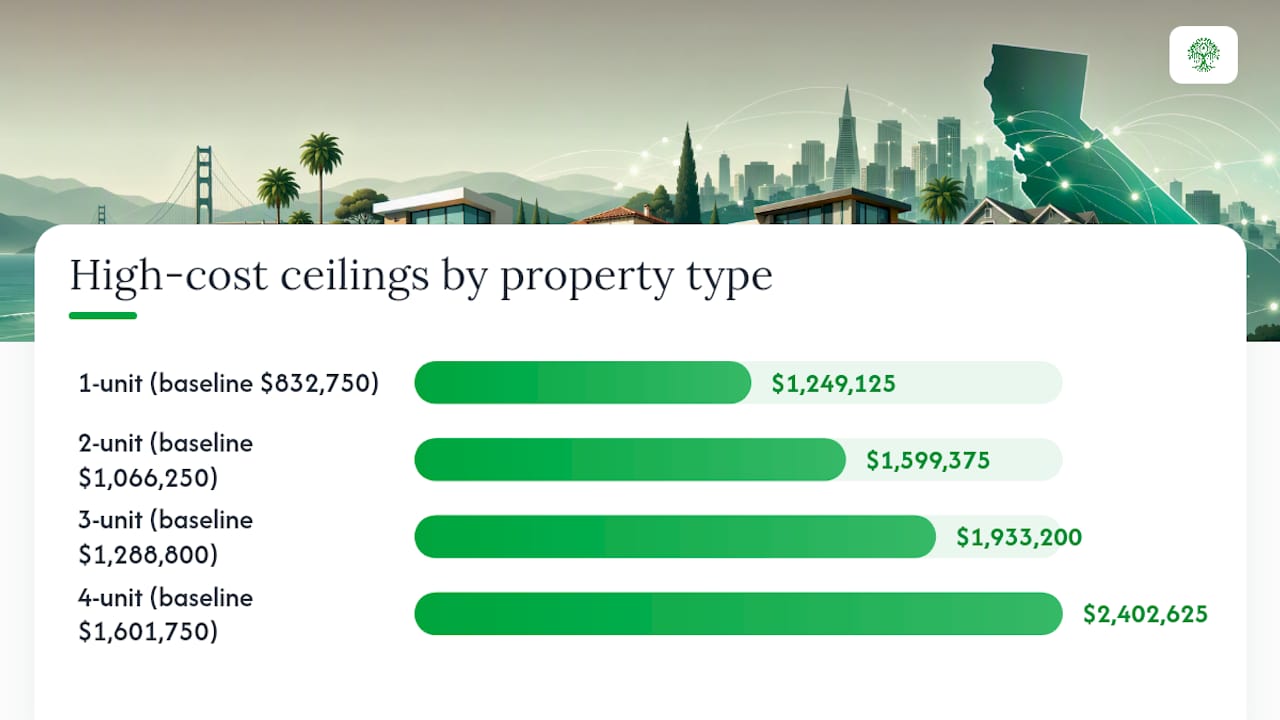
    Diagram of 2026 loan limits by property type in California

    Property Type Baseline (Contiguous U.S.) Alaska / Hawaii / Guam / USVI High-Cost Ceiling 2025 Baseline (for comparison)
    1-unit $832,750 $1,249,125 $1,249,125 $806,500
    2-unit $1,066,250 $1,599,375 $1,599,375 $1,032,650
    3-unit $1,288,800 $1,933,200 $1,933,200 $1,248,150
    4-unit $1,601,750 $2,402,625 $2,402,625 $1,551,250

    Sources: FHFA announcement and Fannie Mae Loan Limits page. County limits may be lower than the statutory ceiling shown above. Alaska, Hawaii, Guam, and the U.S. baseline.

    Key figure: The 2026 high-cost ceiling of $1,249,125 for a one-unit property applies to counties where 115% of the local median home value exceeds the national baseline — a threshold many California coastal counties clear.

    How do county-level limits work, and how do you verify yours?

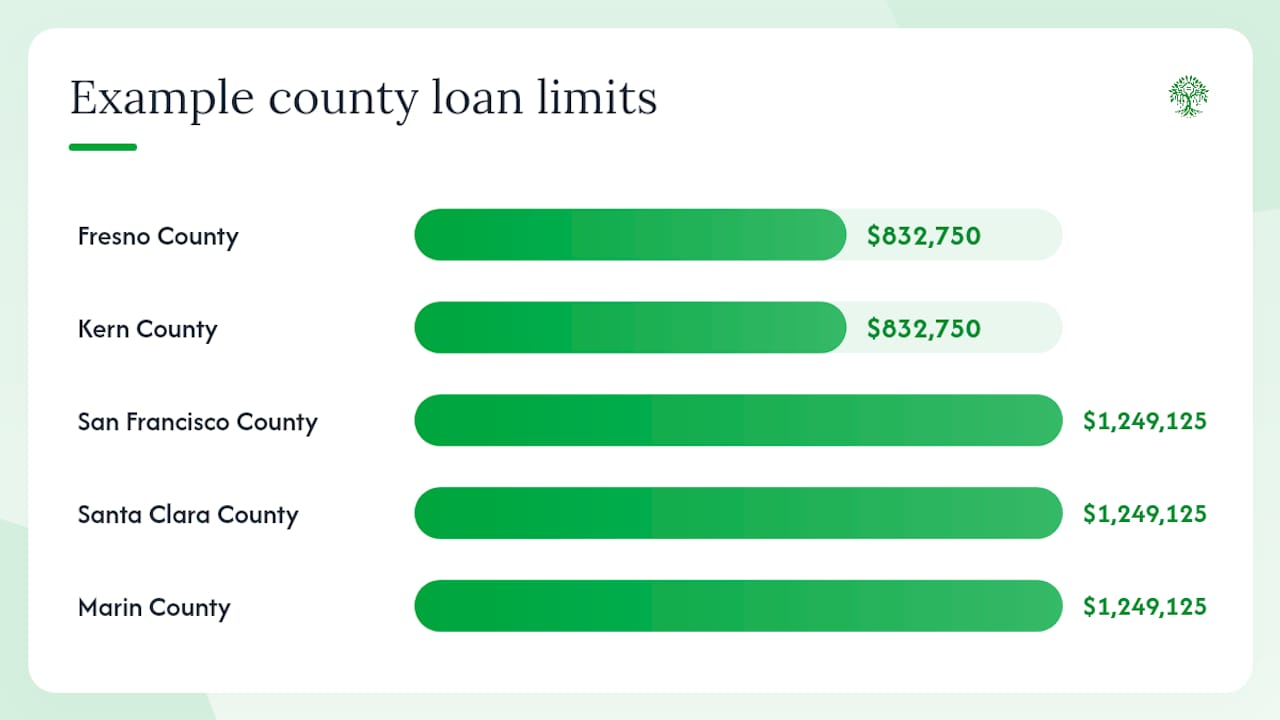
    Not every California county gets the high-cost ceiling. Counties where that calculation falls below the baseline simply use the baseline. Inland counties like Fresno and Kern often sit at or near $832,750, while San Francisco, Santa Clara, and Marin counties reach the $1,249,125 ceiling. Your specific property address determines which limit applies, not the city or zip code.

    Here is how to verify the exact limit for a property you are considering:

    1. Go to the FHFA lookup tool. Open the FHFA Conforming Loan Limit Values Map, enter the county name or property address, and record the limit returned for your unit count.
    2. Cross-check with Fannie Mae. Visit the Fannie Mae Loan Limits page and confirm the county-level value matches. Fannie Mae also references Lender Letter LL-2025-04 for detailed county tables.
    3. Verify with your lender’s system. Ask your loan officer to run the subject property address through Desktop Underwriter (DU) or Loan Product Advisor (LPA). Per Freddie Mac’s guidance, both systems were updated in December 2025 to reflect 2026 limits.
    4. Save your verification. Screenshot the FHFA lookup result or save the API response. You will want this if a limit question arises at underwriting.

    Pro Tip: If a property sits near a county boundary, confirm the county of record on the purchase contract before running the lookup. The county of record, not the mailing address city, determines which limit applies. A property with a San Jose mailing address could technically fall in Santa Clara or Alameda County, each of which may have a different limit.

    Also worth knowing: CalHFA income limits by county interact with conforming limits when you are layering down-payment assistance programs, so check both thresholds together.
    How do county-level limits work, and how do you verify yours? — overview diagram

    What do the 2026 limits mean for your mortgage options?

    The label on your loan changes your product options, pricing, and paperwork.

    • Conforming (baseline): Loan at or below $832,750 in a standard county. Eligible for standard Fannie Mae and Freddie Mac purchase. Widest lender competition, typically the best pricing.
    • High-balance conforming: Loan above the baseline but at or below the county’s high-cost ceiling (up to $1,249,125). Still eligible for GSE purchase, but lenders must use Special Feature Code 808 to identify it. Expect slightly higher rates and additional documentation requirements compared to a standard conforming loan.
    • Jumbo: Any loan exceeding the county’s applicable 2026 limit. Not eligible for Fannie Mae or Freddie Mac purchase. Underwriting standards, pricing, and down payment requirements vary by lender and are generally stricter.

    For most California buyers in high-cost counties, the difference between a $1,249,125 high-balance loan and a $1,250,000 jumbo loan is one dollar, but the rate spread can be meaningful. Ask your lender for a side-by-side pricing comparison.

    Pro Tip: Ask your lender specifically: “Will this loan be delivered to Fannie Mae or Freddie Mac under 2026 limits, and does it qualify as high-balance or standard conforming?” That one question surfaces pricing differences and documentation requirements before you are deep in escrow.

    On the QM side, the Qualified Mortgage points-and-fees thresholds are adjusted annually under Regulation Z. The Federal Register’s 2025 Regulation Z threshold update covers the 2026 methodology. Staying within QM guidelines gives your loan “safe harbor” status, which protects both lender and borrower. Confirm your loan’s points-and-fees total early, before rate lock.

    When do the 2026 limits take effect, and which sources are official?

    The effective date rule is delivery-based, not origination-based. Fannie Mae confirms that 2026 limits apply to loans delivered to the Enterprises on or after January 1, 2026, even if the loan was originated in late 2025. Freddie Mac mirrors this rule and notes that LPA and related tools were updated in December 2025 to support the new limits.

    The authoritative sources, in order of priority:

    Delivery-timing pitfalls to avoid:

    Your 2026 loan limit action checklist for California buyers

    Work through these steps before you make an offer.

    1. Verify your county’s limit. Run the subject property address through the FHFA lookup. Record the result for your unit count.
    2. Confirm lender delivery timing. Ask your loan officer when they plan to deliver the loan to Fannie Mae or Freddie Mac. If delivery falls in 2026, the 2026 limits govern.
    3. Get preapproval under the correct limit. Make sure your preapproval letter reflects the right county limit, not just the national baseline.
    4. Estimate the pricing difference. If your loan amount sits between the baseline and the high-cost ceiling, ask for a rate quote at both the conforming and high-balance tiers. Use Ficustree’s home affordability calculator to model how a rate difference affects your monthly payment.
    5. Confirm QM compliance. Ask your lender to confirm the loan’s points-and-fees total falls within the 2026 Regulation Z thresholds.
    6. Lock your rate with delivery timing in mind. If you are closing in late 2025 or early 2026, confirm whether the lock period covers the delivery date under the correct limit year.

    Pro Tip: Ask your lender for the DU or LPA findings report and check the loan limit field directly. That field shows exactly which limit the automated system applied — a fast way to catch a limit mismatch before it becomes a closing-day problem.

    For a broader walkthrough of the California buying process, the first home buying California guide covers the full sequence from search to keys.

    Why buyers consistently miss the county-level detail

    Most buyers I talk with assume the conforming loan limit is a single national number. They hear “$832,750” and stop there. The county layer is where California gets complicated, and where the real financing decisions live.

    The delivery-timing issue catches even experienced buyers off guard. A buyer who originates in December 2025 and assumes their loan follows 2025 rules may be surprised when their lender flags a delivery-date issue in January 2026. The fix is simple: ask the delivery question early. But most buyers never think to ask it because no one explains that origination date and delivery date are two different things.

    The other common mistake is trusting a lender’s verbal confirmation without checking the FHFA lookup independently. Lenders are human. System updates happen on a schedule, and a loan officer working from a cached limit table can quote the wrong county ceiling. A two-minute lookup on the FHFA map is the fastest way to verify the number yourself before it matters.

    Ficustree helps California buyers get the loan limit right from day one

    Knowing your county’s 2026 limit is step one. Knowing how it affects your offer strategy, down payment, and lender conversations is where most first-time buyers need support.

    Ficustree

    Ficustree is an AI-powered buyer representation platform built for first-time buyers in California. The platform includes affordability calculators that model payment differences across conforming, high-balance, and jumbo tiers, plus county-aware guidance so you are never working from the wrong limit. You get on-demand showing agents and the full platform free. No guessing about delivery dates, no surprises at underwriting.

    Ready to buy with clarity? Start with Ficustree and get your county limit, affordability estimate, and buyer representation lined up in one place.

    Sources

    Official sources are the only reliable reference for conforming loan limits. County designations can change, and third-party summaries sometimes lag the FHFA’s published data by weeks. Go to the primary sources first.

    This article is general information, not a substitute for advice from a qualified financial advisor. Consult a qualified financial professional about your own circumstances before acting on anything here.

    FAQ

    What is the 2026 conforming loan limit for a single-family home in California?

    The national baseline is $832,750, but many California counties qualify as high-cost areas with limits reaching up to $1,249,125 for a one-unit property. Use the FHFA county lookup to confirm the limit for your specific county.

    Can a borrower get a $600,000 conforming loan for a single-family home in California?

    Yes. $600,000 falls below the $832,750 national baseline, so it qualifies as a standard conforming loan in any California county, subject to normal Fannie Mae and Freddie Mac underwriting guidelines.

    What are the qualified mortgage thresholds for 2026?

    The QM points-and-fees thresholds are adjusted annually under Regulation Z. The Federal Register’s December 2025 update covers the 2026 methodology. Confirm your loan’s total points and fees with your lender early in the process to maintain QM safe harbor status.

    What is the difference between a conforming loan and a jumbo loan in California?

    A conforming loan stays at or below the applicable county limit, which can reach $1,249,125 in high-cost California counties, making it eligible for sale to Fannie Mae or Freddie Mac. A jumbo loan exceeds that county limit and is not eligible for GSE purchase, typically carrying stricter underwriting requirements and different pricing.

    When do the 2026 conforming loan limits take effect?

    The 2026 limits apply to loans delivered to Fannie Mae or Freddie Mac on or after January 1, 2026, even if the loan was originated in late 2025. Origination date alone does not determine which limit year governs.

  • CalHFA Loan Application Guide for California First-Time Buyers

    CalHFA Loan Application Guide for California First-Time Buyers

    You apply for a CalHFA loan through a CalHFA-approved private lender, not directly through CalHFA. That single fact trips up more first-time buyers than any other part of this process. Here is your immediate action list:

    • Find a CalHFA-approved loan officer using the official lender database or Preferred Loan Officers list.
    • Prequalify to understand your price range before you start touring homes.
    • Complete your homebuyer education certificate early — certificate timing is the most common cause of application delays.
    • Gather your documents (ID, income, assets, employment) before your first lender meeting.
    • Submit your application through your chosen loan officer, who handles underwriting and funding under CalHFA program rules.

    Pro Tip: Before sharing any financial documents, confirm your loan officer’s NMLS registration at NMLS Consumer Access and ask specifically whether they have closed CalHFA loans before — not just whether their branch is approved.


    Key Takeaways

    CalHFA loans are applied for through CalHFA-approved private lenders, not directly through CalHFA, and completing homebuyer education early is the single most effective way to avoid application delays.

    Point Details
    Apply through a lender CalHFA does not accept direct borrower applications; find an approved loan officer first.
    Education certificate timing Certificates typically expire one year after issuance; complete counseling before your home search.
    NMLS verification is required Confirm every loan officer’s license at NMLS Consumer Access before sharing financial documents.
    Income limits vary by county Check current CalHFA income limits for your county and household size before prequalifying.
    Ficustree organizes your application Ficustree’s platform maps your documents to CalHFA requirements and tracks milestones to closing.

    This article is general information, not a substitute for advice from a qualified financial advisor. Consult a qualified financial professional about your own circumstances before acting on anything here.

    Table of Contents

    Which CalHFA programs should you consider first?

    CalHFA offers several distinct loan programs, and picking the right family early saves weeks of back-and-forth. Here is a plain-language snapshot of each:

    • CalHFA FHA: An FHA-insured 30-year fixed mortgage with government-backed underwriting. Best for buyers with credit scores in the mid-600s who need more flexible qualifying ratios.
    • CalHFA Conventional: A 30-year fixed conventional loan with standard private mortgage insurance. Better for buyers with stronger credit who want to avoid FHA mortgage insurance premiums long-term.
    • CalPLUS Conventional / CalPLUS FHA: These CalPLUS programs pair directly with ZIP, CalHFA’s zero-interest closing-cost assistance loan. Ideal if you need help covering closing costs on top of a down payment.
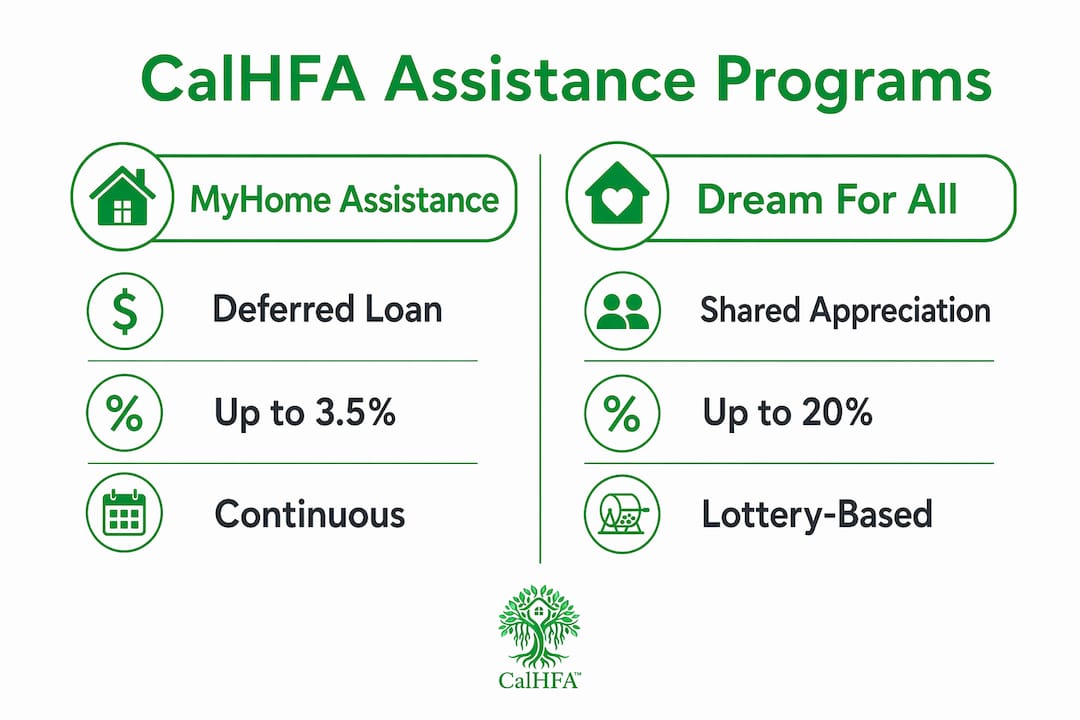
    • California Dream For All (DFA): A shared-appreciation loan that provides up to 20% of the purchase price as down payment assistance. When you sell or refinance, you repay the original assistance plus a share of the home’s appreciation. Best for buyers who need maximum upfront help and plan to stay long-term. Check California first-time buyer programs for a side-by-side comparison.
    • MyHome Assistance Program: A deferred-payment junior loan for down payment or closing costs, paired with most CalHFA first mortgages.

    For exact rate quotes, contact a CalHFA-trained loan officer — rates change daily and depend on your credit profile and the lender’s fee structure.


    Who actually qualifies for a CalHFA loan?

    CalHFA’s borrower eligibility requirements are specific, and a quick self-check before calling a lender saves everyone time.

    Core borrower rules:

    • You must occupy the property as your primary residence. Investment properties and vacation homes are not eligible.
    • CalHFA defines “first-time homebuyer” as someone who has not owned and occupied a primary residence in the past three years. If you owned a home more than three years ago and have rented since, you may still qualify.
    • You must meet the credit and debt-to-income requirements of the underlying loan type (FHA or conventional) plus any CalHFA overlays your lender applies.

    Income limits:

    Household income limits vary by county and household size. CalHFA publishes current limits on its program pages, and they are updated periodically. Check the CalHFA income limits by county before your first lender call so you know whether your household income falls within range. The limit is based on all occupying borrowers and, for some programs, all household members — confirm the exact calculation method with your loan officer.

    Property requirements:

    • One-unit single-family residences, condos, and planned unit developments (PUDs) are generally eligible.
    • The property must be in California.
    • Manufactured homes and multi-unit properties are typically not eligible under standard CalHFA programs.
    • Condos must meet the approval requirements of the underlying loan type (FHA or conventional).

    Pro Tip: If you have a co-borrower who owned a home recently, or if you owned a property through a business entity, ask a Preferred Loan Officer to review your situation before assuming you are ineligible. Edge cases come up often, and the three-year rule has nuances.


    What homebuyer education does CalHFA require?

    Most CalHFA loans require at least one occupying borrower to complete a homebuyer education and counseling course and provide a valid certificate at closing. This is not optional, and the format matters.

    Accepted providers and formats:

    • eHome America: The only online course CalHFA explicitly accepts. The eHome eight-hour online course must be paired with a one-hour one-on-one counseling session to satisfy CalHFA’s requirement. An online-only certificate without the counseling follow-up is commonly rejected.
    • NeighborWorks-affiliated agencies: In-person and virtual courses through NeighborWorks HomeOwnership Centers are accepted.
    • HUD-approved housing counseling agencies: Local agencies offering in-person or virtual sessions qualify. Find one near you through the HUD-approved counseling guide.

    Certificate timing:

    Certificates typically expire one year after issuance, though individual lenders may apply stricter timelines per the CalHFA Lender Program Handbook. If your certificate expires before you close, you may need to retake the course. Lenders verify completion directly with the provider or through the certificate documentation you submit.

    Pro Tip: Schedule your counseling session in the first week of your home search, not after you find a property. Waiting until you are under contract to book a counseling appointment is the single most avoidable delay in the CalHFA process.


    Documents you need before contacting a lender

    Arriving at your first lender meeting with a complete packet cuts days off your timeline. Organize everything by category and save files as PDFs with clear names.

    Identity:

    • Government-issued photo ID (driver’s license or passport)
    • Social Security number for all borrowers

    Income:

    • Two most recent pay stubs
    • W-2s for the past two years
    • Federal tax returns (signed, all pages) for the past two years
    • If self-employed: profit and loss statement, business tax returns

    Assets:

    • Two to three months of bank statements (all pages, all accounts)
    • Investment or retirement account statements if used for down payment

    Employment:

    • Employer contact information for verification
    • If recently changed jobs: offer letter and prior employment history

    Rental history:

    • Twelve months of canceled rent checks or landlord contact information

    Program-specific:

    • Income limit worksheet (your loan officer may provide this)
    • For California Dream For All: first-generation documentation, which may include parent or guardian records confirming they did not own a home in California. See the first-generation homebuyer guide for a full documentation breakdown.

    File-naming tip: Use a consistent pattern such as LastName_W2_2024.pdf or LastName_BankStmt_Jan2026.pdf. Lenders process dozens of files per loan; clear names reduce back-and-forth requests.

    Pro Tip: Scan documents with a flatbed scanner or a scanning app like Adobe Scan rather than photographing them with your phone camera. Lenders and underwriters flag low-resolution or angled images, which can trigger re-submission requests and add days to your timeline.


    How to apply for a CalHFA loan, step by step

    The CalHFA loan process has six clear stages. Your loan officer drives most of the work after Step 2, but knowing what happens at each stage keeps you from being caught off guard.

    1. Find a CalHFA-approved loan officer. Use the CalHFA lender database to find a branch that participates in your target program, then confirm the specific officer’s CalHFA experience. Preferred Loan Officers are the fastest path.
    2. Prequalify. Share your income, assets, and credit profile. Your loan officer calculates your maximum purchase price under CalHFA income limits and identifies which programs fit.
    3. Complete homebuyer education. Book your counseling session now if you have not already. Your certificate must be valid at closing.
    4. Make an offer and go under contract. Once your offer is accepted, your loan officer opens the formal loan file.
    5. Submit the full application and enter underwriting. You provide the complete document packet. The lender underwrites the loan against both standard guidelines and CalHFA program rules per the Loan Program Handbook. CalHFA does not underwrite the loan — your lender does, then submits to CalHFA for program enrollment and funding.
    6. Clear conditions and close. Underwriters issue a conditional approval with a list of outstanding items. Respond within 24–48 hours for each condition. Once you receive a clear-to-close, you sign closing documents and receive your keys.
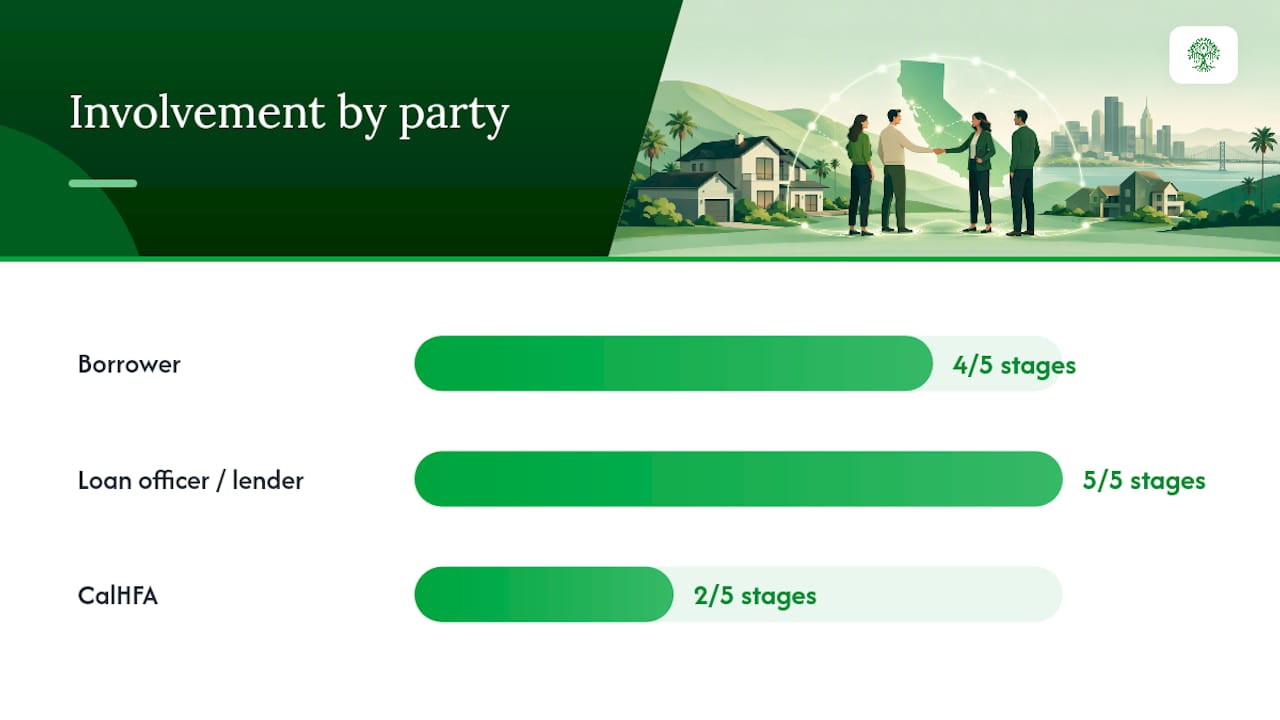
    Stage Borrower Loan officer / lender CalHFA
    Prequalification Provide income and asset info Reviews eligibility, selects program Not involved
    Application Submit full document packet Opens loan file, orders appraisal Not involved
    Underwriting Respond to conditions promptly Underwrites against program rules Not involved
    Program enrollment None Submits to CalHFA for enrollment Enrolls loan, confirms program terms
    Closing Sign documents, pay closing costs Coordinates title and escrow Funds the loan

    Pro Tip: When underwriting issues a condition, read it carefully before responding. Sending the wrong document wastes a review cycle. If the condition is unclear, call your loan officer the same day rather than guessing.


    How to apply for a CalHFA loan, step by step — overview diagram

    How do you find and vet a CalHFA-approved loan officer?

    Not every loan officer at an approved branch has CalHFA experience. The branch being listed does not mean the individual officer has closed a CalHFA loan. That distinction matters.

    Where to search:

    • The CalHFA Preferred Loan Officers list is your first stop. Preferred Loan Officers have completed CalHFA-specific training and are familiar with program documentation quirks.
    • The approved-lenders search lets you filter by county and see which specific CalHFA products each branch offers (CalPLUSConv, CalHFAFHA, etc.).

    How to verify NMLS registration:

    Every mortgage loan originator must hold a valid license and be registered in the NMLS. Look up any officer at NMLS Consumer Access before sharing financial documents. CalHFA requires Preferred Loan Officers to maintain a valid Mortgage Loan Originator license and report any changes, though CalHFA does not independently verify registry status for every update.

    Questions to ask before committing:

    • How many CalHFA loans have you closed in the past 12 months?
    • Which CalHFA programs do you originate most frequently?
    • What is your typical timeline from application to clear-to-close?
    • Have you worked with the California Dream For All shared-appreciation program?

    Pro Tip: A Preferred Loan Officer who has closed multiple CalHFA loans recently will catch documentation issues before they reach underwriting. That experience alone can shave one to two weeks off your timeline.


    What do CalHFA loans actually cost?

    Interest rates on CalHFA loans are not fixed by CalHFA — they vary daily based on your credit score, the loan program, and the lender’s fee structure. The CalHFA FHA program page notes this explicitly: rates change daily and depend on borrower-specific factors. Get a written rate quote from your loan officer and compare it against the Loan Estimate you receive within three business days of application.

    Common cost drivers:

    • Origination fees: Lender charges for processing your loan, typically expressed as a percentage of the loan amount.
    • Discount points: Optional upfront payments to buy down your interest rate. Ask your loan officer whether points make sense given your expected time in the home.
    • PMI: Conventional CalHFA loans with less than 20% down require private mortgage insurance. FHA loans carry a mortgage insurance premium (MIP) instead, which includes an upfront charge and an annual premium.
    • Junior loan costs: MyHome and ZIP are deferred or zero-interest junior loans, but they add to your total debt load and affect your debt-to-income ratio.

    How down payment assistance changes your numbers:

    Pairing a MyHome or ZIP loan with your first mortgage reduces your cash to close but increases your total loan balance. The California Dream For All program eliminates the need for a large down payment upfront, but when you sell or refinance, you repay the original assistance plus a share of the home’s appreciation. For buyers who plan to stay five or more years, that trade-off often works in their favor. For a deeper look at how no-money-down options affect your monthly payment, run the numbers before you commit.

    When you receive your Loan Estimate, compare every line item against CalHFA program rules and ask your loan officer to explain any fee you do not recognize.


    What is the typical CalHFA loan timeline?

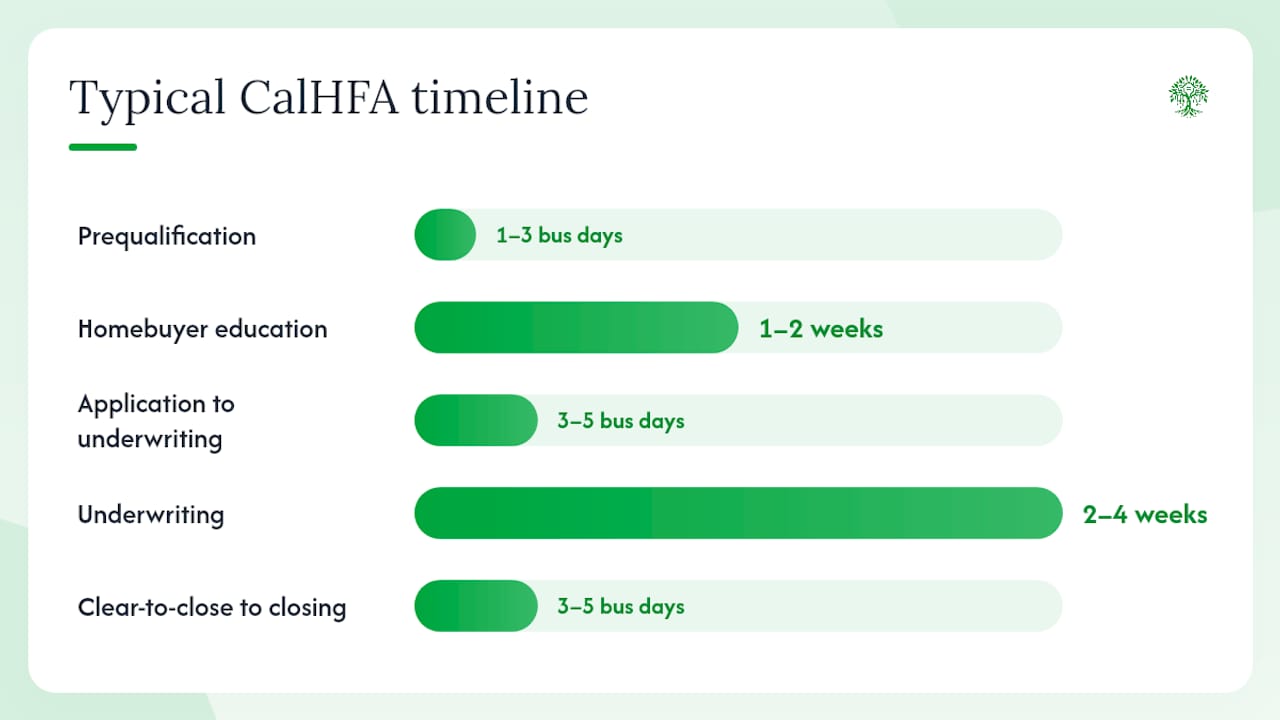
    Plan for several weeks to a couple of months from application to closing under normal conditions. Here are the major milestones:

    • Prequalification: 1–3 business days once you provide complete information.
    • Homebuyer education: 1–2 weeks if you schedule promptly; longer if counseling slots are limited in your area.
    • Offer and contract: Variable, depending on your home search.
    • Formal application to underwriting submission: 3–5 business days after going under contract.
    • Underwriting: 2–4 weeks under standard conditions; longer if conditions require additional documentation or a condo project approval.
    • Clear-to-close to closing: 3–5 business days.

    Common bottlenecks and how to avoid them:

    • Expired or missing education certificate: Complete counseling before you start your home search.
    • Document gaps: Use the checklist above and submit complete packets the first time.
    • Condo project approval: If you are buying a condo, ask your loan officer to confirm project eligibility under FHA or conventional guidelines before you make an offer. Condo approvals can add two to three weeks if the project is not already on the approved list.
    • Appraisal delays: Order the appraisal as soon as you go under contract. Appraisal scheduling in competitive California markets can run 10–14 days.
    • Tax transcript delays: Request your IRS tax transcripts (Form 4506-C) early. Underwriters often need them, and IRS processing can take time.

    For a broader look at the California buying timeline, the first home buying California guide walks through each stage in detail.


    What is the typical CalHFA loan timeline? — overview diagram

    Common mistakes that slow or kill CalHFA applications

    Most CalHFA application denials and delays trace back to a short list of avoidable errors.

    Do not do these:

    • Submit an incomplete document packet and expect the lender to ask for what is missing. Underwriters flag incomplete files and set them aside.
    • Assume any online homebuyer education certificate qualifies. Only eHome’s course with the one-hour counseling follow-up is explicitly accepted as an online option. Other online-only certificates are commonly rejected.
    • Skip NMLS verification. Sharing financial documents with an unverified loan officer is a fraud risk.
    • Ignore asset seasoning rules. Large deposits in your bank accounts within 60 days of application require a paper trail. Unexplained deposits can stall underwriting.
    • Change jobs or take on new debt after prequalification. Both can invalidate your approval.

    What actually works:

    • Complete homebuyer education before you start your home search.
    • Work with a Preferred Loan Officer who has recent CalHFA closing experience.
    • Prepare a two-year income documentation package before your first lender meeting.
    • Respond to every underwriting condition within 24 hours.

    Pro Tip: When you receive a conditional approval, ask your loan officer to prioritize the conditions by complexity. Tackle the hardest ones first — usually tax transcripts or employment verification — so simpler items do not sit waiting while you chase paperwork.


    How does down payment assistance actually work within CalHFA?

    Down payment assistance (DPA) within CalHFA is not a grant. It is a junior loan that sits behind your first mortgage and must be repaid under specific terms.

    No monthly payments are required. The balance is due when you sell, refinance, or pay off the first mortgage. MyHome can be paired with most CalHFA first mortgages.

    ZIP (Zero Interest Program): Paired exclusively with CalPLUS programs. ZIP covers closing costs, not the down payment, and carries a zero-interest deferred payment structure. You cannot use ZIP with a standard CalHFA FHA or CalHFA Conventional loan — it requires the CalPLUS version.

    You make no monthly payments on the DFA portion. At sale or refinance, you repay the original assistance amount plus a percentage of the home’s appreciation proportional to CalHFA’s original contribution. This program has historically been oversubscribed and operates through a lottery when demand exceeds funding. Confirm current availability with a CalHFA-trained loan officer.

    Sourcing rules: DPA funds must come from CalHFA-approved programs. You cannot layer an outside DPA grant on top of a CalHFA junior loan without lender and program approval. Ask your loan officer which combinations are permitted under current program guidelines.


    Why do CalHFA applications get denied, and what can you do?

    Denial is not the end of the road. Most CalHFA application issues are fixable with the right information.

    Common denial reasons:

    • Income over the limit: Your household income exceeds the county limit for your program. Solution: check limits before applying, and confirm which household members’ income counts. Some programs exclude certain income sources.
    • Credit score below program minimum: FHA loans have more flexibility, but a score below the program floor is a hard stop. Solution: work with a credit counselor to identify and address the specific factors pulling your score down, then reapply after 6–12 months of improvement.
    • Debt-to-income ratio too high: Your monthly debt obligations relative to your gross income exceed program limits. Solution: pay down revolving debt before applying, or consider a lower purchase price.
    • Property does not meet program requirements: The home is a multi-unit, manufactured, or non-warrantable condo. Solution: select an eligible property type.
    • Incomplete or inconsistent documentation: Missing pages, unsigned tax returns, or income figures that do not match across documents. Solution: submit complete, consistent packets the first time.
    • Homebuyer education certificate expired or not accepted: Solution: retake the course with an accepted provider.

    If you believe a denial was made in error: Contact your loan officer first. They can request a reconsideration of value on an appraisal or escalate documentation disputes. For program-level issues, CalHFA’s homebuyer resources page provides contact information for program staff. You may also consult a HUD-approved housing counselor for an independent review of your situation.


    What most first-time buyers get wrong about the CalHFA process

    The conventional advice on CalHFA applications focuses almost entirely on eligibility checklists. That is useful, but it misses the real friction point: the relationship between the borrower, the lender, and CalHFA is not a triangle. It is a chain. CalHFA sits at the end of it.

    Your lender is your primary contact. They underwrite, they collect documents, they submit to CalHFA for program enrollment. CalHFA funds the loan, but it does not manage your application. That means a loan officer who is vague about CalHFA program rules, or who has never closed a CalHFA loan, will cost you weeks — not because they are incompetent, but because CalHFA’s documentation requirements are specific and unforgiving of first-time mistakes.

    The second thing buyers underestimate is the homebuyer education requirement. Most people treat it as a box to check. CalHFA treats it as a prerequisite for long-term success, and the timing rules reflect that. A certificate that expires before closing means starting over. Scheduling counseling early is not just good advice — it is the single highest-leverage action in this entire process.

    Finally, the California Dream For All program is genuinely powerful for buyers who qualify, but the shared-appreciation structure deserves careful thought. If your home appreciates significantly over 10 years, the repayment at sale will be larger than it looks on paper today. Run the numbers with your loan officer before committing.


    Ficustree helps you move through the CalHFA process faster

    Pulling together a lender-ready packet for a CalHFA application takes most buyers two to three weeks of scattered effort. Ficustree compresses that into a structured workflow. The platform organizes your documents by category, flags missing items before you submit, and maps your checklist directly to CalHFA application requirements so nothing slips through.

    Ficustree

    Three ways Ficustree shortens your path to closing: it generates a personalized document checklist matched to your target CalHFA program, it connects you with CalHFA-trained representation so you are not navigating lender conversations alone, and it tracks your application milestones so you always know what comes next.

    Ready to get your CalHFA application organized? Start with Ficustree and move from scattered paperwork to a lender-ready packet in days, not weeks.


    Sources

    FAQ

    Does CalHFA accept direct applications from borrowers?

    No. CalHFA does not accept applications directly from borrowers. You apply through a CalHFA-approved private lender or Preferred Loan Officer, who handles underwriting and submits to CalHFA for program enrollment and funding.

    Which online homebuyer education course does CalHFA accept?

    CalHFA explicitly accepts eHome America’s eight-hour online course, but only when paired with a one-hour one-on-one counseling session. Online-only certificates without the counseling component are commonly rejected.

    How long does the CalHFA loan process take?

    Most CalHFA loans typically close within about two months from formal application under standard conditions. Underwriting alone typically takes 2–4 weeks, and delays from missing documents, condo approvals, or expired education certificates can extend that timeline.

    What is the income limit for CalHFA programs?

    Income limits vary by county and household size and are updated periodically by CalHFA. Check the current limits on CalHFA’s program pages or use the CalHFA income limits guide for county-level tables before you prequalify.

    Can you use CalHFA with down payment assistance?

    Yes. Most CalHFA first mortgages can be paired with MyHome (a deferred junior loan for down payment or closing costs), and CalPLUS programs pair with ZIP for closing-cost assistance.

  • Why HELOCs Are So Popular With Tech Homeowners

    Why HELOCs Are So Popular With Tech Homeowners

    HELOCs are popular with tech homeowners because they combine rates lower than unsecured credit, a draw-as-needed structure that matches phased projects, and a digital-first application experience that fits how tech professionals expect to borrow. Here is the short version:

    • Flexible draws: Pull only what you need, when you need it, during a 5–10 year draw period.
    • Lower rates: HELOC rates typically run well below credit cards and personal loans.
    • Interest-only payments during the draw period keep monthly costs manageable while a project is underway.
    • Fast digital applications: Many lenders now approve and close HELOCs online, often in days rather than weeks.

    The single biggest caution: When the draw period ends, your payment switches from interest-only to full principal-and-interest. That jump can be significant. Model it before you draw a dollar, as The Mortgage Reports warns.


    Key Takeaways

    HELOCs work best for tech homeowners running phased projects with stable income, but the repayment-period payment jump is the risk most borrowers underestimate before drawing.

    Point Details
    Draw structure fits phased projects A revolving line matches smart-home and renovation timelines better than a lump-sum loan.
    Model repayment before drawing The switch from interest-only to principal-and-interest can significantly raise your monthly payment.
    Size for overruns Add 15–20% to your project estimate; renovation overruns of 20–40% are common.
    Tax deductibility has conditions Interest is only deductible when funds are used to buy, build, or substantially improve the secured home.
    Ficustree for the buy alternative If renovating no longer makes sense, Ficustree’s affordability calculator helps you model buying instead.

    This article is general information, not a substitute for advice from a qualified financial advisor. Consult a qualified financial professional about your own circumstances before acting on anything here.

    Table of Contents

    How does a HELOC actually work for homeowners?

    A home equity line of credit (HELOC) is an open-end revolving credit line secured by your home’s equity. Think of it like a credit card backed by your house: you get a credit limit, draw against it as needed, and repay what you use.

    Draw period vs. repayment period:

    • Draw period (typically 5–10 years): You borrow up to your limit, pay interest only on the outstanding balance, and can repay and redraw repeatedly.
    • Repayment period (typically 10–20 years): The line closes to new draws, and your balance converts to a fully amortizing loan with principal-and-interest payments.

    Lenders set your credit limit based on your home’s appraised value minus your outstanding mortgage balance, subject to a maximum loan-to-value ratio (usually 80–85%). Qualifying factors include your credit score (most lenders want 620 or higher, with better rates above 700), debt-to-income ratio, and income documentation.

    HELOC rates have been trending toward the high single digits, with Bankrate noting movement toward around 8% depending on market conditions, still well below most credit cards. IRS rules limit interest deductibility to funds used to buy, build, or substantially improve the secured home, so how you use the money matters for tax purposes.


    Why tech-savvy homeowners prefer HELOCs

    The fit is almost structural. Tech homeowners tend to run projects in phases: a smart-home infrastructure rollout this quarter, a home office buildout next year, a kitchen upgrade after that. A HELOC’s revolving draw structure mirrors that cadence exactly. You do not borrow $80,000 upfront for a project you will complete in stages over 18 months.

    The MBA’s white paper on HELOC growth attributes rising HELOC uptake directly to digital-first lenders offering faster approvals and closings, often measured in days rather than the weeks traditional lenders require. For a homeowner who files taxes digitally, manages investments through an app, and expects instant account access, waiting three weeks for a paper-based loan approval feels archaic.

    Market context: Bankrate reports $17.8 trillion in aggregate homeowner equity as of Q2 2025, and a TD Bank survey found many borrowers used that equity specifically for property upgrades. High mortgage rates have also pushed owners to renovate rather than move, keeping HELOC demand strong.

    That “renovate vs. move” calculus is especially sharp for tech homeowners in high-equity markets like California, where home prices remain elevated and trading up often means surrendering a low locked-in mortgage rate.


    What can you use a HELOC for, and when does it make sense?

    For midrange renovations in the $15,000–$100,000 range, a HELOC often offers the best practical balance: near-cash-out-refinance rates, low closing costs, and draw-as-needed access. Common use cases for tech homeowners:

    1. Phased kitchen or bathroom remodels where contractor schedules mean costs arrive in waves.
    2. Smart-home infrastructure (wiring, panels, networking) — typical smart-home upgrades run $12,000–$20,000, and structured cabling or panel upgrades may qualify as substantial improvements.
    3. Energy retrofits (solar, battery storage, EV charging) that add measurable resale value.
    4. Home office buildouts — a dedicated workspace with proper electrical and HVAC can justify the spend.
    5. ADU or addition financing, where a HELOC pairs well with phased construction draws.

    Quick decision checklist — a HELOC fits when:

    • Your project budget is $15,000 or more and will be drawn over several months.
    • You plan to stay in the home long enough to recoup the cost.
    • Your current mortgage rate is well below today’s market (so a cash-out refinance would cost you).
    • You have a stable income and can absorb a rate increase.

    Pro Tip: Size your line at your project estimate plus a 15–20% contingency. EquityWiser notes typical renovation overruns of 20–40%, and a HELOC’s revolving structure lets you draw that buffer without opening a new loan.

    Note on smart-home tech: devices like smart speakers, displays, and security cameras depreciate quickly and add limited resale value. Finance infrastructure, not gadgets.

    Hand installing smart home security camera


    What are the real risks of a HELOC?

    Core risks:

    • Payment shock: The draw-to-repayment transition is the most common source of financial stress. A $60,000 balance at 8% costs roughly $400/month interest-only during the draw period. At repayment, that same balance on a 15-year amortization schedule runs closer to $570/month.
    • Variable rate exposure: Most HELOCs are indexed to the prime rate. A 2-point rate rise meaningfully increases your monthly cost.
    • Foreclosure risk: Your home is the collateral. Missing payments is not like missing a credit card payment.
    • Lender line freezes: If your home value drops or your credit profile weakens, lenders can reduce or freeze your available credit mid-project.

    Mitigation steps:

    1. Model your repayment-period payment now, before drawing, using a HELOC payment calculator.
    2. Run a rate-sensitivity scenario: what does your payment look like if the rate rises 2 points?
    3. Stagger draws to match actual project milestones, not your maximum approved limit.
    4. Ask your lender whether a fixed-rate conversion option is available for part or all of the balance.
    5. Maintain a cash buffer of at least two to three months of projected repayment-period payments.

    How does a HELOC compare to other home equity options?

    Product Best for Typical rate/cost Repayment structure Flexibility Application speed Tax deductibility
    HELOC Phased projects, renovations ~8% variable, low closing costs Interest-only draw, then P&I High — revolving draw Fast with digital lenders Yes, if used for home improvement
    Home equity loan Single large expense, fixed budget Fixed, slightly higher than HELOC Fixed P&I from day one Low — lump sum only Moderate Yes, if used for home improvement
    Cash-out refinance Replacing a high-rate mortgage Tied to current mortgage rates New 15-year mortgage Low — one-time draw Slowest, full underwrite Yes, mortgage interest rules apply
    Unsecured personal loan Small projects, no equity 10–20%+, no closing costs Fixed P&I Moderate Fastest No

    For tech homeowners with a low locked-in mortgage rate, a cash-out refinance almost never makes sense right now. A home equity loan works when you know the exact amount upfront. A personal loan fits small purchases under $10,000 where speed matters more than rate.


    How do you shop for and apply for a HELOC?

    1. Check your current mortgage rate and balance to confirm a cash-out refinance is off the table.
    2. Estimate your available equity: home value minus mortgage balance, then apply an 80–85% LTV cap.
    3. Get prequalified online with two or three lenders to compare APR, not just the rate.
    4. Compare total costs: origination fees, annual fees, early-closure penalties (common in the first 2–3 years), and minimum draw requirements.
    5. Confirm draw and repayment term lengths in writing — lenders vary on this.

    Questions to ask every lender:

    • What index is the rate tied to, and how often does it reset?
    • Is a fixed-rate conversion available, and at what cost?
    • What triggers a line freeze or reduction?
    • What is the minimum draw at closing?

    Pro Tip: Many digital lenders now use automated valuation models (AVMs) instead of full appraisals and offer remote online notarization (RON) at closing. Both can cut days off the timeline. Ask whether your lender supports RON — Ficustree’s guide to e-closing in real estate explains how the process works.


    Why you can trust this guide

    This guide was written by Anand, who leads content at Ficustree, an AI-powered home buying platform serving buyers in California and Texas. Ficustree’s home affordability calculator is built to model real carrying costs, including scenarios like HELOC repayment-period payments stacked on top of a primary mortgage.

    Primary sources used:

    Disclaimer: This article is general information, not tax or financial advice. Consult a licensed financial or tax advisor to confirm interest-deduction eligibility and structuring decisions for your specific situation.


    An honest take on the renovate-vs-buy decision

    The HELOC math works cleanly on paper. But the decision is rarely just about rates.

    Here is a realistic scenario: you want a $40,000 kitchen update and $12,000 in smart-home infrastructure. At 8%, a $52,000 HELOC draw costs roughly $347/month interest-only during the draw period. When repayment starts on a 15-year schedule, that payment climbs to around $496/month. That is manageable if your income is stable and your primary mortgage payment is not already stretched.

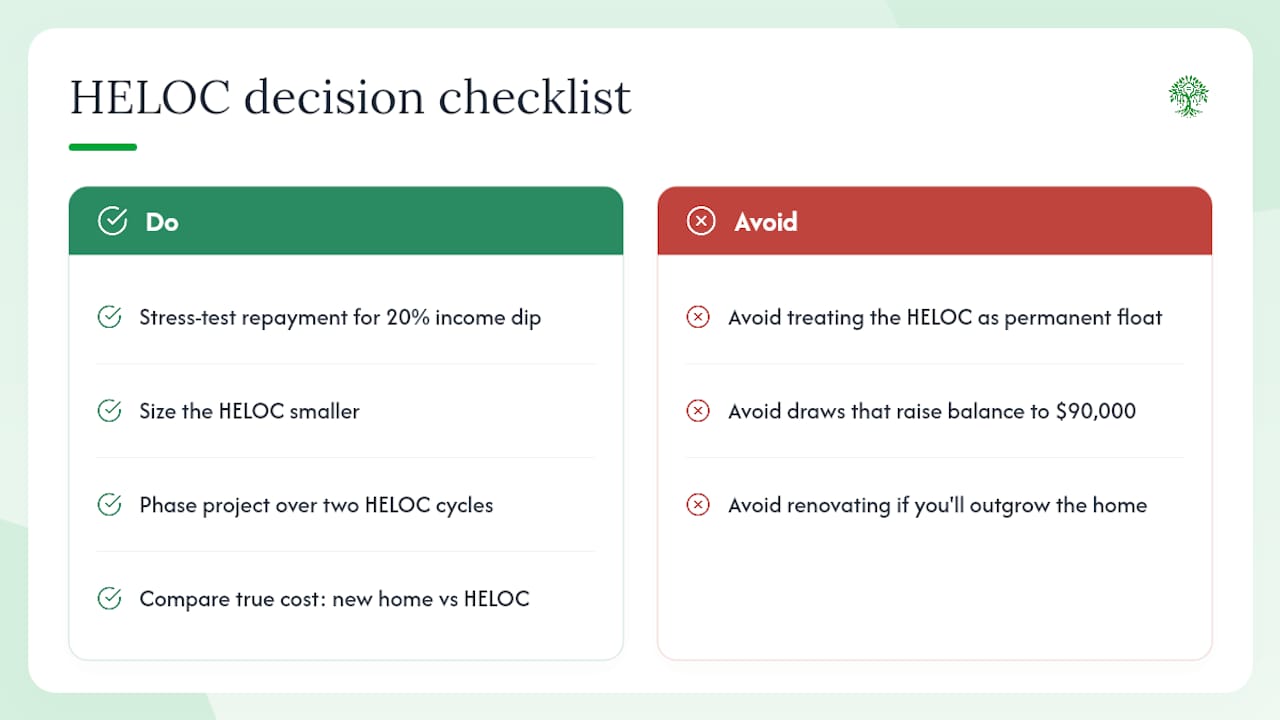
    Where I see tech homeowners get into trouble is treating the HELOC as a permanent float. They draw for the kitchen, then for the home office, then for the EV charger, and suddenly the balance is $90,000 and the repayment-period payment is a real problem. The draw period’s low payments make it easy to underestimate what you have actually committed to.

    The smarter question is not “can I afford the draw period?” but “can I absorb the repayment period if my income dips 20%?” If the answer is uncertain, size the line smaller or phase the project over two HELOC cycles rather than one large draw.

    And if your current home genuinely no longer fits your life, borrowing to renovate a house you will outgrow in three years rarely pencils out. Knowing the true cost of homeownership on a new property versus the cost of a HELOC on your current one is the comparison worth running first.


    An honest take on the renovate-vs-buy decision — overview diagram

    When buying makes more sense than borrowing

    Sometimes the numbers point toward a new home rather than a HELOC. If your current home no longer fits your needs and your equity has grown substantially, buying could be the cleaner financial move.

    Ficustree

    Ficustree is built for exactly that decision. As an AI-powered buyer representation platform serving California and Texas, Ficustree gives you the tools to model whether buying beats renovating: a full affordability calculator that factors in PITI, HOA, and maintenance, plus AI-powered home discovery that matches you to properties based on your actual priorities. Buyers pay $1,000 at closing plus 1% commission and keep a rebate of roughly 2% where permitted. No traditional agency markup, no guesswork on what you can actually afford. If you are weighing a $50,000 HELOC against trading up, start with Ficustree’s buyer platform to run both scenarios side by side before you commit.


    Sources

    FAQ

    Tech homeowners prefer HELOCs because digital-first lenders now offer fast online approvals and account management, and the revolving draw structure matches phased projects like smart-home rollouts and home office buildouts. The MBA white paper ties rising HELOC uptake directly to this digital-first lending shift.

    What is the biggest risk of a HELOC?

    Payment shock at the draw-to-repayment transition is the primary risk. Monthly payments can jump substantially when the line switches from interest-only to full principal-and-interest, so model that scenario before drawing any funds.

    Is HELOC interest tax-deductible?

    Only if the funds are used to buy, build, or substantially improve the home securing the loan, and only if you itemize deductions. Using a HELOC for vacations, car purchases, or non-home expenses eliminates the deduction.

    How much can you borrow with a HELOC?

    Most lenders allow you to borrow up to 80–85% of your home’s appraised value minus your outstanding mortgage balance. Your credit score, income, and debt-to-income ratio also affect the approved limit.

    When does a home equity loan beat a HELOC?

    A home equity loan is the better choice when you know the exact amount you need upfront and want a fixed monthly payment from day one, such as a single contractor bid for a defined scope of work.

  • Why Millennials Delay Homeownership — and What to Do Next

    Why Millennials Delay Homeownership — and What to Do Next

    Millennials delay homeownership primarily because of a compounding set of financial and structural barriers: home prices that have outpaced wage growth, mortgage rates that increased substantially between 2019 and 2024, student and consumer debt that crowds out savings, a chronic shortage of starter homes, and delayed household formation. Pew Research Center finds that the share of renter households under 40 who could afford to buy fell markedly between 2019 and 2024, as the 30-year fixed rate increased significantly over the same period. That single shift priced out nearly one in five potential buyers before they even opened a listing.

    The top six reasons millennials delay buying a home:

    • Home prices have risen faster than young-adult incomes, making the math harder every year
    • Mortgage rates roughly doubled between 2019 and 2024, inflating monthly payments sharply
    • Student loan debt extends down-payment timelines by years, sometimes decades in coastal metros
    • Marriage and household formation rates have declined, reducing the two-income buying unit
    • Starter-home inventory is scarce; most available listings are larger, move-up properties
    • Tighter lending standards and down-payment requirements block buyers who are otherwise ready

    Key Takeaways

    Millennials delay homeownership primarily because of compounding financial barriers: home prices outpacing wages, mortgage rates that increased substantially between 2019 and 2024, student debt extending down-payment timelines by years, and a chronic shortage of starter homes.

    Point Details
    Affordability collapsed between 2019 and 2024 The share of renter households under 40 who could afford ownership fell from 56% in 2019 to 37% in 2024 as rates rose from 3.9% to 6.7%.
    Student debt adds years, not months Student loan payments add several years to the national average down-payment timeline, with longer delays in high-cost coastal metros like Los Angeles.
    Starter-home supply is the hidden barrier Most available inventory is larger, move-up housing; entry-level supply remains critically short in most major metros.
    Buyers are getting older The median first-time buyer age was 34 in Q1 2026, reflecting a long-run trend toward delayed purchase.
    Ficustree offers a structured path forward First-time buyers in California and Texas can use Ficustree’s fixed-fee representation and decision-intelligence tools to move from confusion to closing faster.

    Table of Contents

    Why millennials delay homeownership: the affordability math

    The affordability problem is not just about the sticker price. It is about what a home actually costs each month once you factor in principal, interest, taxes, insurance, and HOA fees — the full PITI stack.

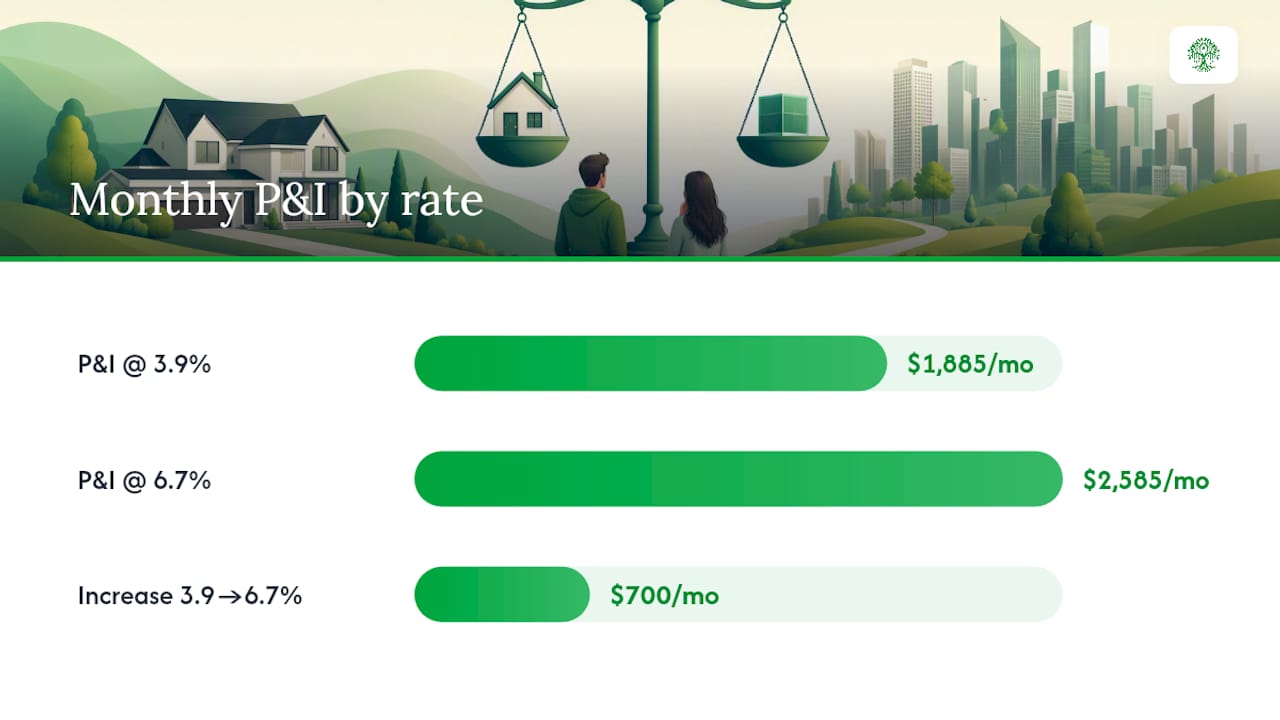
    Pew’s analysis shows that home prices have risen faster than young-adult incomes since 2019. When you combine that price growth with a rate that moved from 3.9% to 6.7%, the monthly payment on a median-priced home increased by hundreds of dollars even before taxes and insurance. A buyer financing $400,000 at 3.9% carries a principal-and-interest payment of roughly $1,885 per month. At 6.7%, that same loan costs about $2,585 per month — a $700 monthly difference that translates to $8,400 more per year just in interest. Add property taxes, homeowner’s insurance, and any HOA, and the total monthly obligation can easily exceed what many first-time buyers qualify for.

    USA Today’s reporting on first-time buyer trends confirms that even as headline prices moderated in some markets after the 2022 peak, elevated rates kept effective affordability near historic lows through 2025 and into 2026. The psychological anchor of pandemic-era rates around 3% makes today’s 6%+ environment feel punishing, even when it is historically normal.

    How to run a realistic affordability check:

    1. Calculate your gross monthly income and multiply by 0.28 — that is the conventional ceiling for housing costs (PITI).
    2. Pull your county’s property tax rate and apply it to your target purchase price, divided by 12.
    3. Get a homeowner’s insurance quote for the area (typically $100–$200/month for a median home).
    4. Add any HOA fees specific to the neighborhoods you are targeting.
    5. Subtract taxes, insurance, and HOA from your 0.28 ceiling to find the maximum principal-and-interest payment you can carry.

    Pro Tip: Run this calculation before you talk to a lender. Lenders qualify you based on DTI, but your real comfort number may be lower. Knowing your own ceiling prevents you from being approved for more than you can comfortably afford.


    Why millennials delay homeownership: the affordability math — overview diagram

    How student debt delays your path to a down payment

    Student loans affect homebuying in three distinct ways: they drain the monthly cash flow you could redirect to savings, they raise your debt-to-income ratio and reduce what lenders will approve, and they can suppress credit scores when balances are high relative to original loan amounts.

    The Mortgage Reports’ opportunity-cost analysis puts a number on this: student loan payments add several years to the national average down-payment timeline, with longer delays in high-cost coastal metros like Los Angeles. The mechanism is straightforward. Every dollar going toward a loan payment is a dollar not going into a down-payment savings account. Redirecting that payment into savings can cut the timeline by a meaningful margin, but most borrowers cannot simply stop paying their loans.

    Ways student debt blocks mortgage qualification:

    • Raises your DTI ratio, reducing the loan amount a lender will approve
    • Limits cash reserves, which many lenders require in addition to the down payment
    • Can lower your credit score if balances remain high relative to original amounts
    • Reduces monthly surplus available for emergency reserves, which lenders factor in informally

    If you carry student loans and want to buy, read buying a house with student loans before you apply — the tactics for income-driven repayment plans and how lenders calculate IBR payments can materially change your qualifying DTI.


    How delayed marriage reduces millennial homeownership rates

    Marriage is a homeownership accelerant. Two incomes, shared savings, and combined credit profiles make qualification dramatically easier. When marriage rates fall, so does the pool of buyers who can clear the financial bar.

    The Urban Institute finds that marriage among young adults has declined substantially between 2005 and 2024. Over the same period, individual-level homeownership among young adults declined significantly. The household-level homeownership rate, which counts married couples as one unit, masks this decline. When you measure ownership at the individual level, the drop is steeper and more telling.

    What this demographic shift means for buyers:

    • Single buyers face a higher income-to-payment ratio with no second earner to offset costs
    • Delayed household formation reduces the urgency to own rather than rent
    • Fewer young adults are forming the two-income units that historically drove first-time purchases
    • Policy tools focused on mortgage access alone cannot fix a structural demographic trend

    The AEI’s credit-report data shows the median first-time buyer age at 34 in Q1 2026, down one year from Q1 2025. That is a slight improvement, but the long-run trend is still toward older first-time buyers compared to prior generations.


    Why starter homes are nearly impossible to find

    Even buyers who are financially ready often cannot find a home that fits their budget. The inventory problem is not just about total supply — it is about the composition of what is available.

    Typical entry-level suburban home exterior

    NAR’s Jessica Lautz and reporting in American Banker flag this directly: most of today’s for-sale inventory consists of larger, multi-bedroom move-up homes that are financially out of reach for many first-time buyers. Entry-level supply has been squeezed from both ends.

    Why starter-home supply stays tight:

    • Zoning rules in most metros favor larger single-family lots, making small-footprint construction economically unattractive for builders
    • Existing homeowners locked into 3% mortgages have little incentive to sell and take on a 6.7% replacement loan, reducing turnover
    • New construction costs (labor, materials, land) make sub-$350,000 homes unprofitable in most major markets
    • Investors and institutional buyers absorbed a meaningful share of entry-level inventory during the 2020–2022 run-up

    MortgageResearch reports that financial barriers persist even when headline prices moderate, partly because the homes that become affordable are rarely in the locations or condition first-time buyers want. Building more total units will not solve the problem if the new stock skews toward higher price points.


    Lifestyle, flexibility, and shifting attitudes toward ownership

    Not every millennial delay is purely financial. A meaningful share reflects deliberate choices about how and where to live.

    Urban amenities, job mobility, and the rise of remote and gig-economy work have made renting a more rational choice for longer periods. A software engineer who relocates every two to three years for career advancement faces real transaction costs from buying and selling. A couple weighing cities before committing to a metro has good reason to rent while they decide. These are not failures of ambition — they are rational responses to a labor market that rewards flexibility.

    NextGen Research’s 2026 survey of roughly 9,000 respondents found that 6 in 10 prospective millennial and Gen Z buyers expect the system to work against them, and 63% feel overwhelmed by homebuying information. Belief that homeownership is a strong wealth-building vehicle dropped sharply between 2021 and 2026. That attitudinal shift matters because it reduces urgency even among buyers who could qualify.

    What millennials prioritize when they choose to rent:

    • Geographic flexibility for career moves or lifestyle changes
    • Lower maintenance burden and no surprise repair costs
    • Access to urban amenities that are often priced out of ownership budgets
    • Ability to invest savings in other vehicles rather than a down payment

    Pro Tip: If you feel overwhelmed by conflicting information, you are not alone — 63% of prospective buyers report the same thing. Read first-time buyer emotional pitfalls before you start your search. Managing the psychology of the process is as important as managing the finances.


    What credit scores and down payments actually block

    Many millennials believe they need a 20% down payment and a near-perfect credit score to buy. Neither is true, but the real requirements are still meaningful hurdles.

    Conventional loans typically require a minimum 620 credit score, though scores below 680 often trigger higher rates and PMI. FHA loans accept scores as low as 580 with 3.5% down, but they carry mandatory mortgage insurance premiums for the life of the loan in most cases. DTI limits generally cap at 43–45% for conventional loans and 50% for FHA with compensating factors.

    MortgageResearch confirms that saving for a down payment ranks among the top stated barriers, even as low-down-payment programs exist and are underused. A buyer putting 5% down on a $400,000 home needs $20,000 in cash plus closing costs of roughly $8,000–$12,000. That is a $28,000–$32,000 savings target, which takes years on a median millennial income after rent, debt payments, and living expenses.

    Pro Tip: Three actions that can materially improve your approval odds in 90–180 days: pay down revolving credit card balances below 30% utilization, dispute any errors on your credit report, and avoid opening new credit accounts. Each of these moves your score faster than most buyers expect.

    Explore buying a house with no money down for a breakdown of VA, USDA, and state-level programs that eliminate or reduce the cash requirement for eligible buyers.


    What the data actually shows: a research synthesis

    The strongest evidence on millennial homebuying delays converges on a consistent picture, though gaps remain at the metro level.

    Metric Finding Source
    Share of renters under 40 able to afford ownership Fell markedly between 2019 and 2024 Pew Research Center
    30-year fixed mortgage rate change Rose from ~3.9% (2019) to ~6.7% (2024) Pew Research Center
    Student-debt down-payment delay, national average ~3.7 years added to timeline The Mortgage Reports
    Median first-time buyer age, Q1 2026 34 years AEI

    The one factor that gets the least attention in mainstream coverage is starter-home inventory. Affordability models typically focus on price and rate. But even a buyer who clears the financial bar faces a market where the available homes are the wrong size, in the wrong condition, or priced above the entry-level range. Urban Institute’s framing makes this explicit: delayed household formation and supply constraints together explain more of the ownership gap than credit access alone.

    The NextGen 2026 survey adds a behavioral layer: even buyers who could qualify are held back by distrust and information overload. That is a solvable problem, but it requires better buyer education and representation, not just lower rates.


    Practical steps to move from thinking about buying to actually closing

    The gap between “I want to buy” and “I closed” is mostly a sequencing problem. Most first-time buyers try to do too many things at once and end up paralyzed. A clear order of operations helps.

    1. Run your real affordability number. Use the PITI method from the affordability section above. Know your ceiling before you talk to anyone.
    2. Pull your credit reports. Get all three (Equifax, Experian, TransUnion) at AnnualCreditReport.com. Dispute errors and note your score range.
    3. Calculate your DTI. Add up all monthly debt payments and divide by gross monthly income. If you are above 43%, identify which debts to pay down first.
    4. Research down-payment assistance programs. California’s CalHFA and Texas’s TDHCA both offer first-time buyer programs with down-payment grants and low-rate loans. Check first-generation homebuyer programs in CA and TX for current options.
    5. Get pre-approved, not just pre-qualified. A full pre-approval with verified income and assets carries real weight with sellers. Pre-qualification is just an estimate.
    6. Talk to a buyer’s agent or buyer-representation platform before you start touring. Understanding your representation options, costs, and rights before you fall in love with a property prevents costly mistakes.

    Numeric example: A buyer with $400/month in student loan payments redirecting that amount into a high-yield savings account earning 4.5% APY would accumulate roughly $5,000 in additional savings per year. Over three years, that is $15,000 toward a down payment — enough to cover the gap on a low-down-payment program in many markets.

    Pro Tip: Talk to a mortgage advisor before you talk to a listing agent. Your lender determines what you can buy; your agent helps you find it. Getting those two conversations in the right order saves weeks and prevents you from falling for homes outside your real range. The home buying timeline guide maps out exactly when each conversation should happen.


    Will the housing market get easier for millennial buyers?

    The near-term outlook depends on four levers, and none of them is moving fast enough to dramatically change the picture in the next 12 months.

    • Mortgage rates: A sustained drop to the 5.5% range would meaningfully improve monthly affordability and likely bring more sellers off the sidelines. Most forecasters expect rates to remain above 6% through 2026.
    • Starter-home supply: New construction at the entry level requires either zoning reform or a sustained drop in construction costs. Neither is imminent in most major metros.
    • Wage growth: Real wage growth for workers under 40 has been positive but modest. It helps at the margin but cannot close a gap driven primarily by rate and price levels.
    • Down-payment assistance policy: Federal and state programs have expanded, but awareness and uptake remain low. Better program design and outreach could move the needle faster than rate changes.

    AEI’s data showing the median first-time buyer age ticking down by one year from Q1 2025 to Q1 2026 is a small positive signal. It suggests that some buyers who delayed during the peak rate environment are now re-entering. But the structural barriers — supply, debt, household formation — do not resolve with a rate cut. They require a longer-horizon response.


    The real problem no one talks about enough

    The national conversation about millennial homeownership focuses almost entirely on rates and prices. Those matter, but they are the visible surface of a deeper problem.

    The starter-home shortage is the most underappreciated driver of delay. You can have a strong credit score, a solid down payment, and a pre-approval letter, and still spend six months finding nothing worth buying in your price range. That experience is demoralizing in a way that statistics do not capture. It is also what turns motivated buyers into long-term renters — not by choice, but by exhaustion.

    The second underappreciated factor is information overload. NextGen’s finding that 63% of prospective buyers feel overwhelmed is not a personality trait. It is a structural failure of how the industry delivers information. Most buyers encounter a flood of conflicting advice from lenders, agents, family members, and social media before they have a clear framework for their own situation. The result is paralysis, not progress.

    What actually helps is a clear decision sequence: know your number, know your credit, know your programs, then search. That order matters more than any single piece of market timing advice.


    Ficustree helps first-time buyers cut through the confusion

    If the barriers above describe your situation, the answer is not to wait for rates to drop. It is to get clarity on what you can actually afford and move with a plan.

    Ficustree

    Ficustree is an AI-powered buyer-representation platform built specifically for first-time buyers in California and Texas. You pay $1,000 at closing plus 1% commission, keep a rebate of roughly 2% where legally permitted, and get on-demand showing agents without committing to a traditional agent relationship upfront. The platform’s decision-intelligence tools walk you through affordability, neighborhood fit, and offer strategy in a structured sequence, so you are not piecing together advice from a dozen sources. Ficustree’s promise: compress six months of first-time-buyer confusion into two months of clarity. If you are ready to move from research to action, start with Ficustree.


    Sources


    This article is general information, not a substitute for advice from a qualified financial advisor. Consult a qualified financial professional about your own circumstances before acting on anything here.

    FAQ

    Why is it so hard for millennials to buy homes?

    Home prices have outpaced millennial incomes for years, and mortgage rates nearly doubled between 2019 and 2024, pushing monthly payments well beyond what many first-time buyers can qualify for. Student debt, limited starter-home inventory, and tighter lending standards compound the problem.

    What salary do you need to afford a $400,000 house?

    At 6.7% interest, principal-and-interest payments on a median-priced $400,000 home amount to roughly $2,585 per month. Adding property taxes, homeowner’s insurance, and any HOA, total monthly obligations can easily exceed what many first-time buyers qualify for under the conventional 28% housing-cost guideline.

    Do most millennials own homes?

    No. The Urban Institute finds that individual-level homeownership among young adults fell from 40% in 2005 to 29% in 2024, and the median first-time buyer age reached 34 in Q1 2026 according to AEI, reflecting a generation buying later than any prior cohort.

    Can Gen Z buy homes more easily than millennials?

    Gen Z faces the same structural barriers: high prices, elevated rates, student debt, and scarce starter-home inventory. The NextGen 2026 survey found that 6 in 10 Gen Z and millennial prospective buyers expect the system to work against them, suggesting the challenges are broadly shared across both generations.

    Should millennials buy a home now or keep waiting?

    Waiting for rates to return to 3% is unlikely to be a winning strategy. Rates are expected to remain above 6% through 2026, and prices in most markets are not falling. Buyers who are financially ready, with solid credit and a realistic down payment, are generally better served by buying within their means now than by waiting for conditions that may not arrive.

  • California Property Taxes Explained: A Buyer’s Guide

    California Property Taxes Explained: A Buyer’s Guide

    Your annual California property tax bill equals your taxable assessed value multiplied by a base rate of 1%, plus any voter-approved bond rates, parcel taxes, Mello-Roos charges, and special assessments layered on top. Under Proposition 13, that taxable value is set at your purchase price the year you buy and can grow by no more than 2% per year after that, regardless of what the market does.

    Three things drive the size of your bill:

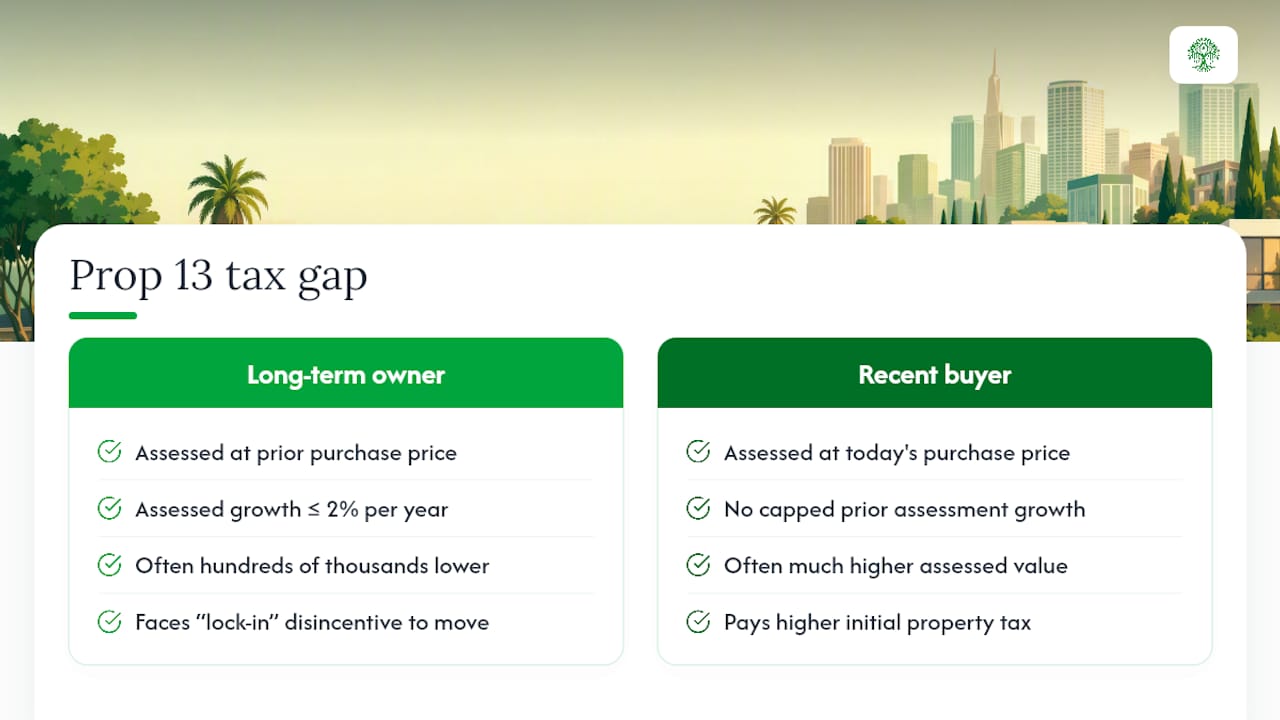
    • What triggers a big jump: A change in ownership or new construction resets your base-year value to current market levels, which is why a neighbor who bought 20 years ago may pay a fraction of what you owe on an identical home.
    • Why long-term owners pay less: Proposition 13’s 2% annual cap means assessed values for longtime owners often sit well below current market value, compressing their tax bill year after year.
    • Where to check right now: Go to your county assessor or tax collector website, search by your parcel number (APN), and confirm your current taxable value and what’s on your bill.

    Understanding California property taxes fully means knowing not just the formula, but every line item on your bill, when reassessments happen, and what you can do to reduce or challenge your assessment.


    Table of Contents

    What actually appears on your California property tax bill

    Most homeowners glance at the total and move on. That’s a mistake. Your bill is a layered document, and each line tells you something different about who’s charging you and why.

    The LAO’s property tax primer breaks the bill into two broad categories: ad valorem charges (based on your assessed value) and non-ad valorem charges (flat amounts that don’t scale with value).

    Line Item Type How It’s Calculated
    1% General Levy Ad valorem 1% × assessed value; goes to county, cities, schools, special districts
    Voter-approved GO bonds Ad valorem Rate set by bond measure; added to your assessed value calculation
    Parcel tax Flat (non-ad valorem) Fixed dollar amount per parcel, regardless of value
    Mello-Roos / CFD levy Flat or ad valorem Varies by district; often a flat annual charge for infrastructure
    Special assessments Flat (non-ad valorem) Street lighting, landscaping, flood control, etc.

    The 1% general levy is the baseline. It’s the line most people recognize, and it funds schools, the county, cities, and special districts. Before Proposition 13, local governments set their own rates independently, and average rates ran much higher. Prop 13 standardized the 1% ceiling and required two-thirds voter approval for any new special local taxes.

    Voter-approved general obligation bonds appear as separate line items with their own rates. These fund school construction, parks, or infrastructure projects that voters approved. They’re ad valorem, so they scale with your assessed value.

    Parcel taxes are flat charges. Every parcel in the district pays the same amount, whether the home is worth $300,000 or $3 million. They require a two-thirds supermajority to pass.

    Mello-Roos Community Facilities Districts (CFDs) deserve special attention. Developers in newer subdivisions often form a CFD to finance roads, schools, and utilities. If you buy in a Mello-Roos district, you’ll pay an annual levy that can add hundreds or thousands of dollars to your bill. The charge typically runs for a fixed term (often 25–40 years) and is tied to the parcel, not the value. Always ask whether a property sits in a CFD before making an offer.

    Developing residential street with infrastructure under construction

    Your bill also shows your Assessor’s Parcel Number (APN), the assessed land and improvement values, the total taxable value, and the two payment installment amounts with their due dates.


    How your assessed value gets set in the first place

    The county assessor is responsible for discovering, inventorying, valuing, and enrolling every taxable property in the county. Here’s how the process works under Proposition 13:

    1. Base-year value is established at purchase — When you buy a property, the assessor sets your base-year value equal to the purchase price. That becomes the starting point for all future assessments.
    2. The assessor completes the roll by July 1. The BOE’s overview confirms that assessors must value property as of January 1 and notify owners when assessed values increase. Assessment notices typically go out in the summer.

    Pro Tip: When you receive your assessment notice (usually July), you have a limited window to appeal. Mark the date and compare the assessed value to your purchase price and recent comparable sales immediately.


    How your annual tax bill is actually calculated

    The formula is straightforward once you know the components:

    Annual property tax = (Taxable assessed value × 1%) + voter-approved bond rates + parcel taxes + Mello-Roos/CFD charges + other special assessments

    The 1% general levy is universal across California. Everything else depends on where the property sits.

    Charge Type Basis Typical Range
    1% general levy Ad valorem 1% of assessed value (statewide)
    GO bond rates Ad valorem Varies by district; often 0.01%–0.05% per measure
    Parcel tax Flat per parcel Varies widely; can be $100–$1,000+ per year
    Mello-Roos levy Flat or ad valorem Varies; often $500–$3,000+ per year in newer subdivisions
    Special assessments Flat per parcel Typically $20–$300 per year per district

    Two homes with identical assessed values in different cities can carry meaningfully different total tax rates. A home in a district with multiple active bond measures and a Mello-Roos CFD will pay more than a comparable home in a district with none. This is why understanding California property taxes requires looking beyond the 1% headline rate.

    • The 1% levy is set by Proposition 13 and applies statewide.
    • Bond rates are set by the bond measure and vary by school district, city, and county.
    • Parcel taxes and Mello-Roos charges are set by the specific district and appear as fixed amounts.
    • Your county tax collector’s website will show the full rate area breakdown for any APN.

    Exemptions and relief programs that can lower your bill

    Several programs reduce either your taxable value or the taxes you owe. Most require a one-time application through your county assessor.

    • Homeowners’ Exemption: — If the property is your primary residence, you may qualify for an exemption that reduces your assessed value by $7,000. At a 1% rate, that saves $70 per year on the general levy. File a claim with your county assessor after purchase; it typically renews automatically as long as you remain the owner-occupant.
    • Property Tax Postponement Program: California’s State Controller administers a program allowing eligible seniors (62+), blind, or disabled homeowners to postpone payment of property taxes on their primary residence. Postponed taxes become a lien on the property, repaid when the home is sold or transferred.

    To apply for any exemption, get the claim form from your county assessor’s office. Some exemptions have filing deadlines, so don’t wait.


    How to appeal your assessed value if it seems too high

    You have the right to challenge your assessed value. The process is formal but manageable if you prepare.

    1. Review your assessment notice — The assessor mails notices when values increase, typically in July. Check the assessed value against your purchase price and recent comparable sales in your neighborhood.

    The window to appeal is short. If you miss the November 30 deadline, you typically must wait until the next assessment cycle.


    What buyers and sellers need to know about reassessment and Prop 19

    Buying a home in California triggers a reassessment. That’s not a surprise. What catches buyers off guard is the supplemental bill that follows.

    Buyer checklist before and during escrow:

    • Ask the seller for the most recent property tax bill. Confirm the current assessed value and all line items.
    • Ask your escrow officer whether supplemental taxes will be collected through escrow. Per Orange County Assessor guidance, escrow typically does not collect supplemental taxes unless explicitly arranged.
    • Confirm with your lender whether your impound account will cover supplemental bills.
    • Check whether the property sits in a Mello-Roos CFD. This is disclosed in the Natural Hazard Disclosure report and the preliminary title report.
    • Review the offer process to understand what tax-related questions to raise before you sign.

    How supplemental assessments work:

    When you close escrow, the assessor calculates the difference between the prior assessed value and your new base-year value (the purchase price). That difference is prorated from your close-of-escrow date to the end of the fiscal year (June 30). You’ll receive a Notice of Supplemental Assessment and then a supplemental tax bill, usually several months after closing.

    Proposition 19 portability:

    If you’re 55 or older, severely disabled, or a wildfire victim, Prop 19 lets you transfer your existing base-year value to a replacement home anywhere in California. The replacement home must be your primary residence, and the transfer must occur within two years of selling the original. If the replacement home costs more than the original, the base-year value is adjusted upward proportionally. Forms and instructions are available through your county assessor. This can be a significant financial benefit for eligible sellers who want to downsize or relocate without losing their low assessed value.

    For a full breakdown of what to budget at closing, the California closing costs guide covers supplemental bills alongside other line items.


    Why Proposition 13 creates a tax gap between neighbors

    This is the part of California property taxes that surprises most buyers, and it’s worth understanding clearly.

    The Lincoln Institute’s research on assessment limits documents how purchase-price-based assessment systems create structural disparities between long-term owners and recent buyers. California’s version is among the most pronounced in the country.

    The core dynamic: Under Proposition 13, two identical homes on the same street can carry assessed values that differ by hundreds of thousands of dollars, simply because one owner bought in 1998 and the other bought last year. The long-term owner’s assessed value has grown at most 2% per year, while the recent buyer’s is set at today’s purchase price. The LAO’s analysis of Proposition 13 confirms this produces a “lock-in” effect: long-term owners face a significant tax penalty for selling and buying again, which can discourage them from moving even when their housing needs change.

    For buyers, this has two practical consequences. First, your initial tax bill will almost certainly be higher than your neighbor’s if they’ve owned for more than a few years. Second, because Prop 13 made assessed values more stable for long-term owners, local governments shifted toward other revenue sources over time, which is part of why bond measures and parcel taxes have proliferated on California ballots.

    The policy trade-off is real. Prop 13 gives homeowners predictability and protection against being taxed out of their homes during price surges. But it also means new buyers absorb a disproportionate share of the local tax base. Factor that into your affordability math before you make an offer. The analysis of why California home prices run high connects this dynamic to broader market pressures worth understanding.


    Why Proposition 13 creates a tax gap between neighbors — overview diagram

    Where to look up your bill, rates, and assessment data

    You don’t need to guess at any of these numbers. Official sources give you everything.

    • Your county assessor’s website: — Search by APN or owner name to find your current assessed value, base-year value, and any exemptions on file. Every California county has a public parcel search tool.
    • Your county tax collector’s website: — Shows your current bill, payment history, due dates, and rate area breakdown. Most counties let you pay online and sign up for e-billing.
    • California Board of Equalization (BOE): The BOE’s property tax overview is the authoritative statewide reference for assessment rules, payment schedules, and revenue distribution.
    • Legislative Analyst’s Office (LAO): The LAO’s Proposition 13 analysis and property tax primer are the clearest policy-level explanations available.

    Pro Tip: When using any online calculator, plug in your county’s actual total rate (not just 1%) for a realistic estimate. The difference between 1% and 1.35% on a $750,000 home is $2,625 per year.


    Key Takeaways

    California property taxes are set by your purchase price under Proposition 13, capped at 2% annual growth, and billed as the 1% base levy plus local voter-approved charges that vary significantly by district.

    Point Details
    Prop 13 sets your base Your taxable value starts at your purchase price and grows no more than 2% per year.
    Local charges vary widely Mello-Roos, bond measures, and parcel taxes can add hundreds or thousands annually beyond the 1% levy.
    Supplemental bills follow purchase Expect a prorated supplemental tax bill months after closing; confirm escrow won’t cover it automatically.
    Appeal window is short File an assessment appeal by November 30 if your assessed value exceeds your purchase price or comparable sales.
    Ficustree integrates tax planning Ficustree’s decision-intelligence platform helps first-time buyers factor property taxes and supplemental bills into affordability before making an offer.

    Ficustree helps you budget for property taxes before you close

    Most buyers figure out their true property tax burden after they’ve already signed. Ficustree is built to flip that sequence. The platform’s decision-intelligence tools let you model your actual post-purchase tax bill, including the 1% base levy, local bond rates, and Mello-Roos charges, before you make an offer. You’ll see the full PITI picture, not just the mortgage payment.

    Ficustree

    When you work with Ficustree, you pay $1,000 at closing plus a 1% commission and keep a rebate of roughly 2% where permitted. The platform is free to use, and you get on-demand showing agents without locking into a traditional agency relationship. For first-time buyers who want to plan their home purchase with clear numbers from the start, that’s a real structural advantage.

    Ready to see what your property taxes will actually look like on a specific home? Start your search at ficustree.ai and get the full cost picture before you commit.

    This article is general information, not tax or legal advice. Verify current figures and exemption eligibility with your county assessor or a qualified tax professional.


    FAQ

    Are California property taxes based on purchase price or market value?

    Yes, under Proposition 13, your assessed value is set at your purchase price (base-year value) and can increase by no more than 2% per year, regardless of market fluctuations.

    How much is property tax on an $800,000 home in California?

    At the 1% base rate, your general levy equals 1% of your assessed value. Add local bond measures, parcel taxes, and any Mello-Roos charges for your specific district, and your total annual tax bill varies depending on location.

    What is the age-55 property tax rule in California?

    Under Proposition 19, homeowners 55 or older can transfer their existing base-year assessed value to a replacement primary residence anywhere in California. If the replacement home costs more than the original, the base-year value is adjusted upward proportionally.

    How do you avoid high property taxes in California?

    You can’t avoid the reassessment at purchase, but you can reduce your bill by applying for the Homeowners’ Exemption, checking whether you qualify for Prop 19 portability, and appealing your assessed value if it exceeds your purchase price or recent comparable sales.

    When is the deadline to appeal a California property tax assessment?

    The standard deadline to file an Application for Changed Assessment with your county Assessment Appeals Board is November 30 for the regular assessment roll. Missing this window means waiting until the next assessment cycle.

  • Best Hybrid Work Commute Home Finders for 2026

    Best Hybrid Work Commute Home Finders for 2026

    The fastest way to find a hybrid-commute-friendly neighborhood is to score candidate areas on door-to-door commute time, transit reliability, home-office readiness, and daily amenities, then rank them with a weighted template. You can start in the next 15 minutes.

    Here is the immediate playbook:

    • Open Google Maps and drop a pin at your office. Draw a mental radius for a 30-minute commute (the research-backed manageable threshold) and a 45-minute outer limit. The average American one-way commute is 27.2 minutes as of 2024.
    • Pick 3–5 neighborhoods inside that radius that fit your rough budget.
    • For each neighborhood, run one simulated commute using Google Maps “Depart at” set to your typical in-office arrival time on a Tuesday or Wednesday.
    • Note door-to-door time, transit options, and last-mile walking distance.
    • Score each neighborhood on a 1–5 scale across commute time, transit reliability, walkability, home-office space, and cost. The highest total wins your shortlist.

    That five-step test takes under 20 minutes and filters out neighborhoods that look good on a Saturday but punish you every Tuesday.


    Table of Contents

    What does a hybrid commute calculator actually measure?

    A commute calculator, in the hybrid-work context, is not just a distance tool. It captures door-to-door travel time, the mix of modes you use (car, train, bike, walk), the variability across departure times, and the cost of each trip. For a daily commuter, a single average time is enough. For a hybrid worker in 2026, you need to know what Tuesday at 8:30 AM looks like versus Thursday at 10:00 AM, because those two trips can differ by 20 minutes on the same route.

    Why does this matter more now? Team-dependent hybrid schedules are the most common format, with a significant share of hybrid workers following a schedule set by their team rather than a fixed personal policy. That means your in-office days are not always predictable, and your commute scoring needs to account for peak-time variability, not just an average.

    Two thresholds from transport research are worth anchoring to. A one-way commute under about half an hour is generally manageable for most workers. At 45 minutes one-way, stress and wellbeing costs increase noticeably. The average American one-way commute is 27.2 minutes as of 2024, which means most buyers are already near the edge of what feels comfortable.

    Employer benefits shift these thresholds. Subsidized transit passes, gas stipends, and quality workplace food materially increase willingness to commute. If your employer covers a monthly transit pass or offers a parking subsidy, a 40-minute commute on two days per week may feel entirely different from the same commute five days a week with no support.

    Pro Tip: Always include last-mile time in your simulation. The walk from the train station to your office door, or from your car to your desk, adds 5–12 minutes that Google Maps sometimes underestimates. Add it manually.

    Census Bureau ACS data provides useful baseline commute times by metro area, which helps you calibrate whether a neighborhood’s typical commute is above or below the regional norm before you run your own test.


    How do you score neighborhoods for hybrid work?

    The scoring template below gives you a reproducible way to compare any 3–5 neighborhoods on the dimensions that actually matter for hybrid commuters. Adjust the weights to match your priorities, but keep the structure.

    Diagram of weighted neighborhood scoring for hybrid commuters

    Recommended weights (adjustable):

    Dimension Weight
    Door-to-door commute time 30%
    Home-office suitability (space, noise, internet) 20%
    Transit reliability and options 15%
    Walkability and daily amenities 15%
    Housing cost and resale demand 10%
    Ongoing commute costs (parking, gas, transit pass) 10%

    Scoring checklist (run this for each neighborhood):

    1. Commute time — Simulate door-to-door at peak time using Google Maps “Depart at.” Score 5 for under 25 minutes, 4 for 25–35, 3 for 35–45, 2 for 45–55, 1 for over 55.
    2. Walkability. Use Walk Score to rate grocery stores, pharmacies, coffee shops, and parks within walking distance. A higher Walk Score indicates that most errands can be handled on foot.
    3. Ongoing commute costs. Estimate monthly parking, gas, or transit pass costs. Add these to your weekly commute budget alongside your mortgage estimate.

    Multiply each score (1–5) by its weight and sum the results. The neighborhood with the highest weighted total leads your shortlist.


    Which tools give you the most reliable neighborhood data?

    Each tool below answers a specific question. Using them together closes the gaps that any single source leaves open.

    Tool What it measures Update frequency Key limitation
    Google Maps “Depart at” Door-to-door travel time by mode at a specific departure time Real-time / historical traffic Does not capture transit delays or crowding
    Transit agency schedules Scheduled frequency, route coverage, and service hours Varies by agency (often weekly) Scheduled vs. actual arrival can differ significantly
    Walk Score Walkability, transit score, and bike score by address Periodic (not real-time) Does not reflect recent business closures or openings
    FCC Broadband Map ISP availability and advertised speeds by address Updated periodically Advertised speeds often exceed actual delivered speeds
    Census ACS (American Community Survey) Median commute times and commute-mode share by metro and tract Annual (1-year and 5-year estimates) Lags current conditions by 1–2 years
    Local transit agency real-time feeds Live arrival data and service alerts Real-time Requires knowing which app or feed your agency uses

    Simulate your commute at peak time using Google Maps first, then cross-check with the transit agency’s own app. Rider forums on Reddit or Nextdoor often surface reliability issues that neither source shows, such as a bus line that runs on schedule but is consistently overcrowded during rush hour.

    For broadband, the FCC map is the right starting point, but call the ISP directly to confirm fiber availability at a specific address before you make an offer. Advertised coverage and actual serviceability at a given address sometimes diverge.


    How do you compare neighborhoods step by step?

    This method works for any 3–5 candidate neighborhoods. Run it once and you have a defensible shortlist.

    1. Gather raw data. For each neighborhood, record: peak-time door-to-door commute (Google Maps), transit score (Walk Score), broadband availability (FCC map), median home price (your agent or Ficustree’s map search), and estimated monthly commute cost.
    2. Validate with a live test. Drive or transit the route on a weekday morning before you make any offer. No simulation replaces the actual experience of standing on a platform at 8:15 AM.

    Worked example — two neighborhoods:

    Neighborhood A is 28 minutes door-to-door by train (score: 4), Walk Score 82 (score: 5), fiber internet available (score: 5), median price at your ceiling (score: 3), monthly transit cost $120 (score: 4). Weighted total: (4×0.30) + (5×0.15) + (5×0.20) + (3×0.10) + (4×0.10) = 1.20 + 0.75 + 1.00 + 0.30 + 0.40 = 3.65.

    Neighborhood B is 38 minutes by car (score: 3), Walk Score 55 (score: 3), cable internet only (score: 3), median price 15% below your ceiling (score: 5), monthly parking $200 (score: 2). Weighted total: (3×0.30) + (3×0.15) + (3×0.20) + (5×0.10) + (2×0.10) = 0.90 + 0.45 + 0.60 + 0.50 + 0.20 = 2.65.

    Neighborhood A wins on this weighting, even though Neighborhood B is cheaper. If you go into the office only twice a week, the commute-time weight matters less, and Neighborhood B’s lower price may close the gap. Adjust the weights to your actual in-office frequency and rerun.


    What neighborhood archetypes do hybrid workers actually choose?

    Most neighborhoods fall into one of four patterns. Recognizing the pattern early saves you from touring homes that will never fit your work life.

    Transit-first urban pocket. High Walk Score (75+), rail or rapid bus within a 10-minute walk, dense amenities, smaller home footprints. Commute is fast and predictable. The downside: home-office space is tight, and noise from street or neighbors can disrupt video calls. Best for workers who go in three or more days per week and can carve out a quiet corner.

    Car-first outer suburb. Larger homes with dedicated office rooms, quiet streets, good broadband. Commute is 35–50 minutes by car, with meaningful cost and variability at peak times. Best for workers going in one or two days per week who prioritize WFH quality over commute speed.

    Mixed-mode inner ring. Moderate Walk Score (55–70), access to both rail and highway, mid-size homes with room for a dedicated office. Commute is 25–40 minutes depending on mode. This archetype suits the most common hybrid schedule: two to three in-office days per week with flexibility to bike or drive depending on weather.

    Walkable small-city core. Lower cost than a major urban pocket, genuine walkability for daily errands, often underserved by transit but close enough to the office for a bike commute. Best for buyers whose office is in a mid-size city and who want the lifestyle benefits of walkability without the price premium of a major metro.

    Employer-benefit-dependent suburb. A neighborhood that only works if your employer provides a transit subsidy or shuttle. Employer perks like transit passes and gas stipends can make a 40-minute commute financially and psychologically manageable. If those benefits disappear, the math changes fast.


    What does the timeline and cost look like from shortlist to move-in?

    For a first-time buyer using a data-driven platform, the realistic timeline from neighborhood shortlist to move-in runs 8–12 weeks in most California and Texas markets, though competitive markets can compress or extend that window.

    Phase Typical duration Key cost
    Neighborhood shortlist and research 1–2 weeks $0 (tools are free)
    Scout visits and live commute tests 1–2 weeks Gas, transit fares, time
    Pre-approval confirmation 3–5 business days Credit pull (minor)
    Active home search and offers 2–6 weeks Inspection deposit ($500)
    Escrow and closing 3–4 weeks Closing costs (2–5% of purchase price)
    Moving 1 week $1,500 depending on distance and volume

    Ongoing monthly commute costs vary widely. A transit commuter in a California metro might spend $150–$200 per month on a monthly pass. A car commuter driving 35 miles round-trip two days per week adds roughly $80–$120 per month in gas and wear, plus parking if the office does not provide it free.

    Build a weekly commute budget alongside your mortgage estimate. A neighborhood that saves $300 per month on housing but adds $250 per month in commute costs is not the deal it appears to be. Use Ficustree’s home affordability calculator to run the full PITI plus commute scenario before you commit to a search area.

    Seasonality affects both timeline and commute quality. Spring markets in California move fast, often with multiple offers within days of listing. Texas markets vary more by city. Winter commutes in northern metros add weather variability that your summer simulation will not capture.


    What does the timeline and cost look like from shortlist to move-in? — overview diagram

    Most buyers spend weeks manually pulling data from five different tools, then lose track of which neighborhood scored what. Ficustree compresses that process by layering commute overlays, neighborhood scoring, and affordability analysis into a single platform built specifically for first-time buyers.

    The platform’s AI-assisted search surfaces homes that match your commute radius, budget, and home-office criteria simultaneously, rather than making you filter for each separately. Ficustree’s decision intelligence approach means the system explains why a neighborhood fits your criteria, not just that it does, which helps buyers who are comparing trade-offs across multiple areas make faster, more confident decisions.

    On representation: Ficustree represents buyers directly at $1,000 at closing plus 1% commission. The premium platform and all buyer tools are free. Where legally permitted, buyers keep a rebate of roughly 2%. Showing agents are available on demand by the hour, so you can schedule live commute-test visits without committing to a full-service agent relationship before you are ready.

    For buyers in California and Texas who are working through the neighborhood scoring method in this article, Ficustree’s tools handle the data-gathering steps automatically, leaving you to focus on the judgment calls: which trade-offs matter most to your work life and your family.


    How do childcare and school locations affect your commute math?

    A neighborhood that scores well on office commute can still fail the daily logistics test if your child’s school or daycare is in the opposite direction. This is one of the most common blind spots in hybrid-work home searches.

    The practical fix is to add a second commute simulation: school drop-off to office, not just home to office. If the school is on the way, the combined trip may add only 5–10 minutes. If it requires a detour, that detour happens every in-office day, and it compounds fast over a school year.

    Commuter house-hunting checklists consistently flag school proximity as a scoring dimension alongside transit access and walkability. The reason is practical: childcare and school schedules are often less flexible than office schedules, so a missed drop-off window can cascade into a late arrival at work.

    When scoring neighborhoods, add a ninth dimension to your template: school or childcare proximity and route efficiency. Score it on the same 1–5 scale. A neighborhood where the school is a five-minute walk scores 5; one where drop-off requires a 20-minute detour in the opposite direction from the office scores 1 or 2.

    Also check after-school care availability in each neighborhood. Hybrid schedules sometimes mean a parent is home by 3:30 PM on WFH days but not on office days. Neighborhoods with strong after-school program infrastructure reduce the logistics burden on office days.


    When should you recalculate your commute score?

    Your hybrid schedule is not static. Employer policies, team structures, and personal circumstances change, and your neighborhood scoring should reflect those changes before they become a problem.

    Recalculate whenever one of these triggers occurs:

    • Your in-office frequency changes by one or more days per week. Going from two days to three days in-office shifts the commute-time weight significantly and can change which neighborhood wins.
    • Your employer changes its transit benefit or parking policy. A lost transit subsidy can add $150–$200 per month to your commute cost, which changes the affordability math on your current home.
    • Your team moves to a different office location. Even a 10-minute shift in office location can change which neighborhoods sit inside your 30-minute radius.
    • A new transit line opens or a service cut reduces frequency on your route. Transit agencies in major metros update schedules periodically, and a route that ran every 10 minutes may drop to every 20.

    Hybrid work schedules are team-dependent for roughly 40% of hybrid workers, which means policy changes at the team level, not just the company level, can shift your commute parameters. Build a calendar reminder to re-run your neighborhood score every six months, or immediately after any employer policy change.

    If you are still in the home search phase, ask your employer directly about schedule stability before you commit to a neighborhood. A written policy or a manager’s clear statement about expected in-office frequency is worth more than an assumption when you are signing a 30-year mortgage.


    Key Takeaways

    The most reliable way to find a hybrid-commute-friendly neighborhood is to score candidates on door-to-door commute time, home-office suitability, transit reliability, and daily amenities using a weighted template, then validate with a live weekday test before making an offer.

    Point Details
    Use the 30/45-minute rule Target under 30 minutes one-way for frequent in-office days; 45 minutes is the stress threshold.
    Weight home-office suitability at 20% Space, noise, and broadband quality matter as much as commute speed on WFH days.
    Factor in-office frequency into your weights Two days per week changes the math significantly compared to four; adjust scores accordingly.
    Add a weekly commute budget Calculate monthly commute costs alongside mortgage estimates to avoid false affordability.
    Ficustree accelerates the shortlist Ficustree’s AI platform layers commute overlays and neighborhood scoring for first-time buyers in California and Texas, compressing weeks of manual research.

    The mistake most buyers make with hybrid commute planning

    Most buyers visit neighborhoods on a Saturday afternoon and call it research. That is the single biggest error in hybrid-commute home searches, and it produces a distorted picture almost every time. Saturday traffic bears no resemblance to Tuesday at 8:20 AM. A neighborhood that feels calm and accessible on a weekend can be a bottleneck on a weekday morning, with a bus that runs every 25 minutes instead of every 8.

    The second mistake is treating the home-office as an afterthought. Buyers spend hours comparing commute times to the minute, then tour homes where the only quiet space is a closet. On a three-day WFH week, you spend more waking hours in your home office than you do commuting. Broadband reliability and a room with a door are not luxuries; they are productivity infrastructure.

    The third mistake is ignoring employer benefit changes. A transit subsidy that makes a 40-minute commute affordable can disappear with a policy update. Buyers who anchor their neighborhood choice to a benefit they do not control are one policy memo away from a commute that no longer works financially.

    The correction for all three is the same: run your analysis on weekday data, weight home-office quality seriously, and build your neighborhood score on the commute you will actually pay for, not the one your employer currently subsidizes. Consulting a local agent, such as those at Attain RE, can also surface neighborhood-level intel that no dataset captures, like which streets flood in winter or which blocks have the most turnover.


    Ficustree helps you find the right neighborhood faster

    Searching for a hybrid-commute-friendly home across five neighborhoods, three data sources, and a spreadsheet you built yourself is a slow way to make one of the largest financial decisions of your life. Ficustree gives you a faster path.

    Ficustree

    The platform combines AI-powered neighborhood scoring, commute overlays, and affordability analysis in one place, built specifically for first-time buyers in California and Texas. You get direct buyer representation at $1,000 at closing plus 1% commission, a free premium platform, on-demand showing agents, and a rebate of roughly 2% where legally permitted. No retainer, no lock-in, no six-month search spiral.

    The Ficustree buyer platform walks you from a scored neighborhood shortlist to a signed offer with decision intelligence at every step. Start your neighborhood search now at ficustree.ai.


    Useful sources

    A note on these resources: each source below answers a specific question in the research process. Use them in the order that matches where you are in your search.


    FAQ

    Is a 30-minute commute reasonable for hybrid workers?

    Yes. Research treats 30 minutes one-way as the practical target for manageable commuting, with 45 minutes marking the threshold where stress and wellbeing costs increase noticeably. For hybrid workers commuting two to three days per week, a 35-minute commute is often acceptable.

    Team-dependent hybrid schedules are the most common format, with a significant share of hybrid workers following a schedule set by their team. Fixed personal schedules (such as Monday/Wednesday in-office) are less common but easier to plan a commute around.

    How do I find the best home locations for hybrid work?

    Score candidate neighborhoods on door-to-door commute time, transit reliability, home-office suitability (space, noise, broadband), walkability, and housing cost using a weighted template. Validate your top two choices with a live weekday morning commute test before making an offer.

    What is the best way to balance commuting and working from home?

    Weight your neighborhood search toward home-office quality on WFH days and commute predictability on in-office days, rather than optimizing for one or the other. A weekly commute budget, calculated alongside your mortgage estimate, helps you see the true cost of each neighborhood trade-off.

    How does Ficustree help with hybrid-commute home searches?

    Ficustree’s AI platform layers commute overlays, neighborhood scoring, and affordability analysis for first-time buyers in California and Texas, compressing weeks of manual research into a guided shortlist. Buyers pay $1,000 at closing plus 1% commission and use the full platform free.

  • How AI Platforms Speed Up Your Home Closing

    How AI Platforms Speed Up Your Home Closing

    AI platforms automate and accelerate the repetitive, deadline-driven work in a home closing while leaving negotiation, legal sign-off, and judgment calls to humans. Concretely, that means document extraction, deadline calendaring, e-sign orchestration, and status communications can all run with minimal manual effort. What stays human: title exception disputes, final contract approval, and any decision where local context or legal liability matters.

    The evidence is building fast. Early adopters of AI transaction coordination reported roughly 40% faster closing timelines and an 87% reduction in missed deadlines in 2025–2026. HomeLight’s EVA, an AI escrow agent, automates tasks across a 120-plus-item escrow checklist by integrating about 80 distinct tools. And a 2026 industry survey found that 75% of homebuyers expect AI in the process but still want human accountability for major decisions.

    The bottom line: AI reduces manual risk across the closing pipeline, but it introduces explainability, privacy, and liability considerations that make a human-in-the-loop mandatory, not optional.

    Three things to keep in mind as you read:

    • AI excels at volume, speed, and consistency on structured tasks.
    • It struggles with edge cases, regional context, and anything requiring legal judgment.
    • Documented audit trails and security certifications such as SOC 2 are commonly considered the minimum security standards for any platform handling closing data.

    Key Takeaways

    AI platforms automate the structured, deadline-driven work in home closings while human agents remain essential for legal decisions, negotiations, and exception handling.

    Point Details
    AI speeds closings measurably Early adopters report roughly 40% faster timelines and 87% fewer missed deadlines.
    Human-in-the-loop is mandatory 75% of buyers expect AI assistance but demand human accountability for major decisions.
    SOC 2 and audit trails are the minimum bar Any platform handling closing documents must have SOC 2 certification and exportable audit logs.
    Local context is AI’s biggest gap Repair estimates and valuation figures need agent review for regional accuracy before entering negotiations.
    Ficustree combines both Ficustree pairs AI closing automation with licensed buyer representation in California and Texas for $1,000 plus 1% at closing.

    This article is general information, not a substitute for advice from a qualified financial advisor. Consult a qualified financial professional about your own circumstances before acting on anything here.

    Table of Contents

    How AI platforms change each stage of the closing process

    The closing timeline runs from executed contract to recorded deed, and AI touches nearly every stage. Here is where the automation actually lands.

    1. Contract execution and intake
    AI extracts key dates, party names, contingency windows, and purchase price from the executed contract in minutes rather than the 20–30 minutes a coordinator typically spends manually. Platforms convert relative terms (“10 business days from acceptance”) into fixed calendar deadlines and push those dates into a shared timeline automatically.

    Infographic of AI-assisted home closing stages

    2. Transaction coordination and deadline monitoring
    Once the timeline exists, AI acts as a deadline watchdog. It auto-generates reminder sequences for each milestone, escalates overdue items to the responsible party, and logs every action with a timestamp. AI transaction coordination platforms also generate state-specific compliance checklists, so a California transaction gets its TDS and NHD reminders while a Texas deal gets its option-period and survey notices.

    3. Title and lien search
    AI-assisted title platforms accelerate document intake and extraction from public records, flag potential liens or encumbrances for examiner review, and produce consistent audit trails. Automated document processing handles the 100–200-page residential closing package with fewer manual handling errors, freeing title examiners to focus on curative work rather than data entry.

    4. Escrow coordination
    This is where tools like EVA operate: opening escrow orders, pulling HOA documents, sending intake forms, and monitoring inboxes for responses. Routine back-and-forth that once consumed hours of coordinator time runs on autopilot.

    5. Closing day and e-sign/e-close orchestration
    AI platforms sequence the signing package, verify that all required documents are present and signed, and flag incomplete or inconsistent signatures before the notary session begins. For e-closing workflows, the platform can route documents to a remote online notary (RON) where state law permits.

    6. Post-closing recording and audit
    After signing, AI verifies that recorded documents match the executed package, flags discrepancies, and archives the full transaction record with a tamper-evident audit trail.


    What each stakeholder actually gains

    The benefits of AI in closing differ meaningfully by role.

    Buyers

    • Fewer last-minute surprises: automated deadline alerts mean contingency windows rarely slip unnoticed.
    • Timelier disclosures: AI flags missing or unsigned disclosure documents before they become a closing-day crisis.
    • Clearer status updates: buyers get real-time visibility into where their transaction stands rather than waiting for an agent callback.
    • NAR notes that AI is increasingly a research and convenience tool, but buyers still rely on human experts for tours, negotiations, and legal decisions.

    Agents and brokers

    • Higher throughput per coordinator: fewer manual tasks means one coordinator can manage more files simultaneously.
    • Consistent quality: every transaction follows the same checklist, regardless of who is handling it.
    • Audit-ready records: documented timelines protect agents in dispute situations.

    Transaction coordinators and closers

    • Time shifts from data entry to exception handling, which is where their expertise matters most.
    • Escalation logic surfaces only the items that need human judgment, reducing cognitive load.

    Lenders and underwriters

    • Faster document verification reduces the time between clear-to-close and funding.
    • Automated cross-checks against lender instructions reduce conditions that bounce back from the title company.
    Stakeholder Key metric improvement
    Transaction coordinators Up to 87% fewer missed deadlines (early adopter data)
    Closing timelines Roughly 40% faster for AI-enabled brokerages
    Title examiners More time on curative work; fewer manual handling errors
    Buyers Real-time status visibility; fewer last-minute document surprises

    Where AI can fail and the risks you need to manage

    AI in closing is genuinely useful, but the failure modes are specific and worth knowing before you trust any platform.

    Common accuracy failures

    • False positives in document extraction: AI may misread a handwritten addendum or a non-standard clause, producing an incorrect deadline.
    • Regional cost-context errors: AI-generated repair estimates often use national-average labor costs that don’t match local rates, which can inflate or deflate negotiation positions.
    • Missed edge-case clauses: unusual contingencies or custom addenda may not parse correctly if the model was trained on standard forms.

    Legal and regulatory cautions

    • E-notary and e-sign rules vary by state. Not every state permits remote online notarization for real estate documents; some require wet signatures on specific instruments.
    • Lender acceptability: some lenders will not accept AI-generated valuations or repair summaries without documented human review.
    • Explainability: the “black box” problem is real. If a platform cannot explain why it flagged a title issue or calculated a deadline a certain way, that creates liability exposure for the agent or closer who relied on it.
    • Data privacy: closing files contain Social Security numbers, bank account details, and income data. Any platform must meet GLBA and state privacy law requirements.

    Risk reality check: AI should summarize and flag issues, not make final calls. Buyers and professionals who treat AI output as a final answer rather than a starting point are taking on liability the platform will not share.

    Liability and security minimums

    • SOC 2 Type II certification is the floor for data security in any platform handling closing documents.
    • Encryption at rest and in transit, plus role-based access controls, are non-negotiable.
    • Every AI action should produce a timestamped, human-readable audit log.

    Pro Tip: Before relying on any AI-extracted deadline, have a coordinator spot-check the five highest-stakes dates (option period, inspection, appraisal, loan, and closing) against the original contract. That five-minute check catches the errors that matter most.


    How to evaluate an AI closing platform before you commit

    Use this checklist when assessing any AI-enabled closing or transaction coordination tool.

    Evaluation criterion What to ask
    LOS/CRM/title integration Does it connect natively to your existing stack, or require manual exports?
    SOC 2 certification Is it Type I or Type II? Request the report.
    Audit trail quality Can you export a full, timestamped log of every AI action?
    Human escalation workflow How does the platform route exceptions to a human, and how fast?
    State coverage Does deadline logic account for California and Texas-specific rules?
    Error rate disclosure Will the vendor share extraction accuracy rates and exception volumes?
    Data retention policy How long is closing data stored, and who can access it after closing?

    Red flags to walk away from:

    • No documented human-in-the-loop for exceptions.
    • Deadline logic that applies a single national template regardless of state.
    • No audit logs, or logs that are not exportable.
    • Vendor cannot explain how the model was trained or what it does with your data.
    • SLA language that excludes liability for missed deadlines caused by AI errors.

    Pro Tip: Ask every vendor for a sample audit log from a completed transaction. A platform that cannot produce one in 10 minutes either does not have real logging or does not want you to see it.


    How Ficustree uses AI during the buyer journey and closing

    Ficustree operates as a buyer-representation platform in California and Texas, and its AI layer is built specifically around the closing stages that matter most to first-time buyers.

    What Ficustree automates:

    • Document timeline generation from the executed contract, including California-specific disclosures (TDS, NHD, SPQ) and Texas option-period tracking.
    • Coordination messaging: automated status updates keep buyers informed without requiring them to chase their agent.
    • Disclosure completeness checks: the platform flags missing or unsigned documents before they become a closing-day problem.

    What stays human:

    • Legal negotiation and contract approval remain with licensed agents.
    • Title exceptions and curative work are handled by the title company’s examiners.
    • Any escalation involving an anomaly, dispute, or unusual clause goes to a human agent immediately.

    Ficustree’s approach: AI handles the structured, repeatable work so your agent can focus on the decisions that actually require judgment. You get faster updates and fewer surprises, not a robot making legal calls on your behalf.

    Ficustree’s pricing is transparent: buyers pay $1,000 at closing plus 1% commission, and where legally permitted, keep a rebate of roughly 2%. The premium platform is free to use. On-demand showing agents are available hourly, so you are never locked into a full-service retainer you do not need.

    Pro Tip: Ask Ficustree for its security whitepaper before you share any financial documents. A platform serious about buyer data will have one ready.

    For buyers who want to understand how AI shapes the earlier stages of the process, Ficustree’s guide to AI home search covers what changes from search through offer.


    How to roll out AI for closing: a practical pilot plan

    Whether you are a brokerage, title shop, or lender, a structured pilot beats a full rollout every time.

    1. Define a narrow scope. Pick one transaction type (single-family purchase, one county) and one workflow (deadline monitoring or document extraction). Do not automate everything at once.
    2. Set your baseline metrics. Before the pilot starts, measure: average time to extract contract dates, missed-deadline rate per 100 transactions, and package completeness rate at closing.
    3. Run parallel workflows for 30 days. Have a human coordinator work alongside the AI on every file. Log every discrepancy between AI output and human review.
    4. Collect and categorize exceptions. Group errors by type (extraction error, state-rule gap, edge-case clause). This tells you where the model needs tuning or human override rules.
    5. Set human-review thresholds. Any AI confidence score below your agreed threshold triggers automatic human review. Document this threshold in your SLA with the vendor.
    6. Iterate and expand. After 30 days, review metrics, adjust thresholds, and expand to a second workflow only when the first is stable.

    Pilot metrics to track:

    • Time to extract key dates (target: under 5 minutes per file)
    • Missed-deadline rate (target: below the pre-AI baseline)
    • Package completeness rate at closing
    • Closings per coordinator per month

    Pro Tip: For repair and valuation suggestions, always require the AI output to include a local comparable range, not just a national average. If the platform cannot provide local context, flag those outputs for mandatory agent review before sharing with the other party.


    The honest case for AI in closing, and where the hype runs ahead of reality

    The productivity gains from AI in closing are real. Roughly 40% faster timelines and near-elimination of missed deadlines are outcomes that matter to every party in a transaction. But the framing that AI “handles closing” overstates what the technology actually does well.

    What AI does reliably is volume work: extracting structured data from standard forms, calculating dates, sending reminders, and logging actions. What it does poorly is anything that requires local knowledge, legal judgment, or the ability to read a counterparty’s intent. An AI that flags a title cloud is useful. An AI that tells you whether to fight it or accept a price reduction is not ready for that job.

    The more useful mental model is this: AI is a very fast, very consistent junior coordinator. It never forgets a deadline, never misfiles a document, and never has a bad day. But it also cannot tell you that the seller’s attorney is stalling, that the local market makes a repair credit more negotiable than a price drop, or that a specific clause in a California addendum has been litigated in a way that changes its practical meaning.

    Real estate agents’ roles are shifting from information provider to strategic advisor. AI accelerates that shift by taking the information-handling load off agents’ plates. The agents who thrive will be the ones who use that freed capacity for judgment, not the ones who assume the AI has it covered.

    For buyers, the practical recommendation is simple: use platforms that show you their work. If an AI flags a document issue or generates a repair estimate, you should be able to see the source data and have a human agent confirm it before it affects a negotiation.


    The honest case for AI in closing, and where the hype runs ahead of reality — overview diagram

    Ficustree guides you through closing with AI and a real agent behind it

    First-time buyers in California and Texas get a lot of AI tools thrown at them. Ficustree is different because it pairs that AI layer with direct buyer representation, so you are never relying on automation alone for a decision that costs you six figures.

    ficustree

    The platform handles the structured closing work: timeline generation, disclosure tracking, coordination messaging, and deadline alerts. Your licensed agent handles everything that requires judgment. You pay $1,000 at closing plus 1% commission, keep a rebate of roughly 2% where California or Texas law permits, and use the full platform free. No retainer, no surprise fees.

    Ficustree operates with documented security standards and can provide a security whitepaper on request. If you want to see how the platform manages your closing data before you share any financial documents, ask for it. Ficustree and see how AI-assisted buyer representation works in practice.


    Sources

    FAQ

    Will AI replace mortgage originators and closing agents?

    No. AI automates structured, repetitive tasks like document extraction and deadline monitoring, but NAR confirms buyers still rely on human professionals for negotiations, legal decisions, and complex judgment calls.

    What are the main downsides of AI in the closing process?

    The biggest risks are extraction errors on non-standard documents, repair estimates that lack local cost context, explainability gaps that create liability exposure, and data-privacy obligations under GLBA and state law. Always require a human review step for high-stakes outputs.

    How does AI transaction coordination actually work?

    AI platforms extract key dates and party information from the executed contract, convert them into a fixed deadline calendar, generate state-specific compliance checklists, and send automated reminders, all while logging every action in an audit trail.

    What should I ask an AI closing platform about security?

    Request their SOC 2 Type II report, confirm encryption at rest and in transit, ask for a sample audit log from a completed transaction, and clarify their data retention policy and who can access your files after closing.

    Does the role of an AI platform in home closing differ by state?

    Yes. E-notary and e-sign rules vary significantly: some states permit remote online notarization for real estate instruments while others require wet signatures. Any platform you use must apply state-specific deadline logic and disclosure requirements, not a single national template.

  • AI Home Platform Features and Benefits for First-Time Buyers

    AI Home Platform Features and Benefits for First-Time Buyers

    An AI home-buying platform gives you decision intelligence: live MLS data, neighborhood scoring, predictive comps, and bargaining signals, all organized into readable recommendations you can act on. For first-time buyers in California and Texas, a brokerage-backed AI platform is worth using, provided it pairs that intelligence with licensed buyer representation. The short version: AI accelerates your research and sharpens your offers; a licensed agent handles fiduciary judgment and contract negotiation. Use both.

    Before your first call with any platform or agent, ask three things:

    • What MLS sources do you pull from, and how current is the data?
    • Can you show me the decision chain behind a specific recommendation?
    • What are your exact fees, and do you offer a buyer rebate where it’s legal?

    If you get vague answers to any of those, keep looking.


    Table of Contents

    What AI home platform features and benefits should you expect?

    A credible AI home platform delivers six core capabilities. Here is what to require, not just hope for.

    Live MLS integration. The platform must pull from your local MLS in near real time. Stale listings waste your time; stale pricing data costs you money at the offer table. Live MLS feeds enable bargaining power scores built from days on market (DOM), price-reduction history, and listing activity signals.

    Diagram summarizing six AI platform capabilities

    Neighborhood scoring. Schools, commute times, walkability, safety indicators, and development pipeline data should be weighted and surfaced as a score you can interrogate, not just a number you have to trust blindly.

    Predictive comps and automated valuation model (AVM) inputs. Predictive comps go beyond raw sold prices by adjusting for condition trends, micro-market absorption rates, and seasonal patterns. They give you a starting range for your offer, not a final answer.

    Bargaining and negotiation signals. DOM flags, price-reduction counts, and listing-view indicators tell you whether a seller is under pressure. These signals shape your opening offer strategy.

    Personalization with a feedback loop. AI property discovery works best when you actively flag misses, not just favorites. Tell the platform when a recommendation is wrong and why. That feedback trains the model on priorities that raw data cannot capture, like noise levels or neighbor dynamics.

    Explainability and privacy controls. Every recommendation should show which data drove it. And the platform must have a clear, written data-retention policy. Never paste sensitive personal information into a general AI chat tool where storage and access are uncontrolled.

    Pro Tip: Ask the platform to walk you through a live recommendation for a specific address. If the rep cannot explain which data points drove the score, the explainability is cosmetic.


    How do these features actually help first-time buyers in California and Texas?

    The features above solve real buyer problems. Here is the mapping.

    Faster, more focused search. AI filters out listings that fail your hard constraints (price, beds, commute) before you ever see them, then ranks the remainder by soft tradeoffs you have taught it. That cuts decision fatigue significantly for buyers who would otherwise scroll for months.

    Better offer timing and pricing. Predictive comps plus DOM flags give you a data-backed opening offer and a counter strategy. You walk into negotiation knowing whether the seller has been sitting on the property or fielding multiple bids.

    Regional differences matter here. California markets, especially the Bay Area and Southern California, run on speed and tight inventory. Live MLS signals and same-day data refresh matter most there. Texas markets, particularly Austin and Dallas-Fort Worth suburbs, have faster DOM variances and active new-build pockets, so predictive comps and development-trend layers carry more weight.

    • In California, data lags of a day or more can mean missing a competitive window entirely.
    • In Texas, new-build incentives and builder concessions require a platform that tracks permit activity and development pipelines, not just resale comps.

    Education and reduced anxiety. AI generates plain-language summaries of comparable sales, likely repair flags from listing history, and long-term value indicators. For a first-time buyer who has never read a CMA, that summary is the difference between a confident offer and a paralyzed one.

    The human layer stays essential. Top agents use AI to automate repetitive prep tasks so they can focus human expertise on pricing strategy and live negotiation. AI prepares the evidence; your agent reads the room, advises on contingencies, and signs the paperwork.

    Pro Tip: When you receive an AI-generated offer brief, bring it to your agent and ask: “What does this miss that you’d add from your local knowledge?” That conversation is where the real value gets built.


    How does an AI home platform actually reach its conclusions?

    Data source What it powers
    Live MLS feed Listing freshness, DOM flags, price-reduction history, bargaining signals
    Public tax and assessment records AVM inputs, ownership history, tax burden estimates
    Building permits and zoning feeds Development trend layers, new-build pipeline alerts
    School and transit APIs Neighborhood scoring components
    Third-party market data Absorption rates, seasonal pricing patterns, micro-market comps

    The model takes those inputs and produces neighborhood scores, predictive comp ranges, and a bargaining power index for each listing. A readable decision chain shows you which inputs moved the score and by how much.

    Data freshness is not a minor detail. In California’s competitive markets, a platform refreshing MLS data every few hours versus every 24 hours can mean the difference between a timely offer and a missed listing. Real estate API integrations that pull directly from MLS systems, rather than aggregating from third-party portals, produce the most reliable signals.

    On security: choose platforms with explicit data-handling and retention policies. AI valuations and negotiation autopilots remain limited; the highest-value AI use cases are research, CMA prep, and offer brief generation, not replacing fiduciary judgment.

    Pro Tip: Ask for the platform’s data-refresh interval in writing. “Real time” means different things to different vendors.


    What should you expect to pay, and how long will it take?

    Cost item Typical range Ficustree model
    Platform access — Free for represented buyers
    Buyer representation fee $1,000 at closing + 1% commission $1,000 at closing + 1% commission
    Buyer rebate (where legal) ~2% rebate where permitted by CA/TX law ~2% rebate where permitted by CA/TX law
    Showing agent (hourly) hourly rate On-demand, hourly

    Timeline: Ficustree’s promise is to compress what typically feels like six months of first-time-buyer confusion into roughly two months of guided, structured progress. AI handles the research and shortlisting; your agent handles showings, offer strategy, and transaction coordination.

    “Free platform” offers from listing aggregators often mean the vendor monetizes your data or routes your inquiry to a paying agent, not necessarily the best one for you. Always confirm in writing what you receive, what you pay, and whether a rebate applies.

    Pro Tip: Before signing buyer representation paperwork, request a written scope of services that specifies which AI outputs you’ll receive, the fee structure, and the rebate policy. Verbal promises are not enforceable at closing.


    How do you choose the right AI buyer platform?

    Questions to ask every platform

    1. What MLS sources do you use, and what is your data-refresh interval?
    2. Can you show me a live decision chain for a specific property recommendation?
    3. What are your exact fees, and is a buyer rebate available in my state?
    4. How do you handle my personal data, and what is your retention policy?
    5. Is this platform deployed at the brokerage level, or is it an individual agent add-on?

    Evaluation criteria

    • Explainable recommendations with visible data inputs
    • Brokerage-level deployment with audit logs
    • Clear, written pricing and rebate policy
    • Local MLS calibration for California or Texas
    • Explicit data-handling and PII policy

    Red flags to walk away from

    • Opaque or verbal-only pricing
    • Unverifiable data sources or no MLS disclosure
    • Requests for Social Security numbers or full account numbers in a chatbot
    • Claims of “automated negotiation” or “guaranteed pricing”
    • No human approval gate on contract-related outputs

    How does Ficustree apply these features for CA and TX buyers?

    Ficustree is a brokerage-backed AI buyer representation platform built specifically for first-time buyers in California and Texas. It is not a listings aggregator. It is the decision intelligence layer between you and the purchase.

    Core capabilities:

    • Live MLS integration with neighborhood scoring across schools, commute, walkability, and development trends
    • Predictive comps and bargaining signal flags (DOM, price-reduction history)
    • Explainable offer briefs with readable decision chains
    • On-demand showing agents, booked hourly
    Onboarding step What happens
    Profile intake You define budget, geography, must-haves, and soft tradeoffs
    AI shortlist Platform surfaces ranked listings with neighborhood scores and comp ranges
    Feedback loop You flag misses; model refines recommendations
    Offer prep AI generates a comp brief and bargaining signal summary for your agent
    Negotiation and close Licensed agent handles fiduciary judgment, contract, and transaction coordination

    Pricing: $1,000 at closing plus 1% commission. The premium platform is free for represented buyers. A rebate of roughly 2% is available where California and Texas law permits. Showing agents are available on demand at an hourly rate.

    For a deeper look at how AI personalized home search works inside the platform, Ficustree’s blog walks through the matching logic and feedback loop in detail.


    Key Takeaways

    AI home platform features and benefits are most valuable when paired with licensed brokerage representation, transparent pricing, and explainable data chains that first-time buyers in California and Texas can audit and act on.

    Point Details
    AI is a research tool, not a replacement Pair AI decision intelligence with a licensed agent for fiduciary judgment and contract work.
    Live MLS access is non-negotiable Data freshness directly affects offer timing, especially in California’s competitive markets.
    Explainability protects you Demand a visible decision chain for every recommendation before you act on it.
    Pricing transparency matters Confirm fees, rebate eligibility, and scope of services in writing before signing representation paperwork.
    Ficustree for CA and TX buyers $1,000 at closing plus 1% commission, with a ~2% rebate where legal and a free premium platform for represented buyers.

    The part most AI platforms get wrong

    The promise of AI in home buying is real. But most platforms oversell the automation and undersell the judgment layer. Buyers come in expecting the AI to tell them what to buy. What it actually does, when built correctly, is tell you what the data says, so your agent and you can decide together.

    The first-time buyers I talk to are not confused about technology. They are confused about whether they can trust what they’re seeing. That is the problem worth solving: not faster listings, but clearer decisions. Explainable AI, brokerage-level compliance, and a transparent fee structure are not features to check off a list. They are the conditions under which a first-time buyer can actually trust the process.

    If you want to see what that looks like in practice, start with a guided consultation and ask Ficustree to walk you through a live recommendation for a property in your target area.


    Ficustree gives first-time buyers a clearer path to closing

    Most buyers spend months comparing listings on their own, then hand everything to an agent at the last minute. Ficustree reverses that. You get AI-driven shortlisting, neighborhood scoring, and offer briefs from day one, backed by a licensed brokerage that keeps a human in the loop on every high-stakes decision.

    ficustree

    Sign up at ficustree.ai and receive a profile intake, an AI-generated shortlist ranked by your priorities, on-demand showing agent scheduling, and a written fee schedule with rebate terms where California or Texas law permits. No vague pricing, no data surprises.

    Start your buyer profile and see your first shortlist within 48 hours.


    FAQ

    What core features should an AI home platform include?

    Live MLS integration, neighborhood scoring, predictive comps, DOM and price-reduction flags, explainable recommendations, and a clear data-privacy policy are the minimum. Platforms without audit logs or explainability are not ready for serious buyer representation.

    How does AI help first-time buyers make better offers?

    AI surfaces bargaining signals like days on market and price-reduction history, then pairs them with predictive comp ranges so you and your agent can build a data-backed opening offer rather than guessing.

    Is AI enough, or do I still need a licensed agent?

    You still need a licensed agent. 82% of buyers use AI for real estate insights but rely on human agents for final decisions. AI handles research and prep; agents handle fiduciary judgment, contract negotiation, and legal compliance.

    What does Ficustree cost for a first-time buyer in California or Texas?

    Ficustree charges $1,000 at closing plus a 1% commission. The platform is free for represented buyers, and a roughly 2% rebate is available where California or Texas law permits.

    What is the biggest red flag when evaluating an AI buyer platform?

    Opaque pricing and unverifiable data sources are the clearest warning signs. If a platform cannot show you the decision chain behind a recommendation or refuses to put its fee structure in writing, move on.

  • Top Multi-Offer Strategy Platforms for Sellers’ Markets

    Top Multi-Offer Strategy Platforms for Sellers’ Markets

    Use a decision-intelligence offer-management portal with a net-to-seller worksheet and a fixed highest-and-best deadline. That combination gives listing agents the fastest path from inbox chaos to a confident, defensible acceptance. Here are four actions you can take right now:

    • Set a firm deadline (example: “5:00 PM Friday”) and communicate it to all buyer agents simultaneously.
    • Require proof of funds or a pre-approval letter as a mandatory upload before any offer is accepted into review.
    • Run every offer through a net-to-seller worksheet before comparing headline prices.
    • Enable an audit trail in your platform so every submission, counter, and acceptance is timestamped.

    The sections below cover which features to prioritize, how to run a highest-and-best window step by step, a worked net-to-seller calculation, legal and MLS obligations, and a vendor-interview checklist you can take into any demo.


    Table of Contents

    Why do multiple offers become chaotic in sellers’ markets?

    Multiple-offer friction has three root causes: timing gaps, incomplete documentation, and inconsistent offer terms that make apples-to-apples comparison nearly impossible. When six offers arrive across three days with different contingency structures, different closing timelines, and missing pre-approval letters, even an experienced listing agent can lose track of which offer is actually strongest.

    The most common failure modes look like this:

    • Late offers that arrive after verbal negotiations have started, creating fairness and disclosure risk.
    • Missing proof of funds on cash offers, leaving close-probability unverified.
    • Vague contingency language (inspection periods with no defined waiver option, open-ended financing contingencies) that shifts risk onto the seller without a clear price offset.
    • Emotional seller pressure to accept the highest headline number before the full picture is clear.
    • Disorganized email threads where the most recent counter lives in a reply chain three agents deep.

    Offer-management portals address these problems by tying every attachment to a single intake link, auto-validating required documents, and timestamping each submission. That alone removes the bottleneck of chasing missing files and prevents late offers from slipping into the process undetected.

    Pro Tip: Create a single intake link with a required-document checklist (pre-approval or POF, signed offer, earnest money documentation) and share that link with all buyer agents at the same time. Any submission missing a required document is held, not reviewed, until complete.

    Infographic comparing inbox tools and decision intelligence features


    What do the top multi-offer strategy platforms actually do?

    The best platforms for multiple offers do more than collect files. They centralize intake, normalize offer terms, and create an auditable decision layer that shifts the listing agent from email manager to strategic advisor.

    Here is what that looks like in practice, feature by feature:

    • Secure intake / one-link submission. Buyer agents submit through a single URL. No account creation required on the buyer side. Prevents duplicate or out-of-band submissions.
    • Document collection and validation. Required attachments are flagged at upload. Incomplete submissions are held automatically, not forwarded to the agent’s inbox.
    • Side-by-side comparison boards. Offers are displayed in a sortable dashboard with price, contingencies, closing date, and financing type visible at a glance. ShowingTime’s Offer Manager integrates this directly with MLS showing workflows.
    • Net-to-seller calculators. Platforms convert raw offer terms into a normalized dollar figure after seller concessions, closing costs, and contingency risk adjustments. This is where headline-price bias gets corrected.
    • Configurable seller-priority weighting. Agents can weight criteria (closing date, financing type, contingency waiver) to match what the seller actually values, not just what looks good on paper.
    • Close-probability scoring. AI-powered tools extract offer terms and score each buyer on likelihood to close, surfacing the top two or three finalists before the agent spends time on full review.
    • Audit trail and version history. Every counter, revision, and acceptance is timestamped and stored. DealTrack’s offer desk provides role-based access so brokers and agents see different views of the same record.
    • Seller-facing summary portal. A read-only view lets sellers see a clean comparison without accessing raw documents or private buyer information.
    • Export and reporting. One-click PDF or CSV export for compliance files, broker review, or post-transaction recordkeeping.
    • Integrations. MLS data sync, e-signature platforms, and CRM connections reduce manual re-entry and keep the transaction record consistent.

    The key distinction worth understanding: inbox and collection tools (email folders, shared drives, basic form builders) handle the logistics of receiving offers. Decision-intelligence layers, like those offered by AI-matching platforms, go further by scoring, ranking, and surfacing the offer most likely to close at the best net-to-seller figure. Both matter; only the second one changes the quality of the decision.


    Which features should you prioritize when choosing a platform?

    Hands using tablet to review platform features

    Start with outcomes, not feature lists. The right platform reduces deal failure, speeds the decision window, and improves net proceeds. Everything else is secondary.

    Must-have features (ranked 1–6)

    1. Secure intake with required-document enforcement. If the platform cannot hold incomplete submissions, you are still chasing files by email.
    2. Net-to-seller calculator. Normalizing offers by adjusting for concessions, closing costs, and contingency risk is the single most important analytical step in a multi-offer review.
    3. Customizable highest-and-best workflow. You need to configure deadline, required fields, and communication templates without calling vendor support.
    4. Audit trail with versioning. Timestamped submissions and a revision log protect you legally and satisfy MLS compliance requirements in most states.
    5. Seller-facing summary view. Sellers need a clean, role-appropriate window into the comparison without seeing private buyer financial details.
    6. MLS and e-sign integration. Manual re-entry between systems is where errors and delays accumulate.

    Nice-to-have features

    • AI close-probability ranking (valuable for high-volume agents managing multiple listings simultaneously)
    • Seller-priority weighting engine (lets you score offers against custom criteria beyond price)
    • Team KPI dashboards (useful for brokerage-level oversight)
    • White-labeling (important for brand-consistent client communication)
    • Counter-recommendation engine (platforms like AgreeZone generate private counter suggestions based on seller priorities)
    • Mobile-first seller portal (speeds approval when sellers are not at a desk)

    How do you run a highest-and-best process that reduces chaos?

    A structured timeline is the difference between a controlled multi-offer review and a reactive scramble. Here is the sequence experienced listing agents use.

    Team collaborating on highest-and-best offer timeline

    Step Action Responsible Party Timing
    1 Activate intake link; set required documents Listing agent —
    2 Notify all buyer agents of H&B deadline and rules Listing agent Same day as first offer received
    3 Enforce intake cutoff; hold incomplete submissions Platform / agent Deadline hour
    4 Run net-to-seller worksheet on all complete offers Listing agent Within 2 hours of deadline
    5 Score finalists by close-probability; identify top 2–3 Agent / AI layer Same review window
    6 Present seller summary; discuss priorities Agent + seller Within 4 hours of deadline
    7 Accept, counter, or request best-and-final from finalists Listing agent —
    8 Document acceptance; archive all offers with audit log Agent / platform Immediately on acceptance

    What to collect from every submission:

    1. Signed purchase agreement with all addenda
    2. Pre-approval letter (dated within 30 days) or proof of funds for cash offers
    3. Earnest money documentation
    4. Any appraisal gap coverage or inspection waiver in writing

    How to communicate the deadline to buyer agents:

    We have received multiple offers on [property address]. All buyers are invited to submit their highest and best offer by [Day, Date] at [Time, Time Zone]. Please submit through the intake link provided. Required documents: signed offer, pre-approval letter or proof of funds, and earnest money documentation. Submissions missing required documents will not be reviewed until complete. No extensions will be granted. The seller reserves the right to accept any offer at any time.

    This language, adapted from standard highest-and-best practice, sets clear expectations and limits the risk of a buyer claiming they were not given a fair opportunity.


    How do you compare offers beyond price? A net-to-seller example

    The highest offer is rarely the objectively best offer. Net-to-seller normalization converts every offer into a comparable dollar figure after adjusting for what the seller actually walks away with.

    The formula:

    Net-to-seller = Sale price minus seller-paid closing costs minus seller concessions minus contingency risk adjustment

    Here is a realistic three-offer comparison:

    Offer Sale Price Seller Closing Costs Concessions Contingency Risk Net-to-Seller
    B — — — — (cash, no contingencies) —
    C — — — — (appraisal gap risk) —

    Offer C has the highest headline price and the lowest net-to-seller. Offer B, $10,000 lower on paper, puts $3,100 more in the seller’s pocket with no contingency risk.

    Common adjustments that change the net-to-seller figure:

    • Appraisal gap coverage. An offer without a written appraisal gap clause carries risk if the property appraises below contract price. Quantify that gap as a downside scenario.
    • Inspection waiver. A buyer who waives the home inspection contingency removes a common deal-killer; assign a positive risk adjustment.
    • Mortgage contingency. A financed offer with a mortgage contingency carries more close risk than a cash offer or a buyer with a verified pre-approval. Adjust accordingly.
    • Earnest money amount. Higher earnest money signals buyer commitment and reduces the cost of a failed transaction.

    Pro Tip: Use a net-to-seller spreadsheet or a platform’s built-in calculator for every offer, not just the top two. Agents who skip this step on “obviously weaker” offers occasionally miss the strongest net outcome.


    NAR guidance is clear: listing agents must handle multiple offers fairly, communicate transparently, and follow local MLS rules on disclosure. The ethical obligation is not just to the seller; it extends to all parties in the transaction.

    Your compliance checklist:

    • Document and preserve all offers received, including those rejected without counter. Most MLS rules and state license laws require this.
    • Avoid disclosing private buyer terms (price, contingencies, financing details) to competing buyers without explicit seller authorization. Disclosing specific terms without permission is an ethics violation under NAR standards.
    • Follow local MLS rules on offer disclosure. Some MLSs require agents to disclose the existence of other offers; others prohibit disclosing specific terms. Know your local rule.
    • Communicate the deadline simultaneously to all buyer agents. Staggered notifications create fairness risk.
    • Maintain an audit trail for every counter and acceptance. Timestamped records protect you if a buyer later claims they were not treated fairly.
    • Use read-only seller summaries that show normalized comparisons without exposing private buyer financial data.

    An offer-management portal with timestamped intake satisfies most of these requirements automatically. The audit log becomes your compliance file without any additional work.

    Pro Tip: Keep a read-only seller summary as a separate export from the full offer file. If a dispute arises, you can share the seller’s decision record without exposing private buyer information.

    This article provides general information about real estate practice and is not legal advice. Confirm current MLS rules and disclosure obligations with your local association or a licensed real estate attorney.


    What nine questions should you ask vendors during a platform demo?

    Choose for outcomes first. A platform that reduces deal failure, speeds the decision window, and improves net proceeds is worth more than one with a longer feature list that requires manual workarounds.

    1. How does your platform calculate net-to-seller, and can I customize the cost inputs for my market?
    2. Do you provide an immutable audit log with timestamps for every submission, counter, and acceptance?
    3. How do you verify proof of funds or pre-approval on cash and financed offers?
    4. Which MLS systems and e-signature platforms do you integrate with natively?
    5. What is your SLA for new-offer notifications, and how are agents alerted (SMS, email, push)?
    6. Can I configure required documents so incomplete submissions are held automatically?
    7. How does your close-probability scoring work, and what inputs does the model use?
    8. What does the seller-facing portal show, and can I control which fields are visible?
    9. What are your export formats, and how long are records retained after closing?

    Decision checklist: map demo answers to go/no-go

    • Net-to-seller calculator with customizable inputs: green
    • Immutable audit log: green
    • MLS and e-sign integration confirmed: green
    • Required-document enforcement: green
    • Close-probability scoring explained clearly: yellow (nice-to-have)
    • No export function or records deleted at closing: red
    • Fees buried in per-transaction charges not disclosed upfront: red
    • Manual intake steps that require agent re-entry: red
    • Vendor promises AI predictions without explaining the model: red

    Decision intelligence in action: a Ficustree-style workflow

    A decision-intelligence layer plus structured intake compresses the time from offer receipt to confident acceptance and reduces the risk of accepting an offer that fails to close.

    The baseline problem: A listing agent managing a competitive property in a California sellers’ market receives multiple offers over a short period. Offers arrive by email, some missing pre-approval letters. The agent spends four hours sorting, requesting missing documents, and building a manual spreadsheet comparison. The seller is anxious. Two offers are withdrawn before the agent finishes the comparison.

    The deployed workflow:

    • Intake link activated at listing; required documents enforced at submission.
    • All buyer agents notified simultaneously with a firm deadline over a set timeframe.
    • Platform auto-holds two incomplete submissions; agent follows up only on those two.
    • Net-to-seller worksheet runs on all five complete offers within 30 minutes of the deadline.
    • AI close-probability scoring surfaces the top three finalists based on financing strength, contingency structure, and buyer pre-approval quality.
    • Agent presents a clean seller summary (three finalists, normalized net figures, close-probability scores) within two hours of the deadline.
    • Seller selects the finalist with the highest net-to-seller and strongest close-probability. Acceptance documented with full audit trail.

    Before vs. after:

    • Time from deadline to seller decision: reduced from 6+ hours to under 3 hours.
    • Offers reviewed without missing documents: 5 of 5 complete (vs. 5 of 7 in the manual process).
    • Net-to-seller outcome: the accepted offer was not the highest headline price; it was $4,100 higher in net proceeds after contingency adjustments.

    When listing agents use decision-intelligence tools, they shift from administrative work (tracking emails) to strategic advising, choosing the buyer most likely to close.

    Ficustree’s AI-powered platform applies this same decision-intelligence logic on the buyer side, scoring buyer readiness and match quality so listing agents working with Ficustree-represented buyers receive cleaner, more complete offers from the start.

    Pro Tip: Run the AI close-probability ranking as a filter, not a final answer. Use it to reduce the candidate pool to two or three finalists, then apply human judgment on seller priorities and relationship factors before accepting.


    The strongest approach combines a structured intake process, net-to-seller normalization, and a decision-intelligence layer that surfaces the most qualified finalists before the seller has to make a call under pressure. Platforms that do all three reduce deal failure, protect net proceeds, and create a defensible compliance record.

    Your operator-level checklist:

    • Pre-listing prep. Configure your intake link, required documents, and deadline language before the listing goes live.
    • Set clear highest-and-best rules. Communicate deadline, required documents, and no-extension policy to all buyer agents at the same time.
    • Use net-to-seller normalization on every offer. Never compare headline prices without adjusting for concessions, contingencies, and closing costs.
    • Run decision-intelligence scoring on finalists. Use close-probability ranking to reduce the candidate pool before presenting to the seller.
    • Preserve the audit trail. Archive all offers, counters, and acceptances with timestamps before closing the file.
    • Communicate transparently throughout. Update all buyer agents on the process status without disclosing private terms.

    For vendor selection, use the nine-question checklist from the section above. Any vendor that cannot answer questions 1, 2, 3, and 4 clearly is not ready for a competitive sellers’ market.


    Key Takeaways

    The most effective multi-offer strategy in a sellers’ market combines a structured intake portal, net-to-seller normalization, and a decision-intelligence layer that ranks finalists by close-probability, not just headline price.

    Point Details
    Net-to-seller beats headline price Always normalize offers using sale price minus costs, concessions, and contingency risk before comparing.
    Audit trail is non-negotiable Timestamped intake and version history protect you legally and satisfy MLS compliance in most states.
    Set a firm H&B deadline A single, non-negotiable deadline creates competitive tension and prevents late-offer fairness risk.
    Decision intelligence speeds decisions AI close-probability scoring reduces the candidate pool to top finalists, cutting review time significantly.
    Ficustree as a decision layer Ficustree applies AI matching and decision intelligence to buyer representation, producing cleaner offers for listing agents to evaluate.

    The gap between “offer management” and actual decision intelligence

    Most agents shopping for offer-management tools are really looking for two different things without realizing it. The first is logistics: a place to collect offers, enforce required documents, and keep a compliance record. Dozens of tools do that adequately. The second is judgment support: a layer that tells you which offer is most likely to close at the best net-to-seller figure, given this seller’s specific priorities. Far fewer tools do that well, and almost none explain their scoring in plain language.

    The risk of conflating the two is real. An agent who buys a collection tool and calls it a decision-intelligence platform will still spend hours on manual comparison, still miss the contingency risk buried in Offer C, and still present the seller with a spreadsheet that requires the agent to interpret everything. The seller’s anxiety does not go down; it just moves from “I don’t know which offer to pick” to “I don’t understand why my agent is recommending this one.”

    What actually works is a platform that normalizes terms automatically, surfaces the top two or three finalists with a clear rationale, and gives the seller a summary they can read in five minutes. The technology handles the arithmetic; the agent handles the relationship. That division of labor is where the best listing agents in competitive markets are already operating, and it is exactly what Ficustree’s decision-intelligence approach is built around.


    Ficustree brings decision intelligence to your offer workflow

    Listing agents in California and Texas who want a decision layer integrated with their buyer and seller workflows have a direct option in Ficustree. Where most platforms stop at collecting and displaying offers, Ficustree’s AI-powered platform scores buyer readiness, match quality, and close-probability before an offer even reaches the listing agent’s desk.

    Ficustree

    For sellers, that means fewer incomplete offers to chase and a cleaner finalist pool to evaluate. For listing agents, it means less time on intake administration and more time on the strategic conversation with your seller. Ficustree represents buyers at $1,000 at closing plus 1% commission, with a roughly 2% rebate where legally permitted, so the buyers submitting through Ficustree are pre-qualified, financially prepared, and guided through the offer process by the same decision-intelligence layer you are using on the listing side.

    See how Ficustree’s buyer platform works, or go straight to ficustree.ai to explore the full decision-intelligence offering and connect with the team.


    Useful sources and references

    Source What it supports
    NAR Consumer Guide: Navigating Multiple Offers Ethical obligations, fair handling, and disclosure rules for listing agents
    Rocket Mortgage: Highest and Best Offer Definition of highest-and-best process and sample buyer-agent communication language
    RLTR Sync: Offer Management Audit trail, document intake enforcement, and compliance log capabilities
    ShowSmartly: AI for Realtors Close-probability scoring and decision-intelligence ranking methodology
    DealTrack: Offers Desk Role-based access, version tracking, and broker compliance dashboards
    ShowingTime: Offer Manager MLS-integrated offer collection and mobile seller comparison tools
    AgreeZone: AI-Powered Negotiation Counter-recommendation engine and seller-priority weighting
    EffectiveAgents: Multiple Offers Net-to-seller normalization methodology and contingency risk adjustment
    Houzeo: Multiple Offers and Highest & Best Highest-and-best deadline mechanics and competitive tension strategy

    FAQ

    What does “highest and best offer” mean in real estate?

    A highest-and-best request signals that a seller has received multiple offers and is asking all interested buyers to submit their final, optimized bid by a firm deadline. It compels buyers to present their best price and terms at once, rather than negotiating back and forth.

    Is the highest offer always the best offer for the seller?

    No. The highest headline price often carries the most contingency risk or the largest seller concessions. Normalizing offers to a net-to-seller figure, adjusting for closing costs, concessions, and contingency risk, frequently reveals that a lower-priced offer puts more money in the seller’s pocket.

    What is the hardest month to sell a house?

    Historically, January and February see the slowest buyer activity in most U.S. markets, which reduces competitive pressure and the likelihood of a multi-offer situation. Spring and early summer typically generate the most competitive conditions for sellers.

    How do offer-management platforms help listing agents stay compliant?

    Platforms with timestamped intake links, required-document enforcement, and immutable audit logs create a compliance record automatically. That record satisfies most MLS documentation rules and protects agents if a buyer later disputes how offers were handled.

    How does Ficustree fit into a multi-offer workflow?

    Ficustree applies decision-intelligence scoring on the buyer side, so offers submitted by Ficustree-represented buyers arrive with verified pre-approvals and complete documentation. That gives listing agents a cleaner, more comparable submission to evaluate alongside other offers in a highest-and-best window.

  • CalHFA Down Payment Assistance for California First-Time Buyers

    CalHFA Down Payment Assistance for California First-Time Buyers

    California offers two main CalHFA down payment assistance programs: the MyHome Assistance Program, a deferred-payment junior loan of up to 3.5% for FHA loans or up to 3% for Conventional, VA, or USDA loans, and the California Dream For All Shared Appreciation Loan, which provides up to 20% of the purchase price (capped at $150,000) in exchange for a share of your home’s future appreciation. MyHome is the steady, always-available option. Dream For All offers a larger amount but runs in funding cycles with a randomized voucher selection, so access is not guaranteed. Both require a CalHFA-approved first mortgage, a qualifying income and purchase price, and completed homebuyer education before closing.

    Before you go further, do these three things:

    • Confirm your lender is on CalHFA’s approved list (not all lenders offer these programs)
    • Verify which first mortgage type you qualify for, since the assistance percentage depends on it
    • Register for homebuyer education now — the right course takes time, and the wrong one will block your closing

    Table of Contents

    What CalHFA down payment assistance programs are available?

    Program What It Covers Assistance Amount Repayment Type Availability
    MyHome Assistance Program Down payment and/or closing costs Up to 3.5% (FHA) or 3% (Conv/VA/USDA) Deferred junior loan Year-round
    Dream For All Shared Appreciation Loan Down payment and/or closing costs Up to 20%, capped at $150,000 Shared appreciation on sale/refinance Voucher cycles; not always open
    CalPLUS FHA + ZIP Closing costs only Varies Deferred zero-interest loan Year-round (paired with CalPLUS FHA)
    CalPLUS Conventional + ZIP Closing costs only Varies Deferred zero-interest loan Year-round (paired with CalPLUS Conv.)
    UC Shared Appreciation Loan Down payment (UC Santa Cruz employees) Shared appreciation structure Shared appreciation Limited to eligible UC employees

    A few things worth knowing about availability: MyHome runs year-round as a continuous program, while Dream For All depends on state funding cycles and voucher windows. If you are targeting Dream For All, check the CalHFA program page for the current voucher status before building your timeline around it.


    How does the MyHome Assistance Program work?

    Hands completing MyHome Assistance application

    MyHome is the workhorse of California homebuyer assistance. It is available to any first-time buyer who qualifies, pairs with multiple first mortgage types, and requires no monthly payment while your primary loan is active.

    Eligibility checklist

    • You have not owned or resided in a home owned by a spouse within the past three years
    • The property will be your primary residence
    • Your income falls within CalHFA’s county-specific limits
    • You complete an accepted homebuyer education course with one-on-one counseling
    • You meet the credit and debt-to-income requirements of both CalHFA and your lender

    Exact assistance amounts

    MyHome offers a deferred-payment junior loan of up to 3.5% of the purchase price or appraised value (whichever is lower) when paired with a CalHFA FHA first mortgage. For Conventional, VA, or USDA first mortgages, the cap drops to 3%. On a $400,000 purchase with an FHA loan, that is up to $14,000 towards your down payment or closing costs.

    Infographic showing comparison of CalHFA assistance programs

    How the deferred repayment works

    No monthly payment is required while your first mortgage is in place. The MyHome loan term matches your first mortgage, up to 30 years, and repayment is triggered when you sell the home, refinance, or pay off the first mortgage. The funds cannot be used to pay off existing debt or give you cash back, and MyHome must sit in second lien position if you layer other assistance on top.

    How to apply for MyHome

    1. Find a CalHFA-approved lender — CalHFA does not originate loans directly
    2. Get pre-approved for a CalHFA first mortgage (FHA, Conventional, VA, or USDA)
    3. Complete the eHome 8-hour homebuyer education course plus the required 1-hour one-on-one counseling session
    4. Provide your education certificate to your lender
    5. Your lender submits the loan package to CalHFA for reservation and approval
    6. Close on your home; MyHome funds are disbursed at closing

    Pro Tip: Ask your lender upfront whether they have closed CalHFA loans in the past 12 months. Lenders who regularly close these loans know the required lien ordering, acceptable education certificates, and documentation gaps that trip up first-timers.


    Loan officer consulting about CalHFA loan

    How does the California Dream For All program work?

    Dream For All is designed for buyers who need a larger boost. It can cover up to 20% of the purchase price, which eliminates the need for private mortgage insurance on a conventional loan and dramatically reduces your monthly payment. The trade-off: CalHFA shares in your home’s future appreciation.

    Program highlights

    • Provides up to 20% of the purchase price for down payment and/or closing costs
    • Capped at $150,000 per borrower
    • No monthly payment on the assistance loan
    • Must be paired with a Dream For All Conventional first mortgage (not FHA)
    • Repayment is due when you sell, refinance, or pay off the first mortgage
    • Applicants must register for a voucher; selection is randomized, not first-come, first-served
    • First-generation homebuyers may receive priority consideration in some voucher rounds

    How the voucher process works

    You register during an open window, and CalHFA runs a randomized drawing to allocate vouchers. Completing your education and getting pre-approved before the window opens is the right move, but a voucher is not guaranteed by timing alone. If you are on the waitlist, check the CalHFA Voucher Portal for status updates. Dream For All is not continuously funded, so buyers who cannot wait for the next cycle should plan around MyHome instead.

    How shared-appreciation repayment is calculated

    When you sell or refinance, you repay the original Dream For All loan amount plus CalHFA’s proportional share of any appreciation. Here is a simple example:

    • Purchase price: $500,000
    • Dream For All loan: $100,000 (20%)
    • CalHFA’s appreciation share: 20%
    • You sell five years later for $650,000 (appreciation of $150,000)
    • You repay: $100,000 (original loan) + $30,000 (20% of $150,000 appreciation) = $130,000

    If your home does not appreciate, you repay only the original loan amount. The shared-appreciation structure means the program costs more in a rising market, which is worth modeling before you commit. For buyers who plan to hold the home long-term, that math can still favor Dream For All over a higher-rate loan with PMI.


    What other CalHFA programs can you layer with assistance?

    Beyond MyHome and Dream For All, CalHFA and its partners offer several targeted programs. Understanding which ones stack together saves you money and avoids technical denials.

    Other programs to know

    • CalPLUS FHA + ZIP: A slightly higher-rate FHA first mortgage paired with the Zero Interest Program (ZIP) for closing cost assistance. Useful when you need help with closing costs but already have a down payment.
    • CalPLUS Conventional + ZIP: Same structure for conventional buyers. ZIP is a deferred, zero-interest subordinate loan.
    • CalPLUS Access FHA / Conventional + MyAccess: Pairs a CalPLUS first mortgage with MyAccess for down payment or closing cost help.
    • UC Shared Appreciation Loan: A new employer-based program for eligible UC Santa Cruz employees, launching July 15, 2026. Structured similarly to Dream For All.
    • Local and county grants: Many California counties and cities offer their own down payment grants that can layer with CalHFA programs.

    Compatibility: which first mortgage works with which assistance?

    Assistance Program FHA First Mortgage Conventional First Mortgage VA First Mortgage USDA First Mortgage
    MyHome Yes (up to 3.5%) Yes (up to 3%) Yes (up to 3%) Yes (up to 3%)
    Dream For All No Yes (Dream For All Conv. only) No No
    ZIP (via CalPLUS) Yes (CalPLUS FHA) Yes (CalPLUS Conv.) No No

    On stacking: You can layer non-CalHFA local grants with MyHome, but MyHome must remain in second lien position when combined with other assistance. Dream For All cannot be combined with MyHome. Always confirm lien ordering with your lender before submitting a loan package, since a lien position error is one of the most common technical denial reasons. For a broader look at California first-time buyer programs, including local grants that pair well with CalHFA, Ficustree’s program guide covers the full picture.


    Who qualifies for CalHFA assistance programs?

    Eligibility has several layers. Meeting CalHFA’s baseline rules is necessary but not sufficient — your lender may apply stricter standards on top.

    Core eligibility requirements

    • First-time buyer definition: You must not have held an ownership interest in a principal residence, or resided in a home owned by a spouse, during the previous three years. All borrowers on the loan must meet this definition.
    • Occupancy: The home must be your primary residence. Investment properties and second homes are not eligible.
    • Income limits: CalHFA sets county-specific income limits that change periodically. Check the current tables on CalHFA’s website for your county before assuming you qualify.
    • Purchase price limits: Similarly county-based. High-cost counties like San Francisco and Santa Clara have higher limits than inland counties.
    • Homebuyer education: You must complete an accepted course before closing. CalHFA accepts eHome’s 8-hour homebuyer education course with a mandatory 1-hour one-on-one counseling session. Courses that skip the counseling component are commonly rejected.
    • Credit and DTI: CalHFA publishes baseline credit score and debt-to-income guidelines, but individual lenders often require higher scores or lower DTI ratios through their own overlays.

    Self-employed applicants

    Self-employed buyers qualify, but documentation requirements are more involved. Lenders typically require two years of federal tax returns (personal and business), a year-to-date profit and loss statement, and sometimes a CPA letter verifying business stability. Income is calculated from net earnings after business deductions, which can reduce your qualifying income significantly compared to a W-2 employee with the same gross revenue.

    Pro Tip: If you are self-employed, run your qualifying income calculation with your lender before you start shopping. Many self-employed buyers are surprised by how much their write-offs reduce their mortgage-eligible income.


    How do you apply for CalHFA assistance, step by step?

    Application steps

    1. Confirm lender approval. Use CalHFA’s lender search to find an approved lender. Not every bank or mortgage broker is on the list.
    2. Get pre-approved. Your lender will pull credit, verify income, and determine which CalHFA first mortgage and assistance program you qualify for.
    3. Complete homebuyer education. Finish the eHome 8-hour course and the 1-hour counseling session. Obtain your certificate.
    4. Register for a voucher (Dream For All only). If you are pursuing Dream For All, watch for the open registration window and submit during that period.
    5. Make an offer and open escrow. Your lender submits the loan package to CalHFA for reservation once you are in contract.
    6. Provide documentation. Your lender will collect the items below.
    7. Close. Assistance funds are disbursed at closing alongside your first mortgage.

    Documents you will need

    Document Notes
    Federal tax returns (2 years) W-2 and self-employed borrowers
    Recent pay stubs (30 days) W-2 employees
    Bank statements (2–3 months) All accounts used for assets
    Government-issued photo ID Driver’s license or passport
    Homebuyer education certificate Must include counseling component
    Rental history / landlord contact Some lenders request 12 months
    Business tax returns + P&L Self-employed borrowers only
    Social Security card Required by most lenders

    Timeline note: Education alone can take one to two weeks if you schedule the counseling session separately. Voucher windows for Dream For All may open only once or twice a year. Build both into your timeline before you write an offer. For a full California homebuying roadmap, the step-by-step guide at Ficustree walks you through the process from pre-approval to keys.


    What do the real numbers look like on a sample purchase?

    MyHome example

    On a $400,000 purchase with a CalHFA FHA loan, MyHome provides assistance up to the allowed percentage. That $14,000 sits as a deferred second mortgage with no monthly payment. Your FHA first mortgage covers the remaining balance after your own down payment contribution. When you sell or refinance, you repay the $14,000 plus any accrued interest. Because MyHome carries no monthly payment, it does not raise your monthly housing cost at all while you own the home.

    Dream For All example

    On a $500,000 purchase, Dream For All covers a significant percentage of the price. This assistance can eliminate PMI on a conventional first mortgage, leading to notable monthly savings compared to a low-down-payment loan. The cost comes later: when you sell for $650,000 (a $150,000 gain), you repay $100,000 plus CalHFA’s 20% share of appreciation ($30,000), totaling $130,000. That is a meaningful cost, but it may still be less than years of PMI payments plus a higher loan balance.

    Cost trade-offs to consider

    • MyHome adds no monthly cost but reduces your equity slightly at payoff
    • Dream For All eliminates PMI but shares upside in a rising market
    • Using assistance lowers your loan-to-value ratio, which can improve your interest rate tier
    • Both programs affect your refinance math: the second lien must be paid off or subordinated when you refinance
    • A home affordability calculator can model how each scenario changes your monthly payment and total cost over time

    Common pitfalls that stall or kill CalHFA applications

    Most CalHFA denials are preventable. Here is where buyers most often run into trouble.

    Frequent stall points

    • Wrong education course: Completing an online course without the required 1-hour counseling session is one of the most common closing blockers. Confirm your course is accepted before you start.
    • Lender not CalHFA-approved: Some buyers get pre-approved with a lender who cannot actually originate CalHFA loans. Verify approval status before you go deep into the process.
    • Income documentation gaps: Missing a year of tax returns, unexplained deposits, or inconsistent self-employment income can delay underwriting by weeks.
    • Lender overlays: Individual lenders can require higher credit scores or lower debt-to-income ratios than CalHFA’s baseline. A buyer who meets CalHFA’s published minimums can still be declined by a specific lender.
    • Voucher timing mismatch: Assuming Dream For All will be open when you are ready to buy is a planning error. The program may be closed or oversubscribed.
    • Lien ordering errors: Layering local grants with MyHome without confirming lien position can cause a technical denial at the last minute.

    Fraud alert

    CalHFA communicates through official channels. Voucher status is confirmed only through the CalHFA Voucher Portal or your CalHFA-approved lender. If someone contacts you claiming to guarantee a voucher or expedite approval for a fee, that is a scam. CalHFA does not charge application fees and does not use third-party brokers to distribute vouchers.

    Pro Tip: Ask your lender for a written confirmation that they are CalHFA-approved and have closed at least five CalHFA loans in the past year. That single question filters out most of the lenders who will waste your time.

    For a broader list of first-time homebuyer mistakes that derail California closings, Ficustree’s guide covers the full range beyond just CalHFA.


    Key Takeaways

    CalHFA down payment assistance gives California first-time buyers two real paths: a steady deferred loan through MyHome or a larger shared-appreciation loan through Dream For All, both requiring a CalHFA-approved lender and completed homebuyer education.

    Point Details
    MyHome assistance amounts Up to 3.5% for FHA loans; up to 3% for Conventional, VA, or USDA loans — deferred with no monthly payment.
    Dream For All structure Up to 20% of purchase price (capped at $150,000); repay original loan plus CalHFA’s appreciation share on sale or refinance.
    Education is a hard requirement Complete eHome’s 8-hour course with 1-hour counseling before closing — courses without counseling are rejected.
    Lender overlays are real CalHFA sets the floor; your lender may require a higher credit score or lower DTI than CalHFA’s published minimums.
    Ficustree supports the process Ficustree matches you with CalHFA-aware lenders, models assistance scenarios with its affordability calculator, and guides you through document prep.

    The part most buyers miss about CalHFA timing

    The biggest mistake I see first-time buyers make with CalHFA is treating it as a last-minute add-on. They find a house, fall in love with it, and then ask their lender about assistance. By that point, they have often already chosen a lender who is not CalHFA-approved, skipped the education requirement, or missed a Dream For All voucher window entirely.

    The buyers who use these programs successfully do the opposite. They confirm lender approval before they start touring homes. They finish the education course during the pre-approval phase, not after they are in contract. If they want Dream For All, they register for the voucher as soon as the window opens and treat MyHome as their backup plan.

    There is also a subtler issue with lender overlays that most guides gloss over. CalHFA’s published credit and income guidelines are the minimum, not the guarantee. A lender with stricter overlays can decline a buyer who technically qualifies by CalHFA’s rules. The fix is simple: ask your lender directly what their overlay requirements are, not just what CalHFA requires. That one conversation can save you weeks of wasted effort.

    My recommended sequence: get pre-approved, complete education, confirm lender CalHFA experience, then make offers. In that order.


    How Ficustree helps you use CalHFA assistance without the guesswork

    Getting CalHFA assistance approved is not complicated, but it requires the right lender, the right timing, and the right documents. That is exactly where Ficustree earns its place in your process.

    Ficustree

    Ficustree matches California first-time buyers with lenders who have a real track record closing CalHFA loans, not just lenders who are technically on the approved list. The platform’s home affordability calculator lets you model how MyHome or Dream For All changes your monthly payment and total loan cost before you commit. Document checklists built into the platform keep you organized from pre-approval through closing, so you are not scrambling for a tax return the night before your loan submission deadline.

    Buyers who use Ficustree pay $1,000 at closing plus 1% commission and keep a rebate of roughly 2% where legally permitted. The platform is free to use. Ficustree does not guarantee CalHFA program approval — eligibility depends on your financial profile and program availability. But it does give you the structure and lender connections to give yourself the best shot.

    Start your search at ficustree.ai and see how much assistance you may qualify for.


    Official sources and where to verify program details

    Use these primary sources to confirm current rules, income limits, and program status before you apply:

    • CalHFA Down Payment Assistance Programs: The official program index listing MyHome, Dream For All, ZIP, and all current assistance options with handbook links.
    • MyHome Assistance Program page: Exact assistance amounts, eligibility rules, and the link to the MyHome Program Handbook.
    • CalHFA MyHome Program Handbook: Full lender and borrower rules, including lien position requirements and fund use restrictions.
    • California Dream For All program page: Voucher registration, shared-appreciation repayment terms, and the Dream For All Handbook.
    • CalHFA Borrower Eligibility: The official three-year lookback definition and occupancy requirements.
    • eHome America: CalHFA’s accepted online homebuyer education provider offering the 8-hour course with the required 1-hour counseling component.
    • HUD Housing Counseling: Find HUD-approved counseling agencies if you prefer in-person or phone counseling over an online course.

    For questions not answered by these pages, contact the CalHFA Help Center directly or ask a CalHFA-approved lender. Program rules, income limits, and voucher availability change; always verify current details before you rely on them.

    This article is general information, not legal or financial advice. Confirm current program rules, income limits, and your personal eligibility with a CalHFA-approved lender or a qualified housing counselor before making any financial decisions.


    FAQ

    Is California giving up to $150,000 to first-time homebuyers?

    Yes, through the California Dream For All Shared Appreciation Loan, which provides up to 20% of the purchase price for down payment and closing costs, capped at $150,000. The program runs in funding cycles with randomized voucher selection, so access is not guaranteed.

    Does CalHFA help with down payments?

    Yes. CalHFA’s MyHome Assistance Program provides a deferred-payment junior loan of up to 3.5% (FHA) or 3% (Conventional/VA/USDA) of the purchase price for down payment and closing costs, with no monthly payment required while the first mortgage is active.

    With a CalHFA FHA loan and MyHome assistance, you could receive up to $10,500 (3.5% of a $300,000 purchase) toward your down payment and closing costs, potentially reducing your out-of-pocket contribution depending on your income and the lender’s requirements.

    How much of a down payment do I need for a $400,000 house?

    MyHome can provide assistance up to the allowed percentage on a CalHFA FHA loan or a somewhat lower percentage on Conventional, VA, or USDA loans. Dream For All can provide assistance up to a significant portion of a conventional purchase, potentially eliminating PMI entirely.