
Use a decision-intelligence offer-management portal with a net-to-seller worksheet and a fixed highest-and-best deadline. That combination gives listing agents the fastest path from inbox chaos to a confident, defensible acceptance. Here are four actions you can take right now:
- Set a firm deadline (example: “5:00 PM Friday”) and communicate it to all buyer agents simultaneously.
- Require proof of funds or a pre-approval letter as a mandatory upload before any offer is accepted into review.
- Run every offer through a net-to-seller worksheet before comparing headline prices.
- Enable an audit trail in your platform so every submission, counter, and acceptance is timestamped.
The sections below cover which features to prioritize, how to run a highest-and-best window step by step, a worked net-to-seller calculation, legal and MLS obligations, and a vendor-interview checklist you can take into any demo.
Table of Contents
- Why do multiple offers become chaotic in sellers’ markets?
- What do the top multi-offer strategy platforms actually do?
- Which features should you prioritize when choosing a platform?
- How do you run a highest-and-best process that reduces chaos?
- How do you compare offers beyond price? A net-to-seller example
- What are the legal and MLS rules for handling multiple offers?
- What nine questions should you ask vendors during a platform demo?
- Decision intelligence in action: a Ficustree-style workflow
- What is the recommended playbook for listing agents in competitive markets?
- Key Takeaways
- The gap between “offer management” and actual decision intelligence
- Ficustree brings decision intelligence to your offer workflow
- Useful sources and references
- FAQ
Why do multiple offers become chaotic in sellers’ markets?
Multiple-offer friction has three root causes: timing gaps, incomplete documentation, and inconsistent offer terms that make apples-to-apples comparison nearly impossible. When six offers arrive across three days with different contingency structures, different closing timelines, and missing pre-approval letters, even an experienced listing agent can lose track of which offer is actually strongest.
The most common failure modes look like this:
- Late offers that arrive after verbal negotiations have started, creating fairness and disclosure risk.
- Missing proof of funds on cash offers, leaving close-probability unverified.
- Vague contingency language (inspection periods with no defined waiver option, open-ended financing contingencies) that shifts risk onto the seller without a clear price offset.
- Emotional seller pressure to accept the highest headline number before the full picture is clear.
- Disorganized email threads where the most recent counter lives in a reply chain three agents deep.
Offer-management portals address these problems by tying every attachment to a single intake link, auto-validating required documents, and timestamping each submission. That alone removes the bottleneck of chasing missing files and prevents late offers from slipping into the process undetected.
Pro Tip: Create a single intake link with a required-document checklist (pre-approval or POF, signed offer, earnest money documentation) and share that link with all buyer agents at the same time. Any submission missing a required document is held, not reviewed, until complete.
What do the top multi-offer strategy platforms actually do?
The best platforms for multiple offers do more than collect files. They centralize intake, normalize offer terms, and create an auditable decision layer that shifts the listing agent from email manager to strategic advisor.
Here is what that looks like in practice, feature by feature:
- Secure intake / one-link submission. Buyer agents submit through a single URL. No account creation required on the buyer side. Prevents duplicate or out-of-band submissions.
- Document collection and validation. Required attachments are flagged at upload. Incomplete submissions are held automatically, not forwarded to the agent’s inbox.
- Side-by-side comparison boards. Offers are displayed in a sortable dashboard with price, contingencies, closing date, and financing type visible at a glance. ShowingTime’s Offer Manager integrates this directly with MLS showing workflows.
- Net-to-seller calculators. Platforms convert raw offer terms into a normalized dollar figure after seller concessions, closing costs, and contingency risk adjustments. This is where headline-price bias gets corrected.
- Configurable seller-priority weighting. Agents can weight criteria (closing date, financing type, contingency waiver) to match what the seller actually values, not just what looks good on paper.
- Close-probability scoring. AI-powered tools extract offer terms and score each buyer on likelihood to close, surfacing the top two or three finalists before the agent spends time on full review.
- Audit trail and version history. Every counter, revision, and acceptance is timestamped and stored. DealTrack’s offer desk provides role-based access so brokers and agents see different views of the same record.
- Seller-facing summary portal. A read-only view lets sellers see a clean comparison without accessing raw documents or private buyer information.
- Export and reporting. One-click PDF or CSV export for compliance files, broker review, or post-transaction recordkeeping.
- Integrations. MLS data sync, e-signature platforms, and CRM connections reduce manual re-entry and keep the transaction record consistent.
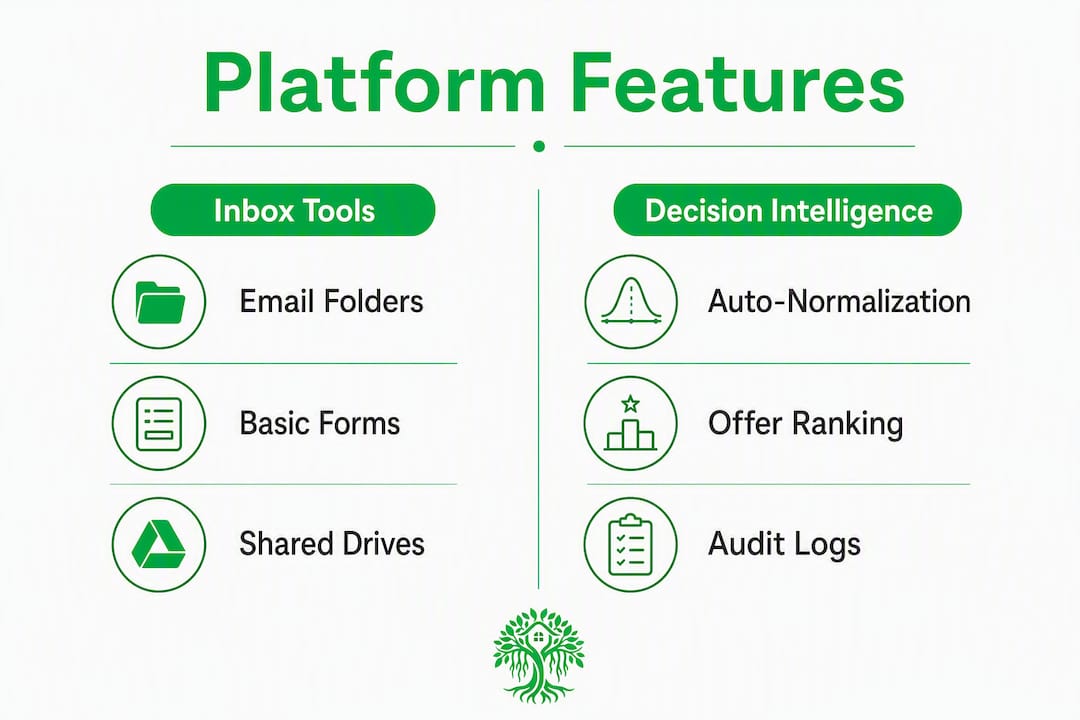
The key distinction worth understanding: inbox and collection tools (email folders, shared drives, basic form builders) handle the logistics of receiving offers. Decision-intelligence layers, like those offered by AI-matching platforms, go further by scoring, ranking, and surfacing the offer most likely to close at the best net-to-seller figure. Both matter; only the second one changes the quality of the decision.
Which features should you prioritize when choosing a platform?

Start with outcomes, not feature lists. The right platform reduces deal failure, speeds the decision window, and improves net proceeds. Everything else is secondary.
Must-have features (ranked 1–6)
- Secure intake with required-document enforcement. If the platform cannot hold incomplete submissions, you are still chasing files by email.
- Net-to-seller calculator. Normalizing offers by adjusting for concessions, closing costs, and contingency risk is the single most important analytical step in a multi-offer review.
- Customizable highest-and-best workflow. You need to configure deadline, required fields, and communication templates without calling vendor support.
- Audit trail with versioning. Timestamped submissions and a revision log protect you legally and satisfy MLS compliance requirements in most states.
- Seller-facing summary view. Sellers need a clean, role-appropriate window into the comparison without seeing private buyer financial details.
- MLS and e-sign integration. Manual re-entry between systems is where errors and delays accumulate.
Nice-to-have features
- AI close-probability ranking (valuable for high-volume agents managing multiple listings simultaneously)
- Seller-priority weighting engine (lets you score offers against custom criteria beyond price)
- Team KPI dashboards (useful for brokerage-level oversight)
- White-labeling (important for brand-consistent client communication)
- Counter-recommendation engine (platforms like AgreeZone generate private counter suggestions based on seller priorities)
- Mobile-first seller portal (speeds approval when sellers are not at a desk)
How do you run a highest-and-best process that reduces chaos?
A structured timeline is the difference between a controlled multi-offer review and a reactive scramble. Here is the sequence experienced listing agents use.

| Step | Action | Responsible Party | Timing |
|---|---|---|---|
| 1 | Activate intake link; set required documents | Listing agent | — |
| 2 | Notify all buyer agents of H&B deadline and rules | Listing agent | Same day as first offer received |
| 3 | Enforce intake cutoff; hold incomplete submissions | Platform / agent | Deadline hour |
| 4 | Run net-to-seller worksheet on all complete offers | Listing agent | Within 2 hours of deadline |
| 5 | Score finalists by close-probability; identify top 2–3 | Agent / AI layer | Same review window |
| 6 | Present seller summary; discuss priorities | Agent + seller | Within 4 hours of deadline |
| 7 | Accept, counter, or request best-and-final from finalists | Listing agent | — |
| 8 | Document acceptance; archive all offers with audit log | Agent / platform | Immediately on acceptance |
What to collect from every submission:
- Signed purchase agreement with all addenda
- Pre-approval letter (dated within 30 days) or proof of funds for cash offers
- Earnest money documentation
- Any appraisal gap coverage or inspection waiver in writing
How to communicate the deadline to buyer agents:
We have received multiple offers on [property address]. All buyers are invited to submit their highest and best offer by [Day, Date] at [Time, Time Zone]. Please submit through the intake link provided. Required documents: signed offer, pre-approval letter or proof of funds, and earnest money documentation. Submissions missing required documents will not be reviewed until complete. No extensions will be granted. The seller reserves the right to accept any offer at any time.
This language, adapted from standard highest-and-best practice, sets clear expectations and limits the risk of a buyer claiming they were not given a fair opportunity.
How do you compare offers beyond price? A net-to-seller example
The highest offer is rarely the objectively best offer. Net-to-seller normalization converts every offer into a comparable dollar figure after adjusting for what the seller actually walks away with.
The formula:
Net-to-seller = Sale price minus seller-paid closing costs minus seller concessions minus contingency risk adjustment
Here is a realistic three-offer comparison:
| Offer | Sale Price | Seller Closing Costs | Concessions | Contingency Risk | Net-to-Seller |
|---|---|---|---|---|---|
| B | — | — | — | — (cash, no contingencies) | — |
| C | — | — | — | — (appraisal gap risk) | — |
Offer C has the highest headline price and the lowest net-to-seller. Offer B, $10,000 lower on paper, puts $3,100 more in the seller’s pocket with no contingency risk.
Common adjustments that change the net-to-seller figure:
- Appraisal gap coverage. An offer without a written appraisal gap clause carries risk if the property appraises below contract price. Quantify that gap as a downside scenario.
- Inspection waiver. A buyer who waives the home inspection contingency removes a common deal-killer; assign a positive risk adjustment.
- Mortgage contingency. A financed offer with a mortgage contingency carries more close risk than a cash offer or a buyer with a verified pre-approval. Adjust accordingly.
- Earnest money amount. Higher earnest money signals buyer commitment and reduces the cost of a failed transaction.
Pro Tip: Use a net-to-seller spreadsheet or a platform’s built-in calculator for every offer, not just the top two. Agents who skip this step on “obviously weaker” offers occasionally miss the strongest net outcome.
What are the legal and MLS rules for handling multiple offers?
NAR guidance is clear: listing agents must handle multiple offers fairly, communicate transparently, and follow local MLS rules on disclosure. The ethical obligation is not just to the seller; it extends to all parties in the transaction.
Your compliance checklist:
- Document and preserve all offers received, including those rejected without counter. Most MLS rules and state license laws require this.
- Avoid disclosing private buyer terms (price, contingencies, financing details) to competing buyers without explicit seller authorization. Disclosing specific terms without permission is an ethics violation under NAR standards.
- Follow local MLS rules on offer disclosure. Some MLSs require agents to disclose the existence of other offers; others prohibit disclosing specific terms. Know your local rule.
- Communicate the deadline simultaneously to all buyer agents. Staggered notifications create fairness risk.
- Maintain an audit trail for every counter and acceptance. Timestamped records protect you if a buyer later claims they were not treated fairly.
- Use read-only seller summaries that show normalized comparisons without exposing private buyer financial data.
An offer-management portal with timestamped intake satisfies most of these requirements automatically. The audit log becomes your compliance file without any additional work.
Pro Tip: Keep a read-only seller summary as a separate export from the full offer file. If a dispute arises, you can share the seller’s decision record without exposing private buyer information.
This article provides general information about real estate practice and is not legal advice. Confirm current MLS rules and disclosure obligations with your local association or a licensed real estate attorney.
What nine questions should you ask vendors during a platform demo?
Choose for outcomes first. A platform that reduces deal failure, speeds the decision window, and improves net proceeds is worth more than one with a longer feature list that requires manual workarounds.
- How does your platform calculate net-to-seller, and can I customize the cost inputs for my market?
- Do you provide an immutable audit log with timestamps for every submission, counter, and acceptance?
- How do you verify proof of funds or pre-approval on cash and financed offers?
- Which MLS systems and e-signature platforms do you integrate with natively?
- What is your SLA for new-offer notifications, and how are agents alerted (SMS, email, push)?
- Can I configure required documents so incomplete submissions are held automatically?
- How does your close-probability scoring work, and what inputs does the model use?
- What does the seller-facing portal show, and can I control which fields are visible?
- What are your export formats, and how long are records retained after closing?
Decision checklist: map demo answers to go/no-go
- Net-to-seller calculator with customizable inputs: green
- Immutable audit log: green
- MLS and e-sign integration confirmed: green
- Required-document enforcement: green
- Close-probability scoring explained clearly: yellow (nice-to-have)
- No export function or records deleted at closing: red
- Fees buried in per-transaction charges not disclosed upfront: red
- Manual intake steps that require agent re-entry: red
- Vendor promises AI predictions without explaining the model: red
Decision intelligence in action: a Ficustree-style workflow
A decision-intelligence layer plus structured intake compresses the time from offer receipt to confident acceptance and reduces the risk of accepting an offer that fails to close.
The baseline problem: A listing agent managing a competitive property in a California sellers’ market receives multiple offers over a short period. Offers arrive by email, some missing pre-approval letters. The agent spends four hours sorting, requesting missing documents, and building a manual spreadsheet comparison. The seller is anxious. Two offers are withdrawn before the agent finishes the comparison.
The deployed workflow:
- Intake link activated at listing; required documents enforced at submission.
- All buyer agents notified simultaneously with a firm deadline over a set timeframe.
- Platform auto-holds two incomplete submissions; agent follows up only on those two.
- Net-to-seller worksheet runs on all five complete offers within 30 minutes of the deadline.
- AI close-probability scoring surfaces the top three finalists based on financing strength, contingency structure, and buyer pre-approval quality.
- Agent presents a clean seller summary (three finalists, normalized net figures, close-probability scores) within two hours of the deadline.
- Seller selects the finalist with the highest net-to-seller and strongest close-probability. Acceptance documented with full audit trail.
Before vs. after:
- Time from deadline to seller decision: reduced from 6+ hours to under 3 hours.
- Offers reviewed without missing documents: 5 of 5 complete (vs. 5 of 7 in the manual process).
- Net-to-seller outcome: the accepted offer was not the highest headline price; it was $4,100 higher in net proceeds after contingency adjustments.
When listing agents use decision-intelligence tools, they shift from administrative work (tracking emails) to strategic advising, choosing the buyer most likely to close.
Ficustree’s AI-powered platform applies this same decision-intelligence logic on the buyer side, scoring buyer readiness and match quality so listing agents working with Ficustree-represented buyers receive cleaner, more complete offers from the start.
Pro Tip: Run the AI close-probability ranking as a filter, not a final answer. Use it to reduce the candidate pool to two or three finalists, then apply human judgment on seller priorities and relationship factors before accepting.
What is the recommended playbook for listing agents in competitive markets?
The strongest approach combines a structured intake process, net-to-seller normalization, and a decision-intelligence layer that surfaces the most qualified finalists before the seller has to make a call under pressure. Platforms that do all three reduce deal failure, protect net proceeds, and create a defensible compliance record.
Your operator-level checklist:
- Pre-listing prep. Configure your intake link, required documents, and deadline language before the listing goes live.
- Set clear highest-and-best rules. Communicate deadline, required documents, and no-extension policy to all buyer agents at the same time.
- Use net-to-seller normalization on every offer. Never compare headline prices without adjusting for concessions, contingencies, and closing costs.
- Run decision-intelligence scoring on finalists. Use close-probability ranking to reduce the candidate pool before presenting to the seller.
- Preserve the audit trail. Archive all offers, counters, and acceptances with timestamps before closing the file.
- Communicate transparently throughout. Update all buyer agents on the process status without disclosing private terms.
For vendor selection, use the nine-question checklist from the section above. Any vendor that cannot answer questions 1, 2, 3, and 4 clearly is not ready for a competitive sellers’ market.
Key Takeaways
The most effective multi-offer strategy in a sellers’ market combines a structured intake portal, net-to-seller normalization, and a decision-intelligence layer that ranks finalists by close-probability, not just headline price.
| Point | Details |
|---|---|
| Net-to-seller beats headline price | Always normalize offers using sale price minus costs, concessions, and contingency risk before comparing. |
| Audit trail is non-negotiable | Timestamped intake and version history protect you legally and satisfy MLS compliance in most states. |
| Set a firm H&B deadline | A single, non-negotiable deadline creates competitive tension and prevents late-offer fairness risk. |
| Decision intelligence speeds decisions | AI close-probability scoring reduces the candidate pool to top finalists, cutting review time significantly. |
| Ficustree as a decision layer | Ficustree applies AI matching and decision intelligence to buyer representation, producing cleaner offers for listing agents to evaluate. |
The gap between “offer management” and actual decision intelligence
Most agents shopping for offer-management tools are really looking for two different things without realizing it. The first is logistics: a place to collect offers, enforce required documents, and keep a compliance record. Dozens of tools do that adequately. The second is judgment support: a layer that tells you which offer is most likely to close at the best net-to-seller figure, given this seller’s specific priorities. Far fewer tools do that well, and almost none explain their scoring in plain language.
The risk of conflating the two is real. An agent who buys a collection tool and calls it a decision-intelligence platform will still spend hours on manual comparison, still miss the contingency risk buried in Offer C, and still present the seller with a spreadsheet that requires the agent to interpret everything. The seller’s anxiety does not go down; it just moves from “I don’t know which offer to pick” to “I don’t understand why my agent is recommending this one.”
What actually works is a platform that normalizes terms automatically, surfaces the top two or three finalists with a clear rationale, and gives the seller a summary they can read in five minutes. The technology handles the arithmetic; the agent handles the relationship. That division of labor is where the best listing agents in competitive markets are already operating, and it is exactly what Ficustree’s decision-intelligence approach is built around.
Ficustree brings decision intelligence to your offer workflow
Listing agents in California and Texas who want a decision layer integrated with their buyer and seller workflows have a direct option in Ficustree. Where most platforms stop at collecting and displaying offers, Ficustree’s AI-powered platform scores buyer readiness, match quality, and close-probability before an offer even reaches the listing agent’s desk.

For sellers, that means fewer incomplete offers to chase and a cleaner finalist pool to evaluate. For listing agents, it means less time on intake administration and more time on the strategic conversation with your seller. Ficustree represents buyers at $1,000 at closing plus 1% commission, with a roughly 2% rebate where legally permitted, so the buyers submitting through Ficustree are pre-qualified, financially prepared, and guided through the offer process by the same decision-intelligence layer you are using on the listing side.
See how Ficustree’s buyer platform works, or go straight to ficustree.ai to explore the full decision-intelligence offering and connect with the team.
Useful sources and references
| Source | What it supports |
|---|---|
| NAR Consumer Guide: Navigating Multiple Offers | Ethical obligations, fair handling, and disclosure rules for listing agents |
| Rocket Mortgage: Highest and Best Offer | Definition of highest-and-best process and sample buyer-agent communication language |
| RLTR Sync: Offer Management | Audit trail, document intake enforcement, and compliance log capabilities |
| ShowSmartly: AI for Realtors | Close-probability scoring and decision-intelligence ranking methodology |
| DealTrack: Offers Desk | Role-based access, version tracking, and broker compliance dashboards |
| ShowingTime: Offer Manager | MLS-integrated offer collection and mobile seller comparison tools |
| AgreeZone: AI-Powered Negotiation | Counter-recommendation engine and seller-priority weighting |
| EffectiveAgents: Multiple Offers | Net-to-seller normalization methodology and contingency risk adjustment |
| Houzeo: Multiple Offers and Highest & Best | Highest-and-best deadline mechanics and competitive tension strategy |
FAQ
What does “highest and best offer” mean in real estate?
A highest-and-best request signals that a seller has received multiple offers and is asking all interested buyers to submit their final, optimized bid by a firm deadline. It compels buyers to present their best price and terms at once, rather than negotiating back and forth.
Is the highest offer always the best offer for the seller?
No. The highest headline price often carries the most contingency risk or the largest seller concessions. Normalizing offers to a net-to-seller figure, adjusting for closing costs, concessions, and contingency risk, frequently reveals that a lower-priced offer puts more money in the seller’s pocket.
What is the hardest month to sell a house?
Historically, January and February see the slowest buyer activity in most U.S. markets, which reduces competitive pressure and the likelihood of a multi-offer situation. Spring and early summer typically generate the most competitive conditions for sellers.
How do offer-management platforms help listing agents stay compliant?
Platforms with timestamped intake links, required-document enforcement, and immutable audit logs create a compliance record automatically. That record satisfies most MLS documentation rules and protects agents if a buyer later disputes how offers were handled.
How does Ficustree fit into a multi-offer workflow?
Ficustree applies decision-intelligence scoring on the buyer side, so offers submitted by Ficustree-represented buyers arrive with verified pre-approvals and complete documentation. That gives listing agents a cleaner, more comparable submission to evaluate alongside other offers in a highest-and-best window.
Recommended
- How to Make a Competitive Home Offer in 2026 – ficustree.ai
- AI Home Search for Buyers: What Changes Now
- Blog Post
- How to Ask for Seller Concessions in California (2026)

Leave a Reply