
An AI home-buying platform gives you decision intelligence: live MLS data, neighborhood scoring, predictive comps, and bargaining signals, all organized into readable recommendations you can act on. For first-time buyers in California and Texas, a brokerage-backed AI platform is worth using, provided it pairs that intelligence with licensed buyer representation. The short version: AI accelerates your research and sharpens your offers; a licensed agent handles fiduciary judgment and contract negotiation. Use both.
Before your first call with any platform or agent, ask three things:
- What MLS sources do you pull from, and how current is the data?
- Can you show me the decision chain behind a specific recommendation?
- What are your exact fees, and do you offer a buyer rebate where it’s legal?
If you get vague answers to any of those, keep looking.
Table of Contents
- What AI home platform features and benefits should you expect?
- How do these features actually help first-time buyers in California and Texas?
- How does an AI home platform actually reach its conclusions?
- What should you expect to pay, and how long will it take?
- How do you choose the right AI buyer platform?
- How does Ficustree apply these features for CA and TX buyers?
- Key Takeaways
- The part most AI platforms get wrong
- Ficustree gives first-time buyers a clearer path to closing
- FAQ
What AI home platform features and benefits should you expect?
A credible AI home platform delivers six core capabilities. Here is what to require, not just hope for.
Live MLS integration. The platform must pull from your local MLS in near real time. Stale listings waste your time; stale pricing data costs you money at the offer table. Live MLS feeds enable bargaining power scores built from days on market (DOM), price-reduction history, and listing activity signals.
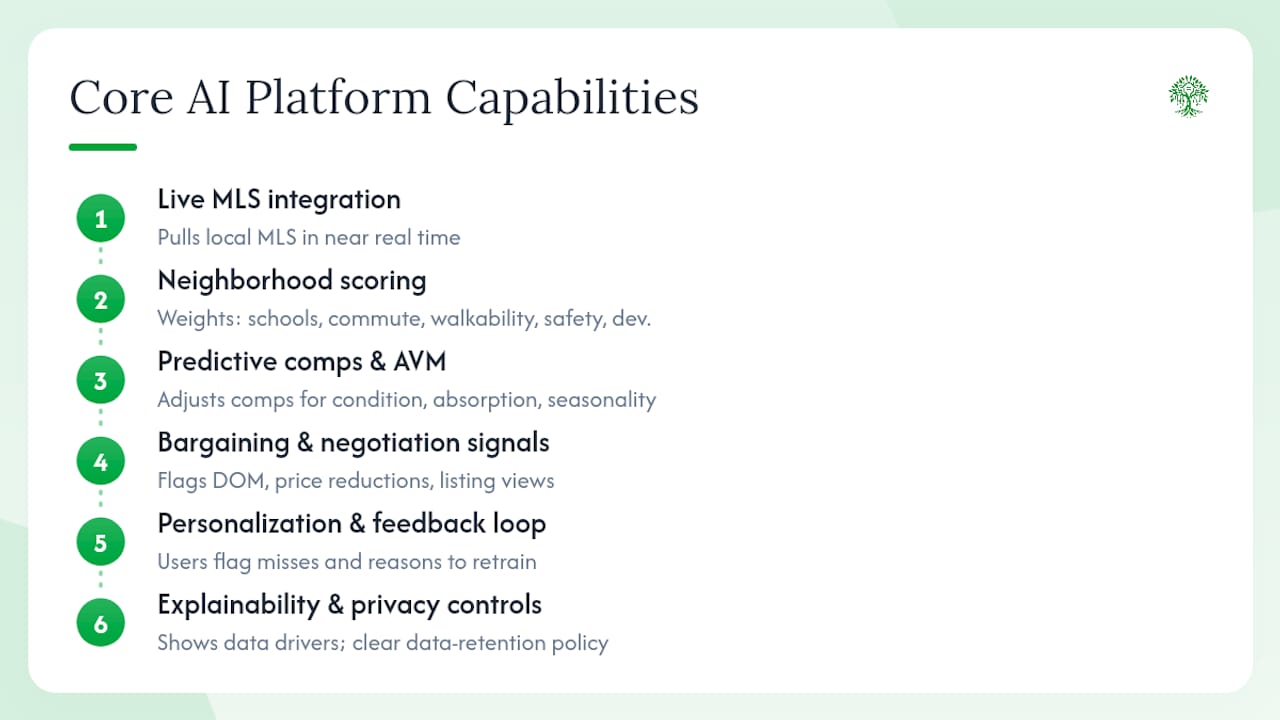
Neighborhood scoring. Schools, commute times, walkability, safety indicators, and development pipeline data should be weighted and surfaced as a score you can interrogate, not just a number you have to trust blindly.
Predictive comps and automated valuation model (AVM) inputs. Predictive comps go beyond raw sold prices by adjusting for condition trends, micro-market absorption rates, and seasonal patterns. They give you a starting range for your offer, not a final answer.
Bargaining and negotiation signals. DOM flags, price-reduction counts, and listing-view indicators tell you whether a seller is under pressure. These signals shape your opening offer strategy.
Personalization with a feedback loop. AI property discovery works best when you actively flag misses, not just favorites. Tell the platform when a recommendation is wrong and why. That feedback trains the model on priorities that raw data cannot capture, like noise levels or neighbor dynamics.
Explainability and privacy controls. Every recommendation should show which data drove it. And the platform must have a clear, written data-retention policy. Never paste sensitive personal information into a general AI chat tool where storage and access are uncontrolled.
Pro Tip: Ask the platform to walk you through a live recommendation for a specific address. If the rep cannot explain which data points drove the score, the explainability is cosmetic.
How do these features actually help first-time buyers in California and Texas?
The features above solve real buyer problems. Here is the mapping.
Faster, more focused search. AI filters out listings that fail your hard constraints (price, beds, commute) before you ever see them, then ranks the remainder by soft tradeoffs you have taught it. That cuts decision fatigue significantly for buyers who would otherwise scroll for months.
Better offer timing and pricing. Predictive comps plus DOM flags give you a data-backed opening offer and a counter strategy. You walk into negotiation knowing whether the seller has been sitting on the property or fielding multiple bids.
Regional differences matter here. California markets, especially the Bay Area and Southern California, run on speed and tight inventory. Live MLS signals and same-day data refresh matter most there. Texas markets, particularly Austin and Dallas-Fort Worth suburbs, have faster DOM variances and active new-build pockets, so predictive comps and development-trend layers carry more weight.
- In California, data lags of a day or more can mean missing a competitive window entirely.
- In Texas, new-build incentives and builder concessions require a platform that tracks permit activity and development pipelines, not just resale comps.
Education and reduced anxiety. AI generates plain-language summaries of comparable sales, likely repair flags from listing history, and long-term value indicators. For a first-time buyer who has never read a CMA, that summary is the difference between a confident offer and a paralyzed one.
The human layer stays essential. Top agents use AI to automate repetitive prep tasks so they can focus human expertise on pricing strategy and live negotiation. AI prepares the evidence; your agent reads the room, advises on contingencies, and signs the paperwork.
Pro Tip: When you receive an AI-generated offer brief, bring it to your agent and ask: “What does this miss that you’d add from your local knowledge?” That conversation is where the real value gets built.
How does an AI home platform actually reach its conclusions?
| Data source | What it powers |
|---|---|
| Live MLS feed | Listing freshness, DOM flags, price-reduction history, bargaining signals |
| Public tax and assessment records | AVM inputs, ownership history, tax burden estimates |
| Building permits and zoning feeds | Development trend layers, new-build pipeline alerts |
| School and transit APIs | Neighborhood scoring components |
| Third-party market data | Absorption rates, seasonal pricing patterns, micro-market comps |
The model takes those inputs and produces neighborhood scores, predictive comp ranges, and a bargaining power index for each listing. A readable decision chain shows you which inputs moved the score and by how much.
Data freshness is not a minor detail. In California’s competitive markets, a platform refreshing MLS data every few hours versus every 24 hours can mean the difference between a timely offer and a missed listing. Real estate API integrations that pull directly from MLS systems, rather than aggregating from third-party portals, produce the most reliable signals.
On security: choose platforms with explicit data-handling and retention policies. AI valuations and negotiation autopilots remain limited; the highest-value AI use cases are research, CMA prep, and offer brief generation, not replacing fiduciary judgment.
Pro Tip: Ask for the platform’s data-refresh interval in writing. “Real time” means different things to different vendors.
What should you expect to pay, and how long will it take?
| Cost item | Typical range | Ficustree model |
|---|---|---|
| Platform access | — | Free for represented buyers |
| Buyer representation fee | $1,000 at closing + 1% commission | $1,000 at closing + 1% commission |
| Buyer rebate (where legal) | ~2% rebate where permitted by CA/TX law | ~2% rebate where permitted by CA/TX law |
| Showing agent (hourly) | hourly rate | On-demand, hourly |
Timeline: Ficustree’s promise is to compress what typically feels like six months of first-time-buyer confusion into roughly two months of guided, structured progress. AI handles the research and shortlisting; your agent handles showings, offer strategy, and transaction coordination.
“Free platform” offers from listing aggregators often mean the vendor monetizes your data or routes your inquiry to a paying agent, not necessarily the best one for you. Always confirm in writing what you receive, what you pay, and whether a rebate applies.
Pro Tip: Before signing buyer representation paperwork, request a written scope of services that specifies which AI outputs you’ll receive, the fee structure, and the rebate policy. Verbal promises are not enforceable at closing.
How do you choose the right AI buyer platform?
Questions to ask every platform
- What MLS sources do you use, and what is your data-refresh interval?
- Can you show me a live decision chain for a specific property recommendation?
- What are your exact fees, and is a buyer rebate available in my state?
- How do you handle my personal data, and what is your retention policy?
- Is this platform deployed at the brokerage level, or is it an individual agent add-on?
Evaluation criteria
- Explainable recommendations with visible data inputs
- Brokerage-level deployment with audit logs
- Clear, written pricing and rebate policy
- Local MLS calibration for California or Texas
- Explicit data-handling and PII policy
Red flags to walk away from
- Opaque or verbal-only pricing
- Unverifiable data sources or no MLS disclosure
- Requests for Social Security numbers or full account numbers in a chatbot
- Claims of “automated negotiation” or “guaranteed pricing”
- No human approval gate on contract-related outputs
How does Ficustree apply these features for CA and TX buyers?
Ficustree is a brokerage-backed AI buyer representation platform built specifically for first-time buyers in California and Texas. It is not a listings aggregator. It is the decision intelligence layer between you and the purchase.
Core capabilities:
- Live MLS integration with neighborhood scoring across schools, commute, walkability, and development trends
- Predictive comps and bargaining signal flags (DOM, price-reduction history)
- Explainable offer briefs with readable decision chains
- On-demand showing agents, booked hourly
| Onboarding step | What happens |
|---|---|
| Profile intake | You define budget, geography, must-haves, and soft tradeoffs |
| AI shortlist | Platform surfaces ranked listings with neighborhood scores and comp ranges |
| Feedback loop | You flag misses; model refines recommendations |
| Offer prep | AI generates a comp brief and bargaining signal summary for your agent |
| Negotiation and close | Licensed agent handles fiduciary judgment, contract, and transaction coordination |
Pricing: $1,000 at closing plus 1% commission. The premium platform is free for represented buyers. A rebate of roughly 2% is available where California and Texas law permits. Showing agents are available on demand at an hourly rate.
For a deeper look at how AI personalized home search works inside the platform, Ficustree’s blog walks through the matching logic and feedback loop in detail.
Key Takeaways
AI home platform features and benefits are most valuable when paired with licensed brokerage representation, transparent pricing, and explainable data chains that first-time buyers in California and Texas can audit and act on.
| Point | Details |
|---|---|
| AI is a research tool, not a replacement | Pair AI decision intelligence with a licensed agent for fiduciary judgment and contract work. |
| Live MLS access is non-negotiable | Data freshness directly affects offer timing, especially in California’s competitive markets. |
| Explainability protects you | Demand a visible decision chain for every recommendation before you act on it. |
| Pricing transparency matters | Confirm fees, rebate eligibility, and scope of services in writing before signing representation paperwork. |
| Ficustree for CA and TX buyers | $1,000 at closing plus 1% commission, with a ~2% rebate where legal and a free premium platform for represented buyers. |
The part most AI platforms get wrong
The promise of AI in home buying is real. But most platforms oversell the automation and undersell the judgment layer. Buyers come in expecting the AI to tell them what to buy. What it actually does, when built correctly, is tell you what the data says, so your agent and you can decide together.
The first-time buyers I talk to are not confused about technology. They are confused about whether they can trust what they’re seeing. That is the problem worth solving: not faster listings, but clearer decisions. Explainable AI, brokerage-level compliance, and a transparent fee structure are not features to check off a list. They are the conditions under which a first-time buyer can actually trust the process.
If you want to see what that looks like in practice, start with a guided consultation and ask Ficustree to walk you through a live recommendation for a property in your target area.
Ficustree gives first-time buyers a clearer path to closing
Most buyers spend months comparing listings on their own, then hand everything to an agent at the last minute. Ficustree reverses that. You get AI-driven shortlisting, neighborhood scoring, and offer briefs from day one, backed by a licensed brokerage that keeps a human in the loop on every high-stakes decision.
Sign up at ficustree.ai and receive a profile intake, an AI-generated shortlist ranked by your priorities, on-demand showing agent scheduling, and a written fee schedule with rebate terms where California or Texas law permits. No vague pricing, no data surprises.
Start your buyer profile and see your first shortlist within 48 hours.
FAQ
What core features should an AI home platform include?
Live MLS integration, neighborhood scoring, predictive comps, DOM and price-reduction flags, explainable recommendations, and a clear data-privacy policy are the minimum. Platforms without audit logs or explainability are not ready for serious buyer representation.
How does AI help first-time buyers make better offers?
AI surfaces bargaining signals like days on market and price-reduction history, then pairs them with predictive comp ranges so you and your agent can build a data-backed opening offer rather than guessing.
Is AI enough, or do I still need a licensed agent?
You still need a licensed agent. 82% of buyers use AI for real estate insights but rely on human agents for final decisions. AI handles research and prep; agents handle fiduciary judgment, contract negotiation, and legal compliance.
What does Ficustree cost for a first-time buyer in California or Texas?
Ficustree charges $1,000 at closing plus a 1% commission. The platform is free for represented buyers, and a roughly 2% rebate is available where California or Texas law permits.
What is the biggest red flag when evaluating an AI buyer platform?
Opaque pricing and unverifiable data sources are the clearest warning signs. If a platform cannot show you the decision chain behind a recommendation or refuses to put its fee structure in writing, move on.
Recommended
- Blog Post
- AI Home Search for Buyers: What Changes Now
- AI Home Search Tools Walkthrough for First-Time Buyers – ficustree.ai
- How AI Personalized Home Search Works in 2026 – ficustree.ai

Leave a Reply