
AI platforms automate and accelerate the repetitive, deadline-driven work in a home closing while leaving negotiation, legal sign-off, and judgment calls to humans. Concretely, that means document extraction, deadline calendaring, e-sign orchestration, and status communications can all run with minimal manual effort. What stays human: title exception disputes, final contract approval, and any decision where local context or legal liability matters.
The evidence is building fast. Early adopters of AI transaction coordination reported roughly 40% faster closing timelines and an 87% reduction in missed deadlines in 2025–2026. HomeLight’s EVA, an AI escrow agent, automates tasks across a 120-plus-item escrow checklist by integrating about 80 distinct tools. And a 2026 industry survey found that 75% of homebuyers expect AI in the process but still want human accountability for major decisions.
The bottom line: AI reduces manual risk across the closing pipeline, but it introduces explainability, privacy, and liability considerations that make a human-in-the-loop mandatory, not optional.
Three things to keep in mind as you read:
- AI excels at volume, speed, and consistency on structured tasks.
- It struggles with edge cases, regional context, and anything requiring legal judgment.
- Documented audit trails and security certifications such as SOC 2 are commonly considered the minimum security standards for any platform handling closing data.
Key Takeaways
AI platforms automate the structured, deadline-driven work in home closings while human agents remain essential for legal decisions, negotiations, and exception handling.
| Point | Details |
|---|---|
| AI speeds closings measurably | Early adopters report roughly 40% faster timelines and 87% fewer missed deadlines. |
| Human-in-the-loop is mandatory | 75% of buyers expect AI assistance but demand human accountability for major decisions. |
| SOC 2 and audit trails are the minimum bar | Any platform handling closing documents must have SOC 2 certification and exportable audit logs. |
| Local context is AI’s biggest gap | Repair estimates and valuation figures need agent review for regional accuracy before entering negotiations. |
| Ficustree combines both | Ficustree pairs AI closing automation with licensed buyer representation in California and Texas for $1,000 plus 1% at closing. |
This article is general information, not a substitute for advice from a qualified financial advisor. Consult a qualified financial professional about your own circumstances before acting on anything here.
Table of Contents
- How AI platforms change each stage of the closing process
- What each stakeholder actually gains
- Where AI can fail and the risks you need to manage
- How to evaluate an AI closing platform before you commit
- How Ficustree uses AI during the buyer journey and closing
- How to roll out AI for closing: a practical pilot plan
- The honest case for AI in closing, and where the hype runs ahead of reality
- Ficustree guides you through closing with AI and a real agent behind it
- Sources
- FAQ
How AI platforms change each stage of the closing process
The closing timeline runs from executed contract to recorded deed, and AI touches nearly every stage. Here is where the automation actually lands.
1. Contract execution and intake
AI extracts key dates, party names, contingency windows, and purchase price from the executed contract in minutes rather than the 20–30 minutes a coordinator typically spends manually. Platforms convert relative terms (“10 business days from acceptance”) into fixed calendar deadlines and push those dates into a shared timeline automatically.
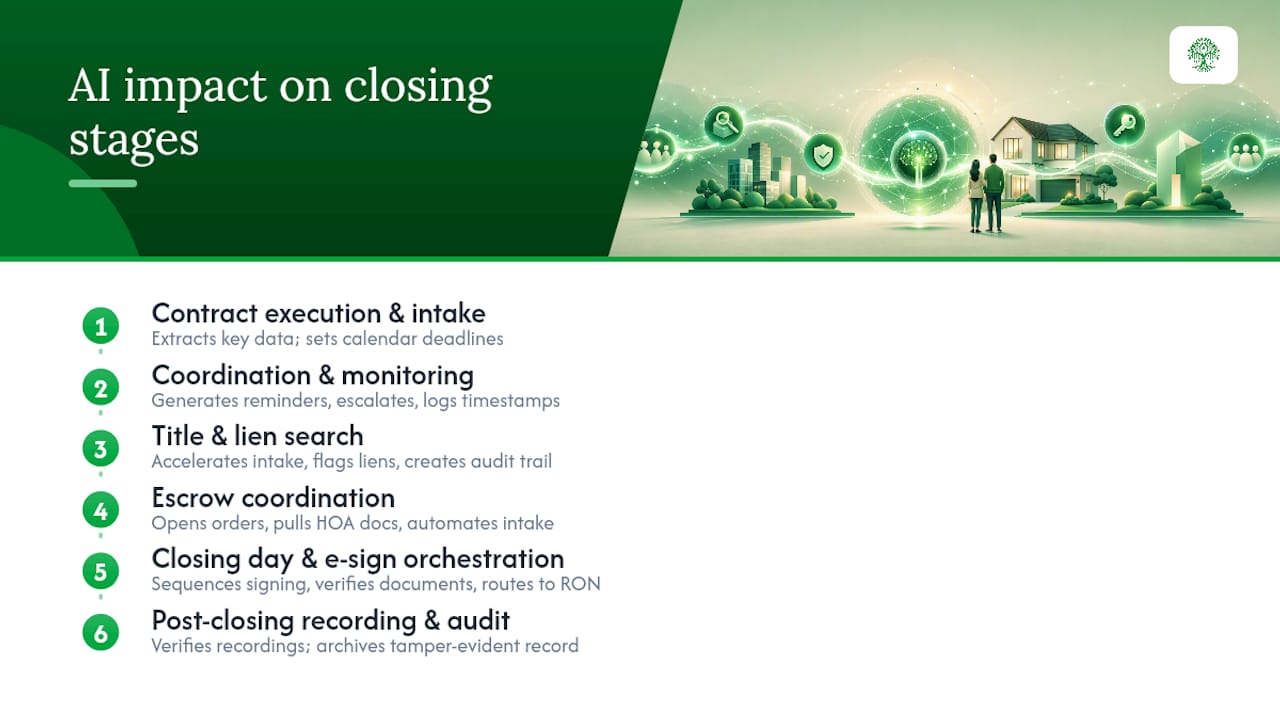
2. Transaction coordination and deadline monitoring
Once the timeline exists, AI acts as a deadline watchdog. It auto-generates reminder sequences for each milestone, escalates overdue items to the responsible party, and logs every action with a timestamp. AI transaction coordination platforms also generate state-specific compliance checklists, so a California transaction gets its TDS and NHD reminders while a Texas deal gets its option-period and survey notices.
3. Title and lien search
AI-assisted title platforms accelerate document intake and extraction from public records, flag potential liens or encumbrances for examiner review, and produce consistent audit trails. Automated document processing handles the 100–200-page residential closing package with fewer manual handling errors, freeing title examiners to focus on curative work rather than data entry.
4. Escrow coordination
This is where tools like EVA operate: opening escrow orders, pulling HOA documents, sending intake forms, and monitoring inboxes for responses. Routine back-and-forth that once consumed hours of coordinator time runs on autopilot.
5. Closing day and e-sign/e-close orchestration
AI platforms sequence the signing package, verify that all required documents are present and signed, and flag incomplete or inconsistent signatures before the notary session begins. For e-closing workflows, the platform can route documents to a remote online notary (RON) where state law permits.
6. Post-closing recording and audit
After signing, AI verifies that recorded documents match the executed package, flags discrepancies, and archives the full transaction record with a tamper-evident audit trail.
What each stakeholder actually gains
The benefits of AI in closing differ meaningfully by role.
Buyers
- Fewer last-minute surprises: automated deadline alerts mean contingency windows rarely slip unnoticed.
- Timelier disclosures: AI flags missing or unsigned disclosure documents before they become a closing-day crisis.
- Clearer status updates: buyers get real-time visibility into where their transaction stands rather than waiting for an agent callback.
- NAR notes that AI is increasingly a research and convenience tool, but buyers still rely on human experts for tours, negotiations, and legal decisions.
Agents and brokers
- Higher throughput per coordinator: fewer manual tasks means one coordinator can manage more files simultaneously.
- Consistent quality: every transaction follows the same checklist, regardless of who is handling it.
- Audit-ready records: documented timelines protect agents in dispute situations.
Transaction coordinators and closers
- Time shifts from data entry to exception handling, which is where their expertise matters most.
- Escalation logic surfaces only the items that need human judgment, reducing cognitive load.
Lenders and underwriters
- Faster document verification reduces the time between clear-to-close and funding.
- Automated cross-checks against lender instructions reduce conditions that bounce back from the title company.
| Stakeholder | Key metric improvement |
|---|---|
| Transaction coordinators | Up to 87% fewer missed deadlines (early adopter data) |
| Closing timelines | Roughly 40% faster for AI-enabled brokerages |
| Title examiners | More time on curative work; fewer manual handling errors |
| Buyers | Real-time status visibility; fewer last-minute document surprises |
Where AI can fail and the risks you need to manage
AI in closing is genuinely useful, but the failure modes are specific and worth knowing before you trust any platform.
Common accuracy failures
- False positives in document extraction: AI may misread a handwritten addendum or a non-standard clause, producing an incorrect deadline.
- Regional cost-context errors: AI-generated repair estimates often use national-average labor costs that don’t match local rates, which can inflate or deflate negotiation positions.
- Missed edge-case clauses: unusual contingencies or custom addenda may not parse correctly if the model was trained on standard forms.
Legal and regulatory cautions
- E-notary and e-sign rules vary by state. Not every state permits remote online notarization for real estate documents; some require wet signatures on specific instruments.
- Lender acceptability: some lenders will not accept AI-generated valuations or repair summaries without documented human review.
- Explainability: the “black box” problem is real. If a platform cannot explain why it flagged a title issue or calculated a deadline a certain way, that creates liability exposure for the agent or closer who relied on it.
- Data privacy: closing files contain Social Security numbers, bank account details, and income data. Any platform must meet GLBA and state privacy law requirements.
Risk reality check: AI should summarize and flag issues, not make final calls. Buyers and professionals who treat AI output as a final answer rather than a starting point are taking on liability the platform will not share.
Liability and security minimums
- SOC 2 Type II certification is the floor for data security in any platform handling closing documents.
- Encryption at rest and in transit, plus role-based access controls, are non-negotiable.
- Every AI action should produce a timestamped, human-readable audit log.
Pro Tip: Before relying on any AI-extracted deadline, have a coordinator spot-check the five highest-stakes dates (option period, inspection, appraisal, loan, and closing) against the original contract. That five-minute check catches the errors that matter most.
How to evaluate an AI closing platform before you commit
Use this checklist when assessing any AI-enabled closing or transaction coordination tool.
| Evaluation criterion | What to ask |
|---|---|
| LOS/CRM/title integration | Does it connect natively to your existing stack, or require manual exports? |
| SOC 2 certification | Is it Type I or Type II? Request the report. |
| Audit trail quality | Can you export a full, timestamped log of every AI action? |
| Human escalation workflow | How does the platform route exceptions to a human, and how fast? |
| State coverage | Does deadline logic account for California and Texas-specific rules? |
| Error rate disclosure | Will the vendor share extraction accuracy rates and exception volumes? |
| Data retention policy | How long is closing data stored, and who can access it after closing? |
Red flags to walk away from:
- No documented human-in-the-loop for exceptions.
- Deadline logic that applies a single national template regardless of state.
- No audit logs, or logs that are not exportable.
- Vendor cannot explain how the model was trained or what it does with your data.
- SLA language that excludes liability for missed deadlines caused by AI errors.
Pro Tip: Ask every vendor for a sample audit log from a completed transaction. A platform that cannot produce one in 10 minutes either does not have real logging or does not want you to see it.
How Ficustree uses AI during the buyer journey and closing
Ficustree operates as a buyer-representation platform in California and Texas, and its AI layer is built specifically around the closing stages that matter most to first-time buyers.
What Ficustree automates:
- Document timeline generation from the executed contract, including California-specific disclosures (TDS, NHD, SPQ) and Texas option-period tracking.
- Coordination messaging: automated status updates keep buyers informed without requiring them to chase their agent.
- Disclosure completeness checks: the platform flags missing or unsigned documents before they become a closing-day problem.
What stays human:
- Legal negotiation and contract approval remain with licensed agents.
- Title exceptions and curative work are handled by the title company’s examiners.
- Any escalation involving an anomaly, dispute, or unusual clause goes to a human agent immediately.
Ficustree’s approach: AI handles the structured, repeatable work so your agent can focus on the decisions that actually require judgment. You get faster updates and fewer surprises, not a robot making legal calls on your behalf.
Ficustree’s pricing is transparent: buyers pay $1,000 at closing plus 1% commission, and where legally permitted, keep a rebate of roughly 2%. The premium platform is free to use. On-demand showing agents are available hourly, so you are never locked into a full-service retainer you do not need.
Pro Tip: Ask Ficustree for its security whitepaper before you share any financial documents. A platform serious about buyer data will have one ready.
For buyers who want to understand how AI shapes the earlier stages of the process, Ficustree’s guide to AI home search covers what changes from search through offer.
How to roll out AI for closing: a practical pilot plan
Whether you are a brokerage, title shop, or lender, a structured pilot beats a full rollout every time.
- Define a narrow scope. Pick one transaction type (single-family purchase, one county) and one workflow (deadline monitoring or document extraction). Do not automate everything at once.
- Set your baseline metrics. Before the pilot starts, measure: average time to extract contract dates, missed-deadline rate per 100 transactions, and package completeness rate at closing.
- Run parallel workflows for 30 days. Have a human coordinator work alongside the AI on every file. Log every discrepancy between AI output and human review.
- Collect and categorize exceptions. Group errors by type (extraction error, state-rule gap, edge-case clause). This tells you where the model needs tuning or human override rules.
- Set human-review thresholds. Any AI confidence score below your agreed threshold triggers automatic human review. Document this threshold in your SLA with the vendor.
- Iterate and expand. After 30 days, review metrics, adjust thresholds, and expand to a second workflow only when the first is stable.
Pilot metrics to track:
- Time to extract key dates (target: under 5 minutes per file)
- Missed-deadline rate (target: below the pre-AI baseline)
- Package completeness rate at closing
- Closings per coordinator per month
Pro Tip: For repair and valuation suggestions, always require the AI output to include a local comparable range, not just a national average. If the platform cannot provide local context, flag those outputs for mandatory agent review before sharing with the other party.
The honest case for AI in closing, and where the hype runs ahead of reality
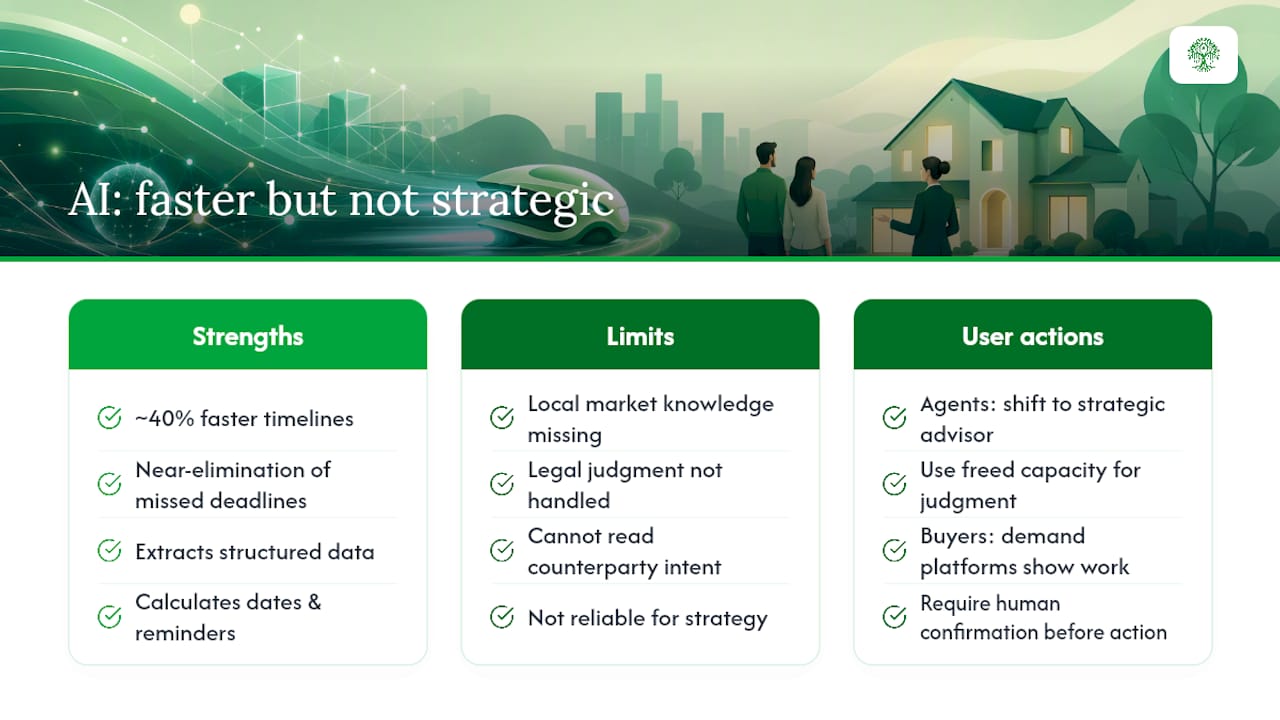
The productivity gains from AI in closing are real. Roughly 40% faster timelines and near-elimination of missed deadlines are outcomes that matter to every party in a transaction. But the framing that AI “handles closing” overstates what the technology actually does well.
What AI does reliably is volume work: extracting structured data from standard forms, calculating dates, sending reminders, and logging actions. What it does poorly is anything that requires local knowledge, legal judgment, or the ability to read a counterparty’s intent. An AI that flags a title cloud is useful. An AI that tells you whether to fight it or accept a price reduction is not ready for that job.
The more useful mental model is this: AI is a very fast, very consistent junior coordinator. It never forgets a deadline, never misfiles a document, and never has a bad day. But it also cannot tell you that the seller’s attorney is stalling, that the local market makes a repair credit more negotiable than a price drop, or that a specific clause in a California addendum has been litigated in a way that changes its practical meaning.
Real estate agents’ roles are shifting from information provider to strategic advisor. AI accelerates that shift by taking the information-handling load off agents’ plates. The agents who thrive will be the ones who use that freed capacity for judgment, not the ones who assume the AI has it covered.
For buyers, the practical recommendation is simple: use platforms that show you their work. If an AI flags a document issue or generates a repair estimate, you should be able to see the source data and have a human agent confirm it before it affects a negotiation.
Ficustree guides you through closing with AI and a real agent behind it
First-time buyers in California and Texas get a lot of AI tools thrown at them. Ficustree is different because it pairs that AI layer with direct buyer representation, so you are never relying on automation alone for a decision that costs you six figures.
The platform handles the structured closing work: timeline generation, disclosure tracking, coordination messaging, and deadline alerts. Your licensed agent handles everything that requires judgment. You pay $1,000 at closing plus 1% commission, keep a rebate of roughly 2% where California or Texas law permits, and use the full platform free. No retainer, no surprise fees.
Ficustree operates with documented security standards and can provide a security whitepaper on request. If you want to see how the platform manages your closing data before you share any financial documents, ask for it. Ficustree and see how AI-assisted buyer representation works in practice.
Sources
- HomeLight Launched An AI Escrow Agent To Automate Dozens Of Tasks | Inman Real Estate News
- How AI Is Automating Real Estate Transaction Coordination…
- When the Closing Gets Delayed, It’s Usually the Title: The Case for Automation in Title Insurance and Escrow
- AI becomes an early step in homebuying journey | National Association of Realtors (NAR)
- AI Transaction Coordination for Real Estate 2026
FAQ
Will AI replace mortgage originators and closing agents?
No. AI automates structured, repetitive tasks like document extraction and deadline monitoring, but NAR confirms buyers still rely on human professionals for negotiations, legal decisions, and complex judgment calls.
What are the main downsides of AI in the closing process?
The biggest risks are extraction errors on non-standard documents, repair estimates that lack local cost context, explainability gaps that create liability exposure, and data-privacy obligations under GLBA and state law. Always require a human review step for high-stakes outputs.
How does AI transaction coordination actually work?
AI platforms extract key dates and party information from the executed contract, convert them into a fixed deadline calendar, generate state-specific compliance checklists, and send automated reminders, all while logging every action in an audit trail.
What should I ask an AI closing platform about security?
Request their SOC 2 Type II report, confirm encryption at rest and in transit, ask for a sample audit log from a completed transaction, and clarify their data retention policy and who can access your files after closing.
Does the role of an AI platform in home closing differ by state?
Yes. E-notary and e-sign rules vary significantly: some states permit remote online notarization for real estate instruments while others require wet signatures. Any platform you use must apply state-specific deadline logic and disclosure requirements, not a single national template.
Recommended
- AI Home Search for Buyers: What Changes Now
- Home – AI-Powered Real Estate Search
- Home – AI-Powered Real Estate Search
- AI Home Search Tools Walkthrough for First-Time Buyers – ficustree.ai

Leave a Reply