Category: Market Guides

  • Appraisal Gap Explained for Homebuyers: 2026 Guide

    Appraisal Gap Explained for Homebuyers: 2026 Guide

    An appraisal gap is the dollar difference between what you agreed to pay for a home and what a licensed appraiser says it’s worth. If you offered a certain amount and the appraisal comes back lower, you have an appraisal gap equal to the difference. Your lender will only finance based on the $350,000 appraised value, so that $5,000 becomes your problem. The single most important thing to do right now: pull out your purchase contract, confirm whether you have an appraisal contingency, and call your lender to verify how much liquid cash you have available.

    • What the gap means in dollars: Your lender caps the loan at appraised value. On a 10% down payment loan, you were already putting down an amount equal to 10% of your offer. Now you need that plus the appraisal gap, or you need to renegotiate.
    • Your contingency is your exit: If your contract includes an appraisal contingency and you cannot or will not cover the gap, you can walk away and recover your earnest money.
    • ROV is your first move before paying cash: The Reconsideration of Value (ROV) process lets you submit up to five comparable sales and a written rationale to challenge a low appraisal before you spend a dollar.
    • Market context matters: In fast-rising markets, appraisal gaps are common because sale prices outpace what recent recorded comps can support.

    Table of Contents

    What an appraisal gap means for your loan and your cash

    When you finance a home purchase, your lender orders an independent appraisal to protect its collateral. The appraiser’s number, not your contract price, sets the ceiling for how much the lender will loan you.

    Here’s the math. Say you’re buying at a certain price with a 10% down payment. Your lender finances 90% of the purchase price. When the appraisal comes back lower than your offer, the lender recalculates the max loan based on the appraised value. You still owe the seller the contract price, so you must cover the difference out of pocket. That extra amount is the appraisal gap’s direct impact on your cash at closing.

    How lenders determine the maximum loan:

    • The loan-to-value ratio (LTV) is calculated against the lower of appraised value or contract price.
    • On a conventional loan, if the appraised value is $350,000 and your LTV is 90%, the max loan is $315,000 regardless of what you offered.
    • The buyer must cover everything above that loan amount out of pocket, or the deal must be restructured.

    Lenders will not approve financing above the appraised value. That’s not negotiable. What is negotiable is who absorbs the shortfall, and that’s where your options open up.
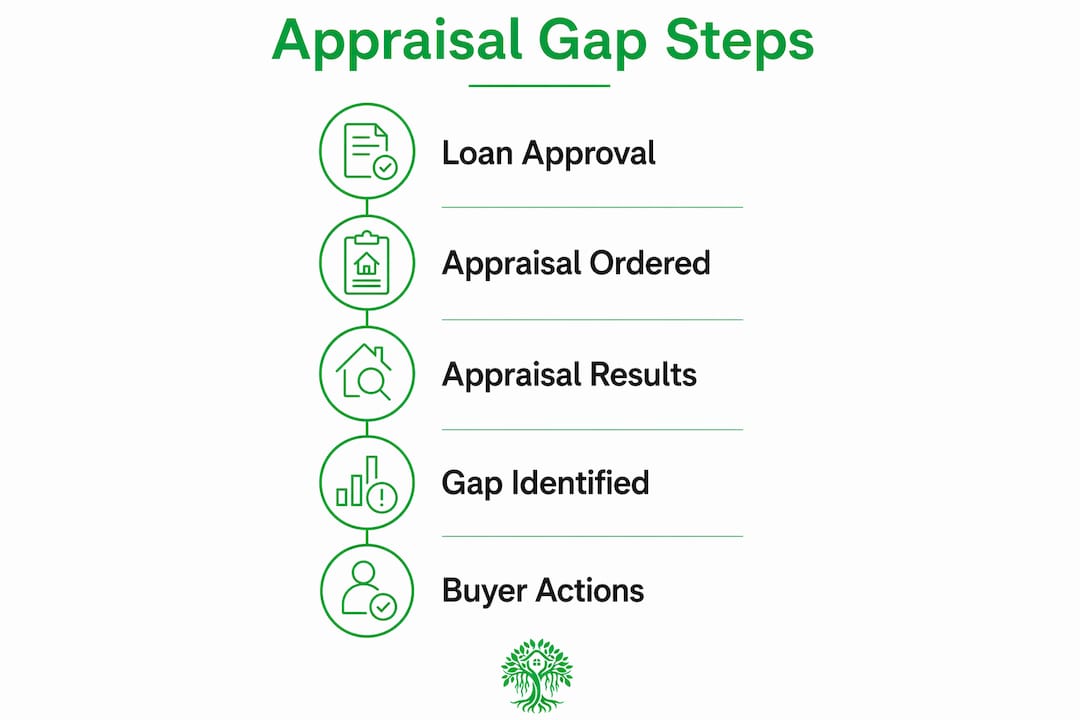

    Infographic showing appraisal gap process steps

    How a home appraisal works and what appraisers check

    A licensed appraiser, hired by your lender but paid by you, visits the property and produces a Uniform Residential Appraisal Report (Form 1004 for most conventional loans). The visit itself typically takes a brief amount of time. The report takes additional time to complete.

    What appraisers evaluate:

    • Recent comparable sales (“comps”) within roughly a half-mile, usually from the past 90 days
    • The home’s square footage, bedroom and bathroom count, lot size, and condition
    • Permitted upgrades and improvements (unpermitted work may not add value)
    • Neighborhood sales trends and local market direction
    • Property condition, deferred maintenance, and functional obsolescence

    The appraiser adjusts the comp prices up or down based on differences between each comp and your home. A comp with a pool gets a downward adjustment if your home lacks one. The final appraised value is the appraiser’s professional opinion, not a fact, which is why errors happen and why the ROV process exists.

    Timeline: Most lenders receive the appraisal report within about one to two weeks of the appraiser’s site visit. During underwriting, the report typically arrives a few weeks after your offer is accepted, depending on appraiser availability in your market. For new construction appraisals, timelines and comp availability differ significantly from resale homes.

    Home appraiser inspecting house exterior with tools

    Pro Tip: Before the appraiser visits, ask your agent to prepare a one-page summary of permitted upgrades, accurate square footage from county records, and any recent comparable sales the appraiser might miss. Appraisers can and do use buyer-submitted data when it’s relevant and documented.


    Why appraisal gaps happen in the first place

    Appraisal gaps are not random. They follow predictable patterns, and knowing the cause helps you decide whether to dispute the number or accept it.

    Market-driven causes:

    • In fast-rising markets, buyers bid above recent comps because they’re competing. Appraisers, bound to use recorded sales, cannot yet reflect prices that haven’t closed.
    • Low inventory pushes offers higher than the neighborhood’s historical range, creating a structural gap between what buyers pay and what data supports.
    • Delayed comp recording means a sale that closed last week may not appear in the MLS data an appraiser uses today.

    Property-driven causes:

    • Unique homes (unusual architecture, oversized lots, non-standard layouts) lack clean comps, so appraisers have less to work with and often err conservative.
    • Condition issues, deferred maintenance, or unpermitted additions can reduce the appraised value below what the seller priced in.
    • Inaccurate listing data, like a wrong square footage figure, can cause the appraiser to undervalue the home.

    Appraiser error: Square footage mistakes, missed upgrades, or outdated comps from a declining market are legitimate grounds for an ROV. If the report lists 1,800 sq ft and county records show 1,950 sq ft, that’s a correctable error, not a market verdict.

    Stat to know: In competitive U.S. markets, appraisal gaps are a documented pressure point: sale prices in fast-moving metros routinely exceed what recent recorded comps can support, making low appraisals a predictable risk rather than a rare surprise.


    What you can do when the appraisal is lower than your offer

    A low appraisal is not a dead end. You have five real options, and the right one depends on your cash position, the seller’s flexibility, and whether the gap is due to error or market reality.

    Agent and buyer discussing appraisal negotiation over coffee

    Option Buyer Pros Buyer Cons Best When
    Submit an ROV Free; may fix the number Takes 2–5 business days; not guaranteed You have documented errors or stronger comps
    Renegotiate price Seller absorbs the gap Seller may refuse in hot markets Balanced or buyer’s market
    Pay the gap in cash Deal closes as planned Depletes reserves; increases effective price paid You have liquid funds and love the home
    Split the difference Compromise; keeps deal alive You still pay more than appraised value Seller is motivated but won’t drop fully
    Walk away (contingency) Full earnest money returned Lose the home; restart search Gap is too large and seller won’t budge

    Step-by-step action sequence:

    1. Read the appraisal report the same day you receive it. Check comps, square footage, and condition notes for errors.
    2. If you spot errors, ask your lender to initiate the ROV process immediately. You can submit up to five comparable sales with a written rationale.
    3. While the ROV is pending, notify your agent so they can open a conversation with the listing agent about the seller’s flexibility.
    4. If the ROV doesn’t change the value, present your preferred option (renegotiate, split, or pay) within 2–3 business days. Sellers get nervous when buyers go quiet.
    5. If the seller won’t move and you can’t fund the gap, exercise your appraisal contingency in writing before the deadline.

    For negotiation language, something like this works: “The appraisal came in at $350,000. We’d like to propose adjusting the purchase price to $352,000, splitting the $5,000 gap. We can provide proof of funds and are ready to close on the original timeline.” Keep it factual, not emotional. Avoid common negotiation mistakes like making ultimatums or going silent after a low appraisal.


    Appraisal gap coverage clause vs. appraisal contingency: what’s the difference?

    These two contract terms are often confused, and the confusion can cost you your earnest money.

    An appraisal contingency is a buyer protection. It says: if the appraisal comes in below the contract price, you can renegotiate or cancel the contract and get your earnest money back. It’s the default protection in most financed purchase contracts.

    An appraisal gap coverage clause is a buyer commitment. It says: I agree to pay up to $X above the appraised value out of my own pocket. It makes your offer more attractive to sellers but shifts risk onto you.

    That sample language illustrates the key elements: a dollar cap, a floor appraised value, and a proof-of-funds requirement. Without a cap, you’re signing a blank check.

    How the two interact: A capped gap clause modifies the contingency. If the gap is within your cap, you’re obligated to pay it. If the gap exceeds your cap, the appraisal contingency typically reactivates and you can exit. This is why the cap amount matters so much.

    FHA and VA borrowers: VA loans include built-in appraisal protections that, in practice, prevent sellers from forcing buyers to forfeit earnest money solely because they invoke a contractual appraisal contingency after a low appraisal. FHA loans carry similar protections. If you’re using a government-backed loan, confirm with your lender before signing any gap coverage clause.

    Risk callouts:

    • Signing an uncapped gap clause creates unlimited buyer liability. If the appraisal comes in $40,000 low, you owe $40,000.
    • If you commit to a capped gap and then can’t fund it at closing, you may forfeit your earnest money.
    • Waiving the appraisal contingency entirely, without a gap clause, means you have no exit and no cap.

    Pro Tip: Always require a proof-of-funds verification step in the clause itself. This protects you from being held to a commitment you made in good faith but can no longer fund if your financial situation changes between offer and closing.

    For a deeper look at how contingencies layer together, the mortgage contingency explainer on Ficustree covers the interaction between appraisal and financing contingencies in plain language.


    How much appraisal-gap coverage should you offer?

    The right cap is the number you can actually write a check for without wrecking your financial position after closing.

    Framework for setting your cap:

    • Start with your total liquid cash available (savings, gift funds, proceeds from asset sales).
    • Subtract your planned down payment and estimated closing costs (typically 2–5% of the loan amount).
    • The remainder is your maximum gap coverage. Never commit to more than this number.
    • Set your cap below that maximum to leave a buffer for post-closing expenses.

    Two scenarios:

    Scenario A — $5,000 cap: You’re buying at $355,000 with $50,000 in liquid savings. Down payment is $35,500, closing costs are roughly $8,000. That leaves $6,500. A $5,000 cap is within reach and leaves a $1,500 cushion. Manageable, but thin.

    Scenario B — $20,000 cap: Same purchase price, same savings. After down payment and closing costs, you have $6,500. A $20,000 cap is a commitment you cannot fund. Signing it puts your earnest money at risk.

    Market strategy: In a competitive California or Texas market with multiple offers, a capped gap clause can be the difference between winning and losing. But accurate preapproval figures and verified proof of funds are what make that clause credible to sellers. A cap without proof of funds is just words.

    Pro Tip: When you submit a capped gap offer, attach a proof-of-funds letter from your bank showing liquid assets that cover the cap amount. Sellers and listing agents read this as a signal that you can actually close, not just that you’re willing to try.

    A dedicated home-buying savings plan that earmarks a specific buffer for appraisal shortfalls is one of the most practical things you can do before you start making offers.


    Buyer safeguards checklist: before and after the appraisal

    Use this list with your agent. Assign each item a responsible party and a deadline before you go under contract.

    Before you make an offer:

    1. Get a fully underwritten preapproval (not just a prequalification) so your loan amount is accurate.
    2. Confirm your liquid cash position: down payment, closing costs, and a gap buffer.
    3. Research recent comps in the neighborhood yourself so you know if your offer is above market.
    4. Insist on an appraisal contingency in your contract if you’re financing the purchase.
    5. Decide your maximum gap cap before you make the offer, not after the appraisal arrives.
    6. Review the home inspection checklist so you’re not surprised by condition issues that could affect appraisal value.

    After the appraisal arrives:

    1. Read the full report the same day. Check comps, square footage, and condition ratings.
    2. Flag any factual errors immediately and share them with your agent and lender.
    3. If errors exist, request an ROV within one business day. The lender must inform you of the ROV process when delivering the appraisal.
    4. If no errors, decide within 48 hours: ROV on market grounds, renegotiate, pay the gap, or exit.
    5. Notify your lender and title company of any price change so closing documents can be updated.
    6. Confirm your contingency deadline in writing before taking any action that could waive it.

    What research and experienced agents say about buyer risk

    The research on appraisal gaps points in one consistent direction: buyers who keep their appraisal contingency and set a clear cap are better protected than those who waive rights to win a bidding war.

    Experienced agents consistently advise keeping the appraisal contingency as the single most important buyer protection in financed purchases. Waiving it to compete is high risk unless you have verified liquid funds for any gap you commit to. That advice holds even in hot markets, because the downside of a large uncapped gap is losing both the home and your earnest money.

    Consider what happens without a cap. A buyer in a competitive California market waives the appraisal contingency entirely to make their offer stand out. The appraisal comes in $28,000 below the contract price. The buyer has two choices: come up with $28,000 in cash on top of their planned down payment, or forfeit their earnest money and walk away. Neither is a good outcome. A capped clause at $10,000 would have protected them from the larger exposure while still making the offer competitive.

    Ficustree’s approach is to model this scenario before the offer goes in. Using the platform’s affordability tools, buyers can see exactly what a $5,000, $10,000, or $20,000 gap does to their cash at closing, and whether their proof-of-funds position supports the commitment they’re about to make.

    Pro Tip: Before signing any gap coverage clause, run the numbers: gap amount plus down payment plus closing costs. If that total exceeds your verified liquid assets, reduce the cap or keep the full contingency. Your earnest money is real cash.


    Timeline and typical costs: who pays and how long it takes

    Appraisal costs are almost always paid by the buyer, upfront or rolled into closing costs. Here’s what to expect.

    Cost and timeline reference: A standard home appraisal in the U.S. typically costs a few hundred dollars for a single-family home, though complex properties or rural locations can be higher. A second appraisal ordered by the lender after a disputed ROV may cost similarly, paid by the buyer.

    Item Typical Cost Who Pays Timeline
    Initial appraisal Typically a few hundred dollars Buyer About 1–2 weeks after site visit
    Appraisal report delivery Included Lender delivers to buyer Same day as receipt
    ROV review No added fee Lender processes A few business days
    Second appraisal (lender-ordered) Additional fee similar to first appraisal Buyer Additional 1–2 weeks
    Reappraisal (buyer-requested) Similar fee to initial appraisal Buyer Varies by lender policy

    Timing matters for your contingency. Most purchase contracts give you a specific window (often 17–21 days in California) to complete the appraisal and act on the results. If the ROV takes 5 business days and the second appraisal takes another 10 days, you may be bumping against your contingency deadline. Ask your agent to request a contingency extension in writing before the clock runs out.

    For a full picture of what happens at the closing table, the home closing checklist covers cost timing and document sequencing from appraisal through keys.


    Key Takeaways

    An appraisal gap is manageable when you know your cash position, keep your contingency, and act within 48 hours of receiving the report.

    Point Details
    Lender caps at appraised value Your loan is based on the lower of contract price or appraised value, so any gap is your cash responsibility.
    ROV before paying Submit up to five comps and a written rationale before spending a dollar on the gap.
    Always cap your commitment Never sign an uncapped gap clause; set a dollar limit you can actually fund with verified liquid assets.
    Contingency is your exit Keep the appraisal contingency unless you have confirmed cash to cover any gap up to your cap.
    Ficustree models the gap for you Ficustree’s affordability tools show exactly how a $5,000–$20,000 gap affects your cash at closing before you sign.

    The part of appraisal gaps most buyers get wrong

    Most buyers treat an appraisal gap as a binary: either the deal dies or they pay whatever it takes. Neither instinct is right.

    The gap coverage clause exists precisely because the market needed a middle path. A capped clause lets you compete in a hot market without writing a blank check. But the clause only works if the cap is grounded in your actual cash position, not in what you think sounds reasonable to a seller.

    What I see buyers underestimate is the compounding effect. You’re not just paying the gap. You’re paying the gap on top of a down payment that’s already stretching your savings, on top of closing costs you may have underestimated, on top of the first month’s mortgage payment, on top of whatever the inspection turned up. A $5,000 gap sounds manageable in isolation. At the end of a $355,000 purchase, it may be the number that breaks the budget.

    The ROV process is also underused. Buyers assume the appraiser’s number is final. It’s not. If the report contains a factual error, a missed upgrade, or a comp that’s clearly inferior to your property, you have a legitimate path to a higher number. That path costs nothing and is typically reviewed by the lender within approximately two business days after submission. Use it before you negotiate price or commit cash.

    The buyers who navigate appraisal gaps best are the ones who prepared before the offer: they knew their liquid cash position, they set a cap they could fund, and they kept their contingency as a backstop. That preparation is not complicated. It just requires doing the math before you’re emotionally invested in a specific home.


    How Ficustree helps you avoid appraisal-gap surprises

    Appraisal gaps are less stressful when you’ve already modeled the scenario before your offer goes in. Ficustree’s buyer platform does exactly that: it shows you the cash impact of a $5,000, $10,000, or $20,000 gap against your actual preapproval and proof-of-funds position, so you set a cap you can genuinely fund.

    Ficustree

    When a gap does appear, Ficustree’s representation model means you have an agent in your corner who knows how to open the renegotiation conversation with the listing agent, request an ROV, and draft the clause language that protects you. Buyers pay $1,000 at closing plus 1% commission, keep a rebate of roughly 2% where legally permitted, and get the full platform free. That rebate, in many cases, offsets a portion of the gap itself.

    Ready to buy with a clear picture of your numbers? Start with Ficustree and see how the platform walks you from preapproval to keys, with appraisal-gap modeling built in. Outcomes vary depending on market conditions and loan type.


    Useful sources for buyers who want more detail

    • Consumer Financial Protection Bureau — Mortgage Tools: The CFPB’s mortgage resource center covers appraisal rights, lender obligations, and borrower protections in plain language. Start here for regulatory context.
    • DSL Mortgage — What Happens When Your Home Appraisal Comes in Low: Practical walkthrough of the ROV process, buyer options, and negotiation steps when an appraisal falls short.
    • Chase — What Happens If Appraisal Is Lower Than Offer: Clear explanation of how lenders underwrite to appraised value and what that means for your loan amount.
    • LegalClarity — Appraisal Gap Coverage in Real Estate: Detailed breakdown of gap coverage clauses, fixed-amount vs. full-coverage commitments, and why a dollar cap matters.
    • LegalClarity — How Appraisal Gap Coverage Works in Competitive Markets: Explains how capped clauses interact with appraisal contingencies and covers FHA/VA-specific protections.
    • Ficustree — Mortgage Contingency Explained: How appraisal and financing contingencies work together in a purchase contract, written for first-time buyers.
    • Ficustree — First-Time Homebuyer Guide: Step-by-step walkthrough of the full buying process, from search through closing.

    FAQ

    What does a $5,000 appraisal gap mean for a buyer?

    It means the appraised value came in $5,000 below your contract price. Your lender will only finance based on the appraised value, so you must either pay the $5,000 out of pocket, renegotiate the price down, or walk away if your appraisal contingency allows it.

    How much appraisal-gap coverage should you offer?

    Only offer a cap you can fund with verified liquid assets after accounting for your down payment and closing costs. A common approach is to cap coverage at $5,000–$10,000 in moderately competitive markets, but the right number depends entirely on your cash position.

    Is appraisal gap coverage a good idea?

    It can be, when it’s capped and backed by proof of funds. Appraisal gap coverage makes your offer more attractive to sellers but shifts financial risk onto you, so a clear dollar cap and a verified cash reserve are non-negotiable before you commit.

    Who pays for an appraisal gap?

    The buyer pays the gap unless the seller agrees to reduce the price. The buyer also pays the initial appraisal fee and any cost for a second appraisal if one is ordered.

    Can you dispute a low appraisal?

    Yes. Through the ROV process, you can submit up to five comparable sales and a written rationale to your lender, who will review your submission within approximately two business days. This is always worth attempting before paying the gap or renegotiating price.


  • CalHFA Income Limits 2026: County Tables and Eligibility

    CalHFA Income Limits 2026: County Tables and Eligibility

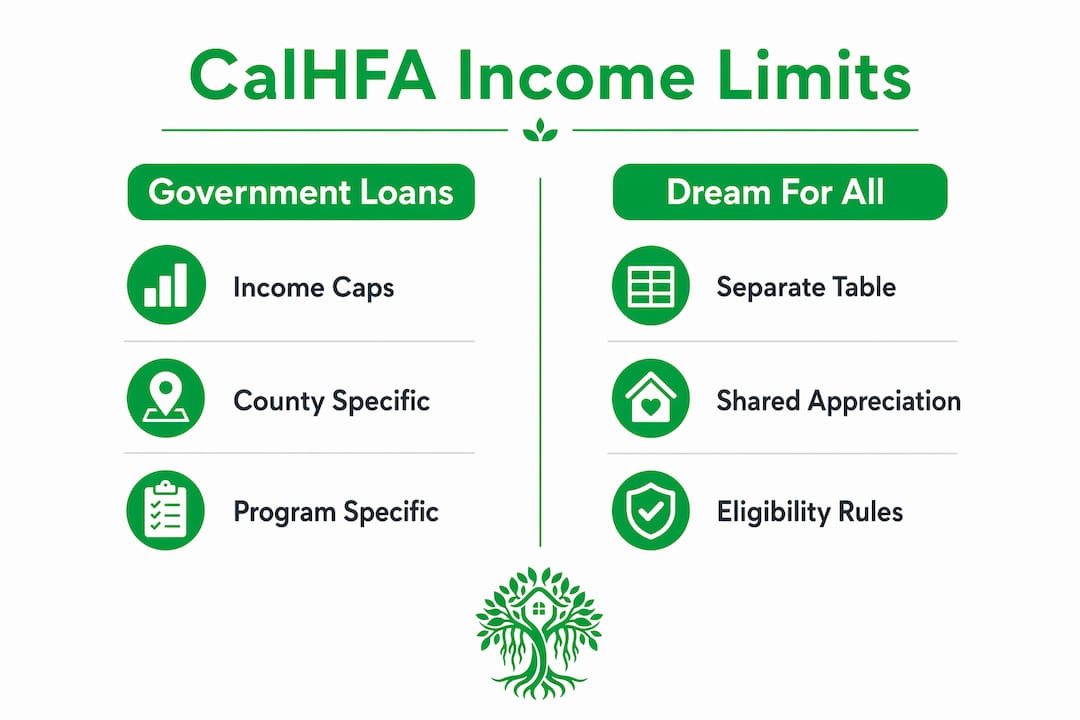
    CalHFA income limits for 2026 are set by two program-specific tables published on the official CalHFA limits page: one for the Dream For All Shared Appreciation Loan and one for All CalHFA First Mortgages and Subordinate Mortgages. The California Department of Housing and Community Development (HCD) publishes the underlying 2026 State Income Limits PDF that feeds several CalHFA programs. Check the effective date printed on each PDF before you rely on any figure.

    Three quick county examples from the 2024 Government and Conventional table (the most recent published PDF) give you a sense of variation across counties: higher-income counties have larger ceilings and lower-income counties smaller ones. The 2026 limits follow the same county-by-county structure; download the current PDF from CalHFA to confirm your county’s exact ceiling. Also check CalHFA Program Bulletins for any mid-year changes, since CalHFA can update limits outside the static page.

    Overhead view of man analyzing county income tables


    Table of Contents

    What are CalHFA income limits and why do they vary by program?

    CalHFA income limits are household gross-income ceilings. If your total annual household income exceeds the cap for your county and program, you cannot use that CalHFA-funded assistance, even if you qualify for the underlying mortgage. That is the key distinction: FHA loans carry no borrower income cap at all. FHA focuses on debt-to-income ratio and affordability, not a maximum income threshold. CalHFA assistance programs layer on top of FHA or conventional financing and add their own county-based income rules.

    Elderly man calculating household income at desk

    Multiple tables exist because each CalHFA product draws on different federal and state funding streams, each with its own eligibility rules. The Dream For All Shared Appreciation Loan, for example, typically carries lower income ceilings than the standard first-mortgage table. County variation reflects local Area Median Income (AMI), which HUD calculates annually and HCD translates into California-specific thresholds.

    Here are the three main limit tables you will encounter:

    • Dream For All Shared Appreciation Loan income limits — program-specific, often lower than the standard table; published separately on CalHFA’s limits page.
    • All CalHFA First Mortgages and Subordinate Mortgages income limits — the broadest table, covering most CalHFA first and subordinate loan products.
    • HCD State Income Limits (2026 PDF) — the statewide AMI-based table used for certain subordinate programs and Low Income (LI) eligibility determinations.

    Understanding which table governs your program before you run the numbers saves you from a late-stage surprise. Many buyers learn this the hard way after a lender pre-qualifies them for an FHA loan, only to find their household income exceeds the CalHFA cap for the down payment assistance they planned to use.


    Infographic comparing CalHFA income limit tables

    Where to find your county’s income limit PDF and how to read it

    The two authoritative downloads are the CalHFA program limits page and the HCD 2026 State Income Limits PDF. Download both and keep them in your mortgage file.

    How to read a CalHFA county table row:

    • Locate your county alphabetically in the PDF.
    • The figure listed is the gross annual household income ceiling for that county under that program.
    • Confirm the effective date printed at the bottom of the PDF (look for a date in MM.DD.YYYY format).
    • If the effective date is older than the current program bulletin, download the updated version from the CalHFA limits page.

    The table below shows example counties from the published Government and Conventional table for All CalHFA First Mortgages, alongside the Dream For All limits, illustrating how the two tables diverge for the same county. Always download the current PDFs from CalHFA for the most up-to-date limits.

    The HCD statewide table differs structurally from the CalHFA program PDFs. HCD breaks limits into AMI categories (extremely low at 30%, very low at 50%, low at 80%, moderate at 120%) and lists figures for household sizes 1 through 8. CalHFA’s program PDFs typically show a single per-county ceiling rather than a full AMI breakdown, which is why you need both documents when checking eligibility for subordinate or LI-specific products.


    Which CalHFA program uses which income limit table?

    The mapping is straightforward once you know it, but it trips up a lot of buyers.

    Dream For All Shared Appreciation Loan uses its own dedicated income limit table, published separately on the CalHFA limits page. These caps are lower than the standard first-mortgage table, and the program has historically been oversubscribed, so confirming eligibility early matters.

    All CalHFA First Mortgages and Subordinate Mortgages (including MyHome Assistance and ZIP programs) use the Government and Conventional income limits table. This is the broader table with higher county ceilings.

    Low Income (LI) subordinate products reference the HCD State Income Limits at the 80% AMI threshold. CalHFA’s Program Bulletin #2026-05 updated these 80% AMI figures specifically to determine LI eligibility, so check that bulletin if you are applying for an LI-designated subordinate loan.

    One important caution: CalHFA publishes program-specific income limits and notes that limits may differ by program and cannot exceed certain federal maximum thresholds. Qualifying for one CalHFA product does not guarantee eligibility for another. Always verify the effective date on the PDF you are using and cross-check against the most recent program bulletin before submitting your loan file.


    How does CalHFA calculate your household income?

    Income eligibility is based on total gross annual household income — every dollar earned by all borrowers and co-borrowers before taxes and deductions. That definition is broader than most buyers expect.

    Common income types CalHFA lenders will count and document:

    • W-2 wages — base salary plus any guaranteed overtime.
    • Bonuses and commissions — typically averaged over two years.
    • Self-employment and 1099 income — net income from Schedule C, averaged over two years.
    • Investment and rental income — documented via tax returns and bank statements.
    • Social Security and disability payments — grossed up per lender guidelines.

    Family-size adjustments matter significantly. HCD’s methodology applies percentage factors to the four-person AMI base to set limits for other household sizes. Smaller households face lower ceilings; larger households get higher ones. The HCD 2026 adjustment table uses factors such as 70% for a one-person household and 108% for a five-person household relative to the four-person base. A quick example: if a county’s four-person limit is $200,000, a two-person household’s limit would be set at 80% of that base, or $160,000.

    Pro Tip: The single most overlooked income item is seasonal or irregular 1099 income. If you did contract work for six months last year, a lender will average that income across 24 months, not just the months you worked. Document it fully and early, or work with your lender to determine whether it qualifies as irregular income that can be excluded with proper documentation.

    HCD’s Hold Harmless policy also means county AMI figures do not decrease below prior high-water marks, even when HUD’s national data would otherwise push them lower. That is why some inland counties hold limits that look high relative to current local wages.


    What should you do right now to check your eligibility?

    Getting this right before you are deep in escrow is the move. Here is a short, prioritized checklist:

    1. Download the right PDF. Go to the CalHFA limits page and download the table for your specific program. Confirm the effective date.
    2. Identify your program. Are you applying for Dream For All, a standard CalHFA first mortgage, or an LI subordinate product? Each uses a different table.
    3. Calculate your gross household income. Add up all income sources for every borrower, including bonuses and 1099 work. Use the home affordability calculator to stress-test the full picture.
    4. Apply the family-size adjustment. Find your household size in the HCD table and confirm you are comparing your income to the right row.
    5. Contact an approved CalHFA lender early. Lenders can run a soft eligibility check before you are under contract. Ask them to pull the current program bulletin, not just the static PDF.

    Check CalHFA Program Bulletins and the Rates and Reservations portal for any mid-year limit changes. CalHFA has issued updates like Program Bulletin #2026-07 (updated income limits) and #2026-05 (updated 80% AMI LI limits) that changed eligibility after the static page was last refreshed. If you are in escrow, re-check.

    Ficustree can help you map your county and program to the right table and run a quick eligibility check before you commit to a loan structure. It is a faster way to confirm you are looking at the right numbers.


    Key Takeaways

    CalHFA income limits vary by both county and program, and using the wrong table is the most common reason buyers discover a problem late in the process.

    Point Details
    Two program tables Check the Dream For All table or the All CalHFA First Mortgages table depending on your program.
    Always confirm the effective date printed on the PDF before relying on any figure — download the current version from CalHFA for updates.
    Gross household income counts All income from all borrowers, including bonuses and 1099 work, counts toward the limit.
    Family-size adjustments apply HCD factors (e.g., 70% for one person, 108% for five) shift the ceiling up or down by household size.
    Ficustree eligibility check Ficustree maps your county and program to the correct table and runs a pre-check before you apply.

    The part most buyers miss about CalHFA income rules

    Most articles on this topic stop at “check your county’s limit.” That is necessary but not sufficient. The real trap is the program-to-table mismatch. Buyers research the standard first-mortgage limit, see they qualify, and then apply for Dream For All without realizing it uses a separate, lower table. By the time the lender catches it, they have already paid for an appraisal and inspection.

    The second trap is treating income as a static number. If you had a strong bonus year or picked up freelance work, your two-year average may push you over the cap even if your base salary sits comfortably below it. The fix is simple: run the numbers before you choose a program, not after you fall in love with a property.

    California’s first-time buyer programs are genuinely valuable, but they reward buyers who do the homework upfront. The county table is the starting point, not the finish line.


    How Ficustree helps you confirm CalHFA eligibility

    Figuring out which table applies to your situation, calculating your gross household income correctly, and matching it to the right county row takes time most buyers do not have. Ficustree cuts that process down significantly.

    Ficustree

    With Ficustree, you get access to an affordability calculator built for real California budgets, direct connections to approved CalHFA lenders, and step-by-step guidance on which program table applies to your situation. Buyers pay $1,000 at closing plus 1% commission, keep a rebate of roughly 2% where legally permitted, and use the full platform free. No obligation to start. Check your eligibility at Ficustree and know where you stand before you make an offer.


    Useful sources to verify current limits

    • CalHFA Income Limits page — the primary source for all program-specific PDFs, including Dream For All and the Government and Conventional table. Check here first.
    • HCD 2026 State Income Limits PDF — the AMI-based statewide table used for LI eligibility and subordinate program calculations.
    • CalHFA Program Bulletins (Income Limits) — mid-year updates that can change eligibility between static PDF refreshes.

    Verify the effective date shown at the bottom of every PDF before you use it. If the date predates the most recent program bulletin, download the updated version. Save or print the exact PDF version used during your loan application and keep it in your mortgage file. Lenders and underwriters may request it.

    For San Diego County buyers, local first-time buyer guidance can also help you understand how county-specific programs layer on top of CalHFA assistance.

    This article is general information, not legal or financial advice. Confirm current limits and program eligibility with an approved CalHFA lender or the official CalHFA program pages for your specific situation.


    FAQ

    What are the CalHFA income limits for 2026?

    CalHFA publishes two program-specific tables; always check the date at the bottom of your county’s PDF and the CalHFA limits page for the current version. Limits vary by county, ranging from lower ceilings in lower-AMI counties to higher ceilings in high-cost counties like Alameda, San Francisco, and Santa Clara under the standard first-mortgage table.

    Does FHA have an income limit for borrowers?

    No. FHA loans have no maximum borrower income requirement; FHA qualification focuses on debt-to-income ratio and credit. CalHFA assistance programs, however, add county-based income caps on top of FHA underwriting, which is why you can qualify for an FHA mortgage but still be ineligible for CalHFA down payment help.

    What income counts toward the CalHFA limit?

    CalHFA uses total gross annual household income from all borrowers, including wages, overtime, bonuses, self-employment income, 1099 contract work, investment income, and rental income. Lenders typically average variable income over two years.

    Is California offering $150,000 to first-time buyers?

    The California Dream For All Shared Appreciation Loan has offered a shared appreciation loan for eligible first-time buyers, with specific terms and caps depending on the program round. Availability depends on program funding, which is limited; check the CalHFA limits page and current program bulletins for open enrollment periods and income eligibility.

    How do family size adjustments affect my CalHFA income limit?

    HCD applies percentage factors to the four-person AMI base to set limits for other household sizes. A one-person household is set at roughly 70% of the four-person base; a five-person household at roughly 108%. Download the HCD 2026 State Income Limits PDF and find your county row to confirm the exact figure for your household size.

  • Is This Neighborhood a Good Place to Live?

    Is This Neighborhood a Good Place to Live?

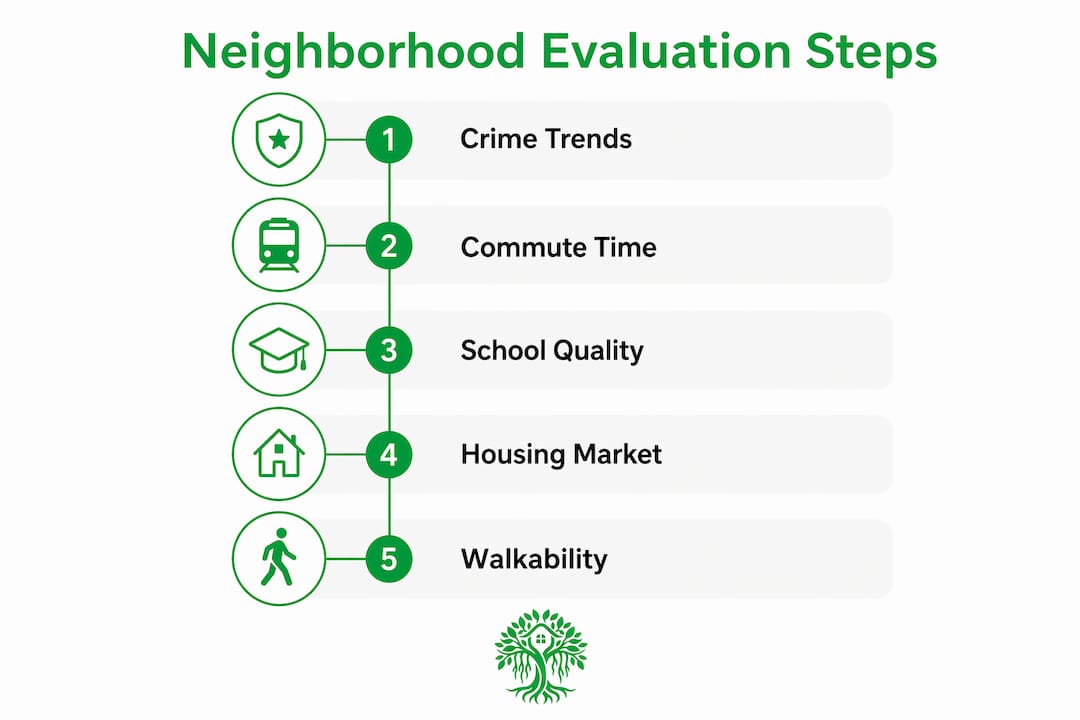
    A neighborhood is a good place to live when its crime trend is falling, your commute is under 30 minutes, schools meet your household’s needs, and housing costs fit your true budget including insurance and taxes. Run this quick check before you go deeper:

    • Crime trend: Pull the last 3 years of data from your local police department portal or FBI crime statistics. A falling trend matters more than a single year’s count.
    • Commute reliability: Test your actual route at your actual departure time, not Google Maps at noon on a Sunday.
    • Grocery and healthcare access: Can you reach both within 15 minutes without a car?
    • School quality: Check the district’s state report card and GreatSchools ratings if there are children in your household.
    • Flood and wildfire flags: Run the address on FEMA’s Flood Map Service Center before you go further.

    If all five pass, keep going. If two or more fail, look at comparable listings one ZIP code over before committing.


    Table of Contents

    What objective metrics actually tell you about a neighborhood

    The best neighborhoods to live in share a pattern: their key metrics trend in the right direction over time, not just at a single snapshot. Here is what to measure and what “good” looks like for each.

    Multi-year crime trend. A neighborhood with a sustained decline in property crimes over several years is meaningfully safer than one with a flat or rising count, even if the raw number looks low today. Single-year snapshots routinely mislead buyers. Pull at least three years from your local PD portal or the FBI’s Uniform Crime Report.

    Group discussing neighborhood crime map in meeting

    Commute time and transit options. For most buyers, a median commute under a moderate time each way is the threshold where daily stress stays manageable. Remote workers should still check transit scores; hybrid schedules change, and resale value tracks transit access closely.

    School-district performance. State report cards and GreatSchools percentile rankings give you a fast read. For families, a district trending upward on proficiency scores matters more than a single year’s rank.

    Infographic showing key neighborhood evaluation steps

    Housing price trends and inventory. A neighborhood where median prices have risen steadily and days-on-market are short signals demand. Thin inventory also means you will likely face competition, which affects your timeline and offer strategy.

    Walkability and daily amenities. Walk Score rates addresses on a 0–100 scale based on proximity to groceries, pharmacies, parks, and restaurants. A score above 70 typically means you can handle most errands without a car.

    Diverse group walking on urban neighborhood sidewalk

    Natural-hazard exposure. FEMA flood zone designations directly affect insurance premiums. Wildfire risk maps from CAL FIRE (for California buyers) or the Texas A&M Forest Service add another layer. Marketing materials and listings rarely surface environmental hazards like Superfund proximity, high-voltage transmission lines, or flight-path noise overlays, so you have to check these yourself.

    Demographic and lifestyle fit. Census/ACS data shows median age, household composition, income distribution, and commute modes. None of these are dealbreakers on their own, but a neighborhood where the lifestyle pattern matches your weekly routine predicts long-term satisfaction better than any single amenity.

    For first-time buyers: weight crime trend, commute, and true housing cost first. For families, add school district. For remote workers, swap commute for walkability and internet infrastructure.


    Where to find reliable data on any neighborhood

    A complete neighborhood picture requires both national public datasets and local sources. Here is the short toolkit:

    • Census/ACS (census.gov): Demographics, income, commute modes, and housing tenure. Use the American Community Survey 5-year estimates for the most stable figures. Note that ACS data carries margins of error, especially in small geographies.
    • FBI UCR / local PD portals: Crime counts and trends by offense type. The FBI’s national data runs 12–18 months behind; your local police department’s online crime map is usually more current.
    • FEMA Flood Map Service Center (msc.fema.gov): Flood zone designation by address. Zone AE or VE means mandatory flood insurance, which adds meaningfully to your monthly cost.
    • GreatSchools (greatschools.org) and Niche (niche.com): School ratings, test scores, and parent reviews. Cross-reference with the state’s official report card for the most accurate proficiency data.
    • Walk Score (walkscore.com): Walkability, transit, and bike scores by address. A 5-minute check that surfaces transit gaps you would not notice from a listing photo.
    • Zillow and Redfin: Median sale price trends, days on market, and price-cut frequency by ZIP code. Use the 12-month trend view, not the current listing price alone.
    • County assessor website: Property tax history, assessed value, and parcel details. Tax rates vary significantly by county and can shift your monthly payment by hundreds of dollars.
    • Local planning and zoning portals: Pending rezoning, approved developments, and infrastructure projects. A planned highway expansion or new transit line can change a neighborhood’s character within your ownership window.

    Pro Tip: Use the AI home search tools available to first-time buyers to pull several of these layers into one view, rather than toggling between eight browser tabs.


    How to evaluate a neighborhood in one weekend

    This method takes 48–72 hours and produces a confident yes/no answer. Follow the steps in order.

    1. Friday evening: run the data check. Pull crime trend, FEMA zone, school rating, Walk Score, and 12-month price trend for the target address. Flag any metric that falls below your threshold. Budget 60–90 minutes.

    2. Saturday morning (7–9 AM): the commute visit. Drive or take transit your actual route at your actual departure time. Note congestion, parking availability near the home, and school-zone traffic if relevant. This is the first leg of the Multi-Visit Test: weekday morning reveals commute and school-flow realities that a weekend afternoon hides entirely.

    3. Saturday afternoon: the walkability walk. Park and walk a 10-minute radius. Check grocery stores, pharmacies, coffee shops, and parks. Note business vacancy rates; a block with multiple empty storefronts is a signal worth investigating.

    4. Saturday evening (8–10 PM): the noise and nightlife check. Return after dark. Assess street lighting, foot traffic, noise levels, and how comfortable you feel. This visit catches bar-district noise, parking overflow, and lighting gaps that daytime visits miss.

    5. Sunday: the bad-weather or off-peak check. If rain is forecast, use it. Drainage problems, flooded gutters, and standing water in driveways reveal maintenance and infrastructure quality that no listing photo will show.

    6. Talk to two or three residents. Ask what they wish they had known before moving in. Dog walkers, people gardening, and parents at a nearby park are the easiest to approach.

    7. Build your decision matrix. Score each metric from 1–5 against your personal weights (see Section 7 for the template). A total score above 350 out of 500 (70% of the maximum) signals a strong fit; above 400 is a strong match. Below 250 means look elsewhere.

    Pro Tip: Before you weight lifestyle amenities like a rooftop gym or wine bar nearby, audit your actual two-year behavior. If you have not used a gym in two years, deprioritize gym proximity versus grocery access or commute time. Buying for who you are, not who you plan to become, reduces buyer regret.


    Costs and timeline that change based on which neighborhood you choose

    Neighborhood choice is not just a lifestyle decision. It directly affects your monthly budget and how long the purchase takes.

    • Commute costs: A 30-mile round-trip daily commute in a gas-powered vehicle costs roughly $200–$400 per month depending on fuel prices and vehicle efficiency. Transit passes in major California metros run $100–$200 per month. These are real line items in your post-purchase budget.
    • Flood and fire insurance: A home in FEMA Zone AE can require flood insurance that adds $1,000–$3,000 per year to your carrying cost. High wildfire-risk designations in California have pushed some insurers out of the market entirely, making coverage harder to find and more expensive.
    • Property taxes: Rates vary by county and city. In California, Proposition 13 caps the assessed value increase annually, but the base rate differs by county. In Texas, effective property tax rates are among the highest in the country, with varying percentages of assessed value annually.
    • HOA fees: Neighborhoods with homeowners associations add monthly fees that range from under $100 to over $500 depending on amenities and maintenance scope. Always request the HOA’s reserve fund study before making an offer.
    • Timeline impact: A neighborhood with low inventory and high demand typically compresses your decision window. Expect to move faster on offers, which means your data check and site visits need to happen before you fall in love with a specific listing, not after.

    Red flags that should give you pause, and trade-offs worth accepting

    Not every imperfect metric is a dealbreaker. Knowing the difference saves you from both bad purchases and missed opportunities.

    Red flags worth pausing for:

    • A rising crime trend over two or more consecutive years, especially for violent crime
    • Repeated FEMA flood claims on the property or adjacent parcels
    • Persistent housing abandonment or high vacancy rates on the block
    • Severe peak-hour congestion that adds 45+ minutes each way to your commute
    • A materially underperforming school district when children are in your household
    • Environmental hazards like Superfund proximity or flight-path noise overlays that do not appear in listing descriptions

    Trade-offs that are often reasonable:

    • A smaller home footprint in exchange for a 15-minute commute versus a 45-minute one
    • Higher ambient noise in a walkable urban neighborhood versus a quiet suburb with car dependency
    • A slightly lower school rating in a district with a clear upward trend

    Before making an offer when a red flag is present, get answers to three questions: Can you get insurance at a reasonable premium? Is there a funded infrastructure project that addresses the issue? And does the seller’s disclosure confirm or contradict what you found in public data?


    A sample decision matrix: turning your scores into a clear answer

    Use this template to compare two neighborhoods on the metrics that matter most to you. Assign a weight (total weights must sum to 100) and a score from 1–5 for each metric, then multiply.

    Metric Weight Neighborhood A Score Neighborhood A Weighted Neighborhood B Score Neighborhood B Weighted
    Crime trend (3-year) — 4 100 2 50
    Commute time/reliability — 3 60 5 100
    School district quality — 5 100 3 60
    Housing cost vs. budget 15 3 45 4 60
    Walkability/amenities 10 4 40 5 50
    Hazard/insurance risk 10 5 50 3 30
    Total 100 395 350

    In this example, Neighborhood A scores 395 out of 500 and Neighborhood B scores 350. A score above 350 (70% of 500) signals a workable fit; above 400 is a strong match. Neighborhood A wins on safety and schools; Neighborhood B wins on commute and walkability. The matrix makes that trade-off visible rather than leaving it as a gut feeling.

    A five-category scoring framework covering housing cost, commute and mobility, daily convenience, home fit, and future flexibility is a practical starting structure. Adjust the weights to reflect your actual priorities, not a generic template.


    How Ficustree helps you apply this method faster

    Ficustree is built specifically for first-time buyers who want data-driven guidance without spending weeks assembling it themselves. Here is how the platform maps to the method above:

    • Neighborhood insights layer: Ficustree pulls public data (crime trends, school ratings, walkability, hazard flags) into plain-English summaries that explain why a neighborhood fits your specific profile, not just a raw score. This is the AI-powered approach that converts dashboard noise into a clear narrative.
    • Affordability calculator: Factor in property taxes, HOA, insurance, and commute costs alongside the mortgage payment to see your true monthly number before you fall for a listing.
    • On-demand showing agents: Book an agent by the hour for your Saturday morning commute visit or your Sunday walkthrough. No full-time agent relationship required until you are ready.
    • Decision intelligence: The platform’s scoring adapts to your weights, so the same neighborhood ranks differently for a family prioritizing schools versus a remote worker prioritizing walkability.
    • Buyer representation: Ficustree represents you directly. You pay $1,000 at closing plus 1% commission and keep a rebate of roughly 2% where legally permitted.

    The goal is to compress what typically takes six months of confusion into two months of clarity, with every data layer you need already assembled.


    Key Takeaways

    A neighborhood is a good fit when its crime trend is falling, commute is manageable, schools meet your needs, and the true all-in cost fits your budget.

    Point Details
    Trend beats snapshot Check crime data over 3 years, not just the most recent year’s count.
    True cost includes more Factor in commute, flood/fire insurance, property taxes, and HOA before deciding.
    Multi-Visit Test Visit at weekday morning, weekend evening, and during bad weather to see the full picture.
    Decision matrix Score each metric against your personal weights; a score above 350 out of 500 (70% of the maximum) signals a strong fit.
    Ficustree Ficustree’s AI decision layer assembles neighborhood data, affordability numbers, and on-demand agents so first-time buyers reach a clear yes/no faster.

    One habit every first-time buyer should build

    Most buyers I talk to have spent months scrolling listings and almost no time auditing their own routine. Before you weight any amenity, write down what you actually did last Tuesday and last Saturday. Where did you go? How did you get there? What would have been harder with a 40-minute commute added each way? That two-minute exercise surfaces your real non-negotiables faster than any checklist. The buyers who regret their neighborhood choice almost always picked for the life they intended to live, not the one they actually live. Build the habit of separating those two things early, and the decision matrix becomes much easier to fill in honestly.


    Ficustree puts this method to work for you

    First-time buyers in California and Texas now have a faster path from “is this neighborhood a good place to live?” to a confident offer. Ficustree is not a listings site. It is the decision intelligence layer that assembles crime trends, school ratings, hazard maps, and affordability numbers into a clear picture of whether a specific address fits your life.

    Ficustree

    You get on-demand showing agents for your site visits, a platform that adapts its neighborhood scoring to your actual priorities, and direct buyer representation at $1,000 plus 1% at closing, with a rebate of roughly 2% where permitted. No six-month confusion spiral. Start your neighborhood search on Ficustree and see your personalized fit score before your next weekend visit.


    Authoritative sources and tools to bookmark

    • FBI Crime Data Explorer: National crime statistics by offense type and jurisdiction; best for multi-year trend analysis.
    • BestNeighborhood.org: Aggregated neighborhood quality scores across U.S. cities; useful for a fast initial screen.
    • FEMA Flood Map Service Center: Official flood zone designations by address; required before any purchase in a coastal or low-lying area.
    • GreatSchools (greatschools.org): School ratings and parent reviews; cross-reference with your state’s official report card.
    • Walk Score (walkscore.com): Walkability, transit, and bike scores by address; free and instant.
    • Zillow and Redfin: Median price trends, days on market, and inventory levels by ZIP code.
    • County assessor website: Property tax history and assessed value; search “[county name] assessor” to find your local portal.
    • Local planning and zoning portal: Pending developments and rezoning decisions; search “[city name] planning department” or “[city name] zoning map.”
    • Census/ACS (data.census.gov): Demographics, income, and commute data; use 5-year ACS estimates for small geographies.

    FAQ

    How do you check if a neighborhood is safe?

    Pull at least three years of crime data from your local police department’s online portal or the FBI’s crime statistics and look for a falling trend, not just a low single-year count. A declining trend over multiple years is a stronger safety signal than any one year’s number.

    How can you tell if a neighborhood is a good fit before moving in?

    Use the Multi-Visit Test: visit at weekday morning, weekend evening, and during bad weather to observe commute flow, noise levels, and drainage. Combine those observations with a scored decision matrix weighted to your personal priorities.

    How do you look up whether a neighborhood is safe?

    Check your local police department’s crime map for current data, then cross-reference with the FBI Uniform Crime Report for multi-year trends. FEMA’s Flood Map Service Center and your state’s environmental agency add hazard-risk context that crime data alone does not cover.

    Is it better to live in a neighborhood with strong walkability?

    Walkability reduces car dependency and tends to support stronger long-term property values, but the right answer depends on your routine. A Walk Score above 70 is a meaningful threshold for buyers who want to handle daily errands without driving.

    How does Ficustree help evaluate a neighborhood?

    Ficustree’s AI decision layer pulls crime trends, school ratings, walkability scores, and hazard flags into plain-English summaries tailored to your priorities, so you can reach a clear yes/no on a neighborhood without assembling eight data sources yourself.

  • What Happens After Pre Approval: Next Steps for Buyers

    What Happens After Pre Approval: Next Steps for Buyers

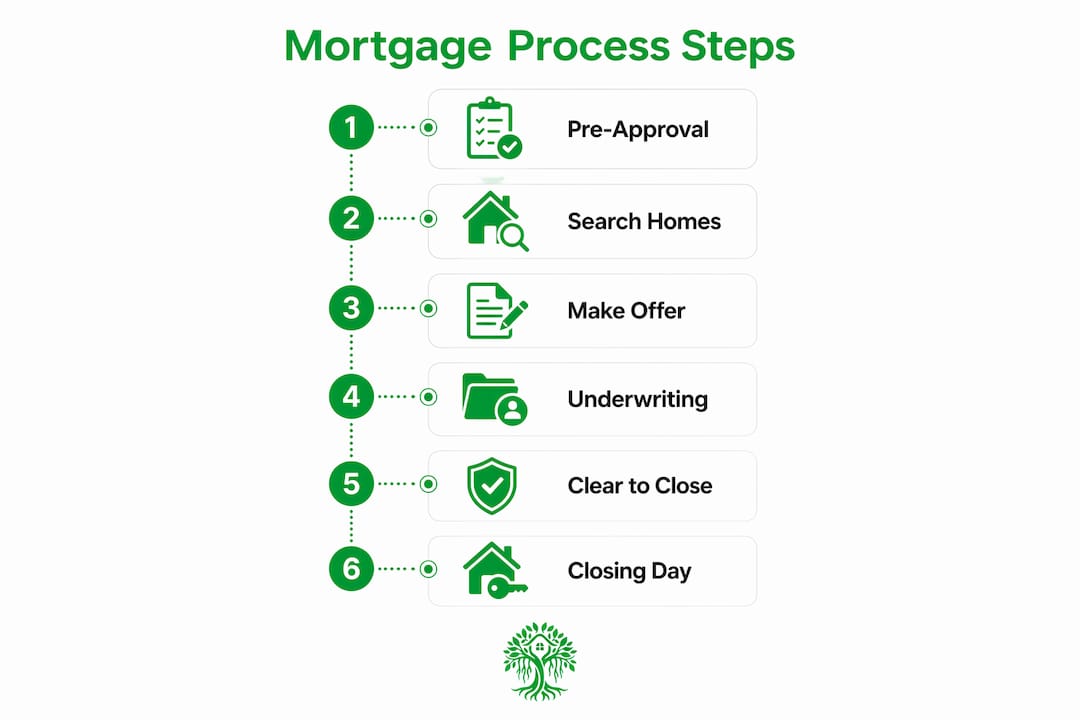
    Pre-approval is a conditional lender estimate, not a loan guarantee. It tells you how much a lender is willing to lend based on a financial snapshot taken at one point in time. What happens after pre-approval is a defined sequence: start house hunting within your approved price range, make an offer, submit a formal loan application, clear the appraisal, move through underwriting, and reach “Clear to Close.” Every step has a lender verification trigger attached to it, and any financial change you make along the way can reopen that verification.

    Here are the three immediate actions to take right now:

    • Start searching within the price range on your pre-approval letter, not above it. Your approved amount is a ceiling, not a target.
    • Get your agent and documents ready. Brief a buyer’s agent with your pre-approval letter and gather pay stubs, W-2s, bank statements, and ID before you need them.
    • Prepare for the full loan application. Once your offer is accepted, your lender will re-verify everything. Fannie Mae underwriting standards and CFPB guidance both emphasize that the formal application triggers a deeper review than pre-approval did.

    Ficustree’s buyer platform is built around exactly this sequence, helping first-time buyers in California and Texas move from pre-approval to clear-to-close without losing track of a single step.


    Table of Contents

    How do you use your pre-approval to search effectively?

    Your pre-approval letter is a working document, not a trophy. Hand it to your buyer’s agent on day one, using tools like real estate photo editing for agents to enhance your listing presentation and marketing efforts. A good agent will use the approved loan amount, estimated monthly payment, and property-type restrictions to filter out homes that would never survive underwriting, saving you time and emotional energy.

    Buyer reviewing pre-approval documents at desk

    Set your search parameters based on what the lender approved, not what you wish they had approved. That means filtering by price, factoring in your estimated down payment, and checking whether the loan type (FHA, conventional, VA) restricts property condition. An FHA loan, for example, will not close on a home with peeling paint or a broken HVAC system.

    Pre-approval letters typically expire after a couple of months. If your search runs long, ask your lender for a refreshed letter before it lapses. Renewing requires updated pay stubs, bank statements, and a new credit pull, so give yourself a week’s lead time.

    Infographic showing mortgage process steps

    Pro Tip: Request a new pre-approval letter for each offer you write, adjusted to match that specific offer price. Showing a seller a letter for exactly $620,000 on a $620,000 offer is stronger than showing one for $700,000. It also protects your negotiation position by not revealing your full borrowing capacity.

    While you search, practice what lenders call “financial silence.” Do not open new credit cards, finance a car, or make large unexplained transfers. Lenders re-verify credit and assets before closing, and any new liability can change your debt-to-income ratio (DTI) enough to void the pre-approval.


    What should your offer include to protect your financing?

    Your pre-approval letter travels with your offer. Listing agents use it to assess whether your financing is real, and sellers use it to compare competing bids. A letter from a well-known lender, dated recently, and matching the offer price signals a serious buyer.

    Two contract elements directly protect your financing:

    • Mortgage contingency: This clause lets you exit the contract and recover your earnest money if your loan is denied. Without it, a financing failure could cost you your deposit.
    • Earnest money deposit: Typically a few percent of the purchase price, paid within a few days of offer acceptance. It shows the seller you are committed. If you back out for a reason not covered by a contingency, you lose it.

    Consider the practical difference: an offer with a mortgage contingency protects you if underwriting turns up a problem. An offer without one (sometimes used in competitive markets to look stronger) puts your earnest money at risk if the loan falls through. In most first-time buyer situations, keeping the mortgage contingency is the right call.

    Once your offer is accepted, your lender will ask for a copy of the purchase contract immediately. That document triggers the appraisal order, title work, and the formal loan application. Request an updated pre-approval letter to match the final accepted price before submitting it to the listing agent.


    What documents does the lender re-check after your offer is accepted?

    Accepting an offer flips the process from shopping to verifying. Your lender will pull an updated credit report, order an appraisal, open a title search, and send a Verification of Employment (VOE) to your employer, sometimes without telling you. The formal loan application, known as the Uniform Residential Loan Application (Form 1003), consolidates everything.

    Expect to provide:

    • Pay stubs from the last 30 days
    • W-2s and federal tax returns for the past two years
    • Bank statements for all accounts, all pages, for the past 60 days
    • Government-issued ID
    • Explanation letters for any large deposits that are not regular payroll
    • Gift letters if any portion of your down payment is a gift
    • Asset statements for retirement accounts, brokerage accounts, or other funds used for closing

    Missing or incomplete paperwork is one of the most common reasons approvals stall. Underwriters need every page of every statement, including blank pages. Submitting a 10-page bank statement with pages 7 and 8 missing will pause your file.

    Respond to every document request within 48–72 hours. Processors work multiple files simultaneously, and a slow response pushes your file to the back of the queue. Organize your documents in a labeled folder (digital or physical) before you even make an offer, so you can upload them the same day the request arrives.

    Hands organizing mortgage loan documents on table


    What is the difference between a home inspection and an appraisal?

    These two reports serve completely different purposes, and confusing them is a common first-time buyer mistake.

    Home Inspection Appraisal
    Who orders it Buyer (optional but strongly advised) Lender (required)
    Who pays Buyer, typically $300 Buyer, typically $500
    Purpose Identify physical defects and safety issues Establish market value of the property
    Who uses the report Buyer (and agent for negotiations) Lender (to size the loan correctly)
    Affects the loan? Indirectly (if repairs trigger contingency) Directly (low value can reduce loan amount)

    The appraisal is what your lender cares about most. The lender orders the appraisal and compares the appraised value to your loan amount to calculate the loan-to-value ratio (LTV). If you agreed to pay $650,000 but the appraiser values the home at $620,000, the lender will only lend against $620,000. You now have a $30,000 appraisal gap to resolve.

    Your options when the appraisal comes in low:

    • Renegotiate the price with the seller down to the appraised value (most common outcome).
    • Bring additional cash to close to cover the gap out of pocket.
    • Request a Reconsideration of Value (ROV) from the lender, submitting comparable sales the appraiser may have missed. This works best when the gap is small and recent comps support a higher value.
    • Walk away under your appraisal contingency, recovering your earnest money.

    An appraisal gap can also trigger a loan reduction or outright denial if you cannot cover the shortfall. Including an appraisal contingency in your offer is the cleanest protection.


    How does underwriting work, and what does “conditional approval” mean?

    Underwriting is the lender’s final, deep verification of everything in your file. A human underwriter (or an automated system like Fannie Mae’s Desktop Underwriter) reviews your credit, income, assets, employment, the appraisal, and the title report against the loan program’s guidelines.

    The three stages buyers move through:

    • Pre-approval: Initial affordability check, limited verification.
    • Conditional approval: Underwriter has reviewed the file and approves the loan subject to specific conditions being met.
    • Clear to Close (CTC): All conditions satisfied, loan is approved, closing can be scheduled.

    Underwriters verify: updated credit score and report, Verification of Employment (VOE) confirming you are still employed, IRS tax transcripts matching your returns, sourcing of all large deposits, title report confirming clean ownership, and proof of homeowner’s insurance.

    Common conditions you will likely receive:

    • Updated pay stub dated within 30 days of closing
    • Complete bank statements with all pages
    • Gift letter from the donor with proof of transfer
    • Signed letter of explanation for a large deposit or credit inquiry
    • Proof of homeowner’s insurance binder

    Typical underwriting timeline:

    Stage Typical Duration
    Appraisal ordered to received 7 days
    Underwriting review 3–7 business days
    Conditions response window 48–72 hours per round
    Title search and clearance 5–10 business days
    Clear to Close to closing day 3–5 business days

    Conditions are normal. Responding within 48 hours with complete, exact documentation is what separates buyers who close on time from those who push their closing date.


    What are the most common reasons a mortgage gets denied after pre-approval?

    Pre-approval can be revoked because it is based on a financial snapshot. Underwriting is a live, updated review. Here are the five highest-probability denial triggers and how to avoid each:

    • New debt: Financing a car, opening a credit card, or co-signing a loan raises your DTI. Ask your lender before taking on any new obligation. The rule is simple: if it shows up on a credit report, ask first.
    • Job change or income gap: Switching employers, going from W-2 to self-employed, or taking unpaid leave can make your income unverifiable. Notify your lender before any employment change, not after.
    • Missed or late payments: A single 30-day late payment after pre-approval can drop your credit score enough to push you out of the loan program’s minimum. Set every account to autopay through closing.
    • Unexplained large deposits: A $10,000 transfer from a family member without a gift letter, or a cash deposit with no paper trail, will pause underwriting. Document the source of every large deposit before moving funds.
    • Low appraisal or title issues: Covered in detail above. An appraisal gap or a title defect (an old lien, an ownership dispute) can block closing entirely.

    Before any financial move during the buying process, ask yourself: “Will this change my DTI, my credit score, or my cash-to-close?” If the answer is yes or maybe, call your lender first.


    How long does the process take from pre-approval to clear-to-close?

    The home buying timeline from offer acceptance to closing usually runs about one to two months for most loan types. Here is a practical breakdown:

    Milestone Typical Duration
    Offer accepted to formal loan application 1–3 days
    Appraisal ordered to received 7 days
    Underwriting review (first pass) 3–7 business days
    Conditions gathered and resubmitted 3–7 business days
    Clear to Close issued 1–2 days after final conditions
    Closing day 3–5 days after CTC

    Pre-approval letters expire after a couple of months. If your search extends past that window, renew before writing offers. Switching lenders after an accepted offer is possible but restarts underwriting and appraisal orders, adding roughly 7–10 days to your timeline and risking your closing date.

    Checklist by stage:

    • At offer: Pre-approval letter (price-matched), proof of earnest money funds, signed purchase contract
    • At appraisal: Access to the property arranged, any recent comparable sales you want the appraiser to consider
    • At underwriting: Updated pay stubs, complete bank statements, gift letters, explanation letters, homeowner’s insurance binder
    • At closing: Closing cost funds (typically 2%–5% of the loan amount beyond the down payment), government-issued ID, certified or wire-transferred funds

    Homeowner’s insurance is required before closing. Most lenders want proof of a paid binder at least three days before the closing date. Shop for coverage as soon as your offer is accepted, not the week of closing.


    What are your options if you’re denied or the appraisal falls short?

    A denial or an appraisal gap is not automatically the end. You have real options, and the right one depends on how much time remains in your contract and how large the gap is.

    1. Renegotiate the purchase price. Ask your agent to go back to the seller with the appraisal report. Sellers in slower markets often accept a price reduction rather than restart with a new buyer.

    2. Bring additional cash to close. If the gap is small (say, $10,000–$20,000) and you have reserves, covering it out of pocket keeps the deal alive without delay.
    3. Request a Reconsideration of Value. Submit recent comparable sales to your lender within the ROV window. This works when the appraiser missed a relevant comp, not when the market simply does not support the price.
    4. Shop a new lender. If the denial is credit- or program-related rather than property-related, a different lender with different guidelines may approve the loan. Budget 7–10 additional days and discuss timing with your agent before switching.
    5. Cancel under contingency. If you have an appraisal or mortgage contingency and the numbers do not work, exercising the contingency lets you exit and recover your earnest money. Missing a contingency deadline, however, can forfeit that protection.

    If contractual deadlines are at risk, loop in your agent and a real estate attorney before acting. A housing counselor approved by HUD can also help you evaluate options without a sales agenda. This article is general information, not legal or financial advice; confirm the specifics of your contract and loan with your lender and a qualified professional.


    How do you protect your pre-approval with a quick-response protocol?

    The buyers who close on time share one habit: they treat every lender request like a same-day priority. Here is a practical protocol to adopt from offer acceptance through closing.

    Timing rules:

    • Notify your loan officer before any job change, even a promotion with a title shift.
    • Avoid new credit inquiries entirely. Even a “soft pull” for a furniture store card can raise flags.
    • Maintain financial silence through closing: no new debt, no large unexplained transfers, no co-signing.

    Sample email template for document requests:

    Keep it short, factual, and attach everything in one message. Underwriters flag incomplete submissions, and a second round of requests adds days.

    Pro Tip: When you receive a condition from underwriting, read it word for word before gathering documents. “Most recent 30-day pay stub” means dated within the last 30 days, not last month’s stub. Sending the wrong document wastes 24–48 hours and can push your closing date.


    Key Takeaways

    The most important thing to remember after pre-approval: it is a conditional green light to shop, not a loan commitment, and every financial move you make between now and closing will be re-verified.

    Point Details
    Pre-approval is conditional It expires in 60 days and can be revoked if your finances change before closing.
    Financial silence protects you Avoid new debt, credit inquiries, and large unexplained deposits from offer to closing day.
    Respond to underwriting fast Return every document request within 48–72 hours with complete, exact files to avoid delays.
    Appraisal gaps need a plan If the appraised value falls short, you can renegotiate, bring cash, request an ROV, or exit under contingency.
    Ficustree guides the full sequence Ficustree’s AI-powered platform helps first-time buyers in California and Texas stay organized from pre-approval through clear-to-close.

    Why representation and organization matter most after pre-approval

    Most buyers assume the hard part is getting pre-approved. The harder part is staying approved. The post-pre-approval phase is where deals fall apart, not because buyers are unqualified, but because they are unorganized or unrepresented at the moments that matter most.

    What I have seen repeatedly is that buyers who have a clear process, someone coordinating their documents, and a lender who communicates proactively close faster and with fewer surprises. The buyers who struggle are the ones navigating underwriting conditions alone, unsure which document to send or how to respond to a lender’s request. Ficustree’s decision intelligence layer exists precisely for this phase: keeping the buyer informed, organized, and one step ahead of every verification trigger.


    Ficustree helps you stay on track after pre-approval

    Getting pre-approved is step one. Staying approved through appraisal, underwriting, and closing is where most first-time buyers need real support.

    Ficustree

    Ficustree is built for exactly this phase. The platform coordinates your documents, tracks lender requests, and gives you clear guidance at every verification trigger, so you are never scrambling for a pay stub at 11 PM. Buyers pay $1,000 at closing plus 1% commission, keep a rebate of roughly 2% where legally permitted, and use the full platform free. You get hourly showing agents on demand and AI-powered decision support from offer to keys.

    Ready to move from pre-approval to clear-to-close with a clear plan? Start with Ficustree and see how the platform walks you through every step.


    Useful sources and further reading

    These official and industry resources go deeper on the topics covered above:

    • Consumer Financial Protection Bureau (CFPB): Guidance on disputing credit report errors that can affect your pre-approval and loan eligibility.
    • National Credit Union Administration (NCUA): Federally regulated lender standards and consumer protection resources for mortgage borrowers.
    • NMLS Consumer Access: Verify that your lender and loan officer are properly licensed before submitting any financial documents.
    • Fannie Mae (via The Mortgage Reports): A nine-step breakdown of the full mortgage loan process, including underwriting standards and Desktop Underwriter guidelines.
    • Ficustree First-Time Buyer Guide: A plain-language walkthrough of the full buying process for first-time buyers in California and Texas, from affordability to closing.

    FAQ

    Can you be denied after pre-approval?

    Yes. Pre-approval is a conditional commitment based on a financial snapshot, and lenders can deny the loan if your credit changes, you take on new debt, your employment shifts, or the appraisal comes in below the purchase price.

    How likely is full approval after pre-approval?

    Most buyers who maintain financial stability and respond quickly to underwriting conditions do reach final approval. The risk rises sharply if you open new credit, change jobs, or have unexplained deposits between pre-approval and closing.

    Does pre-approval mean you will get the loan?

    No. Pre-approval means a lender reviewed your finances at one point in time and estimated what you could borrow. Final approval, or “Clear to Close,” only comes after underwriting verifies your updated credit, employment, assets, the appraisal, and the title.

    How long does it take to get full approval after pre-approval?

    From offer acceptance, most conventional loans reach Clear to Close in about one to one and a half months. Appraisal typically takes about one to two weeks, underwriting several business days, and conditions resolution similarly depends on responsiveness.

    How long does pre-approval last?

    Pre-approval letters typically expire after 60–90 days. If your search runs longer, ask your lender to renew it with updated pay stubs, bank statements, and a fresh credit pull.

  • 3 Percent Down Mortgage for First-Time Buyers

    3 Percent Down Mortgage for First-Time Buyers

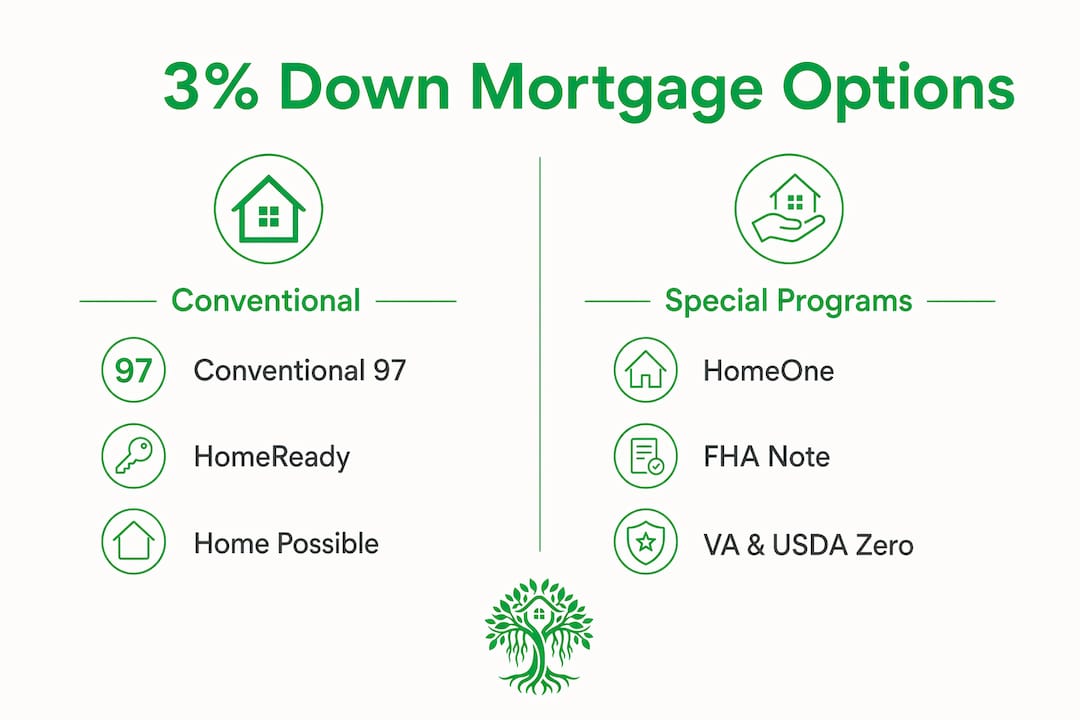
    Yes, you can buy a home with just 3% down using first-time home buyer mortgage options available right now. The main options are Conventional 97, Fannie Mae HomeReady, Freddie Mac Home Possible, and Freddie Mac HomeOne — all of which allow a 3% minimum down payment on a primary residence. Note that FHA loans require 3.5% (not 3%), while VA and USDA loans may require 0% down for eligible veterans and rural buyers.

    Here is a quick program-to-buyer match to orient you:

    • Conventional 97: Any first-time buyer with solid credit who earns above area income limits and wants a straightforward conventional loan.
    • HomeReady (Fannie Mae): First-time or repeat buyer whose income is at or below 80% of the area median income (AMI); offers pricing advantages and flexible income sources.
    • Home Possible (Freddie Mac): Similar to HomeReady with an 80% AMI cap; allows gifts, grants, and employer assistance for the down payment.
    • HomeOne (Freddie Mac): First-time buyer who earns above AMI limits and wants no geographic or income restrictions; at least one borrower must be a first-time buyer.
    • FHA: Buyers with credit scores as low as 580 who can put 3.5% down and want more flexible underwriting.
    • VA / USDA: Eligible veterans or rural buyers who qualify for zero down.

    For most first-time buyers in California and Texas, HomeReady or HomeOne will be the starting point worth exploring with a lender.


    Table of Contents

    Which 3% down programs should you compare?

    Not all low down payment mortgage options are built the same. The table below captures the core decision dimensions across the main programs.

    Couple discussing mortgage options on laptop

    Program Min. Down / Max LTV Who Is Eligible Credit Score Guidance Mortgage Insurance Loan Purpose
    Conventional 97 3% / 97% At least one first-time buyer (some versions allow repeat buyers) Typically 620+ Private mortgage insurance (PMI); cancelable Primary residence only
    HomeReady (Fannie Mae) 3% / 97% First-time or repeat buyer; income ≤ 80% AMI Typically 620+ Reduced PMI; cancelable Primary residence only
    Home Possible (Freddie Mac) 3% / 97% First-time or repeat buyer; income ≤ 80% AMI Typically 660+ Reduced PMI; cancelable Primary residence only
    HomeOne (Freddie Mac) 3% / 97% At least one first-time buyer; no income or geographic limits Typically 620+ Standard PMI; cancelable Primary residence only
    FHA 3.5% / — Any buyer; no first-time requirement 580+ for 3.5% down MIP (upfront + annual); harder to cancel Primary residence only
    VA 0% / — Eligible veterans, active duty, surviving spouses No minimum set by VA No PMI Primary residence only
    USDA 0% / — Buyers in eligible rural/suburban areas; income limits apply Typically 640+ Guarantee fee (upfront + annual) Primary residence only

    Key practical differences to keep in mind:

    • Income caps matter. HomeReady and Home Possible both cap qualifying income at 80% of AMI for the property location. HomeOne has no income or geographic limits, but requires at least one borrower to be a first-time buyer.
    • PMI is not equal across programs. HomeReady and Home Possible often carry reduced mortgage insurance costs compared to standard Conventional 97, which can meaningfully lower your monthly payment.
    • Down payment sources are more flexible on some programs. Home Possible allows gifts, Affordable Seconds, employer assistance, and in some cases sweat equity — sources that standard conventional loans may not accept.
    • FHA’s mortgage insurance is harder to remove. Unlike conventional PMI, FHA’s mortgage insurance premium (MIP) typically stays for the life of the loan if you put less than 10% down.
    • Homeownership education is required for some programs when all occupying borrowers are first-time buyers. That certificate must be in your loan file before closing.

    Gotcha: HomeOne has no income or geographic limits, but it does require at least one borrower to be a first-time homebuyer. HomeReady and Home Possible offer better pricing for income-eligible buyers but cap qualifying income at 80% AMI.


    How does 3% down change your loan math?

    Infographic comparing 3% down mortgage options

    Putting 3% down raises your loan-to-value ratio (LTV) to 97%, which has two direct consequences: you borrow more principal, and you pay private mortgage insurance until you build enough equity. Here is how the numbers actually work.

    Hands using calculator with mortgage charts

    Two numeric examples: $250,000 and $300,000 purchase price

    $250,000 home:

    1. Down payment: 3% of the purchase price.
    2. Loan amount is the purchase price minus the down payment.
    3. LTV is approximately 97%.
    4. Estimated PMI generally ranges from about 0.5% to 1.5% of the loan amount annually, varying by credit score and program; this translates to a rough monthly PMI cost.
    5. Principal and interest payments depend on your interest rate and loan term.
    6. Adding taxes, insurance, and PMI results in a total monthly housing cost that varies based on location and other factors.

    $300,000 home:

    1. Down payment: 3% of the purchase price.
    2. Loan amount is the purchase price minus the down payment.
    3. LTV is approximately 97%.
    4. Estimated PMI varies but typically falls in a range depending on your credit score and program.
    5. Principal and interest payments depend on your interest rate and loan term.
    6. Total monthly housing costs including taxes and insurance vary by location and other factors.

    These are illustrative figures. Your actual rate, PMI rate, taxes, and insurance will vary. Use a down payment calculator to run your specific numbers.

    How PMI works and when it goes away

    Private mortgage insurance protects the lender, not you, if you default. On conventional loans, PMI rates typically range from 0.5% to 1.5% of the loan amount annually, with your credit score and LTV being the biggest pricing factors. A 760+ credit score at 97% LTV will carry a much lower PMI rate than a 640 score at the same LTV.

    The good news: conventional PMI is cancelable. Lenders must automatically terminate PMI when your loan balance reaches 78% of the original purchase price. You can also request cancellation once you reach 80% LTV, provided you have a good payment history and, in some cases, a new appraisal. FHA MIP, by contrast, typically stays for the life of the loan if your down payment is under 10%.

    Pro Tip: Some lenders offer lender-paid mortgage insurance (LPMI), where they cover the PMI cost in exchange for a slightly higher interest rate. This can lower your monthly payment, but the higher rate is permanent — unlike PMI, which you can eventually cancel. Run both scenarios before deciding.


    What are the eligibility requirements for each program?

    Before you call a lender, it helps to know where you stand. Here is a program-by-program breakdown of the core underwriting requirements.

    Conventional 97

    • First-time buyer rule: At least one borrower must be a first-time buyer on most versions (defined as no ownership interest in a primary residence in the past three years).
    • Income limits: None on standard Conventional 97.
    • Credit score: Typically 620 minimum; better pricing above 720.
    • DTI: Generally up to 45%–50% with strong compensating factors.
    • Down payment sources: Personal savings, gift funds, DPA grants.
    • Non-occupant co-borrowers: Allowed on some versions; confirm with lender.
    • Homeownership education: Required when all borrowers are first-time buyers.

    HomeReady (Fannie Mae)

    • First-time buyer rule: Not required — repeat buyers can qualify if income is within AMI limits.
    • Income limit: Total qualifying income may not exceed 80% of AMI for the property location.
    • Credit score: 620 minimum; pricing improves significantly above 680.
    • DTI: Up to 50% with DU approval.
    • Down payment sources: Gifts, grants, Affordable Seconds, and boarder/roommate income can count toward qualifying.
    • Non-occupant co-borrowers: Permitted; income counted at a reduced percentage.
    • Homeownership education: Required when all occupying borrowers are first-time buyers; certificate must be in the loan file before closing.
    • Pricing advantage: Fannie Mae’s Desktop Underwriter (DU) automatically flags HomeReady eligibility and may identify a $2,500 borrower credit for very low-income buyers.

    Home Possible (Freddie Mac)

    • First-time buyer rule: Not required.
    • Income limit: Qualifying income capped at 80% of AMI for most uses.
    • Credit score: Typically 660 minimum.
    • DTI: Up to 45% generally; confirm with lender.
    • Down payment sources: Gifts, Affordable Seconds, employer assistance, and sweat equity in some cases.
    • Non-occupant co-borrowers: Allowed under program rules.
    • Homeownership education: Required for first-time buyers.
    • Important 2026 change: Freddie Mac removed unsecured loan proceeds as eligible assets for Home Possible effective April 2026. If you planned to use a personal loan for reserves or closing costs, that path is now closed under this program.

    HomeOne (Freddie Mac)

    • First-time buyer rule: At least one borrower must be a first-time buyer; no income or geographic limits apply.
    • Income limit: None.
    • Credit score: Typically 620 minimum.
    • DTI: Up to 45% generally.
    • Down payment sources: Personal savings, gifts; confirm eligible sources with lender.
    • Non-occupant co-borrowers: Not permitted under standard HomeOne guidelines.
    • Homeownership education: Required when all borrowers are first-time buyers.

    FHA (brief note)

    FHA requires 3.5% down, not 3%, so it falls outside the strict 3% category. It is worth considering if your credit score is between 580 and 619, where conventional programs become harder to access. Read the full breakdown in how FHA loans work for first-time buyers.

    VA and USDA (zero-down options)

    VA purchase loans require no down payment and no PMI for eligible veterans, active-duty service members, and surviving spouses. USDA’s Single Family Housing Guaranteed Loan Program offers zero-down financing in eligible rural and suburban areas with income limits. If you qualify for either, they almost always beat a 3% conventional loan on total cost.

    Statistic callout: Buyers who meet AMI income limits for HomeReady or Home Possible may receive better pricing — lower credit fees or mortgage insurance advantages — compared to buyers who must use a standard 97% conventional option. That pricing difference can add up to hundreds of dollars per year in PMI savings alone.


    What does a 3% down mortgage actually cost you?

    The 3% down payment is just the beginning. Here is the full budget picture.

    Costs to plan for

    • Down payment: 3% of purchase price.
    • Closing costs: Typically 2%–5% of the loan amount, covering lender fees, title insurance, appraisal, and prepaid items.
    • Prepaid items: First year of homeowners insurance, prepaid interest, and initial escrow deposits for taxes and insurance.
    • PMI: Monthly cost until you reach 80% LTV (conventional) or for the loan’s life (FHA under 10% down).
    • Reserves: Many programs require 1–2 months of housing payments in savings after closing.

    Monthly cost snapshot

    Scenario Loan Amount Est. PMI/Month Est. P&I/Month (7%) Est. Total Monthly Cost
    $250,000 home, 3% down $250,000 — — —
    $300,000 home, 3% down $291,000 — — —

    Note: For a $300,000 home, a 3% down payment is $9,000, resulting in a loan amount of $291,000. This matches the FAQ and Key Takeaways section figures for consistency.

    P&I = principal and interest. Total monthly cost adds estimated taxes, insurance, and PMI. Actual figures vary by location, credit score, and lender pricing.

    The long-term cost of borrowing more

    Starting with a 97% LTV loan means you carry a larger principal balance for longer. Every dollar of principal you do not put down at closing earns interest for the full loan term. On a $291,000 loan at 7% over 30 years, total interest paid exceeds $406,000 — compared to roughly $350,000 on a $250,000 loan at the same rate. That gap is real, and it is why the decision to buy now versus save longer deserves honest math, not just optimism about appreciation.

    PMI removal is the other lever. Once you reach 80% LTV through payments and appreciation, you can request PMI cancellation and recover that monthly cost. Buyers who plan to stay in the home five or more years often find the PMI cost worthwhile given the equity they build over time. Buyers planning to sell within three years may find the math tighter.

    Pro Tip: Shopping at least three lenders for PMI rates is as important as shopping for your interest rate. PMI is priced by the insurer, and different lenders work with different insurers — the same credit score can yield meaningfully different PMI quotes. See how to avoid PMI for strategies specific to California buyers.


    Is a 3% down mortgage the right choice for you?

    A low down payment mortgage gets you into a home faster, but it comes with real trade-offs. Here is a clear-eyed checklist.

    Benefits

    • Lower upfront cash requirement. On a $300,000 home, 3% down is $9,000 versus $60,000 at 20%. That gap is the difference between buying now and waiting years.
    • Access to homeownership sooner. In rising markets, waiting to save a larger down payment can cost more in purchase price appreciation than you save in PMI.
    • Program underwriting flexibilities. HomeReady and Home Possible allow non-occupant co-borrowers, boarder income, and flexible down payment sources that standard loans do not.
    • Keeps cash reserves intact. Preserving savings for repairs, emergencies, and moving costs reduces financial stress in the first year of ownership.

    Trade-offs

    • Higher monthly payment. A larger loan balance means more principal and interest every month, plus PMI on top.
    • Slower equity building. Starting at 97% LTV means a market dip of even 5% puts you underwater. That is a real risk in volatile markets.
    • PMI adds cost. Even at a modest rate, PMI on a $291,000 loan costs roughly $1,940–$4,365 per year depending on your credit score and program.
    • Possible higher interest rate. Some lenders price 97% LTV loans slightly higher than 95% LTV loans; the difference is usually small but worth confirming.
    • Risk of negative equity. If home values fall after purchase, a 3% down buyer has very little cushion before the loan balance exceeds the home’s value.

    Decision triggers

    • Credit score below 620? Conventional 3% programs become inaccessible; FHA at 3.5% or credit repair first are the realistic paths. See buying a house with a low credit score for a practical roadmap.
    • Planning to stay fewer than 5 years? The long-term cost of PMI and higher interest may outweigh the benefit of buying sooner. Run the numbers honestly.
    • Local market falling? A 3% cushion evaporates quickly in a declining market. A larger down payment or waiting may be the safer call.
    • Emergency fund depleted by the down payment? Most financial planners recommend keeping 3–6 months of expenses in reserve after closing. If a 3% down payment wipes out your savings, that is a warning sign.

    How do you actually get a 3% down mortgage?

    Here are the concrete steps, in order.

    1. Check your credit score and DTI. Pull your credit report from all three bureaus. Calculate your debt-to-income ratio: add up all monthly debt payments and divide by gross monthly income. Most 3% programs want DTI at or below 45%–50%.

    2. Gather your documents. You will need: two years of W-2s and tax returns, 30 days of pay stubs, two to three months of bank and asset statements, and a gift letter if any of your down payment is a gift.

    3. Get preapproved with at least two or three lenders. Request program-specific pricing for HomeReady, Home Possible, and HomeOne. The same DU approval does not guarantee identical pricing across lenders — automated underwriting flags eligibility, but lenders set their own rates and overlays.

    4. Confirm program eligibility. Ask each lender to run an AMI check for HomeReady and Home Possible. If your income exceeds 80% AMI, HomeOne or Conventional 97 are your conventional options.

    5. Request and compare Loan Estimates. Within three business days of a completed application, lenders must provide a standardized Loan Estimate. Compare APR, PMI rate, closing costs, and cash-to-close across lenders.

    6. Proceed to contract and underwriting. Once you have an accepted offer, your lender orders the appraisal and begins underwriting. Respond to document requests quickly — delays here are the most common cause of closing timeline slippage.

    Questions to ask every lender

    • Does this loan allow non-occupant co-borrowers?
    • Are gift funds or DPA grants acceptable for the full down payment?
    • What is the PMI rate for my credit score and LTV on this specific program?
    • Do you have any lender overlays that restrict eligibility beyond the program guidelines?
    • If I use student loan income-based repayment, how do you calculate my DTI? (Relevant if you carry student debt — see buying a house with student loans for details.)

    Realistic timeline

    • Preapproval: 1–5 business days once documents are submitted.
    • House hunting: Varies widely; budget 30–90 days in most markets.
    • Underwriting and appraisal: 2–4 weeks after an accepted offer.
    • Closing: Typically 30–45 days from contract to keys.

    What are your alternatives if 3% down doesn’t fit?

    Sometimes a 3% conventional loan is not the right tool. Here are the realistic alternatives.

    • Save for 5%–20% down. Crossing from 97% to 95% LTV can lower your PMI rate and sometimes your interest rate. At 20%, PMI disappears entirely. The trade-off is time in the market.
    • FHA at 3.5% down. Better for buyers with credit scores between 580 and 619. The downside: MIP typically stays for the loan’s life if you put less than 10% down. Detailed breakdown at how FHA loans work.
    • VA loan (0% down). No down payment, no PMI, and competitive rates for eligible veterans and active-duty service members. The VA funding fee applies but can be financed into the loan.
    • USDA loan (0% down). Zero down for buyers in eligible rural and suburban areas who meet income limits. Check eligibility at USDA’s program page.
    • Down payment assistance (DPA) programs. State and local agencies offer grants, forgivable loans, and second liens that can cover some or all of your 3% down and closing costs. These pair well with HomeReady and Home Possible. California buyers should check California first-time buyer programs; the HUD resource page lists programs by state.
    • Co-borrowers or co-signers. Adding a creditworthy non-occupant co-borrower can strengthen your application on programs that allow it. HomeReady explicitly permits this; HomeOne does not.
    • Loan assumption. In rare cases, a seller’s existing low-rate mortgage can be assumed by the buyer. This path is uncommon and requires lender approval, but it can be worth asking about in a high-rate environment.
    • Rent longer and save. If your local market is declining or your financial position is thin, renting another 12–24 months while building savings and credit is a legitimate strategy. See buying a house with no money down for a look at zero-down paths when you are ready.

    HomeOne vs. HomeReady and Home Possible: which fits your situation?

    The practical choice between these programs often comes down to one question: does your income fall within 80% of the area median income?

    If your income exceeds 80% AMI: HomeOne is likely your best conventional 3% option. It has no income or geographic limits, requires at least one first-time buyer, and offers standard conventional pricing. You will not get the reduced credit fees that HomeReady and Home Possible provide, but you will not be disqualified by income either.

    If your income is at or below 80% AMI: HomeReady or Home Possible may offer meaningfully better pricing. Buyers who meet AMI limits can access lower credit fees and potentially reduced PMI costs compared to standard 97% conventional options. HomeReady also allows boarder and roommate income to count toward qualifying — a real advantage for buyers in high-cost markets where a housemate’s rent is part of the household budget.

    Example scenarios:

    • Buyer earning $85,000 in a market where 80% AMI is $78,000: Over the AMI cap, so HomeReady and Home Possible are not available. HomeOne is the right conventional path if this buyer is a first-time buyer.
    • Buyer earning $65,000 in the same market: Under the AMI cap. HomeReady or Home Possible may offer better PMI pricing and credit fee advantages. Worth running both programs through a lender to compare Loan Estimates.

    One critical caveat: program rules change. Freddie Mac removed unsecured loan proceeds as eligible assets for Home Possible effective April 2026 — a change that caught some borrowers off guard. Always confirm current underwriting guidelines directly with your lender at application time, not just from articles published months earlier.

    Statistic callout: Fannie Mae’s DU automatically identifies HomeReady-eligible loans, which means your lender’s automated underwriting submission can flag the program for you — but that flag does not guarantee the best pricing. Always request a side-by-side Loan Estimate comparison across programs.


    Key Takeaways

    A 3 percent down mortgage is accessible through four main conventional programs — Conventional 97, HomeReady, Home Possible, and HomeOne — each with distinct eligibility rules that determine which one saves you the most money.

    Point Details
    Four main 3% programs Conventional 97, HomeReady, Home Possible, and HomeOne each allow 3% down with different income and eligibility rules.
    AMI cap splits the choice HomeReady and Home Possible cap qualifying income at 80% AMI; HomeOne has no income limit but requires a first-time buyer.
    PMI is cancelable on conventional loans Conventional PMI cancels automatically at 78% LTV; request cancellation at 80% LTV with a good payment history.
    Real cash-to-close on a $300k home 3% down is $9,000, plus closing costs of roughly 2%–5% of the loan amount, plus prepaid items and reserves.
    Ficustree for CA and TX buyers Ficustree matches first-time buyers to the right program and lender path, with AI decision support and buyer representation at $1,000 plus 1% commission.

    Why first-time buyers get tripped up on low down payment loans

    The programs exist. The eligibility rules are published. So why do so many first-time buyers end up in the wrong loan — or worse, miss out on pricing advantages they qualified for?

    The honest answer is that the gap between what a program allows and what a specific lender offers is wider than most buyers realize. Automated underwriting flags eligibility, but lenders set their own overlays, PMI relationships, and pricing. A DU “Accept” on HomeReady does not mean every lender will offer you the same rate or PMI cost. The buyer who shops three lenders and asks for program-specific Loan Estimates consistently gets a better deal than the buyer who takes the first preapproval and runs.

    There is also a timing problem. Program rules change faster than most online guides update. The April 2026 Freddie Mac change removing unsecured loan proceeds from Home Possible eligibility is a recent example. Buyers who had planned their cash-to-close around that source had to pivot quickly. The fix is simple but requires discipline: verify current rules with your lender at application time, every time.

    The other underrated risk is the ownership horizon. A 3% down loan makes financial sense for buyers who plan to stay long enough for equity to build and PMI to cancel. For buyers who might move in three years, the math often favors renting longer or saving for a larger down payment. That calculation is worth doing before you fall in love with a specific property.


    How Ficustree helps first-time buyers navigate low down payment options

    Sorting through HomeReady, HomeOne, Home Possible, and FHA while also comparing lender pricing and PMI quotes is a lot to manage alone. Ficustree is built for exactly this situation.

    Ficustree

    Ficustree is an AI-powered buyer representation platform for first-time buyers in California and Texas. Instead of paying a traditional agent 2%–3% commission, you pay $1,000 at closing plus 1% and keep a rebate of roughly 2% where legally permitted. The platform gives you a document checklist, lender comparison tools, and program matching guidance so you walk into every lender conversation knowing which program to ask about and what questions to push on.

    For buyers weighing a 3% down path, Ficustree’s decision intelligence layer helps you calculate your real cash-to-close, compare PMI scenarios across programs, and identify whether DPA programs in your area can reduce your upfront costs further. The platform is free to use; you pay only at closing.

    Ficustree serves buyers in California and Texas. If you are ready to move from research to action, start with Ficustree or explore the home-buying workflow tools to see how the platform guides you from preapproval to keys.


    Useful sources

    Program rules change. Verify all details with your lender at application time.

    • Fannie Mae HomeReady: Official program page covering AMI limits, underwriting flexibilities, and DU eligibility messaging.
    • Freddie Mac Home Possible: Official program page with income limits, eligible funding sources, and credit fee details.
    • Freddie Mac HomeOne overview: Summary of HomeOne’s no-income-limit, first-time-buyer requirements.
    • Home Possible fact sheet (PDF): Detailed list of eligible down payment sources including gifts, Affordable Seconds, and employer assistance.
    • HUD — Helping Americans with Loans: State-by-state DPA program finder and FHA loan resources.
    • VA Purchase Loan: Eligibility and program details for VA zero-down home loans.
    • VA Funding Fee and Closing Costs: Official VA guidance on funding fee amounts and financing options.
    • USDA Single Family Housing Guaranteed Loan Program: Eligibility maps, income limits, and program details for zero-down rural loans.
    • CFPB — What is private mortgage insurance?: Plain-language explanation of PMI, how it is calculated, and who it protects.
    • CFPB — When can I remove PMI?: Official guidance on automatic PMI termination at 78% LTV and borrower-requested cancellation at 80%.
    • Freddie Mac April 2026 program change: Example of how quickly underwriting guidelines can shift; confirms removal of unsecured loan proceeds from Home Possible eligible assets.

    This article is general information, not professional financial or legal advice. Confirm current program rules and eligibility with a licensed lender or HUD-approved housing counselor before making decisions for your specific situation.


    FAQ

    Can you put 3% down on a mortgage?

    Yes. Conventional programs including Conventional 97, HomeReady, Home Possible, and HomeOne all allow a 3% minimum down payment on a primary residence purchase. FHA requires 3.5%, not 3%.

    How much is 3% down on a $300,000 house?

    Three percent of $300,000 is $9,000. The loan amount is $291,000 after the down payment. Add closing costs and prepaid items, and your total cash-to-close on a $300,000 home varies depending on location and lender.

    How much is 3% down on a $250,000 house?

    Three percent of $250,000 is $7,500. The loan amount is $242,500 after the down payment. With closing costs and prepaids, total cash-to-close on a $250,000 home varies depending on location and lender.

    Is it possible to get a 3% mortgage with no income limits?

    Yes. Freddie Mac’s HomeOne program allows 3% down with no income or geographic limits, provided at least one borrower is a first-time homebuyer. HomeReady and Home Possible both cap qualifying income at 80% of the area median income.

    Does a 3% down payment mean you will pay PMI forever?

    No. On conventional loans, PMI cancels automatically when your loan balance reaches 78% of the original purchase price, and you can request cancellation at 80% LTV with a good payment history. FHA mortgage insurance is harder to remove and typically stays for the life of the loan if your down payment is under 10%.

  • Home Inspection Contingency Explained for First-Time Buyers

    Home Inspection Contingency Explained for First-Time Buyers

    A home inspection contingency is a clause in your purchase contract that gives you a defined window to hire a professional inspector, review the findings, and then renegotiate or walk away without losing your earnest money. It is one of the most important protections in any residential purchase agreement, and understanding how it works before you make an offer puts you in a far stronger position.

    Here is what the contingency typically gives you:

    • The right to inspect the property, request repairs or a closing credit, or cancel the contract within the inspection period (usually 7–14 days from offer acceptance), with your earnest money returned if you cancel within that window.
    • A defined seller-response window (commonly 3–7 days) after you submit any repair or credit request.

    Pro Tip: In a competitive market where sellers resist contingencies, ask your agent about an informational inspection. You hire the inspector, learn the home’s condition, and signal to the seller that you will not be requesting repairs or credits. It is a middle path that keeps you informed without weakening your offer.


    Table of Contents

    What is a home inspection contingency in a purchase contract?

    A home inspection contingency is a condition precedent built into your offer. The sale cannot proceed on its current terms until the condition is satisfied or waived. If the inspection reveals problems you cannot accept, you have a contractual right to cancel and recover your deposit, rather than being forced to close on a property with hidden defects.

    Most standard contracts include one of these variations:

    • Unconditional inspection contingency: You can cancel for any reason discovered during the inspection period, no questions asked.
    • Inspection with repair cap: You can only cancel or renegotiate if repair costs exceed a specified dollar threshold (for example, $5,000).
    • Informational inspection: You complete the inspection for knowledge only and waive the right to request repairs or credits.
    • Defined seller-response window: The contract specifies how many days the seller has to respond to any repair or credit request before you can cancel.

    The language in your contract determines which variation applies. A typical clause reads something like:

    That single paragraph is what stands between you and a surprise $30,000 foundation repair bill after closing. Read it carefully, and make sure the number of days and the cancellation terms are clearly stated before you sign.

    Woman reviewing home inspection contract at table


    What does a standard home inspection actually cover?

    A licensed home inspector evaluates the visible, accessible systems and components of the property. The inspection is not a warranty, and it does not guarantee the home is defect-free. It is a professional assessment of condition on the day of the visit.

    Typical scope includes:

    • Structural components: foundation, framing, floors, walls, ceilings, and roof structure
    • Roof covering, gutters, flashing, and visible attic space
    • HVAC systems: heating, cooling, and ventilation
    • Plumbing: supply lines, drains, water heater, and visible fixtures
    • Electrical: panel, wiring, outlets, and safety devices (GFCI, AFCI)
    • Windows, doors, and exterior cladding
    • Visible moisture intrusion or water damage
    • Safety items: smoke detectors, carbon monoxide detectors, handrails, and egress

    Common exclusions (require separate specialists and fees):

    • Termite and pest inspections
    • Septic system or well testing
    • Radon, mold, or asbestos testing
    • Sewer scope (camera inspection of the drain line)
    • Roof certification or engineering reports

    The inspector delivers a written report, usually within 24–48 hours, with photos and a breakdown of major versus minor findings. You will walk through the property with the inspector during the visit, which is the best time to ask questions about anything that concerns you. For a deeper look at what inspectors flag most often, the home inspection secrets guide covers common pitfalls buyers miss.

    Pro Tip: Always attend the inspection in person. Reading a report is useful; watching the inspector point to a cracked heat exchanger or a panel with double-tapped breakers is unforgettable. You will understand the severity of issues far better when you see them firsthand.


    How does the inspection contingency work, step by step?

    The inspection contingency activates the moment the seller accepts your offer. From that point, the clock runs on your inspection period. Here is the typical sequence:

    1. Day 1: Offer accepted. Your inspection period begins.
    2. Days 1–3: Schedule your inspector. In hot markets, inspectors book quickly, so call the same day your offer is accepted.
    3. Days 2–7: Complete the inspection (usually a 2–4 hour on-site visit).
    4. Days 3–10: Review the report with your agent. Decide whether to request repairs, ask for a credit, accept the home as-is, or cancel.
    5. Before the deadline: Submit any repair or credit request to the seller in writing.
    6. Seller response window (3–7 days): Seller accepts, counters, or refuses your request.
    7. Final decision: You accept the seller’s response, renegotiate, or cancel within the contingency window and recover your earnest money.
    Stage Typical Timeframe Key Action
    Inspection period 7–14 days from acceptance Schedule and complete inspection
    Repair/credit request Before inspection deadline Submit written request to seller
    Seller response window 3–7 days after request Seller accepts, counters, or refuses
    Buyer final decision Before contingency expires Accept, renegotiate, or cancel

    Missing your inspection deadline is one of the most costly mistakes a first-time buyer can make. If the period expires without a written cancellation or extension, you may lose your contingency rights entirely and forfeit your earnest money if you later try to walk away. The broader real estate transaction timeline shows how the inspection period fits into the full closing schedule, which typically runs about 43 days from offer to close.

    Hands scheduling home inspection on smartphone


    Infographic showing stages of home inspection contingency process

    What are your options after the inspection comes back?

    Most inspection reports list dozens of items. The vast majority are minor, and that is normal. Your job is to separate the material deficiencies from the routine maintenance notes.

    Typical post-inspection outcomes, roughly in order of frequency:

    • Accept as-is: Minor issues only; you proceed without requesting anything.
    • Request a closing credit: Seller gives you money at closing to handle repairs yourself. This is often the strongest option because you control the contractor and the timeline.
    • Request a price reduction: Seller lowers the purchase price. Similar effect to a credit, but it changes the loan amount and may require a new appraisal.
    • Request seller repairs: Seller fixes specific items before closing. Riskier, because you cannot control the quality or speed of the work.
    • Cancel the contract: Serious defects make the purchase untenable; you cancel within the contingency window and recover your earnest money.

    Sellers are not required to agree to any repair or credit request. Their options mirror yours: they can accept, counter, reduce the price, or refuse entirely and let you decide whether to proceed or cancel. Seller response windows commonly run 3–7 days.

    For a detailed walkthrough of calculating and presenting credits, the seller credit guide breaks down the math step by step.

    Pro Tip: Closing credits beat seller repairs in most situations. When the seller manages the repair, you have no say in who does the work or how well it is done. A credit puts that control in your hands.


    Should you waive the inspection contingency?

    In competitive markets, some buyers waive the inspection contingency to make their offer more attractive. It works: sellers prefer offers with fewer conditions. But the risk is real. Without a contingency, you have no contractual right to renegotiate or cancel based on inspection findings. A $40,000 foundation problem becomes your problem the moment you close.

    Reasons buyers waive:

    • To win in a multiple-offer situation where other buyers are waiving
    • To signal confidence and speed to a seller who wants a clean close
    • To rely on a new-build warranty or recent seller-provided inspection

    Risks of waiving:

    • No protection if major defects surface after closing
    • No leverage to negotiate repairs or credits
    • Potential for large, unexpected repair costs with no recourse

    Safer alternatives that preserve some protection:

    • Informational inspection: You inspect for knowledge, signal no repair requests to the seller, but still learn what you are buying.
    • Shortened inspection window: Offer a 5–7 day window instead of 14 to show urgency without fully waiving.
    • Repair cap language: Only allow cancellation if repair costs exceed a defined threshold.
    • Larger earnest money: Signals commitment and can offset a seller’s concern about contingencies.

    Real estate agents consistently report that an informational inspection can keep your offer competitive while still giving you the benefit of a professional evaluation. Combining a shortened window with a larger earnest money deposit often achieves the same competitive effect as a full waiver, with far less risk. For more tactics on competing without sacrificing protections, see how to make a competitive home offer.

    Pro Tip: Never waive the inspection contingency on a home built before 1980. Older homes carry a higher probability of lead paint, knob-and-tube wiring, galvanized plumbing, and asbestos insulation. The savings on your offer price will rarely cover those repair costs.


    How do you pick a qualified home inspector?

    Your inspector’s skill directly determines the value of the inspection. A thorough inspector who explains findings clearly is worth far more than a cheap one who hands you a vague checklist.

    Vetting checklist:

    • Confirm state licensing (required in most states; check your state’s licensing board)
    • Look for membership in ASHI (American Society of Home Inspectors) or InterNACHI (International Association of Certified Home Inspectors)
    • Ask for a sample report before hiring to assess detail and clarity
    • Request two or three recent client references and actually call them
    • Confirm experience with the home’s age, type, and construction style

    Questions to ask before you hire:

    1. How many inspections have you completed on homes of this age and type?
    2. What does your report include, and how long after the inspection will I receive it?
    3. Do you carry errors and omissions insurance?
    4. Will you walk me through findings on-site, or just send the report?

    Warning signs to avoid:

    • Vague, checkbox-style reports with no photos or explanations
    • Refusal to provide references or a sample report
    • Any offer to also perform the repairs they find (a direct conflict of interest)
    • Pressure to complete the inspection without you present

    The home inspector’s role in the buying process covers what to expect from a qualified inspector and how to read the report once it arrives.


    What does a home inspection cost, and what are the biggest red flags?

    A standard home inspection for a single-family home typically costs between $300 and $500, varying based on the home’s size, age, and location. Larger homes, older construction, or properties with complex systems push costs higher. Specialized tests add to that baseline:

    Red flags that commonly lead buyers to cancel or demand major remedies:

    • Foundation settlement or cracking: Structural repairs are expensive and can affect insurability.
    • Active water intrusion: Moisture in the basement, crawl space, or around windows signals ongoing damage.
    • Major roof failure: Missing shingles, failed flashing, or a roof at end of life can mean $10,000–$25,000 in replacement costs.
    • Unsafe electrical: Federal Pacific or Zinsco panels, aluminum branch wiring, or ungrounded outlets throughout the home.
    • Sewage or septic failure: A failed sewer line or septic system can cost $5,000–$20,000 to repair or replace.
    • Large mold contamination: Especially in HVAC systems, attics, or crawl spaces, where remediation is costly and disruptive.

    When you identify a major deficiency, get a contractor estimate before submitting your repair request. A documented cost estimate makes your negotiation position far more defensible. Keep in mind that lender concession caps typically limit total seller credits to 3%–6% of the purchase price depending on your loan type, so frame your requests to stay within realistic bounds.


    Practical tools: sample clause, buyer checklist, and next-steps workflow

    Sample inspection contingency clause (plain language):

    What each part does: The inspection window sets your deadline. The cancellation right protects your deposit. The seller-response window creates a defined negotiation timeline. The fallback cancellation right is your exit if negotiations fail.

    Buyer checklist for the inspection period:

    • Schedule the inspector within 24 hours of offer acceptance
    • Gather seller disclosures and any prior inspection reports before the visit
    • Attend the inspection in person
    • Note all major findings during the walk-through
    • Request contractor estimates for any item over $2,000
    • Submit repair or credit requests in writing before the deadline
    • Confirm the seller’s response deadline in your contract

    What to do next, in order:

    1. Review the report and sort findings into major, mid-range, and cosmetic categories.
    2. Get repair estimates for major and mid-range items.
    3. Draft a written repair or credit request, dollar-denominated and supported by estimates.
    4. Set a clear seller-response deadline in your request.

    For a printable version of this checklist, the home inspection checklist for buyers covers every system and document you need to track. Understanding how contract terms are structured also helps you read your specific contingency language with confidence.

    Pro Tip: Sort inspection findings into three buckets before you write your request: major systems (HVAC, roof, foundation, electrical, plumbing), mid-range issues (water heater, appliances, drainage), and cosmetic/minor items. Only include the first two buckets in your request. Asking for cosmetic fixes alongside structural repairs dilutes your credibility and gives the seller an easy reason to dismiss the whole request.


    A negotiation script and timing guide for first-time buyers

    Effective post-inspection negotiation is less about pressure and more about documentation. Sellers respond to specifics, not complaints.

    Closing credit request script:

    1. Open with a brief, neutral summary: “The inspection identified several material deficiencies we would like to address before closing.”
    2. List each item with a category label (major system, safety item) and a dollar estimate: “Roof replacement: $14,000–$18,000 per two contractor quotes attached.”
    3. State your request clearly: “We are requesting a closing credit of $15,000 to address these items.”
    4. Set a response deadline: “Please respond by [date, 5 days from today] so we can proceed within our contingency window.”

    For material deficiencies (safety or structural):

    Timing checklist:

    • Get contractor estimates within 48–72 hours of receiving the report.
    • Submit your request at least 3 days before the inspection deadline to leave room for negotiation.
    • If the seller refuses, decide immediately whether to accept, counter, or cancel. Do not let the contingency window expire while you deliberate.

    Lender concession caps matter here. Seller concessions are commonly capped at 3%–6% of the purchase price depending on your loan type. A $500,000 home with a conventional loan may allow up to $15,000 in seller credits, but pushing beyond that cap can complicate your loan approval. Keep your request within that range, and confirm the exact cap with your lender before you submit. Avoiding common negotiation mistakes at this stage can be the difference between a clean close and a deal that falls apart.


    Key Takeaways

    A home inspection contingency gives you the right to inspect, negotiate, or cancel within a defined window, and it is one of the few buyer protections in a purchase contract that directly shields your earnest money.

    Point Details
    Inspection window The contingency typically gives you 7–14 days from offer acceptance to inspect and respond.
    Three negotiation options You can request a closing credit, a price reduction, or seller repairs. Credits give you the most control.
    Seller concession caps Lender rules typically cap seller credits at 3%–6% of the purchase price; confirm your cap before submitting a request.
    When to consider waiving In competitive markets, an informational inspection or a shortened window is safer than a full waiver.
    Ficustree’s role Ficustree helps first-time buyers in California and Texas manage inspection timelines, vet inspectors, and build defensible credit requests.

    The inspection contingency is not a guarantee, and that gap matters

    Most first-time buyers walk into an inspection expecting one of two outcomes: the home passes, or it fails. Neither framing is accurate, and that misunderstanding costs buyers real money.

    Every home has defects. A 10-year-old house will have a list of findings. A 40-year-old house will have a longer one. The inspection contingency is not a tool for demanding a perfect home. It is a tool for identifying material deficiencies, pricing them accurately, and negotiating a fair adjustment. Buyers who treat every finding as a crisis lose deals they should have closed. Buyers who ignore major findings because they are afraid to negotiate end up with expensive surprises after closing.

    The second misunderstanding is that sellers must fix what the inspector finds. They do not. The contingency gives you the right to ask and the right to walk away if the answer is no. That is meaningful leverage, but it is not a guarantee of repairs. Sellers in strong markets often refuse repair requests entirely, knowing another buyer is waiting. Your job is to know which findings are worth fighting for and which ones you can absorb.

    A buyer who used an inspection contingency well once described it this way: the inspector found a failed sewer line and an aging electrical panel. Instead of demanding both be fixed, the buyer requested a single closing credit covering the higher-priority sewer repair. The seller agreed in two days. The buyer closed, hired their own plumber, and had money left over. That outcome happened because the request was specific, documented, and reasonable.

    Keep negotiations professional and in writing. A text message is not a repair request. An email with attached contractor quotes and a clear dollar figure is. Document everything, respond within your deadlines, and avoid common negotiation mistakes that signal inexperience to the other side.


    How Ficustree helps you navigate inspection contingencies

    Ficustree

    Managing inspection timelines, vetting inspectors, and crafting a defensible repair request are exactly the kinds of tasks that overwhelm first-time buyers working without support. Ficustree is built for this moment. As a buyer-representation platform for first-time buyers in California and Texas, Ficustree gives you AI-powered decision tools, on-demand showing agents, and direct buyer representation, all for $1,000 at closing plus 1% commission, with a rebate of roughly 2% where legally permitted.

    When your inspection report arrives, you do not have to figure out alone which findings are material, what a reasonable credit looks like, or how to frame the request so the seller takes it seriously. Ficustree’s platform and buyer-rep team help you work through that process with clarity and speed.

    State and local rules on contingency language, seller concession caps, and earnest money protection vary. Always confirm the specifics with your agent or a local real estate attorney for your situation.

    Ready to buy with a team that has your back from offer to keys? Start with Ficustree and see how buyer representation should work.


    Useful sources for buyers who want to go deeper

    The rules around inspection contingencies, seller concessions, and earnest money protection vary by state and loan type. These sources are reliable starting points, but always confirm specifics with your agent or lender for your market.

    • Rocket Mortgage: Inspection Contingency: Clear explanation of how the contingency protects earnest money and typical timelines for inspection and seller response.
    • NerdWallet: Waiving a Home Inspection: Covers the trade-offs of waiving, the informational inspection strategy, and how inspection timing fits into the broader closing schedule.
    • Chase: Waiving the Home Inspection: Practical overview of when buyers waive and the risk-mitigation alternatives.
    • Realtor.com: Should I Waive a Home Inspection?: Agent perspectives on competitive-market strategies and scheduling realities.
    • Home Buying Hub: How to Negotiate After a Home Inspection: The most detailed negotiation framework available, covering the three-bucket method, dollar-backed requests, and lender concession caps.
    • Texas Real Estate Commission (TREC): Consumer protection notice for Texas buyers, including buyer rights in real estate transactions.
    • Ficustree: First-Time Homebuyer Guide: Step-by-step roadmap from search to closing, with California and Texas context throughout.
    • Ficustree: Home Closing Checklist: What to track from inspection through final walkthrough and closing day.

    State law governs how contingency clauses are written, how earnest money is held, and what disclosures sellers must provide. What applies in California may differ significantly from Texas or any other state. Use these resources as a foundation, then get local guidance from your agent, lender, or a licensed real estate attorney before you sign anything.


    FAQ

    What is a typical inspection contingency?

    A standard inspection contingency gives the buyer 7–14 days from offer acceptance to complete a professional inspection and either accept the home, request repairs or credits, or cancel the contract and recover their earnest money deposit.

    What is the biggest red flag in a home inspection?

    Foundation problems, active water intrusion, major roof failure, and unsafe electrical panels (such as Federal Pacific or Zinsco) are the findings most likely to lead buyers to cancel or demand significant remedies, because repair costs are high and the issues affect safety and insurability.

    How likely is a contingent offer to fall through?

    Not every contingent offer falls through. Most inspection negotiations result in a credit, price adjustment, or seller repairs rather than cancellation. Buyers cancel most often when major structural, electrical, or water-intrusion issues surface and the seller refuses to negotiate.

    Can you make an offer on a house contingent on inspection?

    Yes. Including an inspection contingency in your offer is standard practice in most U.S. markets. The seller can accept, counter, or reject your offer, but the contingency itself is a normal part of residential purchase contracts and does not automatically make your offer less competitive.

    Does waiving the inspection contingency mean skipping the inspection entirely?

    No. You can still hire an inspector after waiving the contingency, but you give up the contractual right to renegotiate or cancel based on findings. An informational inspection is a common middle ground: you learn the home’s condition without signaling to the seller that you will request repairs or credits.


    This article is general information for educational purposes and does not constitute legal, financial, or real estate advice. Inspection contingency rules, earnest money protections, and seller concession caps vary by state, loan type, and contract terms. Confirm the specifics with a licensed real estate agent, lender, or attorney in your market before making any decisions.

  • Mortgage Contingency Explained: What Buyers Must Know

    Mortgage Contingency Explained: What Buyers Must Know

    What is a mortgage contingency and why does it protect you?

    Infographic showing mortgage contingency process steps

    A mortgage contingency is a clause in a home purchase contract that lets you walk away from the deal without losing your earnest money deposit if you cannot secure financing under the terms specified. It is one of the most important buyer protections in any real estate transaction, and understanding it before you make an offer can save you thousands of dollars.

    Here is what the clause does for you:

    • Protects your deposit: If your loan is denied, you get your earnest money back in full rather than forfeiting it to the seller.
    • Sets financing terms in writing: The clause specifies the loan type, interest rate ceiling, and loan amount you need, so there is no ambiguity about what counts as “approved.”
    • Creates a defined exit window: You have a set number of days to secure a commitment letter. If financing falls through inside that window, you can cancel without penalty.
    • Covers more than outright denial: A mortgage contingency also protects you from major financial changes, such as a job loss or a low appraisal that affects your loan approval, not just a flat rejection.

    Think of it as the financial safety net between signing a purchase agreement and actually closing. Without it, you are on the hook even if your lender says no.

    Table of Contents

    How mortgage contingencies work in a real estate transaction

    The clause gets written into your purchase offer before the seller ever sees it. From that point, a clear sequence unfolds.

    • Offer acceptance: The seller accepts your offer, contingency language and all. The contract is now binding, but your obligation to close is conditioned on financing.
    • Loan application: You formally apply for a mortgage. A pre-approval letter is helpful, but it is not a final commitment. Full loan approval depends on property appraisal, an updated credit review, and complete underwriting, all of which happen after the contract is signed.
    • Underwriting and commitment: Your lender reviews the property, your finances, and the appraisal. If everything checks out, they issue a mortgage commitment letter.
    • Contingency satisfied: Once you have the commitment letter, the financing contingency is considered met and the transaction moves toward closing.
    • Invoking the contingency: If the lender denies your loan within the contingency window, you notify the seller in writing, invoke the clause, and your earnest money is returned.
    • Seller’s position: The seller cannot force you to close while the contingency is active. They can, however, continue marketing the property in some states, depending on the contract terms.

    The key distinction most first-time buyers miss: pre-approval is a lender’s preliminary assessment, not a guarantee. The contingency exists precisely because the gap between pre-approval and final underwriting is where deals fall apart.

    How long does a mortgage contingency period typically last?

    Contingency periods generally run for a length of time sufficient to complete the full underwriting process and receive a commitment letter. The right length for your deal depends on several factors.

    • Market conditions: In a hot seller’s market, sellers prefer shorter contingency windows. Buyers may negotiate periods as short as 21 days to make their offers more competitive, though this increases the risk of missing the deadline if the lender runs behind.
    • Buyer readiness: If you are already pre-approved with a responsive lender, a shorter period is manageable. For most buyers, however, a mortgage contingency period of 30 to 60 days is typical and allows enough time for full underwriting and lender approval.
    • Calendar dates vs. day counts: Specifying an exact calendar date rather than “30 days from acceptance” reduces confusion and makes deadline tracking straightforward.
    • Extension rights: Negotiate the right to request a written extension before the deadline passes. Most sellers will grant one if your loan is in process and you communicate proactively.

    The most dangerous scenario is a passive contingency system, common in many states, where the contingency expires automatically if you do not actively remove it or request an extension in writing. Miss the deadline without acting, and you may be locked into the contract with your deposit at risk. Put a reminder on your calendar at least a week before the deadline so you have time to act.

    Pro Tip: Ask your real estate attorney whether your state uses a passive or active removal system. In passive states, silence equals waiver, so you need a written process to track every deadline.

    Attorney explaining mortgage contingency to couple

    What your mortgage contingency clause should specifically include

    A vague contingency offers weak protection. Specific contract language is what actually shields you when a dispute arises. Your clause should spell out:

    • Loan type: Conventional, FHA, VA, or jumbo. If you need an FHA loan and the clause only says “mortgage,” a lender’s refusal to approve an FHA product may not trigger the contingency.
    • Loan amount: The exact dollar amount you need approved. If the appraisal comes in low and the lender reduces the approved amount below this figure, the contingency is triggered.
    • Maximum interest rate: A ceiling rate you are willing to accept. If rates spike and your lender can only offer above that ceiling, you can exit the contract.
    • Maximum closing costs: Typical closing costs represent a notable portion of the loan amount. Capping origination fees and lender charges in the contingency protects you from surprises at the closing table.
    • Contingency deadline: The specific date by which you must have a commitment letter or invoke the clause.
    • Extension rights: Language explicitly allowing you to request a written extension and the process for doing so.

    Every one of these terms is negotiable. Work with a real estate attorney to draft language that matches your specific loan situation rather than relying on a generic form.

    Should you ever waive a mortgage contingency?

    Waiving the mortgage contingency means removing the clause entirely from your offer. You are telling the seller that if your financing falls through, you will still complete the purchase or forfeit your earnest money. In some cases, you could face legal action for breach of contract on top of losing the deposit.

    • Why buyers consider it: In a competitive seller’s market, a contingency-free offer looks cleaner and more certain to a seller. It can be the difference between winning and losing a bidding war.
    • The real financial risk: Earnest money commonly represents a small percentage of the purchase price. On a $600,000 home, that is $6,000 to $18,000 at risk. Losing it is painful; a lawsuit on top of it is worse.
    • When it might be considered: Only if you have a fully underwritten pre-approval (not just a standard pre-approval letter), high confidence in the appraisal, and liquid reserves to cover any gap.
    • Expert consensus: Experts strongly advise against waiving unless your financial position is exceptionally strong and you have reviewed the appraisal risk carefully.

    Pro Tip: A fully underwritten pre-approval, where the lender has already reviewed your income, assets, and credit in detail, reduces but does not eliminate the risk of waiving. Even then, a low appraisal can derail the loan. Review common homebuyer mistakes before deciding.

    Other contingencies you should know about

    The mortgage contingency does not stand alone. Most purchase contracts include several protective clauses that work together.

    • Home inspection contingency: Lets you negotiate repairs, request a price reduction, or exit the contract if the inspection reveals significant defects. It addresses physical condition risk, which the financing contingency does not cover.
    • Appraisal contingency: Protects you if the property appraises below the purchase price. Without it, you would need to cover the gap in cash or lose your deposit. Note that an appraisal contingency and a financing contingency address different risks and cannot substitute for each other.
    • Sale of home contingency: Applies when you need to sell your current home before you can close on the new one. Sellers often dislike this clause because it introduces uncertainty.
    • Kick-out clause: A seller’s counter to a sale contingency. It lets the seller continue marketing the property and “kick out” your offer if a better, non-contingent buyer appears, usually giving you 48 to 72 hours to remove your contingency or walk away.

    Each contingency covers a distinct exposure. Dropping one does not protect you on another. A buyer who waives the inspection contingency still has appraisal protection, but only if that clause is independently preserved in the contract.

    Industry professionals are consistent on one point: the language in your contingency clause matters as much as having one at all.

    • Get local legal review: Contingency forms vary by state and contract type. A clause that provides strong protection in California may leave gaps in Texas. A local attorney can tailor the language to your jurisdiction and your specific loan situation.
    • Vague language creates disputes: A contingency that simply says “subject to financing” without specifying loan type, amount, or rate gives sellers room to argue the contingency was not properly triggered.
    • Deadline enforcement is strict: Courts and arbitrators generally enforce contingency deadlines as written. Missing a deadline by even one day can be treated as a waiver in passive-removal states.
    • Protect your deposit actively: Do not assume your agent is tracking every deadline. Put every contingency date in your own calendar and confirm in writing with your lender and agent at least a week before each one.

    Key insight: Contingencies cover financing outcomes beyond outright denial, including job loss, negative credit events, and low appraisals that affect loan viability. A well-drafted clause accounts for all of these scenarios, not just a lender’s rejection letter.

    For buyers in Florida, the mortgage contingency protections follow similar principles but with state-specific contract forms worth reviewing separately.

    What to do if your mortgage application is denied

    A denial inside the contingency window is not the end of the road. Here is how to respond:

    1. Get the denial in writing: Your lender is required to provide an adverse action notice explaining the reason. This document is what you use to formally invoke the contingency.
    2. Notify the seller immediately: Send written notice to the seller invoking the financing contingency. Timing matters. Do this before the deadline, not after.
    3. Request your earnest money back: With the contingency properly invoked, the seller must return your deposit. Work with your escrow or title company to process the release.
    4. Understand the denial reason: Common causes include a debt-to-income ratio that exceeds the lender’s threshold, a low appraisal, or a credit issue that surfaced during underwriting. Each has a different fix.
    5. Address the underlying issue: If the denial was credit-related, you may be able to resolve it and reapply. If it was appraisal-related, you can dispute the appraisal or negotiate a lower purchase price with the seller.
    6. Consider a different lender: One denial does not mean all lenders will say no. Different lenders have different underwriting standards, especially for FHA, VA, and jumbo products.

    The escrow process for returning your deposit varies by state, but a properly invoked contingency makes the return straightforward in most cases.

    How a mortgage contingency affects both buyers and sellers at the negotiating table

    The contingency clause shifts risk between buyer and seller, and both sides feel it during offer negotiation.

    Hands negotiating mortgage contingency contract

    For buyers: The contingency is your primary financial protection. It lets you make a competitive offer without betting your entire deposit on a loan outcome you cannot fully control. Buyers with strong pre-approvals and shorter contingency windows tend to have more negotiating leverage because they signal lower risk to the seller.

    For sellers: A contingency-free offer is more attractive because it removes the possibility of the deal falling apart at the financing stage. Sellers often prefer buyers who can demonstrate quick lender approval or who agree to a shorter contingency window. That said, most sellers accept contingencies as a standard part of the transaction, especially in balanced or buyer-favoring markets.

    The negotiation dynamic: Buyers can strengthen contingent offers by providing a fully underwritten pre-approval letter, agreeing to a shorter window (such as 21 days rather than 45), or offering a larger earnest money deposit to signal commitment. Sellers can respond with kick-out clauses or counter with a shorter deadline. Neither side should treat the contingency as a throwaway detail. It is a binding contract term with real financial consequences for both parties. Reviewing common offer negotiation mistakes before you submit your offer can help you find the right balance between protection and competitiveness.

    Ficustree helps first-time buyers navigate contingencies with confidence

    Mortgage contingency clauses are one of the most consequential parts of any purchase contract, and most first-time buyers encounter them without any real preparation. Ficustree is built to change that.

    Ficustree

    Ficustree is an AI-powered home buying platform for first-time buyers in California and Texas. Instead of leaving you to decode contract language on your own, Ficustree’s platform walks you through every stage of the purchase, from offer strategy to contingency deadlines to closing. You pay $1,000 at closing plus a 1% commission, keep a rebate of roughly 2% where legally permitted, and get hourly showing agents on demand. No bloated agency fees, no guesswork on contract terms. The platform is free to use while you search and plan.

    Ready to buy with a clear plan? Start with Ficustree and compress months of confusion into a process you actually understand.

    Key Takeaways

    A mortgage contingency is the single most important financial protection in a home purchase contract, and its strength depends entirely on how specifically it is written.

    Point Details
    Standard contingency window Mortgage contingency periods typically run 30 to 60 days to allow full underwriting and lender approval.
    Specific language is critical Your clause must name the loan type, loan amount, maximum rate, and closing cost limits to provide real protection.
    Passive deadlines are a hidden risk In many states, missing the contingency deadline without written action automatically waives your protection and risks your deposit.
    Waiving carries serious financial exposure Removing the contingency puts your earnest money and potentially more at risk if financing falls through.
    Ficustree guides you through it Ficustree’s AI-powered platform helps first-time buyers in California and Texas manage contingency timelines, offer strategy, and contract decisions.

    FAQ

    How long does a mortgage contingency last?

    Most mortgage contingency periods last 30 to 60 days, giving buyers time to complete full loan underwriting and obtain lender approval, though buyers in competitive markets sometimes negotiate shorter windows to strengthen their offers.

    What is the 3-3-3 rule for mortgages?

    The 3-3-3 rule is not a standardized industry term with a single canonical definition. Some real estate educators use it informally to describe a framework for reviewing loan documents, but it does not appear in standard mortgage or contract law. Consult your lender and attorney for guidance specific to your loan.

    Is it risky to waive a mortgage contingency?

    Yes, waiving the contingency means you forfeit your earnest money and may face legal liability if your financing falls through. Experts advise against it unless you have a fully underwritten pre-approval and strong confidence in the appraisal outcome.

    Can a seller reject a contingent offer?

    A seller can reject any offer, including one with a mortgage contingency. In competitive markets, sellers often favor contingency-free offers or those with shorter windows, but accepting a contingent offer is standard practice in most transactions.

  • HUD Approved Housing Counseling Near Me: 2026 Guide

    HUD Approved Housing Counseling Near Me: 2026 Guide

    What is HUD-approved housing counseling and why does it matter?

    Finding HUD approved housing counseling near me is one of the smartest first moves you can make before buying a home. These agencies are federally certified nonprofit or government organizations that give you independent, expert advice on mortgages, budgeting, and credit, often at little or no cost.

    Unlike a lender or real estate agent, a HUD-certified counselor has no financial stake in your decision. Their job is to protect your interests, full stop. HUD certification under 24 CFR Part 214 means every counselor has passed a federal competency exam and the agency meets strict transparency and training standards.

    Key things HUD-approved counseling covers:

    • Mortgage option education and comparison
    • Credit review and improvement strategies
    • Realistic budgeting and affordability analysis
    • Down payment assistance program eligibility
    • Foreclosure prevention and default guidance

    Table of Contents

    What to expect from a session and how to get the most from it

    A typical counseling session follows a clear structure. Your counselor helps you identify short and long-term housing goals, builds a realistic budget with you, and creates a signed Client Action Plan that maps your specific steps to homeownership. That written plan is genuinely useful, not just paperwork.

    Infographic illustrating HUD counseling process steps

    Counselors also assess your mortgage readiness and credit profile, helping buyers with credit challenges understand exactly what needs to change before applying. For first-time buyers in California and Texas navigating complex loan programs, that clarity is hard to put a price on. Many California first-time buyer programs require a completed homebuyer education course, and HUD counseling satisfies that requirement.

    To prepare for your session, bring:

    • Two months of pay stubs and bank statements
    • Your most recent tax returns
    • A list of monthly debts and expenses
    • Any existing credit reports

    Verifying legitimacy is straightforward. Use the CFPB’s search tool at consumerfinance.gov/find-a-housing-counselor or call HUD’s hotline at 800-569-4287 to confirm an agency appears on the official list. Never pay upfront fees to an agency that pressures you before a session begins.

    Pro Tip: Start counseling before you begin house hunting. Fannie Mae guidelines allow homeownership education completed within 12 months before closing to satisfy loan program requirements, so early action counts twice.

    Understanding the difference between HUD rules and what individual lenders require is also worth your time. A good overview of mortgage overlay rules can help you see why your counselor’s advice and your lender’s requirements sometimes differ.

    Why HUD-approved counseling is the right call for first-time buyers

    The core advantage is neutrality. HUD-approved counselors do not push products or earn commissions. They give you a clear picture of what you can actually afford and what steps get you there. For buyers already using an AI-powered platform like Ficustree to guide their purchase decisions, counseling adds a human, certified layer of financial clarity that complements the data.

    • Free or low-cost access to certified experts
    • Written action plans with concrete financial milestones
    • Credit and mortgage guidance tailored to your situation
    • Fulfills homebuyer education requirements for many loan programs
    • Available in person, by phone, or online across California and Texas

    If the stress of buying your first home feels like too much to sort through alone, a local HUD counselor gives you a grounded starting point.

    Key Takeaways

    First-time buyer in counseling appointment

    HUD-approved housing counseling gives first-time buyers free, certified, unbiased guidance on mortgages, credit, and budgeting before they ever make an offer.

    Point Details
    Cost to you Services are offered at little or no cost through HUD-approved agencies.
    What you get A signed Client Action Plan with goals, budget, and a clear timeline.
    Certification standard Agencies must meet federal requirements under 24 CFR Part 214.
    Best timing Complete counseling before house hunting; it counts toward loan program requirements if done within 12 months before closing.
    How to find one Call HUD at 800-569-4287 or use the CFPB’s online counselor search tool.

    FAQ

    What does HUD-approved housing counseling cost?

    Most HUD-approved agencies offer counseling at little or no cost to you. Foreclosure prevention counseling is always free.

    How do I find a local HUD counselor in California or Texas?

    Call HUD’s hotline at 800-569-4287 or use the CFPB’s search tool at consumerfinance.gov/find-a-housing-counselor to find agencies by ZIP code.

    Does HUD counseling satisfy homebuyer education requirements?

    Yes. Counseling completed within 12 months before closing can fulfill homeownership education requirements for many loan programs, including Fannie Mae products.

    How is a HUD counselor different from a lender or real estate agent?

    HUD-certified counselors are neutral. They do not earn commissions and have no stake in which loan or home you choose, so their advice focuses entirely on your financial health.

  • How Much House Can I Afford in 2026?

    How Much House Can I Afford in 2026?

    Most buyers can afford a home priced at several times their gross annual income, but the real answer depends on four things: your income, your existing debts, your credit score, and how much you put down. Lenders use the debt-to-income ratio as the primary gatekeeper, with conventional loans capping your front-end DTI at 36% of gross income and your back-end DTI at 45–50%. FHA loans are more flexible, allowing a front-end DTI up to 31% and a back-end DTI up to 56.9% with strong compensating factors.

    The 28/36 rule is the baseline most financial planners recommend: keep your monthly housing costs below 28% of gross income, and keep all debt payments below 36%. Lenders may approve you for more, but that ceiling is not your budget.

    Key factors that shape your home affordability:

    • Gross monthly income: The starting point for every DTI calculation
    • Monthly debt payments: Car loans, student loans, credit cards (minimum payments only)
    • Credit score: Affects your rate, loan type eligibility, and DTI flexibility
    • Down payment: Larger down payments lower your loan amount and eliminate PMI above 20%
    • Loan type: Conventional, FHA, or VA each carry different DTI limits
    • Property taxes and homeowners insurance: Both are included in your monthly PITI payment
    • HOA fees: Counted as part of your front-end housing cost by lenders

    How to calculate how much house you can afford

    Getting to a real number takes about 15 minutes if you have your pay stubs and a recent credit card statement handy. Here is the process lenders actually use.

    1. Find your gross monthly income. Use pre-tax income. If you are salaried, divide your annual salary by 12. Self-employed buyers should average the last two years of net income from tax returns.
    2. List all monthly debt payments. Pull minimum payments from your credit report: car loans, student loans, personal loans, and credit card minimums. Do not include utilities or subscriptions.
    3. Estimate your monthly housing costs (PITI). Add principal and interest (from a mortgage calculator), property taxes (typically 1–2% of home value annually, divided by 12), homeowners insurance (roughly $100–$200/month for most markets), and any HOA fees.
    4. Calculate your front-end DTI. Divide estimated monthly housing costs by gross monthly income. Stay at or below the commonly recommended thresholds for conservative targets and loan limits.
    5. Calculate your back-end DTI. Add your estimated housing costs to all existing monthly debt payments, then divide by gross monthly income. Conventional loans generally want this below 45–50%.
    6. Factor in your down payment. A larger down payment reduces your loan size, lowers your monthly payment, and eliminates private mortgage insurance (PMI) once you reach 20% of the purchase price.
    7. Compare 15-year vs. 30-year loan terms. A 15-year mortgage carries a higher monthly payment but a lower interest rate and far less total interest paid. A 30-year loan stretches payments out, which lowers the monthly cost but increases total borrowing expense.
    8. Run the numbers through a home affordability calculator. Online tools let you plug in income, debts, rate, and down payment to see a realistic price range in seconds.
    9. Get a lender pre-approval. Pre-approval gives you a verified borrowing limit based on your actual credit file, not estimates.

    Pro Tip: Build a separate line item for irregular homeownership costs before you commit to a price. HVAC repairs, roof maintenance, and appliance replacements are real expenses. A dedicated emergency fund covering several months of housing payments protects your budget when something breaks.


    Hands using calculator and home expense sheets

    Understanding DTI ratios and the 28/36 rule

    Your DTI ratio is the single number lenders care most about. It tells them what share of your income is already committed to debt, and how much room is left for a mortgage.

    Man contemplating financial charts at office desk

    Front-end DTI covers housing costs only: principal, interest, taxes, insurance, and HOA fees. Back-end DTI covers everything: housing plus car payments, student loans, credit cards, and any other recurring debt. Lenders calculate both using your gross (pre-tax) income and the minimum monthly payments listed on your credit report, not your actual balances.

    DTI thresholds by loan type:

    • Conventional loans: Front-end up to 36%, back-end up to 45–50%
    • FHA loans: Front-end up to 31%, back-end up to 56.9% with compensating factors
    • VA loans: No strict DTI ceiling; lenders evaluate residual income instead, giving veterans more flexibility

    The 28/36 rule is a budgeting guideline, not a lender requirement. It predates modern expenses like childcare and rising utility costs, so treat it as a floor for your thinking rather than a final answer. A buyer with $8,000 in gross monthly income who follows the 28% front-end target keeps housing costs at $2,240 per month or below. That is a useful anchor, even if your lender would approve you for more.


    Infographic showing steps to calculate house affordability

    Other factors that shape what you can actually buy

    Credit scores, loan products, interest rates, and your down payment all move the affordability number in ways that can add up to tens of thousands of dollars.

    Credit score impact:

    • Scores above 740 typically unlock the lowest available mortgage rates
    • Scores between 620 and 739 qualify for conventional loans but at higher rates
    • Scores below 620 generally require FHA financing, which carries mortgage insurance premiums regardless of down payment size
    • VA loans have no minimum credit score set by the VA, though individual lenders often require 620 or above

    Loan type differences:

    • Conventional loans suit buyers with strong credit and at least 5% down; PMI drops off once you reach 20% equity
    • FHA loans accept lower credit scores and down payments as low as 3.5%, but require mortgage insurance for the life of the loan in most cases
    • VA loans require no down payment and no PMI for eligible veterans, making them the most affordable entry point available

    Mortgage rate effect: Even a 1-percentage-point rate change significantly shifts your monthly payment and total purchasing power. At a given income and debt level, a higher rate shrinks the loan amount you can qualify for, which directly reduces the home price you can target.

    Down payment and PMI:

    • Putting down less than 20% on a conventional loan triggers PMI, typically 0.5–1.5% of the loan amount annually
    • A larger down payment also improves your loan-to-value ratio, which can unlock better rates
    • Some buyers use lodger income or co-borrower income to strengthen their application when their own income falls short

    What experts say about setting your own affordability limit

    Pre-approval is a lender’s assessment of their risk, not a recommendation for how much you should spend. That distinction matters in practice.

    “Mortgage pre-approval reflects the maximum a lender is willing to risk, not the maximum a buyer should borrow. Buyers who self-regulate their budget below the approved ceiling tend to maintain stronger long-term financial health.” — Mortgage Affordability Calculator, Chase

    Lenders can and do approve loans above standard DTI limits when compensating factors are present. A credit score above 720, a down payment above 20%, and cash reserves covering 6–12 months of payments can all push approval thresholds higher. That flexibility exists to serve buyers with strong overall profiles, not as an invitation to stretch your budget to the edge.

    Smart affordability practices beyond the lender checklist:

    • Account for true ownership costs. Property taxes, insurance, HOA fees, maintenance, and utilities all belong in your monthly budget, not just principal and interest
    • Keep an emergency fund separate from your down payment. Depleting savings to close leaves no buffer for the first repair bill
    • Model rate scenarios. Run your affordability calculation at your quoted rate and at a rate 1 point higher to understand your exposure if rates move before closing
    • Revisit your budget after pre-approval. The true cost of homeownership often runs higher than the mortgage payment alone once maintenance and utilities are added

    Ficustree helps you buy with a clear number, not a guess

    Knowing your affordability ceiling is one thing. Buying confidently within it is another, and that gap is exactly where first-time buyers lose months of time and money.

    Ficustree

    Ficustree is an AI-powered buyer platform built for first-time buyers in California and Texas who want clarity before they commit. You pay $1,000 at closing plus 1% commission, keep a rebate of roughly 2% where legally permitted, and get access to the full platform free. There is no traditional agent retainer, no pressure to stretch your budget, and no listings-site noise. Ficustree’s tools connect your real DTI, credit profile, and down payment to homes that actually fit your numbers. When you are ready to move from calculation to search, start with Ficustree and see what your budget unlocks.


    Key takeaways

    Most buyers can afford a home priced at several times their gross annual income, provided their back-end DTI stays within lender limits and their credit, down payment, and reserves support the loan.

    Point Details
    DTI is the primary lender filter Conventional loans cap back-end DTI at 45–50%; FHA allows up to 56.9% with compensating factors.
    The 28/36 rule is a floor, not a ceiling Keep housing costs below 28% of gross income as a baseline, but personalize for your actual expenses.
    Credit and down payment move the number Scores above 740 and down payments above 20% unlock better rates and eliminate PMI.
    Pre-approval is not your budget Lenders assess their risk tolerance; buyers must set their own comfortable payment limit.
    Ficustree connects your numbers to real homes The platform matches your verified DTI and budget to listings in California and Texas, free to use.

    FAQ

    What is the 28/36 rule for buying a house?

    The 28/36 rule says your monthly housing costs should not exceed 28% of gross income, and total monthly debts should not exceed 36%. It is a budgeting guideline, not a lender requirement.

    How much mortgage can I get on a $100,000 salary?

    Keeping housing costs at the 28% front-end target supports a monthly payment aligned with your income, which in turn influences the loan amount you can afford depending on your rate, down payment, and existing debts.

    Does my credit score affect how much house I can afford?

    Yes, directly. Higher credit scores qualify you for lower mortgage rates, which reduces your monthly payment and increases the home price you can reach at the same income. Scores above 740 typically access the best available rates.

    What DTI ratio do lenders require for a mortgage?

    Conventional lenders generally want a back-end DTI below 45–50%. FHA loans allow up to 56.9% with strong compensating factors. VA loans use a residual income standard rather than a strict DTI cap.

    Should I borrow the maximum my lender approves?

    No. Pre-approval reflects the lender’s risk limit, not your comfortable budget. Buying below your approval ceiling leaves room for maintenance costs, emergencies, and life changes without putting your finances under pressure.

  • Credit Score to Buy a House: 2026 Requirements Guide

    Credit Score to Buy a House: 2026 Requirements Guide

    The minimum credit score to buy a house depends on your loan type. For a conventional loan, you need at least 620. FHA loans accept scores as low as 500 with a 10% down payment, or 580 with just 3.5% down. VA and USDA loans generally require credit scores considered to be in a moderate to good range. Here is a quick breakdown:

    • Conventional loans: 620 minimum
    • FHA loans: 500 with 10% down; 580 with 3.5% down
    • VA loans: 620 minimum (lender-set; no official VA floor)
    • USDA loans: 580+ typically required

    These are program minimums. Many lenders set their own internal floors above these thresholds, so the score that gets you approved at one lender may not work at another. Your credit score also shapes your interest rate, your monthly payment, and how much house you can realistically afford.


    How credit scores actually drive mortgage approval

    Your credit score is a three-digit number on a 300–850 scale, and lenders treat it as a fast read on how reliably you repay debt. But it is one input among several. Lenders also weigh your income, your savings, the property’s value, and your debt-to-income ratio before making a decision.

    Man discussing mortgage approval with officer

    The Federal Reserve Bank of St. Louis identifies five core risk dimensions lenders evaluate: credit history (FICO scores), debt-to-income ratio (DTI), loan-to-value ratio (LTV), employment stability, and liquid reserves. A strong score can offset a modest down payment. A weak score can sink an application even when income looks solid. Automated underwriting systems like Fannie Mae’s Desktop Underwriter weigh all five together, which is why two buyers with the same score can get very different outcomes.

    Analyst's hands pointing at credit risk charts

    Where credit score has the most direct, measurable impact is on your interest rate. The table below shows how FICO score tiers translate to mortgage APR on a 30-year loan, using data from The Mortgage Reports:

    FICO Score Mortgage APR Monthly Payment* Total Interest (30 Years)*
    760–850 6.70% $2,442 $500,602
    700–759 6.95% $2,505 $523,310
    680–699 7.07% $2,535 $534,292
    660–679 7.11% $2,545 $537,965
    640–659 7.21% $2,571 $547,172
    620–639 7.36% $2,610 $561,049

    *Estimates based on a sample loan amount from FICO data.

    The gap between the top and bottom tier is $168 per month and roughly $60,000 over the life of the loan. That is the real cost of a lower score, and it compounds every year you carry the mortgage.

    Infographic showing mortgage rates by credit score range

    Lenders also use score breakpoints at 720 and 740 to unlock better pricing tiers. Hitting 740 is not just a nice milestone. According to Darrin Seppinni, president of HomeLife Mortgage, “pricing usually improves at 740, 760, and higher, depending on the loan program and down payment.” A score of 718 and a score of 720 may look nearly identical, but the two-point difference can move you into a cheaper rate tier before closing.


    How to raise your credit score before applying for a mortgage

    Credit scores can move faster than most buyers expect, especially when you focus on the factors that carry the most weight. Here is a practical sequence to follow in the months before you apply.

    1. Pull all three credit reports and dispute errors. Errors on your Equifax, Experian, or TransUnion report can drag your score down without any fault of your own. The Consumer Financial Protection Bureau outlines how to dispute errors directly with each bureau. Corrections can restore points quickly, sometimes within 30 days.

    2. Pay down credit card balances. Credit utilization, the ratio of your balance to your credit limit, accounts for roughly 30% of your FICO score. Getting each card below 30% of its limit helps. Getting below 10% helps more. This is often the single fastest lever available.

    3. Avoid opening new credit accounts. Every new application triggers a hard inquiry and temporarily lowers your score. Opening a new card or financing furniture in the months before your mortgage application can cost you points at exactly the wrong time.

    4. Keep existing accounts open. Closing old cards reduces your total available credit and raises your utilization ratio. Leave them open, even if you are not using them.

    5. Ask about rapid rescoring. If you have paid down balances or corrected errors but your score has not updated yet, your mortgage lender can request a rapid rescore through the credit bureaus. Borrowers have improved scores by 40 points within 3–4 months using rapid rescoring combined with utilization reduction.

    6. Set up autopay for every account. Payment history is the largest component of your FICO score. A single 30-day late payment can drop your score by dozens of points. Autopay removes the risk entirely.

    7. Monitor your score monthly. Free monitoring through your bank or a service like Credit Karma lets you track progress and catch new errors before they become problems.

    Pro Tip: Time your mortgage application to land after your credit card statements close but before the new balances report to the bureaus. Paying down a card right before the statement date means the lower balance is what lenders see.


    Buying a house with a lower credit score: what actually works

    A score below 620 does not automatically close the door. It narrows your options and raises your costs, but buyers with lower scores do get approved. The key is knowing which programs and strategies apply to your situation.

    • FHA loans are the most accessible path. With a score of 580, you can put down as little as 3.5%. With a score between 500 and 579, you need 10% down. FHA loans are insured by the Federal Housing Administration, which lets lenders accept more risk. Learn more about how FHA loans work and whether the program fits your profile.

    • Lender overlays are the hidden obstacle. Even though FHA policy allows scores as low as 500, many lenders set internal minimums at 580 or 620. Shopping multiple lenders is not optional when your score is on the lower end. Where you apply matters nearly as much as what you earn.

    • A larger down payment can offset a lower score. More equity at closing reduces the lender’s risk exposure. Some portfolio lenders (banks that hold loans rather than sell them) will approve lower-score borrowers who bring 20% or more to the table.

    • A co-signer can strengthen a weak application. Adding a creditworthy co-signer to the loan means the lender evaluates both credit profiles. This works best when the co-signer has a strong score and low DTI.

    • Buying mortgage points lowers your rate. If you cannot raise your score before closing, you can pay points upfront to buy down the interest rate. One point typically costs 1% of the loan amount and reduces the rate by a fraction of a percent. Run the math on how long it takes to break even.

    • A shorter loan term reduces total interest. A 15-year mortgage carries a lower rate than a 30-year, which partially offsets the cost of a lower credit score. Monthly payments are higher, but total interest paid drops.

    Pro Tip: Get pre-qualified with at least three lenders before committing to one. Rate and approval criteria vary more than most buyers realize, and a lender who specializes in FHA or portfolio loans may offer terms a conventional lender will not.


    Affordability and mortgage shopping go hand in hand with your score

    Credit score is the entry ticket, but affordability is the ceiling. Even with a strong score, your DTI ratio determines how much you can actually borrow.

    • DTI is the leading cause of mortgage denials. Research from the Federal Reserve Bank of St. Louis shows that once DTI exceeds 50%, denial rates jump sharply. The 50% mark functions as the practical underwriting boundary for most lenders, even though the qualified mortgage standard historically referenced 43%. Use a DTI calculator to know your number before you apply.

    • Down payment size interacts directly with credit requirements. A larger down payment lowers your LTV ratio, which reduces lender risk. This can help compensate for a lower score or a higher DTI, especially with FHA and portfolio loan programs.

    • Credit mix and history depth matter at the margins. Lenders prefer to see a mix of installment loans (auto, student) and revolving credit (cards). A thin credit file with only one or two accounts can limit approval odds even if the score looks acceptable.

    • Recent credit activity raises flags. Opening multiple accounts in the 12 months before application signals financial stress to underwriters. Keep new credit activity minimal in the year leading up to your purchase.

    • Budget beyond the mortgage payment. Monthly PITI (principal, interest, taxes, and insurance) plus HOA fees, maintenance, and utilities is the real affordability number. A lower score raises your interest rate, which raises PITI, which shrinks the price range you can sustain. See the true cost of homeownership to build a realistic budget.

    • Shop lenders, not just rates. Approval criteria, overlays, and loan products vary by institution. Applying to multiple lenders within a 45-day window counts as a single hard inquiry under FICO’s rate-shopping rules, so there is no credit penalty for comparing offers.


    https://ficustree.ai

    Ficustree is built for buyers who want clarity, not confusion. The platform guides you from credit readiness through offer strategy, with AI-powered tools that match you to homes and help you understand exactly what you can afford. Buyers pay $1,000 at closing plus 1% commission, keep a rebate of roughly 2% where permitted, and get access to the full platform free. Start your search and see how far your credit score can take you.


    Key Takeaways

    Your credit score determines not just whether you qualify for a mortgage, but what interest rate you pay, how much house you can afford, and which loan programs are available to you.

    Point Details
    Minimum scores by loan type Conventional loans require 620; FHA accepts 500 with 10% down or 580 with 3.5% down; VA loans generally require 620 (lender-set); USDA loans typically require 580 or higher.
    Rate tiers matter more than most buyers realize Borrowers with scores 760–850 get APR around 6.70%; scores 620–639 face APR of 7.36%.
    Rapid rescoring works Focused credit actions can improve scores by 40 points in 3–4 months before application.
    DTI is the other bottleneck Once DTI exceeds 50%, denial rates jump sharply regardless of credit score.
    Lender overlays raise the real floor Many lenders require 580 or 620 internally, even when the loan program allows lower scores.

    FAQ

    What credit score do I need to buy a house?

    Most conventional loans require a minimum score of 620. FHA loans accept scores as low as 500 with a 10% down payment, making them the most accessible option for buyers with lower credit.

    What is a good credit score to buy a house?

    A score of 740 or higher typically unlocks the best mortgage rates. Lending experts note that pricing improves at 740, 760, and above, depending on the loan program and down payment size.

    What credit score do I need to buy a $400,000 house?

    The loan amount does not change the minimum score requirement. You still need 620 for a conventional loan or 580 for FHA with 3.5% down. However, a higher score reduces your rate and monthly payment, which directly affects how comfortably you can carry your mortgage.

    What credit score do I need for a $250,000 house?

    The same minimums apply: 620 for conventional, 580 for FHA with 3.5% down. The monthly payment difference between a 760 score (6.70% APR) and a 620–639 score (7.36% APR) adds up to meaningful savings over 30 years.

    Can I get a mortgage with a 500 credit score?

    Yes, through an FHA loan with a 10% down payment. In practice, many lenders set internal minimums at 580 or higher, so you will need to shop specifically for lenders who work with scores in the 500–579 range.