
An appraisal gap is the dollar difference between what you agreed to pay for a home and what a licensed appraiser says it’s worth. If you offered a certain amount and the appraisal comes back lower, you have an appraisal gap equal to the difference. Your lender will only finance based on the $350,000 appraised value, so that $5,000 becomes your problem. The single most important thing to do right now: pull out your purchase contract, confirm whether you have an appraisal contingency, and call your lender to verify how much liquid cash you have available.
- What the gap means in dollars: Your lender caps the loan at appraised value. On a 10% down payment loan, you were already putting down an amount equal to 10% of your offer. Now you need that plus the appraisal gap, or you need to renegotiate.
- Your contingency is your exit: If your contract includes an appraisal contingency and you cannot or will not cover the gap, you can walk away and recover your earnest money.
- ROV is your first move before paying cash: The Reconsideration of Value (ROV) process lets you submit up to five comparable sales and a written rationale to challenge a low appraisal before you spend a dollar.
- Market context matters: In fast-rising markets, appraisal gaps are common because sale prices outpace what recent recorded comps can support.
Table of Contents
- What an appraisal gap means for your loan and your cash
- How a home appraisal works and what appraisers check
- Why appraisal gaps happen in the first place
- What you can do when the appraisal is lower than your offer
- Appraisal gap coverage clause vs. appraisal contingency: what’s the difference?
- How much appraisal-gap coverage should you offer?
- Buyer safeguards checklist: before and after the appraisal
- What research and experienced agents say about buyer risk
- Timeline and typical costs: who pays and how long it takes
- Key Takeaways
- The part of appraisal gaps most buyers get wrong
- How Ficustree helps you avoid appraisal-gap surprises
- Useful sources for buyers who want more detail
- FAQ
What an appraisal gap means for your loan and your cash
When you finance a home purchase, your lender orders an independent appraisal to protect its collateral. The appraiser’s number, not your contract price, sets the ceiling for how much the lender will loan you.
Here’s the math. Say you’re buying at a certain price with a 10% down payment. Your lender finances 90% of the purchase price. When the appraisal comes back lower than your offer, the lender recalculates the max loan based on the appraised value. You still owe the seller the contract price, so you must cover the difference out of pocket. That extra amount is the appraisal gap’s direct impact on your cash at closing.
How lenders determine the maximum loan:
- The loan-to-value ratio (LTV) is calculated against the lower of appraised value or contract price.
- On a conventional loan, if the appraised value is $350,000 and your LTV is 90%, the max loan is $315,000 regardless of what you offered.
- The buyer must cover everything above that loan amount out of pocket, or the deal must be restructured.
Lenders will not approve financing above the appraised value. That’s not negotiable. What is negotiable is who absorbs the shortfall, and that’s where your options open up.
How a home appraisal works and what appraisers check
A licensed appraiser, hired by your lender but paid by you, visits the property and produces a Uniform Residential Appraisal Report (Form 1004 for most conventional loans). The visit itself typically takes a brief amount of time. The report takes additional time to complete.
What appraisers evaluate:
- Recent comparable sales (“comps”) within roughly a half-mile, usually from the past 90 days
- The home’s square footage, bedroom and bathroom count, lot size, and condition
- Permitted upgrades and improvements (unpermitted work may not add value)
- Neighborhood sales trends and local market direction
- Property condition, deferred maintenance, and functional obsolescence
The appraiser adjusts the comp prices up or down based on differences between each comp and your home. A comp with a pool gets a downward adjustment if your home lacks one. The final appraised value is the appraiser’s professional opinion, not a fact, which is why errors happen and why the ROV process exists.
Timeline: Most lenders receive the appraisal report within about one to two weeks of the appraiser’s site visit. During underwriting, the report typically arrives a few weeks after your offer is accepted, depending on appraiser availability in your market. For new construction appraisals, timelines and comp availability differ significantly from resale homes.

Pro Tip: Before the appraiser visits, ask your agent to prepare a one-page summary of permitted upgrades, accurate square footage from county records, and any recent comparable sales the appraiser might miss. Appraisers can and do use buyer-submitted data when it’s relevant and documented.
Why appraisal gaps happen in the first place
Appraisal gaps are not random. They follow predictable patterns, and knowing the cause helps you decide whether to dispute the number or accept it.
Market-driven causes:
- In fast-rising markets, buyers bid above recent comps because they’re competing. Appraisers, bound to use recorded sales, cannot yet reflect prices that haven’t closed.
- Low inventory pushes offers higher than the neighborhood’s historical range, creating a structural gap between what buyers pay and what data supports.
- Delayed comp recording means a sale that closed last week may not appear in the MLS data an appraiser uses today.
Property-driven causes:
- Unique homes (unusual architecture, oversized lots, non-standard layouts) lack clean comps, so appraisers have less to work with and often err conservative.
- Condition issues, deferred maintenance, or unpermitted additions can reduce the appraised value below what the seller priced in.
- Inaccurate listing data, like a wrong square footage figure, can cause the appraiser to undervalue the home.
Appraiser error: Square footage mistakes, missed upgrades, or outdated comps from a declining market are legitimate grounds for an ROV. If the report lists 1,800 sq ft and county records show 1,950 sq ft, that’s a correctable error, not a market verdict.
Stat to know: In competitive U.S. markets, appraisal gaps are a documented pressure point: sale prices in fast-moving metros routinely exceed what recent recorded comps can support, making low appraisals a predictable risk rather than a rare surprise.
What you can do when the appraisal is lower than your offer
A low appraisal is not a dead end. You have five real options, and the right one depends on your cash position, the seller’s flexibility, and whether the gap is due to error or market reality.

| Option | Buyer Pros | Buyer Cons | Best When |
|---|---|---|---|
| Submit an ROV | Free; may fix the number | Takes 2–5 business days; not guaranteed | You have documented errors or stronger comps |
| Renegotiate price | Seller absorbs the gap | Seller may refuse in hot markets | Balanced or buyer’s market |
| Pay the gap in cash | Deal closes as planned | Depletes reserves; increases effective price paid | You have liquid funds and love the home |
| Split the difference | Compromise; keeps deal alive | You still pay more than appraised value | Seller is motivated but won’t drop fully |
| Walk away (contingency) | Full earnest money returned | Lose the home; restart search | Gap is too large and seller won’t budge |
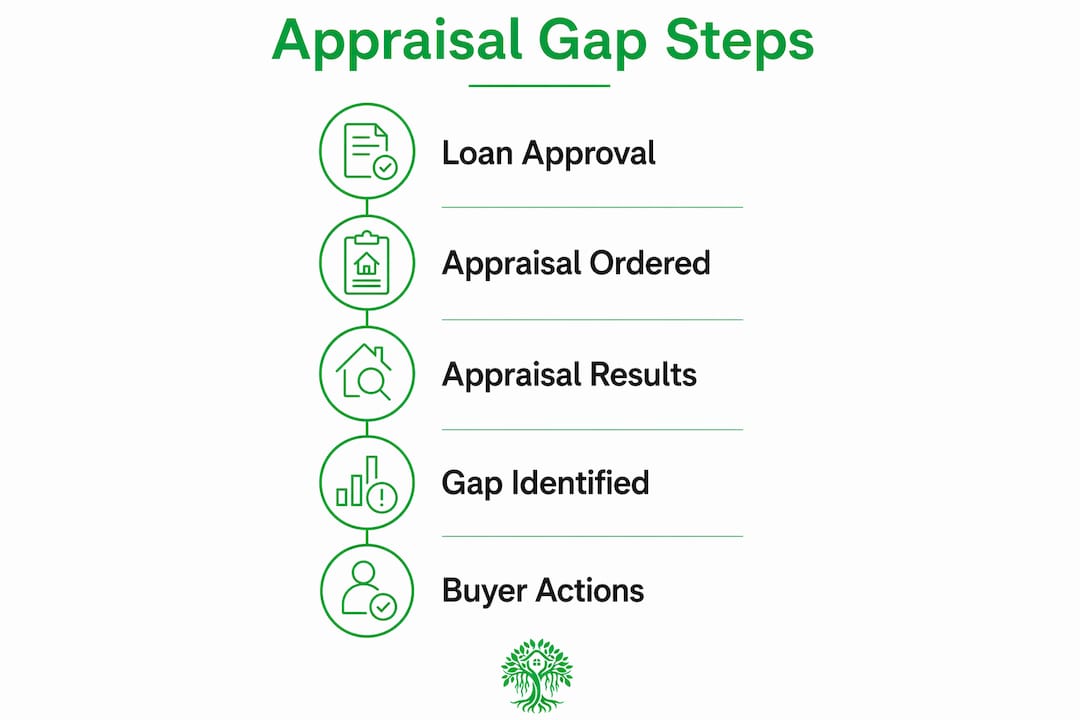
Step-by-step action sequence:
- Read the appraisal report the same day you receive it. Check comps, square footage, and condition notes for errors.
- If you spot errors, ask your lender to initiate the ROV process immediately. You can submit up to five comparable sales with a written rationale.
- While the ROV is pending, notify your agent so they can open a conversation with the listing agent about the seller’s flexibility.
- If the ROV doesn’t change the value, present your preferred option (renegotiate, split, or pay) within 2–3 business days. Sellers get nervous when buyers go quiet.
- If the seller won’t move and you can’t fund the gap, exercise your appraisal contingency in writing before the deadline.
For negotiation language, something like this works: “The appraisal came in at $350,000. We’d like to propose adjusting the purchase price to $352,000, splitting the $5,000 gap. We can provide proof of funds and are ready to close on the original timeline.” Keep it factual, not emotional. Avoid common negotiation mistakes like making ultimatums or going silent after a low appraisal.
Appraisal gap coverage clause vs. appraisal contingency: what’s the difference?
These two contract terms are often confused, and the confusion can cost you your earnest money.
An appraisal contingency is a buyer protection. It says: if the appraisal comes in below the contract price, you can renegotiate or cancel the contract and get your earnest money back. It’s the default protection in most financed purchase contracts.
An appraisal gap coverage clause is a buyer commitment. It says: I agree to pay up to $X above the appraised value out of my own pocket. It makes your offer more attractive to sellers but shifts risk onto you.
That sample language illustrates the key elements: a dollar cap, a floor appraised value, and a proof-of-funds requirement. Without a cap, you’re signing a blank check.
How the two interact: A capped gap clause modifies the contingency. If the gap is within your cap, you’re obligated to pay it. If the gap exceeds your cap, the appraisal contingency typically reactivates and you can exit. This is why the cap amount matters so much.
FHA and VA borrowers: VA loans include built-in appraisal protections that, in practice, prevent sellers from forcing buyers to forfeit earnest money solely because they invoke a contractual appraisal contingency after a low appraisal. FHA loans carry similar protections. If you’re using a government-backed loan, confirm with your lender before signing any gap coverage clause.
Risk callouts:
- Signing an uncapped gap clause creates unlimited buyer liability. If the appraisal comes in $40,000 low, you owe $40,000.
- If you commit to a capped gap and then can’t fund it at closing, you may forfeit your earnest money.
- Waiving the appraisal contingency entirely, without a gap clause, means you have no exit and no cap.
Pro Tip: Always require a proof-of-funds verification step in the clause itself. This protects you from being held to a commitment you made in good faith but can no longer fund if your financial situation changes between offer and closing.
For a deeper look at how contingencies layer together, the mortgage contingency explainer on Ficustree covers the interaction between appraisal and financing contingencies in plain language.
How much appraisal-gap coverage should you offer?
The right cap is the number you can actually write a check for without wrecking your financial position after closing.
Framework for setting your cap:
- Start with your total liquid cash available (savings, gift funds, proceeds from asset sales).
- Subtract your planned down payment and estimated closing costs (typically 2–5% of the loan amount).
- The remainder is your maximum gap coverage. Never commit to more than this number.
- Set your cap below that maximum to leave a buffer for post-closing expenses.
Two scenarios:
Scenario A — $5,000 cap: You’re buying at $355,000 with $50,000 in liquid savings. Down payment is $35,500, closing costs are roughly $8,000. That leaves $6,500. A $5,000 cap is within reach and leaves a $1,500 cushion. Manageable, but thin.
Scenario B — $20,000 cap: Same purchase price, same savings. After down payment and closing costs, you have $6,500. A $20,000 cap is a commitment you cannot fund. Signing it puts your earnest money at risk.
Market strategy: In a competitive California or Texas market with multiple offers, a capped gap clause can be the difference between winning and losing. But accurate preapproval figures and verified proof of funds are what make that clause credible to sellers. A cap without proof of funds is just words.
Pro Tip: When you submit a capped gap offer, attach a proof-of-funds letter from your bank showing liquid assets that cover the cap amount. Sellers and listing agents read this as a signal that you can actually close, not just that you’re willing to try.
A dedicated home-buying savings plan that earmarks a specific buffer for appraisal shortfalls is one of the most practical things you can do before you start making offers.
Buyer safeguards checklist: before and after the appraisal
Use this list with your agent. Assign each item a responsible party and a deadline before you go under contract.
Before you make an offer:
- Get a fully underwritten preapproval (not just a prequalification) so your loan amount is accurate.
- Confirm your liquid cash position: down payment, closing costs, and a gap buffer.
- Research recent comps in the neighborhood yourself so you know if your offer is above market.
- Insist on an appraisal contingency in your contract if you’re financing the purchase.
- Decide your maximum gap cap before you make the offer, not after the appraisal arrives.
- Review the home inspection checklist so you’re not surprised by condition issues that could affect appraisal value.
After the appraisal arrives:
- Read the full report the same day. Check comps, square footage, and condition ratings.
- Flag any factual errors immediately and share them with your agent and lender.
- If errors exist, request an ROV within one business day. The lender must inform you of the ROV process when delivering the appraisal.
- If no errors, decide within 48 hours: ROV on market grounds, renegotiate, pay the gap, or exit.
- Notify your lender and title company of any price change so closing documents can be updated.
- Confirm your contingency deadline in writing before taking any action that could waive it.
What research and experienced agents say about buyer risk
The research on appraisal gaps points in one consistent direction: buyers who keep their appraisal contingency and set a clear cap are better protected than those who waive rights to win a bidding war.
Experienced agents consistently advise keeping the appraisal contingency as the single most important buyer protection in financed purchases. Waiving it to compete is high risk unless you have verified liquid funds for any gap you commit to. That advice holds even in hot markets, because the downside of a large uncapped gap is losing both the home and your earnest money.
Consider what happens without a cap. A buyer in a competitive California market waives the appraisal contingency entirely to make their offer stand out. The appraisal comes in $28,000 below the contract price. The buyer has two choices: come up with $28,000 in cash on top of their planned down payment, or forfeit their earnest money and walk away. Neither is a good outcome. A capped clause at $10,000 would have protected them from the larger exposure while still making the offer competitive.
Ficustree’s approach is to model this scenario before the offer goes in. Using the platform’s affordability tools, buyers can see exactly what a $5,000, $10,000, or $20,000 gap does to their cash at closing, and whether their proof-of-funds position supports the commitment they’re about to make.
Pro Tip: Before signing any gap coverage clause, run the numbers: gap amount plus down payment plus closing costs. If that total exceeds your verified liquid assets, reduce the cap or keep the full contingency. Your earnest money is real cash.
Timeline and typical costs: who pays and how long it takes
Appraisal costs are almost always paid by the buyer, upfront or rolled into closing costs. Here’s what to expect.
Cost and timeline reference: A standard home appraisal in the U.S. typically costs a few hundred dollars for a single-family home, though complex properties or rural locations can be higher. A second appraisal ordered by the lender after a disputed ROV may cost similarly, paid by the buyer.
| Item | Typical Cost | Who Pays | Timeline |
|---|---|---|---|
| Initial appraisal | Typically a few hundred dollars | Buyer | About 1–2 weeks after site visit |
| Appraisal report delivery | Included | Lender delivers to buyer | Same day as receipt |
| ROV review | No added fee | Lender processes | A few business days |
| Second appraisal (lender-ordered) | Additional fee similar to first appraisal | Buyer | Additional 1–2 weeks |
| Reappraisal (buyer-requested) | Similar fee to initial appraisal | Buyer | Varies by lender policy |
Timing matters for your contingency. Most purchase contracts give you a specific window (often 17–21 days in California) to complete the appraisal and act on the results. If the ROV takes 5 business days and the second appraisal takes another 10 days, you may be bumping against your contingency deadline. Ask your agent to request a contingency extension in writing before the clock runs out.
For a full picture of what happens at the closing table, the home closing checklist covers cost timing and document sequencing from appraisal through keys.
Key Takeaways
An appraisal gap is manageable when you know your cash position, keep your contingency, and act within 48 hours of receiving the report.
| Point | Details |
|---|---|
| Lender caps at appraised value | Your loan is based on the lower of contract price or appraised value, so any gap is your cash responsibility. |
| ROV before paying | Submit up to five comps and a written rationale before spending a dollar on the gap. |
| Always cap your commitment | Never sign an uncapped gap clause; set a dollar limit you can actually fund with verified liquid assets. |
| Contingency is your exit | Keep the appraisal contingency unless you have confirmed cash to cover any gap up to your cap. |
| Ficustree models the gap for you | Ficustree’s affordability tools show exactly how a $5,000–$20,000 gap affects your cash at closing before you sign. |
The part of appraisal gaps most buyers get wrong
Most buyers treat an appraisal gap as a binary: either the deal dies or they pay whatever it takes. Neither instinct is right.
The gap coverage clause exists precisely because the market needed a middle path. A capped clause lets you compete in a hot market without writing a blank check. But the clause only works if the cap is grounded in your actual cash position, not in what you think sounds reasonable to a seller.
What I see buyers underestimate is the compounding effect. You’re not just paying the gap. You’re paying the gap on top of a down payment that’s already stretching your savings, on top of closing costs you may have underestimated, on top of the first month’s mortgage payment, on top of whatever the inspection turned up. A $5,000 gap sounds manageable in isolation. At the end of a $355,000 purchase, it may be the number that breaks the budget.
The ROV process is also underused. Buyers assume the appraiser’s number is final. It’s not. If the report contains a factual error, a missed upgrade, or a comp that’s clearly inferior to your property, you have a legitimate path to a higher number. That path costs nothing and is typically reviewed by the lender within approximately two business days after submission. Use it before you negotiate price or commit cash.
The buyers who navigate appraisal gaps best are the ones who prepared before the offer: they knew their liquid cash position, they set a cap they could fund, and they kept their contingency as a backstop. That preparation is not complicated. It just requires doing the math before you’re emotionally invested in a specific home.
How Ficustree helps you avoid appraisal-gap surprises
Appraisal gaps are less stressful when you’ve already modeled the scenario before your offer goes in. Ficustree’s buyer platform does exactly that: it shows you the cash impact of a $5,000, $10,000, or $20,000 gap against your actual preapproval and proof-of-funds position, so you set a cap you can genuinely fund.

When a gap does appear, Ficustree’s representation model means you have an agent in your corner who knows how to open the renegotiation conversation with the listing agent, request an ROV, and draft the clause language that protects you. Buyers pay $1,000 at closing plus 1% commission, keep a rebate of roughly 2% where legally permitted, and get the full platform free. That rebate, in many cases, offsets a portion of the gap itself.
Ready to buy with a clear picture of your numbers? Start with Ficustree and see how the platform walks you from preapproval to keys, with appraisal-gap modeling built in. Outcomes vary depending on market conditions and loan type.
Useful sources for buyers who want more detail
- Consumer Financial Protection Bureau — Mortgage Tools: The CFPB’s mortgage resource center covers appraisal rights, lender obligations, and borrower protections in plain language. Start here for regulatory context.
- DSL Mortgage — What Happens When Your Home Appraisal Comes in Low: Practical walkthrough of the ROV process, buyer options, and negotiation steps when an appraisal falls short.
- Chase — What Happens If Appraisal Is Lower Than Offer: Clear explanation of how lenders underwrite to appraised value and what that means for your loan amount.
- LegalClarity — Appraisal Gap Coverage in Real Estate: Detailed breakdown of gap coverage clauses, fixed-amount vs. full-coverage commitments, and why a dollar cap matters.
- LegalClarity — How Appraisal Gap Coverage Works in Competitive Markets: Explains how capped clauses interact with appraisal contingencies and covers FHA/VA-specific protections.
- Ficustree — Mortgage Contingency Explained: How appraisal and financing contingencies work together in a purchase contract, written for first-time buyers.
- Ficustree — First-Time Homebuyer Guide: Step-by-step walkthrough of the full buying process, from search through closing.
FAQ
What does a $5,000 appraisal gap mean for a buyer?
It means the appraised value came in $5,000 below your contract price. Your lender will only finance based on the appraised value, so you must either pay the $5,000 out of pocket, renegotiate the price down, or walk away if your appraisal contingency allows it.
How much appraisal-gap coverage should you offer?
Only offer a cap you can fund with verified liquid assets after accounting for your down payment and closing costs. A common approach is to cap coverage at $5,000–$10,000 in moderately competitive markets, but the right number depends entirely on your cash position.
Is appraisal gap coverage a good idea?
It can be, when it’s capped and backed by proof of funds. Appraisal gap coverage makes your offer more attractive to sellers but shifts financial risk onto you, so a clear dollar cap and a verified cash reserve are non-negotiable before you commit.
Who pays for an appraisal gap?
The buyer pays the gap unless the seller agrees to reduce the price. The buyer also pays the initial appraisal fee and any cost for a second appraisal if one is ordered.
Can you dispute a low appraisal?
Yes. Through the ROV process, you can submit up to five comparable sales and a written rationale to your lender, who will review your submission within approximately two business days. This is always worth attempting before paying the gap or renegotiating price.
Recommended
- AI Home Search for Buyers: What Changes Now
- True Cost of Homeownership: A Buyer’s Complete Reality Check
- Bay Area Home Buying: A Practical Guide for Buyers
- First-Time Homebuyer Mistakes California Buyers Must Avoid – ficustree.ai

Leave a Reply