Category: Market Guides

  • Does a Good School District Really Raise Your Home’s Value?

    Does a Good School District Really Raise Your Home’s Value?

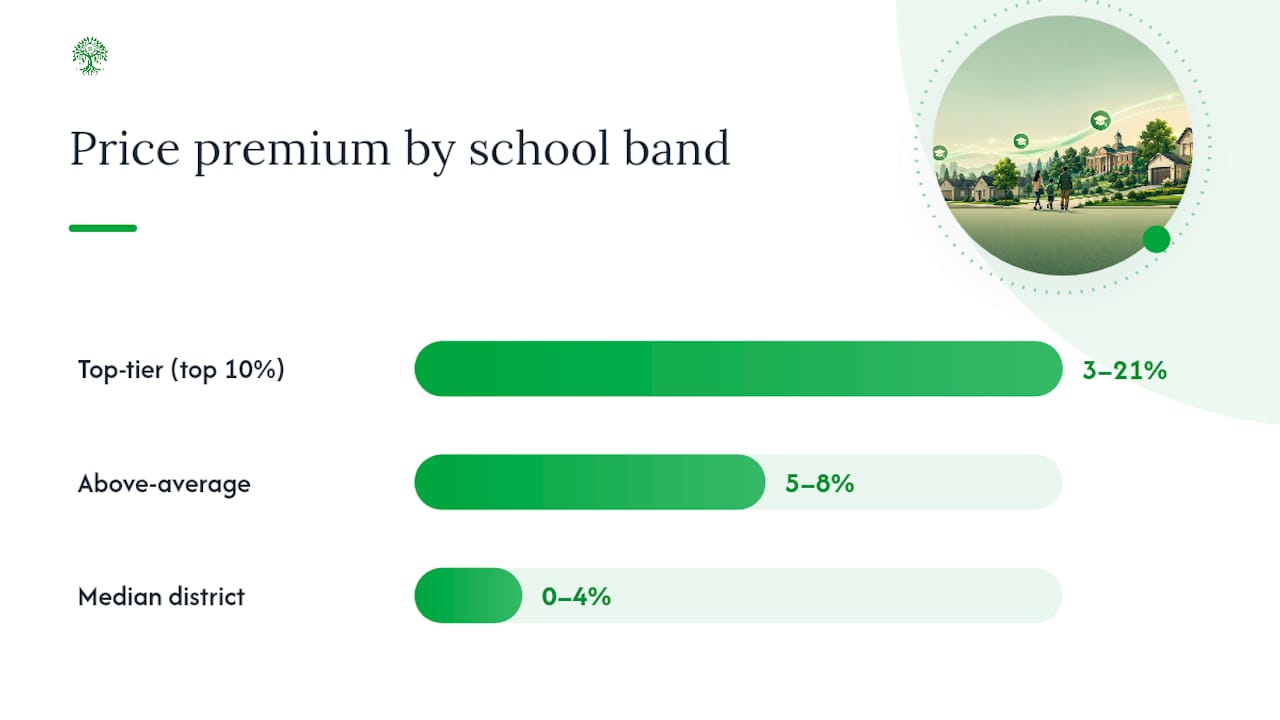
    Yes. That is a wide band on purpose. A district’s effect on price depends on how “good” gets measured (test scores, spending, or growth metrics), how tight the local housing supply is, and whether the area allows open enrollment or school choice, which loosens the tie between address and school assignment. If you’re pricing a home partly on its school zone, treat that range as a starting point, not a formula.

    Key Takeaways

    School district quality changes home value in a measurable, verifiable way, but the size of the effect depends on which measure, boundary, and market you’re actually looking at.

    Point Details
    Premiums vary widely Expect a range of 3% to 21% depending on district tier, study design, and local supply constraints.
    Distance matters more for elementary Elementary proximity carries roughly a 7.29% per-kilometer effect versus 1.43% for high schools.
    Spending signals get priced in Teacher salary spending shows the clearest capitalization link, per NBER’s school finance analysis.
    Verify before you trust a claim Confirm attendance boundaries directly with the district, since listing descriptions can be outdated or wrong.
    Ficustree can run the checks for you Ficustree’s platform surfaces boundary data and comparable sales so buyers can price school premiums before bidding.

    Table of Contents

    Does School District Impact Home Value? The Numbers Buyers Search For

    The short answer to “does school district impact home value” is yes, and the effect shows up in three distinct ways: a price premium, a distance penalty, and a liquidity boost. Here’s what the data actually says.

    • Premium range: Homes zoned to top-rated schools carry price premiums of 3% to 21% over similar homes in average or below-average districts, with the higher end typically found in supply-constrained metros.
    • Distance penalty, elementary schools: Home values drop roughly 7.29% for every additional kilometer a house sits from its nearest elementary school.
    • Distance penalty, high schools: The same study found a much gentler 1.43% drop per kilometer from the nearest high school, since teenagers commute independently and families weigh proximity less heavily.
    • Spending signal: A national panel found a 1% increase in school spending correlates with roughly a 0.95% rise in house prices, driven mostly by teacher salaries.

    Hot markets and weak-capitalization markets tell very different stories. In tight coastal metros with strict zoning and few buildable lots, school quality gets baked hard into price because buyers can’t just build their way into a good district. Compare that to fast-growing Sun Belt metros with abundant new construction and looser district boundaries: builders can add supply near good schools quickly, and open-enrollment policies mean a family isn’t locked to one address. Capitalization in those markets tends to run closer to the low single digits, sometimes near zero.

    How School Quality Actually Gets Baked Into Price

    School ratings don’t move home prices by magic. Three separate channels do the work, and understanding them helps you tell a real premium from a temporary bidding frenzy.

    • Demand channels. Families with school-age kids actively pay more to access a specific attendance zone, and that demand compounds through peer effects: parents believe (rightly or wrongly) that a concentration of engaged families and well-funded classrooms produces better outcomes for their own kids.
    • Supply and market channels. Strong districts trigger bidding wars, shrink time on market, and pull developers toward adjacent land. One analysis of redistricting events found that boundary changes accelerate both price appreciation and new construction almost immediately after a district reassignment is announced.
    • Signal channels. Test scores, per-pupil spending, and report cards act as proxies for a school’s future trajectory. NBER research shows teacher salary spending specifically gets capitalized into home prices, since parents read staffing investment as a leading indicator of quality, not just a budget line.

    The tricky part for researchers, and for you, is separating a school’s actual effect from everything else that happens to cluster with good schools: safer streets, newer housing stock, higher-income neighbors. Economists call this endogeneity, and it’s the reason a simple price comparison across two random zip codes overstates the school effect. The more credible studies use boundary discontinuity designs (comparing homes just inside versus just outside an attendance line) or repeat-sales models that track the same house before and after a redistricting event, which strips out most of the neighborhood noise.

    Pro Tip: When you see a listing agent tout “top-rated schools,” ask which measure they mean. A district with high average test scores but flat year-over-year growth signals something very different from one with rising value-added scores, and only one of those is likely to keep commanding a premium five years from now.

    What Premium Should You Actually Expect By School Rating?

    Translating national research into a number you can use at the negotiating table means separating the school-rating band from the proximity effect, since both move price independently.

    School-Performance Band Typical Price Premium What Drives It
    Top-tier (top 10% statewide) 3% to 21% High test-score concentration, strong staffing budgets, heavy buyer competition
    Above-average 5% to 8% Moderate demand premium, some peer-effect signaling
    Median district 0% to 4% Limited differentiation from adjacent zones
    Below-average Neutral to negative Weaker demand, longer time on market, price concessions common

    These bands come from a range of studies using different methods, so treat them as directional rather than exact. A 2019 meta-analysis of school-quality capitalization found no single dominant measure of school quality across studies. Some papers weight test scores, others weight spending or growth metrics, and regional housing-market conditions swing the results as much as the school variable itself.

    Proximity adds a second, separate layer on top of the rating band. Elementary school distance carries the heavier penalty, roughly 7.29% per kilometer, because parents of younger kids prioritize walkability and short drop-off routes. High school distance matters less, at around 1.43% per kilometer, since older students often bus in or drive themselves. There’s a nuance worth knowing here too: living directly adjacent to a school, within a few hundred feet, can actually work against you. Traffic congestion during drop-off and pickup, plus playground noise, sometimes creates a small nuisance discount that offsets part of the proximity premium.

    Regional variation is significant. A Memphis-area case study found that a one-standard-deviation increase in test scores lifted home prices by 2% to 4%, while the effect of district administration and control alone added another 5% to 8% in some neighborhoods, suggesting governance and local funding decisions carry weight independent of test scores. Markets with widespread school-choice or open-enrollment policies show weaker capitalization overall, since a family isn’t tied to one specific address to access a specific school.

    To apply national ranges locally, start with the band that matches the district’s rating, then adjust up or down based on your metro’s supply constraints. A supply-starved coastal market pushes toward the top of each range; a fast-building Sun Belt suburb with flexible enrollment pushes toward the bottom.
    What Premium Should You Actually Expect By School Rating? — overview diagram

    A Step-by-Step Way to Price School Quality Into Your Offer

    Here’s how to move from “this district looks good” to an actual number you can defend in a negotiation.

    1. Verify the attendance boundary before you fall for the listing. Boundaries shift, and a home advertised as “zoned for” a top school might sit one street outside the actual line. Pull the boundary map directly from the district’s website, not from a listing description.
    2. Identify which quality measure is driving the reputation. A district known for high test scores isn’t automatically the same as one with strong value-added growth or high per-pupil spending. One notable finding: when Los Angeles publicly released value-added teacher ratings, property values barely moved, suggesting the market responds more to simple, visible markers like test-score levels than to complex statistical measures.
    3. Check enrollment against capacity. An overcrowded, popular school can mean portables, waitlists, or future boundary redraws, any of which can undercut the very premium you’re paying for.
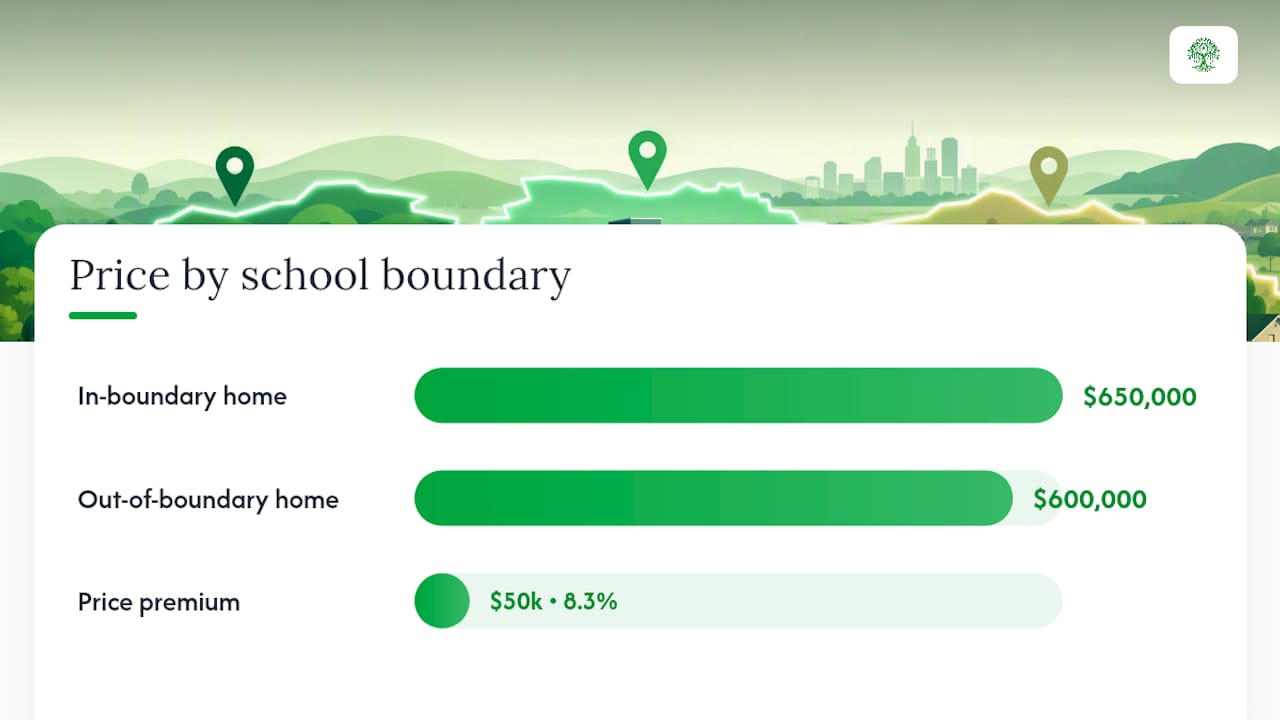
    4. Estimate the premium and adjust your offer math. If comparable sales outside the boundary run 8% cheaper than nearly identical homes inside it, that gap is your working premium. Weigh it against your monthly budget the same way you’d weigh any other true cost of ownership.
    5. Factor in resale liquidity, not just entry price. Homes in strong districts tend to sell faster and attract more competing offers when you eventually list, which matters if you expect to move within five to seven years.

    Here’s a simplified version of the math. Say two nearly identical three-bedroom homes sit half a mile apart, one inside a top-tier elementary boundary and one just outside it. The in-boundary home lists at $650,000; the comparable out-of-boundary home sold last month for $600,000. That’s an 8.3% premium, roughly $50,000. If your investment horizon is short and rental yield matters more to you than school access, that $50,000 might buy you a better cap rate elsewhere. If you’re a long-hold family buyer prioritizing resale demand and stability, the premium often pays for itself through faster appreciation and a shorter time on market when you sell.

    That’s the real trade-off every buyer faces: pay for documented stability now, or bet on appreciation potential in a less-established but improving area. Neither choice is wrong, but only one of them is backed by a verified boundary line.

    Pro Tip: Look for homes that recently sold on both sides of a school boundary within the same few months. That pair gives you a market-implied, neighborhood-specific premium without needing to run a regression, since it strips out almost every variable except the school assignment itself.
    A Step-by-Step Way to Price School Quality Into Your Offer — overview diagram

    Which Studies Should You Actually Trust?

    Not all school-price research is created equal, and the design behind a study matters as much as its headline number.

    • Boundary discontinuity designs compare homes on opposite sides of an attendance line that are otherwise nearly identical in age, size, and neighborhood amenities. This is considered one of the more credible approaches because it isolates the school variable from the neighborhood noise that inflates simpler comparisons.
    • Repeat-sales models track the same property’s price before and after a boundary change or school-quality shift, controlling for anything fixed about the house itself.
    • School finance reform studies exploit sudden, externally imposed changes in spending, letting researchers estimate how much of a price shift comes specifically from the dollars, not from reputation or demographics shifting at the same time.

    A few landmark findings define the outer bounds of what’s credible. The NBER working paper on school spending capitalization puts the elasticity at roughly 0.95%, meaning a 1% jump in spending tracks closely with a nearly proportional rise in home prices, concentrated in salary spending rather than facilities or supplies. On the higher end, the 2025 study on schools as housing amenities documents premiums stretching to 21% in select markets.

    Cross-sectional comparisons, the simplest and most common type of analysis you’ll see quoted in real estate marketing, tend to overstate the true school effect because they can’t fully separate school quality from correlated neighborhood advantages. Research on selection and capitalization suggests these simpler comparisons can inflate the real effect by several multiples compared to causal designs, which is exactly why a realtor’s claim of a “20% school premium” deserves a second look before you accept it at face value. When you’re evaluating aggregated real estate data, always ask whether the school-value claim behind it comes from a causal design or a raw average.

    How We Read School-Price Data When Advising Buyers

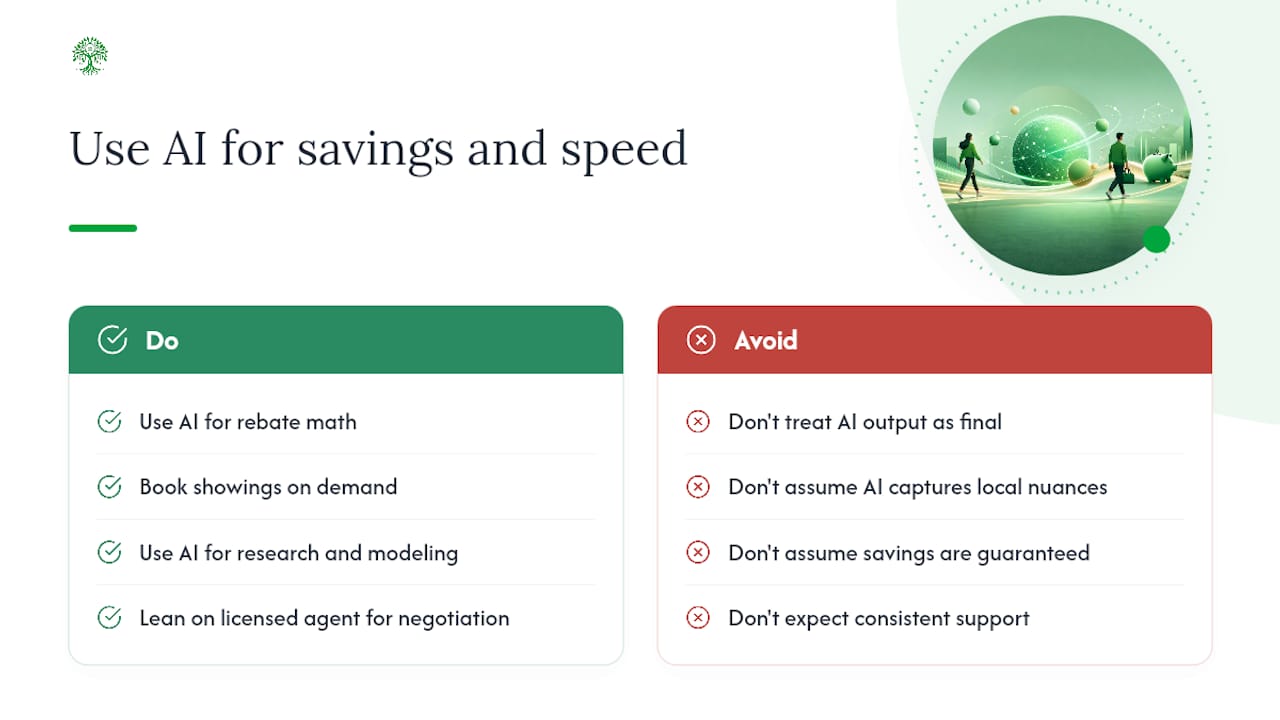
    Three heuristics guide how we think about school capitalization in practice. First, prioritize premiums confirmed by an actual attendance boundary over ones implied by neighborhood reputation, since boundaries are the one variable a district can redraw overnight. Second, always stress-test a premium against resale liquidity, not just entry price. Third, weigh local school-choice policy heavily. In open-enrollment districts, the tight link between address and school access weakens, and so does the price effect. Running these checks by hand takes real research time; an AI-powered platform can pull boundary data and comparable sales side by side in minutes, which is exactly the kind of grunt work worth automating.

    Let Ficustree Check the School Premium Before You Bid

    Verifying an attendance boundary, comparing capitalization measures, and modeling a premium against resale liquidity is exactly the kind of desk work that eats a weekend when you’re doing it manually across five neighborhoods. Ficustree’s AI-powered home search runs those checks in the background as you browse listings, surfacing boundary lines and comparable sales so you’re not guessing whether a “top school” claim actually holds up address by address.

    Ficustree

    As a buyer-side platform, Ficustree represents you directly for a flat $1,000 fee at closing plus 1% commission, with a rebate where state law allows it, so the incentive to help you avoid overpaying for a school zone sits on your side of the table, not the listing agent’s. If a mini-calculation like the one above raised more questions than it answered, that’s a normal reaction. Visit the Ficustree buyer page to see how the platform pairs school-boundary data with affordability tools built for exactly this kind of trade-off, and book an on-demand showing agent for the homes where the numbers actually line up.

    Where to Verify School and Boundary Data Yourself

    Trusting a number in an article is fine for context; trusting it for a six-figure decision is not. Pull the primary data yourself.

    • National Center for Education Statistics (NCES) hosts test-score trends, staffing ratios, and district-level report cards used by most academic studies cited here.
    • State education department portals publish the underlying school report cards behind most third-party rating sites.
    • District websites hold the actual attendance boundary maps, which are the most reliable and current source for confirming exactly which school a specific address feeds into.

    This article is general information, not a substitute for advice from a qualified financial advisor. Consult a qualified financial professional about your own circumstances before acting on anything here.

    Sources

    FAQ

    Does school district affect home value?

    Yes. Homes zoned to higher-performing schools typically sell for a premium of 3% to 21% over comparable homes in weaker districts, with the size of the effect depending on local market conditions and how school quality is measured.

    What decreases property value the most?

    Beyond school quality, the biggest drags on property value tend to be deferred maintenance, proximity to industrial or high-traffic zones, and being zoned to a declining or overcrowded school district, since buyer demand and financing options both shrink for homes with these issues.

    What is the 3-3-3 rule in real estate?

    The 3-3-3 rule is a budgeting guideline suggesting buyers spend no more than 3 times their annual income on a home, keep housing costs under 3 weeks’ worth of savings for the down payment threshold as a benchmark, and hold a 3-month emergency fund after closing. It’s a rough affordability check, not a school-related metric.

    Does living next to a school increase property value?

    Being close to a school generally raises value, since proximity effects run as high as 7.29% per kilometer for elementary schools. Living directly adjacent, within a few hundred feet, can slightly offset that gain due to drop-off traffic and noise.

    How can I estimate a school premium for a specific neighborhood?

    Compare recent sale prices of similar homes on both sides of the same attendance boundary. That pairing isolates the school variable from most other neighborhood factors, and tools like Ficustree’s property search can help surface those comparable sales quickly.

  • When to Sell Startup Equity Before Buying Your First Home

    When to Sell Startup Equity Before Buying Your First Home

    If you can use vested RSUs, sell at vest and season the cash 60–90 days before applying. If you need a lender to count RSU income toward qualifying, wait until you have a documented history of vested RSUs typically around two years and evidence of continued vesting over the next few years. That’s the whole decision tree for most first-time buyers holding startup equity in California and Texas. Everything else is detail.

    Two paths cover almost every case:

    • Sell-and-season path: Cash out a recent vest, park it in a bank or money market account, wait 60 to 90 days, then apply with clean, sourced funds.
    • Wait-and-qualify path: Keep working, let your vest history hit the two-year mark, and let RSU income count toward your debt-to-income ratio instead of relying on a lump-sum sale.

    Pro Tip: In the next 30 days, pull your vest schedule and grant agreements into one folder. Lenders move faster when the paperwork is ready before they ask for it.

    Key Takeaways

    The right time to convert startup equity for a home purchase depends on whether you’re using sale proceeds as cash or relying on RSU income to qualify, and each path has its own seasoning and documentation rules.

    Point Details
    Two paths, one decision Sell vested RSUs and season cash for 60–90 days, or wait until you have two years of vest history to qualify on RSU income.
    Only vested equity counts Unvested RSUs and unexercised options can’t be used for down payment or qualifying income until sold.
    Sell-at-vest is tax-efficient Selling at vest keeps cost basis near sale price, minimizing capital gains versus holding shares longer.
    Documentation wins the underwriting fight Grant agreements, two years of W-2s, brokerage confirmations, and seasoned bank statements prevent delays.
    Ficustree coordinates the timing Ficustree pairs equity-aware lender introductions with flat-fee buyer representation to align your vest schedule with your purchase date.

    This article is general information, not a substitute for advice from a qualified financial advisor. Consult a qualified financial professional about your own circumstances before acting on anything here.

    Table of Contents

    Types of Startup Equity and How Timing Differs for Each

    Not all startup equity behaves the same way when it hits a mortgage application, and confusing one type for another is the fastest way to blow a timeline. RSUs (restricted stock units) convert to real shares at vest and are taxed as ordinary income the moment they vest, whether or not you sell. NSOs and ISOs (stock options) only create value when you exercise them, and taxation depends on the option type: NSOs trigger ordinary income at exercise, while ISOs can trigger the alternative minimum tax. Restricted stock (less common at later-stage startups) usually involves an 83(b) election to lock in tax treatment early.

    Only vested-and-sold equity counts as usable cash. Unvested RSUs and unexercised options generally cannot be used as down payment funds or qualifying income until a liquidity event actually happens.

    • RSUs: taxed at vest, liquid once vested and sold.
    • NSOs/ISOs: taxed at exercise or sale, illiquid until you exercise.
    • Restricted stock with an 83(b): taxed early at grant, but still illiquid until a sale event exists.

    Pro Tip: Label every grant document by type and vest date as soon as you get it. A loan officer sorting through mismatched paperwork is a loan officer asking for more time.

    Which Liquidity Events Actually Put Cash in Your Account

    A vest date is not a payday. It’s the moment your shares become yours to sell, and the actual cash timeline depends entirely on which liquidity event you’re waiting on.

    • RSU vest at a public company: Shares land in your brokerage account on vest day; a sale typically settles in one to two business days after you place the trade.
    • Exercising options then selling: Add the exercise transaction and any company-imposed waiting period before the sale clock even starts.
    • Secondary sale at a private company: Often takes weeks to months, since it requires company approval, a buyer, and paperwork most founders are in no hurry to process.
    • IPO or acquisition: Frequently comes with a lockup period of 90 to 180 days after the event before employees can sell at all.

    Once a sale settles, moving proceeds into a checking or savings account is fast, usually a day or two. The real bottleneck is seasoning that cash for roughly 60 to 90 days so a lender can source it without extra questions. Plan backward from your target closing date, not forward from your vest date.

    Tax Consequences and How Much Cash to Actually Reserve

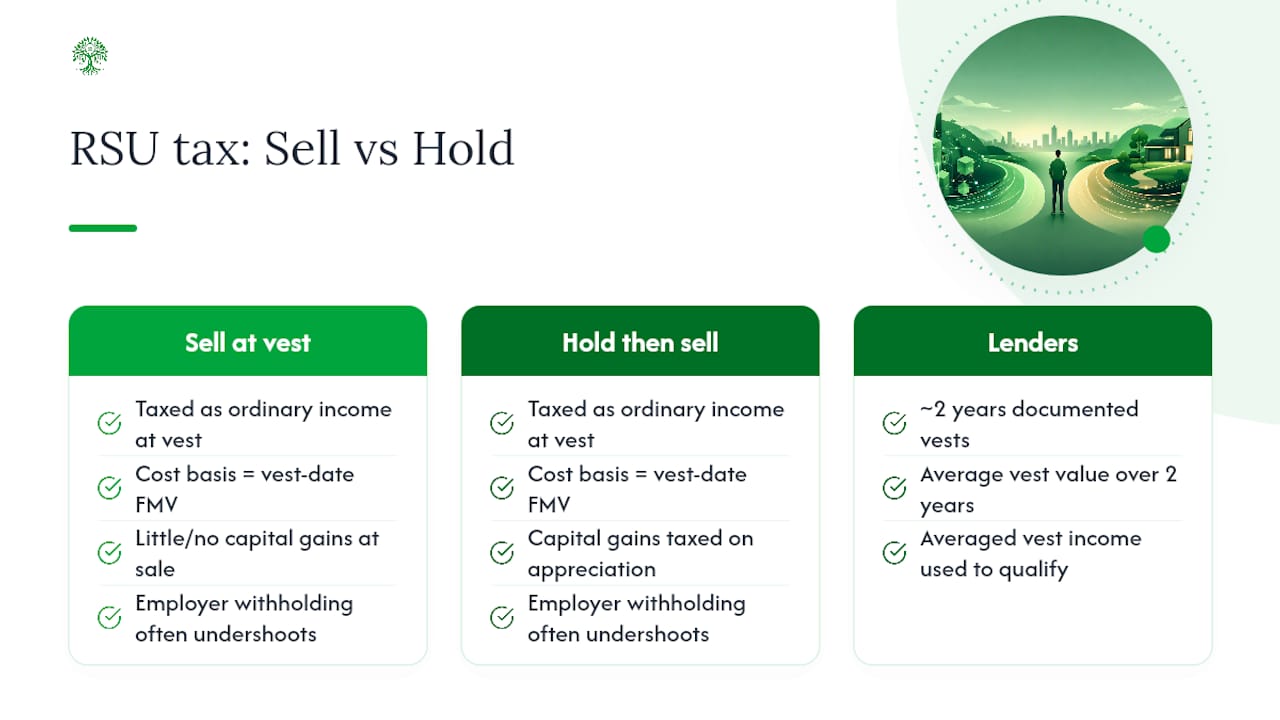
    The number on your vest confirmation is not the number you get to keep, and treating it as such is the single most common mistake first-time buyers make with startup equity. RSUs are taxed as ordinary income at vest, based on the fair market value that day, whether you sell immediately or hold. If you sell at vest, your cost basis equals the vest-date price, which makes that sale close to close to tax-neutral on capital gains. Hold the shares and sell later, and any gain above that basis gets taxed separately as a capital gain.

    Diagram showing RSU tax impact and mortgage qualifying timeline

    Options work differently. NSOs create ordinary income at exercise; ISOs can trigger the alternative minimum tax even without a sale, which surprises a lot of people who assumed “I didn’t sell anything” meant “I don’t owe anything.” Restricted stock with an 83(b) election shifts the tax hit earlier, to the grant date, in exchange for potentially lower tax on future appreciation.

    Don’t assume your employer’s default withholding rate covers your real liability. It usually undershoots.

    Statistic Callout: Lenders typically ask for a documented history of RSU vests spanning about two years before counting that income toward qualifying, and they average the vest value over that two-year window rather than using your most recent, possibly larger, vest.

    Pro Tip: Selling shares right at vest is usually more tax-efficient than holding and selling later, since the cost basis resets to the vest-date price and there’s little or no capital gain to report.

    How Mortgage Lenders View RSU Income and What They’ll Ask For

    Conforming lenders don’t take your RSU statement at face value. Fannie Mae and Freddie Mac guidelines require a documented two-year history of vests before RSU income can count toward your debt-to-income ratio, plus evidence that vesting will continue, commonly three more years of scheduled grants. They then average your vest value over that two-year window rather than crediting your best year.

    Down-payment funds follow a separate rule: vested-and-sold proceeds count as an asset, unvested grants do not, and sold proceeds generally need 60 to 90 days of seasoning in your account with a documented paper trail.

    Before your first conversation with a loan officer, gather:

    • Two years of W-2s or pay stubs showing RSU income.
    • Grant agreements showing your forward vesting schedule.
    • Brokerage sale confirmations for any shares sold.
    • Bank statements showing seasoned funds.
    • Employment verification, since job stability matters as much as the equity itself.

    Handing over this checklist at first contact, rather than piecing it together mid-application, is what keeps underwriting on schedule.

    A Step-by-Step Checklist for Deciding When to Sell

    1. Calculate your target number. Figure out the home price range you’re realistically shopping in and the down payment needed, using a tool like Ficustree’s down payment calculator to model scenarios.
    2. Check your vest history. Two years of documented vests plus three years of future scheduled vesting unlocks RSU income for qualifying.
    3. Check concentration. If startup equity makes up more than 30% to 40% of your investable assets, that’s a signal to diversify regardless of your home purchase.
    4. Check for PMI triggers. If selling shares gets you to 20% down and avoids private mortgage insurance, that tips the scale toward selling now.
    5. Scan for red flags: trading blackout periods, lockup windows, an upcoming job change, missing grant paperwork, or an unmodeled tax bill.
    6. Time the sale and season the funds against your target application date, not your closing date.

    Pro Tip: Loop in your CPA and your loan officer in the same week, not sequentially. A tax move that saves you money can accidentally break a lender’s documentation requirement if nobody checks both sides at once.

    Three Timing Scenarios That Mirror Real Buyers

    This is the most straightforward underwriting path because there’s no reliance on future RSU income at all, just documented, sourced cash.

    Scenario B: The newer hire. A buyer joined their company 14 months ago and doesn’t yet have two years of vest history. Rather than force it, they qualify on salary alone, accept a smaller down payment, or work with a portfolio lender using asset-depletion underwriting instead of RSU income.

    Scenario C: The pre-IPO holder. A buyer expects a liquidity event in 12 to 18 months but needs a home sooner. The move is converting a portion of shares now, through an approved secondary if available, rather than betting the entire down payment on an event with no fixed date. This is precisely where Ficustree steps in to coordinate the sale timing, the lender conversation, and the purchase calendar so none of the three drift out of sync.

    Your 60-30-0 Day Closing Checklist

    1. 60 to 90 days out: Sell at vest, move proceeds into a bank or money market account, and save every trade confirmation.
    2. 30 days out: Confirm your bank statements are clean of unexplained deposits, gather brokerage sale confirmations and settlement statements, and check that your lender has every document on file.
    3. 0 to 7 days out: Don’t make new large deposits, don’t change jobs, don’t open new credit lines, and confirm final numbers on your Closing Disclosure.

    Pro Tip: When you hand sale paperwork to an underwriter, pair every deposit with its matching brokerage confirmation in the same document. Underwriters flag unexplained deposits first and ask questions second, so save them the step.

    The Emotional Side of Selling Company Stock for a Down Payment

    The hardest part of this decision usually isn’t the math. It’s the fear of selling shares the week before they double, or the sense that your identity is tied up in your company’s stock price. Neither feeling makes for a good home-buying decision.

    Hands holding stock certificates reflecting emotional selling decision

    Reframe it: buying a home is a diversification move as much as a life milestone. Money you need within a few years belongs in something stable, not in a single employer’s stock. If letting go entirely feels wrong, sell what you need for the down payment and closing reserves, and keep a smaller holdback if you still want some upside exposure.

    How Ficustree Coordinates Your Equity Timeline and Home Purchase

    Most agents can tell you about square footage. Few can tell you when to sell your RSUs relative to your mortgage application, or which lender will actually count your equity income. Ficustree is built around that gap.

    Ficustree

    We connect you with equity-aware lenders who understand vest schedules and asset-depletion underwriting, flag when a CPA conversation should happen before you sell a single share, and map your vesting calendar against a real home-buying timeline instead of a generic one. If you’re holding startup equity and trying to figure out your timing, start with Ficustree and get a plan built around your specific vest schedule and target close date.

    Sources

    FAQ

    How long should I season RSU cash before applying for a mortgage?

    Most lenders want 60 to 90 days of seasoning in your bank account, backed by brokerage sale confirmations and clean statements.

    Can unvested RSUs count toward my mortgage down payment?

    No. Only vested shares that have been sold and moved into a documented bank account count as usable funds or qualifying assets.

    Do I need two years at my company before RSU income counts?

    Conforming lenders generally require two years of documented vest history plus evidence of at least three more years of scheduled vesting.

    Is selling RSUs right at vest better for taxes than holding them?

    Usually, yes. Selling at vest keeps your cost basis close to the sale price, which minimizes the capital gains tax compared to holding and selling later after the stock appreciates.

    What if I don’t have two years of RSU history yet?

    You can qualify on salary alone with a smaller down payment, or work with a portfolio lender offering asset-depletion or alternative underwriting instead of waiting.

    How does Ficustree help with equity-based home buying?

    Ficustree coordinates equity-aware lender introductions, timing guidance, and flat-fee buyer representation so your vest schedule and mortgage application move on the same calendar.

  • Cloud-Based Home Buying Platform Setup for First-Time Buyers

    Cloud-Based Home Buying Platform Setup for First-Time Buyers

    Create your account, verify your identity with two-factor authentication, and link your mortgage preapproval. That single sequence gets an AI-driven home buying platform working for you immediately, building a prioritized shortlist based on what you can actually afford and where you actually want to live.

    This works because the platform needs three inputs before it can do anything useful: who you are, what you can spend, and what you’re looking for. Once those are in place, 82% of homebuyers now use some form of AI-driven tool for exactly this kind of search organizing and comparison work, and most cloud-based home buying platform setup flows produce a first shortlist within a day or two of account verification.

    1. Create your account and confirm your email or phone number.
    2. Verify identity through 2FA (text code or authenticator app).
    3. Link or upload your preapproval letter.
    4. Set your affordability and location preferences.

    Typical timeline: most buyers see a first shortlist or booked showing within 2 to 4 days of completing verification.

    Key Takeaways

    A cloud-based home buying platform works best when you complete identity verification and link your preapproval first, since those two inputs drive every recommendation that follows.

    Point Details
    Start with verification Create your account, confirm 2FA, and link your preapproval before browsing listings.
    Prepare documents early Have your ID, paystubs, and lender contact ready to avoid onboarding delays.
    Know AI’s limits Use AI for search filtering and drafts; rely on humans for negotiation and local cost judgment.
    Read the agreement closely Buyer representation agreements cover exclusivity, fees, and termination terms.
    Ficustree’s fee model Ficustree charges $1,000 at closing plus 1% commission, with a rebate of roughly 2% where legal.

    Table of Contents

    What to Prepare Before You Start Onboarding

    Nothing slows down an online home purchasing platform faster than missing paperwork mid setup. Gather these before you create your account:

    • A government-issued photo ID (driver’s license or passport) for identity verification
    • Your mortgage preapproval letter and lender’s contact information, if you already have one
    • Recent paystubs, bank statements, and a general sense of your credit standing
    • A firm sense of your absolute maximum budget, separate from what a lender says you qualify for
    • Two or three target neighborhoods and a short list of non-negotiable features (bedrooms, parking, school district)
    • A decision on whether you want direct buyer representation through the platform or just search tools

    Optional but helpful: property tax estimates for your target area, typical HOA dues, and your current lease end date. Having that lease date ready helps the platform and any assigned agent build a realistic offer and closing timeline around your move-out window.

    How to Set Up Your Account and Complete Onboarding

    Setting up a cloud home buying solution takes about 15 minutes of active effort, spread across a few short steps. Here’s the sequence, in order.

    Step-by-step setup process diagram

    1. Create your login. Use a real email you check daily. Password rules typically require 8+ characters with a mix of letters, numbers, and symbols. Choose an authenticator app (like Google Authenticator) over SMS-based 2FA where offered. Text codes can be intercepted; app-based codes are harder to spoof.

    2. Verify your identity. You’ll upload a photo of your ID and, often, a quick selfie for matching. Shoot the ID in good light on a flat surface with no glare. The most common rejection causes are blurry photos, expired IDs, and cropped edges that cut off the ID number. If a scan gets rejected, retake it in daylight rather than under an overhead lamp.

    ID card on wooden table under daylight

    3. Link your preapproval. Enter your lender’s name, loan officer contact, and preapproval amount, or upload the letter directly. This step matters more than it looks. The platform uses that number, not your gross income, to filter listings, and it will flag when a home you like sits above what your preapproval supports.

    4. Set your affordability and preference inputs. This is where PITI (principal, interest, taxes, insurance) plus HOA dues gets factored in, not just a sale price ceiling. Add your commute tolerance, must-have features, and deal-breakers. The AI weighs these against live inventory to build comparative market snapshots, not just a filtered list.

    5. Get oriented on the dashboard. Your home screen will show saved searches, favorited listings, new notifications, and a messaging panel that blends AI chat with human backup. Spend five minutes clicking through each tab on day one so nothing surprises you later.

    6. Book your first showing. Most platforms let you request an on-demand showing agent directly from a listing page, often with same-week availability. You pick a time window; the platform confirms an agent.

    7. Let the AI draft your first messages. If you need to ask a listing agent a question, the AI can prep a draft like: “Hi, I’m interested in scheduling a showing for [address] this weekend. Is Saturday afternoon available?” You review and send, rather than starting from a blank box.

    (Screenshot placeholder: account dashboard overview, to be added during production)
    (Screenshot placeholder: preapproval linking screen, to be added during production)

    Pro Tip: Set up your saved search filters before you start browsing casually. If you scroll first and filter later, the AI has less clean data to work with, and your early recommendations will be less accurate.

    What the AI Handles Well, and Where It Falls Short

    The AI is genuinely good at the repetitive, data-heavy parts of house hunting. It’s not a substitute for judgment on the parts that involve people and local nuance.

    • Strong at: filtering listings against your criteria, building comparative market snapshots, drafting messages and offer templates, and summarizing inspection reports into plain language
    • Weak at: predicting local repair and labor costs, reading why a seller is actually motivated, handling emotional back-and-forth in negotiation, and giving legal advice on contract terms

    Brokers who track this closely note that AI is strong on data but weak on local customs and labor costs, which is exactly why a hybrid model, AI plus a human advisor, tends to outperform either one alone. When AI flags a repair estimate or a contract clause that seems off, that’s your cue to call your onboarding rep or local agent rather than accept the number at face value.

    Pro Tip: Treat every AI-generated answer as a draft to workshop, not a final verdict. Use it to prepare sharper questions for your agent, the same way you’d prep questions before a doctor’s appointment.

    What to Know About Agreements, Fees, and Data Security

    Before you tour a single home, most platforms ask you to sign a buyer representation agreement. It’s a real legal document, and it deserves a real read.

    • Confirm what the agreement covers: exclusivity period, termination terms, and how fees are calculated
    • Expect standard security measures: 2FA, encrypted document upload, and remote online notarization in states where it’s permitted
    • Understand the fee structure up front. Ficustree’s model, for example, runs $1,000 at closing plus 1% commission, with a rebate of roughly 2% passed back to the buyer where state law allows it
    • Never paste a full Social Security number or wire instructions into any chat window, AI or human

    Wire fraud in real estate closings is one of the most common scams tied to online transactions. Always verify wiring instructions by calling a known phone number for your title company, never by replying to an email or chat message, even one that looks legitimate.

    How Long Setup Really Takes, and What Slows It Down

    Here’s a realistic breakdown of how a cloud-based home buying platform setup actually unfolds, start to offer:

    • Day 0: Account creation and identity verification
    • Days 1 to 3: Preapproval linked, preferences set, first shortlist delivered
    • Week 1: First showings scheduled and completed
    • Weeks 2 to 6: Offers written, inspections done, underwriting finalized

    Broader onboarding research shows that even structured, well-documented processes commonly stretch to 60 to 90 days when paperwork or approvals stall, which is why tight upfront prep matters so much on the buyer side too.

    The most common delays: identity verification rejections (fix with a clearer ID photo), missing lender documents (have your loan officer’s direct line ready), and appraisal scheduling backups during busy seasons. If your shortlist stalls past three days, message your onboarding rep directly instead of waiting.

    Why Ficustree Fits First-Time Buyers Right Now

    Ficustree is built as decision intelligence for the purchase itself, not another listings site to scroll. It pairs AI-driven search and comparison tools with direct buyer representation, so you get a real advocate at the table, not just a smarter search bar.

    ficustree

    The fee structure is straightforward: $1,000 at closing plus 1% commission, with a rebate of roughly 2% back to you where state law permits it, and the full platform available at no cost while you search. You get on-demand showing agents booked directly through the dashboard, AI chat backed by a human onboarding rep when questions get complicated, and step-by-step guides like the AI home search walkthrough if you want to see the tools in action before committing.

    If you’re ready to move past scrolling and start a shortlist built around your actual numbers, create your Ficustree account and complete the onboarding checklist. It takes about 15 minutes, and you can schedule an onboarding call the same day if you’d rather talk it through first.

    A Founder’s Note on Building This for First-Time Buyers

    I built Ficustree around a simple frustration: first-time buyers spend months drowning in tabs, spreadsheets, and conflicting advice before they ever see a home that fits. AI can compress that timeline dramatically, but it can’t replace the moment a human tells you a number doesn’t add up or a clause needs a second look. The platforms that work best treat AI as a strategic assistant, not an oracle. Use it to move fast. Lean on people to move safely.

    Sources

    FAQ

    How Long Does Cloud-Based Home Buying Platform Setup Take?

    Account creation and identity verification usually take about 15 minutes, and most buyers see a first shortlist within 2 to 4 days.

    Do I Need a Preapproval Letter Before I Sign Up?

    No, but linking one early speeds things up significantly since it lets the platform filter listings against what you can actually afford.

    Is My Personal Data Safe on These Platforms?

    Reputable platforms use 2FA, encrypted document upload, and secure messaging, but you should never paste full Social Security numbers or wire instructions into chat.

    What Does Ficustree Charge First-Time Buyers?

    Ficustree charges $1,000 at closing plus 1% commission, with a rebate of roughly 2% returned to buyers where state law allows it.

    Can AI Really Write and Negotiate an Offer for Me?

    AI can draft offer language and prep negotiation talking points, as one buyer demonstrated in a documented late-2025 case, but a human should review terms before you sign.

  • Real Estate Market Cycles Explained: When to Buy or Hold

    Real Estate Market Cycles Explained: When to Buy or Hold

    A real estate market cycle is a repeating four-phase pattern, Recovery, Expansion, Hypersupply, and Recession, that governs how supply, demand, rents, and prices move together in a given market. Each phase leaves fingerprints: vacancy trends, construction activity, and lending behavior all shift in predictable ways. Understanding real estate cycles means learning to read those fingerprints before the headlines catch up, so your buying, selling, or refinancing decision matches where the market actually stands, not where it stood six months ago.

    Key Takeaways

    Real estate market cycles move through four repeating phases, and reading vacancy, rent growth, and construction data together tells you which one you’re in.

    Point Details
    Four phases repeat Recovery, Expansion, Hypersupply, and Recession each leave distinct signals in vacancy, rents, and construction activity.
    Delivery lag drives Hypersupply Construction timelines of 12 to 60 months mean supply often overshoots demand right as a market peaks.
    Combine indicators, don’t isolate them Rent growth deceleration plus rising construction starts is a stronger warning than either signal alone.
    Personal readiness beats perfect timing A realistic PITI calculation and 5 to 7 year hold horizon matter more for owner-occupiers than cycle timing.
    Ficustree applies cycle data to your search Its affordability calculator and neighborhood scoring help first-time buyers in California and Texas act on cycle-aware signals with flat-fee representation.

    Table of Contents

    Why Real Estate Market Cycles Matter for Buyers and Investors

    Knowing your phase changes the math on nearly every decision you make. Lenders tighten or loosen underwriting depending on where the cycle sits, developers flood or starve the pipeline, and negotiating leverage swings from seller to buyer and back again.

    • Pricing environment: Sellers hold leverage in Expansion; buyers gain it in Recession.
    • Lender behavior: Underwriting loosens in Recovery and Expansion, then tightens sharply once Hypersupply exposes overbuilding.
    • Development risk: Projects greenlit in late Expansion often deliver straight into Hypersupply, the worst possible timing.
    • Negotiation power: Days-on-market and concession patterns shift phase by phase, giving informed buyers a real edge.

    Liquidity and interest rates amplify all of this. When credit is cheap and available, as J.P. Morgan’s cycle research notes, phases move faster and investors need active liquidity management to avoid getting caught overexposed at the top.

    Pro Tip: If you’re buying a primary residence, your true affordability, PITI plus HOA, insurance, and maintenance, usually matters more than nailing the perfect entry point. A well-timed purchase you can’t comfortably afford is still a bad purchase.

    What Are the Four Phases of a Real Estate Cycle?

    The four-phase model traces back to real estate economist Dr. Glenn Mueller’s Cycle Monitor framework, which has tracked property markets through multiple decades of expansions and corrections. Each phase has a distinct signature.

    Recovery: the cycle bottom, and what to expect

    Recovery starts when a market has stopped shrinking but hasn’t started visibly growing. Vacancy is still high, but it’s falling instead of rising.

    • Demand is quietly improving while rents stay flat or barely positive.
    • New construction is nearly frozen, developers are still licking wounds from the last downturn.
    • Occupancy climbs slowly, often invisible to anyone not tracking absorption data closely.

    Expansion: rising rents, rising confidence, rising cranes

    Expansion is the phase everyone notices. Occupancy tightens, rents accelerate, and construction cranes reappear on the skyline.

    • Vacancy drops below the long-run average, giving landlords real pricing power.
    • Rent growth turns meaningfully positive, often the fastest of any phase.
    • Developers respond to strong fundamentals by breaking ground on new supply, supply that won’t arrive for years.

    Hypersupply: when new construction outpaces demand

    Hypersupply is where cycles get dangerous, because the market often still feels good even as the foundation cracks. Vacancy starts rising again as new deliveries hit the market faster than tenants can absorb them.

    • Rent growth decelerates, then flattens, even though headlines still describe a “hot market.”
    • Construction deliveries peak, often years after the demand signals that triggered them.
    • Concessions creep back in as landlords compete for a shrinking pool of available tenants.

    Recession: oversupply meets falling demand

    Recession is the trough where vacancy peaks and rents actually decline. This is also, historically, where the sharpest buying opportunities appear for investors with liquidity and patience.

    • Occupancy bottoms out as absorption turns negative or stalls.
    • Distressed sales become more common as overleveraged owners face refinancing walls.
    • Development activity halts almost entirely, setting up the next Recovery.

    The reason Hypersupply happens at all comes down to delivery lag: construction takes time, and developers commit capital based on today’s fundamentals for buildings that won’t open for years. Multifamily projects typically take 18 to 36 months from groundbreaking to delivery, industrial facilities 12 to 18 months, and trophy office towers can run 36 to 60 months. Crowdstreet’s breakdown of the cycle confirms this lag as the core mechanic behind why supply consistently overshoots demand.

    It’s also worth remembering that phases aren’t uniform across a metro. An industrial submarket can sit in Expansion while office space in the same city languishes in Recession, and Mueller’s own research stresses that sub-sectors run on independent clocks. Picture a cycle graph as a clock face: Recovery at 12, Expansion moving toward 3, Hypersupply near 6, Recession approaching 9, and different property types each with their own hands sweeping at different speeds.

    Urban real estate sectors showing market variation

    What Indicators Signal a Shift Between Phases?

    A handful of metrics, tracked together rather than in isolation, tell you where a market actually stands. The Real Estate IB Guide frames it as four core data series: supply pipeline, demand absorption, occupancy, and rent growth.

    • Vacancy and occupancy rates: Falling vacancy signals Recovery or Expansion; rising vacancy signals Hypersupply or Recession.
    • Rent growth (YoY and QoQ): Deceleration is often the first warning sign of a phase shift, well before vacancy turns.
    • Net absorption: Positive absorption above the historical average confirms genuine Expansion, not just a temporary bounce.
    • Construction starts and deliveries: A surge in starts today previews Hypersupply two to three years out.
    • Months’ supply or inventory: Rising months of supply typically precedes price softening.
    • Lending standards and delinquency: Tightening credit is a lagging confirmation that a downturn is already underway.
    • Mortgage rates: Rate shocks can compress affordability fast enough to trigger demand pullbacks independent of the underlying cycle.
    • Cap rate spreads: Widening spreads over Treasuries often signal investors pricing in more risk.

    Pro Tip: Combine indicators instead of reading them one at a time. Rising construction pipelines paired with decelerating rent growth is a classic early warning of Hypersupply, according to Harvard Extension’s analysis of housing bubble signals, even months before vacancy data confirms it.

    How Long Does a Real Estate Cycle Typically Last?

    Full cycles commonly run somewhere in the 7 to 10 year range, though that’s a rule of thumb, not a guarantee. Some cycles compress to five years under aggressive rate cuts or loose credit; others stretch past 15 when supply stays constrained.

    Local growth, construction lead times, and policy shocks all stretch or shrink the timeline. A metro with tight zoning and limited buildable land tends to cycle differently than a sprawling Sun Belt market where developers can respond quickly to demand. Principal’s 1Q26 CRE Cycle Monitor found rising private CRE indices and transaction volumes in early 2026, concluding that recovery remained intact even as individual metros moved at different speeds.

    Buyer and Investor Strategies by Cycle Phase

    Reading the phase correctly only pays off if it changes what you actually do next.

    In Recovery, hunt for value-add opportunities while competition is thin. Lock in financing while lenders are still cautious but willing, and stay ready to deploy capital before pricing catches up to improving fundamentals.

    Buyer inspecting fixer-upper exterior for value opportunity

    In Expansion, exercise development discipline even as everyone around you gets more optimistic. Refinance existing holdings to lock in favorable terms, and resist the urge to chase the newest, priciest listings simply because momentum feels good.

    In Hypersupply, avoid breaking ground on new projects entirely, timing is nearly impossible to get right this late. Favor core, stabilized assets with proven cash flow over speculative plays, and start tightening your exit criteria on anything leveraged.

    In Recession, look for distressed opportunities if your liquidity and underwriting discipline allow it. This is historically where patient, well-capitalized buyers build long-term wealth, according to J.P. Morgan’s cycle guidance, which emphasizes liquidity management as the deciding factor between opportunity and overextension.

    If you’re an owner-occupier rather than an investor, the calculus shifts. Job stability and a realistic 5 to 7 year hold horizon matter more than which phase the national cycle happens to be in. A step-by-step home buying timeline helps you separate market noise from your own readiness.

    Pro Tip: Before committing to any offer, stress-test your PITI under a rate increase or a temporary income gap. If a two-point rate jump or three months of reduced income would break your budget, you’re buying on hope, not readiness.

    Does Personal Readiness Matter More Than Market Timing?

    For most owner-occupiers, yes. Research on housing decisions consistently shows that long-term affordability, meaning PITI plus maintenance plus reserves, predicts buyer satisfaction and financial stability far better than whether you bought at a cycle bottom.

    Run through this checklist before anything else:

    • Job and income stability over the next 2 to 3 years
    • An emergency fund covering 3 to 6 months of expenses
    • Down payment plus post-closing reserves, not just the minimum to close
    • Mortgage pre-approval reflecting your actual, verified numbers
    • A realistic PITI plus maintenance calculation, not a lender’s maximum
    • A clear exit or hold horizon of at least 5 years

    Historical recessions have had mixed effects on housing prices. The 2007 to 2009 downturn was unusual because housing-specific excesses caused the crash, while most other recessions saw prices hold steady or even rise as the Fed cut rates. Waiting for a recession isn’t a reliable strategy on its own.

    Pro Tip: Run a 10 to 15 minute affordability stress test using a tool like the home affordability calculator before you fall in love with a listing. It’s faster than a pre-approval call and tells you what you can actually sustain.

    Where Can You Track Current Market Cycle Signals?

    • Atlanta Fed’s CREMI: Check quarterly for metro-level CRE conditions; values above zero mean stronger-than-average performance, per the Federal Reserve Bank of Atlanta.
    • CoStar, JLL, or CBRE research: Review pipeline and absorption data to see supply building before it hits the headlines.
    • Freddie Mac, FHFA, or NCREIF indices: Track quarterly for price and return trends across asset classes.
    • AEI housing indicators: Watch land-share and collateral-risk metrics, which the AEI Housing Center flags as highly predictive of boom and bust dynamics.
    • Local permit data: Pull monthly to gauge forward supply before construction breaks ground.

    An Editorial Note on Reading Cycles Honestly

    Cycle awareness works best paired with a buyer’s actual numbers, not as a substitute for them. When advising buyers, the framework matters less than whether someone can genuinely carry the mortgage they’re about to sign. Always weigh personal financial guidance against a licensed professional’s review of your specific situation.

    Reading a cycle chart is one thing. Knowing what it means for your specific budget, in your specific neighborhood, is another. Ficustree is built to close that gap for first-time buyers in California and Texas, the platform’s affordability calculators run your real PITI numbers against rate and income scenarios, its neighborhood scoring flags submarkets that may be lagging or leading the broader metro cycle, and its on-demand showing agents give you boots on the ground when you’re ready to act.

    Ficustree

    Because buyer representation through Ficustree costs a flat $1,000 at closing plus 1% commission, with a rebate of roughly 2% where legally permitted, you get professional guidance without the traditional agent markup baked into every offer. Compare neighborhoods side by side using the neighborhood comparison tool to see how local supply and demand differ from the national picture before you commit to a search area. This article is educational only and isn’t financial advice, talk with a licensed lender or advisor about your specific numbers. Start by running your numbers through Ficustree’s home affordability calculator to see what phase-aware, readiness-first buying actually looks like for you.

    Sources

    This article is general information, not a substitute for advice from a qualified financial advisor. Consult a qualified financial professional about your own circumstances before acting on anything here.

    FAQ

    What are the 4 cycles of the real estate cycle?

    The four phases are Recovery, Expansion, Hypersupply, and Recession, each defined by shifts in vacancy, rent growth, construction activity, and demand absorption.

    Should I buy a house in 2025 or wait until 2026?

    Rather than timing the national cycle, prioritize your own readiness: job stability, emergency reserves, and a realistic PITI calculation matter more than which calendar year you buy in, since most recessions outside 2007 to 2009 saw prices hold or rise.

    What is the 3-3-3 rule in real estate?

    Definitions of this rule vary across sources and it isn’t part of the standard four-phase cycle framework, so treat any specific version you encounter with caution and verify it against a licensed professional’s guidance.

    How long does a real estate market cycle usually last?

    Full cycles commonly run 7 to 10 years, though local supply constraints, credit conditions, and policy shifts can compress or extend that range significantly.

    Can Ficustree help me figure out where my local market stands?

    Ficustree’s neighborhood comparison tool and affordability calculator help you check submarket conditions and stress-test your own numbers against current rates before you commit to an offer.

  • Hybrid Work Model Home Buying Explained for 2026

    Hybrid Work Model Home Buying Explained for 2026

    Hybrid work changes home buying by shifting the top priority from minimizing commute time to balancing commute optionality with lifestyle and long-term financial resilience. If you only need to be in an office one to three days a week, the math on where you live opens up, but it also gets riskier if you buy assuming that schedule stays fixed.

    Three facts anchor that claim:

    Use the checklist further down before you write an offer. It’s built to catch the assumptions that quietly wreck a hybrid buyer’s budget.

    Key Takeaways

    Hybrid work reshapes home buying by trading pure commute minimization for a balance of location flexibility, lifestyle quality, and financial resilience against policy change.

    Point Details
    Verify before you buy Get your employer’s hybrid schedule in writing, not a verbal understanding with your manager.
    Budget the hidden costs Add fuel, tolls, parking, and vehicle wear to your affordability math, not just PITI and HOA.
    Prioritize connectivity and flexibility Test real internet speeds at showings and prioritize homes with genuine office space.
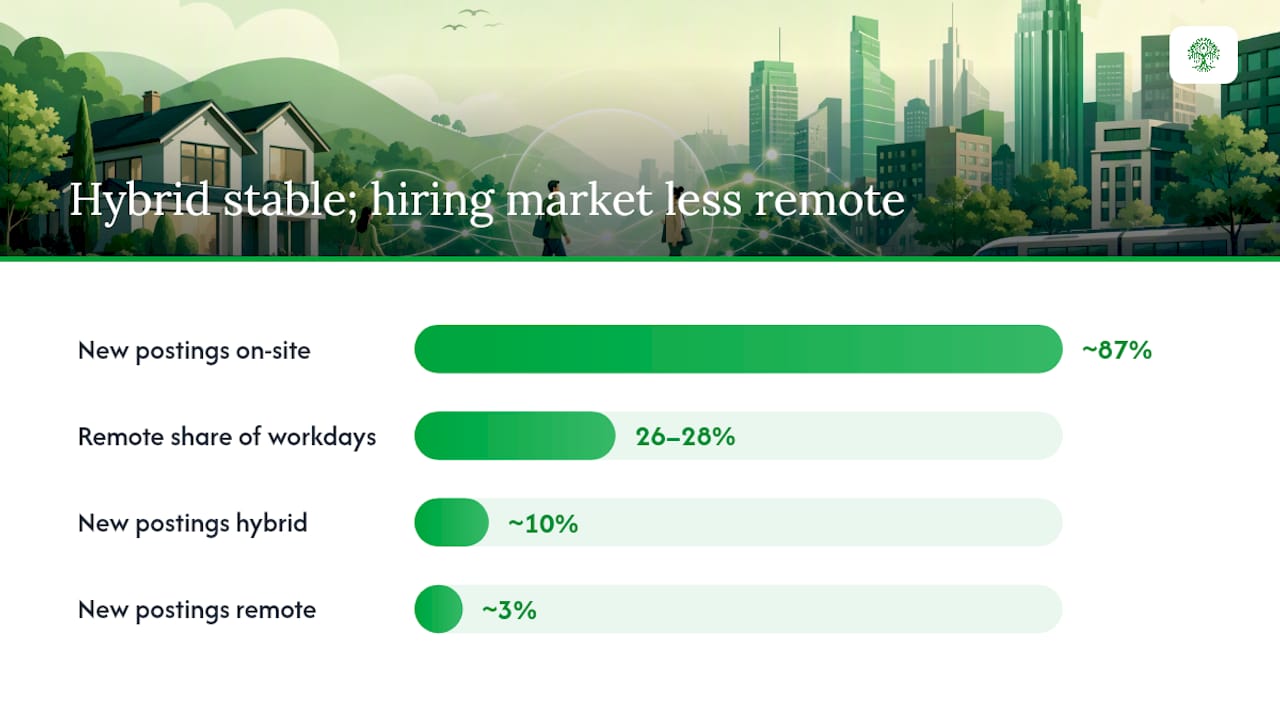
    Plan for policy drift With 87% of new postings requiring full-time on-site work, buy a home that resells well to a five-day commuter too.
    Use a decision-intelligence tool Ficustree offers affordability recalculations and connectivity checks built for hybrid-buyer tradeoffs.

    Table of Contents

    What Does “Hybrid Work” Actually Mean for Home Buyers?

    Hybrid work means splitting your workweek between home and an employer-designated office, but the phrase covers wildly different arrangements. Gartner defines it as an arrangement where employees alternate between home and office, and that alternation can be dictated by your company, your team, or you.

    You’ll typically run into one of three variants:

    • Employer-specified days: the company sets fixed office days for everyone (often Tuesday through Thursday).
    • Team-scheduled days: your manager or department decides the cadence, which can shift when leadership changes.
    • Individual choice: you and your manager agree on a personal schedule, sometimes with a minimum monthly office-day quota instead of a weekly one.

    Researchers studying hybrid arrangements describe them along three dimensions: modality (where you physically work), location (which office or region), and temporality (how often and when). A 2024 framework published on ScienceDirect makes this case well, and it explains why two people at the same company can have completely different “hybrid” realities. One person’s two office days a month is another person’s three days a week.

    Pro Tip: Get your exact variant in writing before you shop for homes. “Hybrid” on a job offer letter is not a commute plan. It’s a starting point for a conversation with your manager.

    How Hybrid Work Shifts What You Look For in a Home

    Hybrid work tends to move your priority list from “shortest commute possible” to a balance between commute optionality and everyday lifestyle quality. When you only drive to the office two or three days a week, the marginal pain of an extra fifteen minutes each way matters far less than it did for a five-day commuter, and that opens the door to homes you’d never have considered before.

    That shift changes what you actually filter for in a home search:

    • Reliable fiber or cable internet, not just “internet available”
    • A room, alcove, or converted space that can function as a real office, not a laptop-on-the-kitchen-table setup
    • Flexible parking or garage space if you need a dedicated car for occasional commute days
    • Proximity to a commuter rail line, highway on-ramp, or park-and-ride, even if you won’t use it daily
    • Access to coworking space nearby, useful on the days your home internet goes down or your kids are loud
    • Outdoor space and neighborhood amenities, since you’ll spend more waking hours at home than a traditional five-day office worker

    How you weigh these depends on which kind of hybrid worker you are. A fully remote buyer with occasional in-person meetings can chase lifestyle and price almost without commute constraints. A “3-2” hybrid buyer, now the most common pattern reported for 2026, needs a commute that’s tolerable three times a week, not zero times. An occasional commuter, someone in the office once or twice a month, can effectively treat commute distance as a non-issue and optimize purely for cost and lifestyle.

    Pro Tip: During any showing, virtual or in person, run a live speed test on your phone and ask to test the home’s actual Wi-Fi, not just the listing agent’s hotspot. Treating internet like a utility, the same way you’d check the water heater, catches problems before you’re locked into a mortgage.

    Hand holding smartphone running Wi-Fi speed test in home office

    If you want a deeper dive into search strategy for this exact tradeoff, our guide to finding homes around a hybrid commute walks through filter setups that balance both sides.

    What’s a Reasonable Commute for a Hybrid Worker?

    A commute of 45 to 60 minutes each way is generally tolerable for hybrid buyers going into the office one to three days a week, even though that same commute would be a dealbreaker for a five-day-a-week worker. The math changes because you’re absorbing that cost less often.

    Here’s what the numbers actually look like. A 45-minute each-way commute, three days a week, costs you about 4.5 hours weekly, roughly 18 hours a month. Compare that to a traditional five-day worker at the same distance: 7.5 hours weekly, 30 hours a month. That’s 12 hours a month you get back, worth real money if you value your time at even a modest hourly rate.

    Direct costs matter just as much as time. A 30-mile round trip three days a week runs roughly 360 miles a month. At current averages for fuel and maintenance, that’s a real monthly line item, and if your route includes tolls or downtown parking, add another $100 to $300 a month depending on your metro. Vehicle wear accelerates too. More highway miles mean earlier tire replacement and more frequent oil changes, costs that rarely make it into a buyer’s mental math.

    There’s a cost that’s even easier to miss: childcare timing. If your commute pushes daycare pickup past a facility’s cutoff, you’re either paying late fees or hiring a backup sitter for your office days, and that expense can erase the savings from buying farther out.

    Before comparing two locations, run through this:

    • Total monthly commute hours at your actual office-day frequency, not a hypothetical daily rate
    • Fuel, tolls, and parking added up monthly, not per trip
    • Estimated added vehicle maintenance from the extra mileage
    • Whether commute timing conflicts with childcare, school pickup, or a partner’s schedule

    The Real Risk of Buying Around a Hybrid Arrangement

    The biggest risk in hybrid-based home buying is that your employer’s policy or the broader hiring market shifts after you’ve already committed to a 30-year mortgage built around a two-day commute. Policies change, managers change, and companies get acquired. None of that shows up in your current offer letter.

    Here’s the market context that makes this risk concrete: Robert Half’s Q2 2026 hiring analysis found that roughly 87% of new professional job postings required full-time on-site work, with only about 10% hybrid and 3% fully remote. If your current hybrid job disappeared tomorrow, the postings you’d likely be applying to skew heavily toward full-time in-office. That’s the gap between what current employees experience and what today’s hiring market actually offers new hires.

    Run through this before you commit to a location built around your current schedule:

    • Is your hybrid schedule written into your offer letter or employee handbook, or is it a verbal understanding with your manager?
    • Does your manager’s team follow the same cadence as company policy, or does your specific team have unwritten expectations?
    • Has your company enforced office-day attendance in the past, or has it looked the other way?
    • Would your role be portable to a different company, or is it tied to something location-specific?
    • If hybrid ended tomorrow, what’s your realistic maximum tolerable commute, and does your home still work under that scenario?

    Ask your manager directly whether the policy is documented anywhere beyond a Slack message, and ask HR if there’s a formal remote-work agreement you can request in writing. If you’re in California and want a sense of how return-to-office obligations are treated legally, this overview of RTO rules is a useful starting point, though your specific employment contract governs your situation. For a broader look at the financial mistakes that trip up first-time buyers generally, our guide to common buyer mistakes covers overlapping ground.

    Your Hybrid Home-Buying Checklist

    Start by verifying your employer’s actual policy in writing, then map a realistic commute before you fall in love with anything on Zillow. Everything else in your search should follow from those two facts, not precede them.

    1. Verify your employer’s hybrid policy in writing. Get the cadence, the enforcement history, and whether it’s team level or company wide.
    2. Re-run your affordability calculation including commute costs. Add fuel, tolls, parking, and estimated maintenance to your monthly budget, not just PITI and HOA.
    3. Test connectivity at every serious showing. Run a real speed test, not just a listing claim.
    4. Rehearse your actual office-day logistics. Drive the commute at the real time of day you’d make it, ideally more than once.
    5. Check resale and resilience. Would this home still make sense to a five-day commuter, in case you need to sell after a policy change?
    6. Adjust your offer strategy accordingly. A home in a hybrid-commute corridor may face less competition than one right next to the office, giving you room to negotiate.

    When you re-run affordability, add these hybrid-specific line items to your monthly PITI and HOA baseline: estimated fuel and tolls for your actual office-day frequency, any coworking membership you might need as backup, and a modest buffer for connectivity upgrades. Subtract the commuting costs you’d have paid under a closer, more expensive home, and compare the net numbers side by side rather than comparing sticker prices alone.

    Pro Tip: If you’re preparing an offer, mention in your buyer’s letter or through your agent that you specifically value the home office setup and connectivity, particularly for a listing that highlights fiber availability or a converted flex room. Sellers who’ve marketed to remote or hybrid buyers already know what matters and respond well to it.

    How Long Does This Take, and What Should You Budget?

    Buying a home as a hybrid worker generally follows the same timeline as any purchase, but expect to add time for connectivity verification and commute rehearsal before you’re comfortable making an offer. Most buyers underestimate how long the “make sure this actually works” phase takes.

    A realistic timeline looks like this:

    • Search phase (4 to 10 weeks): includes virtual walkthroughs, connectivity checks on shortlisted homes, and at least one in-person commute test drive.
    • Offer and negotiation (1 to 2 weeks): faster in a hybrid-commute corridor with less competition than in a tight urban core.
    • Inspection and contingencies (2 to 3 weeks): standard timeline, though add a connectivity confirmation if it wasn’t verified pre-offer.
    • Escrow to closing (3 to 5 weeks): varies by state and lender.

    Beyond the standard closing costs, hybrid buyers often carry a few line items that traditional budgets skip:

    Cost Item Typical Range Notes
    Home office furniture and setup $500–$2,500 Desk, chair, lighting, monitor arm
    Connectivity upgrade (fiber install, mesh Wi-Fi) $100–$600 One-time, plus possible monthly rate increase
    Backup coworking membership $150–$400/month Optional, useful if home internet is unreliable
    Added commute costs (fuel, tolls, parking) $150–$450/month Scales with office-day frequency and distance

    That buffer absorbs a commute you underestimated or a connectivity upgrade you didn’t plan for.

    What the 2026 Data Actually Tells Hybrid Buyers

    Roughly 26–28% of all paid U.S. workdays. Read together, those two numbers tell you hybrid work is stable for people who already have it, but far less available if you’re job-hunting from scratch.

    That distinction matters because it’s easy to conflate “current workers with remote flexibility” with “the hiring market you’d face tomorrow.” They’re not the same population. The BLS figure describes existing paid workdays across the current workforce. The Robert Half figure describes new job postings, a leading indicator of what employers actually want going forward, not what current employees already have.

    Metric Figure What It Measures
    Remote share of paid U.S. workdays 26–28% Existing workforce, BLS tracking
    New postings requiring full-time on-site ~87% Robert Half, Q2 2026
    New postings that are hybrid ~10% Robert Half, Q2 2026
    New postings that are fully remote ~3% Robert Half, Q2 2026

    Workforce distribution of remote, hybrid, and on-site work in 2026

    When you’re deciding how much weight to put on your current hybrid arrangement, weight the hiring-market figure more heavily the more likely you are to change jobs in the next three to five years.

    An honest note on where the market is heading

    Buying a home around hybrid work forces you to reconcile two truths: your current schedule feels stable, and the hiring market that would replace it if things changed looks very different. I don’t think that means hybrid buyers should avoid the tradeoff, real estate coverage increasingly points to durable clustering in what analysts call hybrid-commute corridors, locations far enough out to save real money but close enough for the occasional office day. What I do think buyers underestimate is how much of their financial cushion should come from resale flexibility rather than from betting the whole plan on their employer’s current mood.

    The anxious first-time buyers I think about most are the ones treating this decision as permanent instead of adaptable. It doesn’t have to be either. A home that works for a hybrid schedule and still resells well to a five-day commuter is the safer bet, and that’s the frame Ficustree’s decision-intelligence tools are built around: showing you not just what a home costs today, but how resilient that choice is if your work arrangement changes tomorrow.

    Let Ficustree Run the Hybrid-Buyer Math for You

    Ficustree helps hybrid workers cut through the guesswork of comparing homes by running personalized tradeoff analysis, connectivity checks, and affordability recalculations that account for commute costs, not just sticker price. Instead of manually building spreadsheets for every candidate neighborhood, you get a decision-intelligence layer built specifically for the questions this article just walked through.

    Ficustree

    As direct buyer representation, Ficustree charges $1,000 at closing plus 1% commission, with a rebate of roughly 2% passed back to you where legally permitted, and the platform itself is free to use. You also get access to hourly showing agents on demand, useful when you want to test connectivity and commute logistics in person without coordinating a full-time agent’s schedule. Pricing structures and rebate eligibility vary by state, so confirm current terms for California or Texas directly with Ficustree before you rely on a specific number.

    If you’re ready to see how a hybrid-commute tradeoff actually pencils out for your budget, start your search on Ficustree and run your own numbers against real listings instead of assumptions.

    Sources

    This article is general information, not a substitute for advice from a qualified financial advisor. Consult a qualified financial professional about your own circumstances before acting on anything here.

    FAQ

    What is the hybrid work-from-home model?

    Hybrid work is an arrangement where you split your workweek between home and an employer office, following a schedule set by the company, your team, or a personal agreement with your manager.

    Is remote work dying in 2026?

    workdays](https://www.bls.gov/opub/ted/2024/35-percent-of-employed-people-did-some-or-all-of-their-work-at-home-on-days-they-worked-in-2023.htm) still performed remotely, though new hiring skews heavily toward full-time on-site roles.

    What are the downsides of hybrid work for home buyers?

    The main downside is policy risk: your employer could tighten office-day requirements, or you could need a new job in a market where most new postings require full-time on-site work, making your original commute assumption obsolete.

    What does a hybrid work model mean for where I should buy?

    It generally means you can look further from the office than a five-day commuter, prioritizing connectivity, home office space, and lifestyle amenities, as long as you verify your actual office-day frequency stays stable enough to justify the distance.

    How can I reduce risk when buying a home around a hybrid schedule?

    Get your hybrid policy in writing, budget commute costs into your affordability calculation, and choose a home that would still make sense to a five-day commuter if your schedule changes. Tools like Ficustree can run those tradeoff calculations directly against real listings.

  • How to Make a Competitive Offer in a Low-Inventory Market

    How to Make a Competitive Offer in a Low-Inventory Market

    Sellers in a tight market rarely just take the highest number. They take the offer that feels safest. Making a competitive offer in a low-inventory market means building a package that maximizes price and certainty at the same time, because a seller comparing five offers on a Tuesday morning is scanning for reasons to say no as much as reasons to say yes.

    Here’s your one-minute checklist before you write anything:

    • Price it right, not high. Base your number on real comps and days-on-market data, not gut feeling.
    • Put up strong earnest money. Bigger deposits signal you won’t walk.
    • Get full underwriting, not just pre-approval, if your lender offers it.
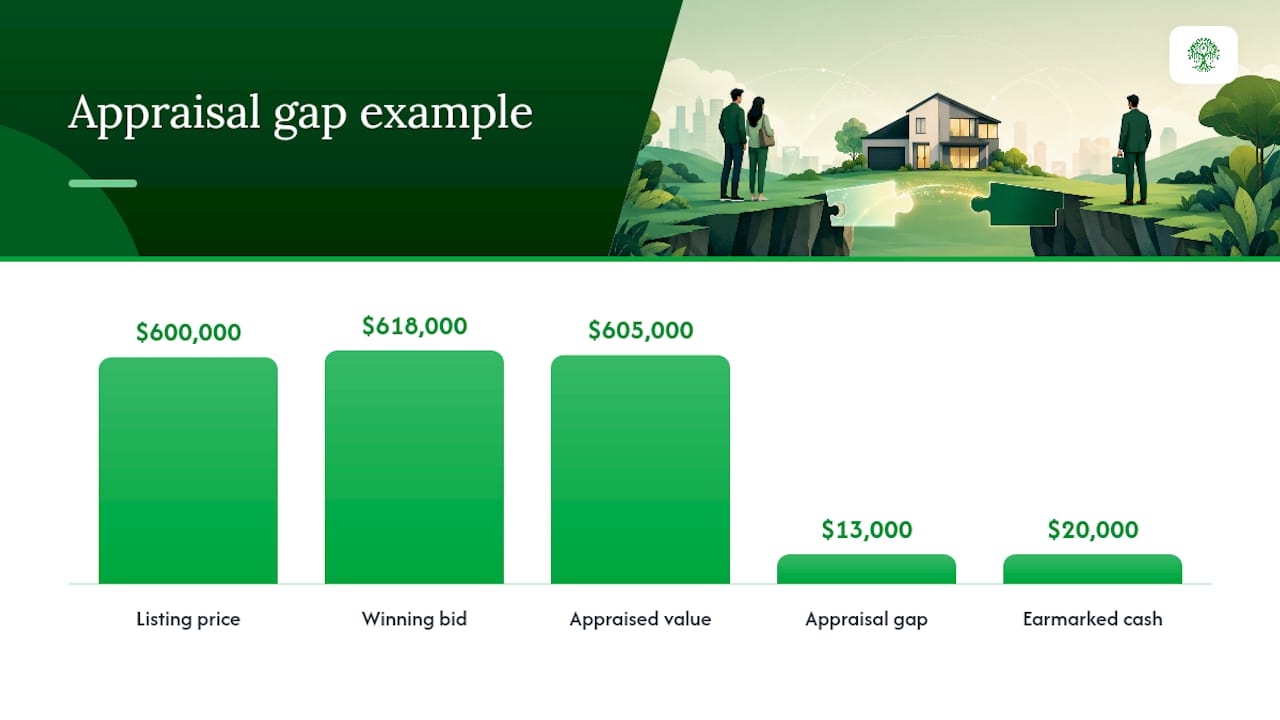
    • Have an appraisal-gap plan or escalation clause ready, sized to cash you actually have.
    • Shorten or convert your inspection to informational, but don’t skip it entirely.
    • Match the seller’s closing timeline, even if it’s inconvenient for you.
    • Offer seller-friendly terms like flexible move dates or a short rent-back.

    Before any of that: set an absolute maximum bid and keep your emergency reserves walled off from the cash you’re earmarking for earnest money or an appraisal gap. That single boundary is what keeps a competitive offer from turning into a financial mistake.

    Key Takeaways

    Winning a competitive offer in a low-inventory market means maximizing seller certainty through price, terms, and clean documentation, while protecting your own finances with pre-set limits.

    Point Details
    Set a hard maximum bid Decide your ceiling and reserve floor before you start touring homes, and don’t move them under pressure.
    Get full underwriting A conditional loan approval carries more weight with sellers than a basic pre-approval letter.
    Earmark appraisal-gap cash Keep gap funds separate from emergency reserves so a low appraisal doesn’t force a scramble.
    Trade terms, not just price Flexible closing dates, rent-backs, and larger earnest money often matter more than a few thousand extra dollars.
    Use Ficustree for coordination Ficustree bundles documents, plans appraisal-gap coverage, and books on-demand showings to speed up competitive offers.

    Where to Verify Lenders and Market Data

    Before you sign with a lender or set your offer price, a few outside resources are worth checking directly rather than relying only on what an agent tells you.

    • NMLS Consumer Access lets you verify a lender’s license, complaint history, and contact information in about two minutes.
    • The National Association of Realtors publishes ongoing research on inventory levels and pricing trends nationally.
    • Bankrate is a solid starting point for comparing lender rates and understanding fee structures side by side.
    • For local comps and months-of-supply figures specific to your target neighborhood, ask your buyer’s agent for MLS-based reports, since these numbers shift by micro-market far more than national averages suggest.

    Table of Contents

    Preparation You Need Before You Start Touring Homes

    The buyers who win multiple-offer situations almost always did their hardest work before they ever walked into an open house. By the time a listing hits the market, there’s no time to fix a shaky financial picture.

    Start with mortgage pre-approval, and push further if your lender allows it. A full underwrite, sometimes called a loan-in-principle or “underwritten pre-approval,” means a human underwriter has already reviewed your income, assets, and credit rather than just running an automated check. That distinction matters to a listing agent evaluating offers, because it tells them your financing is far less likely to fall apart in escrow.

    Pull together your documentation now, not later: recent pay stubs, two months of bank statements, tax returns, and proof of funds for your down payment and closing costs. Attach these to every offer instead of promising to send them “if needed.” A seller’s agent who sees complete financials attached to an offer reads that as a buyer who has done the work.

    It’s worth shopping more than one lender for rate and fees before you commit. Comparing multiple mortgage offers is one of the easiest ways to lower long-term cost, since lenders price the same borrower differently and origination fees can vary by thousands of dollars over a 30-year loan.

    Before you write a single offer, decide three numbers in advance: your maximum bid, your minimum reserve balance you won’t touch, and which contingencies you’re willing to waive under what circumstances. Writing these down when you’re calm keeps you from making a panicked decision in a bidding war three weeks from now.

    Pro Tip: Don’t open a new credit card, finance a car, or switch jobs between pre-approval and closing. Lenders re-verify credit and employment before funding your loan, and a new balance or job change can trigger a denial days before you’re supposed to get keys.

    • Get pre-approved, then ask your lender about full underwriting
    • Gather pay stubs, bank statements, tax returns, and proof of funds now
    • Compare at least two or three lenders on rate and fees
    • Set your max bid, reserve floor, and contingency policy in writing
    • Freeze new credit activity until after closing

    What Sellers Actually Compare in a Competitive Offer

    Price is only one column on the spreadsheet a listing agent builds when multiple offers land. The other columns, quietly, often decide the winner.

    Sellers and their agents weigh the offered price against earnest money size and how fast it’s due, how solid your financing looks, which contingencies you’re keeping or waiving, your proposed closing date, and how clean and simple the contract itself reads. A messy offer with unusual conditions can lose to a slightly lower one that closes without drama.

    Two of the more advanced tools for competing on terms, not just price, are escalation clauses and appraisal-gap coverage. An escalation clause automatically raises your offer above a competing bid up to a ceiling you set, so you’re not guessing what the highest number needs to be. Appraisal-gap coverage promises to make up the difference in cash if the home appraises below your offer price, which matters because lenders won’t loan against a gap between the appraisal and the sale price.

    Strategy Seller signal Buyer risk Typical usage Evidence to attach
    Escalation clause Confidence, willingness to compete openly Can overshoot your comfort zone if not capped carefully Multiple-offer situations with an unclear ceiling Proof of funds covering the cap, pre-approval or underwriting letter
    Appraisal-gap guarantee Certainty the deal survives a low appraisal Requires liquid cash beyond the down payment Markets where bidding regularly exceeds list price Bank statement showing gap funds, separate from down payment reserves
    Large earnest money deposit Seriousness, low flight risk Ties up cash until closing; can be forfeited if you default without a valid contingency Competitive offers where price alone won’t stand out Proof of funds, wire confirmation timeline

    Sample appraisal-gap language an agent can adapt: “Buyer agrees to cover any difference between the appraised value and the purchase price up to $15,000, with funds to be verified by bank statement prior to acceptance.” A sample escalation clause might read: “Buyer offers $650,000, and agrees to increase the purchase price by $2,000 above any competing bona fide offer, up to a maximum price of $685,000.”

    Choose an escalation clause when you genuinely don’t know what the ceiling is and want the contract to do the math for you. Choose a straight over-ask price paired with appraisal-gap coverage when you already have strong comps and want to present one clean, confident number instead of a formula the seller has to interpret. A practical competitive-offer framework also points to shortening contingency timeframes as a lower-risk lever than eliminating contingencies outright.

    How Do You Find Out What the Seller Actually Wants?

    Every seller has a hidden priority list, and it’s rarely just “highest number.” Some need to close in three weeks because they’ve already bought their next place. Others need 60 days and a rent-back because their new construction isn’t finished. Figuring this out before you write an offer costs nothing and can matter more than an extra $5,000.

    Your buyer’s agent should call the listing agent directly, not just read the MLS remarks. That single phone call often surfaces the real story: a job relocation deadline, a divorce timeline, an estate sale with multiple heirs who need unanimous sign-off. Listing remarks and any seller disclosures provided upfront are worth rereading for clues too.

    Practical seller-facing tactics that cost buyers little include writing a short, neutral cover letter explaining your readiness to close, matching the seller’s preferred closing date, and offering flexible occupancy terms. None of these move your purchase price, but all of them reduce the seller’s perceived risk.

    • Ask your agent to call the listing agent before you write the offer
    • Reread listing remarks and disclosures for timeline clues
    • Offer a flexible closing date or a short rent-back if the seller needs one
    • Keep repair requests minimal or bundle them into a credit instead of a repair list
    • Write a brief, factual cover letter, not a sentimental one

    Pro Tip: If a seller’s top concern is certainty of closing on their schedule, matching that date usually beats shaving a few thousand dollars off your price. A seller who needs to be out in 30 days will often take a lower offer that guarantees it.

    Negotiation Rules for Multiple-Offer Situations

    Once your offer is in a pool with three or four others, the negotiation shifts fast, and having pre-set rules keeps you from making decisions you’ll regret.

    1. Present strength up front. Your agent should submit verified financing documents, proof of funds, and a short cover letter focused on the seller’s needs, not your excitement about the house.
    2. Use your pre-set maximum bid as a hard stop. If a competing offer pushes past the ceiling you set while calm, that’s your answer. Walk.
    3. Deploy an escalation clause only with a verified reason to believe in real competition. Before assuming there’s a bidding war, it’s reasonable to ask the listing agent to confirm that multiple offers genuinely exist. Most agents will confirm the number of offers without disclosing terms.
    4. Know your walk-away triggers before you’re in the room. These include an appraisal gap that exceeds your reserved cash, a new lender condition that raises your rate or reduces your loan amount, or a counteroffer that crosses your financial ceiling.
    5. Separate emotion from math at every counter. If you find yourself justifying “just $10,000 more” for the fourth time, that’s the moment to reread your written maximum bid.

    Low-inventory markets move fast for a reason: record-low inventory paired with strong demand means sellers frequently field several offers within days of listing, so hesitation itself can cost you the house even when your terms are strong.

    Costly Mistakes Buyers Make Under Competitive Pressure

    Competitive pressure pushes buyers toward decisions that look fine on offer day and turn into financial trouble weeks later.

    The most common mistakes: waiving the inspection contingency with no fallback plan, bidding beyond what pre-approval actually supports, draining emergency savings to cover earnest money or a gap, opening new credit lines mid-escrow, and rushing or skipping inspections entirely to look more attractive. Each of these individually is risky. Combined, they compound fast. A buyer who overbids and waives the appraisal contingency at the same time has no protection if the home appraises low. They’re now responsible for covering that entire shortfall in cash or walking away and losing their deposit.

    Waiving contingencies without adequate cash or underwriting exposes buyers to exactly this kind of predictable financial harm, and it’s one of the most frequent errors first-time buyers make in fast-moving markets. Reversing these mistakes isn’t complicated, it just requires discipline before you’re emotionally invested in a specific house. Pre-inspections let you know what you’re buying before you waive the contingency. Earmarked appraisal-gap cash, kept separate from your emergency fund, means a low appraisal doesn’t become a crisis. Full underwriting reduces financing surprises. A conservative reserve policy, set before you start touring homes, keeps a bidding war from turning into a liquidity problem.

    • Waiving inspection with no pre-offer walkthrough or professional opinion
    • Bidding above what your actual approved loan amount supports
    • Draining reserves meant for moving costs, repairs, or emergencies
    • Opening new credit or financing a car mid-escrow
    • Rushing an inspection to speed up the offer timeline

    For a deeper look at how emotional pressure specifically drives these decisions, see first-time buyer emotional pitfalls and how to set boundaries before you’re in a bidding war.

    What the Data Says About Safer Competitive Tactics

    The tactics that actually protect buyers while keeping offers competitive aren’t secret, they’re just underused because they take a bit more upfront effort.

    Inspection and appraisal contingency waivers rise noticeably in hot markets, largely because buyers assume waiving is the only way to compete. A pre-offer inspection, where you pay an inspector to walk the property before you write your offer, preserves the information you’d otherwise give up. You still learn about the roof, the foundation, and the electrical panel; you just do it on a compressed timeline before submitting rather than after.

    On the financing side, lenders routinely re-verify credit and employment in the days before closing, which is exactly why full underwriting matters more than a basic pre-approval letter. And rate shopping across lenders remains one of the few moves that lowers your total cost without raising your risk at all. Before working with any lender, you can verify their license and complaint history through NMLS Consumer Access, a public database that takes about two minutes to search.

    Here’s how this plays out in practice: a buyer targeting a $600,000 listing sets a maximum bid of $625,000 and earmarks $20,000 in cash specifically for an appraisal gap, kept separate from their emergency fund and down payment. Three offers come in. The winning bid lands at $618,000. The home appraises at $605,000, a $13,000 gap. Because that cash was already set aside and never touched, covering the gap doesn’t touch reserves or delay closing. The buyer who instead spent that $20,000 cushion on moving costs or a new couch would have faced a choice between renegotiating, walking away, or scrambling for cash days before closing.

    Pro Tip: Get full underwriting or a conditional loan approval before you agree to waive a financing contingency. A pre-approval letter is a starting point, not a guarantee, and the gap between the two can be the difference between a smooth closing and a canceled one.

    What the Data Says About Safer Competitive Tactics — overview diagram

    Your Ready-to-Use Offer Checklist and Sample Language

    Copy this before your next offer goes out.

    Documents to attach: pre-approval or full underwriting letter, proof of funds for down payment and closing costs, proof of funds for any appraisal-gap coverage (kept as a separate document), and a one-page cover letter addressed to the seller.

    Earnest money: wire or certified funds, typically due within 1 to 3 business days of acceptance.

    Contingency windows to propose: inspection within 5 to 7 days (or convert to informational), appraisal contingency tied to your gap coverage terms, financing contingency shortened to reflect your underwriting status.

    Item Suggested range or timing Notes
    Earnest money deposit typically a small percentage of purchase price Higher deposits signal seriousness in competitive markets
    Deposit due date 1 to 3 business days after acceptance Faster timing reads as stronger commitment
    Inspection contingency window a few days or informational only Shorter windows are common in low-inventory markets
    Appraisal-gap coverage Sized to available cash, separate from reserves Never pledge more than verified liquid funds
    Closing timeline a few weeks to over a month, matched to seller preference Confirm with listing agent before finalizing

    Sample informational inspection clause: “Buyer reserves the right to conduct an inspection for informational purposes only. Buyer will not request repairs or credits as a result of this inspection, and this contingency will be waived upon receipt of the inspection report.”

    Ask your agent to adapt these ranges to your specific market. A downloadable version of this checklist, alongside a full walkthrough of the appraisal-gap process, is available through Ficustree’s appraisal gap guide.

    A Founder’s View on Winning Offers Without Taking Foolish Risks

    Representing first-time buyers through multiple-offer situations makes one pattern obvious fast: the buyers who win without regret are the ones who did the boring work early. Full underwriting instead of a basic pre-approval. A pre-offer inspection instead of a blind waiver. Cash set aside specifically for a gap, never touched for anything else.

    I’ve seen a borderline offer, one that was actually a bit below the top bid on price, win because the buyer had already completed a pre-offer inspection and could waive the contingency with real confidence instead of blind hope. I’ve also seen a buyer with full underwriting beat a higher cash offer because the seller’s agent trusted the file completely and didn’t want to risk a financing fallthrough with a less-verified buyer. Preparation, not aggression, won both times.

    The instinct in a hot market is to strip away every protection to look aggressive. That instinct is usually wrong. The buyers who protect their downside while still competing hard on the terms that actually matter to sellers are the ones who end up with keys and their savings intact.

    How Ficustree Helps You Compete Without Losing Your Safety Net

    Building a genuinely competitive offer, one with strong pricing, clean contingencies, and fast documentation, takes real coordination between your lender, your inspector, and your agent. Ficustree exists to manage that coordination for you instead of leaving you to juggle it during the most stressful two weeks of the process.

    Ficustree

    Ficustree pairs you with on-demand showing agents so you can tour a new listing within hours, not days, and bundles your pre-approval documents, proof of funds, and cover letter into a package ready to submit the moment you find the right house. The platform’s pre-offer workflows help you plan appraisal-gap coverage against your actual cash position, and coordinate with your lender toward full underwriting instead of stopping at a basic pre-approval letter. If you’re getting ready to compete in a low-inventory market, start a pre-approval workflow with Ficustree and see what a fully prepared offer package looks like before you find your next listing.

    Sources

    FAQ

    What Is the 3-3-3 Rule in Real Estate?

    It’s a starting sanity check, not a substitute for your lender’s actual underwriting numbers.

    Do Sellers Usually Come Down If the Appraisal Is Low?

    Not automatically. Sellers often expect the buyer to cover the gap in cash, especially in a low-inventory market with backup offers waiting, which is exactly why earmarking appraisal-gap funds before you offer matters so much.

    What Is the Hardest Month to Sell a House?

    Late fall and winter, particularly December, tend to see fewer buyers actively touring homes, which can mean less competition for buyers willing to shop during that window. Seasonal patterns vary by local market, so check recent days-on-market data for your specific area.

    What Is Considered Low Inventory in Real Estate?

    There’s no single universal number, but many agents consider a market with less than three months of supply, meaning it would take under three months to sell all current listings at the current sales pace, to be a seller’s market with low inventory. National data shows inventory has stayed near record lows in many regions, which is part of why competitive offer strategy matters more than ever for buyers today.

    Can Ficustree Help Me Build a Competitive Offer Faster?

    Yes. Ficustree bundles your pre-approval documents, proof of funds, and offer materials so your agent can submit a complete, competitive package quickly, and coordinates appraisal-gap planning against your actual available cash.

  • Wildfire Risk and Home Buying in California: What to Do First

    Wildfire Risk and Home Buying in California: What to Do First

    Wildfire risk rarely kills a California home purchase outright. What it does is change your insurance options, your lender’s requirements, and your closing conditions in ways that can blindside you if you haven’t prepared. The single most important move you can make right now: request the Natural Hazard Disclosure (NHD) and get an insurance pre-eligibility check before you place an offer. Those two steps tell you whether the property is insurable, at what cost, and whether your lender will have conditions you need to satisfy before closing.

    Before escalating any offer on a fire-zone property, collect these documents:

    • Natural Hazard Disclosure (NHD) and any attached verification report
    • Civil Code §1102.6f disclosure notice (required for pre-2010 homes in high or very high Fire Hazard Severity Zones)
    • Current homeowner policy or FAIR Plan acceptance letter from the seller
    • Proof of completed retrofits from the state low-cost retrofit list (required to be disclosed after July 1, 2025)
    • Final inspection report under Gov. Code §51182, if one exists

    Pro Tip: Get a preliminary insurance quote or FAIR Plan pre-eligibility check before you submit earnest money. Discovering the property is uninsurable at standard rates after you’re in contract costs you time, leverage, and potentially your deposit.


    Key Takeaways

    Wildfire risk changes your insurance, financing, and closing conditions in California, but documented mitigation and the right contingencies make it manageable.

    Point Details
    Get the NHD first Request the Natural Hazard Disclosure and §1102.6f retrofit list before submitting any offer.
    Insurance pre-check is non-negotiable Confirm FAIR Plan eligibility or private coverage before earnest money; uninsurability kills financing.
    Mitigation credits are real and documented CCR §2644.9 requires insurers to apply separate credits for each hardening action; request the dollar estimate in writing.
    AB 493 protects your proceeds California law requires lenders to pay at least 2% simple interest per year on hazard insurance proceeds held pending repair.
    Ficustree compresses the process Ficustree’s platform parses disclosures, runs insurance pre-checks, and organizes mitigation documentation for a wildfire-risk purchase.

    Table of Contents

    How does California classify wildfire hazard, and where do you check?

    California uses a tiered system called Fire Hazard Severity Zones (FHSZ), administered by CAL FIRE. Properties fall into Moderate, High, or Very High designations. “State Responsibility Area” (SRA) means the state, not a local agency, bears primary wildfire suppression responsibility for that land. Both SRA status and FHSZ designation trigger disclosure and maintenance obligations for property owners.

    The practical difference between High and Very High matters. Very High FHSZ properties in SRAs face stricter defensible-space requirements under Gov. Code §4291 and trigger mandatory seller disclosures. Local agencies can also designate Very High FHSZs within their own jurisdictions (called “Local Responsibility Areas”), which carry similar obligations under Gov. Code §51178 and §51182.

    Where to check a specific address:

    • CAL FIRE FHSZ viewer: fire.ca.gov — the authoritative state map
    • County recorder or planning department: for local responsibility area designations
    • Natural Hazard Disclosure report: ordered through a third-party NHD company during escrow; it aggregates state and local zone data for the parcel

    California Civil Code Article 1.7 governs how sellers must answer the NHD. If the parcel falls within a mapped zone, the seller marks “Yes.” If the parcel is near a zone boundary and map accuracy is genuinely uncertain, a third-party verification report can be attached to clarify. Sellers cannot simply leave the question blank because the boundary is close.

    One important limitation: CAL FIRE maps are updated periodically, and parcel-level accuracy can lag behind on-the-ground conditions. A property sitting just outside a mapped zone is not necessarily safer than one just inside it. Use the map as a starting point, not a final verdict.


    What does insurance actually look like for homes in wildfire zones?

    This is where wildfire risk home buying in California gets expensive fast. Private insurers have been pulling back from high-risk areas, which means buyers in Very High FHSZs increasingly face limited carrier options, higher premiums, wildfire surcharges, or outright nonrenewal notices.

    Hand holding insurance nonrenewal notice indoors

    The FAIR Plan: what it covers and what it doesn’t

    When private coverage isn’t available, the California FAIR Plan steps in as the state’s insurer of last resort. It covers basic perils: fire, lightning, smoke, and internal explosion. What it does not cover is equally important. A FAIR Plan policy excludes water damage, theft, liability, and additional living expenses. Most buyers who rely on the FAIR Plan pair it with a Difference-in-Conditions (DIC) policy from a surplus-lines carrier to fill those gaps. Budget for both.

    Recent reforms have expanded FAIR Plan residential coverage limits and added a mitigation discount program called “Safer from Wildfires.” A 2026 Stipulation and Order between the Insurance Commissioner and the FAIR Plan also strengthened the plan’s financing and solvency measures to help ensure claims get paid after catastrophic events.

    CCR §2644.9 and mitigation credits

    California’s insurance regulations now require insurers to offer separate mitigation credits for each qualifying hardening action. Under CCR §2644.9, insurers must:

    • Include a distinct credit for each mandatory mitigation factor in their rate filings
    • Provide a dollar estimate of the premium reduction for each mitigation action when you request it
    • Accept CAL FIRE or local fire department inspections as valid verification
    • Update a property’s wildfire risk score within 30 days of receiving verified mitigation documentation
    FAIR Plan item Key detail
    Covered perils Fire, lightning, smoke, internal explosion
    Not covered Water damage, theft, liability, additional living expenses
    Mitigation discount “Safer from Wildfires” program; credits for documented hardening
    Residential coverage limits Expanded under recent reforms; check current limits at time of purchase
    Solvency backing 2026 Stipulation and Order strengthens financing and claims-payment capacity

    Pro Tip: Before closing, ask your insurer in writing for the dollar value of each mitigation credit available for the property. That number is your negotiating baseline with the seller for retrofit cost-sharing or a price reduction.


    How does wildfire risk affect your mortgage approval and escrow?

    Lenders require proof of hazard insurance as a condition of funding. In a wildfire zone, “proof of insurance” is not a formality. If you cannot secure a policy, your loan does not close. Period. That means your insurance search needs to run parallel to your mortgage pre-approval, not after it.

    Lenders will typically accept a FAIR Plan policy plus a DIC policy as satisfying the hazard-insurance requirement, but confirm this with your loan officer early. Some lenders add specific conditions for properties in Very High FHSZs, including requirements for defensible-space compliance or a completed fire inspection before funding.

    What happens to insurance proceeds after a loss?

    Your Deed of Trust gives your lender significant discretion over how insurance proceeds are handled after a covered loss. Historically, servicers could apply proceeds to the loan principal rather than fund repairs if they determined reconstruction was uneconomical. Buyers should review their Deed of Trust carefully and, where possible, negotiate escrow language that protects repair funding.

    California law now provides one important borrower protection: under AB 493, financial institutions holding hazard insurance proceeds in a loss-draft account must pay the borrower at least 2% simple interest per year on those funds while they are held pending repair.

    The FDIC’s 2025 guidance also encourages lenders to work constructively with borrowers in wildfire-affected areas, noting that prudent loan-term modifications for affected borrowers are consistent with safe-and-sound banking practices. That’s useful context if you’re buying in an area recently affected by fire activity and want to understand your servicer’s likely posture.

    Hands reviewing repair invoices post-wildfire

    Pro Tip: Ask your loan officer directly: “How does your institution handle FAIR Plan coverage at underwriting, and what are your conditions for Very High FHSZ properties?” Get the answer in writing before you’re in contract.


    What seller disclosures and inspection reports should you demand?

    California law is specific here, and buyers who skip these documents leave themselves exposed. Civil Code §1102.6f requires sellers of homes in high or very high FHSZs built before 2010 to provide a disclosure notice that lists specific vulnerability features. As of July 1, 2025, sellers must also disclose which state-listed low-cost retrofits have been completed.

    The vulnerability features listed in §1102.6f that you should look for in any disclosure:

    • Untreated wood shingle or shake roofing
    • Combustible landscaping or mulch within five feet of the structure
    • Single-pane windows
    • Vents that are not ember-resistant
    • Attached decks or fences made of combustible materials connecting to the structure

    Each of these matters to your insurer and your lender. An untreated wood shake roof, for example, can disqualify a property from standard coverage entirely.

    Article 1.7 of the Civil Code governs the NHD itself and explains when a seller must mark “Yes” on the fire-zone question versus when a verification report may be attached. The California DRE oversees compliance with these disclosure requirements and is a useful resource if you believe a seller has failed to disclose properly. For local implementation details, city fire departments often publish their own AB-38 guidance, as the Glendale Fire Department does for its jurisdiction.

    Use the disclosure to negotiate. A seller who has not completed any retrofits on a pre-2010 home in a Very High FHSZ has handed you a documented list of deferred costs. Price reduction, seller-paid retrofits, or an escrow holdback for specific repairs are all reasonable asks. For a deeper look at how to read and use these documents, the California buyer disclosures guide walks through what each section means and where the leverage points are.

    Pro Tip: Make receipt of the §1102.6f disclosure, the retrofit completion list, and any final inspection report under Gov. Code §51182 explicit conditions of your offer. Don’t assume the seller’s agent will volunteer them.


    Which home-hardening retrofits reduce vulnerability and can lower your premiums?

    Wildfire mitigation is now a property-level calculation, not a zone-wide label. Documented hardening actions translate directly into insurer credits under CCR §2644.9, and buyers who complete or verify retrofits before closing can materially improve both insurability and premium costs.

    Prioritized retrofits by cost and impact

    Zone 0 clearance (the five-foot noncombustible zone immediately around the structure) is the highest-leverage, lowest-cost action for most properties. Practical Zone 0 landscaping guidance and fire-resistant plant selection can help you plan what to remove and what to replace it with before your insurer inspection.

    Diagram of wildfire home-hardening retrofits priorities

    The Santa Barbara Fire Safe Council’s homebuyer resources provide locally-grounded checklists that align with state defensible-space standards and are worth bookmarking for any Northern or Central Coast purchase.

    To get mitigation credits recognized by your insurer, acceptable verification includes: a CAL FIRE inspection, a local fire department inspection, or contractor invoices with before-and-after photos. Keep all of these in your closing folder.

    Pro Tip: If you’re splitting retrofits into phases, prioritize ember-resistant vents and Zone 0 clearance first. These are the two items most commonly flagged in insurer inspections and the two with the fastest credit recognition timeline under CCR §2644.9.


    Your pre-offer and pre-closing wildfire checklist

    Follow this sequence. Skipping steps or reordering them is where buyers lose money and time.

    1. Request the NHD and §1102.6f disclosure from the seller or listing agent before submitting an offer. Confirm FHSZ designation on the CAL FIRE map independently.
    2. Get an insurance pre-eligibility check from at least two private carriers and a FAIR Plan inquiry. Do this before earnest money changes hands.
    3. Notify your lender of the FHSZ designation and ask for written confirmation of their insurability conditions for that property type.
    4. Commission targeted inspections: roof condition and material, ember vulnerability (vents, eaves, soffits), and defensible-space compliance. A standard home inspection often misses these.
    5. Review the retrofit completion list disclosed under §1102.6f. Price any uncompleted items and decide whether to negotiate a reduction, require seller completion, or use an escrow holdback.
    6. Include contingencies for mitigation verification or insurer pre-approval where wildfire exposure is material. Make receipt of the final inspection report under §51182 a named contingency.
    7. Confirm mitigation credits with your insurer in writing before removing contingencies.
    8. Assemble your closing folder: NHD, §1102.6f disclosure, retrofit completion list, inspection reports, insurer correspondence, CAL FIRE or fire department inspection forms, and contractor invoices.

    Negotiation options tied to wildfire risk include price reductions based on documented retrofit costs, seller-paid completion of specific items before close, escrow holdbacks released upon verified completion, and repair escrow release conditions tied to insurer acceptance. Avoid the common mistake of treating wildfire risk as a reason to walk away before you’ve quantified it. For a broader look at what first-time buyers in California typically get wrong at this stage, the common first-time buyer mistakes guide covers the negotiation and contingency errors that cost buyers the most.

    Pro Tip: Schedule your insurance pre-check and lender conversation before your earnest-money deposit, not after. Once you’re in contract, your negotiating position on wildfire-related conditions weakens significantly.


    How Ficustree helps you navigate a wildfire-risk purchase

    Ficustree’s platform is built for exactly this kind of complexity. When you’re buying a home in a wildfire zone, the platform gives you:

    • Automated disclosure parsing: Ficustree flags FHSZ designations, §1102.6f vulnerability items, and missing retrofit disclosures in the seller’s documents before you review them manually.
    • Insurance pre-check workflows: the platform walks you through the FAIR Plan inquiry and private carrier comparison process so you have coverage options confirmed before earnest money.
    • Risk-flag alerts: if a property’s zone designation, roof material, or disclosed features create financing or insurability issues, Ficustree surfaces those flags early in your search.
    • On-demand showing agents: hourly showing agents available when you need to visit a property and assess defensible space, roof condition, or vegetation before making an offer.
    • Mitigation documentation support: Ficustree helps you organize contractor invoices, inspection forms, and insurer correspondence into a closing folder that satisfies CCR §2644.9 verification requirements.

    The platform compresses the typical first-time buyer decision timeline from months of scattered research into a structured, two-month process. For buyers dealing with wildfire-risk variables on top of standard purchase complexity, that structure is the difference between a confident close and a last-minute scramble. The first-time buyer California guide explains how the full workflow fits together from search to keys.


    Wildfire risk is negotiable — here’s why buyers shouldn’t panic

    The conventional wisdom is that a Very High FHSZ designation is a red flag that should push buyers toward safer zip codes. That framing misses something real.

    Properties in wildfire zones often carry a price discount that reflects the market’s perception of risk. When a buyer does the actual work, quantifies the insurance cost, documents the mitigation, and negotiates accordingly, that discount can represent genuine value. The buyers who get hurt are the ones who either ignore the risk entirely or walk away without doing the math.

    Consider a straightforward scenario: a pre-2010 home in a Very High FHSZ with an untreated wood shake roof and no ember-resistant vents. The seller hasn’t completed any retrofits. The §1102.6f disclosure makes all of this visible. A prepared buyer uses that disclosure to negotiate a $15,000 price reduction, completes the roof replacement and vent upgrades for roughly $12,000, documents the work, and gets a FAIR Plan policy with Safer from Wildfires credits applied. The net position: a property purchased below comparable non-zone prices, with documented mitigation that improves both insurability and resale value.

    That outcome requires the right contingencies, the right inspections, and a lender who understands FAIR Plan coverage. None of it is complicated once you know what to ask for. What it is not is a reason to panic.


    Start your wildfire-risk home search with Ficustree

    Buying a home in a wildfire zone in California doesn’t have to mean months of confusion about insurance, disclosures, and lender conditions.

    Ficustree

    The platform runs your wildfire-risk pre-check, parses your disclosures, and connects you with an on-demand showing agent who can assess defensible space and roof condition before you commit. You get the same decision intelligence a seasoned buyer’s agent brings, at a fraction of the cost.

    Ficustree and get clarity on your specific property’s insurance, financing, and mitigation picture before your next offer.


    Sources

    For maps and zone designations, start with CAL FIRE’s FHSZ viewer and cross-reference with your county planning department for local responsibility area designations.

    For statutory disclosure text, California Civil Code §1102.6f and Article 1.7 are the primary sources. The California DRE oversees disclosure compliance and publishes buyer-facing guidance.

    For insurance regulation and mitigation credits, the California Department of Insurance FAQ on CCR §2644.9 is the definitive reference. The California FAIR Plan program page covers current coverage limits, Safer from Wildfires discounts, and how to apply.

    For post-loss legal and claims processes, including what to do if your home sustains fire damage after purchase, the Oaks Law Firm wildfire claims guide covers servicer interactions and insurance-proceed handling in plain language.

    For mortgage and servicer guidance, the FDIC’s 2025 guidance letter explains lender obligations toward wildfire-affected borrowers.

    Bookmark these five sources. They cover every official need from zone lookup through post-close claims, and they’re updated by the agencies that set the rules.


    This article is general information, not a substitute for advice from a qualified financial advisor. Consult a qualified financial professional about your own circumstances before acting on anything here.

    FAQ

    Which California cities have the highest wildfire risk?

    Communities in the Sierra Nevada foothills, the Santa Ana wind corridor (including parts of Los Angeles, Ventura, and San Bernardino counties), and the North Bay region consistently rank among the highest-risk areas in CAL FIRE’s Very High FHSZ designations. Specific cities with large Very High FHSZ footprints include Paradise, Malibu, Altadena, and areas of Santa Rosa.

    Does standard California homeowners insurance cover wildfires?

    Standard homeowners policies typically cover wildfire damage, but many private insurers have stopped writing new policies or nonrenewed existing ones in high-risk zones. Buyers who can’t obtain private coverage use the California FAIR Plan, which covers fire, lightning, and smoke but excludes liability, water damage, and additional living expenses.

    What is the safest part of California from wildfire risk?

    Coastal urban areas with low vegetation density, such as parts of San Francisco, San Diego’s coastal neighborhoods, and the Los Angeles basin near the coast, generally carry lower wildfire risk. No area of California is entirely fire-free, but CAL FIRE’s FHSZ map lets you compare designations by parcel before you search.

    Will wildfire risk affect my ability to get a mortgage in California?

    Wildfire risk itself doesn’t disqualify you from a mortgage, but the inability to secure hazard insurance does. Lenders require proof of coverage before funding. Confirm your insurance options, including FAIR Plan eligibility, before you’re in contract, and notify your lender of the property’s FHSZ designation early in the process.

    What is the Natural Hazard Disclosure and when do sellers provide it?

    The Natural Hazard Disclosure is a state-mandated form that sellers must provide to buyers, disclosing whether a property falls within designated hazard zones including high and very high FHSZs and state responsibility areas. It is governed by California Civil Code Article 1.7 and is typically delivered within a few days of an accepted offer as part of the seller’s disclosure package.

  • Bay Area Flood Zone Property: What Buyers Must Check

    Bay Area Flood Zone Property: What Buyers Must Check

    If a Bay Area parcel shows up on a FEMA flood map or a local agency map, that single flag can trigger mandatory flood insurance, reshape your mortgage terms, and complicate resale years down the road. The good news: flood-zone status is verifiable, often challengeable, and always manageable when you know the right steps.

    Your three immediate next steps:

    1. Look up the address on the FEMA Map Service Center to find the official Flood Insurance Rate Map (FIRM) panel for the parcel.
    2. Cross-check local Bay Area maps: San Francisco buyers check the SFPUC 100-Year Storm Flood Risk Map; Santa Clara County buyers check Valley Water’s flood-control GIS portal; other counties use their own assessor or flood-control agency layers.
    3. If either map shows the parcel in a high-risk zone, order an elevation certificate before you finalize your offer, and request any prior LOMA (Letter of Map Amendment) or LOMC (Letter of Map Change) letters from the seller.

    A quick note on disclosure: California Civil Code §1103 requires sellers to disclose when a property falls within a Special Flood Hazard Area on a public map. San Francisco adds a separate layer: the SFPUC map can trigger disclosure even when FEMA maps show no SFHA designation. Both obligations run independently, so a clean FEMA result does not mean you are done checking.


    Key Takeaways

    Bay Area flood-zone property considerations require checking both FEMA and local agency maps, ordering an elevation certificate early, and modeling full insurance costs before finalizing any offer.

    Point Details
    Check two map layers Run every parcel through FEMA MSC and the relevant local map (SFPUC, county GIS) before making an offer.
    Elevation certificate is the key document Order it early in escrow; it drives insurance quotes, LOMA eligibility, and negotiation credits.
    Disclosure obligations overlap California Civil Code §1103 and local rules like SFPUC’s map create independent disclosure duties.
    Map removal is not physical safety A LOMA or SFPUC parcel removal changes regulatory obligations but does not eliminate actual flood exposure.
    Ficustree flags flood risk automatically Ficustree’s buyer workflow surfaces FEMA and local flood-zone status at the property level and keeps due-diligence steps on track.

    Table of Contents

    How to check whether a Bay Area property is in a flood zone

    Confirming flood-zone status for a specific parcel takes three layers of research. Work through them in order, and save every screenshot and PDF to your escrow file.

    Step 1: FEMA Map Service Center lookup

    Go to the FEMA Map Service Center and enter the property address. The MSC returns the FIRM panel covering that parcel. Note the panel number, the effective date, and the zone label. Download the PDF panel and save it. If the label reads Zone A, AE, V, VE, AO, or AH, the parcel is inside a Special Flood Hazard Area (SFHA) and mandatory flood insurance applies to federally backed mortgages.

    Step 2: Local Bay Area agency maps

    FEMA maps are updated on a multi-year cycle and may not reflect recent local drainage improvements or stormwater modeling. Always check the local layer:

    • San Francisco: The SFPUC 100-Year Storm Flood Risk Map (updated December 2024) covers stormwater flooding that FEMA maps do not capture. A parcel on the SFPUC map triggers a separate seller disclosure obligation under San Francisco local rules.
    • Santa Clara County: Valley Water maintains flood-control maps and parcel-level GIS data for unincorporated areas and many cities.
    • Alameda, Contra Costa, Marin, San Mateo, Sonoma counties: Each county’s flood-control district or planning department publishes GIS layers. Check the county assessor portal and the local flood-control agency site.

    Step 3: Interpret and document what you find

    When FEMA and a local map disagree, document both. The FEMA designation controls mandatory insurance and federal lending rules. The local designation controls local disclosure duties and may affect permits. Note both in your escrow file with dates.

    Step 4: Request parcel review, LOMA/LOMC, or elevation certificate

    If the parcel appears in an SFHA but the building sits at or above the Base Flood Elevation (BFE), a licensed surveyor can produce an elevation certificate. That certificate may support a LOMA application to FEMA, which, if approved, removes the parcel from the SFHA on the official map. The SFPUC also runs its own parcel-review process with separate removal criteria.

    Surveyor measuring property elevation

    Pro Tip: Order the elevation certificate before you submit your final offer, not after. The cost is modest relative to the premium savings or LOMA eligibility it can unlock, and it gives you a concrete negotiation data point.


    What do flood zone labels actually mean?

    FEMA’s zone codes translate directly into insurance requirements, construction rules, and lender behavior. Here is what each label means in plain English.

    Zone Short definition Typical regulatory/insurance consequence
    A SFHA, 1% annual flood chance; no BFE published Mandatory NFIP insurance for federally backed loans; BFE must be determined locally
    AE SFHA, 1% annual chance; BFE published on FIRM Mandatory NFIP insurance; lowest floor must meet or exceed BFE; most common Bay Area inland zone
    AO / AH Shallow flooding (sheet flow or ponding); depth given Mandatory insurance; construction must account for stated depth
    V / VE Coastal high-hazard zone; wave action; BFE published Mandatory NFIP insurance; elevation on piles/columns required; fill prohibited for structural support
    X (shaded) 0.2% annual chance (500-year flood); moderate risk No mandatory purchase, but flood insurance is available and often advisable
    X (unshaded) / Zone C / Zone B Minimal or moderate risk; outside SFHA No mandatory purchase requirement

    Key terms to know:

    • Special Flood Hazard Area (SFHA): Any zone with a 1% or greater annual chance of flooding. This is the threshold that triggers mandatory insurance and most regulatory requirements.
    • Base Flood Elevation (BFE): The computed water-surface elevation during the 1% annual chance flood. Your building’s lowest floor elevation relative to BFE is the single biggest driver of your NFIP premium.
    • Floodway: The channel of a stream plus adjacent floodplain needed to carry the 1% flood without raising water levels more than one foot. Development inside a floodway faces the most restrictive NFIP rules.
    • 100-year flood vs. 500-year flood: These labels describe probability, not recurrence. A “100-year flood” has a 1% chance of occurring in any given year; a “500-year flood” has a 0.2% chance. Neither label means the event happens only once per century.

    The SFPUC’s 100-Year Storm Flood Risk Map uses a parallel concept: parcels likely to experience stormwater flooding during a 100-year storm event. That map uses local hydrology and drainage modeling, not FEMA’s riverine or coastal methodology, so a parcel can appear on one map but not the other.


    How flood-zone status affects your insurance and mortgage

    Flood-zone designation has direct, dollar-denominated consequences for your monthly payment and your ability to close on schedule.

    Mandatory purchase rules

    If your mortgage is federally backed (FHA, VA, Fannie Mae, Freddie Mac, or any federally regulated lender), and the property is in an SFHA, you must carry flood insurance. There is no waiver. The lender will verify coverage before closing and will escrow the premium alongside your homeowners insurance and property taxes.

    NFIP vs. private flood insurance

    The National Flood Insurance Program (NFIP), administered by FEMA, sets coverage limits of $250,000 for the building and $100,000 for contents. Many Bay Area properties exceed those values, so a private flood policy or an excess layer is often necessary. Private insurers can price below NFIP rates for well-elevated structures, but they may also exclude certain perils or cancel more readily. Get quotes from both channels before closing.

    What drives your premium

    • Elevation relative to BFE: A building one foot below BFE can cost significantly more to insure than one at or above BFE. An elevation certificate quantifies this gap.
    • Building characteristics: Foundation type, number of floors, presence of a basement, and construction date all affect rating.
    • Community CRS rating: Communities that participate in FEMA’s Community Rating System (CRS) earn discounts on NFIP premiums for all policyholders. Ask your local planning department whether the jurisdiction participates and what discount class applies.

    Lender behavior and closing timing

    Lenders typically require a flood-zone determination at loan origination. If the determination shows SFHA status, the lender will require proof of flood insurance before funding. That requirement can add one to three weeks to your closing timeline if you have not ordered coverage early. Some lenders also place underwriting holds when a property is in a V or VE zone, requiring additional documentation or engineering review.

    Calculator and flood insurance documents on desk

    Pro Tip: Request a preliminary flood-insurance quote from at least two carriers within the first week of escrow. If the quote is materially higher than your budget assumed, you have time to order an elevation certificate, explore a LOMA, or renegotiate the purchase price before your contingency deadline.


    Bay Area disclosure rules and the parcel-review process

    California and local Bay Area rules create overlapping disclosure obligations that operate independently of each other.

    California Civil Code §1103 and the NHD report

    California Civil Code §1103 requires sellers to disclose when a property falls within a Special Flood Hazard Area (FEMA Zone A or V) on a public map. In practice, most sellers satisfy this through a Natural Hazard Disclosure (NHD) report ordered from a third-party provider. The NHD is driven by public mapping data, not seller memory, and it covers six statutory hazard zones including the SFHA. The NHD is separate from the Transfer Disclosure Statement (TDS); agents commonly use third-party NHD providers to limit liability and ensure consistent results.

    San Francisco’s SFPUC layer

    San Francisco adds a local disclosure requirement tied to the SFPUC 100-Year Storm Flood Risk Map. A parcel appearing on that map triggers a seller/landlord disclosure obligation under San Francisco rules, even if FEMA maps show no SFHA designation. The SFPUC runs a parcel-review process under which a property owner can apply to have the parcel removed from the SFPUC Flood Risk Zone if specific criteria are met. Removal changes the disclosure obligation, but it does not change the parcel’s physical exposure to stormwater flooding.

    Questions to ask sellers and agents during escrow

    • Has a parcel-review application been submitted to SFPUC, and what was the outcome?
    • Does the seller have a prior LOMA or LOMC letter from FEMA? If so, request a copy.
    • Is there an existing elevation certificate on file?
    • Have there been any flood insurance claims on the property? Request the claims history.
    • What does the NHD report show for flood zone, and what is the effective date of the underlying map?

    Documents to collect before closing

    1. NHD report pages covering flood zone and any local hazard overlays
    2. SFPUC parcel-review notice or removal letter (San Francisco properties)
    3. Prior LOMA or LOMC letters from FEMA
    4. Elevation certificate (if one exists)
    5. Flood insurance claims history from the seller or NFIP

    Pro Tip: Review the NHD report in the first week of escrow, not the last. If the flood-zone entry surprises you, you still have time to order an elevation certificate, request LOMA history, and adjust your offer before contingency deadlines expire. Reviewing it at the last minute leaves you with no leverage.


    Mitigation options, building rules, and permitting in flood-prone areas

    Flood risk is not static. The right mitigation can lower your insurance premium, satisfy lender requirements, and protect the building. But every mitigation measure in a flood zone comes with permitting strings attached.

    Common mitigation options

    • Elevate the lowest floor: The most effective long-term measure for A/AE zones. Raising the lowest floor above BFE directly reduces NFIP premiums and may qualify the structure for a LOMA.
    • Flood vents and automatic equalization openings: Required in enclosed areas below BFE in A/AE zones; they allow water to enter and exit, reducing hydrostatic pressure on foundation walls.
    • Backflow prevention and non-return valves: Protect interior plumbing from sewer surcharge during heavy rain events; particularly relevant in San Francisco’s combined sewer areas.
    • Dry floodproofing: Sealing walls and openings to keep water out; permitted for non-residential structures in A/AE zones but generally not for residential lowest floors under NFIP rules.
    • Interior finish choices: Using flood-resistant materials (concrete, tile, pressure-treated wood) below BFE reduces repair costs after a flood event.
    • Temporary barriers: Deployable flood barriers or door shields can protect openings during a storm but do not affect insurance rating.
    • Landscape and site drainage: Regrading, French drains, and bioswales can reduce surface runoff and stormwater ponding, which is especially relevant for SFPUC-mapped parcels.

    V-zone and coastal high-hazard constraints

    In V and VE zones, NFIP rules and model building codes require elevation on open foundations (piles or columns), prohibit fill for structural support, and mandate breakaway walls below the lowest floor. These requirements raise retrofit costs substantially compared with A/AE zones. Coastal Bay Area parcels near the shoreline may also require review by the San Francisco Bay Conservation and Development Commission (BCDC), which regulates development within 100 feet of the Bay shoreline and in the Bay itself. BCDC permits are separate from local building permits and can add months to a project timeline.

    Permits you will typically need

    1. Local building permit from the city or county building department
    2. Floodplain development permit from the local floodplain administrator (often the same department)
    3. BCDC permit for Bay-adjacent or shoreline parcels
    4. Coastal Commission review for oceanfront properties in coastal zones

    Pro Tip: Before you agree to a seller credit for mitigation work, require a contractor bid that explicitly references NFIP-compliant design and lists the permits to be pulled. A credit tied to a vague estimate often falls short of actual permitted-work costs.


    How flood-zone designation affects property value and resale

    Flood-zone status does not automatically kill a deal, but it does reshape the buyer pool and the negotiation dynamic.

    Typical market effects

    Properties in SFHA zones tend to attract a smaller pool of buyers, partly because mandatory flood insurance adds to monthly carrying costs and partly because some buyers simply walk away from the disclosure. Days on market can run longer in some segments, and price discounts relative to comparable non-flood-zone properties are common, though the magnitude varies widely by neighborhood, designation severity, and local market demand. Bay Area markets are competitive enough that well-located SFHA properties still sell, but sellers should expect more due-diligence scrutiny and more requests for credits or price reductions.

    What improves resale prospects

    • A current elevation certificate showing the building at or above BFE
    • A favorable CRS rating in the community (translates to lower NFIP premiums for the buyer)
    • A completed LOMA or LOMC removing the parcel from the SFHA
    • Documented, permitted mitigation work with final inspection sign-offs
    • Flood insurance quotes included in listing materials so buyers can budget accurately

    Seller strategy: credit vs. repair

    Offering a buyer-paid escrow holdback tied to a verified contractor bid for mitigation work often moves deals faster than a price reduction. The buyer gets certainty about the work scope and cost; the seller avoids doing the work before closing. The key is tying the holdback to a specific, NFIP-compliant bid rather than a round-number credit that may not cover permitted work.

    For buyers, a flood-zone property with documented mitigation and a favorable elevation certificate can represent genuine value relative to comparable non-flood-zone listings, provided the insurance costs are fully modeled into the affordability calculation before making an offer.


    Your Bay Area flood-zone checklist

    Work through this list in sequence. Each step builds on the one before it.

    Pre-offer checks

    1. Run the address through the FEMA Map Service Center and save the FIRM panel PDF.
    2. Check the SFPUC Flood Risk Map (San Francisco) or the relevant county GIS flood layer.
    3. Review the NHD report pages for flood-zone entries and note the effective map dates.
    4. Request seller disclosures and ask specifically about prior LOMA/LOMC letters, elevation certificates, and flood claims.
    5. Get a preliminary flood-insurance quote from at least two carriers to model the true monthly cost.

    During due diligence

    • Order an elevation certificate from a licensed surveyor if the parcel is in an SFHA or close to BFE.
    • Request LOMA/LOMC history from the seller and verify with FEMA’s MSC if letters exist.
    • Require evidence of permits for any past mitigation work (elevation, flood vents, drainage).
    • Obtain contractor bids for any mitigation work you plan to negotiate as a credit or escrow holdback.
    • Confirm whether the community participates in the CRS and what discount class applies.

    At closing and after

    1. Confirm the flood-insurance policy effective date aligns with the closing date; there is typically a 30-day waiting period for new NFIP policies.
    2. Record the elevation certificate and any LOMA/LOMC paperwork in your permanent property file.
    3. Save the SFPUC parcel-review notice if one exists.
    4. Schedule any permitted mitigation work with a contractor who understands NFIP-compliant design.

    Estimated costs and timelines for key checklist items

    Item Typical cost range Typical timeline
    Elevation certificate (licensed surveyor) $500 1–3 weeks
    LOMA application to FEMA $500 (surveyor + filing) Several weeks
    Flood-insurance premium (SFHA, AE zone) Varies widely by BFE gap and building Quote within days
    Basic flood vents / equalization openings Several thousand dollars installed 1–4 weeks
    Full floor elevation (A/AE zone) $20,000–$80,000+ depending on structure Months, with permits

    Pro Tip: When negotiating a price reduction or credit tied to flood-zone findings, anchor the number to a real contractor bid or elevation-certificate result, not a round estimate. A $15,000 credit tied to a $14,800 permitted bid closes faster than a vague $20,000 reduction with no documentation behind it.


    How Ficustree supports Bay Area buyers navigating flood-zone risk

    Flood-zone research is one of the steps where first-time buyers most often lose time or miss something material. Ficustree’s AI-first buyer-representation workflow builds flood-risk checks directly into the buying process so nothing falls through the cracks.

    What the Ficustree workflow covers for flood risk:

    • Automated address-level flags that surface FEMA SFHA status and local map hits in your buyer packet
    • Direct links to the FEMA MSC and relevant local agency maps at the point of property review
    • Reminders to order an elevation certificate or request LOMA research before contingency deadlines
    • Guidance on collecting flood-insurance quotes early and modeling the full PITI cost with flood coverage included
    • Support for reviewing California buyer disclosures, including NHD flood-zone entries and SFPUC parcel-review notices

    How it works in practice:

    1. A buyer flags a San Francisco property through the Ficustree platform.
    2. The platform surfaces an SFPUC flood-risk flag alongside the FEMA FIRM panel for the parcel.
    3. The buyer is prompted to order an elevation certificate during due diligence.
    4. The elevation certificate shows the building is 1.5 feet above BFE, supporting a LOMA application.
    5. Armed with that data, the buyer negotiates a credit covering the LOMA filing cost and closes on schedule.

    Important: Ficustree provides decision intelligence and buyer representation support. It is not a substitute for a licensed surveyor, structural engineer, or insurance professional. Elevation certificates, LOMA applications, and mitigation designs require licensed professionals.

    Pro Tip: Use Ficustree’s home buying workflow tools to track every flood-related document in one place: FIRM panel, elevation certificate, LOMA letters, insurance quotes, and contractor bids. Keeping them organized speeds up lender review and reduces last-minute closing delays.


    Flood risk is manageable, but only if you treat it as a data problem

    Most buyers who walk away from a flood-zone property do so because the designation felt abstract and the insurance cost felt unknowable. Both problems are solvable with the right data, ordered in the right sequence.

    The buyers who handle flood-zone properties well share one habit: they get the elevation certificate early. That single document converts a vague risk label into a specific number, and that number drives everything else: the insurance quote, the LOMA eligibility, the negotiation credit, and the lender’s comfort level. Buyers who wait until the last week of escrow to order it consistently run out of time to act on what it shows.

    The other underrated move is checking local maps alongside FEMA. In San Francisco especially, the SFPUC map catches stormwater flooding that FEMA’s riverine and coastal methodology misses entirely. A property can look clean on the federal map and still carry meaningful local flood exposure. Treating FEMA as the only source is one of the most common first-time buyer mistakes in the Bay Area market.

    Flood-zone status is a transactional variable, not a verdict. With verified data, early insurance estimates, and documented mitigation, most flood-zone properties are manageable. The buyers who struggle are the ones who treat the designation as a reason to skip the research rather than a reason to do it faster.


    Ficustree makes flood-zone complexity part of your buyer workflow

    Flood-zone checks, elevation certificates, LOMA research, and insurance quotes add real complexity to an already demanding process. Ficustree is built to carry that complexity for you. As an AI-powered buyer-representation platform serving California first-time buyers, Ficustree flags flood-zone status at the property level, surfaces the right local maps, and keeps your due-diligence checklist on track so you never miss a contingency deadline because of a flood-related delay.

    Ficustree

    Ficustree is not a substitute for licensed surveyors, engineers, or insurance professionals; those experts remain part of your team. But the coordination, the document tracking, and the decision intelligence are handled for you.

    Start your flood-zone review with Ficustree and get a buyer packet that includes flood-risk flags, local map links, and a step-by-step due-diligence checklist for your specific Bay Area parcel.


    Sources

    The following official and authoritative resources support the research and guidance in this article. Each link is best used for the purpose noted.


    FAQ

    What happens if my property is in a flood zone?

    If your property is in a Special Flood Hazard Area (Zone A, AE, V, or VE) and you carry a federally backed mortgage, you are required to purchase flood insurance. You may also face building permit restrictions and additional lender documentation requirements.

    Should you buy a property in a Bay Area flood zone?

    Flood-zone status alone is not a reason to walk away. Get an elevation certificate, model the full insurance cost, and verify whether a LOMA is feasible. Many Bay Area flood-zone properties are manageable with the right data and mitigation plan in place.

    How hard is it to sell a house in a flood zone?

    Flood-zone properties typically attract a smaller buyer pool and may sit on the market longer than comparable non-flood-zone listings. Providing a current elevation certificate, documented mitigation, and upfront insurance quotes in listing materials reduces buyer hesitation and speeds the process.

    Does a flood zone designation decrease property value?

    It often does, relative to comparable properties outside the SFHA, because mandatory insurance adds to carrying costs and some buyers avoid flood-zone listings. The discount varies by zone severity, neighborhood demand, and whether the seller has documented mitigation or a favorable elevation certificate.

    What is a LOMA and how does it help Bay Area buyers?

    A Letter of Map Amendment (LOMA) is a formal FEMA determination that removes a specific structure or parcel from the SFHA when an elevation certificate shows it sits at or above the Base Flood Elevation. A LOMA eliminates the mandatory flood-insurance requirement for federally backed mortgages and can materially reduce premiums if the buyer chooses to keep coverage.

  • Best LandOnEarth Alternatives for Agents and Brokers

    Best LandOnEarth Alternatives for Agents and Brokers

    For most broker and agent teams evaluating LandOnEarth alternatives, the strongest category to pilot first is a buyer-representation platform with built-in AI matching — and Ficustree is the publisher’s recommended option for teams that want lead ownership, a transparent pricing model, and coverage in California and Texas.

    Here are the four platform categories worth evaluating:

    • Buyer-representation platforms — AI-driven matching plus direct buyer advocacy; the agent or platform owns the client relationship from first search to closing.
    • Enterprise MLS-integrated portals — large-scale listing aggregators with AI layers bolted on; strong on inventory breadth, weaker on lead ownership for individual agents.
    • Consumer listing portals with AI features — buyer-facing search tools (conversational or filter-based) that generate leads but typically route them to participating agents rather than a dedicated buyer rep.
    • Agent-centric AI assistants — workflow tools (CRM integrations, showing coordination, e-sign) that add AI to an existing agent stack without replacing the search layer.

    The case for buyer-representation platforms is straightforward: they keep the buyer relationship with the agent or brokerage, not the portal. That distinction drives lead ownership, conversion rates, and long-term client retention in ways the other categories rarely match.


    Key Takeaways

    Buyer-representation platforms with built-in AI matching offer the strongest combination of lead ownership, transparent pricing, and buyer-side advocacy among all LandOnEarth alternatives.

    Point Details
    Category to pilot first Buyer-representation platforms protect lead ownership and margin better than portal-based alternatives.
    Top evaluation metric Lead-to-qualified-showing conversion rate is the clearest signal of whether AI matching is working in your market.
    AEO/GEO discoverability gap Fewer than 10% of agents appear in AI-generated recommendations today; hyperlocal answer content closes that gap.
    Lead ownership in writing Confirm who owns the buyer relationship contractually before any platform goes live.
    Ficustree for CA and TX teams Ficustree’s flat-fee plus 1% commission model with direct buyer representation is built for first-time buyer teams in California and Texas.

    Table of Contents

    How do LandOnEarth alternatives compare across key dimensions?

    Choosing among sites like LandOnEarth means comparing platforms on eight dimensions that actually move the needle for brokerages. The table below uses generic category labels so you can map each to vendors you are already evaluating.

    Point Buyer-Rep Platform (e.g., Ficustree) Enterprise MLS Portal Consumer Listing Portal Agent AI Assistant
    Best for Buyer-rep brokerages, first-time buyer teams Large brokerages needing inventory scale Consumer acquisition; referral-fee models Agents augmenting an existing stack
    AI matching capability NLP search, lifestyle scoring, explainable recommendations Broad filter AI; limited explainability Conversational AI (e.g., RealAssist-style); filter-optional Task automation; limited matching
    Buyer rep vs. portal Full buyer representation Portal; lead sold or referred Portal; lead routed to agent Agent tool; no buyer-facing matching
    Pricing model Flat fee + commission; rebate where legal Subscription or display ad Referral fee or lead subscription Monthly SaaS subscription
    US market & MLS integration Focused market (CA & TX for Ficustree); MLS-connected National MLS feeds National; IDX/MLS aggregation Integrates with agent’s existing MLS
    Agent-facing tools & lead ownership Agent owns lead; buyer dashboard, showing coordination Portal owns lead; agent pays for access Portal owns lead; agent pays referral fee Agent owns lead; CRM-native
    Implementation time 2–4 weeks onboarding 4–12 weeks; enterprise contracts Immediate (buyer self-serves) 1–3 weeks; API-dependent
    Trust signals Case studies, fixed-fee transparency, MLS partnerships Brand recognition, funding disclosures Press coverage, user volume Integration partner lists, SaaS reviews

    How to read this table quickly: If lead ownership is your top concern, focus on the first and last columns. If inventory breadth matters more than representation, the enterprise portal column is your starting point. The AI matching capability row is where most platforms overstate their case — ask vendors specifically whether their “AI” is NLP-based lifestyle scoring or a filter repackaged with a chatbot interface.

    Pro Tip: When you have limited evaluation time, flag any vendor that cannot explain how their AI produces a recommendation. Explainability — the ability to tell a buyer “we matched this home because your commute tolerance, school preference, and price ceiling intersect here” — is the real differentiator between genuine AI matching and a dressed-up keyword filter.


    What does each alternative category actually look like in practice?

    Buyer-representation platforms

    These platforms sit on the buyer’s side of the transaction. They use AI to surface listings that match lifestyle criteria — commute tolerance, school quality, neighborhood character — not just price and square footage. The buyer gets a dedicated representative, and the agent or brokerage retains the client relationship through closing. Typical customers are boutique buyer-rep brokerages and teams that handle 20–200 transactions per year. Pricing usually combines a flat fee at closing with a commission, and some platforms pass a rebate to the buyer where state law permits.

    Ficustree operates in this category with a specific focus on first-time buyers in California and Texas. The platform provides AI-driven home discovery, on-demand showing agents booked by the hour, and step-by-step decision guides — all at no cost to the buyer until closing. Lead ownership stays with Ficustree’s buyer-rep model, not a portal. For broker teams evaluating AI matching for buyers, this structure means the buyer relationship is never auctioned to the highest bidder.

    Homebuyer discussing options in living room

    Enterprise MLS-integrated portals

    These are the large-scale platforms that aggregate national MLS feeds and layer AI features on top. They excel at inventory breadth and brand recognition. The trade-off: the portal owns the lead. Agents pay subscription fees or referral percentages to access buyers who found listings on the platform. AI matching at this tier tends to be broad — recommendation engines tuned for engagement rather than buyer-specific lifestyle fit. Implementation typically runs 4–12 weeks because enterprise contracts require IT and compliance review.

    Consumer listing portals with AI features

    This category is evolving fast. Realtor.com’s RealAssist AI is a current example: a conversational assistant layered over existing map overlays and filters, giving buyers the choice to search by conversation or by traditional filter. These portals generate high consumer volume, but the lead economics are unfavorable for individual agents — you pay a referral fee for a buyer who may have already toured three homes with a competing agent. The AI layer improves early-stage discovery; it does not change the lead ownership model.

    Agent-centric AI assistants

    These tools plug into your existing CRM (Salesforce, Follow Up Boss, and similar platforms) and automate workflows: showing coordination, e-sign routing, client dashboard updates. They are not buyer-facing matching platforms. They reduce agent administrative time and can push qualified leads from other sources directly into your pipeline. For teams that already have a strong buyer-acquisition channel and just need operational efficiency, this category is worth a look. For teams that need the matching layer itself, it is the wrong starting point.


    How should you evaluate alternatives to LandOnEarth?

    A structured evaluation prevents you from choosing a vendor based on a polished demo rather than real operational fit. Work through this checklist before signing anything.

    Evaluation checklist

    1. AI matching capability — Does the platform use NLP and lifestyle scoring, or is it a filter with a conversational wrapper? Ask for a live demo with a real buyer persona.
    2. MLS and API integrations — Which MLS feeds does the vendor pull? How current is the data? What is the API refresh rate?
    3. Lead ownership — Who owns the buyer relationship: you, the brokerage, or the platform? Get this in writing.
    4. CRM integration — Does the platform push qualified leads into your existing CRM automatically, or does it require manual export?
    5. Pricing model and margin impact — Map the total cost (subscription + referral fees + implementation) against your average commission. Calculate break-even at your current transaction volume.
    6. Onboarding and training — What does the vendor provide? Live training, documentation, a dedicated success manager? What is the realistic go-live timeline?
    7. Demo and trial availability — Will the vendor run a 30–60 day pilot before a full contract? Any vendor that refuses a pilot on a buyer-rep platform is a red flag.
    8. Privacy and compliance — Does the platform comply with state data privacy laws (California’s CCPA, for example)? Who owns buyer data after the transaction closes?

    Questions to ask vendors during demos

    • How does your AI produce a match recommendation, and can you show me the explanation a buyer sees?
    • Which MLS boards are you currently integrated with, and what is your data refresh frequency?
    • If a buyer I bring to your platform closes without my involvement, who earns the commission?
    • What CRM integrations are native vs. requiring a third-party connector like Zapier?
    • What is your average onboarding time for a team of our size?
    • Do you offer AEO/GEO content tools or structured data support so our listings appear in AI search results?
    • What happens to buyer data if we terminate the contract?
    • Can you provide two or three references from brokerages with a similar transaction volume?

    Red flags to watch for: vague answers on lead ownership, AI “matching” that is actually a keyword filter, no pilot option, and privacy policies that grant the vendor perpetual rights to buyer data.

    Pilot KPIs for a 30–90 day test

    • Lead-to-qualified-showing conversion rate — baseline vs. pilot period.
    • Time to first qualified showing — how many days from first contact to a showing the buyer actually attends?
    • Buyer satisfaction score — a simple 1–5 survey at the showing stage.
    • Agent time savings — hours per transaction saved on search curation and scheduling.
    • AEO/GEO discoverability — track whether your listings or agent profiles appear in AI-generated search results during the pilot. Given that fewer than 10% of agents appear in AI recommendations today, any measurable improvement here is a meaningful signal.

    Pro Tip: Pair your pilot KPIs with a comparative market analysis for each neighborhood you are testing. AI matching surfaces listings; local price context is what converts a showing into an offer.


    What does industry research say AI home matching actually delivers?

    AI improves early-stage matching and personalization, but it does not replace agent judgment at negotiation and closing. That is the honest summary of where the technology stands in 2026.

    Conversational search is becoming a standard way buyers explore housing options, and AI can meaningfully reduce time spent on unproductive showings by matching on lifestyle and community fit rather than only price or square footage. That is a real operational benefit for buyer-rep teams: fewer wasted showings, higher buyer satisfaction, and faster time to offer.

    Agent setting up open house sign outdoors

    The personalization layer is getting more sophisticated. OpenAI and Google Gemini partnerships are enabling native AI search experiences that surface listings slightly above budget or in adjacent neighborhoods, generate daily matching reports, and personalize early-stage search without replacing agent judgment. The key phrase there is “without replacing” — these tools are discovery accelerators, not transaction managers.

    That gap between where buyers start and where agents appear is the most important number in this article. It means that even if you choose the best AI matching platform available, your buyers may be pre-influenced by AI search results before they ever contact you. Agents who publish hyperlocal, answer-focused content structured for AI discovery (AEO/GEO) are measurably more likely to appear in those early recommendations. For a deeper look at how this plays out in buyer workflows, the AI home search guide on Ficustree covers the practical steps.

    Platform design choices also matter operationally. Some platforms preserve traditional filter-based search alongside conversational AI; others try to eliminate filters entirely. The RealAssist approach — layering conversation over existing map and filter UI — shows that most buyers want choice, not a forced replacement of familiar tools. When you evaluate a vendor, ask which workflows survive the AI layer and which ones disappear. That answer tells you how much retraining your team will need.


    Which platform category fits your brokerage’s situation?

    Match your primary use case to the category that fits, then shortlist vendors within it.

    • Buyer-rep-first brokerages — Start with buyer-representation platforms. Lead ownership and a transparent fee structure protect your margin and your client relationships. Ficustree’s flat-fee plus commission model is designed for this use case, with market coverage focused on California and Texas.
    • Enterprise brokerages needing MLS-scale inventory — Enterprise MLS-integrated portals give you the broadest listing coverage. Budget for lead acquisition costs and plan for longer implementation timelines.
    • Agent teams focused on conversion — If you already have buyer leads and need to convert them faster, an agent-centric AI assistant that integrates with your CRM will deliver faster ROI than a full platform replacement. Pair it with AI platform features that map to your existing workflow.
    • Teams building AEO/GEO discoverability — Any category works here, but prioritize vendors that support structured data and hyperlocal content publishing. The 60%-plus of buyers who start with AI search need to find your listings before they find a competitor’s.
    • Solo agents or small teams — Consumer listing portals with AI features offer the lowest barrier to entry, but model the referral fee economics carefully before committing. At lower transaction volumes, the per-deal cost can erode margin quickly.

    What the first 90 days of a platform pilot actually require

    The single best early action in any platform pilot is this: lock lead ownership in writing before you go live, then map the AI output to your actual local buyer personas. Everything else is secondary.

    Most pilots stall not because the technology fails but because the internal handoff breaks down. The buyer completes an AI-matched search, gets a list of homes, and then waits two days for an agent to follow up. That delay is a process problem, not a platform problem. Before launch, assign a specific agent or team lead to own AI-generated leads within a defined response window — 30 minutes is a reasonable target for a warm lead.

    Training priorities for the first 30 days: teach your team to read AI match explanations and translate them into buyer conversations. If the platform says a home scored high on “commute fit” and “school proximity,” your agent needs to be able to walk a buyer through why that matters for their specific situation. That translation skill is what separates agents who use AI well from those who just forward a list of links.

    For the 30–60 day mark, focus on content. Agents who publish neighborhood-specific Q&A content structured for AI discovery are more likely to appear in the AI recommendations that buyers see before they ever contact an agent. Short, direct answers to questions like “What are closing costs in [neighborhood]?” or “Is [neighborhood] good for families?” feed AI search engines the structured data they need. This is the AEO/GEO work that most agents skip — and it is where the discoverability gap closes fastest.

    By day 60–90, you should have enough data to evaluate your pilot KPIs: lead-to-showing conversion, time to first qualified showing, and agent time savings per transaction. If those numbers are moving in the right direction, you have a platform worth expanding. If they are flat, the issue is usually lead ownership ambiguity or a mismatch between the AI’s buyer personas and your actual market.

    Pro Tip: Combine AI matching output with local market credibility by pairing every AI-generated recommendation with a one-paragraph neighborhood note from your team. Buyers trust AI for discovery and agents for context — give them both in the same touchpoint.


    Ficustree is a practical alternative for buyer-rep teams

    If you are evaluating top LandOnEarth alternatives and your priority is buyer representation with AI-driven matching, Ficustree is built for that exact use case.

    Ficustree

    Here is how Ficustree maps to the comparison dimensions that matter:

    • AI matching: Personalized home discovery using lifestyle scoring and explainable recommendations, not a filter repackaged as a chatbot.
    • Buyer representation: Ficustree represents buyers directly. The buyer relationship stays with the agent and the platform, not a portal.
    • Pricing: Buyers pay $1,000 at closing plus 1% commission. Where legally permitted, buyers keep a rebate of roughly 2%. No hidden referral fees for the agent.
    • Market coverage: California (primary) and Texas (secondary), with MLS connectivity in both markets.
    • Agent-facing tools: On-demand showing agents booked by the hour, buyer dashboards, and step-by-step decision guides that reduce agent time on administrative tasks.
    • Onboarding: The platform is free for buyers to use, which shortens the adoption barrier. Agent-side onboarding typically runs 2–4 weeks.

    For broker teams that want predictable costs, clear lead ownership, and a buyer experience that compresses the typical six-month search into roughly two months, Ficustree is worth a pilot. Start with a walkthrough of the platform to see how the AI matching and buyer-rep model work together in practice.


    Sources

    These industry sources and reports informed the guidance in this article:


    FAQ

    What are the best LandOnEarth alternatives for buyer-rep brokerages?

    Buyer-representation platforms with AI-driven matching are the strongest category for brokerages that prioritize lead ownership and direct buyer advocacy.

    How is a buyer-representation platform different from a listing portal?

    A listing portal owns the buyer lead and charges agents a referral fee or subscription to access it. A buyer-representation platform keeps the buyer relationship with the agent or brokerage from first search through closing, which protects both lead ownership and commission margin.

    What AI matching features should you ask about when evaluating similar platforms?

    Ask whether the platform uses NLP and lifestyle scoring or a filter with a conversational wrapper. True AI matching produces explainable recommendations — it can tell a buyer why a specific home was surfaced, not just that it matched a price range.

    Why do fewer than 10% of agents appear in AI-generated home search results?

    NAR reporting attributes this gap to agents not yet publishing the hyperlocal, answer-focused content that AI search engines index. Structured neighborhood Q&A content (AEO/GEO) is the most direct way to close that discoverability gap.

    What is a realistic onboarding timeline for an AI home-matching platform?

    Buyer-representation platforms typically run 2–4 weeks for agent-side onboarding. Enterprise MLS-integrated portals can take 4–12 weeks due to contract and IT review. Any vendor offering a 30–60 day pilot before a full contract is worth prioritizing in your shortlist.

  • The Best Zeego.ai Alternatives for First-Time Buyers

    The Best Zeego.ai Alternatives for First-Time Buyers

    For self-directed first-time buyers in California and Texas, the most practical Zeego.ai alternatives fall into three categories: AI-led rebate platforms, portal AI search tools, and brokerage-integrated AI suites. Of these, Ficustree is the recommended pick for buyers who want lower fees, explainable AI recommendations, and direct buyer representation in CA and TX.

    Top picks at a glance:

    • AI-led rebate platforms — automate scheduling and paperwork; offer flat fees or rebate models that reduce cash at close
    • Portal AI search tools — natural-language search and neighborhood scoring; no direct buyer representation
    • Brokerage-integrated AI suites — offer drafting, document parsing, CRM; typically agent-facing, not buyer-facing
    • Ficustree (recommended) — $1,000 at closing plus 1% commission, roughly 2% rebate where permitted, on-demand showing agents, decision intelligence built for first-time buyers in California and Texas

    AI-powered platforms can materially reduce buyer costs by automating admin tasks and replacing traditional commission structures with flat fees or rebates, making them worth a close look before you sign with anyone.


    Key Takeaways

    For first-time buyers in California and Texas, Ficustree offers the clearest combination of low fees, licensed buyer representation, and explainable AI among the practical alternatives to Zeego.ai.

    Point Details
    Recommended pick Ficustree charges $1,000 at closing plus 1% commission with a ~2% rebate for CA and TX buyers.
    Verify fees in writing Get the full rebate math on a specific purchase price before signing any buyer agreement.
    Written buyer agreement required NAR settlement rules require a written agreement before your first tour; no agreement is a red flag.
    Insist on human AI review AI offer recommendations must be reviewed by a licensed agent before submission.
    Ask about local coverage Confirm the platform holds a brokerage license in your state and has showing agents in your target market.

    Table of Contents

    How do Zeego.ai alternatives compare across the dimensions that matter?

    Dimension AI-Led Rebate Platforms Portal AI Search Tools Brokerage-Integrated AI Suites Ficustree
    Pricing / fees 1% commission or flat fee + rebate Free search; agent fees vary Agent-set fees; platform cost to brokerage $1,000 at closing + 1% commission
    Geographic coverage Varies; select metro markets National Regionally licensed via brokerages California and Texas
    AI capabilities Scheduling, paperwork, offer templates Natural-language search, preference memory Offer drafting, document parsing, CRM Decision intelligence, neighborhood scoring, affordability modeling
    Human involvement Licensed agent for negotiation and closing Referral to agent; no direct rep Full agent team; AI is back-office Licensed buyer rep + on-demand showing agents
    Rebates / buyer credits Rebate model; amount varies by market None None ~2% rebate where legally permitted
    Best for Cost-conscious buyers in covered metros Early-stage search and shortlisting Full-service buyers via a brokerage First-time buyers in CA and TX wanting low fees + guidance
    Transparency Published fee schedules vary No buyer agreement required Written agreement via brokerage Written buyer agreement, disclosed fees
    Support level Varies; some offer on-demand agents No showing or negotiation support Full showing, negotiation, closing On-demand showing agents, step-by-step guides

    How to choose the right Zeego.ai alternative for your situation

    The single best-fit rule for self-directed first-time buyers: prioritize platforms that combine a transparent, low-fee structure with a licensed local agent and explainable AI. Lower fees alone are not enough. Comparing buyer agents by market knowledge, offer strategy, negotiation skill, and compensation clarity produces better outcomes than choosing on price alone.

    Decision criteria, in priority order:

    • Fees and rebate structure — get the full math in writing before you tour anything
    • State licensing — confirm the platform holds a brokerage license in your state
    • Human-review policy — AI outputs for offers and disclosures must be reviewed by a licensed agent
    • Explainability — can the platform show you why it recommended a neighborhood or a price?
    • Written buyer agreement — required before touring under NAR settlement guidance since August 17, 2024
    • Showing availability — on-demand or scheduled? What is the turnaround?
    • Cancellation terms — can you exit without a penalty if the platform underdelivers?

    Questions to ask any platform during a discovery call:

    1. What is your brokerage license number, and which states are you licensed in?
    2. Can you show me a sample written buyer agreement with fees itemized?
    3. Who reviews AI-generated offer recommendations before they go to the seller?
    4. How do you handle a situation where your AI recommendation conflicts with local market conditions?
    5. What is your showing agent availability in my target zip code?
    6. How is the rebate calculated, and are there conditions that reduce it?
    7. What happens to my data if I cancel before closing?

    Red flags to walk away from: no written buyer agreement before touring, fee math that changes after you ask follow-up questions, no named licensed agent assigned to your transaction, no documented process for escalating disputes, and AI recommendations with no explainability log.

    Pro Tip: Ask the platform to run the rebate math on a specific address in your target price range before you sign. A platform confident in its model will do this in minutes. One that hedges or redirects is telling you something.


    What AI actually does (and doesn’t) inside buyer platforms

    AI in buyer platforms is a decision-support and automation layer, not a replacement for licensed advice. Industry practitioners recommend using AI as a “guidance counselor” that slows buyers down, helps rehearse sensitive communication, and models long-term financial impact to prevent emotional overbidding.

    What AI handles well:

    • Natural-language home search (“three-bedroom near good schools, under $600k, walkable”)
    • Automated showing scheduling and calendar coordination
    • Paperwork parsing and disclosure summarization
    • Offer-drafting templates and escalation-clause suggestions
    • Neighborhood fit scoring based on commute, schools, and amenities
    • Affordability modeling across PITI, HOA, and maintenance scenarios

    Where AI falls short: local labor costs for repairs, a seller’s true motivation, bespoke negotiation judgment in a multiple-offer situation, and live MLS accuracy in fast-moving markets. Major portals embedding AI search improve query flexibility but still face limitations around real-time MLS feeds and explainability. Meanwhile, consumers increasingly use AI for neighborhood research, pricing, and contract questions while still relying on human advisors for negotiation and local context. This split is the right mental model: let AI handle the data, and keep a licensed agent in the room for judgment calls.

    Pro Tip: Always verify a listing’s status directly against the MLS before scheduling a showing. AI search tools can lag by hours or days in competitive markets, and a showing wasted on a pending sale costs you time you cannot recover.


    What AI actually does (and doesn't) inside buyer platforms — overview diagram

    State coverage and typical fee structures you should verify

    Coverage patterns vary significantly by platform category:

    • AI-led rebate platforms — typically concentrated in high-volume metros; California and Texas are well-covered markets for this model
    • Portal AI search tools — national reach for search, but no direct buyer representation in any state
    • Brokerage-integrated AI suites — coverage depends on the brokerage’s state licenses; check each state individually
    • Ficustree — California (primary) and Texas (secondary); licensed buyer representation in both states

    Fee shapes you will encounter:

    AI-led rebate platforms typically charge a low commission plus a flat fee, then rebate part of the fee to the buyer, reducing cash needed at closing where state law permits. That rebate can offset closing costs or supplement a down payment.

    Verification caveat: Rebate legality varies by state. Confirm your state’s rules before counting on a rebate in your closing math. Under NAR’s written buyer agreement rules, any platform whose agents are MLS participants must provide a written agreement before your first tour, with fees and services clearly disclosed. If a platform skips this step, that is a compliance gap, not a paperwork shortcut.


    Which trust signals should you check before committing to a platform?

    Platforms were evaluated on fees, state licensing, AI explainability, buyer representation clarity, customer support, and published case studies. Here is what you should confirm independently:

    • Published fee schedule with example math — not just a percentage; an actual dollar figure on a sample purchase price
    • Licensed brokerage disclosure — state license number, publicly verifiable
    • Written buyer agreement prior to touring — required under NAR settlement guidance; non-negotiable
    • Human review policy for AI outputs — who signs off on offer recommendations?
    • Explainability documentation — can you see why the AI scored a neighborhood or flagged a disclosure?
    • Public reviews or case studies — look for outcome examples, not just star ratings
    • Industry reporting — coverage in outlets like Inman and HousingWire signals product maturity and accountability; platforms that have been publicly demonstrated or reviewed carry less opacity risk

    For AI home search tools, the explainability standard matters most: a platform that cannot show its reasoning is one you cannot audit when something goes wrong.


    For first-time buyers in California and Texas, Ficustree is the clearest fit among the alternatives to Zeego.ai. On-demand showing agents mean you book a showing when you need one, without being locked into a single agent’s schedule. The platform’s decision intelligence layer covers affordability modeling, neighborhood scoring, and disclosure summarization, with human review built into the offer process.

    If Ficustree is not available in your state, the next-best options by category:

    • AI-led rebate platform — best for cost-conscious buyers in covered metros who want a licensed agent and rebate math in writing
    • Portal AI search tool — useful for early-stage shortlisting; pair with a separately hired buyer’s agent for representation
    • Brokerage-integrated AI suite — best for buyers who want full-service support and are comfortable paying closer to standard commission

    What real users say about AI buyer platforms

    User feedback on AI-led buyer platforms clusters around two consistent themes: savings and speed on the positive side; local knowledge gaps and support inconsistency on the negative side.

    Buyers who use AI-led rebate platforms frequently cite the rebate math as the deciding factor, particularly first-time buyers who are cash-constrained at closing. The ability to book showings on demand, without waiting for an agent’s availability window, also draws strong positive mentions. Faster paperwork turnaround and automated disclosure summaries reduce the cognitive load that overwhelms many first-time buyers.

    The recurring complaints center on situations where AI recommendations lacked local nuance: a neighborhood score that did not account for a recent zoning change, an offer template that missed a local custom, or a showing agent unfamiliar with the specific submarket. AI-first platforms still pair buyers with licensed local agents for negotiation and closing precisely because these gaps are real. Savings depend on market conditions and fee structure, and buyers who treated AI output as final rather than advisory reported the most friction.

    The pattern that holds across platforms: buyers who stayed engaged with the process, used AI for research and modeling, and leaned on their licensed agent for negotiation reported the best outcomes.


    What real users say about AI buyer platforms — overview diagram

    How customer support quality varies across platform types

    Support quality is one of the sharpest differentiators between platform categories, and it is underweighted in most comparisons.

    Portal AI search tools offer the least support: no buyer representation, no showing coordination, and no negotiation assistance. You are on your own once the search ends. Brokerage-integrated AI suites sit at the other end, with full agent teams handling showings, offers, and closing, though response times vary by brokerage and market load.

    AI-led rebate platforms fall in the middle, and the range is wide. Some offer on-demand showing agents with same-day availability; others route requests through a central queue with 24–48 hour turnaround. Ask specifically: How quickly can I get a showing agent in [your target city]? The answer tells you more than any marketing page.

    For buyer lead generation and platform discovery, the quality of the initial intake experience also signals how a platform handles support under pressure. A slow or generic onboarding flow often predicts slow support later.


    The gap between what AI promises and what buyers actually need

    AI in homebuying is genuinely useful for compressing the research phase, modeling affordability scenarios, and reducing paperwork friction. What it cannot do is read a seller’s motivation, judge whether a neighborhood is on the way up or the way down, or negotiate a repair credit after a tough inspection. Those moments require a licensed agent with local knowledge and accountability.

    The platforms that deliver real value are the ones honest about this split. They use AI where it is fast and accurate, and they keep a human in the loop where judgment is irreplaceable. First-time buyers who understand that split go into the process with the right expectations, and they close with fewer surprises.


    Ficustree gives you lower fees and a licensed agent in your corner

    That is up to $10,000 back in your pocket on a $500,000 home, with a licensed buyer’s agent representing you and on-demand showing agents available when you need them.

    Ficustree

    The platform’s decision intelligence tools cover affordability modeling, neighborhood scoring, and disclosure analysis, all with human review built into the offer process. Before you commit, verify the written buyer agreement, confirm the fee schedule in writing, and check Ficustree’s California and Texas brokerage license. When you are ready to move, Ficustree.


    Sources


    This article is general information, not a substitute for advice from a qualified financial advisor. Consult a qualified financial professional about your own circumstances before acting on anything here.

    FAQ

    What is the best Zeego.ai alternative for first-time buyers in California?

    Do AI buyer platforms require a written buyer agreement?

    Yes. Under NAR settlement rules effective August 17, 2024, MLS participants must provide a written buyer agreement before touring a home, with fees and services clearly disclosed. Any platform that skips this step is out of compliance.

    Can AI replace a buyer’s agent for negotiation?

    No. AI handles research, scheduling, paperwork, and affordability modeling well, but negotiation, local market judgment, and offer strategy still require a licensed agent. Practitioners recommend using AI as a decision-support layer, not a replacement for human representation.

    How much can a rebate model save on a $500,000 home?

    Is there an alternative to Zeego.ai that covers Texas?

    Ficustree covers both California and Texas with licensed buyer representation. For buyers in other states, AI-led rebate platforms in covered metros or brokerage-integrated AI suites via locally licensed brokerages are the next-best options.