
Wildfire risk rarely kills a California home purchase outright. What it does is change your insurance options, your lender’s requirements, and your closing conditions in ways that can blindside you if you haven’t prepared. The single most important move you can make right now: request the Natural Hazard Disclosure (NHD) and get an insurance pre-eligibility check before you place an offer. Those two steps tell you whether the property is insurable, at what cost, and whether your lender will have conditions you need to satisfy before closing.
Before escalating any offer on a fire-zone property, collect these documents:
- Natural Hazard Disclosure (NHD) and any attached verification report
- Civil Code §1102.6f disclosure notice (required for pre-2010 homes in high or very high Fire Hazard Severity Zones)
- Current homeowner policy or FAIR Plan acceptance letter from the seller
- Proof of completed retrofits from the state low-cost retrofit list (required to be disclosed after July 1, 2025)
- Final inspection report under Gov. Code §51182, if one exists
Pro Tip: Get a preliminary insurance quote or FAIR Plan pre-eligibility check before you submit earnest money. Discovering the property is uninsurable at standard rates after you’re in contract costs you time, leverage, and potentially your deposit.
Key Takeaways
Wildfire risk changes your insurance, financing, and closing conditions in California, but documented mitigation and the right contingencies make it manageable.
| Point | Details |
|---|---|
| Get the NHD first | Request the Natural Hazard Disclosure and §1102.6f retrofit list before submitting any offer. |
| Insurance pre-check is non-negotiable | Confirm FAIR Plan eligibility or private coverage before earnest money; uninsurability kills financing. |
| Mitigation credits are real and documented | CCR §2644.9 requires insurers to apply separate credits for each hardening action; request the dollar estimate in writing. |
| AB 493 protects your proceeds | California law requires lenders to pay at least 2% simple interest per year on hazard insurance proceeds held pending repair. |
| Ficustree compresses the process | Ficustree’s platform parses disclosures, runs insurance pre-checks, and organizes mitigation documentation for a wildfire-risk purchase. |
Table of Contents
- How does California classify wildfire hazard, and where do you check?
- What does insurance actually look like for homes in wildfire zones?
- How does wildfire risk affect your mortgage approval and escrow?
- What seller disclosures and inspection reports should you demand?
- Which home-hardening retrofits reduce vulnerability and can lower your premiums?
- Your pre-offer and pre-closing wildfire checklist
- How Ficustree helps you navigate a wildfire-risk purchase
- Wildfire risk is negotiable — here’s why buyers shouldn’t panic
- Start your wildfire-risk home search with Ficustree
- Sources
- FAQ
How does California classify wildfire hazard, and where do you check?
California uses a tiered system called Fire Hazard Severity Zones (FHSZ), administered by CAL FIRE. Properties fall into Moderate, High, or Very High designations. “State Responsibility Area” (SRA) means the state, not a local agency, bears primary wildfire suppression responsibility for that land. Both SRA status and FHSZ designation trigger disclosure and maintenance obligations for property owners.
The practical difference between High and Very High matters. Very High FHSZ properties in SRAs face stricter defensible-space requirements under Gov. Code §4291 and trigger mandatory seller disclosures. Local agencies can also designate Very High FHSZs within their own jurisdictions (called “Local Responsibility Areas”), which carry similar obligations under Gov. Code §51178 and §51182.
Where to check a specific address:
- CAL FIRE FHSZ viewer: fire.ca.gov — the authoritative state map
- County recorder or planning department: for local responsibility area designations
- Natural Hazard Disclosure report: ordered through a third-party NHD company during escrow; it aggregates state and local zone data for the parcel
California Civil Code Article 1.7 governs how sellers must answer the NHD. If the parcel falls within a mapped zone, the seller marks “Yes.” If the parcel is near a zone boundary and map accuracy is genuinely uncertain, a third-party verification report can be attached to clarify. Sellers cannot simply leave the question blank because the boundary is close.
One important limitation: CAL FIRE maps are updated periodically, and parcel-level accuracy can lag behind on-the-ground conditions. A property sitting just outside a mapped zone is not necessarily safer than one just inside it. Use the map as a starting point, not a final verdict.
What does insurance actually look like for homes in wildfire zones?
This is where wildfire risk home buying in California gets expensive fast. Private insurers have been pulling back from high-risk areas, which means buyers in Very High FHSZs increasingly face limited carrier options, higher premiums, wildfire surcharges, or outright nonrenewal notices.

The FAIR Plan: what it covers and what it doesn’t
When private coverage isn’t available, the California FAIR Plan steps in as the state’s insurer of last resort. It covers basic perils: fire, lightning, smoke, and internal explosion. What it does not cover is equally important. A FAIR Plan policy excludes water damage, theft, liability, and additional living expenses. Most buyers who rely on the FAIR Plan pair it with a Difference-in-Conditions (DIC) policy from a surplus-lines carrier to fill those gaps. Budget for both.
Recent reforms have expanded FAIR Plan residential coverage limits and added a mitigation discount program called “Safer from Wildfires.” A 2026 Stipulation and Order between the Insurance Commissioner and the FAIR Plan also strengthened the plan’s financing and solvency measures to help ensure claims get paid after catastrophic events.
CCR §2644.9 and mitigation credits
California’s insurance regulations now require insurers to offer separate mitigation credits for each qualifying hardening action. Under CCR §2644.9, insurers must:
- Include a distinct credit for each mandatory mitigation factor in their rate filings
- Provide a dollar estimate of the premium reduction for each mitigation action when you request it
- Accept CAL FIRE or local fire department inspections as valid verification
- Update a property’s wildfire risk score within 30 days of receiving verified mitigation documentation
| FAIR Plan item | Key detail |
|---|---|
| Covered perils | Fire, lightning, smoke, internal explosion |
| Not covered | Water damage, theft, liability, additional living expenses |
| Mitigation discount | “Safer from Wildfires” program; credits for documented hardening |
| Residential coverage limits | Expanded under recent reforms; check current limits at time of purchase |
| Solvency backing | 2026 Stipulation and Order strengthens financing and claims-payment capacity |
Pro Tip: Before closing, ask your insurer in writing for the dollar value of each mitigation credit available for the property. That number is your negotiating baseline with the seller for retrofit cost-sharing or a price reduction.
How does wildfire risk affect your mortgage approval and escrow?
Lenders require proof of hazard insurance as a condition of funding. In a wildfire zone, “proof of insurance” is not a formality. If you cannot secure a policy, your loan does not close. Period. That means your insurance search needs to run parallel to your mortgage pre-approval, not after it.
Lenders will typically accept a FAIR Plan policy plus a DIC policy as satisfying the hazard-insurance requirement, but confirm this with your loan officer early. Some lenders add specific conditions for properties in Very High FHSZs, including requirements for defensible-space compliance or a completed fire inspection before funding.
What happens to insurance proceeds after a loss?
Your Deed of Trust gives your lender significant discretion over how insurance proceeds are handled after a covered loss. Historically, servicers could apply proceeds to the loan principal rather than fund repairs if they determined reconstruction was uneconomical. Buyers should review their Deed of Trust carefully and, where possible, negotiate escrow language that protects repair funding.
California law now provides one important borrower protection: under AB 493, financial institutions holding hazard insurance proceeds in a loss-draft account must pay the borrower at least 2% simple interest per year on those funds while they are held pending repair.
The FDIC’s 2025 guidance also encourages lenders to work constructively with borrowers in wildfire-affected areas, noting that prudent loan-term modifications for affected borrowers are consistent with safe-and-sound banking practices. That’s useful context if you’re buying in an area recently affected by fire activity and want to understand your servicer’s likely posture.

Pro Tip: Ask your loan officer directly: “How does your institution handle FAIR Plan coverage at underwriting, and what are your conditions for Very High FHSZ properties?” Get the answer in writing before you’re in contract.
What seller disclosures and inspection reports should you demand?
California law is specific here, and buyers who skip these documents leave themselves exposed. Civil Code §1102.6f requires sellers of homes in high or very high FHSZs built before 2010 to provide a disclosure notice that lists specific vulnerability features. As of July 1, 2025, sellers must also disclose which state-listed low-cost retrofits have been completed.
The vulnerability features listed in §1102.6f that you should look for in any disclosure:
- Untreated wood shingle or shake roofing
- Combustible landscaping or mulch within five feet of the structure
- Single-pane windows
- Vents that are not ember-resistant
- Attached decks or fences made of combustible materials connecting to the structure
Each of these matters to your insurer and your lender. An untreated wood shake roof, for example, can disqualify a property from standard coverage entirely.
Article 1.7 of the Civil Code governs the NHD itself and explains when a seller must mark “Yes” on the fire-zone question versus when a verification report may be attached. The California DRE oversees compliance with these disclosure requirements and is a useful resource if you believe a seller has failed to disclose properly. For local implementation details, city fire departments often publish their own AB-38 guidance, as the Glendale Fire Department does for its jurisdiction.
Use the disclosure to negotiate. A seller who has not completed any retrofits on a pre-2010 home in a Very High FHSZ has handed you a documented list of deferred costs. Price reduction, seller-paid retrofits, or an escrow holdback for specific repairs are all reasonable asks. For a deeper look at how to read and use these documents, the California buyer disclosures guide walks through what each section means and where the leverage points are.
Pro Tip: Make receipt of the §1102.6f disclosure, the retrofit completion list, and any final inspection report under Gov. Code §51182 explicit conditions of your offer. Don’t assume the seller’s agent will volunteer them.
Which home-hardening retrofits reduce vulnerability and can lower your premiums?
Wildfire mitigation is now a property-level calculation, not a zone-wide label. Documented hardening actions translate directly into insurer credits under CCR §2644.9, and buyers who complete or verify retrofits before closing can materially improve both insurability and premium costs.
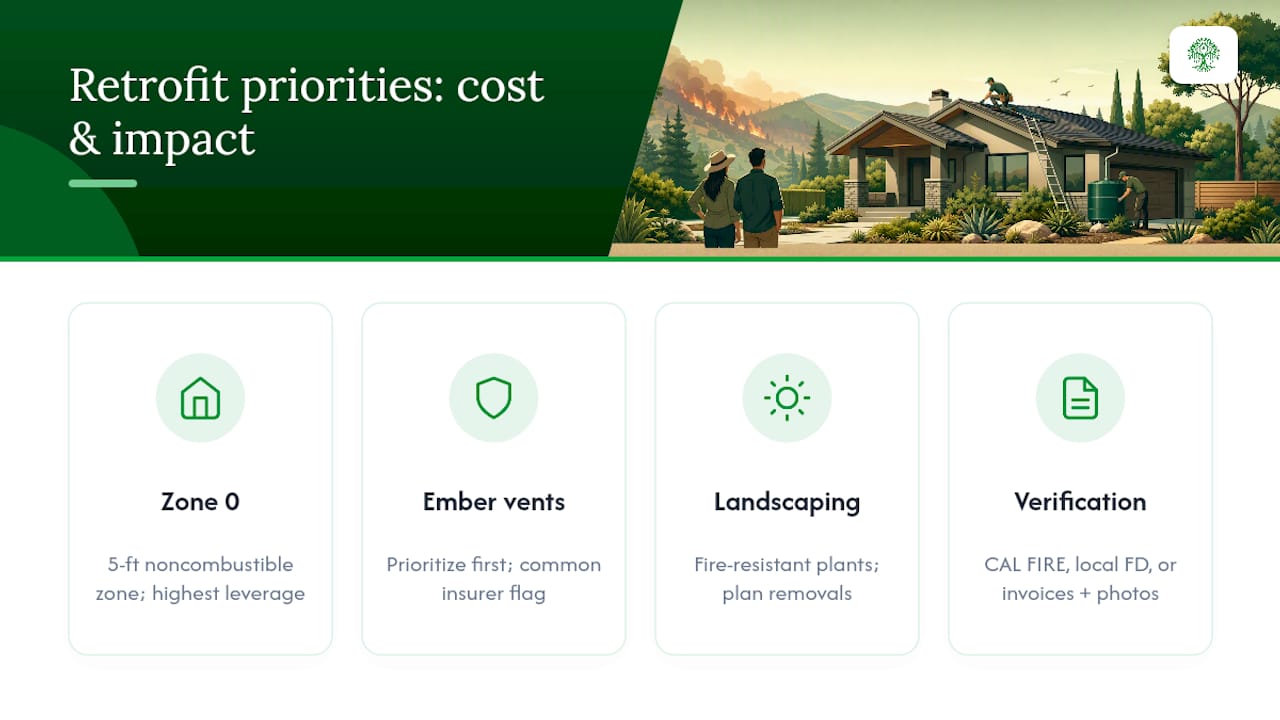
Prioritized retrofits by cost and impact
Zone 0 clearance (the five-foot noncombustible zone immediately around the structure) is the highest-leverage, lowest-cost action for most properties. Practical Zone 0 landscaping guidance and fire-resistant plant selection can help you plan what to remove and what to replace it with before your insurer inspection.
The Santa Barbara Fire Safe Council’s homebuyer resources provide locally-grounded checklists that align with state defensible-space standards and are worth bookmarking for any Northern or Central Coast purchase.
To get mitigation credits recognized by your insurer, acceptable verification includes: a CAL FIRE inspection, a local fire department inspection, or contractor invoices with before-and-after photos. Keep all of these in your closing folder.
Pro Tip: If you’re splitting retrofits into phases, prioritize ember-resistant vents and Zone 0 clearance first. These are the two items most commonly flagged in insurer inspections and the two with the fastest credit recognition timeline under CCR §2644.9.
Your pre-offer and pre-closing wildfire checklist
Follow this sequence. Skipping steps or reordering them is where buyers lose money and time.
- Request the NHD and §1102.6f disclosure from the seller or listing agent before submitting an offer. Confirm FHSZ designation on the CAL FIRE map independently.
- Get an insurance pre-eligibility check from at least two private carriers and a FAIR Plan inquiry. Do this before earnest money changes hands.
- Notify your lender of the FHSZ designation and ask for written confirmation of their insurability conditions for that property type.
- Commission targeted inspections: roof condition and material, ember vulnerability (vents, eaves, soffits), and defensible-space compliance. A standard home inspection often misses these.
- Review the retrofit completion list disclosed under §1102.6f. Price any uncompleted items and decide whether to negotiate a reduction, require seller completion, or use an escrow holdback.
- Include contingencies for mitigation verification or insurer pre-approval where wildfire exposure is material. Make receipt of the final inspection report under §51182 a named contingency.
- Confirm mitigation credits with your insurer in writing before removing contingencies.
- Assemble your closing folder: NHD, §1102.6f disclosure, retrofit completion list, inspection reports, insurer correspondence, CAL FIRE or fire department inspection forms, and contractor invoices.
Negotiation options tied to wildfire risk include price reductions based on documented retrofit costs, seller-paid completion of specific items before close, escrow holdbacks released upon verified completion, and repair escrow release conditions tied to insurer acceptance. Avoid the common mistake of treating wildfire risk as a reason to walk away before you’ve quantified it. For a broader look at what first-time buyers in California typically get wrong at this stage, the common first-time buyer mistakes guide covers the negotiation and contingency errors that cost buyers the most.
Pro Tip: Schedule your insurance pre-check and lender conversation before your earnest-money deposit, not after. Once you’re in contract, your negotiating position on wildfire-related conditions weakens significantly.
How Ficustree helps you navigate a wildfire-risk purchase
Ficustree’s platform is built for exactly this kind of complexity. When you’re buying a home in a wildfire zone, the platform gives you:
- Automated disclosure parsing: Ficustree flags FHSZ designations, §1102.6f vulnerability items, and missing retrofit disclosures in the seller’s documents before you review them manually.
- Insurance pre-check workflows: the platform walks you through the FAIR Plan inquiry and private carrier comparison process so you have coverage options confirmed before earnest money.
- Risk-flag alerts: if a property’s zone designation, roof material, or disclosed features create financing or insurability issues, Ficustree surfaces those flags early in your search.
- On-demand showing agents: hourly showing agents available when you need to visit a property and assess defensible space, roof condition, or vegetation before making an offer.
- Mitigation documentation support: Ficustree helps you organize contractor invoices, inspection forms, and insurer correspondence into a closing folder that satisfies CCR §2644.9 verification requirements.
The platform compresses the typical first-time buyer decision timeline from months of scattered research into a structured, two-month process. For buyers dealing with wildfire-risk variables on top of standard purchase complexity, that structure is the difference between a confident close and a last-minute scramble. The first-time buyer California guide explains how the full workflow fits together from search to keys.
Wildfire risk is negotiable — here’s why buyers shouldn’t panic
The conventional wisdom is that a Very High FHSZ designation is a red flag that should push buyers toward safer zip codes. That framing misses something real.
Properties in wildfire zones often carry a price discount that reflects the market’s perception of risk. When a buyer does the actual work, quantifies the insurance cost, documents the mitigation, and negotiates accordingly, that discount can represent genuine value. The buyers who get hurt are the ones who either ignore the risk entirely or walk away without doing the math.
Consider a straightforward scenario: a pre-2010 home in a Very High FHSZ with an untreated wood shake roof and no ember-resistant vents. The seller hasn’t completed any retrofits. The §1102.6f disclosure makes all of this visible. A prepared buyer uses that disclosure to negotiate a $15,000 price reduction, completes the roof replacement and vent upgrades for roughly $12,000, documents the work, and gets a FAIR Plan policy with Safer from Wildfires credits applied. The net position: a property purchased below comparable non-zone prices, with documented mitigation that improves both insurability and resale value.
That outcome requires the right contingencies, the right inspections, and a lender who understands FAIR Plan coverage. None of it is complicated once you know what to ask for. What it is not is a reason to panic.
Start your wildfire-risk home search with Ficustree
Buying a home in a wildfire zone in California doesn’t have to mean months of confusion about insurance, disclosures, and lender conditions.

The platform runs your wildfire-risk pre-check, parses your disclosures, and connects you with an on-demand showing agent who can assess defensible space and roof condition before you commit. You get the same decision intelligence a seasoned buyer’s agent brings, at a fraction of the cost.
Ficustree and get clarity on your specific property’s insurance, financing, and mitigation picture before your next offer.
Sources
For maps and zone designations, start with CAL FIRE’s FHSZ viewer and cross-reference with your county planning department for local responsibility area designations.
For statutory disclosure text, California Civil Code §1102.6f and Article 1.7 are the primary sources. The California DRE oversees disclosure compliance and publishes buyer-facing guidance.
For insurance regulation and mitigation credits, the California Department of Insurance FAQ on CCR §2644.9 is the definitive reference. The California FAIR Plan program page covers current coverage limits, Safer from Wildfires discounts, and how to apply.
For post-loss legal and claims processes, including what to do if your home sustains fire damage after purchase, the Oaks Law Firm wildfire claims guide covers servicer interactions and insurance-proceed handling in plain language.
For mortgage and servicer guidance, the FDIC’s 2025 guidance letter explains lender obligations toward wildfire-affected borrowers.
Bookmark these five sources. They cover every official need from zone lookup through post-close claims, and they’re updated by the agencies that set the rules.
This article is general information, not a substitute for advice from a qualified financial advisor. Consult a qualified financial professional about your own circumstances before acting on anything here.
- FDIC: Guidance to help financial institutions and facilitate recovery (2025)
- California Civil Code, Article 1.7: Disclosure of Natural and Environmental Hazards
- California FAIR Plan (California Department of Insurance)
FAQ
Which California cities have the highest wildfire risk?
Communities in the Sierra Nevada foothills, the Santa Ana wind corridor (including parts of Los Angeles, Ventura, and San Bernardino counties), and the North Bay region consistently rank among the highest-risk areas in CAL FIRE’s Very High FHSZ designations. Specific cities with large Very High FHSZ footprints include Paradise, Malibu, Altadena, and areas of Santa Rosa.
Does standard California homeowners insurance cover wildfires?
Standard homeowners policies typically cover wildfire damage, but many private insurers have stopped writing new policies or nonrenewed existing ones in high-risk zones. Buyers who can’t obtain private coverage use the California FAIR Plan, which covers fire, lightning, and smoke but excludes liability, water damage, and additional living expenses.
What is the safest part of California from wildfire risk?
Coastal urban areas with low vegetation density, such as parts of San Francisco, San Diego’s coastal neighborhoods, and the Los Angeles basin near the coast, generally carry lower wildfire risk. No area of California is entirely fire-free, but CAL FIRE’s FHSZ map lets you compare designations by parcel before you search.
Will wildfire risk affect my ability to get a mortgage in California?
Wildfire risk itself doesn’t disqualify you from a mortgage, but the inability to secure hazard insurance does. Lenders require proof of coverage before funding. Confirm your insurance options, including FAIR Plan eligibility, before you’re in contract, and notify your lender of the property’s FHSZ designation early in the process.
What is the Natural Hazard Disclosure and when do sellers provide it?
The Natural Hazard Disclosure is a state-mandated form that sellers must provide to buyers, disclosing whether a property falls within designated hazard zones including high and very high FHSZs and state responsibility areas. It is governed by California Civil Code Article 1.7 and is typically delivered within a few days of an accepted offer as part of the seller’s disclosure package.
Recommended
- First Home Buying California Guide: Steps That Work – ficustree.ai
- First-Time Homebuyer Mistakes California Buyers Must Avoid – ficustree.ai
- Why Are Home Prices So High in California? – ficustree.ai
- Bay Area Home Buying: A Practical Guide for Buyers

Leave a Reply