
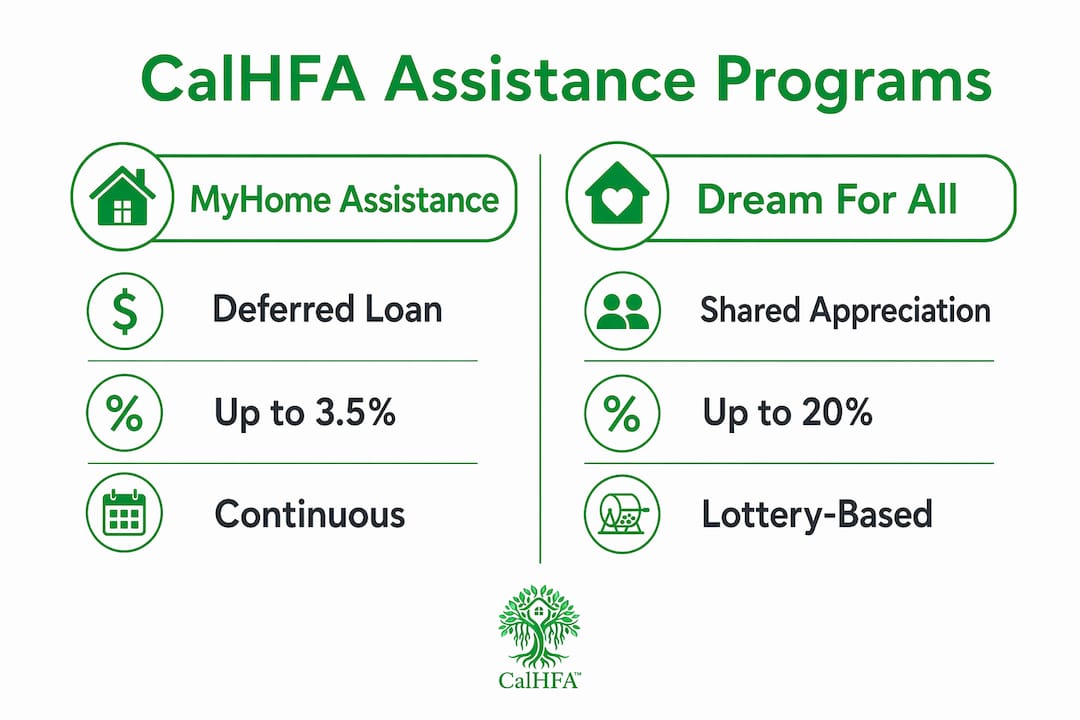
California offers two main CalHFA down payment assistance programs: the MyHome Assistance Program, a deferred-payment junior loan of up to 3.5% for FHA loans or up to 3% for Conventional, VA, or USDA loans, and the California Dream For All Shared Appreciation Loan, which provides up to 20% of the purchase price (capped at $150,000) in exchange for a share of your home’s future appreciation. MyHome is the steady, always-available option. Dream For All offers a larger amount but runs in funding cycles with a randomized voucher selection, so access is not guaranteed. Both require a CalHFA-approved first mortgage, a qualifying income and purchase price, and completed homebuyer education before closing.
Before you go further, do these three things:
- Confirm your lender is on CalHFA’s approved list (not all lenders offer these programs)
- Verify which first mortgage type you qualify for, since the assistance percentage depends on it
- Register for homebuyer education now — the right course takes time, and the wrong one will block your closing
Table of Contents
- What CalHFA down payment assistance programs are available?
- How does the MyHome Assistance Program work?
- How does the California Dream For All program work?
- What other CalHFA programs can you layer with assistance?
- Who qualifies for CalHFA assistance programs?
- How do you apply for CalHFA assistance, step by step?
- What do the real numbers look like on a sample purchase?
- Common pitfalls that stall or kill CalHFA applications
- Key Takeaways
- The part most buyers miss about CalHFA timing
- How Ficustree helps you use CalHFA assistance without the guesswork
- Official sources and where to verify program details
- FAQ
What CalHFA down payment assistance programs are available?
| Program | What It Covers | Assistance Amount | Repayment Type | Availability |
|---|---|---|---|---|
| MyHome Assistance Program | Down payment and/or closing costs | Up to 3.5% (FHA) or 3% (Conv/VA/USDA) | Deferred junior loan | Year-round |
| Dream For All Shared Appreciation Loan | Down payment and/or closing costs | Up to 20%, capped at $150,000 | Shared appreciation on sale/refinance | Voucher cycles; not always open |
| CalPLUS FHA + ZIP | Closing costs only | Varies | Deferred zero-interest loan | Year-round (paired with CalPLUS FHA) |
| CalPLUS Conventional + ZIP | Closing costs only | Varies | Deferred zero-interest loan | Year-round (paired with CalPLUS Conv.) |
| UC Shared Appreciation Loan | Down payment (UC Santa Cruz employees) | Shared appreciation structure | Shared appreciation | Limited to eligible UC employees |
A few things worth knowing about availability: MyHome runs year-round as a continuous program, while Dream For All depends on state funding cycles and voucher windows. If you are targeting Dream For All, check the CalHFA program page for the current voucher status before building your timeline around it.
How does the MyHome Assistance Program work?

MyHome is the workhorse of California homebuyer assistance. It is available to any first-time buyer who qualifies, pairs with multiple first mortgage types, and requires no monthly payment while your primary loan is active.
Eligibility checklist
- You have not owned or resided in a home owned by a spouse within the past three years
- The property will be your primary residence
- Your income falls within CalHFA’s county-specific limits
- You complete an accepted homebuyer education course with one-on-one counseling
- You meet the credit and debt-to-income requirements of both CalHFA and your lender
Exact assistance amounts
MyHome offers a deferred-payment junior loan of up to 3.5% of the purchase price or appraised value (whichever is lower) when paired with a CalHFA FHA first mortgage. For Conventional, VA, or USDA first mortgages, the cap drops to 3%. On a $400,000 purchase with an FHA loan, that is up to $14,000 towards your down payment or closing costs.
How the deferred repayment works
No monthly payment is required while your first mortgage is in place. The MyHome loan term matches your first mortgage, up to 30 years, and repayment is triggered when you sell the home, refinance, or pay off the first mortgage. The funds cannot be used to pay off existing debt or give you cash back, and MyHome must sit in second lien position if you layer other assistance on top.
How to apply for MyHome
- Find a CalHFA-approved lender — CalHFA does not originate loans directly
- Get pre-approved for a CalHFA first mortgage (FHA, Conventional, VA, or USDA)
- Complete the eHome 8-hour homebuyer education course plus the required 1-hour one-on-one counseling session
- Provide your education certificate to your lender
- Your lender submits the loan package to CalHFA for reservation and approval
- Close on your home; MyHome funds are disbursed at closing
Pro Tip: Ask your lender upfront whether they have closed CalHFA loans in the past 12 months. Lenders who regularly close these loans know the required lien ordering, acceptable education certificates, and documentation gaps that trip up first-timers.

How does the California Dream For All program work?
Dream For All is designed for buyers who need a larger boost. It can cover up to 20% of the purchase price, which eliminates the need for private mortgage insurance on a conventional loan and dramatically reduces your monthly payment. The trade-off: CalHFA shares in your home’s future appreciation.
Program highlights
- Provides up to 20% of the purchase price for down payment and/or closing costs
- Capped at $150,000 per borrower
- No monthly payment on the assistance loan
- Must be paired with a Dream For All Conventional first mortgage (not FHA)
- Repayment is due when you sell, refinance, or pay off the first mortgage
- Applicants must register for a voucher; selection is randomized, not first-come, first-served
- First-generation homebuyers may receive priority consideration in some voucher rounds
How the voucher process works
You register during an open window, and CalHFA runs a randomized drawing to allocate vouchers. Completing your education and getting pre-approved before the window opens is the right move, but a voucher is not guaranteed by timing alone. If you are on the waitlist, check the CalHFA Voucher Portal for status updates. Dream For All is not continuously funded, so buyers who cannot wait for the next cycle should plan around MyHome instead.
How shared-appreciation repayment is calculated
When you sell or refinance, you repay the original Dream For All loan amount plus CalHFA’s proportional share of any appreciation. Here is a simple example:
- Purchase price: $500,000
- Dream For All loan: $100,000 (20%)
- CalHFA’s appreciation share: 20%
- You sell five years later for $650,000 (appreciation of $150,000)
- You repay: $100,000 (original loan) + $30,000 (20% of $150,000 appreciation) = $130,000
If your home does not appreciate, you repay only the original loan amount. The shared-appreciation structure means the program costs more in a rising market, which is worth modeling before you commit. For buyers who plan to hold the home long-term, that math can still favor Dream For All over a higher-rate loan with PMI.
What other CalHFA programs can you layer with assistance?
Beyond MyHome and Dream For All, CalHFA and its partners offer several targeted programs. Understanding which ones stack together saves you money and avoids technical denials.
Other programs to know
- CalPLUS FHA + ZIP: A slightly higher-rate FHA first mortgage paired with the Zero Interest Program (ZIP) for closing cost assistance. Useful when you need help with closing costs but already have a down payment.
- CalPLUS Conventional + ZIP: Same structure for conventional buyers. ZIP is a deferred, zero-interest subordinate loan.
- CalPLUS Access FHA / Conventional + MyAccess: Pairs a CalPLUS first mortgage with MyAccess for down payment or closing cost help.
- UC Shared Appreciation Loan: A new employer-based program for eligible UC Santa Cruz employees, launching July 15, 2026. Structured similarly to Dream For All.
- Local and county grants: Many California counties and cities offer their own down payment grants that can layer with CalHFA programs.
Compatibility: which first mortgage works with which assistance?
| Assistance Program | FHA First Mortgage | Conventional First Mortgage | VA First Mortgage | USDA First Mortgage |
|---|---|---|---|---|
| MyHome | Yes (up to 3.5%) | Yes (up to 3%) | Yes (up to 3%) | Yes (up to 3%) |
| Dream For All | No | Yes (Dream For All Conv. only) | No | No |
| ZIP (via CalPLUS) | Yes (CalPLUS FHA) | Yes (CalPLUS Conv.) | No | No |
On stacking: You can layer non-CalHFA local grants with MyHome, but MyHome must remain in second lien position when combined with other assistance. Dream For All cannot be combined with MyHome. Always confirm lien ordering with your lender before submitting a loan package, since a lien position error is one of the most common technical denial reasons. For a broader look at California first-time buyer programs, including local grants that pair well with CalHFA, Ficustree’s program guide covers the full picture.
Who qualifies for CalHFA assistance programs?
Eligibility has several layers. Meeting CalHFA’s baseline rules is necessary but not sufficient — your lender may apply stricter standards on top.
Core eligibility requirements
- First-time buyer definition: You must not have held an ownership interest in a principal residence, or resided in a home owned by a spouse, during the previous three years. All borrowers on the loan must meet this definition.
- Occupancy: The home must be your primary residence. Investment properties and second homes are not eligible.
- Income limits: CalHFA sets county-specific income limits that change periodically. Check the current tables on CalHFA’s website for your county before assuming you qualify.
- Purchase price limits: Similarly county-based. High-cost counties like San Francisco and Santa Clara have higher limits than inland counties.
- Homebuyer education: You must complete an accepted course before closing. CalHFA accepts eHome’s 8-hour homebuyer education course with a mandatory 1-hour one-on-one counseling session. Courses that skip the counseling component are commonly rejected.
- Credit and DTI: CalHFA publishes baseline credit score and debt-to-income guidelines, but individual lenders often require higher scores or lower DTI ratios through their own overlays.
Self-employed applicants
Self-employed buyers qualify, but documentation requirements are more involved. Lenders typically require two years of federal tax returns (personal and business), a year-to-date profit and loss statement, and sometimes a CPA letter verifying business stability. Income is calculated from net earnings after business deductions, which can reduce your qualifying income significantly compared to a W-2 employee with the same gross revenue.
Pro Tip: If you are self-employed, run your qualifying income calculation with your lender before you start shopping. Many self-employed buyers are surprised by how much their write-offs reduce their mortgage-eligible income.
How do you apply for CalHFA assistance, step by step?
Application steps
- Confirm lender approval. Use CalHFA’s lender search to find an approved lender. Not every bank or mortgage broker is on the list.
- Get pre-approved. Your lender will pull credit, verify income, and determine which CalHFA first mortgage and assistance program you qualify for.
- Complete homebuyer education. Finish the eHome 8-hour course and the 1-hour counseling session. Obtain your certificate.
- Register for a voucher (Dream For All only). If you are pursuing Dream For All, watch for the open registration window and submit during that period.
- Make an offer and open escrow. Your lender submits the loan package to CalHFA for reservation once you are in contract.
- Provide documentation. Your lender will collect the items below.
- Close. Assistance funds are disbursed at closing alongside your first mortgage.
Documents you will need
| Document | Notes |
|---|---|
| Federal tax returns (2 years) | W-2 and self-employed borrowers |
| Recent pay stubs (30 days) | W-2 employees |
| Bank statements (2–3 months) | All accounts used for assets |
| Government-issued photo ID | Driver’s license or passport |
| Homebuyer education certificate | Must include counseling component |
| Rental history / landlord contact | Some lenders request 12 months |
| Business tax returns + P&L | Self-employed borrowers only |
| Social Security card | Required by most lenders |
Timeline note: Education alone can take one to two weeks if you schedule the counseling session separately. Voucher windows for Dream For All may open only once or twice a year. Build both into your timeline before you write an offer. For a full California homebuying roadmap, the step-by-step guide at Ficustree walks you through the process from pre-approval to keys.
What do the real numbers look like on a sample purchase?
MyHome example
On a $400,000 purchase with a CalHFA FHA loan, MyHome provides assistance up to the allowed percentage. That $14,000 sits as a deferred second mortgage with no monthly payment. Your FHA first mortgage covers the remaining balance after your own down payment contribution. When you sell or refinance, you repay the $14,000 plus any accrued interest. Because MyHome carries no monthly payment, it does not raise your monthly housing cost at all while you own the home.
Dream For All example
On a $500,000 purchase, Dream For All covers a significant percentage of the price. This assistance can eliminate PMI on a conventional first mortgage, leading to notable monthly savings compared to a low-down-payment loan. The cost comes later: when you sell for $650,000 (a $150,000 gain), you repay $100,000 plus CalHFA’s 20% share of appreciation ($30,000), totaling $130,000. That is a meaningful cost, but it may still be less than years of PMI payments plus a higher loan balance.
Cost trade-offs to consider
- MyHome adds no monthly cost but reduces your equity slightly at payoff
- Dream For All eliminates PMI but shares upside in a rising market
- Using assistance lowers your loan-to-value ratio, which can improve your interest rate tier
- Both programs affect your refinance math: the second lien must be paid off or subordinated when you refinance
- A home affordability calculator can model how each scenario changes your monthly payment and total cost over time
Common pitfalls that stall or kill CalHFA applications
Most CalHFA denials are preventable. Here is where buyers most often run into trouble.
Frequent stall points
- Wrong education course: Completing an online course without the required 1-hour counseling session is one of the most common closing blockers. Confirm your course is accepted before you start.
- Lender not CalHFA-approved: Some buyers get pre-approved with a lender who cannot actually originate CalHFA loans. Verify approval status before you go deep into the process.
- Income documentation gaps: Missing a year of tax returns, unexplained deposits, or inconsistent self-employment income can delay underwriting by weeks.
- Lender overlays: Individual lenders can require higher credit scores or lower debt-to-income ratios than CalHFA’s baseline. A buyer who meets CalHFA’s published minimums can still be declined by a specific lender.
- Voucher timing mismatch: Assuming Dream For All will be open when you are ready to buy is a planning error. The program may be closed or oversubscribed.
- Lien ordering errors: Layering local grants with MyHome without confirming lien position can cause a technical denial at the last minute.
Fraud alert
CalHFA communicates through official channels. Voucher status is confirmed only through the CalHFA Voucher Portal or your CalHFA-approved lender. If someone contacts you claiming to guarantee a voucher or expedite approval for a fee, that is a scam. CalHFA does not charge application fees and does not use third-party brokers to distribute vouchers.
Pro Tip: Ask your lender for a written confirmation that they are CalHFA-approved and have closed at least five CalHFA loans in the past year. That single question filters out most of the lenders who will waste your time.
For a broader list of first-time homebuyer mistakes that derail California closings, Ficustree’s guide covers the full range beyond just CalHFA.
Key Takeaways
CalHFA down payment assistance gives California first-time buyers two real paths: a steady deferred loan through MyHome or a larger shared-appreciation loan through Dream For All, both requiring a CalHFA-approved lender and completed homebuyer education.
| Point | Details |
|---|---|
| MyHome assistance amounts | Up to 3.5% for FHA loans; up to 3% for Conventional, VA, or USDA loans — deferred with no monthly payment. |
| Dream For All structure | Up to 20% of purchase price (capped at $150,000); repay original loan plus CalHFA’s appreciation share on sale or refinance. |
| Education is a hard requirement | Complete eHome’s 8-hour course with 1-hour counseling before closing — courses without counseling are rejected. |
| Lender overlays are real | CalHFA sets the floor; your lender may require a higher credit score or lower DTI than CalHFA’s published minimums. |
| Ficustree supports the process | Ficustree matches you with CalHFA-aware lenders, models assistance scenarios with its affordability calculator, and guides you through document prep. |
The part most buyers miss about CalHFA timing
The biggest mistake I see first-time buyers make with CalHFA is treating it as a last-minute add-on. They find a house, fall in love with it, and then ask their lender about assistance. By that point, they have often already chosen a lender who is not CalHFA-approved, skipped the education requirement, or missed a Dream For All voucher window entirely.
The buyers who use these programs successfully do the opposite. They confirm lender approval before they start touring homes. They finish the education course during the pre-approval phase, not after they are in contract. If they want Dream For All, they register for the voucher as soon as the window opens and treat MyHome as their backup plan.
There is also a subtler issue with lender overlays that most guides gloss over. CalHFA’s published credit and income guidelines are the minimum, not the guarantee. A lender with stricter overlays can decline a buyer who technically qualifies by CalHFA’s rules. The fix is simple: ask your lender directly what their overlay requirements are, not just what CalHFA requires. That one conversation can save you weeks of wasted effort.
My recommended sequence: get pre-approved, complete education, confirm lender CalHFA experience, then make offers. In that order.
How Ficustree helps you use CalHFA assistance without the guesswork
Getting CalHFA assistance approved is not complicated, but it requires the right lender, the right timing, and the right documents. That is exactly where Ficustree earns its place in your process.

Ficustree matches California first-time buyers with lenders who have a real track record closing CalHFA loans, not just lenders who are technically on the approved list. The platform’s home affordability calculator lets you model how MyHome or Dream For All changes your monthly payment and total loan cost before you commit. Document checklists built into the platform keep you organized from pre-approval through closing, so you are not scrambling for a tax return the night before your loan submission deadline.
Buyers who use Ficustree pay $1,000 at closing plus 1% commission and keep a rebate of roughly 2% where legally permitted. The platform is free to use. Ficustree does not guarantee CalHFA program approval — eligibility depends on your financial profile and program availability. But it does give you the structure and lender connections to give yourself the best shot.
Start your search at ficustree.ai and see how much assistance you may qualify for.
Official sources and where to verify program details
Use these primary sources to confirm current rules, income limits, and program status before you apply:
- CalHFA Down Payment Assistance Programs: The official program index listing MyHome, Dream For All, ZIP, and all current assistance options with handbook links.
- MyHome Assistance Program page: Exact assistance amounts, eligibility rules, and the link to the MyHome Program Handbook.
- CalHFA MyHome Program Handbook: Full lender and borrower rules, including lien position requirements and fund use restrictions.
- California Dream For All program page: Voucher registration, shared-appreciation repayment terms, and the Dream For All Handbook.
- CalHFA Borrower Eligibility: The official three-year lookback definition and occupancy requirements.
- eHome America: CalHFA’s accepted online homebuyer education provider offering the 8-hour course with the required 1-hour counseling component.
- HUD Housing Counseling: Find HUD-approved counseling agencies if you prefer in-person or phone counseling over an online course.
For questions not answered by these pages, contact the CalHFA Help Center directly or ask a CalHFA-approved lender. Program rules, income limits, and voucher availability change; always verify current details before you rely on them.
This article is general information, not legal or financial advice. Confirm current program rules, income limits, and your personal eligibility with a CalHFA-approved lender or a qualified housing counselor before making any financial decisions.
FAQ
Is California giving up to $150,000 to first-time homebuyers?
Yes, through the California Dream For All Shared Appreciation Loan, which provides up to 20% of the purchase price for down payment and closing costs, capped at $150,000. The program runs in funding cycles with randomized voucher selection, so access is not guaranteed.
Does CalHFA help with down payments?
Yes. CalHFA’s MyHome Assistance Program provides a deferred-payment junior loan of up to 3.5% (FHA) or 3% (Conventional/VA/USDA) of the purchase price for down payment and closing costs, with no monthly payment required while the first mortgage is active.
With a CalHFA FHA loan and MyHome assistance, you could receive up to $10,500 (3.5% of a $300,000 purchase) toward your down payment and closing costs, potentially reducing your out-of-pocket contribution depending on your income and the lender’s requirements.
How much of a down payment do I need for a $400,000 house?
MyHome can provide assistance up to the allowed percentage on a CalHFA FHA loan or a somewhat lower percentage on Conventional, VA, or USDA loans. Dream For All can provide assistance up to a significant portion of a conventional purchase, potentially eliminating PMI entirely.
Recommended
- California First-Time Buyer Programs Explained for 2026 – ficustree.ai
- Buying a House with No Money Down: 2026 Guide – ficustree.ai
- First Generation Homebuyer Program: 2026 Guide for CA and TX – ficustree.ai
- California Closing Costs Breakdown for First-Time Buyers – ficustree.ai

Leave a Reply