
A listing agent is a licensed real estate professional who represents the seller exclusively throughout a home sale, managing everything from pricing to closing. If you are buying a home in California or Texas, understanding this role is not optional. It shapes every offer you submit, every negotiation you enter, and every disclosure you receive. The listing agent works for the seller, not for you. Knowing that changes how you approach the entire process.
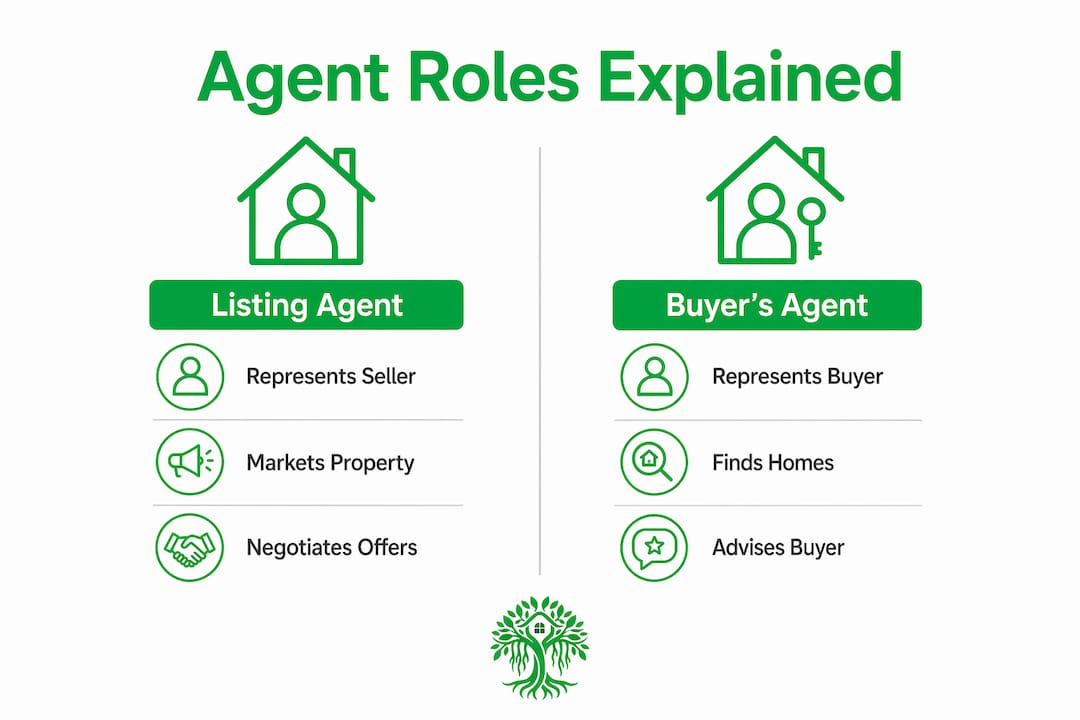
What is a listing agent and what do they actually do?
A listing agent is the seller’s dedicated representative, hired to market the property, attract qualified buyers, and close the sale at the best possible price. The industry also calls this person the seller’s agent. Both terms refer to the same role.
The relationship begins with a listing agreement, a contract that grants the agent exclusive rights to market and sell the property, typically for a period of 3–6 months. During that window, the agent owes the seller fiduciary duties: loyalty, confidentiality, and careful handling of the seller’s financial interests. Those duties do not extend to you as a buyer.

From there, the agent’s responsibilities span pricing, marketing, vetting buyers, managing inspections, and coordinating the final closing. That is a wide scope of work, and each piece directly affects your experience as a buyer on the other side of the transaction.
What are the key responsibilities of a listing agent?
The listing agent’s job covers six distinct phases, each with real consequences for buyers.
- Pricing strategy. The agent runs a Comparative Market Analysis (CMA), reviewing recent sales of similar homes nearby to recommend a listing price. A well-priced home attracts multiple offers. An overpriced one sits on the market and often sells for less in the end.
- Marketing the home. Agents market homes through MLS and platforms like Zillow and Realtor.com, plus social media and open houses. Quality marketing drives buyer interest and improves the final sale price.
- Vetting offers. When offers arrive, the agent does not simply pick the highest number. They assess price, contingencies, buyer qualifications, and closing timelines to identify which offer poses the least risk of falling apart.
- Negotiating terms. The agent negotiates price, repair requests, seller concessions, and closing dates on the seller’s behalf.
- Managing inspections and appraisals. After an offer is accepted, the agent coordinates inspections and appraisal scheduling, then advises the seller on how to respond to any findings.
- Closing coordination. The agent’s role continues until closing, managing financing deadlines, title work, and possession timing.
Pro Tip: When a listing agent counters your offer with a closing cost credit instead of agreeing to repairs, that is a deliberate tactic. Agents often favor credits over repairs to keep the deal moving and protect the seller’s convenience. Factor that into your offer strategy.
Experienced listing agents also advise sellers on property improvements that deliver the best return before listing, steering sellers away from costly upgrades that buyers will not pay extra for. That advice shapes the condition of the home you eventually tour.
Listing agent vs. buyer’s agent: what is the difference?
The distinction between a listing agent and a buyer’s agent is the most important concept a first-time buyer can understand. These two roles sit on opposite sides of the transaction with opposing goals.
| Factor | Listing agent | Buyer’s agent |
|---|---|---|
| Who they represent | The seller | You, the buyer |
| Primary goal | Maximize the seller’s sale price | Get the buyer the best deal |
| Fiduciary duty | Owed to the seller only | Owed to the buyer |
| Disclosure obligations | Must protect seller’s confidential information | Must share all relevant information with buyer |
| Who pays them | Seller (from sale proceeds) | Negotiated, often covered by seller concession |
Listing agents advocate exclusively for the seller’s financial interests. They cannot share information that would disadvantage their seller client during negotiations. That means if the seller is desperate to close quickly, the listing agent is not going to tell you that.
Many buyers mistakenly assume the listing agent represents their interests. This misunderstanding causes real harm during negotiations. Going directly to the listing agent without your own representation is called dual agency in California, and it creates a conflict of interest that rarely benefits the buyer.
Hiring your own buyer’s agent gives you someone whose fiduciary duty runs to you. That agent can review disclosures critically, advise on offer strategy, and negotiate repairs without any obligation to protect the seller. For a first-time buyer in California or Texas, that representation is not a luxury. It is a practical necessity.
How do listing agents price and market a home?
Pricing is where listing agents earn their keep, and it is also where buyers need to pay close attention. Effective pricing focuses on a competitive yet realistic number that attracts multiple offers, not simply the highest sticker price. A home priced too high sits on the market, collects price reductions, and often sells for less than a correctly priced home would have.
The CMA compares the subject property to recently sold homes with similar size, condition, location, and features. In California markets like the Bay Area or Los Angeles, comparable sales from the past 90 days carry the most weight. In Texas markets like Austin or Dallas, inventory moves fast enough that 60-day comps are often more relevant.
Marketing follows pricing. A strong listing agent deploys:
- Professional photography and, in higher price ranges, video walkthroughs
- MLS syndication to Zillow, Realtor.com, and regional portals
- Targeted social media advertising to reach buyers actively searching in the area
- Open houses and broker tours to generate in-person interest
Pro Tip: Pay attention to the quality of a listing’s photos and description. A poorly marketed home may be underpriced to compensate, which could signal a motivated seller. A beautifully presented listing with strong marketing signals a confident seller who expects competition.
The marketing plan a listing agent presents to a seller during the listing presentation reveals their competence and approach. As a buyer, the quality of that marketing affects how many competing offers you face.
What first-time buyers in California and Texas should know
Buying in California or Texas means interacting with listing agents constantly, even before you submit a single offer. Here is what you need to keep in mind.
- The listing agent’s loyalty is not yours. Every question you ask at an open house, every comment you make about your budget or timeline, can be shared with the seller. The listing agent is required to pass along information that helps their client.
- Understand the offer review process. In California, sellers typically review all offers on a set date to encourage competition. In Texas, offers are often reviewed as they arrive. Knowing which approach applies changes your timing strategy. You can learn more about California’s offer process before you submit.
- Hire your own representation. A buyer’s agent reviews disclosures on your behalf, advises on contingencies, and negotiates repairs without any obligation to the seller. This is especially important in California, where disclosure packages can run dozens of pages.
- Know how contingencies work. Inspection, appraisal, and financing contingencies protect you as a buyer. The listing agent will push to minimize or waive them on the seller’s behalf. Your agent’s job is to protect them for you.
- Understand seller concessions. In both California and Texas, buyers can request seller concessions to cover closing costs. The listing agent will negotiate these on the seller’s behalf, so knowing what is reasonable in your market gives you a real advantage.
How to choose the right listing agent: what buyers can learn from the process
Sellers choose listing agents through a process called a listing presentation. Understanding what a good listing agent looks like helps you recognize whether the seller’s agent across the table is skilled or not.
- Local market knowledge. A strong listing agent knows recent sales, active competition, and neighborhood trends. In California, that means understanding school ratings, HOA rules, and disclosure norms. In Texas, it means knowing flood zone designations and property tax implications.
- A clear marketing plan. Competent agents arrive at listing presentations with a written marketing plan, not a verbal promise. That plan should include MLS strategy, photography, and a timeline.
- A verifiable track record. Days on market, list-to-sale price ratios, and the number of transactions closed in the past 12 months all reveal agent performance. Ask for these numbers.
- Communication style. A responsive agent moves transactions forward. An unresponsive one creates delays that cost both sides money.
- Negotiation skill. The best listing agents do not just accept the first offer. They manage multiple offers, create competition, and protect the seller’s bottom line. That skill works against you if you do not have equally skilled representation.
Understanding how real estate commission works also helps you see why agent incentives matter. Commission structures affect how motivated an agent is to close quickly versus hold out for a better offer.
Key takeaways
A listing agent represents the seller exclusively and owes no fiduciary duty to the buyer, making independent buyer representation the single most protective step a first-time buyer can take.
| Point | Details |
|---|---|
| Listing agent loyalty | The listing agent works for the seller only and cannot share information that harms the seller’s position. |
| Offer evaluation | Agents assess price, contingencies, and buyer qualifications together, not just the highest number. |
| Marketing drives competition | Strong marketing on Zillow, MLS, and social media increases buyer competition and raises the final sale price. |
| Buyer representation matters | Hiring your own buyer’s agent gives you fiduciary protection the listing agent cannot provide. |
| Post-inspection tactics | Listing agents often push for closing cost credits instead of repairs to protect the seller’s timeline. |
Why buyers who understand listing agents win more negotiations
Most first-time buyers walk into open houses and treat the listing agent like a neutral resource. That is the single most expensive mistake I see. The listing agent is a skilled professional whose entire job is to get the seller the best outcome possible. Treating them as a helpful guide puts you at a structural disadvantage before you even write an offer.
What I have found is that buyers who understand the listing agent’s role stop volunteering information they should not. They stop asking the listing agent for advice on what to offer. They stop assuming the agent will flag problems in the home. Once you internalize that the listing agent is the seller’s advocate, your behavior at open houses, your questions during tours, and your offer strategy all change for the better.
The other thing worth saying plainly: the listing agent is not your enemy. They are doing their job. The answer is not to distrust them but to match their representation with your own. A good buyer’s broker levels the playing field completely. You get someone who reads the disclosures looking for problems, not reassurances. You get someone who knows when to push on repairs and when to take the credit. That is the difference between a buyer who closes with confidence and one who discovers surprises after move-in.
In California and Texas, where transactions move fast and the stakes are high, knowing who is in the room and whose side they are on is not paranoia. It is preparation.
— Anand
How Ficustree helps California and Texas buyers stay informed

Ficustree is built for first-time buyers in California and Texas who want clarity, not confusion. The platform gives you AI-powered search that matches homes to your actual priorities, not just your price range. You get on-demand showing agents, disclosure analysis support, and buyer representation at $1,000 plus 1% at closing, with a rebate of roughly 2% where permitted. You do not need to figure out listing agent dynamics alone. Ficustree puts a knowledgeable advocate in your corner from the first search to the final signature. Start your search and see how much clearer the process gets when the house finds you.
FAQ
What is a listing agent in simple terms?
A listing agent is a licensed real estate agent hired by the seller to market the home, negotiate offers, and manage the sale from listing to closing. They represent the seller’s interests exclusively.
Does a listing agent represent the buyer too?
No. A listing agent owes fiduciary duties to the seller only. Buyers who work directly with a listing agent without their own representation give up the right to unbiased advice and negotiation support.
How is a listing agent paid?
The listing agent is typically paid a commission from the sale proceeds at closing. The total commission is negotiated in the listing agreement and is usually split between the listing agent and the buyer’s agent.
Can a listing agent show me homes I want to buy?
A listing agent can show you the specific home they represent, but they cannot act as your buyer’s agent on that same transaction without creating a dual agency conflict. In California, dual agency requires written consent from both parties.
What should I never say to a listing agent at an open house?
Do not share your maximum budget, your move-in urgency, or any personal motivation for buying. The listing agent is required to pass information that benefits the seller to their client, and those details can be used against you in negotiations.
Recommended
- What Is a Buyer’s Agent? Your 2026 Home Buying Guide – ficustree.ai
- First Time Homebuyer Guide: Simple Steps for Your First Home
- Why Title Search Matters When Buying a Home – ficustree.ai
- How Real Estate Commission Works for Buyers and Sellers – ficustree.ai

Leave a Reply