
Offer optimization in real estate is defined as the strategic, data-driven process of structuring a purchase offer to maximize acceptance by balancing price with non-monetary terms. Most first-time buyers assume the highest bid wins. The reality is that sellers weigh certainty, speed, and simplicity just as heavily as the number on the page. A well-structured offer addresses all three. Understanding what does offer optimization mean in real estate gives you a real edge in the real estate bidding process, especially in competitive California and Texas markets where multiple offers arrive within days of listing.
What does offer optimization mean in real estate?
Offer optimization is the practice of adjusting every lever in a purchase offer, not just price, to reduce a seller’s perceived risk and increase the likelihood of acceptance. The industry term for this broader practice is offer strategy, and the two phrases describe the same discipline. Offer optimization strategies involve balancing earnest money deposits, contingency timelines of 7–14 days, and closing speed to signal buyer seriousness without overexposing yourself financially.
Typical closing timelines run 30–45 days, but a well-structured offer can close in 21 days. That speed alone can tip a seller’s decision. Earnest money above 1% of the purchase price adds buyer risk, so the goal is to hit the right amount, not the highest amount.

The core insight is this: sellers are not just evaluating your price. They are evaluating how likely the deal is to close without drama. Every element of your offer either adds or removes that uncertainty.
What are the main elements of an optimized real estate offer?
Six components determine whether your offer stands out or gets passed over.
- Earnest money deposit. The standard is roughly 1% of the purchase price. Going higher signals commitment but increases your financial exposure if the deal falls apart. Match the local norm unless your agent has a specific reason to go above it.
- Contingency type and timeline. Inspection contingencies typically run 7–10 days. Appraisal contingencies run 10–14 days. Shorter windows signal confidence. A pass/fail inspection clause lets you keep protection while showing the seller you are not looking for minor repair credits.
- Closing date flexibility. A seller moving out of a family home may need 45 days. A seller who has already bought elsewhere may need 21. Matching their timeline costs you nothing and can be worth thousands in goodwill.
- Escalation clauses. These automatically raise your offer by a set increment above competing bids, up to a cap you define. AI tools now calibrate escalation caps at the 75th percentile of winning premiums in a target zip code, using the last 90 days of data.
- Appraisal gap coverage. If the home appraises below your offer price, an appraisal gap guarantee commits you to covering the shortfall out of pocket. Appraisal gap guarantees typically cover $5,000–$15,000 and remove one of the most common reasons deals collapse.
- Temporary rate buydowns. A 2-1 buydown reduces your mortgage payment in the first two years without changing the purchase price. Rate buydowns and seller credits make your monthly payment more manageable while keeping the headline number competitive.
Pro Tip: Ask your agent to run a pre-inspection before submitting your offer. You can then waive the inspection contingency with full knowledge of the home’s condition, which reads as a clean offer without the blind risk.
How do sellers evaluate offers beyond the price?
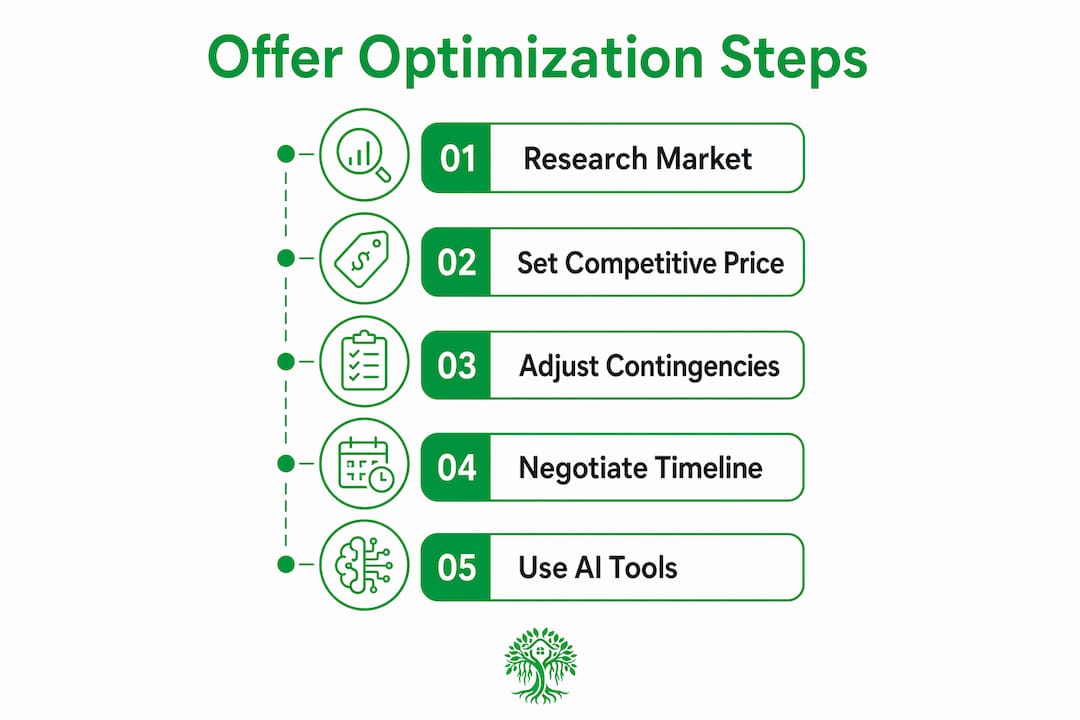
Sellers prioritize certainty. A slightly lower offer with fewer contingencies and a faster close will beat a higher offer loaded with conditions in most competitive markets. Understanding this changes how you approach enhancing property offers entirely.
Here is how sellers typically rank what matters to them:
- Likelihood of closing. Sellers fear the deal falling through after they have taken the home off the market. Fewer contingencies and a strong pre-approval letter reduce that fear directly.
- Simplicity of terms. Overcomplicated offers confuse sellers and their agents. When a seller has three to six competing bids, a clean offer with standard terms is easier to say yes to than a creative one that requires explanation.
- Closing timeline alignment. Sellers have lives outside the transaction. A lease expiring, a school year starting, or a new job beginning all affect when they need to move. Offering to match their preferred date shows you did your homework.
- Flexibility on possession. A rent-back agreement lets the seller stay in the home for a set period after closing, often 30–60 days. Understanding seller timing needs like lease expirations or school schedules, then offering a rent-back agreement, can decisively influence which offer gets chosen.
- Financial strength signals. A larger down payment, a verified pre-approval rather than a pre-qualification, and a reputable lender all reduce the seller’s anxiety about financing falling through.
Pro Tip: Have your agent call the listing agent before submitting. Ask one direct question: “Is there anything beyond price that matters to the seller?” You will be surprised how often you get a useful answer.
How do technology and data shape offer strategies today?
AI has changed what a well-informed offer looks like. Buyers who work with agents using AI tools enter negotiations with a level of precision that was unavailable five years ago.
AI-powered tools now analyze market velocity and appraisal risk in under 60 seconds. That speed matters when a listing goes live on a Thursday and offers are due by Sunday. The tool pulls sold-above-list data from the past 90 days in a specific zip code and calculates where your escalation cap should sit to be competitive without overpaying.
| Data input | What AI analyzes | Offer output |
|---|---|---|
| Recent sold prices | Days on market and list-to-sale ratio | Recommended offer price range |
| Appraisal history | Gap between list price and appraised value | Appraisal gap coverage amount |
| Competing offer patterns | Escalation premiums in the zip code | Escalation clause cap |
| Seller listing history | Days listed, price reductions | Seller motivation score |
The buyer’s agent role has evolved alongside these tools. Agents now act as data-driven strategists, probing seller motivations and aligning offer terms to specific needs, not just submitting a price and hoping. For first-time buyers who lack experience reading a market, this combination of agent judgment and AI analysis removes a significant amount of guesswork. Ficustree’s platform is built around exactly this model, giving buyers access to AI-powered offer analysis alongside direct buyer representation.
Practical steps to optimize your offer as a first-time buyer
Knowing the theory is one thing. Applying it under time pressure is another. These steps give you a clear process to follow when you are ready to submit.
- Define your true maximum before you tour. Know the highest price you would pay with no regrets, then set your opening offer below it. This gives you room to escalate without panic.
- Get a first-time buyer guide before your first offer. Understanding the full process, from pre-approval through escrow, prevents surprises that slow down your offer response time.
- Ask your agent to profile the seller. How long has the home been listed? Has the price been reduced? Is the seller already under contract on another home? Each answer shapes which terms to adjust.
- Shorten contingency windows, not eliminate them. Waiving an inspection entirely is high risk for a first-time buyer. A 7-day inspection window with a pass/fail clause gives you protection while signaling speed.
- Keep the offer document clean. One page of terms is better than three. Every extra condition is a reason for the seller to hesitate. Work with your agent to strip out anything that is not necessary.
- Consider an appraisal gap guarantee on tight inventory. In markets where homes routinely sell above list price, an appraisal gap guarantee of $5,000–$10,000 can be the difference between winning and losing. Know your limit before you write it in.
- Use AI tools to check your offer before submitting. Platforms like Ficustree analyze comparable sales and flag whether your offer price and terms are competitive for that specific zip code. That check takes minutes and can save you from a weak offer or an overpay.
Understanding how AI changes home search also helps you move faster. When you already know a neighborhood’s price trends, you can submit a confident offer the same day you tour, which sellers notice.
Key takeaways
Offer optimization in real estate means structuring every term of your purchase offer, not just the price, to reduce seller risk and maximize your chances of acceptance.
| Point | Details |
|---|---|
| Price is one lever, not the only one | Earnest money, contingency timelines, and closing speed all influence seller decisions. |
| Sellers choose certainty over maximum price | A clean, simple offer with fewer conditions often beats a higher, complicated one. |
| AI tools sharpen offer precision | Data from the last 90 days of sales helps calibrate escalation caps and appraisal gap amounts. |
| Contingency modifications beat waivers | Pass/fail inspection clauses protect buyers while signaling confidence to sellers. |
| Agent intelligence is still the edge | Agents who probe seller motivations and align terms to specific needs win more offers. |
What I’ve learned about offer optimization that most guides skip
Most articles on offer strategy focus on the mechanics. Earnest money percentages, contingency timelines, escalation clauses. That information is useful, but it misses the human layer that actually decides most deals.
I have watched buyers lose homes they could have won because they treated the offer like a form to fill out rather than a message to send. Every term you include or exclude communicates something to the seller. A 21-day close says, “I am organized and ready.” A 14-day inspection window says, “I am not going to drag this out.” A rent-back offer says, “I did my homework on your situation.”
The buyers who win in competitive markets are not always the ones with the most money. They are the ones whose agents asked the right questions before submitting. What does the seller need beyond price? What would make them nervous about your offer? What would make them feel safe?
The second thing most guides miss is the risk of over-engineering. I have seen buyers add appraisal gap guarantees, escalation clauses, pre-inspection waivers, and rent-back offers all at once, and lose to a buyer who submitted a clean offer at a fair price with a 30-day close. Sellers read complexity as risk. When in doubt, simplify.
Work with a buyer’s agent who treats offer strategy as a problem to solve, not a template to complete. The data tools available today are genuinely useful, but they work best when paired with someone who can read the room.
— Anand
How Ficustree helps first-time buyers craft stronger offers
First-time buyers in California and Texas face some of the most competitive markets in the country. Ficustree is built to give you the same data-driven offer intelligence that experienced buyers and agents use, without the traditional commission structure that eats into your budget.

Ficustree’s AI platform analyzes market velocity, recent sold-above-list data, and appraisal risk for your target zip code. You get clear guidance on offer price, escalation caps, and term adjustments before you submit. Buyers pay $1,000 at closing plus 1% commission and keep a rebate of roughly 2% where legally permitted. You also get hourly showing agents on demand and the full platform free. Start building your offer strategy at Ficustree and see what a data-backed offer looks like for your market.
FAQ
What does offer optimization mean in real estate?
Offer optimization is the process of structuring a purchase offer to balance price with non-monetary terms like earnest money, contingency timelines, and closing speed to maximize the seller’s likelihood of accepting.
Is the highest offer always the winning offer?
No. Sellers prioritize certainty and simplicity. A slightly lower offer with fewer contingencies and a faster close regularly beats a higher offer with complex conditions in competitive markets.
What is an escalation clause and when should I use one?
An escalation clause automatically raises your offer above competing bids by a set increment, up to a cap you define. Use one when you expect multiple offers and want to stay competitive without guessing the final price.
Should first-time buyers waive the inspection contingency?
Waiving the inspection entirely carries significant risk. A better approach is a pass/fail inspection clause or a pre-inspection, which signals confidence to the seller while keeping your core protections intact.
How does AI help with real estate offer strategies?
AI tools analyze recent sold-above-list data, appraisal history, and market velocity to recommend offer price ranges, escalation caps, and appraisal gap amounts, giving buyers data-backed precision in under 60 seconds.
Recommended
- First Time Homebuyer Guide: Simple Steps for Your First Home
- AI Home Search for Buyers: What Changes Now
- Home – AI-Powered Real Estate Search
- Home – AI-Powered Real Estate Search

Leave a Reply