
A bridge loan is a short-term loan that lets you use the equity in your current home to fund the purchase of a new home before your existing property sells. For first-time buyers in California and Texas who already own a home and are moving up, bridge loan home buying explained simply means: you borrow against what you already own so you can buy without waiting. These loans typically run 6–12 months, carry higher costs than conventional mortgages, and require a clear repayment plan. Understanding how they work can be the difference between winning a home in a competitive market and losing it to a cash buyer.
How do bridge loans work?
A bridge loan gives you access to your current home’s equity before the sale closes. Loan amounts are structured at 65%–80% of your home’s current value, minus your remaining mortgage balance. That net figure becomes your available bridge capital for a down payment on the new property.
Most bridge loans are interest-only during the loan term. You pay only the interest each month, and the full principal comes due in a lump sum when your old home sells or when you refinance. Terms run 6–12 months, with some lenders offering extensions if the sale takes longer than expected.

The collateral structure varies by lender. Some lenders secure the bridge loan against your current home only. Others cross-collateralize, meaning both your current home and the new property back the loan. Cross-collateralization gives lenders more security but gives you less flexibility if either deal runs into trouble.
Pro Tip: Calculate your available bridge capital before you talk to a lender. Take your home’s estimated sale price, multiply by 0.75, then subtract your mortgage payoff. That number is roughly what a bridge lender will offer you.
| Feature | Typical bridge loan terms |
|---|---|
| Loan amount | 65%–80% of home value minus mortgage balance |
| Loan term | 6–12 months |
| Payment structure | Interest-only monthly; principal due at sale |
| Repayment trigger | Home sale proceeds or refinance |
| Collateral | Current home, or current and new home combined |
What does a bridge loan cost, and what are the risks?
Bridge loans are expensive. Interest rates range from 8%–14% as of 2026, well above conventional mortgage rates. On top of that, origination fees and closing costs add another 3%–6% of the loan amount. On a $200,000 bridge loan, that fee layer alone can reach $12,000.
The underwriting process is different from a standard mortgage. Bridge lenders focus on collateral value and exit strategy rather than your debt-to-income ratio. A strong exit plan, meaning a realistic sale price and timeline for your current home, carries more weight than your paycheck. That said, your home still needs to appraise cleanly and be priced in line with market expectations.
The risks worth knowing before you commit:
- Overlapping payments. During the period between purchase and sale, you may carry a mortgage on the new home, interest payments on the bridge loan, and possibly a remaining mortgage on the old home. That triple payment load requires real financial reserves.
- Sale timeline risk. If your current home sits on the market longer than expected, the bridge loan term can expire before you repay it. Extensions are possible but cost more.
- Market absorption risk. Lenders deny bridge loans when the home being sold shows poor sale prospects, regardless of your income or credit score. A slow neighborhood or overpriced listing can kill the application.
- HELOC is not a substitute. Many buyers assume a home equity line of credit can serve the same purpose. HELOCs are frequently frozen or denied once your home is listed for sale, making them unreliable as a last-minute financing tool.
Pro Tip: Get a comparative market analysis on your current home before applying for a bridge loan. Lenders will order their own appraisal, but knowing your home’s realistic sale price in advance helps you size the loan correctly and avoid a shortfall.
Bridge lenders also require a minimum equity floor of at least 20%, with 30% being the comfortable threshold for approval. If your equity is thin, the math may not work regardless of how strong your income looks.
When does a bridge loan actually make sense?
The right situation for a bridge loan is specific. It is not a product for every buyer or every market condition. The core use case is a timing mismatch: you need to close on a new home within 30–45 days, but your current home’s sale will take longer.
In California and Texas markets, that timing gap is common. Sellers in high-demand areas often reject offers with sale contingencies. Contingent offers are rejected over 70% of the time in competitive metro markets. A bridge loan lets you remove that contingency and compete with cash-equivalent offers, which sellers strongly prefer.
A bridge loan makes sense when all of the following are true:
- You have at least 20%–30% equity in your current home.
- Your current home is priced correctly and will sell within the bridge loan term.
- You have financial reserves to cover overlapping payments for at least 2–3 months.
- The cost of the bridge loan is less than the cost of moving twice or renting between sales.
- You have a clear exit strategy that a lender will find credible.
“The decision to use a bridge loan depends more on situation economics and timing than on the product itself. The cost must be lower than the alternatives, including moving twice, losing the home, or waiting in a rising market.” — AmeriSave, 2026
If your current home is in a slow market, priced above comparable sales, or has been sitting without offers, a bridge loan is a poor fit. The lender will likely decline the application, and even if approved, the risk of carrying two properties for an extended period is real.
What is the bridge loan process, step by step?
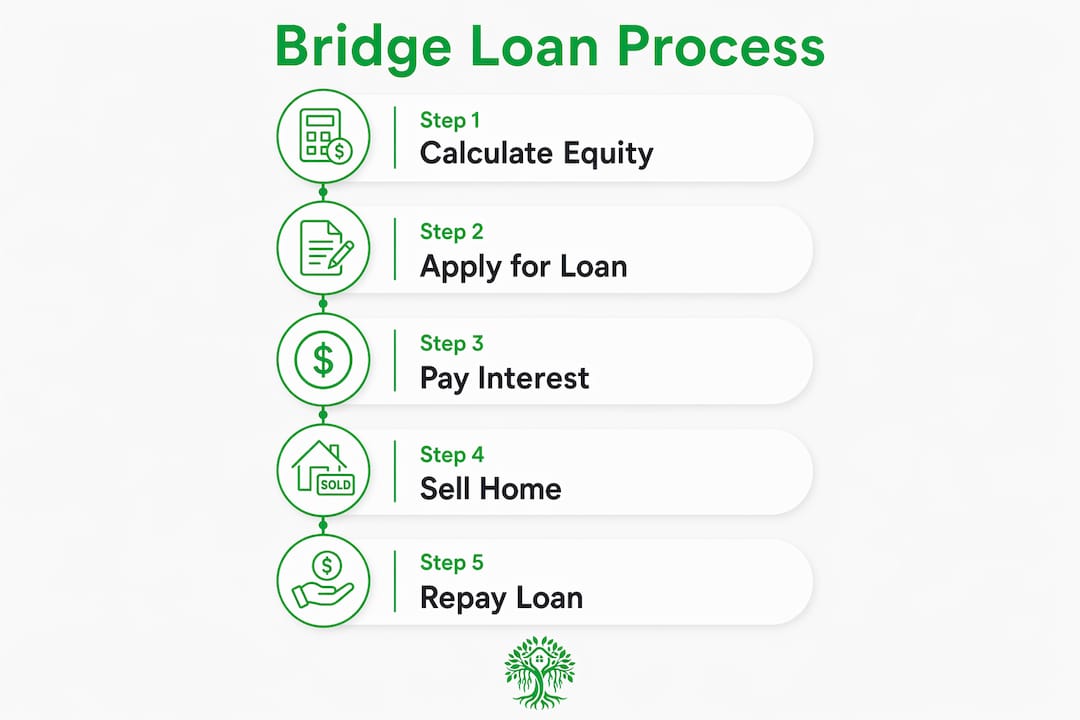
The bridge loan process follows a clear sequence. Knowing each step helps you move quickly when the right home appears.
-
Assess your equity and exit plan. Calculate your home’s likely sale price, subtract your mortgage payoff, and confirm you have enough equity to meet the lender’s 65%–80% threshold. Identify a realistic sale timeline based on current market conditions in your area.
-
Apply with a bridge lender. Submit your application with documentation of your current home’s value, your mortgage balance, and your purchase contract for the new home. Underwriting focuses on collateral and exit strategy, so have your pricing rationale ready.
-
Close on the new home. Once approved, bridge funds are used for your down payment and closing costs on the new property. You now own both homes simultaneously.
-
Manage overlapping payments. Pay interest on the bridge loan monthly while also carrying your new mortgage. Keep a cash reserve specifically for this period. Most buyers experience 1–3 months of overlap.
-
Sell your current home. When your old home closes, the sale proceeds pay off both the bridge loan balance and your remaining mortgage in a balloon payment. Any amount left over goes to you.
-
Handle extensions if needed. If your home has not sold before the bridge loan term ends, contact your lender early. Extensions are available but add cost. Having a clear exit strategy from day one reduces the chance you will need one.
Key Takeaways
A bridge loan is a viable financing tool when your equity is strong, your home will sell quickly, and the cost is lower than your alternatives.
| Point | Details |
|---|---|
| Loan sizing | Borrow 65%–80% of your home’s value minus your mortgage balance. |
| Cost reality | Rates of 8%–14% plus 3%–6% in fees make bridge loans expensive; calculate total cost before committing. |
| Underwriting focus | Lenders prioritize your exit strategy and collateral value over income or credit score. |
| Competitive advantage | Removing a sale contingency lets you make offers that compete with cash in California and Texas markets. |
| Exit plan is non-negotiable | A slow market or overpriced listing will result in loan denial regardless of your financial profile. |
My honest read on bridge loans for first-time movers
I have watched buyers in California use bridge loans brilliantly and badly. The brilliant ones had one thing in common: they were honest about their home’s sale timeline before they signed anything. The bad outcomes almost always traced back to wishful pricing. A seller who insists their home is worth $50,000 more than the comps will not get a bridge loan approved, and if they do, they will carry two properties longer than they planned.
The other mistake I see is treating bridge financing as a way to avoid hard decisions. If you are not ready to price your current home aggressively and sell it fast, a bridge loan adds cost without solving the real problem. The product works when the math works. First-time buyers in California often underestimate how quickly lender patience runs out when a home sits on the market.
My advice: before you apply, get a realistic broker price opinion on your current home from someone who will tell you the truth, not what you want to hear. Then model the worst case. If your home takes four months to sell instead of six weeks, can you cover the payments? If the answer is no, the bridge loan is not the right tool right now.
Bridge loans are not a universal solution. They are a situation-specific product that rewards buyers who plan carefully and punishes those who assume everything will go smoothly.
— Anand
How Ficustree helps buyers compete in California and Texas
Knowing your financing options is only part of the equation. You also need to find the right home fast, make a strong offer, and avoid the common negotiation mistakes that cost buyers deals in competitive markets.

Ficustree is an AI-powered home buying platform built specifically for first-time buyers in California and Texas. The platform helps you identify properties that match your criteria, understand your offer position, and move with confidence when timing matters. Buyers pay $1,000 at closing plus 1% commission, keep a rebate of roughly 2% where permitted, and get access to on-demand showing agents. If you are weighing bridge financing and want to know which homes are worth the cost of competing for, start your search at Ficustree and let the platform do the heavy lifting.
FAQ
What is a bridge loan in home buying?
A bridge loan is a short-term loan secured by your current home’s equity, used to fund the purchase of a new home before your existing property sells. Terms typically run 6–12 months, with interest-only payments during the loan period.
How much can you borrow with a bridge loan?
Most bridge lenders offer 65%–80% of your current home’s value minus your remaining mortgage balance. That net figure is the maximum available for your new home’s down payment and closing costs.
Are bridge loans worth it in California and Texas markets?
In competitive markets where contingent offers are rejected over 70% of the time, a bridge loan can be the only way to make a credible non-contingent offer. The cost is justified when the alternative is losing the home or moving twice.
What happens if my home does not sell before the bridge loan expires?
You can request an extension from your lender, though extensions add cost. Lenders may also require updated appraisals. The best way to avoid this is to price your home correctly from day one and have a realistic sale timeline before you apply.
Can I use a HELOC instead of a bridge loan?
A HELOC is not a reliable substitute. Lenders frequently freeze or deny HELOC applications once your home is listed for sale, which is exactly when you need the funds. A dedicated bridge loan is structured specifically for this transition and does not carry that restriction.
Recommended
- First Home Buying California Guide: Steps That Work – ficustree.ai
- Home Buying Timeline: A First-Time Buyer’s Guide – ficustree.ai
- Escrow Process for First-Time Buyers: California Guide – ficustree.ai
- How FHA Loans Work for First-Time Buyers in 2026 – ficustree.ai

Leave a Reply