For most Texas homeowners, the right approach is not chasing the cheapest quote. It is shopping the admitted market first, confirming replacement-cost dwelling coverage, and treating the Texas Windstorm Insurance Association (TWIA) or the Texas FAIR Plan as placement lanes rather than first choices. Check the roof valuation method and the wind/hail deductible before you sign anything, buy flood coverage separately if your home carries any risk, and if you are still shopping while buying a house, a buyer-representation platform like Ficustree can help you line up insurance timing with your closing date.
TL;DR:
- Homeowners in coastal or hail-prone areas should prioritize policies with lower wind and hail deductibles to avoid upfront costs exceeding insurance payouts after a storm.
- It is essential to verify whether coverage is based on replacement cost or actual cash value, especially for roofs over 15 years old, to prevent depreciation from reducing claim payments.
- Comparing insurance quotes requires checking each policy’s deductible dollar amount, roof valuation method, and coverage limits, rather than just focusing on premium prices.
- Buyers should avoid canceling existing policies until new coverage is fully in effect and align insurance effective dates with their closing schedule to prevent coverage gaps.
- For homes declined in the voluntary market, the Texas FAIR Plan and TWIA serve as residual options, but their policies typically come with narrower scope and higher deductibles than standard insurers.
Table of Contents
- What Does “Best” Mean for Homeowners Insurance in Texas?
- What Does a Standard Texas Homeowners Policy Cover?
- How Much Does Homeowners Insurance Cost in Texas?
- How Do You Compare Homeowners Insurance Quotes in Texas?
- What Are TWIA and the Texas FAIR Plan?
- When Should You Shop for Insurance and When Should You Switch?
- How Does Ficustree Help Texas Buyers Handle Insurance Timing?
- What First-Time Buyers Consistently Get Wrong About Insurance
- Get Insurance Timing Right When You Buy in Texas
- Where to Verify Texas Insurance Rules Yourself
- Sources
- FAQ
What Does “Best” Mean for Homeowners Insurance in Texas?
There is no single best homeowners insurance company in Texas, because the right policy depends on where your house sits and what it is made of. A brick home in Plano fifty miles from the coast has a completely different risk profile than a 1980s frame house in Corpus Christi. The best homeowners insurance Texas policy for one is a mediocre fit for the other, and the market itself is structured to reflect that.
Texas insurance operates in three lanes. The admitted market is made up of licensed carriers regulated directly by the Texas Department of Insurance (TDI), offering standard rate filings and the strongest consumer protections. The surplus lines (E&S) market picks up higher-risk homes, older roofs, or coastal properties that admitted carriers decline; rates are less regulated and often higher, but coverage exists where it otherwise wouldn’t. Then there are the residual markets, TWIA for coastal wind and hail, and the Texas FAIR Plan for general property risk, which exist specifically because private insurers won’t touch certain homes.
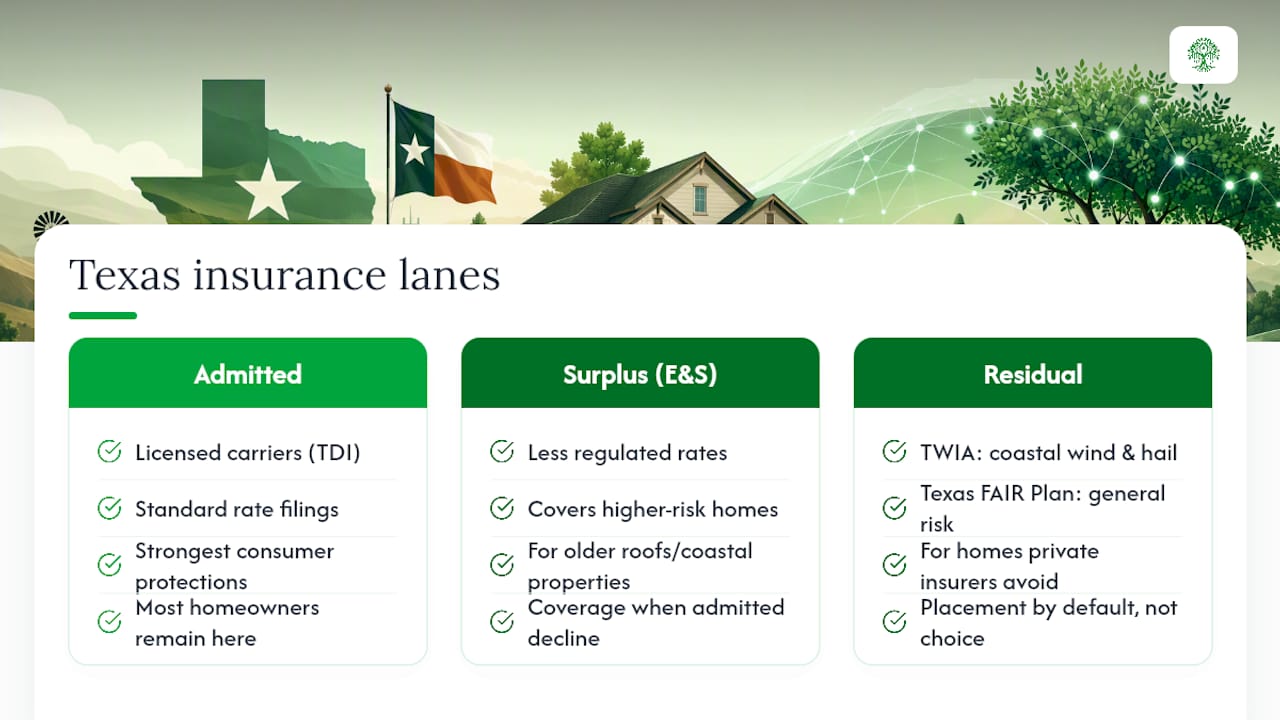
Most homeowners never need to leave the admitted market. But if your home is within TWIA’s designated coastal counties, has a roof older than 15 to 20 years, or has a claims history that scared off two or more carriers, you may find yourself pushed toward surplus lines or a residual-market policy by default, not by choice.
The category matters more than the carrier’s name on the declarations page. Two homeowners with the same insurer can have wildly different coverage quality depending on which lane wrote the policy, what deductible structure applies, and whether the roof is valued at replacement cost or actual cash value (ACV). That’s the real comparison to make, and it’s why generic “top 10 insurers” lists tend to mislead buyers who assume brand recognition equals better protection.
What Does a Standard Texas Homeowners Policy Cover?
A standard Texas homeowners policy, typically written on an HO-3 form, breaks down into six coverage areas. Understanding each one lets you actually read a quote instead of just checking whether the annual premium fits your budget.
- Dwelling coverage (Coverage A): Pays to rebuild the structure itself after a covered loss like fire or wind damage.
- Other structures (Coverage B): Covers detached garages, fences, and sheds, usually set around 10% of the dwelling limit.
- Personal property (Coverage C): Covers belongings inside the home, generally defaulted to 50% of the dwelling limit.
- Loss of use / additional living expenses (Coverage D): Pays for a hotel or rental while your home is rebuilt, often 20% of dwelling coverage.
- Personal liability: Covers legal costs if someone is injured on your property or you’re found responsible for damage elsewhere.
- Medical payments to others: A smaller, no-fault coverage for minor injuries to guests, regardless of liability.
A standard Texas homeowners policy covers those six areas, but flood and earthquake damage are excluded outright. That single fact catches more Texas homeowners off guard than any other coverage gap, especially those buying outside a mapped flood zone who assume they’re automatically protected.
Pro Tip: Buy flood coverage well before you think you need it. Flood insurance through the National Flood Insurance Program typically carries a 30-day waiting period before coverage takes effect, so a policy purchased the week a storm forms won’t help you.
Coverage B, C, and D limits are commonly auto-set as percentages of your dwelling limit, often 10%, 50%, and 20% respectively. Those defaults aren’t tailored to your actual home, and under-insuring any of them can reduce a claim payout or trigger a coinsurance penalty on a partial loss. The other question that matters just as much as the limit itself is how the payout is calculated: replacement cost coverage rebuilds your home at today’s material and labor costs, while actual cash value factors in depreciation, which can leave you thousands of dollars short on an older roof.
How Much Does Homeowners Insurance Cost in Texas?
Texas homeowners insurance runs roughly $3,900 to $4,100 per year for a $300,000 dwelling, though your actual number could land well outside that range depending on where you live and what your roof looks like. Coastal counties and hail-belt regions like the Dallas-Fort Worth metro and parts of West Texas routinely see higher premiums than inland areas with milder storm exposure, sometimes by a wide margin.
Several factors move that number up or down for any individual home:
- Replacement cost of the dwelling: A larger or more expensive-to-rebuild home costs more to insure, independent of market value.
- Roof age and material: A roof under 10 years old, especially impact-resistant shingles, typically earns better rates and avoids ACV roof schedules.
- Deductible structure: Percentage-based wind/hail deductibles lower your premium on paper but increase your real exposure in a claim.
- Claims history: Prior claims, even weather-related ones outside your control, can raise renewal premiums or trigger nonrenewal.
- Available credits: Security systems, storm shutters, newer plumbing and electrical, and bundling home and auto can all shave money off the quote.
Here’s where a lot of Texas homeowners get burned. A policy quoted several hundred dollars cheaper than the rest often hides a percentage wind/hail deductible or an ACV roof endorsement buried in the fine print. That “savings” evaporates the first time a hailstorm rolls through and your payout comes in thousands less than expected. Comparing premiums without comparing deductible structure and valuation method isn’t really comparing anything at all. If you’re still working out how insurance fits into your overall housing budget, a true cost of homeownership breakdown is worth reading before you lock in a mortgage payment that doesn’t account for the real premium.
How Do You Compare Homeowners Insurance Quotes in Texas?
Comparing Texas homeowners insurance quotes side by side only works if you’re comparing the same underlying structure, not just the bottom-line number. Run through this checklist before you sign anything.
- Confirm the dwelling is insured at true replacement cost, not market value or your purchase price. Ask the agent to walk you through how that figure was calculated.
- Convert every percentage deductible into a dollar amount. A 2% wind/hail deductible on a $350,000 dwelling limit is $7,000 out of pocket, not an abstract percentage on a form.
- Verify the roof valuation method. ACV roof schedules that depreciate payouts based on roof age are common on homes over 10 to 15 years old and can dramatically shrink a claim check.
- Check the additional living expense limit and time period. Twelve months of ALE coverage sounds generous until a major rebuild after a hailstorm stretches past that window.
- Ask what’s excluded or endorsed separately. Water backup, foundation movement, and scheduled personal property (jewelry, firearms) often need their own endorsement.
At quote time, ask the agent directly whether the carrier is admitted or surplus lines, what happens to your rate at renewal after a claim, and whether the quote assumes any credits you haven’t actually confirmed (like a security system you don’t have yet). Treat a quote that’s dramatically cheaper than everything else you’ve received as a signal to dig deeper, not a reason to celebrate. It usually means a bigger deductible, a lower valuation method, or a coverage gap you haven’t spotted yet.
What Are TWIA and the Texas FAIR Plan?
Texas has two placement mechanisms built specifically for homes the voluntary market won’t touch, and both function very differently from a standard policy.
TWIA provides windstorm and hail coverage as a residual option for specified coastal counties in Texas, and it exists because private insurers have historically limited their exposure along the Gulf Coast. TWIA doesn’t replace a full homeowners policy; it pairs with a separate policy covering fire, theft, liability, and everything else. If you’re buying near the coast, expect to carry two policies rather than one, and budget accordingly.
The Texas FAIR Plan functions as the general-risk backstop for homeowners who have been declined by at least two insurers in the voluntary market. It comes with coverage caps and a narrower scope than a standard admitted-market policy, and eligibility typically needs to be refreshed periodically to stay in force. If you’ve been declined and are heading toward FAIR Plan placement, it’s worth requesting a written declination letter from the carriers that turned you down. That documentation is often what an agent needs to move your application forward.
Here’s the deductible math that trips up more buyers than any other Texas insurance detail. Wind/hail percentage deductibles commonly range from 1% to 5% of the dwelling limit, and a 2% deductible on a $400,000 dwelling comes out to $8,000 you’d owe before coverage kicks in on a hail claim.
- 1% on $400,000 = $4,000 out of pocket
- 2% on $400,000 = $8,000 out of pocket
- 5% on $400,000 = $20,000 out of pocket
For a coastal or hail-belt home, that means shopping isn’t just about premium anymore. It’s about weighing a slightly higher monthly cost against a materially lower deductible, because the deductible is the number that determines whether a claim actually helps you financially. Inland buyers in low hail-risk counties have more flexibility here; coastal and hail-belt buyers should treat the deductible structure as the primary decision point, with premium as secondary.
When Should You Shop for Insurance and When Should You Switch?
Timing your insurance shopping around a home purchase or renewal takes more coordination than most first-time buyers expect, and getting the sequence wrong can leave you without coverage at the worst possible moment.
- Gather your documentation early. Have the home’s square footage, roof age and material, year of major system updates (electrical, plumbing, HVAC), and any prior claims history ready before you request quotes.
- Request quotes from multiple lanes at once. Compare at least one admitted-market carrier alongside any surplus-lines option your agent surfaces, especially on older or coastal homes.
- Never cancel your current policy until the new one is bound. TDI’s own guidance is explicit on this point: confirm the replacement coverage is fully finalized, with proof of coverage in hand, before you let the old policy lapse.
- Align effective dates with your closing date. Your lender will require proof of insurance before funding, and a mismatched effective date can delay closing by days.
- If pursuing FAIR Plan, request written declinations from at least two carriers first. That paperwork is usually a prerequisite, not an optional step.
An independent broker who can shop admitted, surplus-lines, and residual markets in parallel tends to serve homeowners with older roofs or coastal exposure better than a single-carrier captive agent locked into one company’s underwriting rules. If you’re buying a home and juggling insurance shopping on top of financing and closing logistics, that’s exactly the coordination gap where a buyer-representation platform earns its keep.
How Does Ficustree Help Texas Buyers Handle Insurance Timing?
Insurance placement doesn’t happen in isolation. It happens in the middle of inspections, loan underwriting, and a closing date that doesn’t move for anyone’s convenience, which is exactly where first-time buyers in Texas tend to lose track of details that matter.
Ficustree represents buyers directly through the entire purchase, not just the search phase, and that includes helping you sequence insurance shopping so it lands correctly before closing instead of becoming a last-minute scramble. The platform’s mortgage calculator with taxes and insurance lets you see how a percentage wind/hail deductible or a coastal TWIA pairing actually affects your monthly payment, not just your premium, before you fall in love with a listing you can’t realistically insure.
Buyers who wait until the week of closing to think about insurance are the ones most likely to accept the first quote they see, deductible structure and all. Sequencing insurance shopping alongside financing, not after it, is what actually protects a buyer’s budget.
A few concrete ways this shows up for Ficustree clients working through a Texas purchase:
- On-demand showing agents who can flag roof age or coastal exposure concerns during a walkthrough, before you’re emotionally attached to a house that’s hard to insure affordably.
- Buyer representation for a $1,000 fee at closing plus 1% commission, with a rebate provided where legally permitted, so the cost of guided representation doesn’t compete with your insurance budget.
- Step-by-step decision intelligence guides that walk through closing logistics, including where insurance timing fits into the broader checklist.
If you’re comparing homes in different parts of Texas, the buyer representation page walks through how that support actually works before you commit to anything.
What First-Time Buyers Consistently Get Wrong About Insurance
The mistake I see most often isn’t picking the wrong insurance company. It’s treating insurance as a line item to minimize instead of a coverage decision that determines what happens after the worst day of homeownership. A buyer who saves $40 a month by accepting a percentage wind/hail deductible without doing the math is making a bet they haven’t actually priced out, and most don’t realize it until a hailstorm sends them an $8,000 bill they assumed insurance would cover.
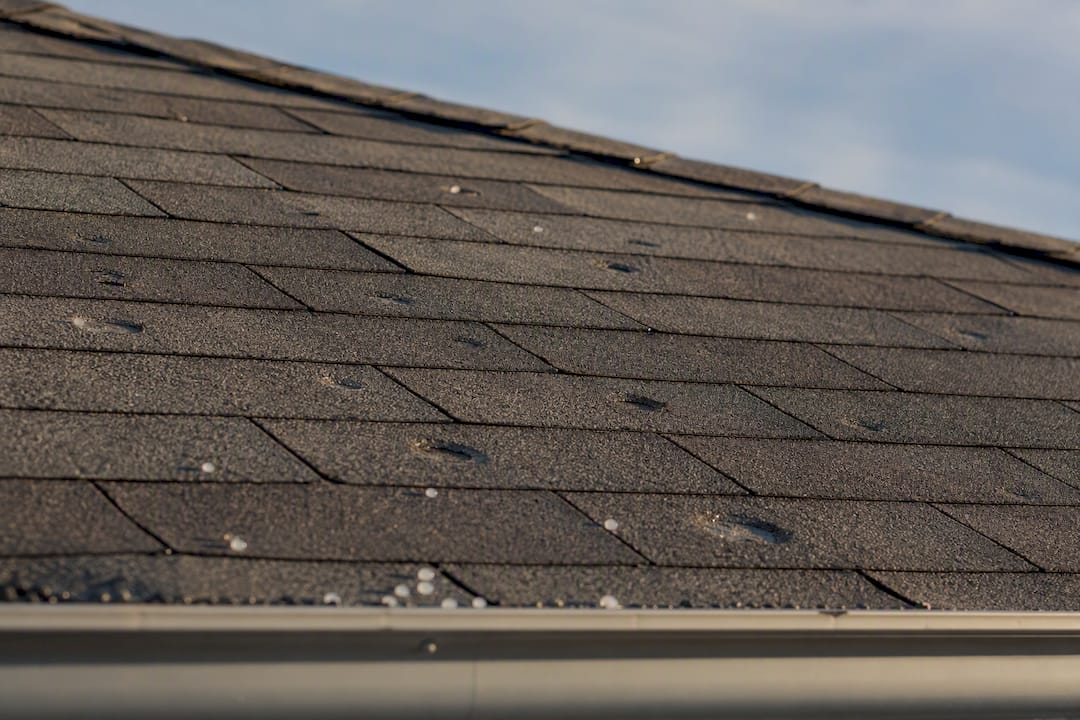
The conventional advice to “shop around and pick the cheapest quote” isn’t wrong exactly, it’s just incomplete in a way that hurts Texas homeowners specifically. Cheap quotes in this state are cheap for identifiable reasons: an ACV roof schedule, a higher percentage deductible, or a surplus-lines carrier with thinner protections than an admitted one. None of that shows up on the premium line. It shows up months or years later, during a claim, when depreciation or a deductible you never converted to dollars eats the payout you were counting on.
If there’s one action worth taking before you sign anything, it’s converting every percentage deductible into an actual dollar figure and comparing that number, not the premium, across your quotes. That single habit catches more bad decisions than any amount of brand research ever will. Anyone buying a home in Texas right now, especially a first-timer juggling financing and inspections at the same time, benefits from treating insurance as part of the purchase decision rather than a formality handled after the fact.
— Anand
Get Insurance Timing Right When You Buy in Texas
Most homeowners insurance advice treats insurance and home buying as two separate errands. They aren’t. The deductible structure you accept, the roof valuation method on your policy, and the effective date of your coverage all need to line up with your closing timeline, and that coordination is exactly where Ficustree steps in for Texas buyers.

Ficustree represents buyers directly through the purchase for a fixed $1,000 fee at closing plus 1% commission, with a rebate provided where legally permitted, and the platform itself, including the affordability tools and decision intelligence guides, stays free to use. That structure means the guidance you get on insurance timing, deductible math, and closing logistics isn’t competing with a commission incentive to rush you into a decision. If you’re financing your purchase and want to understand how loan terms interact with insurance requirements, Texas Bank Statement Loans is a useful resource for self-employed buyers navigating that side of the process.
If you’re actively shopping for a home in Texas and want insurance placement handled alongside your purchase timeline instead of after it, visit the Ficustree buyer page and request representation before you’re deep into an offer.
Where to Verify Texas Insurance Rules Yourself
A few official sources are worth bookmarking before you shop, since insurance rules shift and your agent’s summary is never a substitute for the primary source.
- Texas Department of Insurance consumer guides: The authoritative source on coverage requirements, complaint history for licensed carriers, and rate comparison tools.
- TWIA’s policy program overview: Details eligibility, coverage limits, and the coastal counties where windstorm placement applies.
- FEMA’s FloodSmart resource: The place to check flood zone status and understand NFIP policy waiting periods before you assume you’re covered.
- Texas FAIR Plan Association’s official page: Confirms eligibility criteria and caps for homeowners declined by the voluntary market.
Sources
- Texas Department of Insurance — Homeowners insurance: coverage basics
- FEMA / FloodSmart — Flood insurance information
- TWIA — Overview and policy program (2025)
FAQ
What Is a Good Price for Homeowners Insurance in Texas?
A reasonable annual premium for a $300,000 home in Texas typically falls between $3,900 and $4,100, though coastal and hail-belt homes often run higher. The number matters less than what deductible structure and valuation method back it up.
Which Homeowners Insurance Companies in Texas Are Considered the Worst?
TDI doesn’t publish a definitive “worst company” ranking, but complaint ratios and nonrenewal rates on TDI’s own consumer site are the most reliable way to flag carriers with a pattern of claim disputes. Checking that record before buying matters more than relying on general reputation.
How Much Is Homeowners Insurance on a $400,000 House in Texas?
Scaling from the $300,000 average of roughly $3,900 to $4,100 a year, a $400,000 home in a comparable area typically lands somewhat higher, with the exact figure driven heavily by roof age, location, and deductible structure rather than dwelling value alone.
Who Is the Most Trusted Homeowners Insurance Company in Texas?
There’s no single most trusted carrier, since trust in this market depends on claims handling in your specific region and risk category. Checking TDI complaint records for admitted carriers serving your county is a more reliable measure than brand reputation alone.
What Is the Best Homeowners Insurance in Texas for a First-Time Buyer?
The best homeowners insurance Texas fit for a first-time buyer is usually an admitted-market policy with confirmed replacement-cost dwelling coverage and a flat, not percentage, deductible where available. Coordinating that shopping with a buyer representation platform like Ficustree helps make sure the policy lines up with your closing date.
Recommended
- True Cost of Homeownership: A Buyer’s Complete Reality Check
- How to Make a Competitive Home Offer in 2026

Leave a Reply