
AI home search tools are advanced digital assistants that use conversational search, natural language processing, and data analytics to match homebuyers with properties that fit their specific needs. For first-time buyers in California and Texas, these tools cut through the noise of thousands of listings and compress months of research into focused, manageable sessions. Nearly half of prospective homebuyers planned to use AI tools during their home search in late 2025. That number signals a clear shift: AI home search is no longer a novelty. It is becoming the standard starting point for buyers who want clarity before they ever call an agent.
What is an AI home search tools walkthrough?
An AI home search tools walkthrough is a step-by-step process of using AI-powered real estate platforms to find, evaluate, and compare homes. The industry term for the underlying technology is conversational AI search, which lets you describe what you want in plain language instead of filling out rigid filter forms. You might type “three-bedroom under $550k near good schools in Austin with a short commute” and receive a curated list of matching homes. Conversational AI platforms like Realtor.com’s RealAssist, powered by Google Gemini, already handle requests exactly like that. The result is a search experience that feels more like talking to a knowledgeable friend than clicking through dropdown menus.
These tools go beyond basic filtering. They analyze listing photos, flag potential issues, estimate renovation costs, and score neighborhoods on commute times, school ratings, and walkability. AI adoption among brokerage leaders has reached approximately 90% in 2026. That professional adoption means the underlying data feeding buyer-facing tools is more accurate and more current than it was even two years ago.

What do you need before starting your AI home search?
Getting the most from any AI real estate tool requires a few things in place before you type your first query.
Technology basics:
- A reliable internet connection and a smartphone or laptop
- An account on at least one AI-powered real estate platform
- Familiarity with basic search terms: bedrooms, bathrooms, square footage, zip code or neighborhood name
Information you need ready:
- Your pre-approval amount or a realistic budget range (principal, interest, taxes, insurance, and HOA combined)
- Your must-have features versus nice-to-haves
- Your target neighborhoods or commute corridors in California or Texas
- Your timeline: are you buying in 60 days or 6 months?
Privacy considerations: AI platforms collect your search behavior to personalize results. Read each platform’s data policy before creating an account. Avoid entering sensitive financial details like Social Security numbers into any search tool that is not a licensed lender or verified financial institution.
Pro Tip: Write your home criteria in one clear paragraph before you open any platform. Buyers who enter vague queries get vague results. Specificity is the single biggest factor in getting useful AI recommendations on the first try.
How do you use AI home search tools step by step?
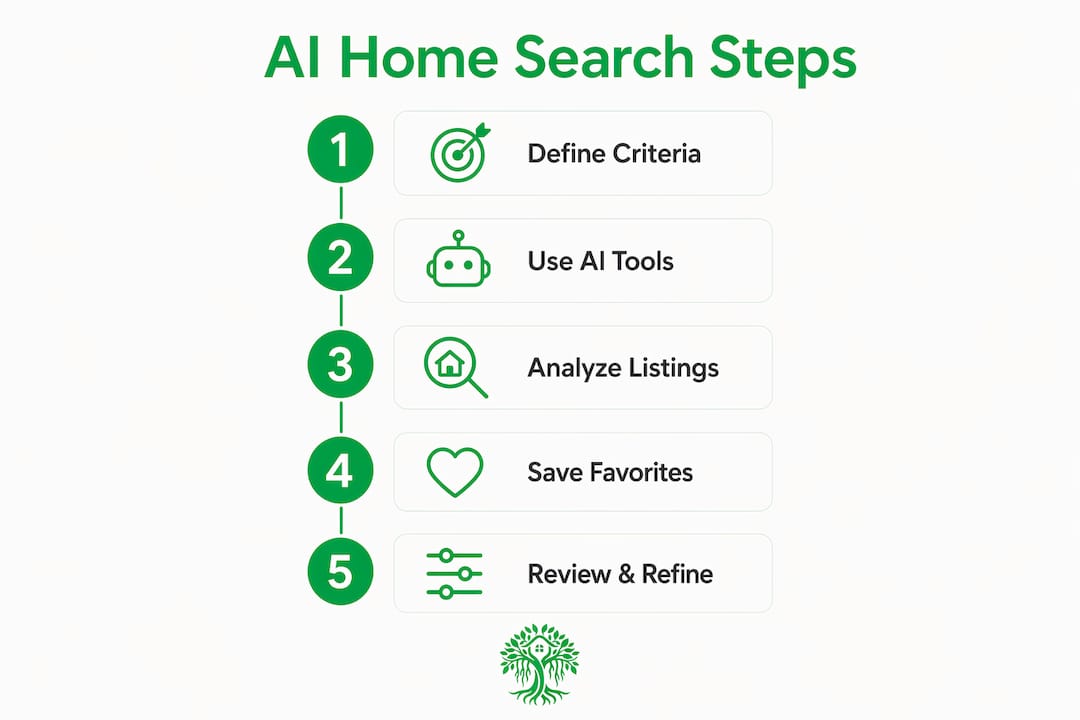
This walkthrough covers the full sequence from first query to informed offer decision.
-
Set your criteria in natural language. Open your chosen platform and describe your ideal home as if you were texting a friend. Include price range, bedroom count, location, and one or two non-negotiable features. Conversational AI tools remember your preferences across sessions and refine results as you give feedback. That means your second search session will be sharper than your first.
-
Explore neighborhoods with AI scoring. Most platforms offer neighborhood insight tools that pull commute data, school ratings, crime statistics, and walkability scores. In California, pay attention to wildfire risk overlays. In Texas, check flood zone data, which is especially relevant in Houston and parts of the Austin metro. Use these scores as a starting filter, not a final verdict.
-
Take virtual tours and analyze photos. 3D virtual tours with AI spatial tagging let you measure rooms, check ceiling heights, and assess layout before scheduling a showing. You can also upload listing photos to tools like Google Gemini to simulate renovation options and check whether a home has structural potential worth pursuing.
-
Decode listing language with AI. Listing descriptions are written to sell, not to inform. AI tools can analyze listing text and photos to flag phrases like “cozy” (small), “as-is” (needs work), or “investor special” (significant repairs likely). AI photo and text analysis identifies features, potential issues, and renovation possibilities that a quick scroll would miss.
-
Run affordability and mortgage estimates. Many platforms integrate AI-powered mortgage calculators that adjust in real time as you change down payment amounts or loan terms. Cross-reference these estimates with your lender’s pre-approval letter. The calculator gives you a range; your lender gives you the real number.
-
Set multi-platform alerts. Different platforms pull MLS data at different speeds. Setting alerts across multiple platforms increases your chances of catching new listings and price reductions early. In competitive California markets like the Bay Area or San Diego, a 24-hour head start on a new listing can be the difference between scheduling a showing and missing out entirely.
Pro Tip: After your first week of searching, review which listings you saved and look for patterns. If you keep saving homes with open floor plans or large backyards, update your AI criteria to weight those features more heavily. The tool improves when you teach it.
Here is a quick reference for matching your goal to the right AI feature:
| Your goal | AI feature to use |
|---|---|
| Find homes matching your lifestyle | Conversational natural language search |
| Evaluate neighborhoods before visiting | AI neighborhood scoring and commute tools |
| Visualize a home’s potential | Virtual tours and photo upload with renovation simulation |
| Check if a listing price is fair | AI valuation estimate (cross-check multiple sources) |
| Stay ahead of new inventory | Multi-platform listing alerts |
What mistakes should you avoid with AI home search tools?
AI tools are powerful, but first-time buyers make predictable errors that cost time and money.
- Over-relying on AI valuations without cross-checking. AI valuation tools can carry meaningful error margins depending on the market. A single estimate from one platform is a starting point, not a final price opinion. Always compare estimates from at least two sources and confirm with your agent before making an offer.
- Treating neighborhood scores as ground truth. AI scores aggregate public data and user-reported inputs. They can miss hyperlocal details: a noisy flight path, a planned commercial development two blocks away, or a neighborhood that is actively gentrifying. No score replaces a Saturday afternoon walk through the area.
- Skipping alert setup. Buyers who browse manually and check listings once a day miss early inventory. Configure alerts on at least two platforms with your full criteria set, including price range, bedroom count, and zip codes.
- Accepting AI document summaries without professional review. AI can summarize a disclosure report or HOA document in seconds. That summary is useful for triage. It is not a substitute for a licensed agent or real estate attorney reviewing binding contracts.
- Ignoring the limits of AI in fast-moving markets. In California and Texas metros, homes can go under contract within 48 hours of listing. AI tools help you prepare and prioritize, but speed still depends on having a responsive agent and a ready offer.
“AI is a research assistant, not a replacement for licensed agents who provide negotiation expertise, local market knowledge, and legal guidance critical to home buying.” — Real estate industry consensus, 2026
How do you combine AI insights with real agent expertise?
AI tools and licensed agents solve different problems. Knowing which to use for what saves you time and protects you legally.
- Use AI for research; use agents for decisions. AI surfaces data, scores, and comparisons. Licensed agents provide negotiation strategy, read local market dynamics, and guide you through contracts. These are not interchangeable functions.
- Bring AI data to agent conversations. Print or screenshot your AI neighborhood comparisons and valuation estimates before meeting with your agent. It makes the conversation more productive and helps your agent understand your priorities quickly.
- Cross-reference AI price estimates with comparable sales. Your agent can pull recent comparable sales (comps) from the MLS. Compare those comps to the AI estimate. When they align, you have confidence. When they diverge, ask why.
- Use AI summaries to prepare questions, not to skip reading. If an AI tool summarizes a seller’s disclosure report, use that summary to identify which sections need closer attention. Then read those sections in full with your agent.
- Visit every serious contender in person. Virtual tours and AI photo analysis are excellent filters. They are not substitutes for standing in a kitchen, checking water pressure, or noticing that the neighbor’s yard backs directly to a highway sound wall.
Pro Tip: Before your first showing, run the address through an AI tool to generate a list of questions about the property. Bring that list to the showing. Buyers who arrive with specific questions get far more useful information from listing agents than buyers who walk through without a plan.
My honest read on AI home search in California and Texas
I have watched buyers in both California and Texas use AI tools with wildly different results. The buyers who get the most out of these tools share one habit: they treat AI as a preparation engine, not a decision engine. They use it to narrow a field of 400 listings to 12 serious candidates before they ever call an agent. That is genuinely valuable. It saves weeks.
What AI consistently misses in both markets is the texture of a neighborhood at 7 p.m. on a Tuesday. In the Bay Area, two zip codes with identical walkability scores can feel completely different because of street-level density and parking. In Dallas, a neighborhood AI scores as “family-friendly” might have school zoning lines that cut right through it, sending kids on one block to a top-rated school and kids on the next block to an underperforming one. These details live in local knowledge, not in datasets.
My advice: use AI to get to the right 10 homes faster, then invest your real energy in those 10. The AI personalized search tools available in 2026 are genuinely good at matching stated preferences. They are less good at matching unstated ones, the things you only discover when you are standing in the space. That gap is where a great agent earns their value. The hybrid approach, AI for research and humans for judgment, is not a compromise. It is the most effective way to buy a home right now.
— Anand
How Ficustree puts this walkthrough into practice
Ficustree is built specifically for first-time buyers in California and Texas who want AI-powered search without giving up real representation. The platform uses conversational search and neighborhood fit scoring to match you with homes that meet your actual criteria, not just your keyword inputs. You keep a rebate of roughly 2% where legally permitted, pay $1,000 at closing plus 1% commission, and get hourly showing agents on demand.

Ficustree’s AI home search platform integrates the tools covered in this walkthrough, including listing analysis, neighborhood insights, and document summarization, into one place designed for buyers who are serious about making a clear, confident decision. The promise is simple: compress six months of first-time-buyer confusion into two months of clarity. Start your search at Ficustree and see which homes match you today.
Key takeaways
AI home search tools work best when buyers use them for research and preparation, then rely on licensed agents for negotiation, legal review, and final decisions.
| Point | Details |
|---|---|
| Start with clear criteria | Write your must-haves before opening any platform to get useful results from the first query. |
| Use conversational search | Natural language queries return better matches than rigid filter forms on AI-powered platforms. |
| Cross-check AI valuations | Compare estimates from at least two sources before using a price as the basis for an offer. |
| Set multi-platform alerts | Different platforms update MLS data at different speeds; alerts on multiple platforms catch listings earlier. |
| Combine AI with agent expertise | AI handles research and filtering; licensed agents handle negotiation, contracts, and local nuance. |
FAQ
What are AI home search tools?
AI home search tools are software platforms that use natural language processing and data analytics to match buyers with properties based on conversational queries and behavioral preferences. They go beyond basic filters to include neighborhood scoring, virtual tours, and listing analysis.
How accurate are AI property valuations?
AI valuations vary by platform and market. Cross-checking estimates from multiple sources and comparing them to recent comparable sales pulled by a licensed agent gives you the most reliable price picture before making an offer.
Can AI replace a real estate agent for first-time buyers?
AI cannot replace a licensed agent. Agents provide negotiation expertise, local market knowledge, and legal guidance that AI tools are not equipped to deliver, especially for contracts and offer strategy.
How do I get better results from AI home search tools?
Enter specific criteria in natural language, including price range, location, bedroom count, and key features. Update your preferences after each session based on which listings you saved, since conversational AI tools refine results dynamically based on your feedback.
Are AI home search tools useful in competitive California and Texas markets?
Yes, particularly for early-stage research and alert setup. In fast-moving markets, AI tools help you identify and prioritize homes quickly, but closing a competitive offer still requires a responsive agent and a prepared financing strategy.
Recommended
- AI Home Search for Buyers: What Changes Now
- How AI Personalized Home Search Works in 2026 – ficustree.ai
- First Time Homebuyer Guide: Simple Steps for Your First Home
- Blog Post

Leave a Reply