
The Texas residence homestead exemption cuts the school-taxable value of your qualifying primary home by $140,000 in 2026, and you claim it by filing Form 50-114 with your county appraisal district. That single form, once approved, sticks with your home year after year without refiling. Miss it, and you’re leaving real money on the table.
Here’s what changed and what to do about it:
- General school exemption: $140,000 off your home’s taxable value for school district taxes, up from $100,000 before the 2025 legislative session.
- Seniors and disabled homeowners: an additional $60,000, for a combined $200,000 school exemption plus a tax ceiling that locks your school tax bill from rising further.
- The deadline: April 30, 2026, though Texas law allows late filing for up to two years back if you missed it.
- The action: file Form 50-114 with your county appraisal district, not the state Comptroller’s office. Filing is free.
These increases came from voter-approved constitutional amendments passed in November 2025, and they apply to every qualifying primary residence in the state, whether you’ve owned your home for decades or closed on it last month.
Key Takeaways
The Texas homestead exemption cuts $140,000 from your home’s school-taxable value in 2026, and filing Form 50-114 with your county appraisal district by April 30 is the only action required to claim it.
| Point | Details |
|---|---|
| 2026 exemption amount | The mandatory school-district homestead exemption is $140,000, up from $100,000. |
| Seniors and disabled | An additional $60,000 school exemption brings the combined total to $200,000, plus a tax ceiling. |
| Filing deadline | April 30 is standard, with late filing allowed up to two years back under Tax Code §11.431. |
| Where to file | Submit Form 50-114 to your county appraisal district, not the Texas Comptroller’s office. |
| Ficustree’s role | Buyer representation that builds homestead filing into your closing checklist so it doesn’t get missed. |
Table of Contents
- Who Qualifies for a Homestead Exemption in Texas?
- How Much Does the Homestead Exemption Save You in Texas?
- What Other Exemptions and Tax Protections Exist?
- How Do You Apply for the Texas Homestead Exemption?
- What Happens After Your Homestead Exemption Is Approved?
- What Mistakes Cause Homestead Exemption Delays or Denials?
- When Does Your Homestead Exemption Officially Kick In?
- How Ficustree Helps First-Time Texas Buyers Handle Homestead Filing
- Where to Verify Homestead Exemption Rules and File Your Application
- What Texas Homeowners Get Wrong About This Exemption
- Get Buyer Representation That Tracks Every Deadline for You
- Sources
- FAQ
Who Qualifies for a Homestead Exemption in Texas?
You qualify for the Texas homestead exemption if you own the home, live in it as your principal residence, and occupied it as of January 1 of the tax year. That’s the entire test at its core, but the details around ownership structure and timing trip up a surprising number of applicants.
Ownership doesn’t have to be a clean, sole-name deed. Partial owners, revocable trusts, and life estate holders all typically qualify, provided the applicant has an ownership interest in the property and it functions as their primary home. If you inherited a share of a family property, known in Texas as heir property, you can usually claim the exemption on your percentage interest even without a formal probate resolution, though appraisal districts increasingly ask for an affidavit of heirship.
One rule catches people off guard every year: you can only claim one homestead exemption at a time. If you own a home in Dallas and a lake house in the Hill Country, only the one you actually live in as your primary residence qualifies. Claiming both is a violation with real financial consequences, covered later in this guide.
For buyers closing on a home after January 1, the exemption doesn’t apply automatically for that tax year. If the previous owner already claimed the exemption on that property, some counties allow a prorated qualification once you take occupancy, but rules vary by county appraisal district, so check with yours directly.
Here’s the sequence for confirming your eligibility before you file:
- Confirm you hold an ownership interest in the property, whether sole, joint, or through a qualifying trust.
- Verify you occupied the home as your principal residence on January 1 of the tax year (or qualify under your county’s post-purchase rule).
- Check that you have not claimed a homestead exemption on any other property for the same tax year.
- Update your Texas driver’s license or state ID so the address matches the property exactly.
- Gather ownership documentation if you’re a partial owner, heir, or trust beneficiary.
The address-match requirement deserves its own callout because it derails more applications than any other single issue. Appraisal districts generally require the address on your driver’s license or state ID to match the homestead property address exactly, with limited exceptions for people enrolled in the Texas Address Confidentiality Program or residents of certain licensed care facilities.
Pro Tip: Update your Texas driver’s license address before you submit Form 50-114, not after. Chief appraisers enforce the address-match rule closely, and a mismatched ID is the single fastest way to get your application bounced back for resubmission.
How Much Does the Homestead Exemption Save You in Texas?
The math is straightforward once you know the formula: your annual savings equal the exemption amount multiplied by your school tax rate, divided by 100. With the $140,000 school exemption now in effect, it translates into real, calculable relief no matter what your home is worth.
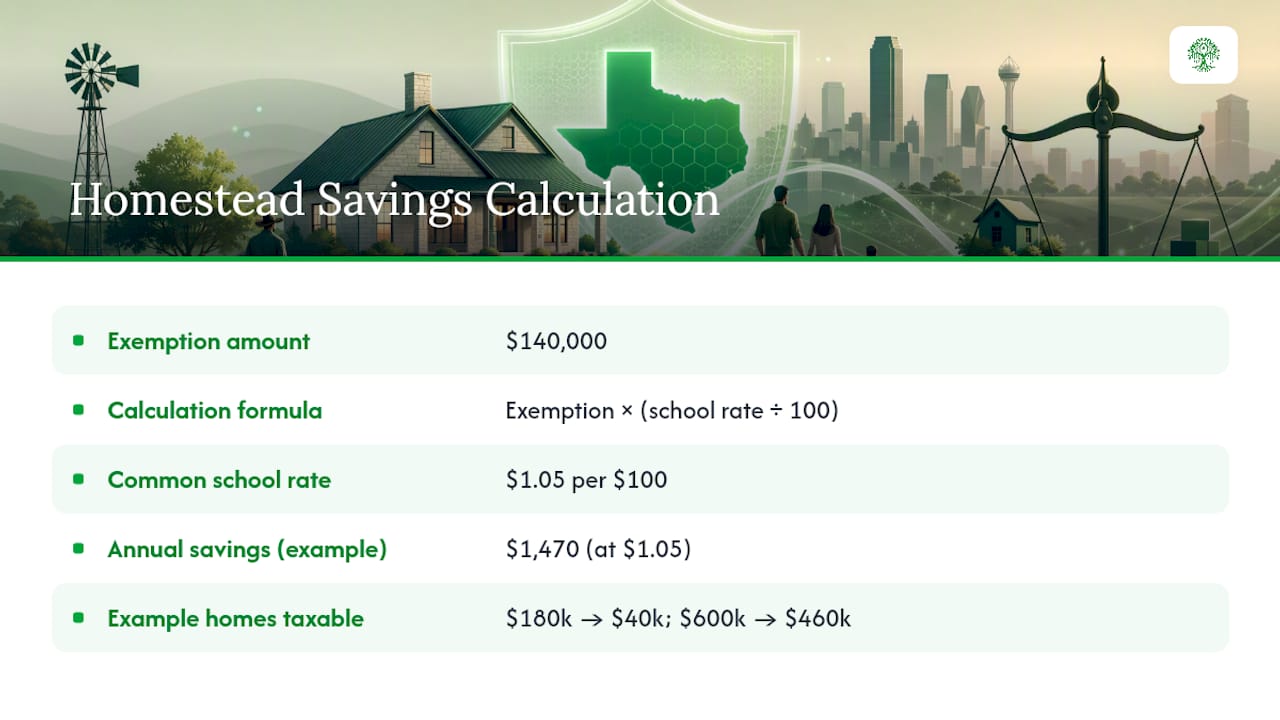
At a common school tax rate of $1.05 per $100 of value, $140,000 in exempted value works out to roughly $1,470 in annual school-tax savings alone, separate from any county, city, or special-district exemptions that stack on top.
Because the exemption is a flat dollar amount rather than a percentage, it delivers a bigger proportional benefit to lower-valued homes. A $180,000 home effectively drops to $40,000 in school-taxable value, an enormous cut, while a $600,000 home drops to $460,000, a smaller percentage reduction. Local percentage-based exemptions sometimes flip that dynamic, letting higher-value homes capture larger dollar savings overall once city and county exemptions are layered in.
Notice the savings amount stays roughly flat regardless of home value, since the exemption itself is a fixed dollar figure, not a percentage of your home’s price. The variable that actually moves your savings is your local school tax rate, which differs district by district across Texas.
Your total savings climb higher once local optional exemptions enter the picture. Counties, cities, and special districts can each adopt their own homestead exemptions on top of the mandatory school exemption, and many do.
What Other Exemptions and Tax Protections Exist?
Beyond the base $140,000 school exemption, several additional categories of relief apply to specific homeowners, and stacking the right ones can meaningfully lower your total bill.
- Over-65 and disabled homeowners receive an additional $60,000 school exemption, bringing their combined school exemption to $200,000. They also receive a school tax ceiling, which freezes the school-tax portion of their bill at the amount owed in the year they first qualify, even if their home’s value rises later.
- Disabled veterans qualify for exemptions on a sliding scale tied to their VA disability rating, ranging from partial reductions up to a full 100% exemption from property taxes for veterans rated at 100% disabled or individually unemployable.
- Surviving spouses of qualifying seniors, disabled homeowners, or disabled veterans can often retain the exemption and tax ceiling after the qualifying spouse’s death, provided they continue living in the home and were 55 or older at the time of death for the over-65 category.
- Local optional exemptions let counties, cities, and special districts adopt their own homestead exemptions, commonly up to 20% of appraised value with a $5,000 minimum, and counties that collect farm-to-market or flood-control taxes must offer at least a $3,000 exemption for those specific levies.
These programs aren’t mutually exclusive. A 68-year-old disabled veteran with a qualifying VA rating could potentially stack the base exemption, the senior exemption, the disabled veteran exemption, and any local optional exemption their county offers, all on the same homestead.
How Do You Apply for the Texas Homestead Exemption?
Filing the Texas homestead exemption comes down to one form, one recipient, and a handful of documents that need to line up exactly. Here’s the process from start to finish.
Step 1: Get Form 50-114. Download it from your county appraisal district’s website or the Texas Comptroller’s forms page. Both versions are identical statewide, since it’s a standardized state form, but your county CAD site usually has local filing instructions attached.
Step 2: Confirm where to send it. This trips up more people than any other step. You file Form 50-114 with your county appraisal district, never the Comptroller’s office in Austin. The Comptroller sets statewide rules and publishes the form; your local CAD processes the actual application. Search “[your county] appraisal district homestead exemption” to find the right office.
Step 3: Complete the form accurately. You’ll need to provide the tax year you’re applying for, a legal description of the property, your percentage of ownership interest, and check the boxes for any additional exemptions you qualify for, such as over-65, disabled, or disabled veteran status. Leave a box unchecked and you simply won’t receive that exemption, even if you qualify.
Step 4: Assemble your supporting documents. You’ll need a copy of your Texas driver’s license or state-issued ID with an address that matches the homestead property exactly. If you’re claiming a partial ownership interest, an over-65 or disability status, or a disabled veteran exemption, some counties request additional documentation like a disability determination letter or VA rating decision. Check your specific county’s requirements before submitting.
Step 5: Choose your submission method. Most Texas counties now accept Form 50-114 through three channels:
- Online portal. A growing number of counties offer electronic filing directly through their appraisal district website, generally the fastest option.
- Mail. Print the completed form, attach copies of your documents, and send it to your county appraisal district’s mailing address, listed on their site.
- In person. Drop off your application at the appraisal district’s office if you want confirmation of receipt on the spot.
Step 6: Know what happens next. After submission, your county appraisal district reviews the application, verifies your documentation, and either approves the exemption or requests additional information. Processing times vary by county and by how close you file to the deadline, with faster turnaround for applications submitted well before the April 30 rush.
Step 7: Track the deadline and your fallback window. The standard filing deadline is April 30. If that date falls on a weekend or state holiday, your deadline typically shifts to the next business day, though you should confirm this with your specific county rather than assume. If you miss April 30 entirely, Texas Tax Code Section 11.431 allows you to file late and claim the exemption retroactively for up to two years back, which can mean a meaningful refund if you’ve been overpaying without realizing it.
Pro Tip: File as soon as you close on your home rather than waiting for a reminder. Applications submitted early in the year are more likely to be processed before appraisal notices go out in the spring, which means your exemption shows up correctly the first time instead of requiring a corrected notice later.
What Happens After Your Homestead Exemption Is Approved?
Once your county appraisal district approves Form 50-114, the exemption appears on your next appraisal notice and carries forward automatically. You don’t need to refile every year, and the savings show up on your annual property tax bill once the district applies the reduced taxable value.
A few things happen behind the scenes that are worth understanding:
- Automatic renewal is standard, but it isn’t unconditional. Texas appraisal districts periodically run verification audits, roughly every five years, to confirm the property still qualifies. If you get a verification letter, respond promptly with the requested documentation. Ignoring it can result in your exemption being removed.
- Your exemption and your appraisal protest are two separate processes. The exemption reduces your taxable value once it’s granted; a protest challenges whether your home’s overall appraised value is accurate in the first place. You can and should do both. Reducing an inflated appraisal saves you money on top of whatever your homestead exemption already saves.
- Savings typically show up the same tax year you’re approved, assuming you filed before the appraisal roll was certified. Late filers see their savings applied retroactively once approved, sometimes as a refund or credit rather than a lower bill in real time.
Keep an eye on your annual appraisal notice each spring. It’s the fastest way to confirm your exemption is still active and correctly calculated.
What Mistakes Cause Homestead Exemption Delays or Denials?
Most rejected or delayed applications trace back to one of four preventable errors, and every one of them is fixable before you ever hit submit.
Address mismatch on your ID is the most common denial reason by a wide margin. If your driver’s license still shows your old apartment or a previous home, update it with the Texas Department of Public Safety before filing Form 50-114. This takes a few minutes online and saves weeks of back-and-forth with your appraisal district.
Paid filing services are worth naming directly because they prey on new homeowners. Filing your homestead exemption costs nothing and takes maybe fifteen minutes. Any company charging a fee to “file” it for you is charging for something you can do yourself for free, often by simply mailing a one-page form.
Co-owner filing errors show up often among unmarried couples or family members who jointly purchased a home. Unmarried co-owners generally need to file separately, each listing their percentage of ownership interest on their own application, rather than submitting one combined form.
Documentation gaps for special exemptions, like a missing VA disability letter for a veteran exemption or an incomplete heirship affidavit, are the final common snag.
- If your application is denied, ask your appraisal district for the specific reason in writing.
- Correct the issue, whether it’s an ID address or missing document, and resubmit promptly.
- If you believe the denial was made in error, you can appeal to your county’s appraisal review board.
Pro Tip: Keep a copy of everything you submit, including the date and method. If a dispute arises later, having your own paper trail speeds up resolution considerably.
When Does Your Homestead Exemption Officially Kick In?
Your eligibility date is fixed by law: you must own and occupy the home as your principal residence on January 1 of the tax year you’re claiming. Everything else in the timeline flows from that anchor point.
- January 1 is your qualification snapshot date. If you bought the home in November and moved in immediately, you likely won’t qualify for that tax year unless your county has a specific post-purchase provision, but you will qualify starting the following January 1.
- April 30 is the standard deadline to file Form 50-114 for that tax year’s exemption.
- Up to two years back is your safety net if you miss the deadline entirely. Filing late under Tax Code Section 11.431 lets you claim the exemption retroactively, and your county will typically issue a corrected tax bill or refund for the affected years once approved.
Processing timelines vary county by county, but refunds or adjusted bills from retroactive claims commonly appear within a billing cycle or two after approval, not instantly. If you’re expecting a refund from a late filing, follow up with your appraisal district if you haven’t seen an adjustment within a couple of months.
How Ficustree Helps First-Time Texas Buyers Handle Homestead Filing
Filing Form 50-114 is free and simple once you know the steps, but it’s also the kind of task that quietly slips through the cracks during the chaos of closing week. That’s exactly the gap Ficustree exists to close for first-time buyers in Texas.
Ficustree represents buyers directly through the entire purchase, and that includes making sure homestead filing doesn’t get lost in the shuffle. Here’s what that looks like in practice:
- A closing checklist that flags Form 50-114 as an action item, with your specific county appraisal district’s submission method already identified.
- An ID and address-match reminder built into your post-closing timeline, so you update your driver’s license before you file rather than after a rejection.
- Buyer representation for a fixed fee of $1,000 at closing plus 1% commission, with a rebate of roughly 2% where legally permitted, all built around getting first-time buyers from an accepted offer to a fully settled home without missed paperwork.
- On-demand showing agents and a premium platform available at no cost, so the guidance doesn’t stop once you’re under contract.
None of this changes the fact that the homestead exemption itself is free to file. What Ficustree adds is timeline management: a system that makes sure the task actually happens instead of becoming a forgotten line item three months after you’ve moved in.
| Point | Details |
|---|---|
| Filing cost | Form 50-114 is free to file directly with your county appraisal district. |
| Common risk | Post-closing checklists often omit homestead filing, delaying savings by a full tax year. |
| Ficustree’s role | Buyer representation that folds homestead filing into a standard closing timeline for Texas buyers. |
Where to Verify Homestead Exemption Rules and File Your Application
- Texas Comptroller’s property tax exemptions overview for statutory guidance and statewide rules.
- Henderson County Appraisal District’s homestead exemption page as a representative example of county-level filing instructions and required documents.
- Your own county appraisal district’s website for Form 50-114 and local submission options.
What Texas Homeowners Get Wrong About This Exemption
Most guides treat the homestead exemption as a one-time errand: file the form, forget about it. That undersells how much this benefit actually shapes a Texas homeowner’s long-term tax exposure, especially with the 2026 increases pushing the school exemption to $140,000.
The bigger blind spot is timing. Buyers fixate on closing costs and interest rates, then let homestead filing slide for months because nobody frames it as urgent. It is urgent. A delayed filing can cost a full year of savings, roughly $1,470 at a typical school tax rate, money that simply evaporates if the form sits in a drawer past the appraisal roll certification.
I’d also push back on the instinct to hire a paid filing service. This is a fifteen-minute form with a free process behind it. If you’re paying someone to file it for you, you’re paying for convenience you don’t need. Spend that energy instead on getting your driver’s license address updated before you file. That’s the detail that actually derails applications.
— Anand
Get Buyer Representation That Tracks Every Deadline for You
Ficustree is the alternative to hiring a traditional agent and hoping they remember your paperwork after closing. Where a typical transaction leaves homestead filing entirely on you, Ficustree’s buyer representation builds it into your closing timeline from day one, alongside document checklists and on-demand showing agents whenever you need to see a property.

That means the guidance that catches a missed Form 50-114 deadline costs you nothing extra beyond the representation you’d need anyway. If you’re getting ready to buy, start your search on the Ficustree buyer platform and see how a closing checklist built around Texas filing deadlines keeps you from losing a year of homestead savings before you’ve even unpacked.
Sources
- Property Tax Exemptions – Texas Comptroller
- Propertytaxes
- Homestead Exemption — Henderson County Appraisal District
- Texas homestead exemption 2026: How to apply, who qualifies | Houston Chronicle
- The Texas Homestead Exemption in 2026: What It Is, Who Qualifies, and How to File | TaxDrop
FAQ
Who qualifies for a homestead exemption in Texas?
You qualify if you own the home, occupy it as your principal residence, and lived there as of January 1 of the tax year. Partial owners, trust beneficiaries, and heir-property owners typically qualify on their ownership share.
How much does the homestead exemption reduce your taxes in Texas?
The $140,000 school exemption saves many homeowners roughly $1,400 to $1,700 annually on school taxes alone, depending on their local school tax rate, with additional savings possible from county, city, and special-district exemptions.
How much is the homestead exemption in Texas for 2026?
The mandatory school-district exemption is $140,000 in 2026, and homeowners who are 65 or older or disabled receive an additional $60,000 for a combined $200,000 exemption.
Should I claim the homestead exemption?
Yes, if your home is your principal residence and you meet the ownership and occupancy requirements. It’s free to file, reduces your taxable value permanently, and Ficustree can help fold the filing step into your closing checklist so it never gets missed.
Recommended
- First Time Home Buyer Tax Credit: 2026 Guide – ficustree.ai
- How to Make a Competitive Home Offer in 2026 – ficustree.ai
- California First-Time Buyer Programs Explained for 2026 – ficustree.ai
- California Property Taxes Explained: A Buyer’s Guide – ficustree.ai

Leave a Reply