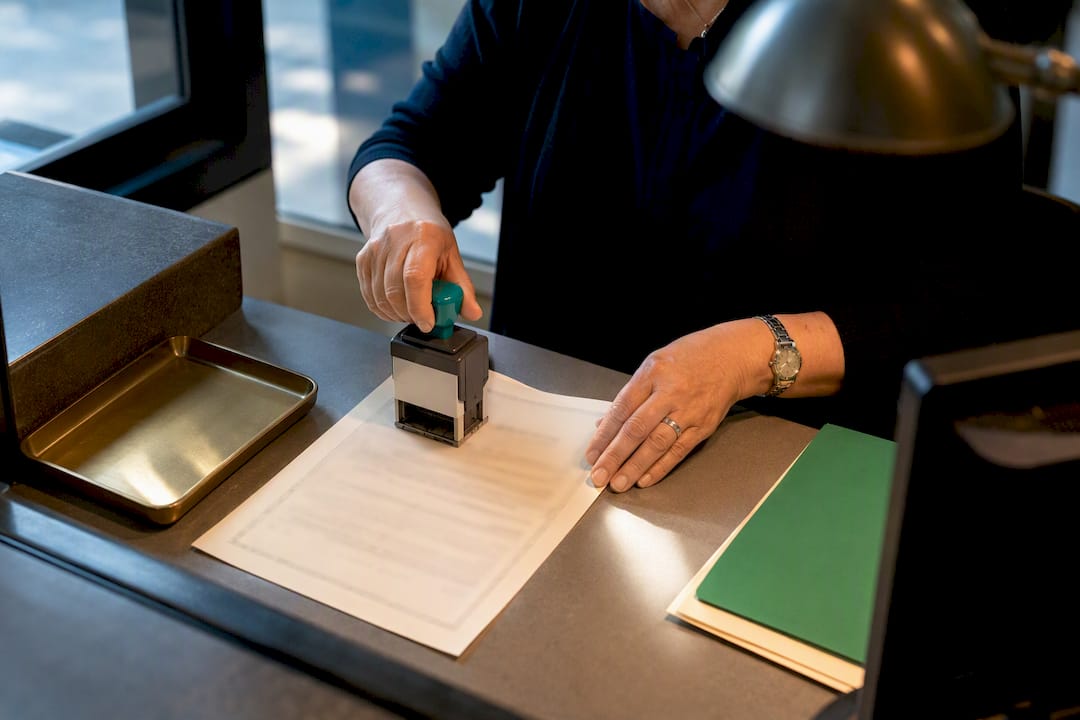
California’s documentary transfer tax runs $0.55 per $500 of property value, commonly written as $1.10 per $1,000, and it applies to nearly every recorded real estate sale in the state. That’s just the county floor. Cities like San Francisco and Los Angeles layer on their own tax, sometimes tripling or quadrupling what a seller actually owes at closing.
TL;DR:
- California’s base transfer tax is $0.55 per $500 of sale consideration, but city and charter city taxes can significantly increase the total, especially on high-value properties.
- Transfer taxes are calculated by dividing the sale price by 500, rounding up, then multiplying by $0.55, with exemptions available for certain transfers like gifts or spouse transfers.
- Cities like San Francisco and Los Angeles layer additional tiered or flat city transfer taxes on top of the county rate, which can raise total costs into five figures for multimillion-dollar properties.
- Transfer tax responsibility is determined by negotiation, but most counties require sellers to pay, while city taxes vary and may be split, with escrow handling the calculation and remittance.
- Buyers should estimate transfer tax early, confirm city rates before writing offers, and carefully review affidavit details, especially on high-value or complex transactions, to avoid costly mistakes.
Table of Contents
- What Is California’s Transfer Tax and How Does It Work?
- How to Calculate Transfer Taxes for Your California Purchase
- Who Pays Transfer Tax in California, and How Escrow Handles It
- Common Transfer Tax Exemptions and How to Claim Them
- Cities With Higher or Tiered Transfer Tax Rates
- Filing the Transfer Tax Affidavit Without Errors
- Ficustree’s Take on Budgeting for Transfer Tax
- Which Property Transfers Actually Owe Transfer Tax?
- Transfer Tax vs. Property Tax Reassessment and Recording Fees
- What Happens If Transfer Tax Isn’t Paid Correctly?
- Recent Changes Affecting California Transfer Taxes
- The Real Cost of Skipping the Transfer Tax Math
- How Ficustree Helps You Get Ahead of Closing Costs
- Sources
- FAQ
What Is California’s Transfer Tax and How Does It Work?
Transfer tax, formally the documentary transfer tax, is an excise tax on the privilege of recording a deed that transfers ownership of real property. Every county in California collects it, and the amount is tied directly to what the property sold for, not its assessed value under Prop 13.
The statutory rate comes from the Documentary Transfer Tax Act: $0.55 for every $500 of consideration, or a fraction of $500. Most escrow officers and title companies express it as $1.10 per $1,000 because the math is cleaner, but the two figures describe the identical rate.
Here’s where it gets more complicated for buyers budgeting a purchase. That county rate is only the floor. Charter cities in California can set their own transfer tax rates independent of the county rate, and several of them do, sometimes dramatically. A $2 million home in unincorporated Sonoma County pays a very different transfer tax than the same home inside San Francisco city limits.
How the tax gets calculated in practice
Los Angeles County’s recorder explains that the tax applies whenever consideration exceeds $100, and the county collects it at the moment of recording, whether or not a city tax also applies. The LA County Recorder’s documentary transfer tax page walks through how the county acts as the collection point even for taxes that ultimately fund city budgets.
For most buyers, the practical question isn’t the legal definition. It’s how much cash they need at the closing table, and who’s supposed to bring it.
How to Calculate Transfer Taxes for Your California Purchase
The formula sounds simple until the rounding rule catches you. California rounds up to the next $500 increment for any fractional amount, so a sale price of $500,001 gets taxed as if it were $500,500.
Here’s the calculation walkthrough:
- Take the sale price and divide by 500.
- Round up to the next whole number if there’s any remainder, even a single dollar over a $500 line.
- Multiply by $0.55 to get the county documentary transfer tax owed.
- Add any city transfer tax if the property sits inside a jurisdiction with its own rate.
- Check for exemptions before finalizing, since certain transfers owe nothing at all.
That third step where new money comes into play matters most in assumption sales. When a buyer takes over an existing mortgage rather than obtaining new financing, Napa County’s transfer tax guidance confirms the tax often applies only to the new consideration, not the full assumed loan balance. If a buyer assumes a $300,000 existing loan and pays $50,000 in new cash and equity, the taxable consideration in many cases is that $50,000, not the full $350,000 purchase price.
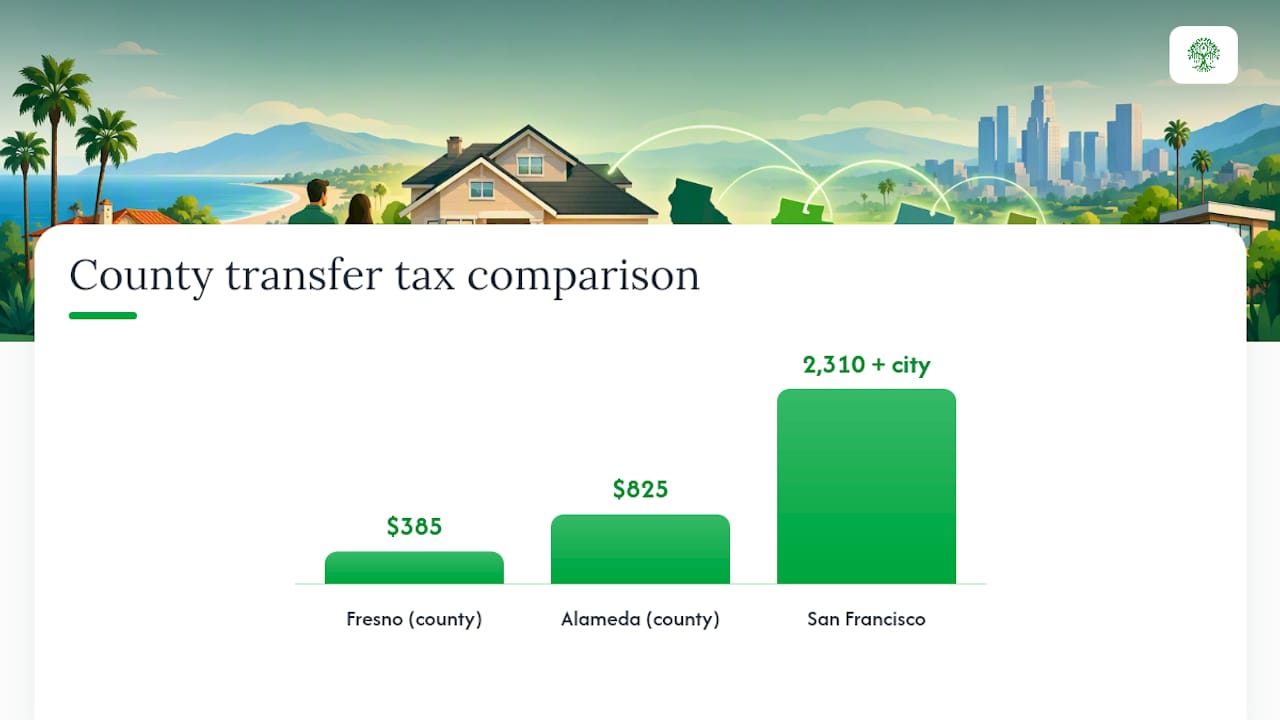
Low-end example: A $350,000 condo in Fresno County, no city tax. $350,000 ÷ 500 = 700. 700 × $0.55 = $385 owed at recording.
Mid-range example: A $750,000 single-family home in unincorporated Alameda County. $750,000 ÷ 500 = 1,500. 1,500 × $0.55 = $825, with no city layer added since the property sits outside Oakland or Berkeley city limits.
High-end example: A $2,100,000 home inside San Francisco. The county portion alone is $2,100,000 ÷ 500 = 4,200 × $0.55 = $2,310. San Francisco’s own tiered city tax then applies on top of that county figure, which is where the total can jump substantially, sometimes into five figures. We’ll break down exactly how those city tiers work in the next section.
Pro Tip: Run your transfer tax number before you write an offer, not after. A $10,000 to $30,000 swing on a high-value San Francisco or Los Angeles property can change what you’re willing to offer or what concessions you ask for.
Who Pays Transfer Tax in California, and How Escrow Handles It
California law doesn’t assign transfer tax to either party. The Revenue and Taxation Code stays neutral on who writes the check, which means it’s entirely a matter of local custom and contract negotiation.
In most California counties, sellers customarily pay the county transfer tax. That’s tradition, not statute, and it varies by region. City transfer taxes get murkier: in San Francisco, the seller almost always pays by local custom, but in some Los Angeles-area transactions, buyers and sellers split city tax or negotiate it as part of the broader deal.
Escrow and title companies handle the mechanics regardless of who pays. They calculate the tax based on the final sale price, collect the funds as part of the closing disbursements, and remit payment to the recorder at the moment the deed is recorded. Your settlement statement should show the exact transfer tax line item, broken out by county and city where applicable.
Before signing, confirm these items with your escrow officer or agent:
- The exact county and city transfer tax amounts appearing on your closing disclosure.
- Which party the purchase contract assigns each portion to.
- Whether the amount reflects full consideration or net consideration if a loan is being assumed.
- That the county and city rates used match the property’s actual jurisdiction, not a neighboring one.
If you want the seller to cover transfer tax as part of your offer, put it in writing. Standard California purchase agreements let buyers request that language directly, and SmartAsset’s guide to California transfer tax confirms this kind of negotiation is common enough that agents expect the ask. Our guide on asking for seller concessions in California walks through the exact phrasing that tends to work.
Common Transfer Tax Exemptions and How to Claim Them
Not every deed transfer owes tax. Revenue and Taxation Code Section 11930 lists several categories of exempt transfers, and knowing which one applies to your situation can save real money.
The most common exemptions include:
- Transfers between spouses, including as part of a marriage or upon divorce.
- Gifts, where no money or consideration changes hands.
- Transfers by death, such as when property passes through a will or trust distribution.
- Transfers into a revocable living trust, when the trustor and beneficiary remain the same person.
- Entity transfers that preserve ownership percentages, such as moving a property into an LLC where the ownership interests stay identical.
Claiming an exemption isn’t automatic. The deed itself must carry the correct statutory recital, meaning the specific code section being claimed, along with any required signature or supporting documentation. Sonoma County’s recorder notes that missing or incorrect recitals are a frequent reason claims get rejected or flagged at recording, according to Sonoma County’s documentary transfer tax page.
The entity-transfer exemption deserves extra caution. Under Revenue and Taxation Code Section 11925, the exemption for moving property into an LLC or partnership only holds if the ownership percentages stay exactly the same before and after the transfer. Bring in a new partner at a different split, and the exemption fails, making the whole transfer taxable.
If you missed claiming a valid exemption at the time of recording, you generally need to work with the recorder’s office or a title company to file a correction and request a refund. This is one of the few spots where hiring a real estate attorney pays for itself; our guide on the role of a real estate attorney at closing covers when that call makes sense.
Cities With Higher or Tiered Transfer Tax Rates
San Francisco and Los Angeles don’t use the flat county rate. Both cities layer additional tax on top of the state base rate, and in San Francisco’s case, the rate climbs sharply as property value increases.
San Francisco applies a tiered schedule where the tax rate rises in bands tied to the sale price, published on the city’s transfer tax page. A modest condo sale and a multimillion-dollar home sale in the same city can face transfer tax rates that differ by several multiples, not just a proportional increase.
Los Angeles applies its own additional city tax on top of the county rate, and other cities across the state have followed similar patterns:
- San Francisco: Tiered rate structure, with higher bands kicking in above set price thresholds.
- Los Angeles: Additional city rate stacked on the county’s $0.55 per $500 base.
- Culver City: Progressive tiers similar in spirit to San Francisco’s approach, scaled for its market.
The legal mechanism behind this patchwork is the charter city distinction. Charter cities can set transfer tax rates independent of the state’s Documentary Transfer Tax Act, while general-law cities are more constrained. That’s why two cities twenty minutes apart can have wildly different transfer tax obligations on an identical sale price.
Before you make an offer on a property in any major California metro, check the specific city recorder or city ordinance page, not just the county rate. Factor that city number into your closing cost estimate from the start, because it can shift your total cash-to-close by thousands of dollars.
Filing the Transfer Tax Affidavit Without Errors
Every recorded deed in California needs an accompanying transfer tax declaration, sometimes called a preliminary change of ownership report or transfer tax affidavit, that states the consideration paid and any exemption claimed.
Here’s how the filing process typically works:
- The document preparer or escrow officer fills out the declaration, listing the assessor’s parcel number, total consideration, any assumed liens, and the exemption code if one applies.
- The buyer, seller, or their authorized representative signs it, affirming the figures are accurate under penalty of perjury.
- Escrow submits the declaration alongside the deed at the county recorder’s office when the transaction closes.
- The recorder collects the tax owed and records the deed, but critically, the recorder does not verify the calculation. Sonoma County’s recorder guidance confirms that responsibility for accuracy sits with the preparer, not the county.
That last point matters more than most buyers realize. Because recorders collect based on the declared figure without auditing it, an incorrect consideration amount or a missing exemption citation can sit unnoticed for years, until a title issue, an audit, or a future sale surfaces the error. Keep your closing documents and any exemption paperwork on file indefinitely, since correcting a mistake later almost always requires proving the original transaction terms.
Ficustree’s Take on Budgeting for Transfer Tax
Transfer tax should show up in your affordability math from day one, right alongside PITI, HOA dues, and homeowners insurance. Buyers who wait until escrow to learn their city’s rate often get an unpleasant surprise on the closing disclosure.
Follow three steps: estimate your county and city transfer tax as soon as you have a target price range, confirm the exact city rate with the recorder before you write an offer, and review the transfer tax affidavit line by line before it’s signed at closing.
Ficustree’s buyer representation surfaces these numbers early in your search, not after you’ve fallen for a property. Anand and the Ficustree platform build closing-cost estimates, including transfer tax, into the affordability picture from the first showing, so you negotiate from real numbers instead of guesswork.
Which Property Transfers Actually Owe Transfer Tax?
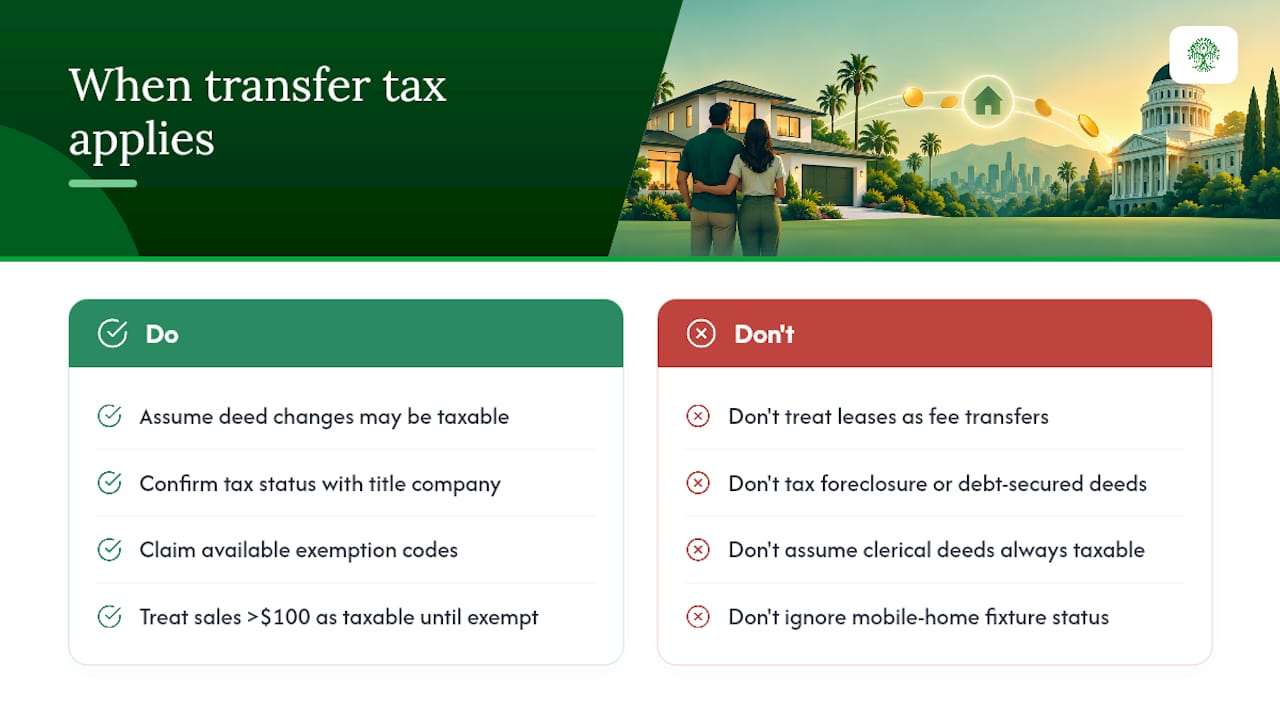
Transfer tax applies specifically to recorded transfers of real property, meaning land and anything permanently attached to it, when consideration exceeds $100. Leases, even long-term ground leases, generally fall outside the tax because a lease doesn’t transfer fee ownership.
Certain transfers avoid the tax entirely regardless of value. Foreclosure deeds to a lender, transfers securing a debt, and transfers that don’t actually change beneficial ownership, such as moving property into a straw entity that’s later moved back, can all fall outside taxable transfers. Mobile homes not permanently affixed to land typically aren’t subject to it either, since they’re treated as personal property rather than real property under most county rules.
Commercial and residential sales both owe the tax identically, since the rate structure doesn’t distinguish by property type, only by consideration paid and jurisdiction. A $5 million commercial building and a $5 million residential estate in the same city face the same base calculation.
Where readers get confused is assuming any change in a deed triggers tax. Adding a spouse to title, correcting a clerical error on a deed, or transferring into a trust where beneficial ownership doesn’t change are common scenarios that often owe nothing, provided the exemption is properly claimed and recited. The safest approach is treating every deed change as potentially taxable until you’ve confirmed otherwise with your title company or the exemption codes covered earlier in this guide.
Transfer Tax vs. Property Tax Reassessment and Recording Fees
These three costs get lumped together constantly, and they’re entirely different animals. Transfer tax is a one-time excise tax paid at the moment a deed records, calculated on sale price. It has nothing to do with your ongoing property tax bill.
Property tax reassessment is a separate event triggered by the same sale. Under Prop 13, California caps annual property tax increases at 2% of assessed value, but a change in ownership typically resets the assessed value to current market price. That reassessment drives your annual property tax bill for years afterward, while transfer tax is paid once and never again. Our breakdown of California property taxes covers how that reassessment actually works.
Recording fees are a third, unrelated cost. These are flat administrative fees the county charges to physically record any document, deed included, regardless of value or consideration. They’re usually modest, often in the range of $20 to $100 depending on the county and document length, and they apply whether or not any transfer tax is owed at all.
None of these three costs are the same as a documentary stamp tax, a term used in other states but not California’s own terminology, though it describes a functionally similar transfer tax concept elsewhere. If you see “stamp tax” referenced in a California closing document, it’s almost certainly being used loosely to mean the same documentary transfer tax discussed throughout this guide.
What Happens If Transfer Tax Isn’t Paid Correctly?
Recording a deed without paying the correct transfer tax creates real exposure, and it doesn’t go away once the deed is filed. Because county recorders collect based on the declared figure without independently verifying it, an underpayment can surface years later during a refinance, a future sale, or a title audit.
When an error is caught, the county can demand the unpaid tax plus penalties and interest calculated from the original recording date, not the date the error was discovered. In cases where the underpayment appears intentional, such as deliberately understating consideration to reduce the tax owed, the declaration’s penalty-of-perjury language means the signer faces exposure beyond a simple back-tax bill.
A related trap involves the popular idea of selling property to a family member for a token amount, like $1, to avoid transfer tax. This doesn’t work the way people assume. Recorders and courts look at fair market value, not the stated purchase price, when the sale is between related parties at a price far below market value. The IRS and county assessors treat that kind of transaction as a gift of the difference between the token price and actual value, which can trigger gift tax reporting obligations and still leave the parties owing transfer tax based on the property’s real worth, not the nominal $1 figure.
The safer path for family transfers is using the documented gift exemption correctly, with the proper recital on the deed, rather than trying to disguise a gift as a nominal sale.
Recent Changes Affecting California Transfer Taxes
California’s transfer tax landscape keeps shifting at the city level even when the state statute stays fixed. The base $0.55 per $500 county rate has remained stable, but the real movement has come from charter cities adjusting their own additional rates through local ballot measures.
Voters in several California cities have approved higher tiered transfer taxes in recent years specifically targeting higher-value property sales, following the model San Francisco established with its own tiered structure. These measures typically get framed as revenue tools for housing or homelessness programs, and they tend to concentrate the increase on sales well above median home prices rather than raising rates across the board.
The practical lesson for buyers and sellers is that county rates are the stable baseline, but city rates are not something to assume stays constant year over year. Any time you’re transacting in a charter city, particularly one that has passed a housing-related ballot measure recently, verify the current rate directly with that city’s recorder or treasurer’s office rather than relying on a rate you saw quoted even a year or two earlier. Legislative changes at this level move faster than most statewide tax rules, precisely because they’re decided locally rather than through the state legislature.
The Real Cost of Skipping the Transfer Tax Math
Most first-time buyers treat transfer tax as a rounding error in their closing cost estimate, and in cities without a local add-on, that’s often fine. It stops being fine the moment you’re buying in San Francisco, Los Angeles, or another charter city with its own tiered schedule, where the gap between what you assumed and what you actually owe can run into five figures.
The fix isn’t complicated: get the exact city and county rate before you write an offer, not after you’ve opened escrow. Negotiate who pays it explicitly in your contract rather than assuming custom will hold. And if your transaction touches a trust, an LLC, or a family transfer, get the exemption recital right the first time, because fixing it after recording is slower and more expensive than doing it correctly upfront.
— Anand
How Ficustree Helps You Get Ahead of Closing Costs
Most buyers don’t find out their real transfer tax exposure until they’re deep in escrow, staring at a settlement statement with numbers they never budgeted for. Ficustree builds that number into your affordability picture from the first search, using AI-guided cost estimates that account for your specific city and county rate, not a generic statewide average.

Ficustree’s platform surfaces the affidavit details, the exemption questions, and the negotiation angles on seller-paid transfer tax well before you’re sitting in the escrow office wondering what you missed. If you’re actively house hunting in California and want that clarity from your very first showing, start with Ficustree’s buyer platform and see what a fully budgeted offer actually looks like.
This article is general information, not a substitute for advice from a qualified financial advisor. Consult a qualified financial professional about your own circumstances before acting on anything here.
Sources
- California Revenue & Taxation Code, Documentary Transfer Tax Act (statutory text)
- Los Angeles County Recorder — Documentary Transfer Taxes
- San Francisco transfer tax page
FAQ
What is the transfer tax in California?
California’s base documentary transfer tax is $0.55 per $500 of consideration, commonly written as $1.10 per $1,000. Cities like San Francisco and Los Angeles add their own tax on top of that county rate, sometimes with tiered schedules for higher-value sales.
How to avoid transfer tax in California?
You can’t avoid transfer tax simply by choosing a low sale price between related parties, since counties assess tax based on fair market value in those cases. Legitimate ways to avoid it include qualifying transfers between spouses, gifts, transfers into a revocable trust, or entity transfers that preserve identical ownership percentages, as long as the exemption is properly recited on the deed.
How do I calculate the documentary transfer tax in California?
Divide the sale price by 500, round up to the nearest whole number for any fractional amount, then multiply by $0.55 to get the county tax owed. Add any applicable city tax on top, and check whether a mortgage assumption limits the taxable amount to just the new consideration, as Napa County’s guidance explains.
Can I sell my house to my son for $1?
You can record a deed at any stated price, but the county will still calculate transfer tax and any gift tax exposure based on the property’s actual fair market value, not the $1 figure. The safer route for family transfers is documenting it properly as a gift using the statutory gift exemption rather than disguising it as a nominal sale.
Does Ficustree help with transfer tax and closing cost estimates?
Yes. Ficustree’s buyer representation platform builds city and county transfer tax estimates into your affordability picture from the start of your search, and its $1,000 flat fee plus 1% commission structure is designed to give first-time buyers clearer visibility into total closing costs than a traditional agent relationship typically offers.
Recommended
- California Closing Costs Breakdown for First-Time Buyers
- First-Time Homebuyer Mistakes California Buyers Must Avoid
- Role of a Real Estate Attorney at Closing: CA Guide
- California Property Taxes Explained: A Buyer’s Guide

Leave a Reply