
For most first-time buyers, the smartest WithJoy.AI alternatives are not pure AI platforms at all. They’re hybrid services that pair AI-driven home discovery with a licensed agent who can negotiate and stand behind the deal. Ficustree fits that hybrid category, and this guide walks through the categories, a checklist to test any platform, and the buyer profiles each option actually serves.
TL;DR:
- Hybrid platforms like Ficustree pair AI-driven home discovery with licensed agents who handle negotiations and closing, making them ideal for first-time buyers.
- Ensure the platform provides active MLS access, direct representation, and clear legal terms before trusting it with a major purchase.
- AI excels at quickly scanning listings and ranking matches but falls short in judgment, negotiation, and regional repair cost estimates.
- First-time buyers especially benefit from a hybrid approach, combining fast discovery with the support of a human agent during critical negotiation stages.
- Ficustree’s free tools and licensed representation aim to give buyers speed, guidance, and accountability throughout the homebuying process.
Table of Contents
- What Are the Best WithJoy.AI Alternatives for Home Buyers?
- How Do You Choose Between These Alternative Gift Registry Platforms and Real Estate Tools?
- Where Does AI Actually Help, and Where Does It Fall Short?
- How Does Ficustree Fit Into This Picture?
- Why the Hybrid Model Wins for Most First-Time Buyers
- Try Ficustree: Decision Intelligence Plus Real Representation
- Sources
- FAQ
What Are the Best WithJoy.AI Alternatives for Home Buyers?
Searching for withjoy.ai alternatives usually means one of three things: you want a similar gift registry style platform, you’re evaluating alternative gift registries for a wedding, or you’ve landed here because “AI plus real estate” search results are a tangled mess of unrelated tools. This guide addresses the real estate side of that confusion, because a growing number of platforms marketed as free gift registry sites or comparable gift services have nothing to do with buying a house, and buyers researching AI homebuying tools deserve a clear map of what’s actually out there.
Three broad categories cover almost every option you’ll find:
- AI-only agentic platforms. These tools scan listings, rank matches, and sometimes draft offer language, but they carry no real estate license and no fiduciary duty to you. Pricing tends to run as a monthly subscription or a flat search fee, and the typical user is an experienced investor who already knows how to vet a contract.
- Hybrid AI plus agent services. These combine algorithmic matching with a licensed human who handles negotiation, disclosures, and closing. Pricing usually blends a smaller flat fee with a reduced commission, often with a rebate back to the buyer. This is where Ficustree operates, and it’s the category most first-time buyers should start with.
- Traditional human-first brokerages with AI toolsets. Here, an agent still drives the relationship, but the brokerage layers in AI for showing scheduling or market alerts. Pricing follows the standard commission model, typically 2.5 to 3 percent of the sale price, with no rebate structure built in.
The gap between the first category and the other two matters more than most comparison charts admit. Brookings has documented how much of a traditional commission is baked into a home’s price rather than itemized as a visible fee, which is exactly why AI-only subscriptions look cheap by comparison, until you realize you’re on your own for the negotiation that determines your actual purchase price.
How Do You Choose Between These Alternative Gift Registry Platforms and Real Estate Tools?
Skip the platforms that don’t survive this checklist. Run any AI real estate tool through these six questions before you trust it with your biggest purchase:
- Is there a licensed agent attached to my search, and will they represent me in writing? A platform that only “connects” you to an agent network isn’t the same as one that provides direct representation.
- Can the platform negotiate on my behalf, or does it stop at generating a suggested offer price? Negotiation is a skill, not a data output.
- Does it have live MLS access for your specific market, or is it scraping public listing feeds that lag by days?
- What’s the actual pricing model? Flat fee, subscription, or commission, and is a rebate legally available in your state?
- How current and hyper-local is its cost data? A tool that doesn’t know your city’s transfer tax or a neighborhood’s typical repair costs will misprice your risk.
- What happens when something goes wrong? Is there a real, licensed party accountable for errors, or just a terms-of-service disclaimer?
If you’re a first-time buyer, weight questions 1, 2, and 6 the heaviest. If you’re an experienced investor doing a cash deal, an AI-only or subscription model may genuinely be enough.
Pro Tip: Before you commit to any platform, ask directly for proof of active MLS feed access and the exact wording of its representation agreement. G2’s research on comparable gift services and real estate alternatives shows users consistently rank reliability and ease of use above flashy features, and a platform that hesitates to show you its MLS credentials or representation terms is telling you something.
Where Does AI Actually Help, and Where Does It Fall Short?
AI is genuinely good at three things: scanning thousands of listings in seconds, ranking matches against your stated preferences, and monitoring new inventory around the clock so you never miss a listing that fits. That’s the discovery layer, and it’s a real upgrade over manually refreshing a search every morning.
Where it breaks down is judgment. AI models can hallucinate details about a property’s condition, miscalculate local repair costs because construction pricing varies wildly by zip code, and miss the subtle cues a human picks up during a showing.
Industry reporting is converging on the same conclusion: buyers increasingly use AI for discovery but still lean on human advisors once a deal gets serious, and that split is widening rather than closing.
Three concrete failure modes show up repeatedly in industry reporting:
- Agents interviewed by Inman point out that AI can’t read a buyer’s hesitation standing in a kitchen, a signal that often changes offer strategy on the spot.
- Repair-cost estimates generated by algorithms routinely miss regional labor pricing, leading buyers to underbid or overbid based on bad math.
- Forbes coverage of the shift notes that AI is reshaping agent workflows, not eliminating the need for a human who can adjust a negotiation strategy mid-conversation.
None of this makes AI a bad tool. It just makes it a discovery tool, not a closing tool.
How Does Ficustree Fit Into This Picture?
Ficustree was built specifically for the gap the sections above describe: buyers who want AI-speed discovery but still need a licensed human accountable for the deal. You get decision intelligence matched to your actual budget and preferences, direct buyer representation, and hourly showing agents you can book on demand instead of waiting on one agent’s calendar.
The platform, including affordability calculators and neighborhood insights, is free to use.
Two buyer profiles map cleanly onto this:
- A first-time buyer who’s never negotiated a contract and doesn’t know what “contingency” really protects. Ficustree pairs AI-driven matching with a licensed agent who handles the offer, disclosures, and closing, so you’re never negotiating alone.
- A buyer who wants the commission rebate but doesn’t want to sacrifice guided support. The fee structure, combined with rebates where legal, aims to keep more money in your pocket than standard commission models without cutting you loose to figure out escrow on your own.
Ficustree doesn’t try to be the AI-only category. It’s built for buyers who want both speed and someone answering for the outcome.
Why the Hybrid Model Wins for Most First-Time Buyers
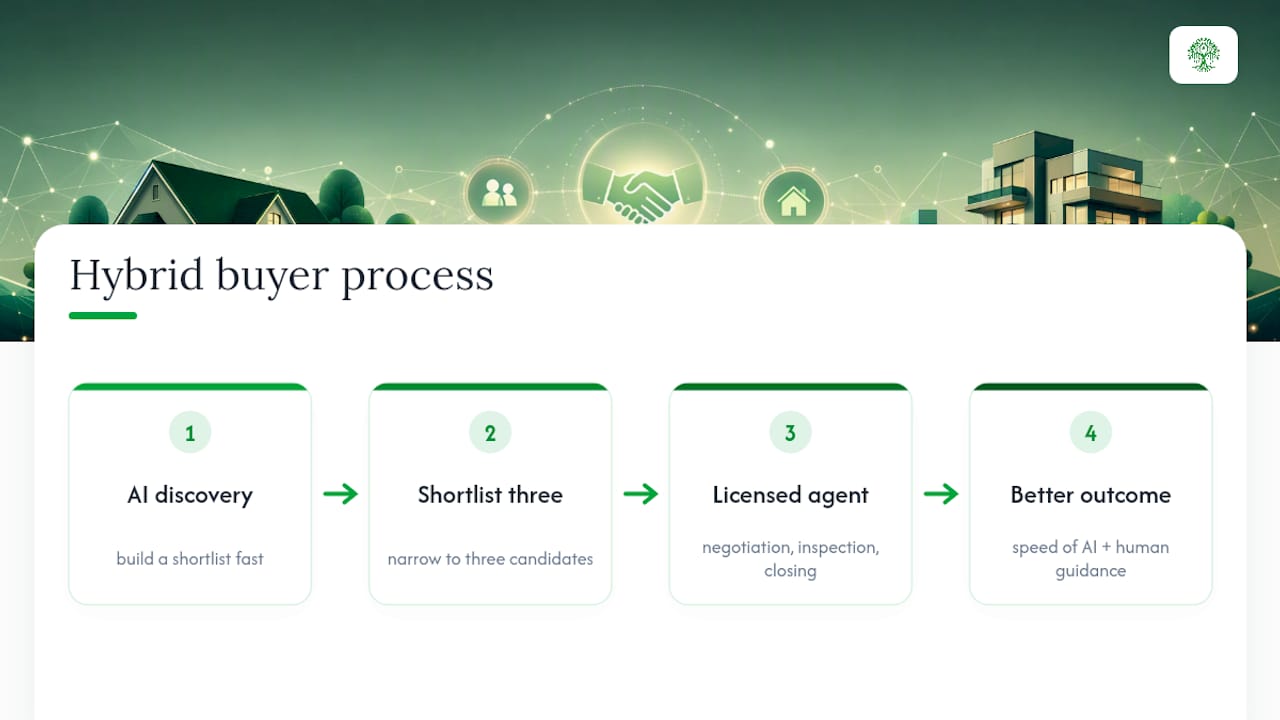
The honest path forward is simple: use an AI discovery tier to build a shortlist fast, narrow it to three serious candidates, then hand the negotiation, inspection, and closing to a licensed agent who uses proven types of buyers agent search strategies in Sydney. That sequence gets you the speed of AI without gambling your largest purchase on a tool that can’t sit across a negotiating table.
An AI-only route is reasonable if you’re a repeat buyer or an investor who already knows contract language cold and just wants faster listing access. For everyone else, especially anyone buying for the first time, the emotional and practical guidance a human agent brings during a stressful negotiation isn’t optional. It’s the part of the process where deals actually get won or lost.
— Anand
Try Ficustree: Decision Intelligence Plus Real Representation
Ficustree gives you what the AI-only platforms above can’t: a licensed agent backing every offer, not just a ranked list of listings.

Getting started takes three steps. Visit the Ficustree homepage to see how the matching works for your budget and target neighborhoods. Book an hourly showing agent the next time you want to see a property without waiting on a single agent’s schedule. And when you’re ready to make an offer, you’ll already have a licensed representative in place instead of scrambling to find one after you’ve fallen for a house. The house should find you. Start by seeing what it finds.
Sources
- Consumers use AI in homebuying, agents shift to advisor role — HousingWire
- In the age of AI, here’s why homebuyers still need a human — Inman
- Why AI Is Reshaping – Not Replacing – The Real Estate Agent — Forbes
- Top 10 WithJoy.AI Alternatives & Competitors — G2
FAQ
What Is the Best AI Assistant for Real Estate Agents Right Now?
There’s no single tool that dominates every market, but agentic platforms that handle listing analysis and showing scheduling are gaining ground fastest because they free agents up for negotiation and client strategy.
Which CRM Does Keller Williams Use?
Keller Williams runs its own proprietary platform called Command, built to handle lead management and transaction tracking for its agents.
What Is the 80/20 Rule for Realtors?
The 80/20 rule suggests roughly 80% of an agent’s business comes from about 20% of their efforts or clients, usually repeat buyers and referrals, which is why relationship-driven service still outperforms pure lead volume.
Are There Free Gift Registry Sites That Work Like WithJoy.AI for Home Buying?
WithJoy.AI’s registry features don’t translate to real estate, but Ficustree offers its full home-buying platform, including matching and calculators, free to buyers, with revenue coming only from the fee and commission paid at closing.
Should a First-Time Buyer Choose an AI-Only Platform or a Hybrid Service?
First-time buyers should generally choose a hybrid service, since reporting from HousingWire shows buyers increasingly rely on human advisors once negotiation and accountability enter the picture.
Recommended
- The Best Zeego.ai Alternatives for First-Time Buyers
- AI Home Search for Buyers: What Changes Now
- Top 3 homes.com Alternatives for 2026
- AI Home Platform Features and Benefits for First-Time Buyers

Leave a Reply