
Millennials delay homeownership primarily because of a compounding set of financial and structural barriers: home prices that have outpaced wage growth, mortgage rates that increased substantially between 2019 and 2024, student and consumer debt that crowds out savings, a chronic shortage of starter homes, and delayed household formation. Pew Research Center finds that the share of renter households under 40 who could afford to buy fell markedly between 2019 and 2024, as the 30-year fixed rate increased significantly over the same period. That single shift priced out nearly one in five potential buyers before they even opened a listing.
The top six reasons millennials delay buying a home:
- Home prices have risen faster than young-adult incomes, making the math harder every year
- Mortgage rates roughly doubled between 2019 and 2024, inflating monthly payments sharply
- Student loan debt extends down-payment timelines by years, sometimes decades in coastal metros
- Marriage and household formation rates have declined, reducing the two-income buying unit
- Starter-home inventory is scarce; most available listings are larger, move-up properties
- Tighter lending standards and down-payment requirements block buyers who are otherwise ready
Key Takeaways
Millennials delay homeownership primarily because of compounding financial barriers: home prices outpacing wages, mortgage rates that increased substantially between 2019 and 2024, student debt extending down-payment timelines by years, and a chronic shortage of starter homes.
| Point | Details |
|---|---|
| Affordability collapsed between 2019 and 2024 | The share of renter households under 40 who could afford ownership fell from 56% in 2019 to 37% in 2024 as rates rose from 3.9% to 6.7%. |
| Student debt adds years, not months | Student loan payments add several years to the national average down-payment timeline, with longer delays in high-cost coastal metros like Los Angeles. |
| Starter-home supply is the hidden barrier | Most available inventory is larger, move-up housing; entry-level supply remains critically short in most major metros. |
| Buyers are getting older | The median first-time buyer age was 34 in Q1 2026, reflecting a long-run trend toward delayed purchase. |
| Ficustree offers a structured path forward | First-time buyers in California and Texas can use Ficustree’s fixed-fee representation and decision-intelligence tools to move from confusion to closing faster. |
Table of Contents
- Why millennials delay homeownership: the affordability math
- How student debt delays your path to a down payment
- How delayed marriage reduces millennial homeownership rates
- Why starter homes are nearly impossible to find
- Lifestyle, flexibility, and shifting attitudes toward ownership
- What credit scores and down payments actually block
- What the data actually shows: a research synthesis
- Practical steps to move from thinking about buying to actually closing
- Will the housing market get easier for millennial buyers?
- The real problem no one talks about enough
- Ficustree helps first-time buyers cut through the confusion
- Sources
- FAQ
Why millennials delay homeownership: the affordability math
The affordability problem is not just about the sticker price. It is about what a home actually costs each month once you factor in principal, interest, taxes, insurance, and HOA fees — the full PITI stack.
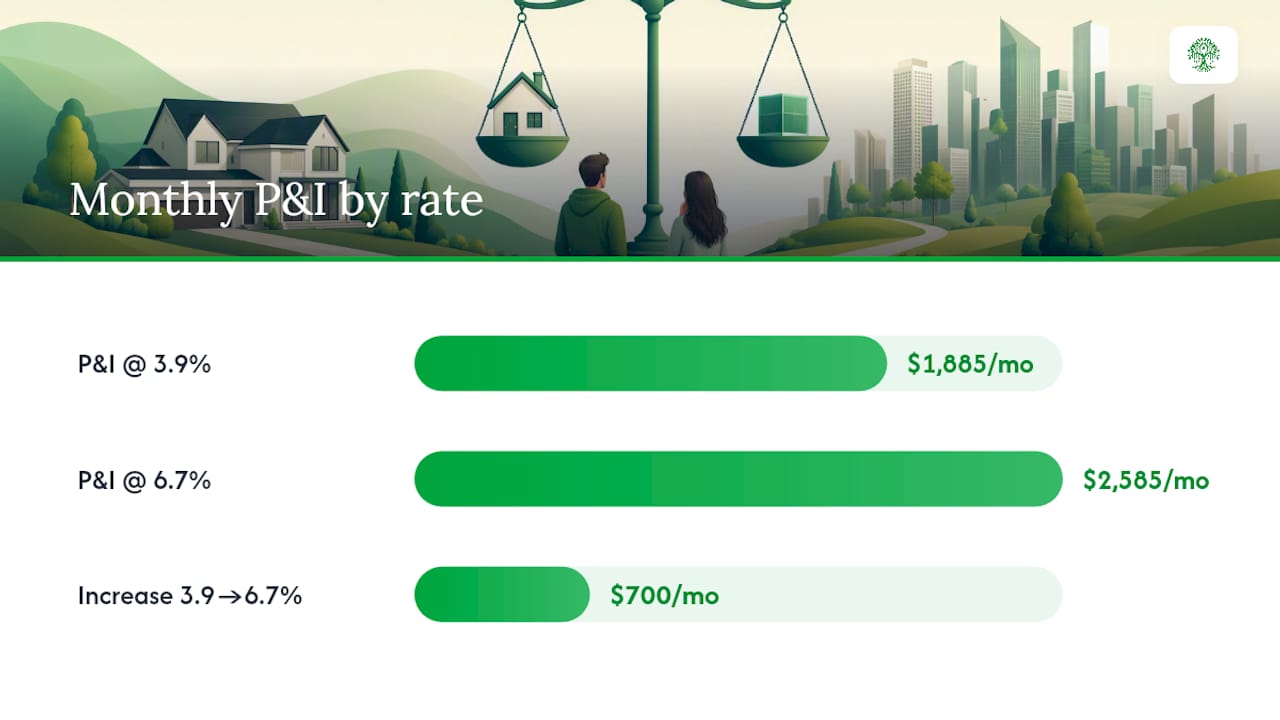
Pew’s analysis shows that home prices have risen faster than young-adult incomes since 2019. When you combine that price growth with a rate that moved from 3.9% to 6.7%, the monthly payment on a median-priced home increased by hundreds of dollars even before taxes and insurance. A buyer financing $400,000 at 3.9% carries a principal-and-interest payment of roughly $1,885 per month. At 6.7%, that same loan costs about $2,585 per month — a $700 monthly difference that translates to $8,400 more per year just in interest. Add property taxes, homeowner’s insurance, and any HOA, and the total monthly obligation can easily exceed what many first-time buyers qualify for.
USA Today’s reporting on first-time buyer trends confirms that even as headline prices moderated in some markets after the 2022 peak, elevated rates kept effective affordability near historic lows through 2025 and into 2026. The psychological anchor of pandemic-era rates around 3% makes today’s 6%+ environment feel punishing, even when it is historically normal.
How to run a realistic affordability check:
- Calculate your gross monthly income and multiply by 0.28 — that is the conventional ceiling for housing costs (PITI).
- Pull your county’s property tax rate and apply it to your target purchase price, divided by 12.
- Get a homeowner’s insurance quote for the area (typically $100–$200/month for a median home).
- Add any HOA fees specific to the neighborhoods you are targeting.
- Subtract taxes, insurance, and HOA from your 0.28 ceiling to find the maximum principal-and-interest payment you can carry.
Pro Tip: Run this calculation before you talk to a lender. Lenders qualify you based on DTI, but your real comfort number may be lower. Knowing your own ceiling prevents you from being approved for more than you can comfortably afford.
How student debt delays your path to a down payment
Student loans affect homebuying in three distinct ways: they drain the monthly cash flow you could redirect to savings, they raise your debt-to-income ratio and reduce what lenders will approve, and they can suppress credit scores when balances are high relative to original loan amounts.
The Mortgage Reports’ opportunity-cost analysis puts a number on this: student loan payments add several years to the national average down-payment timeline, with longer delays in high-cost coastal metros like Los Angeles. The mechanism is straightforward. Every dollar going toward a loan payment is a dollar not going into a down-payment savings account. Redirecting that payment into savings can cut the timeline by a meaningful margin, but most borrowers cannot simply stop paying their loans.
Ways student debt blocks mortgage qualification:
- Raises your DTI ratio, reducing the loan amount a lender will approve
- Limits cash reserves, which many lenders require in addition to the down payment
- Can lower your credit score if balances remain high relative to original amounts
- Reduces monthly surplus available for emergency reserves, which lenders factor in informally
If you carry student loans and want to buy, read buying a house with student loans before you apply — the tactics for income-driven repayment plans and how lenders calculate IBR payments can materially change your qualifying DTI.
How delayed marriage reduces millennial homeownership rates
Marriage is a homeownership accelerant. Two incomes, shared savings, and combined credit profiles make qualification dramatically easier. When marriage rates fall, so does the pool of buyers who can clear the financial bar.
The Urban Institute finds that marriage among young adults has declined substantially between 2005 and 2024. Over the same period, individual-level homeownership among young adults declined significantly. The household-level homeownership rate, which counts married couples as one unit, masks this decline. When you measure ownership at the individual level, the drop is steeper and more telling.
What this demographic shift means for buyers:
- Single buyers face a higher income-to-payment ratio with no second earner to offset costs
- Delayed household formation reduces the urgency to own rather than rent
- Fewer young adults are forming the two-income units that historically drove first-time purchases
- Policy tools focused on mortgage access alone cannot fix a structural demographic trend
The AEI’s credit-report data shows the median first-time buyer age at 34 in Q1 2026, down one year from Q1 2025. That is a slight improvement, but the long-run trend is still toward older first-time buyers compared to prior generations.
Why starter homes are nearly impossible to find
Even buyers who are financially ready often cannot find a home that fits their budget. The inventory problem is not just about total supply — it is about the composition of what is available.

NAR’s Jessica Lautz and reporting in American Banker flag this directly: most of today’s for-sale inventory consists of larger, multi-bedroom move-up homes that are financially out of reach for many first-time buyers. Entry-level supply has been squeezed from both ends.
Why starter-home supply stays tight:
- Zoning rules in most metros favor larger single-family lots, making small-footprint construction economically unattractive for builders
- Existing homeowners locked into 3% mortgages have little incentive to sell and take on a 6.7% replacement loan, reducing turnover
- New construction costs (labor, materials, land) make sub-$350,000 homes unprofitable in most major markets
- Investors and institutional buyers absorbed a meaningful share of entry-level inventory during the 2020–2022 run-up
MortgageResearch reports that financial barriers persist even when headline prices moderate, partly because the homes that become affordable are rarely in the locations or condition first-time buyers want. Building more total units will not solve the problem if the new stock skews toward higher price points.
Lifestyle, flexibility, and shifting attitudes toward ownership
Not every millennial delay is purely financial. A meaningful share reflects deliberate choices about how and where to live.
Urban amenities, job mobility, and the rise of remote and gig-economy work have made renting a more rational choice for longer periods. A software engineer who relocates every two to three years for career advancement faces real transaction costs from buying and selling. A couple weighing cities before committing to a metro has good reason to rent while they decide. These are not failures of ambition — they are rational responses to a labor market that rewards flexibility.
NextGen Research’s 2026 survey of roughly 9,000 respondents found that 6 in 10 prospective millennial and Gen Z buyers expect the system to work against them, and 63% feel overwhelmed by homebuying information. Belief that homeownership is a strong wealth-building vehicle dropped sharply between 2021 and 2026. That attitudinal shift matters because it reduces urgency even among buyers who could qualify.
What millennials prioritize when they choose to rent:
- Geographic flexibility for career moves or lifestyle changes
- Lower maintenance burden and no surprise repair costs
- Access to urban amenities that are often priced out of ownership budgets
- Ability to invest savings in other vehicles rather than a down payment
Pro Tip: If you feel overwhelmed by conflicting information, you are not alone — 63% of prospective buyers report the same thing. Read first-time buyer emotional pitfalls before you start your search. Managing the psychology of the process is as important as managing the finances.
What credit scores and down payments actually block
Many millennials believe they need a 20% down payment and a near-perfect credit score to buy. Neither is true, but the real requirements are still meaningful hurdles.
Conventional loans typically require a minimum 620 credit score, though scores below 680 often trigger higher rates and PMI. FHA loans accept scores as low as 580 with 3.5% down, but they carry mandatory mortgage insurance premiums for the life of the loan in most cases. DTI limits generally cap at 43–45% for conventional loans and 50% for FHA with compensating factors.
MortgageResearch confirms that saving for a down payment ranks among the top stated barriers, even as low-down-payment programs exist and are underused. A buyer putting 5% down on a $400,000 home needs $20,000 in cash plus closing costs of roughly $8,000–$12,000. That is a $28,000–$32,000 savings target, which takes years on a median millennial income after rent, debt payments, and living expenses.
Pro Tip: Three actions that can materially improve your approval odds in 90–180 days: pay down revolving credit card balances below 30% utilization, dispute any errors on your credit report, and avoid opening new credit accounts. Each of these moves your score faster than most buyers expect.
Explore buying a house with no money down for a breakdown of VA, USDA, and state-level programs that eliminate or reduce the cash requirement for eligible buyers.
What the data actually shows: a research synthesis
The strongest evidence on millennial homebuying delays converges on a consistent picture, though gaps remain at the metro level.
| Metric | Finding | Source |
|---|---|---|
| Share of renters under 40 able to afford ownership | Fell markedly between 2019 and 2024 | Pew Research Center |
| 30-year fixed mortgage rate change | Rose from ~3.9% (2019) to ~6.7% (2024) | Pew Research Center |
| Student-debt down-payment delay, national average | ~3.7 years added to timeline | The Mortgage Reports |
| Median first-time buyer age, Q1 2026 | 34 years | AEI |
The one factor that gets the least attention in mainstream coverage is starter-home inventory. Affordability models typically focus on price and rate. But even a buyer who clears the financial bar faces a market where the available homes are the wrong size, in the wrong condition, or priced above the entry-level range. Urban Institute’s framing makes this explicit: delayed household formation and supply constraints together explain more of the ownership gap than credit access alone.
The NextGen 2026 survey adds a behavioral layer: even buyers who could qualify are held back by distrust and information overload. That is a solvable problem, but it requires better buyer education and representation, not just lower rates.
Practical steps to move from thinking about buying to actually closing
The gap between “I want to buy” and “I closed” is mostly a sequencing problem. Most first-time buyers try to do too many things at once and end up paralyzed. A clear order of operations helps.
- Run your real affordability number. Use the PITI method from the affordability section above. Know your ceiling before you talk to anyone.
- Pull your credit reports. Get all three (Equifax, Experian, TransUnion) at AnnualCreditReport.com. Dispute errors and note your score range.
- Calculate your DTI. Add up all monthly debt payments and divide by gross monthly income. If you are above 43%, identify which debts to pay down first.
- Research down-payment assistance programs. California’s CalHFA and Texas’s TDHCA both offer first-time buyer programs with down-payment grants and low-rate loans. Check first-generation homebuyer programs in CA and TX for current options.
- Get pre-approved, not just pre-qualified. A full pre-approval with verified income and assets carries real weight with sellers. Pre-qualification is just an estimate.
- Talk to a buyer’s agent or buyer-representation platform before you start touring. Understanding your representation options, costs, and rights before you fall in love with a property prevents costly mistakes.
Numeric example: A buyer with $400/month in student loan payments redirecting that amount into a high-yield savings account earning 4.5% APY would accumulate roughly $5,000 in additional savings per year. Over three years, that is $15,000 toward a down payment — enough to cover the gap on a low-down-payment program in many markets.
Pro Tip: Talk to a mortgage advisor before you talk to a listing agent. Your lender determines what you can buy; your agent helps you find it. Getting those two conversations in the right order saves weeks and prevents you from falling for homes outside your real range. The home buying timeline guide maps out exactly when each conversation should happen.
Will the housing market get easier for millennial buyers?
The near-term outlook depends on four levers, and none of them is moving fast enough to dramatically change the picture in the next 12 months.
- Mortgage rates: A sustained drop to the 5.5% range would meaningfully improve monthly affordability and likely bring more sellers off the sidelines. Most forecasters expect rates to remain above 6% through 2026.
- Starter-home supply: New construction at the entry level requires either zoning reform or a sustained drop in construction costs. Neither is imminent in most major metros.
- Wage growth: Real wage growth for workers under 40 has been positive but modest. It helps at the margin but cannot close a gap driven primarily by rate and price levels.
- Down-payment assistance policy: Federal and state programs have expanded, but awareness and uptake remain low. Better program design and outreach could move the needle faster than rate changes.
AEI’s data showing the median first-time buyer age ticking down by one year from Q1 2025 to Q1 2026 is a small positive signal. It suggests that some buyers who delayed during the peak rate environment are now re-entering. But the structural barriers — supply, debt, household formation — do not resolve with a rate cut. They require a longer-horizon response.
The real problem no one talks about enough
The national conversation about millennial homeownership focuses almost entirely on rates and prices. Those matter, but they are the visible surface of a deeper problem.
The starter-home shortage is the most underappreciated driver of delay. You can have a strong credit score, a solid down payment, and a pre-approval letter, and still spend six months finding nothing worth buying in your price range. That experience is demoralizing in a way that statistics do not capture. It is also what turns motivated buyers into long-term renters — not by choice, but by exhaustion.
The second underappreciated factor is information overload. NextGen’s finding that 63% of prospective buyers feel overwhelmed is not a personality trait. It is a structural failure of how the industry delivers information. Most buyers encounter a flood of conflicting advice from lenders, agents, family members, and social media before they have a clear framework for their own situation. The result is paralysis, not progress.
What actually helps is a clear decision sequence: know your number, know your credit, know your programs, then search. That order matters more than any single piece of market timing advice.
Ficustree helps first-time buyers cut through the confusion
If the barriers above describe your situation, the answer is not to wait for rates to drop. It is to get clarity on what you can actually afford and move with a plan.

Ficustree is an AI-powered buyer-representation platform built specifically for first-time buyers in California and Texas. You pay $1,000 at closing plus 1% commission, keep a rebate of roughly 2% where legally permitted, and get on-demand showing agents without committing to a traditional agent relationship upfront. The platform’s decision-intelligence tools walk you through affordability, neighborhood fit, and offer strategy in a structured sequence, so you are not piecing together advice from a dozen sources. Ficustree’s promise: compress six months of first-time-buyer confusion into two months of clarity. If you are ready to move from research to action, start with Ficustree.
Sources
- Homeownership Among Young Adults Has Fallen, and It’s Worse Than You Think | Urban Institute
- Buying a home has gotten harder for young adults in most U.S. metro areas | Pew Research Center
- Student Debt Down Payment Penalty: 8 Months to 16 Years of Homebuying Delay | The Mortgage Reports
- 2026 NextGen Homebuyer Report | Gen Z & Millennial Homeownership Research — NextGen Research
- Why young Americans aren’t relying on homes to build wealth | American Banker
- Despite Improving Market Conditions, Millennials Still Face Barriers to Homeownership | MortgageResearch
- Median first-time homebuyer age at 34 years in quarter 1 2026 down 1 year from quarter 1 2025 | AEI
This article is general information, not a substitute for advice from a qualified financial advisor. Consult a qualified financial professional about your own circumstances before acting on anything here.
FAQ
Why is it so hard for millennials to buy homes?
Home prices have outpaced millennial incomes for years, and mortgage rates nearly doubled between 2019 and 2024, pushing monthly payments well beyond what many first-time buyers can qualify for. Student debt, limited starter-home inventory, and tighter lending standards compound the problem.
What salary do you need to afford a $400,000 house?
At 6.7% interest, principal-and-interest payments on a median-priced $400,000 home amount to roughly $2,585 per month. Adding property taxes, homeowner’s insurance, and any HOA, total monthly obligations can easily exceed what many first-time buyers qualify for under the conventional 28% housing-cost guideline.
Do most millennials own homes?
No. The Urban Institute finds that individual-level homeownership among young adults fell from 40% in 2005 to 29% in 2024, and the median first-time buyer age reached 34 in Q1 2026 according to AEI, reflecting a generation buying later than any prior cohort.
Can Gen Z buy homes more easily than millennials?
Gen Z faces the same structural barriers: high prices, elevated rates, student debt, and scarce starter-home inventory. The NextGen 2026 survey found that 6 in 10 Gen Z and millennial prospective buyers expect the system to work against them, suggesting the challenges are broadly shared across both generations.
Should millennials buy a home now or keep waiting?
Waiting for rates to return to 3% is unlikely to be a winning strategy. Rates are expected to remain above 6% through 2026, and prices in most markets are not falling. Buyers who are financially ready, with solid credit and a realistic down payment, are generally better served by buying within their means now than by waiting for conditions that may not arrive.
Recommended
- Buying a House With Student Loans: Your 2026 Guide – ficustree.ai
- First Time Homebuyer Guide: Simple Steps for Your First Home
- Buying a House with No Money Down: 2026 Guide – ficustree.ai
- How to Avoid PMI as a First-Time Buyer in California – ficustree.ai

Leave a Reply