
If you can use vested RSUs, sell at vest and season the cash 60–90 days before applying. If you need a lender to count RSU income toward qualifying, wait until you have a documented history of vested RSUs typically around two years and evidence of continued vesting over the next few years. That’s the whole decision tree for most first-time buyers holding startup equity in California and Texas. Everything else is detail.
Two paths cover almost every case:
- Sell-and-season path: Cash out a recent vest, park it in a bank or money market account, wait 60 to 90 days, then apply with clean, sourced funds.
- Wait-and-qualify path: Keep working, let your vest history hit the two-year mark, and let RSU income count toward your debt-to-income ratio instead of relying on a lump-sum sale.
Pro Tip: In the next 30 days, pull your vest schedule and grant agreements into one folder. Lenders move faster when the paperwork is ready before they ask for it.
Key Takeaways
The right time to convert startup equity for a home purchase depends on whether you’re using sale proceeds as cash or relying on RSU income to qualify, and each path has its own seasoning and documentation rules.
| Point | Details |
|---|---|
| Two paths, one decision | Sell vested RSUs and season cash for 60–90 days, or wait until you have two years of vest history to qualify on RSU income. |
| Only vested equity counts | Unvested RSUs and unexercised options can’t be used for down payment or qualifying income until sold. |
| Sell-at-vest is tax-efficient | Selling at vest keeps cost basis near sale price, minimizing capital gains versus holding shares longer. |
| Documentation wins the underwriting fight | Grant agreements, two years of W-2s, brokerage confirmations, and seasoned bank statements prevent delays. |
| Ficustree coordinates the timing | Ficustree pairs equity-aware lender introductions with flat-fee buyer representation to align your vest schedule with your purchase date. |
This article is general information, not a substitute for advice from a qualified financial advisor. Consult a qualified financial professional about your own circumstances before acting on anything here.
Table of Contents
- Types of Startup Equity and How Timing Differs for Each
- Which Liquidity Events Actually Put Cash in Your Account
- Tax Consequences and How Much Cash to Actually Reserve
- How Mortgage Lenders View RSU Income and What They’ll Ask For
- A Step-by-Step Checklist for Deciding When to Sell
- Three Timing Scenarios That Mirror Real Buyers
- Your 60-30-0 Day Closing Checklist
- The Emotional Side of Selling Company Stock for a Down Payment
- How Ficustree Coordinates Your Equity Timeline and Home Purchase
- Sources
- FAQ
Types of Startup Equity and How Timing Differs for Each
Not all startup equity behaves the same way when it hits a mortgage application, and confusing one type for another is the fastest way to blow a timeline. RSUs (restricted stock units) convert to real shares at vest and are taxed as ordinary income the moment they vest, whether or not you sell. NSOs and ISOs (stock options) only create value when you exercise them, and taxation depends on the option type: NSOs trigger ordinary income at exercise, while ISOs can trigger the alternative minimum tax. Restricted stock (less common at later-stage startups) usually involves an 83(b) election to lock in tax treatment early.
Only vested-and-sold equity counts as usable cash. Unvested RSUs and unexercised options generally cannot be used as down payment funds or qualifying income until a liquidity event actually happens.
- RSUs: taxed at vest, liquid once vested and sold.
- NSOs/ISOs: taxed at exercise or sale, illiquid until you exercise.
- Restricted stock with an 83(b): taxed early at grant, but still illiquid until a sale event exists.
Pro Tip: Label every grant document by type and vest date as soon as you get it. A loan officer sorting through mismatched paperwork is a loan officer asking for more time.
Which Liquidity Events Actually Put Cash in Your Account
A vest date is not a payday. It’s the moment your shares become yours to sell, and the actual cash timeline depends entirely on which liquidity event you’re waiting on.
- RSU vest at a public company: Shares land in your brokerage account on vest day; a sale typically settles in one to two business days after you place the trade.
- Exercising options then selling: Add the exercise transaction and any company-imposed waiting period before the sale clock even starts.
- Secondary sale at a private company: Often takes weeks to months, since it requires company approval, a buyer, and paperwork most founders are in no hurry to process.
- IPO or acquisition: Frequently comes with a lockup period of 90 to 180 days after the event before employees can sell at all.
Once a sale settles, moving proceeds into a checking or savings account is fast, usually a day or two. The real bottleneck is seasoning that cash for roughly 60 to 90 days so a lender can source it without extra questions. Plan backward from your target closing date, not forward from your vest date.
Tax Consequences and How Much Cash to Actually Reserve
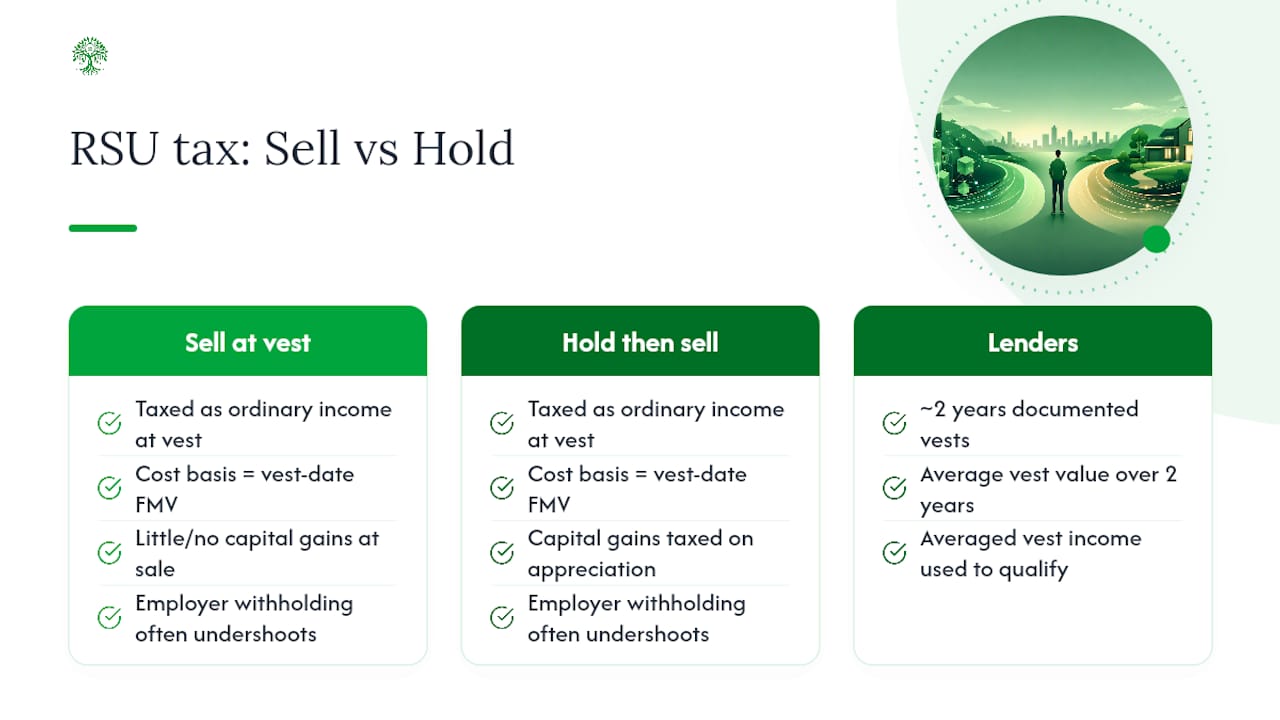
The number on your vest confirmation is not the number you get to keep, and treating it as such is the single most common mistake first-time buyers make with startup equity. RSUs are taxed as ordinary income at vest, based on the fair market value that day, whether you sell immediately or hold. If you sell at vest, your cost basis equals the vest-date price, which makes that sale close to close to tax-neutral on capital gains. Hold the shares and sell later, and any gain above that basis gets taxed separately as a capital gain.
Options work differently. NSOs create ordinary income at exercise; ISOs can trigger the alternative minimum tax even without a sale, which surprises a lot of people who assumed “I didn’t sell anything” meant “I don’t owe anything.” Restricted stock with an 83(b) election shifts the tax hit earlier, to the grant date, in exchange for potentially lower tax on future appreciation.
Don’t assume your employer’s default withholding rate covers your real liability. It usually undershoots.
Statistic Callout: Lenders typically ask for a documented history of RSU vests spanning about two years before counting that income toward qualifying, and they average the vest value over that two-year window rather than using your most recent, possibly larger, vest.
Pro Tip: Selling shares right at vest is usually more tax-efficient than holding and selling later, since the cost basis resets to the vest-date price and there’s little or no capital gain to report.
How Mortgage Lenders View RSU Income and What They’ll Ask For
Conforming lenders don’t take your RSU statement at face value. Fannie Mae and Freddie Mac guidelines require a documented two-year history of vests before RSU income can count toward your debt-to-income ratio, plus evidence that vesting will continue, commonly three more years of scheduled grants. They then average your vest value over that two-year window rather than crediting your best year.
Down-payment funds follow a separate rule: vested-and-sold proceeds count as an asset, unvested grants do not, and sold proceeds generally need 60 to 90 days of seasoning in your account with a documented paper trail.
Before your first conversation with a loan officer, gather:
- Two years of W-2s or pay stubs showing RSU income.
- Grant agreements showing your forward vesting schedule.
- Brokerage sale confirmations for any shares sold.
- Bank statements showing seasoned funds.
- Employment verification, since job stability matters as much as the equity itself.
Handing over this checklist at first contact, rather than piecing it together mid-application, is what keeps underwriting on schedule.
A Step-by-Step Checklist for Deciding When to Sell
- Calculate your target number. Figure out the home price range you’re realistically shopping in and the down payment needed, using a tool like Ficustree’s down payment calculator to model scenarios.
- Check your vest history. Two years of documented vests plus three years of future scheduled vesting unlocks RSU income for qualifying.
- Check concentration. If startup equity makes up more than 30% to 40% of your investable assets, that’s a signal to diversify regardless of your home purchase.
- Check for PMI triggers. If selling shares gets you to 20% down and avoids private mortgage insurance, that tips the scale toward selling now.
- Scan for red flags: trading blackout periods, lockup windows, an upcoming job change, missing grant paperwork, or an unmodeled tax bill.
- Time the sale and season the funds against your target application date, not your closing date.
Pro Tip: Loop in your CPA and your loan officer in the same week, not sequentially. A tax move that saves you money can accidentally break a lender’s documentation requirement if nobody checks both sides at once.
Three Timing Scenarios That Mirror Real Buyers
This is the most straightforward underwriting path because there’s no reliance on future RSU income at all, just documented, sourced cash.
Scenario B: The newer hire. A buyer joined their company 14 months ago and doesn’t yet have two years of vest history. Rather than force it, they qualify on salary alone, accept a smaller down payment, or work with a portfolio lender using asset-depletion underwriting instead of RSU income.
Scenario C: The pre-IPO holder. A buyer expects a liquidity event in 12 to 18 months but needs a home sooner. The move is converting a portion of shares now, through an approved secondary if available, rather than betting the entire down payment on an event with no fixed date. This is precisely where Ficustree steps in to coordinate the sale timing, the lender conversation, and the purchase calendar so none of the three drift out of sync.
Your 60-30-0 Day Closing Checklist
- 60 to 90 days out: Sell at vest, move proceeds into a bank or money market account, and save every trade confirmation.
- 30 days out: Confirm your bank statements are clean of unexplained deposits, gather brokerage sale confirmations and settlement statements, and check that your lender has every document on file.
- 0 to 7 days out: Don’t make new large deposits, don’t change jobs, don’t open new credit lines, and confirm final numbers on your Closing Disclosure.
Pro Tip: When you hand sale paperwork to an underwriter, pair every deposit with its matching brokerage confirmation in the same document. Underwriters flag unexplained deposits first and ask questions second, so save them the step.
The Emotional Side of Selling Company Stock for a Down Payment
The hardest part of this decision usually isn’t the math. It’s the fear of selling shares the week before they double, or the sense that your identity is tied up in your company’s stock price. Neither feeling makes for a good home-buying decision.

Reframe it: buying a home is a diversification move as much as a life milestone. Money you need within a few years belongs in something stable, not in a single employer’s stock. If letting go entirely feels wrong, sell what you need for the down payment and closing reserves, and keep a smaller holdback if you still want some upside exposure.
How Ficustree Coordinates Your Equity Timeline and Home Purchase
Most agents can tell you about square footage. Few can tell you when to sell your RSUs relative to your mortgage application, or which lender will actually count your equity income. Ficustree is built around that gap.

We connect you with equity-aware lenders who understand vest schedules and asset-depletion underwriting, flag when a CPA conversation should happen before you sell a single share, and map your vesting calendar against a real home-buying timeline instead of a generic one. If you’re holding startup equity and trying to figure out your timing, start with Ficustree and get a plan built around your specific vest schedule and target close date.
Sources
- Tech Worker Home Buying Bay Area 2026: RSU and Equity Guide — LA Metro Home Finder
- RSUs for goals: house down payment & 529 college 2026
- How to Use Tech RSUs and Stock Options to Buy a Home in Silicon Val…
FAQ
How long should I season RSU cash before applying for a mortgage?
Most lenders want 60 to 90 days of seasoning in your bank account, backed by brokerage sale confirmations and clean statements.
Can unvested RSUs count toward my mortgage down payment?
No. Only vested shares that have been sold and moved into a documented bank account count as usable funds or qualifying assets.
Do I need two years at my company before RSU income counts?
Conforming lenders generally require two years of documented vest history plus evidence of at least three more years of scheduled vesting.
Is selling RSUs right at vest better for taxes than holding them?
Usually, yes. Selling at vest keeps your cost basis close to the sale price, which minimizes the capital gains tax compared to holding and selling later after the stock appreciates.
What if I don’t have two years of RSU history yet?
You can qualify on salary alone with a smaller down payment, or work with a portfolio lender offering asset-depletion or alternative underwriting instead of waiting.
How does Ficustree help with equity-based home buying?
Ficustree coordinates equity-aware lender introductions, timing guidance, and flat-fee buyer representation so your vest schedule and mortgage application move on the same calendar.
Recommended
- First Time Homebuyer Guide: Simple Steps for Your First Home
- Why Millennials Delay Homeownership — and What to Do Next – ficustree.ai
- First-Time Buyer Emotional Pitfalls: Your 2026 Guide – ficustree.ai
- How Long Does It Take to Buy a House in 2026 – ficustree.ai

Leave a Reply